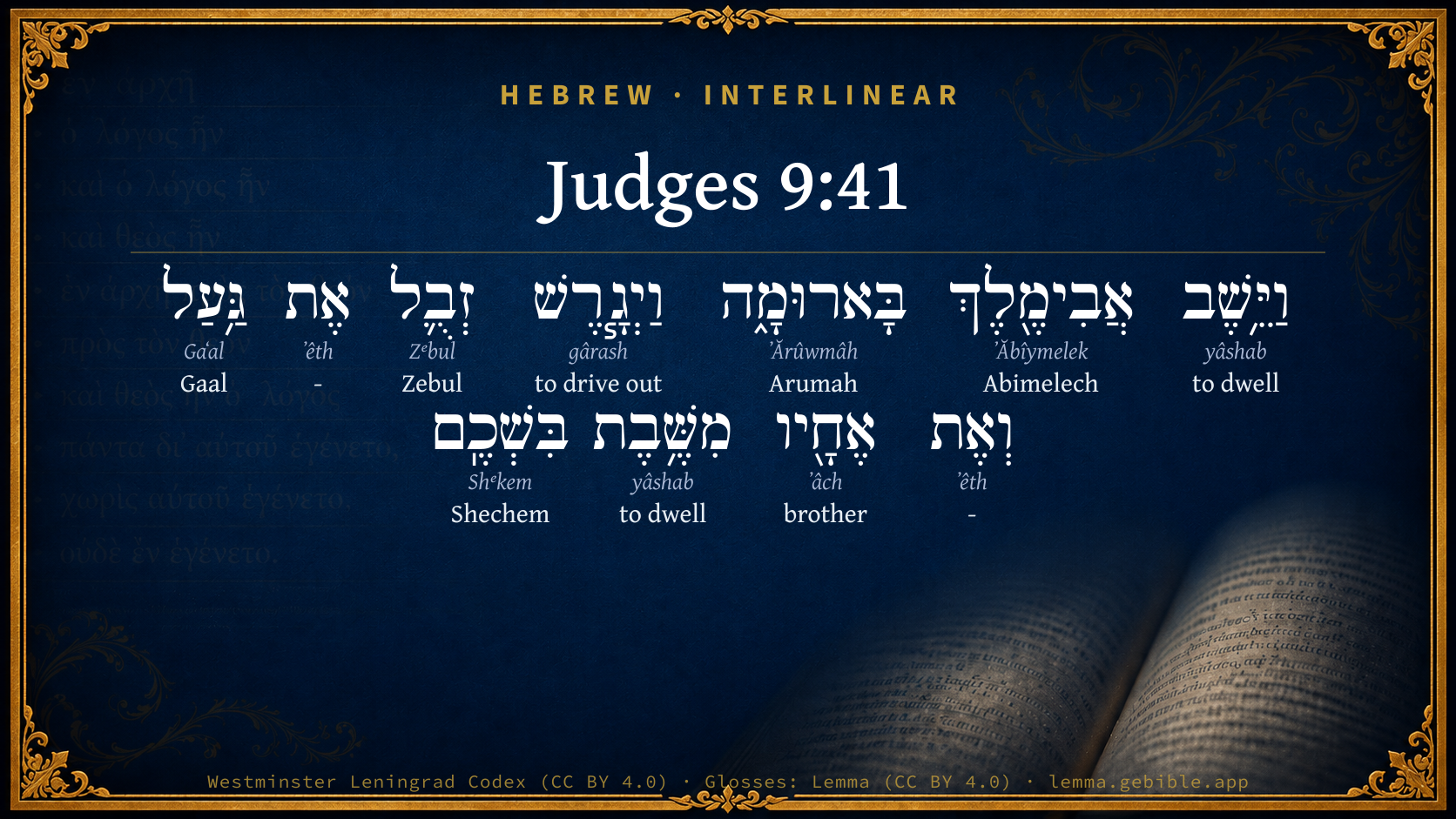
Judges 9:41

Hebrew (Westminster Leningrad Codex) Judges 9:41 appears in the Hebrew Old Testament. The text above is from the Westminster Leningrad Codex. Each word links to its Strong’s number, a concise gloss, and parsing drawn from the Open Scriptures Hebrew Bible morphology. Click any word for its full Brown-Driver-Briggs (BDB) entry.
Download image
Cite this verse

Judges 9:41 (World English Bible). Public Domain. Lemma interlinear Bible study tool, https://lemma.gebible.app/v/judges/9/41.

Show BibTeX & RIS
BibTeX
RIS
English Translation
Abimelech lived at Arumah: and Zebul drove out Gaal and his brothers, that they should not dwell in Shechem.
World English Bible · Public Domain
Highlights
  • 1 hapax legomenon — only here in the Hebrew Bible
  • 1 first appearance in the Hebrew Bible
Full analysis ↓
Download a study sheet

One document with this verse’s original text, its word-by-word gloss line, the meaning frame, cross-references with their text, attributed commentary, and full source and license credits — printable, and it pastes into notes with its structure intact.

This verse Autodidact and up

Study sheet (.html) Plain text (.txt)

A passage Seminary Student

Up to 50 verses in one chapter. A passage sheet keeps up to 6 commentary sources and 12 cross-references per verse, in the order this page ranks them, and says so on the sheet whenever that leaves anything out. Ask for a single verse and you get the Autodidact verse sheet above.

Everything on this page stays free to read, with no account — the sheet is a download of what is already on screen, not access to it.

Want to remove ads? Support Godless Engineer
Compare translations 3

The same verse in 3 English versions, stacked beneath the original-language interlinear above. Click any original word for its lexicon entry.

Each is an independent rendering of the whole verse — the interlinear is not word-aligned to these translations.

Highlighted words mark where these versions differ — a whole-verse word diff, not a word-by-word alignment.

  • World English Bible Public Domain
    Abimelech lived at Arumah: and Zebul drove out Gaal and his brothers, that they should not dwell in Shechem.
  • King James Version Public Domain
    And Abimelech dwelt at Arumah: and Zebul thrust out Gaal and his brethren, that they should not dwell in Shechem.
  • unfoldingWord Literal Text CC BY-SA 4.0
    Then Abimelech dwelt in Arumah. And Zebul drove out Gaal and his brothers from dwelling in Shechem.

unfoldingWord Literal Text — © unfoldingWord, licensed CC BY-SA 4.0. Word-aligned USFM3 via Door43 (git.door43.org/unfoldingWord/en_ult).

Versions to compare (up to 4)

3 of 4 selected

Show all 18 translations

Every available English version of this verse, each an independent rendering of the whole verse.

  • World English Bible Public Domain
    Abimelech lived at Arumah: and Zebul drove out Gaal and his brothers, that they should not dwell in Shechem.
  • Berean Standard Bible Public Domain
    Abimelech stayed in Arumah, and Zebul drove Gaal and his brothers out of Shechem.
  • Majority Standard Bible Public Domain
    Abimelech stayed in Arumah, and Zebul drove Gaal and his brothers out of Shechem.
  • King James Version Public Domain
    And Abimelech dwelt at Arumah: and Zebul thrust out Gaal and his brethren, that they should not dwell in Shechem.
  • American Standard Version (1901) Public Domain
    And Abimelech dwelt at Arumah: and Zebul drove out Gaal and his brethren, that they should not dwell in Shechem.
  • Revised Version (1885) Public Domain
    And Abimelech dwelt at Arumah: and Zebul drave out Gaal and his brethren, that they should not dwell in Shechem.
  • Geneva Bible (1599) Public Domain
    And Abimelech dwelt at Arumah: and Zebul thrust out Gaal and his brethren that they should not dwell in Shechem.
  • Douay-Rheims (1899) Public Domain
    And Abimelech sat down in Ruma: but Zebul drove Gaal, and his companions out of the city, and would not suffer them to abide in it.
  • Young's Literal Translation Public Domain
    And Abimelech abideth in Arumah, and Zebul casteth out Gaal and his brethren from dwelling in Shechem.
  • Literal Standard Version CC BY-SA 4.0
    And Abimelech abides in Arumah, and Zebul casts out Gaal and his brothers from dwelling in Shechem.
  • Unlocked Literal Bible CC BY-SA 4.0
    Abimelech stayed in Arumah. Zebul forced Gaal and his relatives out of Shechem.
  • unfoldingWord Literal Text CC BY-SA 4.0
    Then Abimelech dwelt in Arumah. And Zebul drove out Gaal and his brothers from dwelling in Shechem.
  • Darby Bible Public Domain
    And Abim'elech dwelt at Aru'mah; and Zebul drove out Ga'al and his kinsmen, so that they could not live on at Shechem.
  • World Messianic Bible Public Domain
    Abimelech lived at Arumah; and Zebul drove out Gaal and his brothers, that they should not dwell in Shechem.
  • Webster's Bible Public Domain
    And Abimelech dwelt at Arumah: and Zebul thrust out Gaal and his brethren, that they should not dwell in Shechem.
  • Free Bible Version CC BY-SA 4.0
    Abimelech went back to Arumah while Zebul expelled Gaal and his relatives from Shechem.
  • Bible in Basic English Public Domain
    Then Abimelech went back to Arumah; and Zebul sent Gaal and his brothers away and would not let them go on living in Shechem.
  • JPS Tanakh (1917) Public Domain
    And Abimelech dwelt at Arumah; and Zebul drove out Gaal and his brethren, that they should not dwell in Shechem.

Literal Standard Version (2020), Covenant Press — licensed CC BY-SA 4.0. Text via the HelloAO Bible API (eBible.org). Unlocked Literal Bible (unfoldingWord) — licensed CC BY-SA 4.0. Text via the HelloAO Bible API (eBible.org). unfoldingWord Literal Text — © unfoldingWord, licensed CC BY-SA 4.0. Word-aligned USFM3 via Door43 (git.door43.org/unfoldingWord/en_ult). Free Bible Version, Dr. Jonathan Gallagher — licensed CC BY-SA 4.0. Text via the HelloAO Bible API (eBible.org).

Word by word

More ways to search: Search by grammar → Find every occurrence → Compare this word →

Practice this passage: Drill this verse → Learn its vocabulary →

בָּארוּמָ֑ה
ʼĂrûwmâh
H725
“in/at · Arumah”
Preposition + Noun, Proper
Part of Speech
Preposition + Noun
Type
Proper
Full BDB Definition

Origin: a variation of H7316

TWOT: None

Arumah = "I shall be exalted" - a place near Shechem, home of Abimelech
  1. וַיֵּ֥שֶׁב yâshab H3427 “and · to dwell” Conjunction + Verb, Qal, Sequential Imperfect, 3rd Person, Masculine, Singular
  2. אֲבִימֶ֖לֶךְ ʼĂbîymelek H40 “Abimelech” Noun, Proper
  3. וַיְגָ֧רֶשׁ gârash H1644 “and · to drive out” Conjunction + Verb, Piel, Sequential Imperfect, 3rd Person, Masculine, Singular
  4. זְבֻ֛ל Zᵉbul H2083 “Zebul” Noun, Proper
  5. אֶת ʼêth H853 “-” Particle, Direct Object
  6. גַּ֥עַל Gaʻal H1603 “Gaal” Noun, Proper
  7. וְאֶת ʼêth H853 “and · -” Conjunction + Particle, Direct Object
  8. אֶחָ֖יו ʼâch H251 “brothers · his” Noun, Common, Masculine, Plural, Construct + Suffix, Personal, 3rd Person, Masculine, Singular
  9. מִשֶּׁ֥בֶת yâshab H3427 “from · to dwell” Preposition + Verb, Qal, Infinitive Construct
  10. בִּשְׁכֶֽם Shᵉkem H7927 “in/at · Shechem” Preposition + Noun, Proper

About this verse

These counts appear in no published source. They are computed here, from the morphology-tagged text and Lemma’s own curated glosses. What Lemma adds →

11
words
9
distinct lemmas
Historical
section

Notable vocabulary

1 hapax legomenon — a word that appears only here in the entire Hebrew Bible:

  • בָּארוּמָ֑ה Arumah H725

First appearance in Scripture

This word makes its first canonical appearance in the Hebrew Bible here:

  • בָּארוּמָ֑ה Arumah H725

Shared distinctive vocabulary

זְבֻ֛ל Zebul H2083 occurs in 5 verses of the Hebrew Bible. Also found in:

Grammatical profile

  • 3 verbs
  • 6 nouns
  • 2 particles

Verb forms

  • וַיֵּ֥שֶׁב Qal · Sequential Imperfect
  • וַיְגָ֧רֶשׁ Piel · Sequential Imperfect
  • מִשֶּׁ֥בֶת Qal · Infinitive Construct

Repetition

A word recurs within this verse — often emphatic in Hebrew:

  • וַיֵּ֥שֶׁב to dwell H3427 ×2

Hebrew & Septuagint length

In English translation the verse runs 19 words from the Hebrew and 21 from the Septuagint (LXX English) — closely comparable.

A rough comparison of the two English renderings, which tokenize alike — not a word-level alignment.

Word counts can differ between the Hebrew and the Greek without any difference in meaning — e.g. the Hebrew direct-object marker אֵת has no separate Greek word, and Greek often adds the article ὁ.

In the original languages it is 11 Hebrew tokens and 18 Greek tokens — but the two are counted differently (Hebrew bundles its prefixes and suffixes into one token; the Greek is in lemma form), so that isn’t a like-for-like length.

Cross-references

2

Topical passages linked to Judges 9:41 in the Treasury of Scripture Knowledge — connected by theme and wording, ordered by reader-vote popularity; previews shown in the World English Bible.

  • Judges 9:28 Gaal the son of Ebed said, Who is Abimelech, and who is Shechem, that we should serve him? Isn't he the son of Jerubbaal? and Zebul his officer? serve you the men of Hamor the father of Shechem: but why should we serve him?
  • Judges 9:30 When Zebul the ruler of the city heard the words of Gaal the son of Ebed, his anger was kindled.

Cross-references courtesy of OpenBible.info (CC BY 4.0).

Hebrew and Greek witnesses Masoretic Hebrew ↔ Greek Septuagint

The same verse in the two great witnesses to the Old Testament, shown verse-for-verse.

These are two independent witnesses, not word-aligned to each other, and the Septuagint is shown in lemma (dictionary) form.

Hebrew Judges 9:41 Masoretic · Westminster Leningrad Codex

וַיֵּ֥שֶׁב אֲבִימֶ֖לֶךְ בָּארוּמָ֑ה וַיְגָ֧רֶשׁ זְבֻ֛ל אֶת גַּ֥עַל וְאֶת אֶחָ֖יו מִשֶּׁ֥בֶת בִּשְׁכֶֽם

Abimelech lived at Arumah: and Zebul drove out Gaal and his brothers, that they should not dwell in Shechem.

World English Bible · Public Domain

Greek LXX Judges 9:41 Septuagint · lemma form

καί εἰςἔρχομαι αβιμελεχ ἐν αρημα καί ἐκβάλλω ζεβουλ ὁ γααλ καί ὁ ἀδελφός αὐτός μή οἰκέω ἐν συχεμ

And Abimelech entered into Arema, and Zebul cast out Gaal and his brethren, so that they should not dwell in Sychem.

LXX2012 (modern English Septuagint) · Public Domain

Hebrew: Westminster Leningrad Codex (CC BY 4.0). Greek: Septuagint (public domain); English from LXX2012 (modern English Septuagint) (Public Domain). How the Septuagint differs from the Hebrew →

Targum (Aramaic paraphrase)

1

The Targum is the ancient Jewish Aramaic paraphrase of the Hebrew Scriptures — an interpretive translation, not the Hebrew text itself. Onkelos (literal) and Pseudo-Jonathan (expansive) render the Torah, and Jonathan the Prophets. Coverage is partial: where no permissively-licensed English translation exists for a verse, only the Aramaic is shown. This is verse-level text, not a word-by-word alignment to the Hebrew.

  1. Targum Jonathan Prophets (Joshua–Malachi)
    וִיתֵיב אֲבִימֶלֶךְ בָּארוּמָא וְתָרֵיךְ זְבוּל יַת גַעַל וְיַת אֲחוֹהִי מִלְמֵיתַב בִּשְׁכֶם:

    (no public-domain English translation for this verse)

    Targum Jonathan — Aramaic: “Mikraot Gedolot” (public domain). English: “Sefaria Community Translation” (CC0 1.0 (public-domain dedication)); “London "Chaldee Paraphrase," 1871” (public domain). Text via Sefaria.

Commentary

Notes on Judges 9:41 from classic Christian and Jewish commentators (each source and its license shown beneath its notes). The classic Christian expositions comment on the surrounding passage and are grouped to its opening verse, so a note may address several verses; the Jewish commentaries on the Tanakh (Rashi and others) are per-verse, so they appear only where the commentator wrote on this verse.

Lemma curates 59 commentaries, every one of them public domain or Creative Commons licensed, each selected and text-cleaned for this edition rather than reprinted as found. About our sources →

Trapp's Complete Commentary

John Trapp

Jdg 9:41 And Abimelech dwelt at Arumah: and Zebul thrust out Gaal and his brethren, that they should not dwell in Shechem.

Ver. 41. And Abimelech dwelt at Arumah.] {a} Concealing his ill-will against the Shechemites, as though he had meant it to Gaal only. It is said of Tiberius the Emperor, that the farther off he threatened, the heavier the stroke fell. And of our Richard III, that he would use most compliment and courtesy to him in the morning whose throat he had taken order to be cut that evening.

{a} Jerome saith that Arumah is the same with Arimathea.

John Trapp, A Commentary or Exposition upon All the Books of the Old and New Testament (1647–1656) — public domain. Text from a community e-Sword module.

Joseph Benson's Commentary

Jdg 9:41. Abimelech dwelt at Arumah — He did not prosecute his victory, but retreated to Arumah, to see whether the Shechemites would not, of themselves, return to his government, or in expectation that they would hereby grow secure, and so give him the greater advantage against them. And Zebul thrust out Gaal — Finding the spirit of Gaal’s party a little cooled, perhaps through their suspecting him of cowardice, or ill conduct, he took the opportunity of expelling him and his brethren from the city; but seems to have shut the gates against Abimelech also. His interest, it seems, was not so considerable with the people that he could prevail with them either to kill Gaal and his brethren, or to yield themselves to Abimelech; and therefore he still complies with them, and waits for a fairer opportunity.

Joseph Benson's Commentary on the Old and New Testaments (1811–1818) — public domain. Text from a community e-Sword module.

Ellicott's Commentary for English Readers

(41) Dwelt at Arumah.—Eusebius and Jerome identify Arumah with Remphis or Arimathea, near Lydda, which is most improbable on every ground. It is clearly some place at no great distance from Shechem which he was still determined to punish.

Zebul thrust out Gaal and his brethren.—Josephus seems here to supply us with the proper clue, for he says that Zebul accused Gaal to the Shechemites of military cowardice and mismanagement. He seems to have been a deep dissembler. Gaal, however, escaped the fate of the Shechemites by their expulsion of him.

A Bible Commentary for English Readers, edited by Charles John Ellicott (1878–1897) — public domain. Text from a community e-Sword module.

The Cambridge Bible for Schools and Colleges

gen. ed. J. J. S. Perowne

41. Arumah] Unknown; el-‘Örme (the initial letter is different), 2 m. S.E. of Nâblus, has been suggested. This verse evidently brings the narrative to an end.

The Cambridge Bible for Schools and Colleges (gen. ed. J. J. S. Perowne; Cambridge University Press, 1878–1918) — public domain. Text from a community e-Sword module.

John Gill's Exposition

And it came to pass on the morrow,.... The day after the battle:

that the people went out into the field; some think to fight, and try the event of another battle, in order to be freed from Abimelech, but that seems not so likely: rather to finish their vintage, as Josephus (l), or to till their ground, to plough and sow, which quickly came on after the vintage was ended; find this they might do the more securely, since Abimelech had withdrawn himself and his forces to his place of habitation, and so concluded he would not soon at least return to them; and the rather they might think he would be more easy, with then, since Gaal was thrust out from among them:

and they told Abimelech; or it was told Abimelech, that the people came out into the field, and so an opportunity offered to him to come and cut them off, as they were at their business unarmed.

(l) Antiqu. l. 5. c. 7. sect. 4.

John Gill's Exposition of the Whole Bible (1746–1763) — public domain (CC PDM 1.0). Text via the HelloAO Bible API.

Haydock's Catholic Bible Commentary

Ruma may be the same place as Arimathea, between Joppe and Lidda. (St. Jerome) (Menochius) --- But this seems to be too remote from Sichem, (Haydock; Bonfrere) in the neighbourhood of which Abimelech halted, to give the citizens time to enter into themselves, (Calmet) and to open their gates to him without farther resistance. Gaal entered the city after his defeat: but was forced the next day to leave it by Zebul. Whereupon he was met by two divisions of Abimelech’s army, which routed him, and pursued the fugitives, while the king marched straight to the city; and though he had a party within the walls, headed by Zebul, (Haydock) unless he was slain, (Calmet) the rest of the inhabitants made such a stout resistance, that the tyrant resolved to demolish the city, when he took it, at night. (Haydock)

George Leo Haydock (1774–1849), Haydock's Catholic Family Bible and Commentary, 1859 edition — public domain. Excludes Psalms (Douay-Rheims chapter numbering differs from Protestant) and Deuterocanonical books (Catholic canon only).

Matthew Poole's English Annotations

Abimelech did not prosecute his victory, but retreated to Arumah, partly to see the effect of this fight, and whether the Shechemites would not of themselves return to his government, being either persuaded by Zebul upon this occasion, or terrified by his strength and valour, or now by his clemency in proceeding no further against them; and partly that, being hereby grown more secure, he might have the greater advantage against them, which accordingly he here makes use of.

Zebul thrust out Gaal and his brethren; which he was enabled to do, because the multitude, which is generally light and unstable, and judgeth of all things by events, were now enraged against Gaal, suspecting him guilty either of treachery, or cowardice, or ill conduct; and besides, they thought the expulsion of Gaal would sweeten and satisfy Abimelech, and make him give over the war against them. But though they were offended with Gaal, yet Zebul’s interest was not so considerable with them, that he could prevail with them either to kill Gaal and his brethren, or to yield themselves to Abimelech; and therefore he still complies with the people, and waits for a fairer opportunity, though in vain.

Matthew Poole's English Annotations on the Holy Bible (1683–1685) — public domain. Text from a community e-Sword/MySword module.

Whedon's Commentary on the Bible

Daniel D. Whedon

41. Arumah — A city evidently near to Shechem, but now unknown. Van de Velde proposes to identify it with the ruin El-ormah, on the brow of a mountain southeast of Shechem. To this place Abimelech retired after the fight before the gates of Shechem.

Zebul thrust out Gaal — By taking advantage of his defeat and confusion. After his failure to defend them, the people opposed to Abimelech would not care to have Gaal dwell in Shechem.

Daniel D. Whedon (gen. ed.), Commentary on the Old and New Testaments (1874–1909) — public domain. Text from a community e-Sword module.

The Pulpit Commentary

Arumah. A place not otherwise known, but apparently (ver. 42) very near Shechem, and possibly the same place as Rumah, the birthplace of Queen Zebudah, (2Ki_23:36) and, from its name, apparently among the mountains. Zebul thrust out, etc. Gaal was so much weakened by his defeat that Zebul was now strong enough to expel him and the remainder of "his brethren from the city.

The Pulpit Commentary (1880–1919), ed. H.D.M. Spence-Jones & Joseph S. Exell — public domain. Text from a community e-Sword module.

John Wesley's Explanatory Notes

Dwelt at Arumah - He did not prosecute his victory, but retreated to Arumah, to see whether the Shechemites would not of themselves return to his government, or else, that being hereby grown secure, he might have the greater advantage against them. Thrust out - It seems the same night. Probably the multitude, which is generally light and unstable, were now enraged against Gaal, suspecting him of cowardice or ill-conduct. Zebul's interest was not so considerable with them, that he could prevail with them either to kill Gaal and his brethren, or to yield themselves to Abimelech; and therefore he still complies with the people, and waits for a fairer opportunity.

John Wesley, Explanatory Notes Upon the Whole Bible (1754–1765) — public domain. Text via the GEBible commentary corpus.

Keil & Delitzsch

C. F. Keil & F. Delitzsch

Abimelech did not force his way into the city, but remained (ישׁב, lit. sat down) with his army in Arumah, a place not mentioned again, which was situated, according to Jdg 9:42, somewhere in the neighbourhood of Shechem. It cannot possibly have been the place called Ῥουμὰ ἡ καὶ Ἄριμα in the Onom. of Eusebius, which was named Ῥέμφις in his day, and was situated in the neighbourhood of Diospolis (or Lydda). Zebul, however, drove Gaal and his brethren (i.e., his retinue) out of Shechem.

Keil & Delitzsch — Biblical Commentary on the Old Testament (1861–1891) — public domain (CC PDM 1.0). Text via the HelloAO Bible API. (Old Testament only.)

unfoldingWord translationNotes

Door43 World Missions Community

Arumah

This is the name of a city. (See: How to Translate Names)

Zebul

This is the name of a man. See how you translated this in Judges 9:28.

Gaal

This is the name of a man. See how you translated this in Judges 9:26.

this was reported to Abimelech

This can be stated in active form. AT: "someone reported this to Abimelech" (See: Active or Passive)

divided them into three units

"separated them into 3 groups" (See: Numbers)

they set an ambush in the fields

"they hid in the fields to attack the people by surprise"

he attacked

Here "he" refers to Abimelech who represents himself and all of his soldiers. AT: "they attacked" (See: Synecdoche)

translationWords

Abimelech

Shechem

unfoldingWord translationNotes — © Distant Shores Media and the Door43 World Missions Community, licensed CC BY-SA 4.0. Source: git.door43.org/Door43/en_tn.

Lesson kit

Teaching starters — assembled from the data on this page, not authored interpretation. Every prompt links to the verse data it draws on. Edit before teaching.

Judges, in the Historical, opens this verse with 11 words (9 distinct Hebrew lemmas). Its most distinctive word is ʼĂrûwmâh (“Arumah”). A historical commentator’s framing appears above. Read the whole chapter for the surrounding context.

Discussion questions

  1. The word ʼĂrûwmâh carries the sense “Arumah.” How does it shape the verse?
  2. This verse holds 1 word here found nowhere else in the Hebrew Bible. What might the rare word draw attention to?
  3. The word “Arumah” first appears here in Scripture. What is being introduced at this debut?
  4. Judges 9:28 shares the word «Zebul» with this verse. How do the two illuminate each other?
  5. “to dwell” occurs 2× in this one verse. What is the effect of the repetition?
  6. The translations on this page render this verse differently — a whole-verse word diff, not a word-by-word alignment. What might account for the different wordings?
  7. The verb «וַיֵּ֥שֶׁב» is Qal Sequential Imperfect. How does its form color the action?
  8. Reading how Trapp's Complete Commentary and Joseph Benson's Commentary read this verse, where do the two commentators agree and where do they part?

Things to notice

  • 1 word in this verse appears nowhere else in the Hebrew Bible.
  • 1 word makes its first canonical appearance in Scripture here.
  • This verse counts 11 Hebrew ↔ 18 Greek words.
  • These translations choose different wording for 9 words in this verse.
  • “to dwell” occurs 2× in this single verse.

Reading settings

Reading text

Shown beneath each verse's original-language words.

Old Testament
Old Testament edition

Read the OT as the Masoretic Hebrew (MT) or the Greek Septuagint (LXX).

English shown for the Greek Septuagint (in the Hebrew ↔ Greek comparison).

Comparing translations? Open the Compare panel on any verse page to stack up to four side by side.