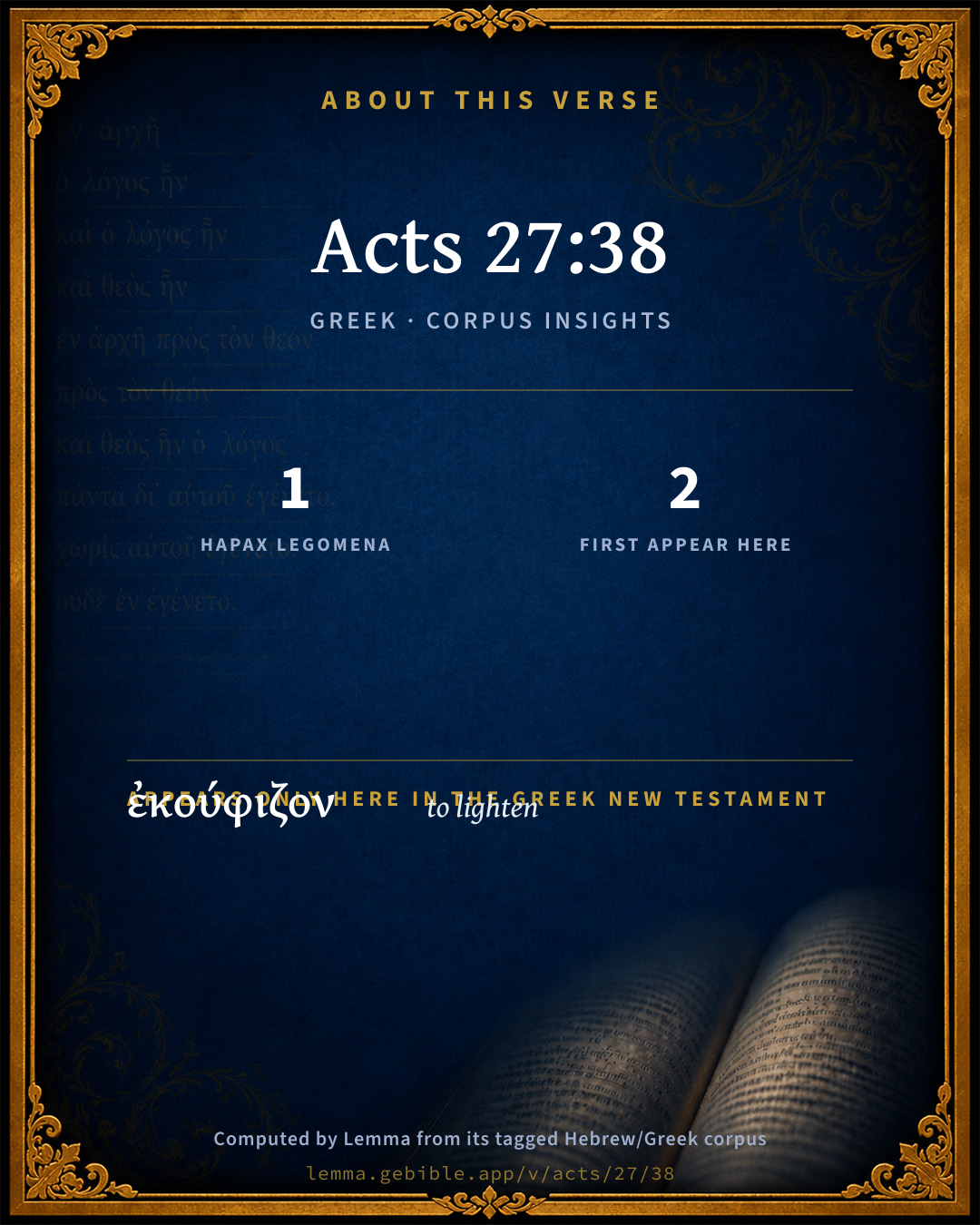
Acts 27:38

Greek (Tischendorf 8th ed.) Acts 27:38 appears in the Greek New Testament. The text above is from the Tischendorf 8th edition. Each word links to its Strong’s number and a concise gloss. Click any word for its full Thayer’s Greek Lexicon entry.
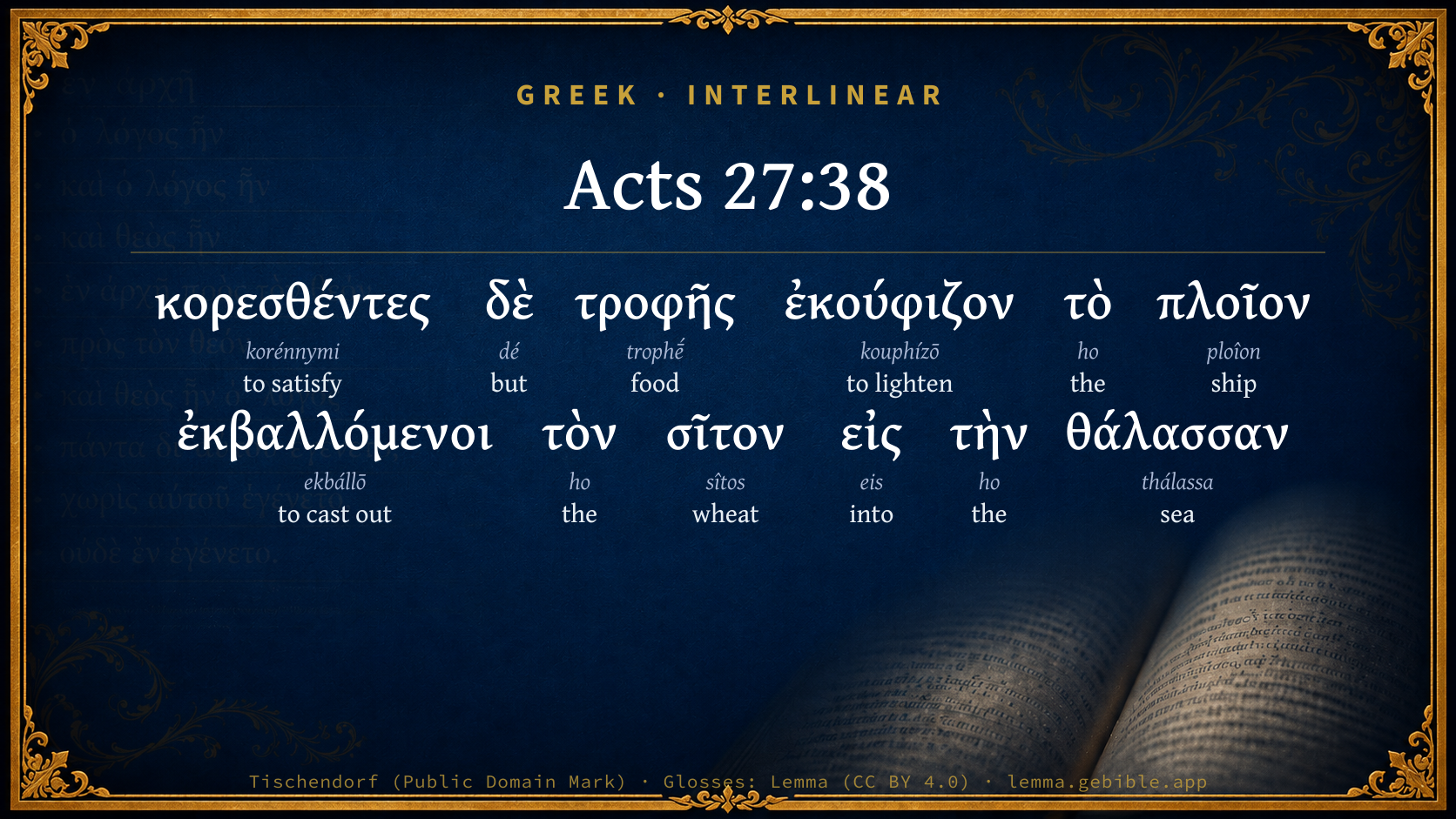
Download image
Cite this verse

Acts 27:38 (World English Bible). Public Domain. Lemma interlinear Bible study tool, https://lemma.gebible.app/v/acts/27/38.

Show BibTeX & RIS
BibTeX
RIS
English Translation
When they had eaten enough, they lightened the ship, throwing out the wheat into the sea.
World English Bible · Public Domain
Highlights
  • 1 hapax legomenon — only here in the Greek New Testament
  • 2 first appearances in the Greek New Testament
Full analysis ↓
Download a study sheet

One document with this verse’s original text, its word-by-word gloss line, the meaning frame, cross-references with their text, attributed commentary, and full source and license credits — printable, and it pastes into notes with its structure intact.

This verse Autodidact and up

Study sheet (.html) Plain text (.txt)

A passage Seminary Student

Up to 50 verses in one chapter. A passage sheet keeps up to 6 commentary sources and 12 cross-references per verse, in the order this page ranks them, and says so on the sheet whenever that leaves anything out. Ask for a single verse and you get the Autodidact verse sheet above.

Everything on this page stays free to read, with no account — the sheet is a download of what is already on screen, not access to it.

Want to remove ads? Support Godless Engineer
Compare translations 3

The same verse in 3 English versions, stacked beneath the original-language interlinear above. Click any original word for its lexicon entry.

Each is an independent rendering of the whole verse — the interlinear is not word-aligned to these translations.

Highlighted words mark where these versions differ — a whole-verse word diff, not a word-by-word alignment.

  • World English Bible Public Domain
    When they had eaten enough, they lightened the ship, throwing out the wheat into the sea.
  • King James Version Public Domain
    And when they had eaten enough, they lightened the ship, and cast out the wheat into the sea.
  • unfoldingWord Literal Text CC BY-SA 4.0
    And having been satisfied with food, they were lightening the ship, throwing out the wheat into the sea.

unfoldingWord Literal Text — © unfoldingWord, licensed CC BY-SA 4.0. Word-aligned USFM3 via Door43 (git.door43.org/unfoldingWord/en_ult).

Versions to compare (up to 4)

3 of 4 selected

Show all 19 translations

Every available English version of this verse, each an independent rendering of the whole verse.

  • World English Bible Public Domain
    When they had eaten enough, they lightened the ship, throwing out the wheat into the sea.
  • Berean Standard Bible Public Domain
    After the men had eaten their fill, they lightened the ship by throwing the grain into the sea.
  • Majority Standard Bible Public Domain
    After the men had eaten their fill, they lightened the ship by throwing the grain into the sea.
  • King James Version Public Domain
    And when they had eaten enough, they lightened the ship, and cast out the wheat into the sea.
  • American Standard Version (1901) Public Domain
    And when they had eaten enough, they lightened the ship, throwing out the wheat into the sea.
  • Revised Version (1885) Public Domain
    And when they had eaten enough, they lightened the ship, throwing out the wheat into the sea.
  • Geneva Bible (1599) Public Domain
    And whe they had eaten ynough, they lightened the ship, and cast out the wheat into the sea.
  • Douay-Rheims (1899) Public Domain
    And when they had eaten enough, they lightened the ship, casting the wheat into the sea.
  • Young's Literal Translation Public Domain
    and having eaten sufficient nourishment, they were lightening the ship, casting forth the wheat into the sea.
  • Literal Standard Version CC BY-SA 4.0
    and having eaten sufficient nourishment, they were lightening the ship, casting forth the wheat into the sea.
  • Unlocked Literal Bible CC BY-SA 4.0
    When they had eaten enough, they made the ship lighter by throwing out the wheat into the sea.
  • unfoldingWord Literal Text CC BY-SA 4.0
    And having been satisfied with food, they were lightening the ship, throwing out the wheat into the sea.
  • Darby Bible Public Domain
    And having satisfied themselves with food, they lightened the ship, casting out the wheat into the sea.
  • World Messianic Bible Public Domain
    When they had eaten enough, they lightened the ship, throwing out the wheat into the sea.
  • Webster's Bible Public Domain
    And when they had eaten enough, they lightened the ship, and cast the wheat into the sea.
  • Free Bible Version CC BY-SA 4.0
    Once they'd had enough to eat, the crew made the ship lighter by throwing the supplies of wheat overboard.
  • Bible in Basic English Public Domain
    And when they had had enough food, they made the weight of the ship less, turning the grain out into the sea.
  • Text-Critical English NT CC BY 4.0
    When they had eaten their fill of food, they began to lighten the ship by throwing the wheat out into the sea.
  • Tyndale New Testament (1534) Public Domain
    And when they had eate ynough they lightened the ship and cast out the wheate into the see.

Literal Standard Version (2020), Covenant Press — licensed CC BY-SA 4.0. Text via the HelloAO Bible API (eBible.org). Unlocked Literal Bible (unfoldingWord) — licensed CC BY-SA 4.0. Text via the HelloAO Bible API (eBible.org). unfoldingWord Literal Text — © unfoldingWord, licensed CC BY-SA 4.0. Word-aligned USFM3 via Door43 (git.door43.org/unfoldingWord/en_ult). Free Bible Version, Dr. Jonathan Gallagher — licensed CC BY-SA 4.0. Text via the HelloAO Bible API (eBible.org).

Word by word

More ways to search: Search by grammar → Find every occurrence → Compare this word →

Practice this passage: Drill this verse → Learn its vocabulary →

ἐκούφιζον
kouphízō
G2893
“to lighten”
Verb, Imperfect, Active, Indicative, 3rd person, Plural
Part of Speech
Verb
Tense
Imperfect
Voice
Active
Mood
Indicative
Person
3rd person
Number
Plural
Full Thayer's Definition

Origin: from kouphos (light in weight)

TDNT: None

1. to be light 2. to lighten a. a ship by throwing the cargo overboard
  1. κορεσθέντες korénnymi G2880 “to satisfy” Verb, Aorist, Passive, Participle, Nominative, Plural, Masculine
  2. δὲ dé G1161 “but” Conjunction
  3. τροφῆς trophḗ G5160 “food” Noun, Genitive, Singular, Feminine
  4. τὸ ho G3588 “the” Article, Accusative, Singular, Neuter
  5. πλοῖον ploîon G4143 “ship” Noun, Accusative, Singular, Neuter
  6. ἐκβαλλόμενοι ekbállō G1544 “to cast out” Verb, Present, Middle, Participle, Nominative, Plural, Masculine
  7. τὸν ho G3588 “the” Article, Accusative, Singular, Masculine
  8. σῖτον sîtos G4621 “wheat” Noun, Accusative, Singular, Masculine
  9. εἰς eis G1519 “into” Preposition
  10. τὴν ho G3588 “the” Article, Accusative, Singular, Feminine
  11. θάλασσαν thálassa G2281 “sea” Noun, Accusative, Singular, Feminine

About this verse

These counts appear in no published source. They are computed here, from the morphology-tagged text and Lemma’s own curated glosses. What Lemma adds →

12
words
10
distinct lemmas
Acts
section

Notable vocabulary

1 hapax legomenon — a word that appears only here in the entire Greek New Testament:

  • ἐκούφιζον to lighten G2893

First appearance in Scripture

These words make their first canonical appearance in the Greek New Testament here:

  • κορεσθέντες to satisfy G2880
  • ἐκούφιζον to lighten G2893

Shared distinctive vocabulary

κορεσθέντες to satisfy G2880 occurs in 2 verses of the Greek New Testament. Also found in:

Repetition

A word recurs within this verse:

Cross-references

6

Topical passages linked to Acts 27:38 in the Treasury of Scripture Knowledge — connected by theme and wording, ordered by reader-vote popularity; previews shown in the World English Bible.

  • Jonah 1:5 Then the mariners were afraid, and cried every man to his god. They threw the cargo that was in the ship into the sea, to lighten it. But Jonah had gone down into the innermost parts of the ship, and he was laying down, and was fast asleep.
  • Matthew 6:25 Therefore, I tell you, don't be anxious for your life: what you will eat, or what you will drink; nor yet for your body, what you will wear. Isn't life more than food, and the body more than clothing?
  • Matthew 16:26 For what will it profit a man, if he gains the whole world, and forfeits his life? Or what will a man give in exchange for his life?
  • Acts 27:18–19 As we labored exceedingly with the storm, the next day they began to throw things overboard.
  • Job 2:4 Satan answered Yahweh, and said, "Skin for skin. Yes, all that a man has will he give for his life.
  • Hebrews 12:1 Therefore let us also, seeing we are surrounded by so great a cloud of witnesses, lay aside every weight and the sin which so easily entangles us, and let us run with patience the race that is set before us,

Cross-references courtesy of OpenBible.info (CC BY 4.0).

Commentary

Notes on Acts 27:38 from classic Christian and Jewish commentators (each source and its license shown beneath its notes). The classic Christian expositions comment on the surrounding passage and are grouped to its opening verse, so a note may address several verses; the Jewish commentaries on the Tanakh (Rashi and others) are per-verse, so they appear only where the commentator wrote on this verse.

Lemma curates 59 commentaries, every one of them public domain or Creative Commons licensed, each selected and text-cleaned for this edition rather than reprinted as found. About our sources →

The Biblical Illustrator

Joseph S. Exell

Act_27:38-44

And when they had eaten enough, they lightened the ship.

Food and work

What is the use of gaining strength by eating, unless we are to put our strength to some practical service? We might as well starve for lack of food as to live worthless lives while we have bread enough and to spare. It is of less importance that we have our breakfast than that we do something worth doing after breakfast. If any man will not work, neither let him eat. What if you do go to school? What if you have been to college? What if you are a great reader? What if you listen to the best sermons ever preached? What if you study the Bible week days and Sunday? What is to come of your having this full fare? When you have eaten enough, what work are you going to do on shipboard--or on shore? (H. C. Trumbull, D. D.)

The process of salvation

1. Here was a great multitude in the direst peril needing salvation. The good and the bad, the learned and the ignorant, the aristocrat and the plebeian, the rich and the poor, were all represented here, and were all alike in danger. Sin reduces all men to the same level, and annihilates all social and other distinctions. God be merciful to me a sinner, is a prayer appropriate to prince or pauper.

2. This multitude is strengthened for the impending effort by the supply of immediate wants. A great struggle was at hand, for which they would have been unequal but for that physical strength which food only can give and maintain. So the sinner convinced of his need of salvation, and without strength in himself, needs a Divinely imparted strength for all the sacrifice and effort required for the renunciation of self and sin and consecration to Christ. This is supplied by the Divine promises, and by grace for the time of need.

3. Being strengthened, as the first requirement for safety, the crew lightened the ship by throwing every superfluity overboard. The cargo was a valuable one; but in comparison with life what was it, or the whole world? So wealth, learning, social position, etc., of great value under certain circumstances, may be hindrances in the way of salvation, and must be abandoned. What things are gain to us must be counted loss for Christ and His salvation.

4. Light came and revealed the only means of safety. They knew not the land, but they saw the way of escape, and, like sensible men, they availed themselves of it (Act_27:39). What cared they for the geological formation of a certain creek? What cared they whether it were constructed according to the accepted principles of harbour architecture? If it were possible they would thrust in the ship there. And so the light of the Spirit is thrown on the Cross. He takes of the things of Christ and shows them. What has the sinner to do with their conformity to his own opinion, or the opinion of others, of what should constitute the means of salvation? As it is gloriously possible let him thrust in his ship there without asking any questions, and trust to the result.

5. Like rational creatures they availed themselves of the only means of escape at all risks. That which might have been useful elsewhere they unceremoniously abandoned, and taking up anchors, and loosing rudder bands, simply hoisted the mainsail, committed themselves to the sea, and made for shore. Let the convinced sinner thus, cutting himself off from his past, simply yield to the movements of the Spirit who not only enlightens but impels. Loose the moorings! Hoist the mainsail of faith! there is now nothing for it but that--and the Spirit who bloweth where He listeth will fill the sail.

6. The ship ran aground, and the passengers were exposed to tremendous hardship (Act_27:41). Not a few have experienced spiritually what was suffered here. Faith laying hold of Christ renders the soul safe, but the hinder part is broken by the violence of the waves. And nowhere more than just here is the malignity of Satan exhibited (Act_27:42. Cf. Christian at the Wicket Gate). But the Christian need fear not the violence of the waves of this troublesome world on his bark, nor the machinations of the adversary, for he knows that no weapon that is formed against him shall prosper.

7. Salvation, however, comes at last (Act_27:44). They lost everything but their lives, and man can afford to lose everything but his soul. (J. W. Burn.)

And when they had taken up the anchors, they … hoisted the mainsail.--

Anchors and sails

Anchors are very well so long as you want to keep from going ahead; but if you want to reach the shore, one sail is worth more than four anchors. It is a great thing to know when to use anchors and when to use sails. If a young man is asked to follow evil companions in evil ways he needs anchors. If he is urged to go ahead in the path of duty and in the service of Christ, a sail is the thing for him. When the breakers of warning are sounding through the night on the rocks of error and unbelief just ahead of us, we ought to pray God that the anchors may hold. When we see by the clear light of Gods truth that the harbour of spiritual peace is open before us, we may cut loose from the anchors, and hoist all sail to the breeze of Divine grace which shall speed us to the shore. (H. C. Trumbull, D. D.)

And falling into a place where two seas met, they ran the ship aground.

Running aground

(Childrens sermon):--It is a sad sight to see a noble vessel stranded and going to pieces; but it is sadder far to see a soul which ought to be sailing over the sea of time to heaven stuck fast in the things of this world. If we would avoid this we must--

I. Keep a steady course. How often on a sea-bound steamer going through some intricate channel do we hear the word Steady! The pilot cannot go by any course he pleases; if he tries experiments, disregards the chart, and sails on the wrong side of the buoys, he must be prepared for running aground. A captain once left his vessel in charge of a man, whom he ordered to steer towards a certain star, while he retired for rest. Presently the mans attention was attracted by some object, and he let go the tiller. When he took it again the star was behind. By and by the captain came on deck, and seeing the position of affairs, exclaimed, Why, Jim, where are you steering her to? The star I told you to keep ahead of the mainmast is now astern! Oh, said Jim, we sailed by him an hour ago. The fact was the boat had swung round. And much in the same way we trifle with the helm, for the sake of looking at something about us, and forget to keep our eyes on the star; and many who think they have sailed past the star have simply turned their back upon it. It is common for people to think they have advanced far ahead of the Bible, their ancestral faith, etc., and before they know it they are aground.

II. Know our soundings. When the Atlantic went ashore on the coast of Nova Scotia it was because the captain, thinking he was miles from the coast, neglected to take soundings. So many a life is wrecked through ignorance of the proximity of shoals and rocks, and negligence to ascertain its position. How necessary, then, to examine ourselves, to watch for temptations, so that we may know where we stand!

III. Beware of cross currents. It was the opposite tides which did the work for Pauls ship. We all meet with cross currents in life, and how hard it is to keep out of them! We want to study, and yet to play; to serve Christ and to please ourselves; to gain heaven and yet keep earth. This is a sure way to wreck our souls.

IV. Trust our pilot. When the pilot comes aboard he takes full command, and the crew must not mind the old captain. And so when we have taken Christ as our Commander we must obey Him in everything. (W. Newton.)

And the soldiers counsel was to kill the prisoners.--

The shipwreck

I. The brutalising tendency of a military life. One might have thought that common trials would have made every heart sympathetic; but these soldiers meditated the cold-blooded murder of men who had saved their lives. Why? Because they were trained to bloody deeds. Human life to them was cheap.

II. The social value of a good man. The centurion, willing to save Paul, kept them from their purpose, etc. The salvation of passengers must, under God, be ascribed to Paul, and the other prisoners were saved from massacre because of him. No one but God can tell the value of one good man in a neighbourhood or nation. Ten righteous men would have saved Sodom, etc.

III. The faithfulness of the Divine word. God had said that no life should be lost, that they should be cast upon a certain island, and that the ship should be destroyed. And here is the fulfilment. Heaven and earth shall pass away, etc.

IV. The necessity of human effort. Although the safety attained had been promised by God, yet the human agency was indispensable. (D. Thomas, D. D.)

Those who get us into trouble will not stay to help us out

These shipmen got Paul out of Fair Havens into the storm; but as soon as the tempest dropped upon them, they wanted to go off in the small boat, caring nothing for what became of Paul and the passengers. Ah me! human nature is the same in all ages. They who tempt that young man into a life of dissipation will be the first to laugh at his imbecility, and to drop him out of decent society. Gamblers always make fun of the losses of gamblers. They who tempt you into the contest with fists, saying, I will back you, will be the first to run. Look over all the predicaments of your life, and count the names of those who have got you into those predicaments, and tell me the name of one who ever helped you out. They were glad enough to get you out from Fair Haven, but when with damaged rigging you tried to get into harbour, did they hold for you a plank or throw to you a rope? Not one. Satan has got thousands of men into trouble, but he never got one out. He led them into theft, but he would not hide the goods or bail out the defendant. The spider shows the way over the gossamer bridge into the cobweb; but it never shows the way out of the cobweb over the gossamer bridge. I think that there were plenty of fast young men to help the prodigal spend his money; but when he had wasted his substance in riotous living, they let him go to the swine pastures, while they betook themselves to some other newcomer. They who take Paul out of Fair Havens will be of no help to him when he gets into the breakers of Melita. Hear it, young man! hear it. (T. De Witt Talmage, D. D.)

The Biblical Illustrator, edited by Joseph S. Exell (c. 1880s–1900s) — public domain. Text from a community e-Sword module.

Burkitt's Expository Notes on the New Testament

William Burkitt

Here observe, 1. How willing men in distress are to part with all things for the preservation of life; these sea-faring men are here found three times lightening their ship of her lading and burden; first the merchandise was cast overboard, Act 27:18 next all the ship’s furniture was heaved over, Act 27:19 and now Act 27:38 goes over the very wheat, which they had provided for their daily bread; future provision is cast away to save life at present: life is the most precious treasure, the most excellent thing in nature; a man will part with all the comforts and supports of life, rather than with life itself.

Observe, 2. What a wonderful work of God was here upon the hearts of these poor Pagans, thus to venture their lives by parting with their food which they had to live upon, barely upon St. Paul’s word, that they should want wheat no more in the ship. Such an influence has God upon the hearts and minds of men, when he pleases to make use of it.

Observe, 3. How God’s delivering power is most gloriously manifest in the most deplorable extremities of his people.

Now, when the ship was fallen into a place where two seas met, when she ran aground, and was broken with the violence of the waves, this extremity was God’s opportunity; and this strait was the season of his succour.

Observe, 4. What horrid and cruel ingratitude was found with these wretched soldiers towards the apostle: they design to take away his life, who had taken such care of them, and for whose sake all their lives were preserved!

It is no new thing for an unkind world to return evil for good, and hatred for good-will; but to do good and to suffer evil is the Christian’s exercise at present. They consulted to kill the prisoners, (of whom the apostle was chief,) lest any of them should swim out and escape.

Observe, 5. How God put it into the centurion’s heart to defeat their barbarity and bloody counsel, and to save the apostle, for whose sake the centurion and all in the ship were saved.

Many are the wicked devices in the heart of man, but the counsel of the Lord, that shall stand.

Observe, 6. How God performed his promise to the apostle to a very tittle: they were all saved, not a man drowned, no not any one of the bloody soldiers who gave counsel to kill Paul.

O how good is God to the unthankful and unholy! his tender mercies are over all his works; and how well do sinners fare sometimes for the saints’ sake.

Thus, after a long and dangerous voyage, the providence of God brought St. Paul, with the rest of the passengers at last safe to shore.

O how punctual is God to what he promises! What he foretells he will fulfil. He had foretold by Paul, that they should suffer shipwreck, and at last be cast upon a certain island: and accordingly here they escaped to an island called Melita; where what signal instances of humanity they received from the hands of barbarous heathens, the following chapter fully informs us.

William Burkitt's Expository Notes on the New Testament (1700–1703) — public domain. Text from a community e-Sword module.

Bengel's Gnomon

Johann Albrecht Bengel

Act 27:38. Τὸν σῖτον, the corn) having a sure hope of getting to land.

Bengel's Gnomon of the New Testament — English translation (T&T Clark, Edinburgh, 1860) — public domain. Text from a community e-Sword module.

Meyer's Critical & Exegetical Commentary

Heinrich August Wilhelm Meyer

Act_27:38. Now, seeing that for some time (and in quite a brief period must the fate of those on board be decided) further victuals were unnecessarynow they ventured on the last means of lightening the ship (which, with the decreasing depth, Act_27:28, was urgently required for the purpose of driving it on to the land), and cast the provisions overboard, which, considering the multitude of men and the previous ἀσιτία, was certainly still a considerable weight. Chrysostom aptly remarks: οὕτω λοιπὸν τὸ πᾶν ἔῤῥιψαν ἐπὶ τὸν Παῦλον, ὡς καὶ τὸν σῖτον ἐκβαλεῖν. Σῖτος may denote either corn, or also, as here and often with Greek writers, provisions particularly prepared from corn (meal, bread, etc.). Others (Erasmus, Luther, Beza, et al., including Baumgarten, Smith, Hackett) have explained it as the corn with which, namely, the ship had been freighted. But against this it may be urged, first, that this freighting is not indicated; secondly, that κορεσθ. δὲ τροφῆς corresponds to the throwing out of the provisions, and not of the freight; and thirdly, that the throwing out of the freight had already taken place, Act_27:18, as this indeed was most natural, because the freight was the heaviest.

Meyer — Critical and Exegetical Commentary on the New Testament — English translation by Peter Christie, edited by Frederick Crombie (T&T Clark, 1880) — public domain. Text from a community e-Sword module.

Expositor's Greek Testament

ed. W. Robertson Nicoll

Act 27:38 . κορεσθ ., 1Co 4:8 , nowhere else in N.T., with genitive of the thing with which one is filled, as in classical Greek. Alford refers to LXX, Deu 31:20 , but see Hatch and Redpath, sub v. ἐκούφιζον : de nave , Polyb., i., 60, 8; LXX, Jon 1:5 . τὸν σῖτον : “the wheat,” A. and R.V., Vulgate, triticum ; so Ramsay, Breusing, Vars, J. Smith, Page, and so too Erasmus, Bengel, etc., i.e. , the cargo, cf. Act 27:6 . Blass thinks that the word used is decisive in favour of this interpretation; otherwise we should have had σιτία or ἄρτοι if merely food had been meant; not only was the cargo of sufficient weight really to lighten the ship, but there was need for the ship being as clear as possible for the operations in Act 27:40 . Wendt 1899 appears also to favour this view, cf. his comments with those in 1888 edition, where he adopts the view of Meyer and Weiss, that the word means provisions of food, as at first sight the context seems to indicate. But the latter would not have made much appreciable difference in weight, nor would those on board have been likely to throw them away, since they could not tell on, what shore they might be cast, whether hospitable or not, or how long they would be dependent on the food which they had in the ship. In Act 27:18 the reference may be to the cargo on deck, or at all events only to a part of the cargo (Holtzmann). Naber conjectured ἱστόν , but no such emendation is required (Wendt).

The Expositor's Greek Testament, edited by W. Robertson Nicoll (1897–1910) — public domain. Text from a community e-Sword module.

Jamieson, Fausset & Brown

Robert Jamieson, A. R. Fausset & David Brown

when they had eaten enough, &c.--With fresh strength after the meal, they make a third and last effort to lighten the ship, not only by pumping, as before, but by throwing the whole cargo of wheat into the sea (see on Act 27:6).

Jamieson, Fausset & Brown — Commentary Critical and Explanatory on the Whole Bible (1871) — public domain (CC PDM 1.0). Text via the HelloAO Bible API.

Adam Clarke's Commentary

Verse 38. They lightened the ship] They hoped that, by casting out the lading, the ship would draw less water; in consequence of which, they could get nearer the shore.

Adam Clarke's Commentary on the Bible (1810–1826) — public domain. Text from a community e-Sword/MySword module.

John Calvin's Commentaries

38. And when they had eaten enough. This circumstance doth show that they were at length moved with Paul’s words. It was not yet light, that they could know whether there were any haven near. And yet they cast out into the sea the wheat which remained, that they might lighten the ship. They would not have done this unless Paul’s authority had prevailed more with them now than before. But as all unbelievers are unstable, that persuasion did quickly vanish out of their minds.

John Calvin's Commentaries (1540-1563) — public domain. Text from the Calvin Translation Society English edition (1840s-50s) via the Christian Classics Ethereal Library (ccel.org). Calvin's coverage is partial (roughly two-thirds of the Bible); uncommented books and verses are honest gaps, never fabricated. The 19th-century editor's footnotes and remarks are omitted so the notes are faithfully Calvin's own voice.

Ellicott's Commentary for English Readers

(38) And when they had eaten enough . . .—More accurately, when they were filled with food. The words describe a full and hearty meal. The first effect of this was seen in renewed activity for work. In spite of all that had been done before (Act_27:18-19), the ship still needed to be lightened. The tense implies a process of some continuance. The “wheat” which they now cast out may have been part of the cargo which had been reserved by way of provisions. As it was clear that they could no longer continue in the ship, this was no longer required, and the one essential point was to keep her floating till they reached the shore.

A Bible Commentary for English Readers, edited by Charles John Ellicott (1878–1897) — public domain. Text from a community e-Sword module.

The Cambridge Bible for Schools and Colleges

gen. ed. J. J. S. Perowne

38. And when they had eaten enough] Gk. “And having been satisfied with food.” When they had satisfied their present need, there was no use in trying to save more of the food which they had. So they set about lightening the ship. This is implied by the tense of the verb, and the next clause tells us the way they did it. They cast into the sea the corn which had been the first cargo of the vessel from Alexandria. No doubt this was the heaviest part of the freight, and would relieve the vessel greatly.

The Cambridge Bible for Schools and Colleges (gen. ed. J. J. S. Perowne; Cambridge University Press, 1878–1918) — public domain. Text from a community e-Sword module.

John Gill's Exposition

And when it was day they knew not the land,.... What place it was, or the name of it:

but they discovered a certain creek with a shore; a gulf or bay, with a shore near it; the Ethiopic version explains it,

an arm of the sea, where was a port, where they thought they could secure themselves, or get ashore:

into which they were minded, if it were possible, to thrust in the ship; whither they had a mind, and consulted to run the ship, if it could be done by any means, believing it was the most likely method of saving themselves, and that; for notwithstanding the assurance they had that no man's life should be lost, they made use of all proper means for their safety and security.

John Gill's Exposition of the Whole Bible (1746–1763) — public domain (CC PDM 1.0). Text via the HelloAO Bible API.

Trapp's Complete Commentary

John Trapp

38 And when they had eaten enough, they lightened the ship, and cast out the wheat into the sea.

Ver. 38. Cast out the wheat] Fastidientes divinum verbum, et damnum et dedecus pall oportet. "Behold! they have rejected the word of the Lord, and what wisdom is in them?" Jer 8:9.

John Trapp, A Commentary or Exposition upon All the Books of the Old and New Testament (1647–1656) — public domain. Text from a community e-Sword module.

Albert Barnes' Notes on the Bible

They lightened the ship - By casting the wheat into the sea. As they had no hope of saving the cargo, and had no further use for it, they hoped that by throwing the wheat overboard the ship would draw less water, and that thus they would be able to run the vessel on the shore.

Albert Barnes' Notes on the Bible (1834–1885) — public domain. Text from a community e-Sword/MySword module.

Matthew Poole's English Annotations

Cast out the wheat, the provision they had for their sustenance. This is the third time that they lightened the ship, being willing that all their goods should perish for them, rather than with them. Or these heathens were so far persuaded by St. Paul, that they ventured their lives upon the credit of what he had foretold them; and parted with their food, and all they had to live upon, only upon his word, that they should want them in the ship no more.

Matthew Poole's English Annotations on the Holy Bible (1683–1685) — public domain. Text from a community e-Sword/MySword module.

Whedon's Commentary on the Bible

Daniel D. Whedon

38. Eaten enough—So as to have full strength for the task.

Wheat—They threw over the grain, as aware that the ship must go to pieces, and that the rescue of life would be easier by lessening the weight of the ship.

Daniel D. Whedon (gen. ed.), Commentary on the Old and New Testaments (1874–1909) — public domain. Text from a community e-Sword module.

The Pulpit Commentary

Throwing out for and cast out, A.V.. They lightened the ship; ejkoufisan, only here in the New Testament; but it is the technical word for lightening a ship so as to keep her afloat. So in Polybius, 1:39, jEkriyantev ejk twn ploiwn panta tarh moliv ejkoufisan tav nauv: and Jon_1:5, "They cast forth the wares that were in the ship into the sea, to lighten it of them (tou koufisqhnai ajp aujtwn" (see ver. 18, note). Koufisai thn naun is one of the technical expressions for taking cargo out of a ship, given by Julius Pollux (Smith), The wheat (ton siton). There is a difference of opinion as to what St. Luke here means by ton siton. Meyer and others think it was merely "the ship"s provision," and that, considering the number of persons in the ship, and the little consumption during the last fortnight, the weight of what was left would be considerable. They add that the cargo had been already thrown overboard in ver. 18. Others, as Howson, following Smith and Penroso, Farrar, Lewin, and many older commentators, with more reason, understand "the wheat" to mean the ship"s cargo from Alexandria to Rome; they think it had been impossible to get at it while the ship was drifting; and that, even had it been possible, it was the last thing they would have recourse to. But now, when it was impossible to save the ship, and the only chance of saving their lives was to run her on the beach, it was an absolute necessity to lighten the ship as much as possible. They therefore cast her freight of Alexandrian corn into the sea, and waited for daylight (see note to ver. 18).

The sanctity of human life.

This subject is suggested by the fact that they cast out the very wheat into the sea, bring willing to lose everything if they could only save dear life. "Skin after skin, yea, all that a man hath will he give for his life." There is no intenser passion in the creature than the desire to preserve life. Not the tiniest insect, not the gentlest animal, but holds life most dear, and will do battle for it to the very last. The foe that man most dreads, all earthly creatures dread. God does not permit us to see anywhere around us life that is not valued, and for the sake of which all else will not be sacrificed. Man can do everything but die. Man can calmly lose everything but his life. Circumstances the most wretched, pains the most violent, desolation the most complete, can all be borne rather than life should be lost. Poor men cling to life as much as do rich men. Ignorant men hold life as tightly as do wise men. Young men value life no more highly than do old men. Well does the poet say, "All men think all men mortal but themselves, themselves immortal." Now, why has God made life thus sacred, and implanted such an instinct for the preservation of life in one nature?

I TO ACCOMPLISH GOD"S PURPOSE THE TIME OF EACH MAN"S LIFE MUST RE IN HIS OWN HANDS. Life is a probation for us all, and one man requires a longer probation than another. One lad may be fitted for the business of life with four years" apprenticeship, while another may require six years. So it is in our schooling for eternity. God must hold in his hand both the incomings and the outgoings of our life. Some end life almost as soon as it is begun, while others drag wearily through their seventy or eighty years. And yet man has the power of taking away his life at any moment. God has, indeed, hidden away all the vital parts of our frame in secret places: covered the brain with bone and hair; set the arteries deep down beneath the flesh, and preserved the lungs and heart within a bony cage. Nevertheless, man can easily reach and spill his life. The poor suicide finds easy entrance into the secret chambers where his life dwells. It would almost seem that, if the entrance of life is in God"s hands, the exit of it is in man"s. And yet it must not be so. For man"s own sake it must not. But how shall man"s hand be guarded from touching his own life? God has done it by simply making the love of life the one master instinct in every man. He has also done it by revelation and by law, declaring, "Whoso sheddeth man"s blood, by man shall his blood be shed." But, more important than any merely outward revelation is the inward revelation found in the clinging of the creature to its existence, so that, until the brain reels and self-control is lost, man will bear anything and lose anything rather than die. So God alone knows the appointed time for man on the earth, and he can accomplish in each his purposes of grace.

II THE ORDER AND ARRANGEMENT OF SOCIETY COULD NOT BE MAINTAINED IF MEN HAD UNLIMITED CONTROL OVER THEIR OWN LIVES, Consider how the reasons which now induce men to take their lives would then be multiplied. For the smallest things, a little over-anxiety, a little unusual trouble, a commonplace vexation, slighted love, or unsuccessful effort, men would be destroying themselves. We think life is sadly full of change now that, at God"s bidding, homes are here and there broken up, and hearts are rifled. But what would be the uncertainties and the crowded miseries of this world"s story, if men were unchecked by this universal feeling of the sanctity of life? Widows moan, and orphans weep, and homes are desolated now; but then if life were felt to be without value, and might be flung away for trifles then, everywhere men would walk amidst ruins, fallen pillars, broken carvings, shattered roofs, scarce one stone upon another, and the wretched remnant would soon cry out of its desolation that God would seal again the sanctity of life.

III BUT FOR THIS INSTINCT OF LIFE, MAN WOULD HAVE NO IMPULSE TO TOIL. We know that toil is necessary for the well-being of every creature; that Adam had to till the garden of Eden in the days of his purity and innocence. We know that the judgment on sinning man, that "he should eat bread at the sweat of his face," was no mere punishment, but the indication of the process by which he should be recovered to goodness. We know that through work moral character is cultivated, that alike the common necessities and the higher training of human nature demand toil. We must work if we would eat. We must work if we would know. We must work if we would be "meetened for the inheritance of the saints in the light." Yet who would work if there were not this instinct of life? What motive would be left sufficient to urge us to earnest endeavors, and to the mastering of difficulties? Though men do not say it to themselves in so many words, their real reason for working is that they must live, they want to live, they cling to life, they will do and bear anything if only they may, as we say, "keep body and soul together.

IV THIS INSTINCT OF LIFE IS THE MEANS OF PRESERVING US FROM THE LAWLESS AND THE VIOLENT. That clinging to my own makes me jealous of my brother"s life. As I would not imperil my own, so I would not endanger his. Let him be in the waters or in the fires, we would do our utmost to save his life. But suppose there was no such instinct; suppose life were of no higher value than property, then we should be at the mercy of every lawless, vicious man, who would not hesitate to kill us for our purse. Every robbery would be liable to become a murder, a robbery with violence. But now, even in the soul of the thief and the vicious man is this impress of the sacredness of life, and only at the utmost extremity will they dare to take it. We may therefore bless God for this universal instinct, recognizing its importance in the economy of this world. We may be comforted, as Christians, when we find it so strong within us as to make us even dread death. It is better for the race, it is better for all, that this should be a mastering instinct; and we may be willing to bear a seeming disability which is so evidently for the good of the many. B.T.

The Pulpit Commentary (1880–1919), ed. H.D.M. Spence-Jones & Joseph S. Exell — public domain. Text from a community e-Sword module.

John Wesley's Explanatory Notes

Casting out the wheat - So firmly did they now depend on what St. Paul had said.

John Wesley, Explanatory Notes Upon the Whole Bible (1754–1765) — public domain. Text via the GEBible commentary corpus.

Godbey's Commentary on the New Testament

William B. Godbey

38. “And being regaled with the food, they continued to lighten the ship, casting out their wheat into the sea.” It was absolutely necessary to make the ship as light as possible so they could run it near enough to the shore for them to make their escape. Hence it was impossible to save the wheat or anything else on board. Paul has no trouble with them. The immediate presence of death, fourteen days and nights, has so wrought upon them that they are glad to let everything perish, at the same time unutterably delighted with dear life.

William B. Godbey, Commentary on the New Testament (1896–1900) — public domain. Text from a community e-Sword module.

McGarvey & Pendleton's Commentaries

J. W. McGarvey

See notes on verse 37

J. W. McGarvey (with Philip Y. Pendleton), Commentaries on the New Testament (The Fourfold Gospel, 1914; Acts; and the epistles) — public domain. Text from a community e-Sword/MySword module.

Cambridge Greek Testament for Schools and Colleges

38. κορεσθέντες δὲ τροφῆς, and when they had eaten enough. Literally ‘having been satisfied with food.’ When they had satisfied their present need, there was no use in trying to save more of the food which they had. So they set about lightening the ship. This is implied by the tense of the verb (ἐκούφιζον), and the next clause tells us the way they did it. They cast into the sea the corn which had been the first cargo of the vessel from Alexandria. No doubt this was the heaviest part of the freight, and would relieve the vessel greatly.

Cambridge Greek Testament for Schools and Colleges (Cambridge University Press, 1896; 21 vols, various authors incl. Carr, Maclear, Plummer, Farrar, Lumby, Moule, M. R. James, Simcox) — public domain. Text from a community e-Sword module.

Alford’s Greek Testament

Henry Alford

38. ἐκούφ. τ. πλοῖον] See above on ver. 18.

This wheat was either the remainder of the cargo, part of which had been disposed of in ver. 18—or was the store for their sustenance, the cargo having consisted of some other merchandise. And this latter is much the more likely, for two reasons: (1) that σῖτος is mentioned here and not in ver. 18, which it would have been in all probability, had the material cast out there been the same as here; and (2) that the fact is related immediately after we are assured that they were satisfied with food: from whence we may infer almost with certainty that ὁ σῖτος is the ship’s provision, of part of which they had been partaking. It is a sufficient answer to Mr. Smith’s objection to this (“to suppose that they had remaining such a quantity as would lighten the ship is quite inconsistent with the previous abstinence,” p. 99), that the ship was provisioned for the voyage to Italy for 276 persons, and that for the last fourteen days hardly any food had been touched. This would leave surely enough to be of consequence in a ship ready to sink from hour to hour.

Henry Alford, The Greek Testament (1849–1861) — public domain. Text from a community e-Sword module.

Lesson kit

Teaching starters — assembled from the data on this page, not authored interpretation. Every prompt links to the verse data it draws on. Edit before teaching.

Acts, in the Acts, opens this verse with 12 words (10 distinct Greek lemmas). Its most distinctive word is kouphízō (“to lighten”). A historical commentator’s framing appears above. Read the whole chapter for the surrounding context.

Discussion questions

  1. The word kouphízō carries the sense “to lighten.” How does it shape the verse?
  2. 1 word here appears nowhere else in the Greek New Testament. Why might the author reach for such rare wording?
  3. 2 words make their first appearance in Scripture here. What does this debut establish?
  4. How does 1 Corinthians 4:8, which shares the word «to satisfy», read alongside this verse?
  5. What does the repetition of “the” (3× in this one verse) do in this verse?
  6. The translations on this page render this verse differently — a whole-verse word diff, not a word-by-word alignment. What might account for the different wordings?
  7. Compare how The Biblical Illustrator and Burkitt's Expository Notes on the New Testament read this verse. Where do they agree or differ?

Things to notice

  • 1 word in this verse appears nowhere else in the Greek New Testament.
  • 2 words make their first canonical appearance in Scripture here.
  • These translations choose different wording for 12 words in this verse.
  • “the” occurs 3× in this single verse.
  • 10 distinct Greek lemmas span 12 words in this verse.

Reading settings

Reading text

Shown beneath each verse's original-language words.

Old Testament
Old Testament edition

Read the OT as the Masoretic Hebrew (MT) or the Greek Septuagint (LXX).

English shown for the Greek Septuagint (in the Hebrew ↔ Greek comparison).

Comparing translations? Open the Compare panel on any verse page to stack up to four side by side.