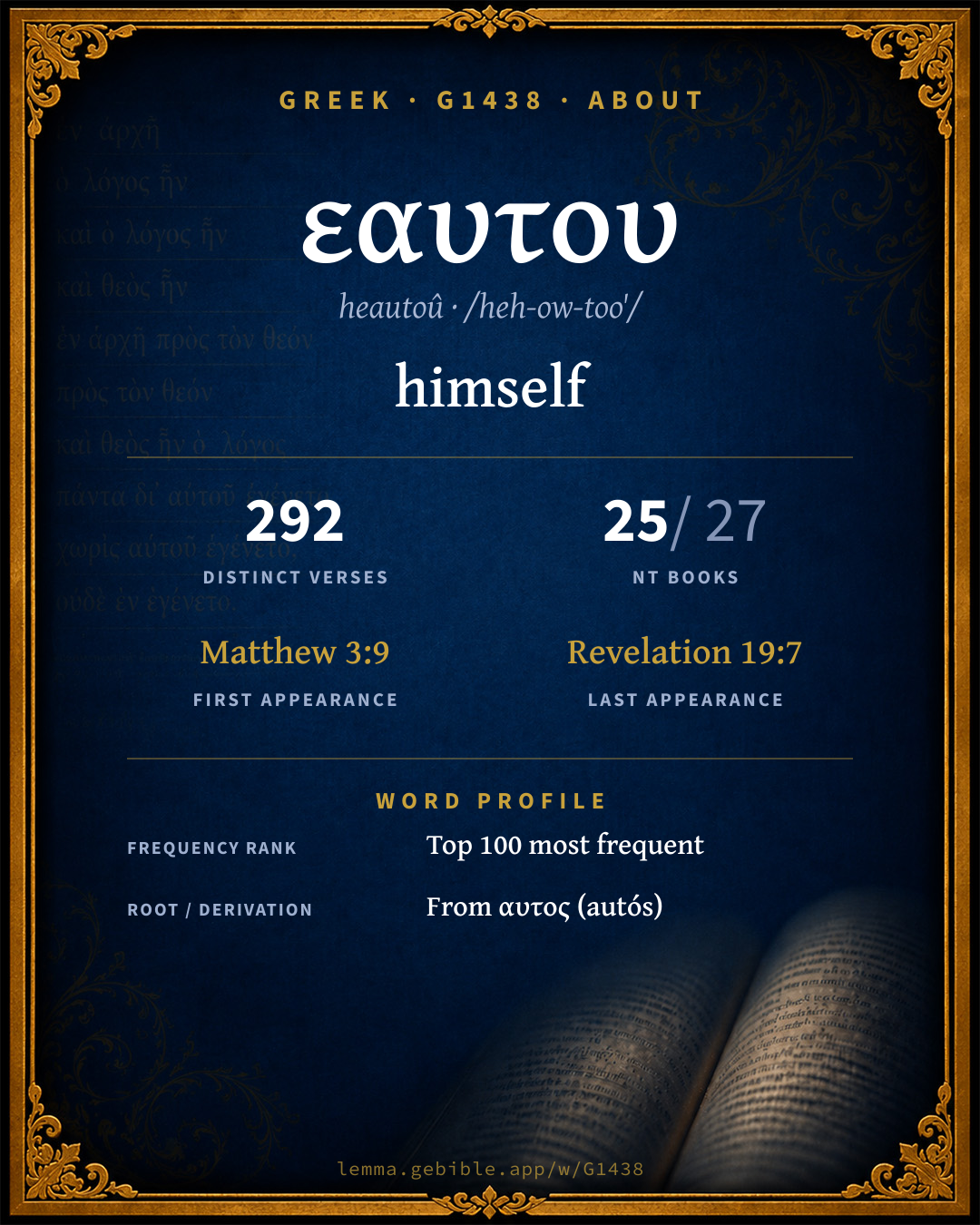
ἑαυτοῦ
himself
Full lexicon entry — Thayer's Greek Lexicon
From Thayer's Greek Lexicon
Where this word appears
See every Dative-case word in the Greek New Testament →
Grammar key — what these labels mean
Part of speech
- Reflexive pronoun
- Refers the action back to the subject (“himself”).
Case
- Accusative
- The case of the direct object and of extent.
- Genitive
- The case of source, possession, or “of” — answers “whose / from what.”
- Dative
- The case of the indirect object, means, or location — “to / for / with / in.”
Person
- 3rd person
- The one spoken about (“he / she / it / they”).
- 2nd person
- The one addressed (“you”).
- 1st person
- The speaker (“I / we”).
Gender
- Masculine
- Grammatically masculine.
- Feminine
- Grammatically feminine.
- Neuter
- Grammatically neuter.
Number
- Singular
- One.
- Plural
- More than one.
5 verses where G1438 appears in the Accusative case in the Book of Romans. Filtered view — show all forms. Click any verse to open its interlinear word-by-word view. Verse text shown in the World English Bible for context — . Each verse’s Greek form is shown with its reference; the English is not keyword-highlighted, since the data carries no word-level English alignment. Use “Compare translations” on any verse to read it across multiple English versions. This concordance covers the Greek New Testament; Septuagint (Greek Old Testament) occurrences of this word are not indexed here.
Romans
- Romans 6:11 ἑαυτοὺς refl.pron 2 acc pl masc Thus also consider yourselves also to be dead to sin, but alive to God in Christ Jesus our Lord.
- Romans 6:13 ἑαυτοὺς refl.pron 2 acc pl masc Neither present your members to sin as instruments of unrighteousness, but present yourselves to God, as alive from the dead, and your members as instruments of righteousness to God.
- Romans 6:16 ἑαυτοὺς refl.pron 2 acc pl masc Don't you know that to whom you present yourselves as servants to obedience, his servants you are whom you obey; whether of sin to death, or of obedience to righteousness?
- Romans 12:19 ἑαυτοὺς refl.pron 2 acc pl masc Don't seek revenge yourselves, beloved, but give place to God's wrath. For it is written, "Vengeance belongs to me; I will repay, says the Lord."
- Romans 14:22 ἑαυτὸν refl.pron 3 acc sg masc Do you have faith? Have it to yourself before God. Happy is he who doesn't judge himself in that which he approves.
About this entry
At a glance — auto-summarized from this page’s data, not written by a person. Every figure links to its source below. This summary describes the numbers; it doesn’t interpret them.
The Greek word εαυτου centers on the idea of “himself.” Its earliest occurrence is Matthew 3:9. Spanning 292 verses in 25 books, it ranks among the common words of the Greek New Testament. Related forms include αυτος, αυθαδης and αυθαιρετος. For the data behind this summary, explore the sense tree and the renderings breakdown below.
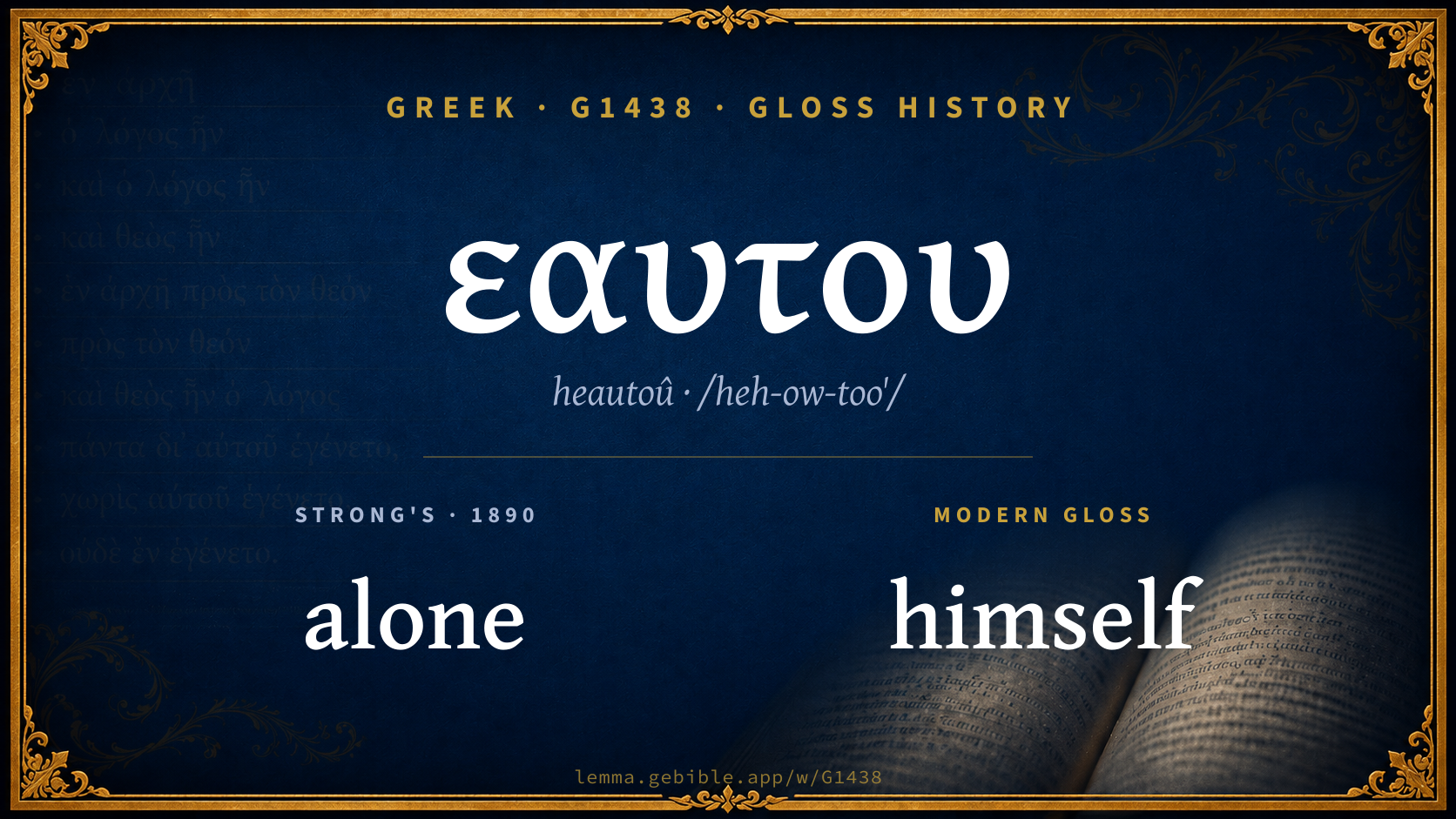
Gloss history
Strong's 1890 vs modern scholarship
About this word
Strong's G1438 catalogs a Greek word from the Greek New Testament.
These counts are not copied from any lexicon or concordance. They are computed here, from the morphology-tagged Greek New Testament. What Lemma adds →
- 292
- distinct verses
- The word appears in 292 distinct verses.
- 25 / 27
- NT books
- The word appears in 25 of 27 New Testament books.
- #58
- by frequency
- Top 100 most frequent Greek words (rank 58 of 5,347 Greek words by occurrence).
View all 292 occurrences in the concordance →
By section of the New Testament
By traditional corpus
Conventional, traditional groupings — biblical authorship is debated, so this is a traditional corpus grouping, not an authorship claim. Some books belong to more than one corpus (Luke is in both the Gospels and the Lukan corpus, and so on), so these shares overlap and need not total 100%. Each figure is a share of the word’s 292 distinct verses.
- Gospels 133 verses · 46%
- Pauline corpus 96 verses · 33%
- Lukan (Luke–Acts) 73 verses · 25%
- Johannine 39 verses · 13%
- General (Catholic) Epistles 21 verses · 7%
- Hebrews 14 verses · 5%
- Revelation 7 verses · 2%
How translations render this word
Counts come from each version’s own published word-to-Strong’s tagging or interlinear alignment — an approximate guide to how each version renders this word, not a word-level alignment the data otherwise carries. Because each total is that version’s own tagged count, the per-version totals vary from one another and need not match the appearance or distinct-verse counts above. These counts may also differ from a printed concordance because Lemma counts each distinctly tagged rendering and does not collapse phrase taggings into a single head-word total. This is a fixed set of word-tagged versions (KJV, ASV, BSB, ULT) and does not change with the reading translation you choose elsewhere. Each version’s license is shown beside its name below (and on Sources).
- King James Version: Himself 108×, Themselves 57×, Yourselves 35×
- American Standard Version: Himself 100×, Themselves 48×, Yourselves 32×
- Berean Standard Bible: Himself 75×, Themselves 33×, Yourselves 29×
- unfoldingWord Literal Text: Himself 103×, Themselves 53×, Own 45×
King James Version Public Domain
Renders G1438 across 333 tagged occurrences — most commonly:
Plus other, less common renderings. Plus 11 renderings that appear only once — usually multi-word phrases or single function words the recovered tagging swept in, not distinct renderings. Not rendered by a distinct English word in 6 further occurrences.
American Standard Version Public Domain
Renders G1438 across 329 tagged occurrences — most commonly:
Plus other, less common renderings. Plus 23 renderings that appear only once — usually multi-word phrases or single function words the recovered tagging swept in, not distinct renderings.
Berean Standard Bible Public Domain
Renders G1438 across 269 tagged occurrences — most commonly:
Plus other, less common renderings. Plus 20 renderings that appear only once — usually multi-word phrases or single function words the recovered tagging swept in, not distinct renderings. Not rendered by a distinct English word in 48 further occurrences.
unfoldingWord Literal Text CC BY-SA 4.0
Renders G1438 across 319 tagged occurrences — most commonly:
Plus other, less common renderings. Plus 6 renderings that appear only once — usually multi-word phrases or single function words the recovered tagging swept in, not distinct renderings.
Senses in Thayer's
The 1 sense Thayer's distinguishes for this word, in lexicon order (not ranked by frequency or importance). The full entry — with sub-senses — is in the Lexicon Entry tab.
- himself, herself, itself, themselves
Word origin
Derived from αυτος (autós) (G846) — he.
(Including all the other cases); from a reflexive pronoun otherwise obsolete and the genitive (dative or accusative) of G846 ; him ( her it them also [in conjunction with the personal pronoun of the other persons] my thy our your ) -self (-selves) etc. : - alone her (own -self) (he) himself his (own) itself one (to) another our (thine) own (-selves) + that she had their (own own selves) (of) them (-selves) they thyself you your (own own conceits own selves -selves).
— Strong’s Exhaustive Concordance (1890), public domain.
Forms in the corpus
The 16 distinct written forms G1438 takes in the Greek New Testament, most frequent first — each parse links to that case’s occurrences in the concordance.
Same root — word family
Other Thayer's entries built from the same root as G1438, grouped by Strong’s listed origin. These share a root / origin per the lexicon — not necessarily a shared meaning. Each links to that word’s own entry.
Derives from
Shares the same root
- αυθαδης authádēs G829 self-willed
- αυθαιρετος authaíretos G830 voluntary
- αυθεντεω authentéō G831 autocrat
- αυταρκης autárkēs G842 self-sufficient
- αυτοκατακριτος autokatákritos G843 self-condemned
- αυτοματος autómatos G844 of itself
- αυτοπτης autóptēs G845 eyewitness
- αυτου autoû G847 there
- αυτοχειρ autócheir G849 with own hands
Derived from this word
Compare all same-root words → Showing 4 of 13 — not the complete family. They share a root, not necessarily a meaning.
Septuagint usage
The same Greek word εαυτου appears 478 times in the Greek Old Testament (Septuagint), across 423 verses in 34 books.
- 478
- LXX occurrences
- Tagged occurrences of this Greek word in the Septuagint.
- 423
- verses
- Distinct Septuagint verses containing this word.
- 34 / 39
- OT books
- The word appears in 34 of the 39 Old Testament books.
Sample Septuagint occurrences
- Genesis 1:29 ἑαυτοῦ
- Exodus 1:21 ἑαυτοῦ
- Leviticus 15:14 ἑαυτοῦ
- Numbers 1:52 ἑαυτοῦ
- Deuteronomy 1:13 ἑαυτοῦ
- Joshua 2:19 ἑαυτοῦ
- Judges 3:6 ἑαυτοῦ
- Ruth 1:4 ἑαυτοῦ
- 1 Samuel 2:14 ἑαυτοῦ
- 2 Samuel 2:7 ἑαυτοῦ
- 1 Kings 1:5 ἑαυτοῦ
- 2 Kings 3:26 ἑαυτοῦ
Septuagint occurrences (same lexeme)
Every verse where the same Strong’s number (G1438) appears in the Greek Septuagint — showing the first 50 of 423. Verse text shown in the World English Bible for context; the Greek form is the matched word — the English is not keyword-highlighted.
- Genesis 1:29 ἑαυτοῦ God said, "Behold, I have given you every herb yielding seed, which is on the surface of all the earth, and every tree, which bears fruit yielding seed. It will be your food.
- Genesis 1:30 ἑαυτοῦ To every animal of the earth, and to every bird of the sky, and to everything that creeps on the earth, in which there is life, I have given every green herb for food." And it was so.
- Genesis 3:7 ἑαυτοῦ Both of their eyes were opened, and they knew that they were naked. They sewed fig leaves together, and made themselves aprons.
- Genesis 4:19 ἑαυτοῦ Lamech took two wives: the name of the one was Adah, and the name of the other Zillah.
- Genesis 4:23 ἑαυτοῦ Lamech said to his wives, "Adah and Zillah, Hear my voice, You wives of Lamech, listen to my speech, For I have slain a man for wounding me, A young man for bruising me.
- Genesis 6:2 ἑαυτοῦ that God's sons saw that men's daughters were beautiful, and they took for themselves wives of all that they chose.
- Genesis 6:4 ἑαυτοῦ The Nephilim were in the earth in those days, and also after that, when God's sons came to men's daughters. They bore children to them: the same were the mighty men who were of old, men of renown.
- Genesis 8:9 ἑαυτοῦ but the dove found no place to rest her foot, and she returned to him into the ark; for the waters were on the surface of the whole earth. He put forth his hand, and took her, and brought her to him into the ark.
- Genesis 11:4 ἑαυτοῦ They said, "Come, let's build us a city, and a tower, whose top reaches to the sky, and let's make us a name; lest we be scattered abroad on the surface of the whole earth."
- Genesis 11:29 ἑαυτοῦ Abram and Nahor took wives. The name of Abram's wife was Sarai, and the name of Nahor's wife, Milcah, the daughter of Haran who was also the father of Iscah.
- Genesis 13:11 ἑαυτοῦ So Lot chose the Plain of the Jordan for himself. Lot traveled east, and they separated themselves the one from the other.
- Genesis 16:3 ἑαυτοῦ Sarai, Abram's wife, took Hagar the Egyptian, her handmaid, after Abram had lived ten years in the land of Canaan, and gave her to Abram her husband to be his wife.
- Genesis 18:12 ἑαυτοῦ Sarah laughed within herself, saying, "After I have grown old will I have pleasure, my lord being old also?"
- Genesis 18:13 ἑαυτοῦ Yahweh said to Abraham, "Why did Sarah laugh, saying, 'Will I really bear a child, yet I am old?'
- Genesis 19:10 ἑαυτοῦ But the men put forth their hand, and brought Lot into the house to them, and shut the door.
- Genesis 22:3 ἑαυτοῦ Abraham rose early in the morning, and saddled his donkey, and took two of his young men with him, and Isaac his son. He split the wood for the burnt offering, and rose up, and went to the place of which God had told him.
- Genesis 22:8 ἑαυτοῦ Abraham said, "God will provide himself the lamb for a burnt offering, my son." So they both went together.
- Genesis 24:10 ἑαυτοῦ The servant took ten camels, of his master's camels, and departed, having all goodly things of his master's in his hand. He arose, and went to Mesopotamia, to the city of Nahor.
- Genesis 24:44 ἑαυτοῦ She will tell me, "Drink, and I will also draw for your camels." Let the same be the woman whom Yahweh has appointed for my master's son.'
- Genesis 24:46 ἑαυτοῦ She hurried and let down her pitcher from her shoulder, and said, 'Drink, and I will also give your camels a drink.' So I drank, and she made the camels drink also.
- Genesis 25:20 ἑαυτοῦ Isaac was forty years old when he took Rebekah, the daughter of Bethuel the Syrian of Paddan Aram, the sister of Laban the Syrian, to be his wife.
- Genesis 28:6 ἑαυτοῦ Now Esau saw that Isaac had blessed Jacob and sent him away to Paddan Aram, to take him a wife from there, and that as he blessed him he gave him a charge, saying, "You shall not take a wife of the daughters of Canaan,"
- Genesis 30:37 ἑαυτοῦ Jacob took to himself rods of fresh poplar, almond, plane tree, peeled white streaks in them, and made the white appear which was in the rods.
- Genesis 30:40 ἑαυτοῦ Jacob separated the lambs, and set the faces of the flocks toward the streaked and all the black in the flock of Laban: and he put his own droves apart, and didn't put them into Laban's flock.
- Genesis 31:23 ἑαυτοῦ He took his relatives with him, and pursued after him seven days' journey. He overtook him in the mountain of Gilead.
- Genesis 32:2 ἑαυτοῦ When he saw them, Jacob said, "This is God's host." He called the name of that place Mahanaim.
- Genesis 33:17 ἑαυτοῦ Jacob traveled to Succoth, built himself a house, and made shelters for his cattle. Therefore the name of the place is called Succoth.
- Genesis 36:2 ἑαυτοῦ Esau took his wives from the daughters of Canaan: Adah the daughter of Elon, the Hittite; and Oholibamah the daughter of Anah, the daughter of Zibeon, the Hivite;
- Genesis 38:14 ἑαυτοῦ She took off of her the garments of her widowhood, and covered herself with her veil, and wrapped herself, and sat in the gate of Enaim, which is by the way to Timnah; for she saw that Shelah was grown up, and she wasn't given to him as a wife.
- Genesis 38:19 ἑαυτοῦ She arose, and went away, and put off her veil from her, and put on the garments of her widowhood.
- Genesis 39:6 ἑαυτοῦ He left all that he had in Joseph's hand. He didn't concern himself with anything, except for the food which he ate. Joseph was well-built and handsome.
- Genesis 39:16 ἑαυτοῦ She laid up his garment by her, until his master came home.
- Genesis 41:11 ἑαυτοῦ We dreamed a dream in one night, I and he. We dreamed each man according to the interpretation of his dream.
- Genesis 43:22 ἑαυτοῦ We have brought down other money in our hand to buy food. We don't know who put our money in our sacks."
- Genesis 43:32 ἑαυτοῦ They served him by himself, and them by themselves, and the Egyptians, that ate with him, by themselves, because the Egyptians don't eat bread with the Hebrews, for that is an abomination to the Egyptians.
- Genesis 47:23 ἑαυτοῦ Then Joseph said to the people, "Behold, I have bought you and your land today for Pharaoh. Behold, here is seed for you, and you shall sow the land.
- Genesis 49:16 ἑαυτοῦ "Dan will judge his people, As one of the tribes of Israel.
- Exodus 1:21 ἑαυτοῦ It happened, because the midwives feared God, that he gave them families.
- Exodus 2:11 ἑαυτοῦ It happened in those days, when Moses had grown up, that he went out to his brothers, and looked at their burdens. He saw an Egyptian striking a Hebrew, one of his brothers.
- Exodus 4:14 ἑαυτοῦ The anger of Yahweh was kindled against Moses, and he said, "What about Aaron, your brother, the Levite? I know that he can speak well. Also, behold, he comes forth to meet you. When he sees you, he will be glad in his heart.
- Exodus 5:7 ἑαυτοῦ "You shall no longer give the people straw to make brick, as before. Let them go and gather straw for themselves.
- Exodus 5:11 ἑαυτοῦ Go yourselves, get straw where you can find it, for nothing of your work shall be diminished."
- Exodus 5:19 ἑαυτοῦ The officers of the children of Israel saw that they were in trouble, when it was said, "You shall not diminish anything from your daily quota of bricks!"
- Exodus 6:20 ἑαυτοῦ Amram took Jochebed his father's sister to himself as wife; and she bore him Aaron and Moses: and the years of the life of Amram were a hundred and thirty-seven years.
- Exodus 12:4 ἑαυτοῦ and if the household be too little for a lamb, then he and his neighbor next to his house shall take one according to the number of the souls; according to what everyone can eat you shall make your count for the lamb.
- Exodus 12:21 ἑαυτοῦ Then Moses called for all the elders of Israel, and said to them, "Draw out, and take lambs according to your families, and kill the Passover.
- Exodus 12:39 ἑαυτοῦ They baked unleavened cakes of the dough which they brought forth out of Egypt; for it wasn't leavened, because they were thrust out of Egypt, and couldn't wait, neither had they prepared for themselves any food.
- Exodus 13:19 ἑαυτοῦ Moses took the bones of Joseph with him, for he had made the children of Israel swear, saying, "God will surely visit you, and you shall carry up my bones away from here with you."
- Exodus 14:6 ἑαυτοῦ He made ready his chariot, and took his army with him;
- Exodus 16:18 ἑαυτοῦ When they measured it with an omer, he who gathered much had nothing over, and he who gathered little had no lack. They gathered every man according to his eating.
These are occurrences of the same Greek lexeme (G1438) in the Septuagint — not a translation of any one Hebrew word. The store carries no word-level Hebrew↔Greek alignment, so no Hebrew original is asserted here. Counts come from the recovered LXX Strong's tagging — high-frequency vocabulary is well covered, while rare or late forms may be untagged — so they reflect tagged occurrences and may slightly undercount.