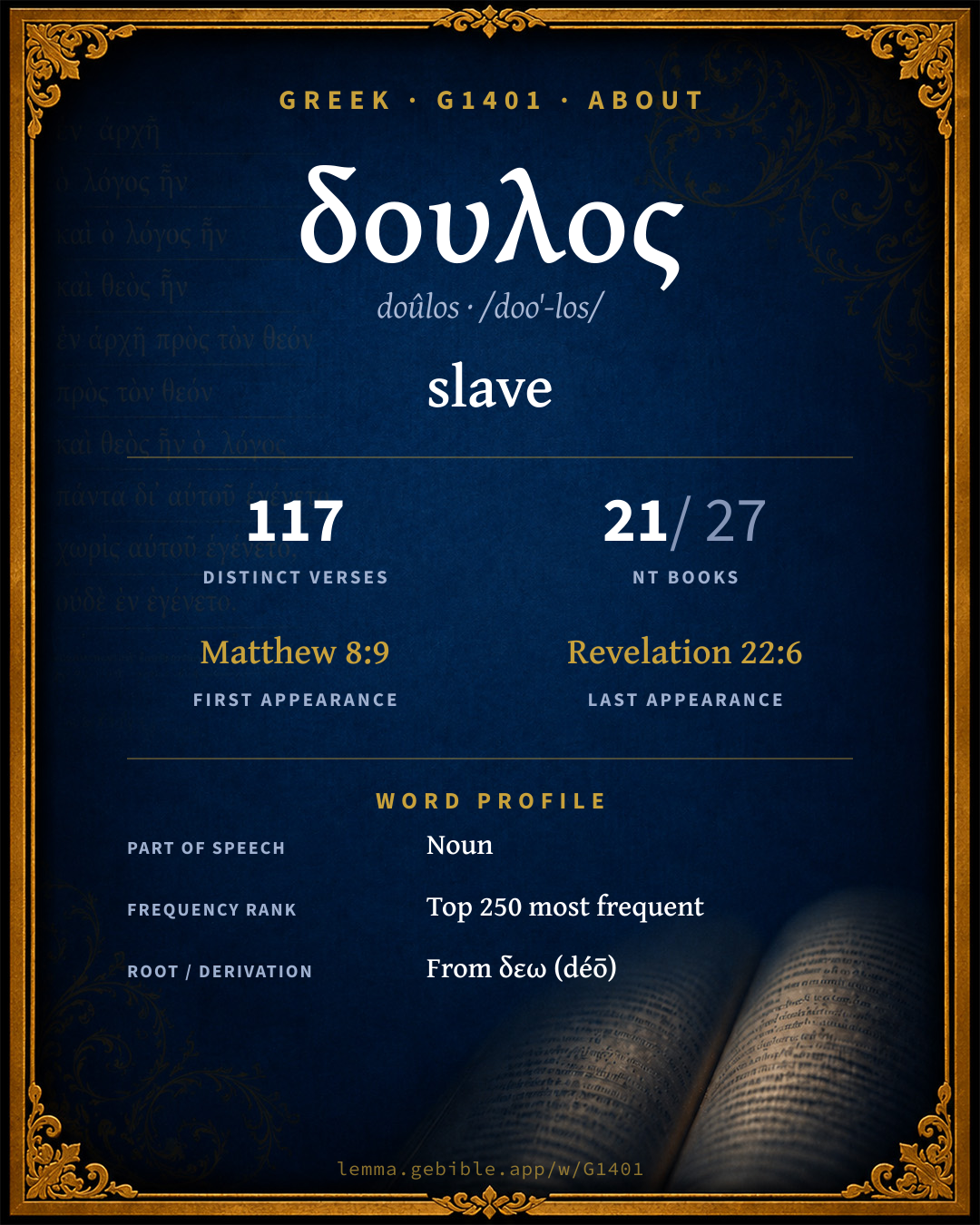
δοῦλος
slave
‘slave’ is one of 2 main senses fuller range ↓
Full lexicon entry — Thayer's Greek Lexicon
From Thayer's Greek Lexicon
Where this word appears
See every Nominative-case word in the Greek New Testament →
Grammar key — what these labels mean
Part of speech
- Noun
- A naming word — a person, place, thing, or idea.
Case
- Nominative
- The case of the subject (and the predicate nominative).
- Accusative
- The case of the direct object and of extent.
- Dative
- The case of the indirect object, means, or location — “to / for / with / in.”
- Genitive
- The case of source, possession, or “of” — answers “whose / from what.”
- Vocative
- The case of direct address (“O Lord”).
Gender
- Masculine
- Grammatically masculine.
Number
- Singular
- One.
- Plural
- More than one.
3 verses where G1401 appears in the Nominative case in the Book of Galatians. Filtered view — show all forms. Click any verse to open its interlinear word-by-word view. Verse text shown in the World English Bible for context — . Each verse’s Greek form is shown with its reference; the English is not keyword-highlighted, since the data carries no word-level English alignment. Use “Compare translations” on any verse to read it across multiple English versions. This concordance covers the Greek New Testament; Septuagint (Greek Old Testament) occurrences of this word are not indexed here.
Galatians
- Galatians 1:10 δοῦλος n nom sg masc For am I now seeking the favor of men, or of God? Or am I striving to please men? For if I were still pleasing men, I wouldn't be a servant of Christ.
- Galatians 3:28 δοῦλος n nom sg masc There is neither Jew nor Greek, there is neither slave nor free man, there is neither male nor female; for you are all one in Christ Jesus.
- Galatians 4:7 δοῦλος n nom sg masc So you are no longer a bondservant, but a son; and if a son, then an heir of God through Christ.
About this entry
At a glance — auto-summarized from this page’s data, not written by a person. Every figure links to its source below. This summary describes the numbers; it doesn’t interpret them.
The Greek noun δουλος centers on the idea of “slave.” Its English rendering has broadened — “servant” classically, “slave” (unfoldingWord Literal Text) in modern versions; see the renderings breakdown. Spanning 117 verses in 21 books, it ranks among the common words of the Greek New Testament. Matthew dominates its distribution — 30 of 117 verses. Lexicons map it across 2 senses. For the data behind this summary, explore the sense tree and the renderings breakdown below.
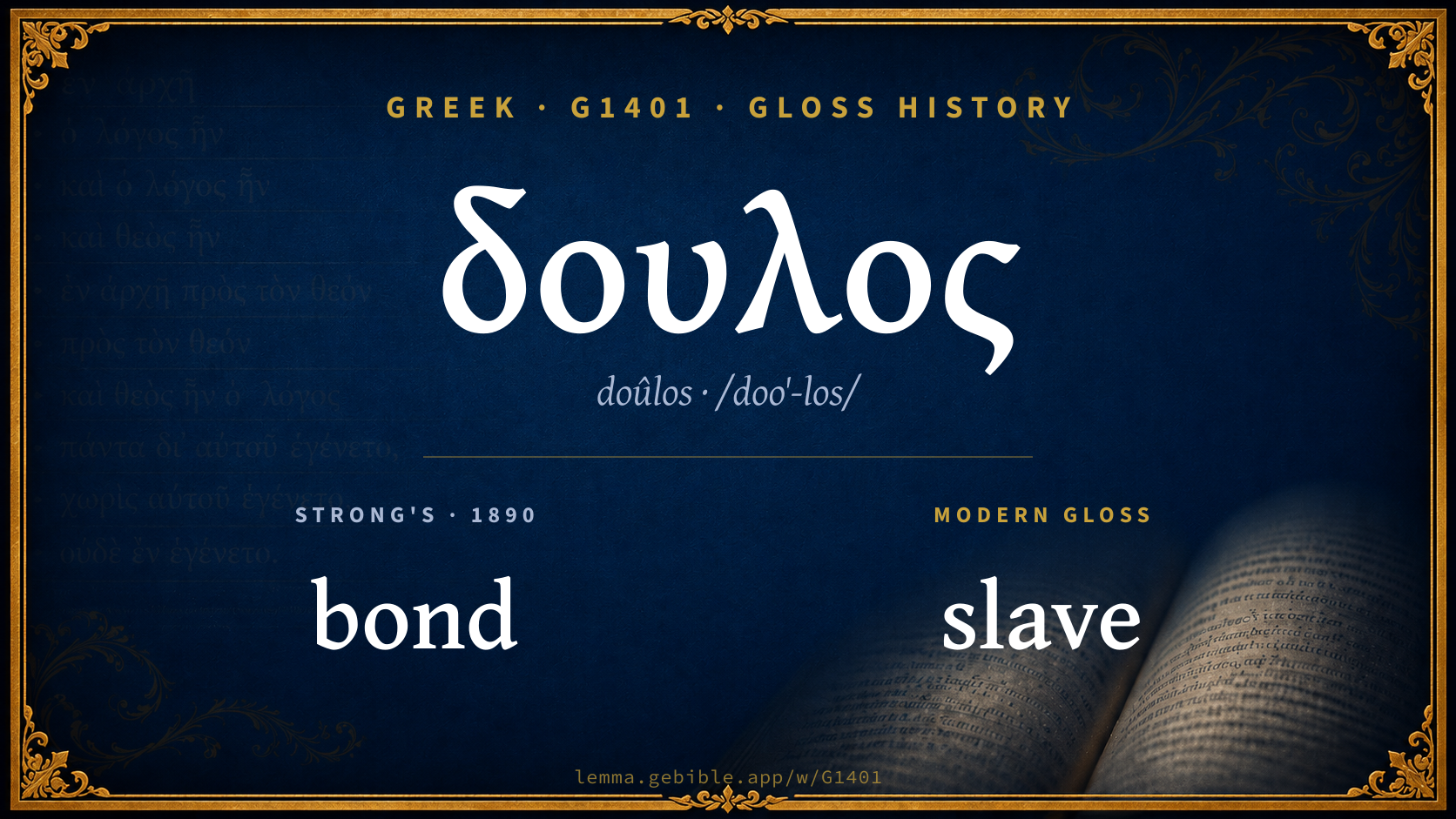
Gloss history
Strong's 1890 vs modern scholarship
About this word
Strong's G1401 catalogs a Greek word from the Greek New Testament.
These counts are not copied from any lexicon or concordance. They are computed here, from the morphology-tagged Greek New Testament. What Lemma adds →
- 117
- distinct verses
- The word appears in 117 distinct verses.
- 21 / 27
- NT books
- The word appears in 21 of 27 New Testament books.
- #132
- by frequency
- Top 250 most frequent Greek words (rank 132 of 5,347 Greek words by occurrence).
View all 117 occurrences in the concordance →
Most concentrated in
- Matthew 30 verses 26%
- Luke 25 verses 21%
- Revelation 13 verses 11%
By section of the New Testament
By traditional corpus
Conventional, traditional groupings — biblical authorship is debated, so this is a traditional corpus grouping, not an authorship claim. Some books belong to more than one corpus (Luke is in both the Gospels and the Lukan corpus, and so on), so these shares overlap and need not total 100%. Each figure is a share of the word’s 117 distinct verses.
- Gospels 69 verses · 59%
- Lukan (Luke–Acts) 28 verses · 24%
- Pauline corpus 27 verses · 23%
- Johannine 22 verses · 19%
- Revelation 13 verses · 11%
- General (Catholic) Epistles 5 verses · 4%
How translations render this word
Counts come from each version’s own published word-to-Strong’s tagging or interlinear alignment — an approximate guide to how each version renders this word, not a word-level alignment the data otherwise carries. Because each total is that version’s own tagged count, the per-version totals vary from one another and need not match the appearance or distinct-verse counts above. These counts may also differ from a printed concordance because Lemma counts each distinctly tagged rendering and does not collapse phrase taggings into a single head-word total. This is a fixed set of word-tagged versions (KJV, ASV, BSB, ULT) and does not change with the reading translation you choose elsewhere. Each version’s license is shown beside its name below (and on Sources).
- King James Version: Servant 64×, Servants 52×, Bond 4×
- American Standard Version: Servant 53×, Servants 46×, Bond 4×
- Berean Standard Bible: Servant 55×, Servants 35×, Slave 17×
- unfoldingWord Literal Text: Slave 37×, Servant 35×, Servants 34×
King James Version Public Domain
Renders G1401 across 127 tagged occurrences — most commonly:
Plus 5 renderings that appear only once — usually multi-word phrases or single function words the recovered tagging swept in, not distinct renderings.
American Standard Version Public Domain
Renders G1401 across 134 tagged occurrences — most commonly:
Plus 8 renderings that appear only once — usually multi-word phrases or single function words the recovered tagging swept in, not distinct renderings.
Berean Standard Bible Public Domain
Renders G1401 across 125 tagged occurrences — most commonly:
Plus 5 renderings that appear only once — usually multi-word phrases or single function words the recovered tagging swept in, not distinct renderings. Not rendered by a distinct English word in 1 further occurrence.
unfoldingWord Literal Text CC BY-SA 4.0
Renders G1401 across 142 tagged occurrences — most commonly:
Plus 4 renderings that appear only once — usually multi-word phrases or single function words the recovered tagging swept in, not distinct renderings.
Senses in Thayer's
The 2 senses Thayer's distinguishes for this word, in lexicon order (not ranked by frequency or importance). The full entry — with sub-senses — is in the Lexicon Entry tab.
- a slave, bondman, man of servile condition
- a servant, attendant
Word origin
Derived from δεω (déō) (G1210) — to bind.
From G1210 ; a slave (literally or figuratively involuntarily or voluntarily; frequently therefore in a qualified sense of subjection or subserviency ): - bond (-man) servant.
— Strong’s Exhaustive Concordance (1890), public domain.
Forms in the corpus
The 13 distinct written forms G1401 takes in the Greek New Testament, most frequent first — each parse links to that case’s occurrences in the concordance.
| Form | Parsing | Example | Uses |
|---|---|---|---|
| δοῦλος doûlos | Noun, Nominative, Singular, Masculine | Matthew 10:24 | 33 |
| δοῦλοι doûloi | Noun, Nominative, Plural, Masculine | Matthew 13:27 | 21 |
| δούλους doúlous | Noun, Accusative, Plural, Masculine | Matthew 21:34 | 18 |
| δοῦλον doûlon | Noun, Accusative, Singular, Masculine | Matthew 25:30 | 17 |
| δούλοις doúlois | Noun, Dative, Plural, Masculine | Matthew 22:8 | 7 |
| δούλου doúlou | Noun, Genitive, Singular, Masculine | Matthew 18:27 | 6 |
| δούλῳ doúlō | Noun, Dative, Singular, Masculine | Matthew 8:9 | 6 |
| δοῦλε doûle | Noun, Vocative, Singular, Masculine | Matthew 18:32 | 6 |
| δούλων doúlōn | Noun, Genitive, Plural, Masculine | Matthew 18:23 | 5 |
| δοῦλός doûlós | Noun, Nominative, Singular, Masculine | John 8:34 | 2 |
| Δούλους Doúlous | Noun, Accusative, Plural, Masculine | Titus 2:9 | 1 |
| δοῦλοί doûloí | Noun, Nominative, Plural, Masculine | Romans 6:16 | 1 |
| δοῦλόν doûlón | Noun, Accusative, Singular, Masculine | Luke 2:29 | 1 |
Same root — word family
Other Thayer's entries built from the same root as G1401, grouped by Strong’s listed origin. These share a root / origin per the lexicon — not necessarily a shared meaning. Each links to that word’s own entry.
Derives from
Shares the same root
- δει deî G1163 it is necessary
- δεομαι déomai G1189 to ask
- δεσμον desmón G1199 bond
- δεσποτης despótēs G1203 master
- δημος dēmos G1218 people
Derived from this word
- δουλαγωγεω doulagōgéō G1396 to enslave
- δουλευω douleúō G1398 to serve
- δουλη doúlē G1399 female slave
- δουλον doûlon G1400 slave
- δουλοω doulóō G1402 to enslave
Compare all same-root words → Showing 4 of 12 — not the complete family. They share a root, not necessarily a meaning.
Septuagint usage
The same Greek word δουλος appears 334 times in the Greek Old Testament (Septuagint), across 299 verses in 26 books.
- 334
- LXX occurrences
- Tagged occurrences of this Greek word in the Septuagint.
- 299
- verses
- Distinct Septuagint verses containing this word.
- 26 / 39
- OT books
- The word appears in 26 of the 39 Old Testament books.
Sample Septuagint occurrences
- Leviticus 25:44 δοῦλος
- Deuteronomy 32:36 δοῦλος
- Joshua 9:23 δοῦλος
- Judges 2:8 δοῦλος
- 1 Samuel 2:27 δοῦλος
- 2 Samuel 3:18 δοῦλος
- 1 Kings 1:19 δοῦλος
- 2 Kings 1:13 δοῦλος
- 1 Chronicles 17:7 δοῦλος
- 2 Chronicles 2:7 δοῦλος
- Ezra 2:65 δοῦλος
- Job 40:28 δοῦλος
Septuagint occurrences (same lexeme)
Every verse where the same Strong’s number (G1401) appears in the Greek Septuagint — showing the first 50 of 299. Verse text shown in the World English Bible for context; the Greek form is the matched word — the English is not keyword-highlighted.
- Leviticus 25:44 δοῦλος "'As for your male and your female slaves, whom you may have; of the nations that are around you, from them you may buy male and female slaves.
- Leviticus 26:13 δοῦλος I am Yahweh your God, who brought you forth out of the land of Egypt, that you should not be their slaves; and I have broken the bars of your yoke, and made you go upright.
- Deuteronomy 32:36 δοῦλος For Yahweh will judge his people, Repent himself for his servants; When he sees that [their] power is gone, There is none [remaining], shut up or left at large.
- Joshua 9:23 δοῦλος Now therefore you are cursed, and there shall never fail to be of you bondservants, both wood cutters and drawers of water for the house of my God.
- Joshua 24:30 δοῦλος They buried him in the border of his inheritance in Timnathserah, which is in the hill-country of Ephraim, on the north of the mountain of Gaash.
- Judges 2:8 δοῦλος Joshua the son of Nun, the servant of Yahweh, died, being one hundred ten years old.
- Judges 6:27 δοῦλος Then Gideon took ten men of his servants, and did as Yahweh had spoken to him: and it happened, because he feared his father's household and the men of the city, so that he could not do it by day, that he did it by night.
- Judges 9:28 δοῦλος Gaal the son of Ebed said, Who is Abimelech, and who is Shechem, that we should serve him? Isn't he the son of Jerubbaal? and Zebul his officer? serve you the men of Hamor the father of Shechem: but why should we serve him?
- Judges 15:18 δοῦλος He was very thirsty, and called on Yahweh, and said, You have given this great deliverance by the hand of your servant; and now shall I die for thirst, and fall into the hand of the uncircumcised.
- 1 Samuel 2:27 δοῦλος There came a man of God to Eli, and said to him, Thus says Yahweh, Did I reveal myself to the house of your father, when they were in Egypt [in bondage] to Pharaoh's house?
- 1 Samuel 3:9 δοῦλος Therefore Eli said to Samuel, Go, lie down: and it shall be, if he call you, that you shall say, Speak, Yahweh; for your servant hears. So Samuel went and lay down in his place.
- 1 Samuel 3:10 δοῦλος Yahweh came, and stood, and called as at other times, Samuel, Samuel. Then Samuel said, Speak; for your servant hears.
- 1 Samuel 8:14 δοῦλος He will take your fields, and your vineyards, and your olive groves, even the best of them, and give them to his servants.
- 1 Samuel 8:15 δοῦλος He will take the tenth of your seed, and of your vineyards, and give to his officers, and to his servants.
- 1 Samuel 8:16 δοῦλος He will take your men-servants, and your maid-servants, and your best young men, and your donkeys, and put them to his work.
- 1 Samuel 8:17 δοῦλος He will take the tenth of your flocks: and you shall be his servants.
- 1 Samuel 12:19 δοῦλος All the people said to Samuel, Pray for your servants to Yahweh your God, that we not die; for we have added to all our sins [this] evil, to ask us a king.
- 1 Samuel 13:3 δοῦλος Jonathan struck the garrison of the Philistines that was in Geba: and the Philistines heard of it. Saul blew the trumpet throughout all the land, saying, Let the Hebrews hear.
- 1 Samuel 14:21 δοῦλος Now the Hebrews who were with the Philistines as before, and who went up with them into the camp, [from the country] round about, even they also [turned] to be with the Israelites who were with Saul and Jonathan.
- 1 Samuel 14:41 δοῦλος Therefore Saul said to Yahweh, the God of Israel, Show the right. Jonathan and Saul were taken [by lot]; but the people escaped.
- 1 Samuel 16:16 δοῦλος Let our lord now command your servants who are before you, to seek out a man who is a skillful player on the harp: and it shall happen, when the evil spirit from God is on you, that he shall play with his hand, and you shall be well.
- 1 Samuel 17:9 δοῦλος If he be able to fight with me, and kill me, then will we be your servants; but if I prevail against him, and kill him, then shall you be our servants, and serve us.
- 1 Samuel 17:12 δοῦλος Now David was the son of that Ephrathite of Bethlehem Judah, whose name was Jesse; and he had eight sons: and the man was an old man in the days of Saul, stricken [in years] among men.
- 1 Samuel 17:14 δοῦλος David was the youngest; and the three eldest followed Saul.
- 1 Samuel 17:16 δοῦλος The Philistine drew near morning and evening, and presented himself forty days.
- 1 Samuel 19:4 δοῦλος Jonathan spoke good of David to Saul his father, and said to him, Don't let the king sin against his servant, against David; because he has not sinned against you, and because his works have been very good toward you:
- 1 Samuel 20:7 δοῦλος If he says, 'It is well;' your servant shall have peace: but if he be angry, then know that evil is determined by him.
- 1 Samuel 20:8 δοῦλος Therefore deal kindly with your servant; for you have brought your servant into a covenant of Yahweh with you: but if there be in me iniquity, kill me yourself; for why should you bring me to your father?
- 1 Samuel 22:8 δοῦλος that all of you have conspired against me, and there is none who discloses to me when my son makes a league with the son of Jesse, and there is none of you who is sorry for me, or discloses to me that my son has stirred up my servant against me, to lie in wait, as at this day?
- 1 Samuel 22:14 δοῦλος Then Ahimelech answered the king, and said, Who among all your servants is so faithful as David, who is the king's son-in-law, and is taken into your council, and is honorable in your house?
- 1 Samuel 22:15 δοῦλος Have I today begun to inquire of God for him? be it far from me: don't let the king impute anything to his servant, nor to all the house of my father; for your servant knows nothing of all this, less or more.
- 1 Samuel 23:10 δοῦλος Then said David, O Yahweh, the God of Israel, your servant has surely heard that Saul seeks to come to Keilah, to destroy the city for my sake.
- 1 Samuel 23:11 δοῦλος Will the men of Keilah deliver me up into his hand? will Saul come down, as your servant has heard? Yahweh, the God of Israel, I beg you, tell your servant. Yahweh said, He will come down.
- 1 Samuel 25:10 δοῦλος Nabal answered David's servants, and said, Who is David? and who is the son of Jesse? there are many servants now-a-days who break away every man from his master.
- 1 Samuel 25:39 δοῦλος When David heard that Nabal was dead, he said, Blessed be Yahweh, who has pleaded the cause of my reproach from the hand of Nabal, and has kept back his servant from evil: and the evil-doing of Nabal has Yahweh returned on his own head. David sent and spoke concerning Abigail, to take her to him as wife.
- 1 Samuel 26:17 δοῦλος Saul knew David's voice, and said, Is this your voice, my son David? David said, It is my voice, my lord, O king.
- 1 Samuel 26:18 δοῦλος He said, Why does my lord pursue after his servant? for what have I done? or what evil is in my hand?
- 1 Samuel 26:19 δοῦλος Now therefore, please let my lord the king hear the words of his servant. If it be Yahweh that has stirred you up against me, let him accept an offering: but if it be the children of men, cursed be they before Yahweh: for they have driven me out this day that I shouldn't cling to Yahweh's inheritance, saying, Go, serve other gods.
- 1 Samuel 27:5 δοῦλος David said to Achish, If now I have found favor in your eyes, let them give me a place in one of the cities in the country, that I may dwell there: for why should your servant dwell in the royal city with you?
- 1 Samuel 27:12 δοῦλος Achish believed David, saying, He has made his people Israel utterly to abhor him; therefore he shall be my servant forever.
- 1 Samuel 28:2 δοῦλος David said to Achish, Therefore you shall know what your servant will do. Achish said to David, Therefore will I make you keeper of my head for ever.
- 1 Samuel 29:3 δοῦλος Then said the princes of the Philistines, What [do] these Hebrews [here]? Achish said to the princes of the Philistines, Isn't this David, the servant of Saul the king of Israel, who has been with me these days, or [rather] these years, and I have found no fault in him since he fell away [to me] to this day?
- 1 Samuel 29:8 δοῦλος David said to Achish, But what have I done? and what have you found in your servant so long as I have been before you to this day, that I may not go and fight against the enemies of my lord the king?
- 1 Samuel 30:13 δοῦλος David said to him, To whom belong you? and whence are you? He said, I am a young man of Egypt, servant to an Amalekite; and my master left me, because three days ago I fell sick.
- 2 Samuel 3:18 δοῦλος now then do it; for Yahweh has spoken of David, saying, By the hand of my servant David I will save my people Israel out of the hand of the Philistines, and out of the hand of all their enemies.
- 2 Samuel 6:20 δοῦλος Then David returned to bless his household. Michal the daughter of Saul came out to meet David, and said, How glorious was the king of Israel today, who uncovered himself today in the eyes of the handmaids of his servants, as one of the vain fellows shamelessly uncovers himself!
- 2 Samuel 7:5 δοῦλος Go and tell my servant David, Thus says Yahweh, Shall you build me a house for me to dwell in?
- 2 Samuel 7:8 δοῦλος Now therefore thus shall you tell my servant David, Thus says Yahweh of Hosts, I took you from the sheep pen, from following the sheep, that you should be prince over my people, over Israel;
- 2 Samuel 7:19 δοῦλος This was yet a small thing in your eyes, Lord Yahweh; but you have spoken also of your servant's house for a great while to come; and this [too] after the manner of men, Lord Yahweh!
- 2 Samuel 7:20 δοῦλος What can David say more to you? for you know your servant, Lord Yahweh.
These are occurrences of the same Greek lexeme (G1401) in the Septuagint — not a translation of any one Hebrew word. The store carries no word-level Hebrew↔Greek alignment, so no Hebrew original is asserted here. Counts come from the recovered LXX Strong's tagging — high-frequency vocabulary is well covered, while rare or late forms may be untagged — so they reflect tagged occurrences and may slightly undercount.