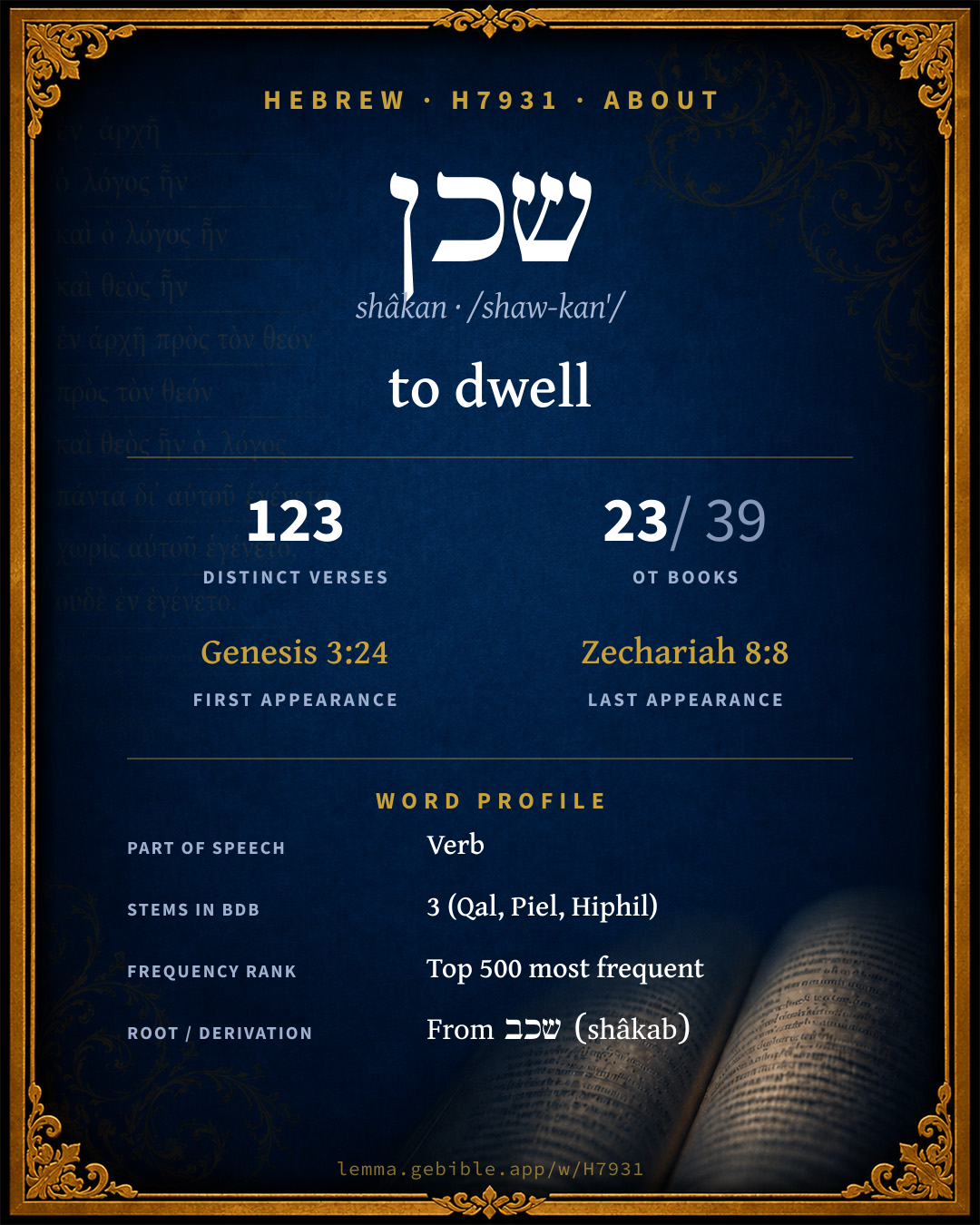
שָׁכַן
to dwell
‘to dwell’ is one of 7 main senses fuller range ↓
Full lexicon entry — Brown-Driver-Briggs (BDB)
From Brown-Driver-Briggs (BDB)
Where this word appears
Grammar key — what these labels mean
Part of speech
- Verb
- An action or state-of-being word.
Stem
- Qal
- The basic, simple active stem — the plain form of the verb (“he wrote”). Here: ‘settle down to abide’
- Piel
- An intensive or resultative active stem. Here: ‘make settle down’
- Hiphil
- The causative active stem (“he caused / brought about”). Here: ‘lay’
Form
- Imperfect
- An incomplete, ongoing, or future action (“he will / would write”).
- Participle Active
- A verbal adjective expressing ongoing or characteristic action (“writing / one who writes”).
- Infinitive Construct
- A bound verbal noun, frequently with prepositions (“to write / in writing”).
- Sequential Perfect
- A perfect with prefixed waw continuing a preceding imperfect or command (waw-consecutive perfect).
- Sequential Imperfect
- An imperfect with prefixed waw — the standard past-narrative form (waw-consecutive imperfect).
- Perfect
- A completed action or state — Hebrew marks aspect (completeness) more than strict tense (“he wrote”).
- Imperative
- A direct command (“write!”).
- Cohortative
- A first-person volitional form expressing wish or resolve (“let me / let us write”).
- Jussive
- A third- or second-person volitional form expressing wish or command (“let him write”).
- Participle Passive
- A verbal adjective expressing action received (“written”).
State
- Absolute
- The independent form of a noun, not bound to a following word.
- Construct
- A noun bound to a following noun in a possessive / “of” relationship (the construct chain).
Person
- 3rd Person
- The one spoken about (“he / she / it / they”).
- 1st Person
- The speaker (“I / we”).
- 2nd Person
- The one addressed (“you”).
Gender
- Masculine
- Grammatically masculine.
- Feminine
- Grammatically feminine.
- Common
- Either gender — not distinguished for this form.
Number
- Singular
- One.
- Plural
- More than one (in Hebrew, generally three or more).
Every verse where H7931 appears in the Book of Micah — 2 distinct verses. Click any verse to open its interlinear word-by-word view. Verse text shown in the World English Bible for context — . Each verse’s Hebrew form is shown with its reference; the English is not keyword-highlighted, since the data carries no word-level English alignment. Use “Compare translations” on any verse to read it across multiple English versions. This concordance covers the Hebrew Bible; Septuagint (Greek Old Testament) occurrences are not indexed here.
Micah
- Micah 4:10 וְ/שָׁכַ֣נְתְּ conj + Qal wpf 2fs Be in pain, and labor to bring forth, daughter of Zion, Like a woman in travail; For now you will go forth out of the city, And will dwell in the field, And will come even to Babylon. There you will be rescued. There Yahweh will redeem you from the hand of your enemies.
- Micah 7:14 שֹׁכְנִ֣י Qal ptcp.act ms cs Shepherd your people with your staff, The flock of your heritage, Who dwell by themselves in a forest, In the midst of fertile pasture land, let them feed; In Bashan and Gilead, as in the days of old.
About this entry
At a glance — auto-summarized from this page’s data, not written by a person. Every figure links to its source below. This summary describes the numbers; it doesn’t interpret them.
At its core, שכן (shâkan) means “to dwell.” Scripture first uses it in Genesis 3:24. It turns up in 123 verses across 23 books, a common footprint. Read the stem: it spans 3 stems, including Qal and Piel. It shares a root with שכב, משכב and שכבה. Dig into 123-verse concordance and the renderings breakdown below.
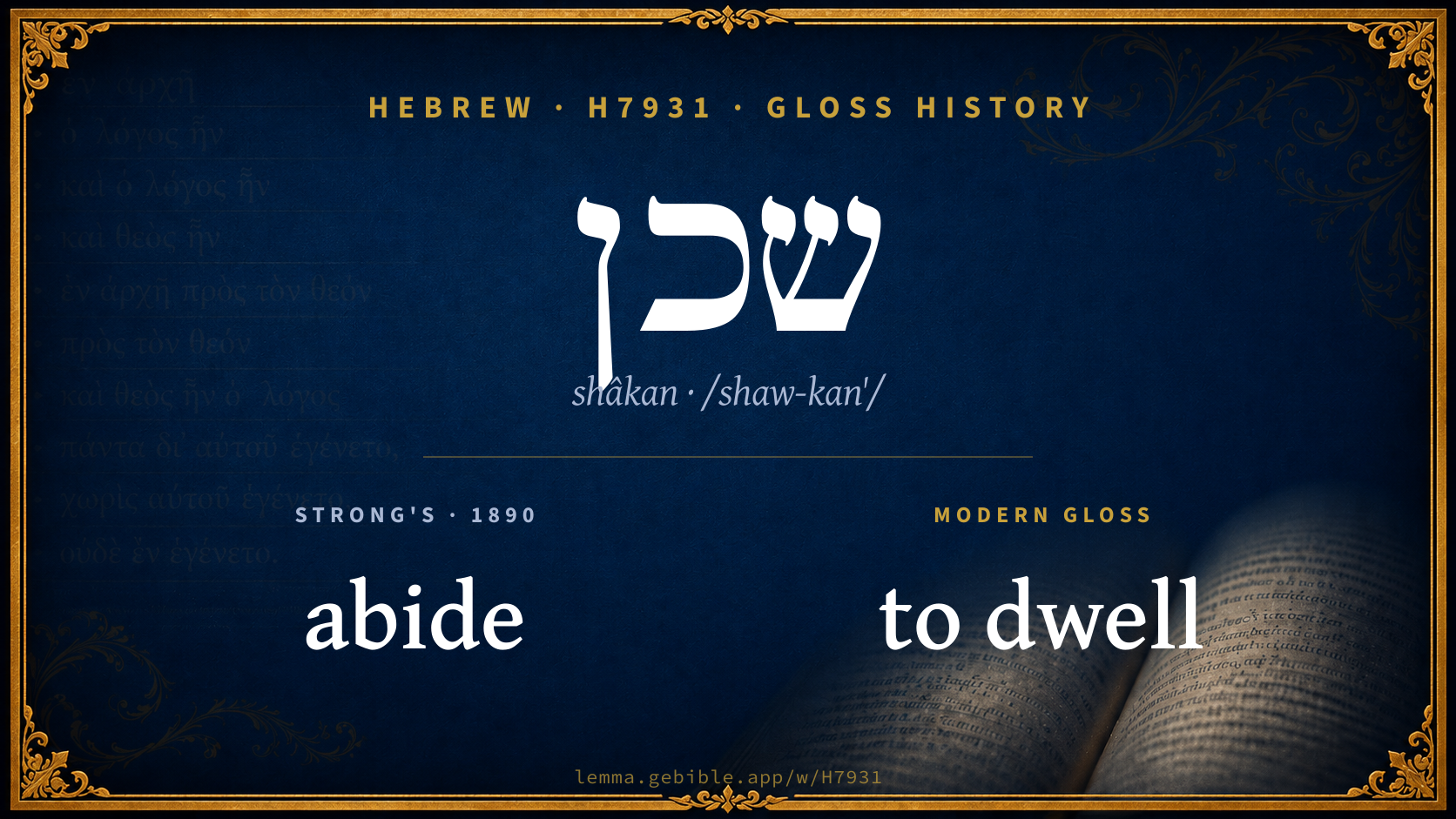
Gloss history
Strong's 1890 vs modern scholarship
About this word
Strong's H7931 catalogs a Hebrew word from the Hebrew Old Testament.
These counts are not copied from any lexicon or concordance. They are computed here, from the morphology-tagged Hebrew Old Testament. What Lemma adds →
- 123
- distinct verses
- The word appears in 123 distinct verses.
- 23 / 39
- OT books
- The word appears in 23 of 39 Old Testament books.
- #346
- by frequency
- Top 500 most frequent Hebrew words (rank 346 of 8,640 Hebrew words by occurrence).
View all 123 occurrences in the concordance →
By section of the Old Testament
By traditional corpus
Conventional, traditional groupings — biblical authorship is debated, so this is a traditional corpus grouping, not an authorship claim. Each share is this word’s portion of its verses in that division of the Hebrew canon. Each figure is a share of the word’s 123 distinct verses.
- Prophets (Nevi'im) 47 verses · 38%
- Writings (Ketuvim) 43 verses · 35%
- Torah (Pentateuch) 33 verses · 27%
How translations render this word
Counts come from each version’s own published word-to-Strong’s tagging or interlinear alignment — an approximate guide to how each version renders this word, not a word-level alignment the data otherwise carries. Because each total is that version’s own tagged count, the per-version totals vary from one another and need not match the appearance or distinct-verse counts above. These counts may also differ from a printed concordance because Lemma counts each distinctly tagged rendering and does not collapse phrase taggings into a single head-word total. This is a fixed set of word-tagged versions (KJV, ASV, BSB, ULT) and does not change with the reading translation you choose elsewhere. Each version’s license is shown beside its name below (and on Sources).
- King James Version: Dwell 17×, Shall dwell 16×, Abode 6×
- American Standard Version: Dwell 15×, Shall dwell 13×, Abode 7×
- Berean Standard Bible: Dwell 14×, Dwelling 9×, Will dwell 7×
- unfoldingWord Literal Text: Dwell 17×, Will dwell 8×, Make 7×
King James Version Public Domain
Renders H7931 across 128 tagged occurrences — most commonly:
Plus other, less common renderings. Plus 39 renderings that appear only once — usually multi-word phrases or single function words the recovered tagging swept in, not distinct renderings. Not rendered by a distinct English word in 1 further occurrence.
American Standard Version Public Domain
Renders H7931 across 127 tagged occurrences — most commonly:
Plus other, less common renderings. Plus 52 renderings that appear only once — usually multi-word phrases or single function words the recovered tagging swept in, not distinct renderings.
Berean Standard Bible Public Domain
Renders H7931 across 129 tagged occurrences — most commonly:
Plus other, less common renderings. Plus 49 renderings that appear only once — usually multi-word phrases or single function words the recovered tagging swept in, not distinct renderings.
unfoldingWord Literal Text CC BY-SA 4.0
Renders H7931 across 159 tagged occurrences — most commonly:
Plus other, less common renderings. Plus 62 renderings that appear only once — usually multi-word phrases or single function words the recovered tagging swept in, not distinct renderings.
18 senses and sub-senses in the full BDB
Hebrew verbs can shift meaning by stem (binyan): Qal is the basic action, Niphal is often passive or reflexive, Piel often intensifies or makes it factitive, and Hiphil is typically causative. The senses below are grouped under the stem BDB assigns to each.
What do BDB’s symbols mean?
BDB uses these scholarly abbreviations:
| Symbol | Meaning |
|---|---|
| 𝔊 | the Septuagint (the ancient Greek translation, LXX) |
| 𝔙 | the Vulgate (the Latin translation) |
| 𝔖 | the Syriac version (the Peshitta) |
| 𝔗 | the Targum (the Aramaic translation) |
| ψ | the Psalms |
| √ | root (the underlying root or stem) |
| ‖ | parallel passage (a synonymous or contrasted parallel) |
| † | the dagger: every passage where the word occurs is cited |
The 18 senses and sub-senses the full Brown-Driver-Briggs lexicon distinguishes for this word, in lexicon order (not ranked by frequency), with BDB’s own verbatim wording and sub-sense lettering. Shown in Hebrew script with BDB’s own scholarly abbreviations. The condensed entry is in the Lexicon Entry tab. See also the Forms in the corpus table below.
Qal
- Pf. 3 ms. שׁ׳ Ex 40:35 + 5 times; שָׁכֵ֑ן Dt 33:12 + 2 times, etc.; Impf. 3 ms. יִשְׁכֹּן Gn 16:12 +; יִשְׁכָּן־ Nu 9:17 + 2 times; 3 mpl. יִשְׁכֹּ֑נוּ Je 49:31; 3 fpl. תִּשְׁכֹּ֑נָּה Ez 17:23, etc.; Imv. ms. שְׁכֹן Gn 26:2 ψ 37:27; שְׁכָן־ v 3; mpl. שִׁכְנוּ Je 48:28; Inf. cstr. בִּשְׁכֹּן (Ges§ 45 g) Gn 35:22, לִשְׁכּוֹן 2 Ch 6:1, etc.; sf. שָׁכְנִי Ex 29:46; שִׁכְנוֹ Dt 12:5 (but v. Pi. 1), etc.; Pt. שֹׁכֵן Gn 14:13 +, שֹׁכְנִי (Ges§ 90 l m) Dt 33:16 + 3 times; sf. fs. שֹׁכַנְתְּי Je 51:13; Pt. pass. appar. pl. cstr. c. art. הַשְּׁכוּנֵי Ju 8:11 (but corrupt, n.pr.loc. needed, v. GFM):— e.g. Exodus 40:35
- 1. settle down to abide:
- a. of pers.: encamp Nu 24:2 (E); settle permanently ψ 102:29 (abs.: ‖ יִכּוֹן); שׁ׳ כמלך Jb 29:25 (‖ ישׁב); settle down (to remain) Ju 5:17; תַּחְתָּיו 2 S 7:10 = 1 Ch 17:9 (not to be removed); especially at rest, peace, in security, לבטח Je 23:6; 33:16; Dt 33:12, cf. בין כתפים v 12; ψ 16:9 (‖ שׂמח); בטח Dt 33:28 Pr 1:33; (ל)בדד Nu 23:9 (poem) Je 49:31; Mi 7:14; land of Egypt Je 46:26 (remain undisturbed), so 50:39; Is 13:20 (‖ תֵּשֵׁב, cf. ישׁב 4); c. acc. מרומים 33:16; abs. Na 3:18, subj. אדּירים (We יָֽשְׁנוּ, Now יִשְׁכְּבוּ; ‖ נָמוּ); Pr 7:11 her feet tarry not in her house. e.g. Numbers 24:2
- b. of animals: כְּלָבִיא Dt 33:20; ב loc. Is 34:11; Jb 37:8; שָׁם Is 13:21; birds שׁ׳ תַּחַת (under) Ez 17:23, שׁ׳ בְּצֵל, v 23; c. עַל = upon 31:13, = by ψ 104:12; c. acc. סֶלַע Jb 39:28; abs., of man under fig. of bird, אָע֫וּפָה וְאֶשְׁכֹּ֑נָה ψ 55:7. e.g. Deuteronomy 33:20
- c. things: c. עַל of cloud, Jb 3:5 settle down over; cf. Ex 24:16; 40:35; Nu 9:17, 18, 22 (all P); c. בְּ 10:12 (P). e.g. Job 3:5
- 2. abide, dwell:
- a. of men: abs. ψ 37:27 (לְעוֹלָם); שָׁ֫מָּה Is 65:9; c. ב loc. ψ 69:37 Jb 18:15; 30:6; Mi 4:10; Je 48:28 + 10 times; לְחוֹף יַמִּים Gn 49:13; c. עַל, by Ju 5:17; Je 51:13; upon ψ 37:29; על פני Gn 16:12 (J); c. עִם with ψ 120:5, 6; c. acc. Pr 2:21 Je 17:6 + 5 times; מִן … עַד Gn 25:18 (J); שֹׁכְנֵי אָ֑רֶץ Is 18:3 (‖ ישְׁבֵי תֵבֵל). e.g. Psalms 37:27
- b. of the dead: שֹׁכְנֵי עָפָר Is 26:19 (‖ רְפָאִים); cf. Jb 26:5 (‖ id.), so mortals, שֹׁכְנֵי בָתֵּי חֹמֶר 4:19; שׁ׳ דוּמָה ψ 94:17 (i.e. שׁאול). e.g. Isaiah 26:19
- c. of God: שׁ׳ בָּֽעֲרָפֶל 1 K 8:12 = 2 Ch 6:1 (poem); מָרוֹם Is 33:5; עַד 57:15; מָרוֹם וְקָדוֹשׁ v 15; שׁ׳ סְנֶה Dt 33:16 (theoph.); בְּאָֽהֳלֵי־שֵׁם Gn 9:27 (J, v. BrMP 82; al. Japheth subj.); בְּתוֹכָם Ex 25:8; 29:46; Nu 5:3 (all P), Ez 43:9; c. בְּתוֹךְ elsewhere Ex 29:45 (P) + 6 times; ב loc. ψ 85:10; later בְּצִיּוֹן Jo 4:17, 21; בְּהַר צִיּוֹן Is 8:18; ψ 68:17, 19 (abs.) + 4 times; שֹׁכֵן יְרוּשָׁלַםִ ψ 135:21. e.g. 1 Kings 8:12
- d. things: אֹהֶל מוֹעֵד, c. את Lv 16:16 (P); מִשְׁכַּן י׳ שָׁם Jos 22:19 (P); אוֹר Jb 38:19. e.g. Leviticus 16:16
- e. abstr. subj.: מִשְׁפָּט Is 32:16 (בַּמִּדְבָּר); חָכְמָה, c. acc. עָרְמָה Pr 8:12. e.g. Isaiah 32:16
Piel
- Pf. 3 ms. שִׁכֵּן ψ 78:60; 1 s. שִׁכַּנְתִּי Je 7:7, 12; Impf. 1 s. אֲשַׁכְּנָה Je 7:3; Inf. cstr. שַׁכֵּן Nu 14:30 + 7 times; sf. שַׁכְּנוֹ Dt 12:5 (so read for MT לְשִׁכְנוֹ, cf. Köii. 1. 21);— e.g. Psalms 78:60
- 1. make settle down, establish: אֹהֶל שׁ׳ בָּֽאָדָֽם ψ 78:60; especially in Dt, לְשַׁכֵּן שְׁמוֹ שָׁם establish his name there (cf. šakan šuma as Canaanism WklTelAm. 138 Rev. 20; 181. 6) Dt 12:11; 14:23; 16:2, 6, 11; 26:2, cf. Je 7:12 Ne 1:9; + לָשׂוּם אֶת־שְׁמוֹ שָׁם לְשִׁכְנוֹ Dt 12:5 (read לְשַׁכְּנוֹ). e.g. Psalms 78:60
- 2. make to dwell: c. acc. pers., ב loc., Nu 14:30 (J) Je 7:3, 7. e.g. Numbers 14:30
Hiphil
- Pf. 1 s. הִשְׁכַּ֫נְתִּי Ez 32:4; Impf. 3 ms. juss. יַשְׁכֵּן ψ 7:6, וַיַּשְׁכֵּן Gn 3:24 ψ 78:55, etc.;— e.g. Ezekiel 32:4
- 1.
- a. lay, כבודי לעפר ψ 7:6 lay my honour in the dust (of death); place, set, Gn 3:24 (J); place, establish, אהל מועד at Shilo Jos 18:1 (P). e.g. Psalms 7:6
- b. cause birds to settle, עַל Ez 32:4. e.g. Ezekiel 32:4
- 2. cause to dwell, c. acc. pers., ב loc., ψ 78:55; cf. Jb 11:14. e.g. Psalms 78:55
Senses from the full Brown-Driver-Briggs lexicon (Brown, Driver, Briggs; Oxford 1906 — public domain), digitized via Sefaria, supplemented by the OpenScriptures HebrewLexicon (CC BY 4.0). Full attribution on Sources.
Word origin
vb. settle down, abide, dwell (NH id.; Ecclus 43:17d +; Ph. שכן Lzb375; Aramaic שְׁכֵין; Syriac ܫܟܶܢ, all dwell; Arabic سَكَنَ rest, dwell, cf. Assyrian šakânu, set, lay, deposit, set up (a dwelling), intrans. be situated (of city), maškanu, place, dwelling-place);—
— Brown-Driver-Briggs (Oxford 1906, public domain), digitized via Sefaria, supplemented by the OpenScriptures HebrewLexicon (CC BY 4.0). See Sources.
Derived from שכב (shâkab) (H7901) — to lie down.
Jastrow Dictionary
A second Hebrew/Aramaic lexicon for comparison, covering Aramaic and post-biblical (Talmudic, Targumic, Midrashic) usage that the biblical-Hebrew BDB does not. Matched by lemma rather than by Strong’s number, so a lemma may carry more than one Jastrow headword (shown separately below), and the entries cover usage well beyond the Bible.
שָׁכַן
- v. כון, to dwell, rest. Ḥull. 65ᵃ ש׳ עם הטמאים טמא a bird (of which you do not know whether it is clean or unclean) that nests with unclean birds, is unclean. B. Kam. 92ᵇ (quot. from an unknown writing, v. Rabb. D. S. a. l. note 7) כל עוף למינו יִשְׁכּוֹן וכ׳ every bird nests with its kind, and man with his like; Yalk. Gen. 116; Yalk. Jud. 67. Tanḥ. Noah 15 אין הקללה שׁוֹכֶנֶת וכ׳ (Gen. R. s. 36 הוָֹה) curse does not rest (take effect) where blessing has been pronounced; a. fr.
- 1. to cause to dwell, establish. Ber. 12ᵃ מי שש׳ את שמו הוא יַשְׁכִּין וכ׳ may he who caused his name to dwell in this house, let dwell among you love and brotherhood &c. Ib. 16ᵇ שתְּשַׁכֵּן (or שתַּשְׁכֵּן), v. פּוּר. Gen. R. s. 64 (ref. to שְׁכֹן, Gen. XXVI, 2) שׁכֵּן השכינה בארץ let the Shechinah rest in the land (do not cause the Shechinah to move with thee to a foreign land); Yalk. ib. 111. Pirké d’R. El. ch. XXXVI איני יכול לשַׁכֵּן שכינתי עליך וכ׳ I cannot let my Shechinah (holy inspiration) rest upon thee in a foreign land; a. fr.—2) to make prosperous. Num. R. s. 143 שבשבילו ש׳ ה׳ לאדוניו because for his (Joseph’s) sake the Lord prospered his master; [Matt. K.; the Lord revealed himself to his master, v. Gen. R. s. 86, end].—[Gen. R. s. 34 שיכן בזכות, v. שִׁיכּוּן.] e.g. Genesis 26:2
- to cause to dwell. Cant. R. to V, 1 (ref. to Ps. XXXVII, 29) יַשְׁכִּינוּ לשכינה וכ׳ they cause the Shechinah to dwell on earth; ib. הצדיקים הִשְׁכִּינוּ וכ׳ the righteous (Abraham, Isaac etc.) brought the Shechinah down to earth. Ber. 12ᵃ, v. supra; a. e. e.g. Psalms 37:29
שְׁכַן
- 1. to dwell, sit, nest. Targ. Ps. CIV, 12 Ms. (ed. יִשְׁרוּן).—Gen. R. s. 65 וכל עוף דש׳ וכ׳ and whatever bird will nest with it (the starling, v. זַרְזִיר II), to its kind will it belong; Yalk. Ps. 794 דיִשְׁכּוֹן; ib. אתא … וש׳ גביה the Egyptian raven came and joined it; a. e.
- 2. to rest, settle. Ḥull. 26ᵇ שָׁכְנֵי תיתאי, v. קְפֵי. Ib. 111ᵇ, v. קְפֵי.
- 1. to cause to dwell. Targ. Cant. III, 10 (not דשְׁכֵין).
- 2. to fix, appoint. Y. Ab. Zar. I, 39ᵈ top שַׁכְּנִית, v. ארקליס.
שָׁכֵן
- preced.) settler, neighbor. Keth. 85ᵇ ש׳ ותלמיד חכם וכ׳ if a neighbor (of the deceased) and a scholar (of the same name claim a legacy), the scholar is preferred; B. Mets. 108ᵇ ש׳ ותלמיד וכ׳ if a neighbor and a scholar want to buy a field, the scholar has the preemption. Ab. I, 7 הרחק מש׳ רע keep away from a bad neighbor. Ib. II, 9. Neg. XII, 6 (prov.) אוי לרשע אוי לשְׁכֵנוֹ woe to the wicked, and woe to his neighbor; Num. R. s. 185; a. fr.—Y. Ab. Zar. II, end, 42ᵃ (mixed dict.) ש׳ חד הוה לנא וכ׳ we had one (gentile) neighbor &c.—Pl. שְׁכֵנִים, שְׁכֵי׳. Keth. l. c. שניהם קרובים ושניהם ש׳ וכ׳ if both claimants are relatives (of the deceased), or both neighbors, or both scholars, it is left to the discretion of the judges (v. שׁוּדָא). B. Mets. l. c. שְׁכֵינֵי העיר ושְׁכֵינֵי שדה וכ׳ if neighbors in the town and neighbors in the field (want to buy a field), the city neighbors have the pre-emption. Sot. I, 4 (address to the suspected adulteress) הרבה ש׳ הרעים וכ׳ bad neighbors do much (may have influenced you). Keth. 72ᵃ שמשיאתו שם רע בשְׁכֵינָיו she is the cause of his bearing a bad name among his neighbors; a. fr.—Fem. שְׁכֵנָה, שְׁכֵי׳. Y. Bets. II, end, 61ᵈ שְׁכֵינָתוֹ היתה it was his neighbor’s wife that did it; ויש … על שכינתו is a man punished for what his neighboress does?; a. e.—Pl. שְׁכֵינוֹת. Keth. l. c. משיאה … בשְׁכֵיניֹתֶיהָ he is the cause of her bearing a bad name among her neighbors; a. e.
שָׁכֵן ²
- , v. שְׁכֵינָא
A Dictionary of the Targumim, the Talmud Babli and Yerushalmi, and the Midrashic Literature (Marcus Jastrow; London, Luzac, 1903) — Public Domain. Digitized via Sefaria. Digitized via Sefaria. Full attribution on Sources.
Forms in the corpus
The 101 distinct written forms H7931 takes in the Hebrew Bible, most frequent first — each parse links to that stem’s occurrences in the concordance. Hebrew forms include their vowel points and cantillation, so a single lemma takes many written forms.
The 60 most common forms are shown; 41 rarer forms follow in the full concordance.
Same root — word family
Other BDB entries built from the same root as H7931, grouped by Strong’s listed origin. These share a root / origin per the lexicon — not necessarily a shared meaning. Each links to that word’s own entry.
Derives from
Shares the same root
Derived from this word
- משכן mishkân H4908 dwelling place
- שכן shᵉkan H7932 to dwell
- שכן sheken H7933 dwelling
- שכן shâkên H7934 inhabitant
Proper names from this root
People and places named from this root — a name, not an additional meaning of the word.
Compare all same-root words → Showing 4 of 10 — not the complete family. 1 of the same-root words is a proper name (a person or place). They share a root, not necessarily a meaning.
Septuagint verse parallels
This word appears in 106 verses that also exist in the Greek Old Testament (Septuagint), out of the 123 Hebrew verses it occurs in. You can read those verses in Greek by switching the Old Testament edition to the Septuagint.
Read these verses in the Septuagint
- Genesis 3:24
- Exodus 24:16
- Leviticus 16:16
- Numbers 5:3
- Deuteronomy 12:11
- Joshua 18:1
- Judges 5:17
- 2 Samuel 7:10
- 1 Chronicles 17:9
- 2 Chronicles 6:1
- Job 3:5
- Psalms 7:5
This is a verse-level parallel only — the same verses exist in both the Hebrew and Greek Old Testaments. No word-level Hebrew↔Greek correspondence is claimed: the data carries no such alignment, so no Greek word is shown as this Hebrew word’s translation. Coverage is not total — the Septuagint omits the deuterocanon and renumbers the Psalms, so some Hebrew verses have no direct Greek parallel.