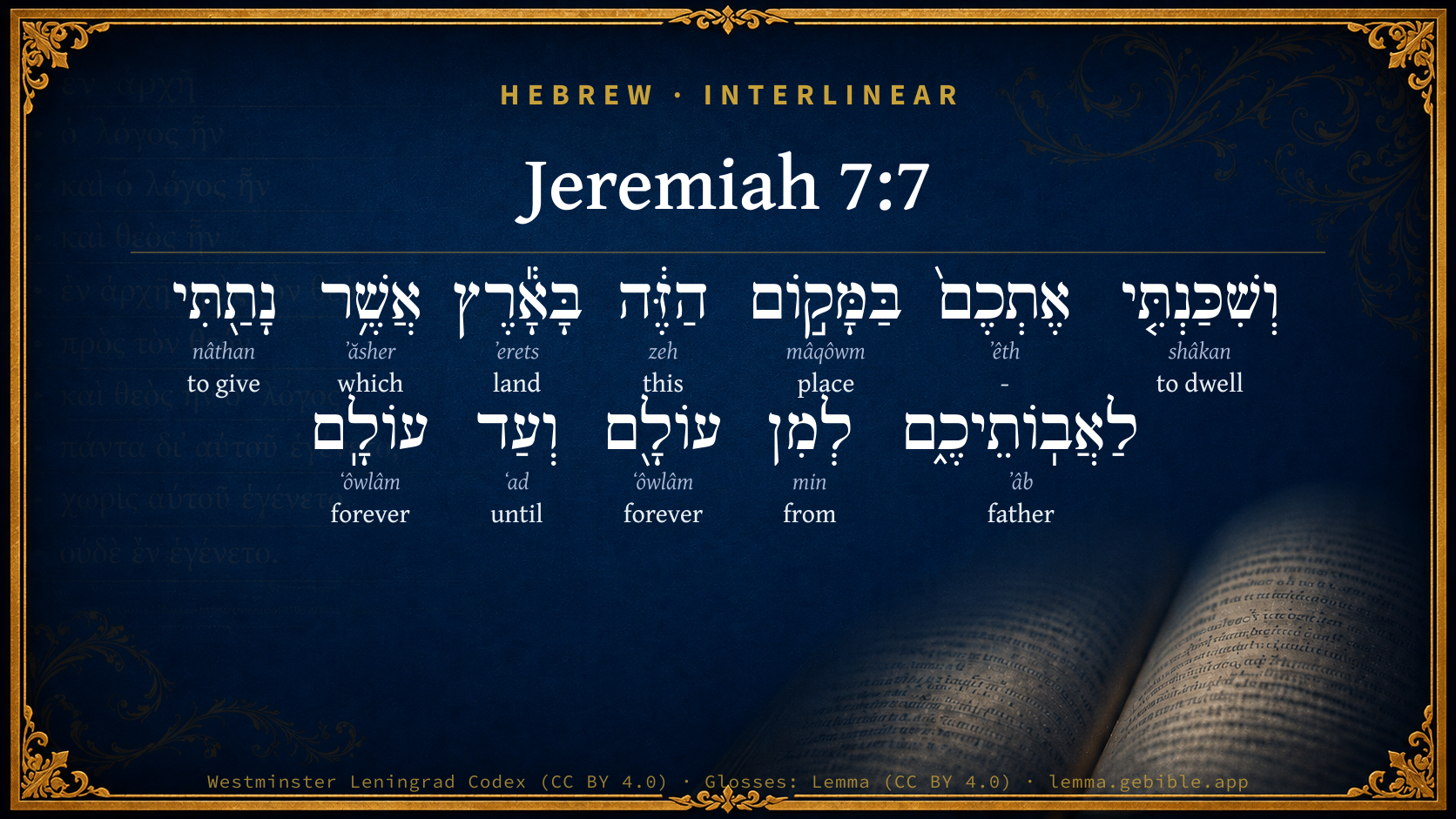
Jeremiah 7:7

Hebrew (Westminster Leningrad Codex) Jeremiah 7:7 appears in the Hebrew Old Testament. The text above is from the Westminster Leningrad Codex. Each word links to its Strong’s number, a concise gloss, and parsing drawn from the Open Scriptures Hebrew Bible morphology. Click any word for its full Brown-Driver-Briggs (BDB) entry.
Download image
Cite this verse

Jeremiah 7:7 (World English Bible). Public Domain. Lemma interlinear Bible study tool, https://lemma.gebible.app/v/jeremiah/7/7.

Show BibTeX & RIS
BibTeX
RIS
English Translation
then will I cause you to dwell in this place, in the land that I gave to your fathers, from of old even forevermore.
World English Bible · Public Domain
Download a study sheet

One document with this verse’s original text, its word-by-word gloss line, the meaning frame, cross-references with their text, attributed commentary, and full source and license credits — printable, and it pastes into notes with its structure intact.

This verse Autodidact and up

Study sheet (.html) Plain text (.txt)

A passage Seminary Student

Up to 50 verses in one chapter. A passage sheet keeps up to 6 commentary sources and 12 cross-references per verse, in the order this page ranks them, and says so on the sheet whenever that leaves anything out. Ask for a single verse and you get the Autodidact verse sheet above.

Everything on this page stays free to read, with no account — the sheet is a download of what is already on screen, not access to it.

Want to remove ads? Support Godless Engineer
Compare translations 3

The same verse in 3 English versions, stacked beneath the original-language interlinear above. Click any original word for its lexicon entry.

Each is an independent rendering of the whole verse — the interlinear is not word-aligned to these translations.

Highlighted words mark where these versions differ — a whole-verse word diff, not a word-by-word alignment.

  • World English Bible Public Domain
    then will I cause you to dwell in this place, in the land that I gave to your fathers, from of old even forevermore.
  • King James Version Public Domain
    Then will I cause you to dwell in this place, in the land that I gave to your fathers, for ever and ever.
  • unfoldingWord Literal Text CC BY-SA 4.0
    then I will cause you to dwell in this place, in the land that I gave to your fathers from ancient times and to eternity.

unfoldingWord Literal Text — © unfoldingWord, licensed CC BY-SA 4.0. Word-aligned USFM3 via Door43 (git.door43.org/unfoldingWord/en_ult).

Versions to compare (up to 4)

3 of 4 selected

Show all 18 translations

Every available English version of this verse, each an independent rendering of the whole verse.

  • World English Bible Public Domain
    then will I cause you to dwell in this place, in the land that I gave to your fathers, from of old even forevermore.
  • Berean Standard Bible Public Domain
    then I will let you live in this place, in the land that I gave to your fathers forever and ever.
  • Majority Standard Bible Public Domain
    then I will let you live in this place, in the land that I gave to your fathers forever and ever.
  • King James Version Public Domain
    Then will I cause you to dwell in this place, in the land that I gave to your fathers, for ever and ever.
  • American Standard Version (1901) Public Domain
    then will I cause you to dwell in this place, in the land that I gave to your fathers, from of old even for evermore.
  • Revised Version (1885) Public Domain
    then will I cause you to dwell in this place, in the land that I gave to your fathers, from of old even for evermore.
  • Geneva Bible (1599) Public Domain
    Then will I let you dwell in this place in the lande that I gaue vnto your fathers, for euer and euer.
  • Douay-Rheims (1899) Public Domain
    I will dwell with you in this place: in the land, which I gave to your fathers from the beginning and for evermore.
  • Young's Literal Translation Public Domain
    Then I have caused you to dwell in this place, In the land that I gave to your fathers, From age even unto age.
  • Literal Standard Version CC BY-SA 4.0
    Then I have caused you to dwell in this place, || In the land that I gave to your fathers, || From age even to age.
  • Unlocked Literal Bible CC BY-SA 4.0
    then I will let you stay in this place, in the land that I gave to your ancestors from ancient times and forever.
  • unfoldingWord Literal Text CC BY-SA 4.0
    then I will cause you to dwell in this place, in the land that I gave to your fathers from ancient times and to eternity.
  • Darby Bible Public Domain
    then will I cause you to dwell in this place, in the land that I gave to your fathers from of old even for ever.
  • World Messianic Bible Public Domain
    then I will cause you to dwell in this place, in the land that I gave to your fathers, from of old even forever more.
  • Webster's Bible Public Domain
    Then will I cause you to dwell in this place, in the land that I gave to your fathers, for ever and ever.
  • Free Bible Version CC BY-SA 4.0
    then I'll let you go on living here in the country that I gave to your forefathers forever and ever.
  • Bible in Basic English Public Domain
    Then I will let you go on living in this place, in the land which I gave to your fathers in the past and for ever.
  • JPS Tanakh (1917) Public Domain
    then will I cause you to dwell in this place, in the land that I gave to your fathers, for ever and ever.

Literal Standard Version (2020), Covenant Press — licensed CC BY-SA 4.0. Text via the HelloAO Bible API (eBible.org). Unlocked Literal Bible (unfoldingWord) — licensed CC BY-SA 4.0. Text via the HelloAO Bible API (eBible.org). unfoldingWord Literal Text — © unfoldingWord, licensed CC BY-SA 4.0. Word-aligned USFM3 via Door43 (git.door43.org/unfoldingWord/en_ult). Free Bible Version, Dr. Jonathan Gallagher — licensed CC BY-SA 4.0. Text via the HelloAO Bible API (eBible.org).

Word by word

More ways to search: Search by grammar → Find every occurrence → Compare this word →

Practice this passage: Drill this verse → Learn its vocabulary →

וְשִׁכַּנְתִּ֤י
shâkan
H7931
“and · to dwell”
Conjunction + Verb, Piel, Sequential Perfect, 1st Person, Common, Singular
Part of Speech
Conjunction + Verb
Stem
Piel
Form
Sequential Perfect
Person
1st Person
Gender
Common
Number
Singular
Full BDB Definition

Origin: a primitive root [apparently akin (by transmission) to H7901 through the idea of lodging]

TWOT: 2387

to settle down, abide, dwell, tabernacle, reside - (Qal) - to settle down to abide - to abide, dwell, reside - (Piel) - to make settle down, establish - to make or cause to dwell - (Hiphil) - to lay, place, set, establish, settle, fix - to cause to dwell or abide
  1. אֶתְכֶם֙ ʼêth H853 “- · you” Particle, Direct Object + Suffix, Personal, 2nd Person, Masculine, Plural
  2. בַּמָּק֣וֹם mâqôwm H4725 “in/at the · place” Preposition, Determined + Noun, Common, Masculine, Singular, Absolute
  3. הַזֶּ֔ה zeh H2088 “the · this” Particle, Definite Article + Pronoun, Demonstrative, Masculine, Singular
  4. בָּאָ֕רֶץ ʼerets H776 “in/at the · land” Preposition, Determined + Noun, Common, Both, Singular, Absolute
  5. אֲשֶׁ֥ר ʼăsher H834 “which” Particle, Relative
  6. נָתַ֖תִּי nâthan H5414 “to give” Verb, Qal, Perfect, 1st Person, Common, Singular
  7. לַאֲבֽוֹתֵיכֶ֑ם ʼâb H1 “to/for · fathers · your” Preposition + Noun, Common, Masculine, Plural, Construct + Suffix, Personal, 2nd Person, Masculine, Plural
  8. לְמִן min H4480 “to/for · from” Preposition + Preposition
  9. עוֹלָ֖ם ʻôwlâm H5769 “forever” Noun, Common, Masculine, Singular, Absolute
  10. וְעַד ʻad H5704 “and · until” Conjunction + Preposition
  11. עוֹלָֽם ʻôwlâm H5769 “forever” Noun, Common, Masculine, Singular, Absolute

About this verse

These counts appear in no published source. They are computed here, from the morphology-tagged text and Lemma’s own curated glosses. What Lemma adds →

12
words
11
distinct lemmas
Prophets
section

Grammatical profile

  • 2 verbs
  • 5 nouns
  • 1 pronoun
  • 2 prepositions
  • 2 particles

Verb forms

  • וְשִׁכַּנְתִּ֤י Piel · Sequential Perfect
  • נָתַ֖תִּי Qal · Perfect

Repetition

A word recurs within this verse — often emphatic in Hebrew:

  • עוֹלָ֖ם forever H5769 ×2

Hebrew & Septuagint length

In the original languages it is 12 Hebrew tokens and 19 Greek tokens — but the two are counted differently (Hebrew bundles its prefixes and suffixes into one token; the Greek is in lemma form), so that isn’t a like-for-like length.

Cross-references

6

Topical passages linked to Jeremiah 7:7 in the Treasury of Scripture Knowledge — connected by theme and wording, ordered by reader-vote popularity; previews shown in the World English Bible.

  • Deuteronomy 4:40 You shall keep his statutes, and his commandments, which I command you this day, that it may go well with you, and with your children after you, and that you may prolong your days in the land, which Yahweh your God gives you, forever.
  • Jeremiah 25:5 saying, Return you now everyone from his evil way, and from the evil of your doings, and dwell in the land that Yahweh has given to you and to your fathers, from of old and even forevermore;
  • Jeremiah 3:18 In those days the house of Judah shall walk with the house of Israel, and they shall come together out of the land of the north to the land that I gave for an inheritance to your fathers.
  • Jeremiah 18:7–8 At what instant I shall speak concerning a nation, and concerning a kingdom, to pluck up and to break down and to destroy it;
  • 2 Chronicles 33:8 neither will I any more remove the foot of Israel from off the land which I have appointed for your fathers, if only they will observe to do all that I have commanded them, even all the law and the statutes and the ordinances [given] by Moses.
  • Jeremiah 17:20–27 and tell them, Hear you the word of Yahweh, you kings of Judah, and all Judah, and all the inhabitants of Jerusalem, that enter in by these gates:

Cross-references courtesy of OpenBible.info (CC BY 4.0).

Hebrew and Greek witnesses Masoretic Hebrew ↔ Greek Septuagint

The same verse in the two great witnesses to the Old Testament, shown verse-for-verse.

These are two independent witnesses, not word-aligned to each other, and the Septuagint is shown in lemma (dictionary) form.

Hebrew Jeremiah 7:7 Masoretic · Westminster Leningrad Codex

וְשִׁכַּנְתִּ֤י אֶתְכֶם֙ בַּמָּק֣וֹם הַזֶּ֔ה בָּאָ֕רֶץ אֲשֶׁ֥ר נָתַ֖תִּי לַאֲבֽוֹתֵיכֶ֑ם לְמִן עוֹלָ֖ם וְעַד עוֹלָֽם

then will I cause you to dwell in this place, in the land that I gave to your fathers, from of old even forevermore.

World English Bible · Public Domain

Greek LXX Structure differs

In the Septuagint, Jeremiah is about an eighth shorter than the Hebrew and arranges its material differently — the Oracles Against the Nations (Hebrew chapters 46–51) appear in the middle of the Greek book, after 25:13. Because the chapter and verse boundaries do not line up, a verse-for-verse comparison with the Hebrew is not shown.

A verse-for-verse comparison isn’t shown here because the chapters and verses don’t line up. Switch to the LXX edition with the MT / LXX toggle above to read the Greek directly.

On this verse, Haydock's Catholic Bible Commentary discusses the Septuagint’s reading. Read the note in Commentary ↓

Hebrew: Westminster Leningrad Codex (CC BY 4.0). Greek: Septuagint (public domain); English from a public-domain English Septuagint. How the Septuagint differs from the Hebrew →

Targum (Aramaic paraphrase)

1

The Targum is the ancient Jewish Aramaic paraphrase of the Hebrew Scriptures — an interpretive translation, not the Hebrew text itself. Onkelos (literal) and Pseudo-Jonathan (expansive) render the Torah, and Jonathan the Prophets. Coverage is partial: where no permissively-licensed English translation exists for a verse, only the Aramaic is shown. This is verse-level text, not a word-by-word alignment to the Hebrew.

  1. Targum Jonathan Prophets (Joshua–Malachi)
    וְאַשְׁרֵי יַתְכוֹן בְּאַתְרָא הָדֵין בְּאַרְעָא דִיהָבִית לַאֲבָהַתְכוֹן לְמִן עַלְמָא וְעַד עַלְמָא:

    (no public-domain English translation for this verse)

    Targum Jonathan — Aramaic: “Mikraot Gedolot” (public domain). English: “Sefaria Community Translation” (CC0 1.0 (public-domain dedication)); “London "Chaldee Paraphrase," 1871” (public domain). Text via Sefaria.

Commentary

Notes on Jeremiah 7:7 from classic Christian and Jewish commentators (each source and its license shown beneath its notes). The classic Christian expositions comment on the surrounding passage and are grouped to its opening verse, so a note may address several verses; the Jewish commentaries on the Tanakh (Rashi and others) are per-verse, so they appear only where the commentator wrote on this verse.

Lemma curates 59 commentaries, every one of them public domain or Creative Commons licensed, each selected and text-cleaned for this edition rather than reprinted as found. About our sources →

Trapp's Complete Commentary

John Trapp

Jer 7:7 Then will I cause you to dwell in this place, in the land that I gave to your fathers, for ever and ever.

Ver. 7. Then will I cause you to dwell in this place.] Not else. God’s promises are with a condition, which is as an oar in a boat or stern of a ship, and turns the promise another way.

John Trapp, A Commentary or Exposition upon All the Books of the Old and New Testament (1647–1656) — public domain. Text from a community e-Sword module.

Geneva Bible (1599)

Geneva Bible translators

God showeth on what condition he made his promise to this Temple: that they should be an holy people unto him, as he would be a faithful God to them.

Geneva Bible (1599) marginal notes — public domain. Text via Bolls.life.

Jamieson, Fausset & Brown

Robert Jamieson, A. R. Fausset & David Brown

The apodosis to the "if . . . if" (Jer 7:5-6).

to dwell--to continue to dwell.

for ever and ever--joined with "to dwell," not with the words "gave to your fathers" (compare Jer 3:18; Deu 4:40).

Jamieson, Fausset & Brown — Commentary Critical and Explanatory on the Whole Bible (1871) — public domain (CC PDM 1.0). Text via the HelloAO Bible API.

John Calvin's Commentaries

Then follows the latter part, Then I will make you to dwell, etc. God sets this clause in opposition to the false confidence of the people, as though he had said, “Ye wish me to be propitious to you; but mock me not by offering sacrifices without sincerity of heart, without a devout feeling; be consistent; and think not that I am pacified by you, when ye come to the Temple with empty display, and pollute your sacrifices with impure hands. I therefore do not allow this state of things; but if ye come on the condition of returning into favor with me, then I will make you to dwell in this place and in the land which I gave to your fathers.” The last part of the verse, from age to age, ought to be connected with the verb, “I will make you to dwell, “שכנתי, shekanti, “I will make you to dwell from age to age, “that is, As your fathers dwelt formerly in this land, so shall you remain quiet in the same, and there shall be to you a peaceable possession; but not in any other place. We must bear in mind the contrast which I noticed yesterday; for he indirectly denounces exile on the Jews, because they had contaminated the land by their vices, and gloried only in their sacrifices. It now follows —

John Calvin's Commentaries (1540-1563) — public domain. Text from the Calvin Translation Society English edition (1840s-50s) via the Christian Classics Ethereal Library (ccel.org). Calvin's coverage is partial (roughly two-thirds of the Bible); uncommented books and verses are honest gaps, never fabricated. The 19th-century editor's footnotes and remarks are omitted so the notes are faithfully Calvin's own voice.

Ellicott's Commentary for English Readers

(7) For ever and ever.—Literally, from eternity to eternity, or, perhaps, from age to age. The English punctuation connects these words with “I will cause you to dwell,” but the accentuation of the Hebrew with “I gave to your fathers;” the gift was to have been in perpetuity (Gen_17:8), but the guilt of the people had brought about its forfeiture.

A Bible Commentary for English Readers, edited by Charles John Ellicott (1878–1897) — public domain. Text from a community e-Sword module.

John Gill's Exposition

Then will I cause you to dwell in this place,.... In the land of Judea, and not suffer them to be carried captive, which they had been threatened with, and had reason to expect, should they continue in their sins, in their impenitence and vain confidence:

in the land that I gave to your fathers; to Abraham, Isaac, and Jacob, by promise; and to the Jewish fathers in the times of Joshua, by putting them in actual possession of it:

for ever and ever: for a great while; a long time, as Kimchi explains it; from the days of Abraham for ever, even all the days of the world, provided they and their children walked in the ways of the Lord. This clause may either be connected with the word "dwell", or with the word give; and the sense is, either that they should dwell in it for ever and ever; or it was given to their fathers for ever and ever.

John Gill's Exposition of the Whole Bible (1746–1763) — public domain (CC PDM 1.0). Text via the HelloAO Bible API.

Haydock's Catholic Bible Commentary

Dwell. Hebrew and Septuagint as [in] ver. 3. (Haydock)

George Leo Haydock (1774–1849), Haydock's Catholic Family Bible and Commentary, 1859 edition — public domain. Excludes Psalms (Douay-Rheims chapter numbering differs from Protestant) and Deuterocanonical books (Catholic canon only).

Matthew Poole's English Annotations

Then, i.e. upon this condition, that you will return unto me, then either I will establish and fix you in the land; or, as anciently read, sachanti in kal, I will dwell, viz. amongst you in this place, otherwise not.

In this place, viz. Judea, both in Jerusalem and the whole country, as the next words manifest.

For ever and ever, i.e. from age to age, as your fathers did before you from the days of Joshua until now.

Matthew Poole's English Annotations on the Holy Bible (1683–1685) — public domain. Text from a community e-Sword/MySword module.

The Pulpit Commentary

Forever and ever. It is doubtful, both here and in Jer_25:5, whether these words should be joined to "gave" or "cause you to dwell." Still, the latter connection is both in itself the more probable one, and that suggested first of all by the accentuation (this, however, is not here decisive). It was not the extent of the original premise, but that of the enjoyment of the gift, which was in question. A more exact rendering of the prophet"s formula is that of the Septuagint ex aiwnov kai ewv aiwnov : i.e. from the most remote antiquity to the most distant future.

The Pulpit Commentary (1880–1919), ed. H.D.M. Spence-Jones & Joseph S. Exell — public domain. Text from a community e-Sword module.

Lesson kit

Teaching starters — assembled from the data on this page, not authored interpretation. Every prompt links to the verse data it draws on. Edit before teaching.

Jeremiah, in the Prophets, opens this verse with 12 words (11 distinct Hebrew lemmas). Its most distinctive word is shâkan (“to dwell”). A historical commentator’s framing appears above. Read the whole chapter for the surrounding context.

Discussion questions

  1. What does “to dwell” (shâkan) contribute to the verse as a whole?
  2. How does Deuteronomy 4:40, which shares this passage’s theme, read alongside this verse?
  3. What does the repetition of “forever” (2× in this one verse) do in this verse?
  4. These translations render this verse differently. What is at stake in choosing one wording over another?
  5. «וְשִׁכַּנְתִּ֤י» is a Piel Sequential Perfect verb. How does that grammatical form shape the action described?
  6. Compare how Trapp's Complete Commentary and Geneva Bible (1599) read this verse. Where do they agree or differ?

Things to notice

Reading settings

Reading text

Shown beneath each verse's original-language words.

Old Testament
Old Testament edition

Read the OT as the Masoretic Hebrew (MT) or the Greek Septuagint (LXX).

English shown for the Greek Septuagint (in the Hebrew ↔ Greek comparison).

Comparing translations? Open the Compare panel on any verse page to stack up to four side by side.