
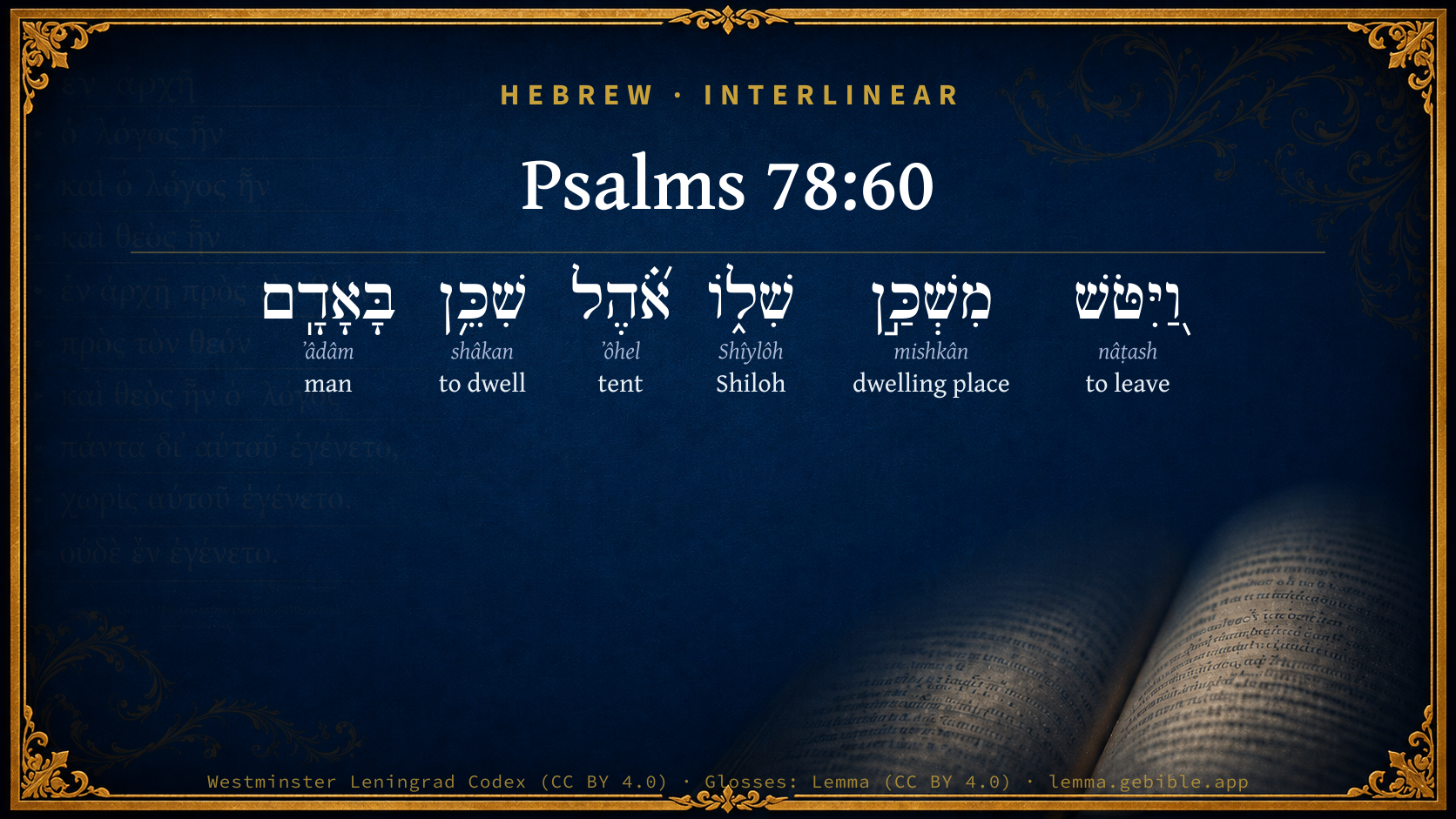
Psalms 78:60

Hebrew (Westminster Leningrad Codex) Psalms 78:60 appears in the Hebrew Old Testament. The text above is from the Westminster Leningrad Codex. Each word links to its Strong’s number, a concise gloss, and parsing drawn from the Open Scriptures Hebrew Bible morphology. Click any word for its full Brown-Driver-Briggs (BDB) entry.
Download image
Cite this verse

Psalms 78:60 (World English Bible). Public Domain. Lemma interlinear Bible study tool, https://lemma.gebible.app/v/psalms/78/60.

Show BibTeX & RIS
BibTeX
RIS
English Translation
So that he forsook the tent of Shiloh, The tent which he placed among men;
World English Bible · Public Domain
Download a study sheet

One document with this verse’s original text, its word-by-word gloss line, the meaning frame, cross-references with their text, attributed commentary, and full source and license credits — printable, and it pastes into notes with its structure intact.

This verse Autodidact and up

Study sheet (.html) Plain text (.txt)

A passage Seminary Student

Up to 50 verses in one chapter. A passage sheet keeps up to 6 commentary sources and 12 cross-references per verse, in the order this page ranks them, and says so on the sheet whenever that leaves anything out. Ask for a single verse and you get the Autodidact verse sheet above.

Everything on this page stays free to read, with no account — the sheet is a download of what is already on screen, not access to it.

Want to remove ads? Support Godless Engineer
Compare translations 3

The same verse in 3 English versions, stacked beneath the original-language interlinear above. Click any original word for its lexicon entry.

Each is an independent rendering of the whole verse — the interlinear is not word-aligned to these translations.

Highlighted words mark where these versions differ — a whole-verse word diff, not a word-by-word alignment.

  • World English Bible Public Domain
    So that he forsook the tent of Shiloh, The tent which he placed among men;
  • King James Version Public Domain
    So that he forsook the tabernacle of Shiloh, the tent which he placed among men;
  • unfoldingWord Literal Text CC BY-SA 4.0
    And he abandoned the dwelling of Shiloh, the tent he had dwelt among mankind.

unfoldingWord Literal Text — © unfoldingWord, licensed CC BY-SA 4.0. Word-aligned USFM3 via Door43 (git.door43.org/unfoldingWord/en_ult).

Versions to compare (up to 4)

3 of 4 selected

Show all 18 translations

Every available English version of this verse, each an independent rendering of the whole verse.

  • World English Bible Public Domain
    So that he forsook the tent of Shiloh, The tent which he placed among men;
  • Berean Standard Bible Public Domain
    He abandoned the tabernacle of Shiloh, the tent He had pitched among men.
  • Majority Standard Bible Public Domain
    He abandoned the tabernacle of Shiloh, the tent He had pitched among men.
  • King James Version Public Domain
    So that he forsook the tabernacle of Shiloh, the tent which he placed among men;
  • American Standard Version (1901) Public Domain
    So that he forsook the tabernacle of Shiloh, The tent which he placed among men;
  • Revised Version (1885) Public Domain
    So that he forsook the tabernacle of Shiloh, the tent which he placed among men;
  • Geneva Bible (1599) Public Domain
    So that hee forsooke the habitation of Shilo, euen the Tabernacle where hee dwelt among men,
  • Douay-Rheims (1899) Public Domain
    And he put away the tabernacle of Silo, his tabernacle where he dwelt among men.
  • Young's Literal Translation Public Domain
    And He leaveth the tabernacle of Shiloh, The tent He had placed among men,
  • Literal Standard Version CC BY-SA 4.0
    And He leaves the Dwelling Place of Shiloh, || The tent He had placed among men,
  • Unlocked Literal Bible CC BY-SA 4.0
    He abandoned the sanctuary of Shiloh, the tent where he had lived among people.
  • unfoldingWord Literal Text CC BY-SA 4.0
    And he abandoned the dwelling of Shiloh, the tent he had dwelt among mankind.
  • Darby Bible Public Domain
    And he forsook the tabernacle at Shiloh, the tent where he had dwelt among men,
  • World Messianic Bible Public Domain
    so that he abandoned the tent of Shiloh, the tent which he placed among men,
  • Webster's Bible Public Domain
    So that he forsook the tabernacle of Shiloh, the tent which he placed among men;
  • Free Bible Version CC BY-SA 4.0
    He abandoned his place at Shiloh, the Tabernacle where he lived among the people.
  • Bible in Basic English Public Domain
    So that he went away from the holy place in Shiloh, the tent which he had put among men;
  • JPS Tanakh (1917) Public Domain
    And He forsook the tabernacle of Shiloh, the tent which He had made to dwell among men;

Literal Standard Version (2020), Covenant Press — licensed CC BY-SA 4.0. Text via the HelloAO Bible API (eBible.org). Unlocked Literal Bible (unfoldingWord) — licensed CC BY-SA 4.0. Text via the HelloAO Bible API (eBible.org). unfoldingWord Literal Text — © unfoldingWord, licensed CC BY-SA 4.0. Word-aligned USFM3 via Door43 (git.door43.org/unfoldingWord/en_ult). Free Bible Version, Dr. Jonathan Gallagher — licensed CC BY-SA 4.0. Text via the HelloAO Bible API (eBible.org).

Word by word

More ways to search: Search by grammar → Find every occurrence → Compare this word →

Practice this passage: Drill this verse → Learn its vocabulary →

About this verse

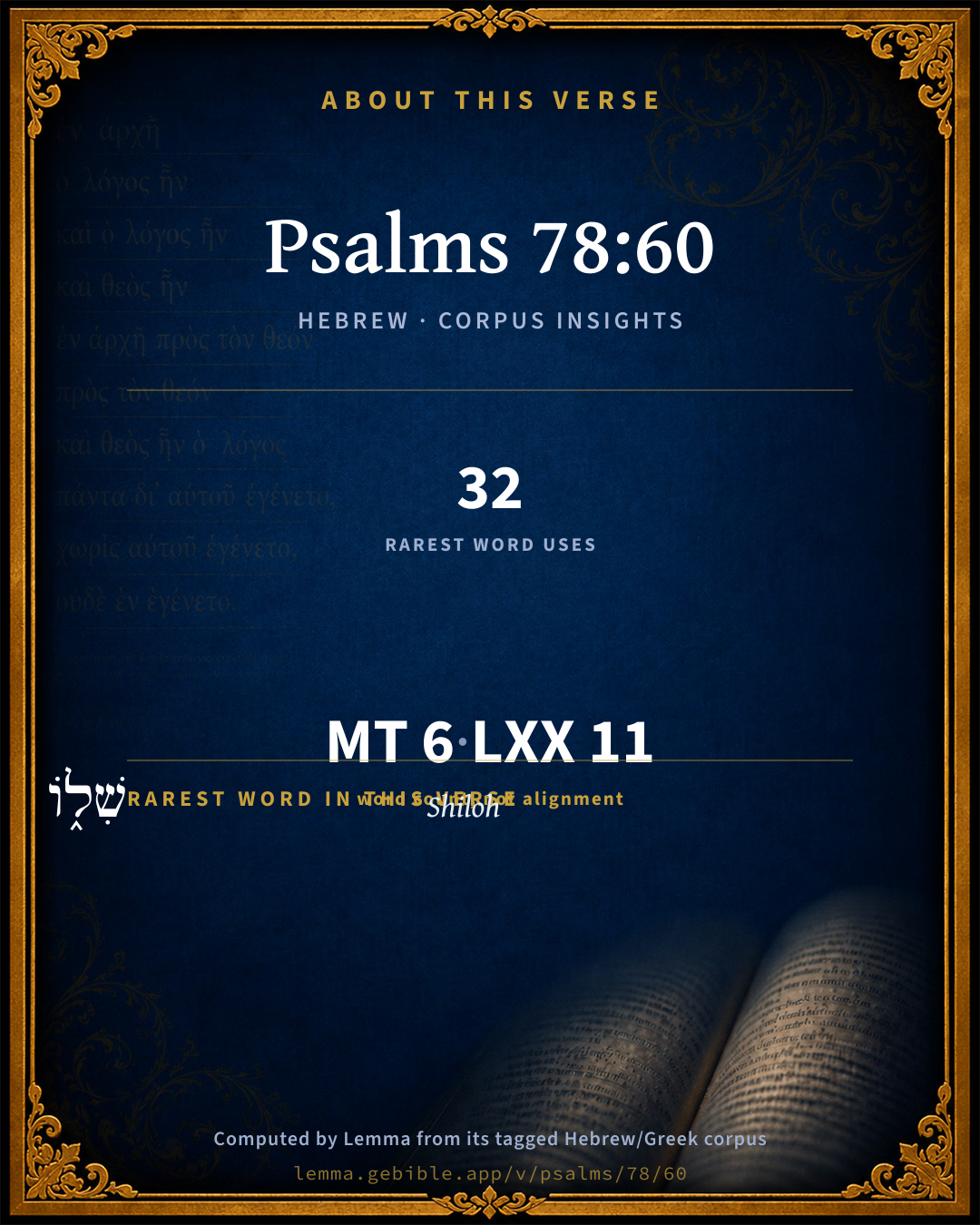
These counts appear in no published source. They are computed here, from the morphology-tagged text and Lemma’s own curated glosses. What Lemma adds →

6
words
6
distinct lemmas
Wisdom
section

Shared distinctive vocabulary

שִׁל֑וֹ Shiloh H7887 occurs in 30 verses of the Hebrew Bible. Also found in:

Grammatical profile

  • 2 verbs
  • 4 nouns

Verb forms

  • וַ֭יִּטֹּשׁ Qal · Sequential Imperfect
  • שִׁכֵּ֥ן Piel · Perfect

Hebrew & Septuagint length

In English translation the verse runs 15 words from the Hebrew and 14 from the Septuagint (LXX English) — closely comparable.

A rough comparison of the two English renderings, which tokenize alike — not a word-level alignment.

Word counts can differ between the Hebrew and the Greek without any difference in meaning — e.g. the Hebrew direct-object marker אֵת has no separate Greek word, and Greek often adds the article ὁ.

In the original languages it is 6 Hebrew tokens and 11 Greek tokens — but the two are counted differently (Hebrew bundles its prefixes and suffixes into one token; the Greek is in lemma form), so that isn’t a like-for-like length.

Cross-references

5

Topical passages linked to Psalms 78:60 in the Treasury of Scripture Knowledge — connected by theme and wording, ordered by reader-vote popularity; previews shown in the World English Bible.

  • Joshua 18:1 The whole congregation of the children of Israel assembled themselves together at Shiloh, and set up the tent of meeting there: and the land was subdued before them.
  • 1 Samuel 4:4–11 So the people sent to Shiloh; and they brought from there the ark of the covenant of Yahweh of Hosts, who sits [above] the cherubim: and the two sons of Eli, Hophni and Phinehas, were there with the ark of the covenant of God.
  • Jeremiah 26:6–9 then will I make this house like Shiloh, and will make this city a curse to all the nations of the earth.
  • 1 Samuel 1:3 This man went up out of his city from year to year to worship and to sacrifice to Yahweh of Hosts in Shiloh. The two sons of Eli, Hophni and Phinehas, priests to Yahweh, were there.
  • Jeremiah 7:12–14 But go you now to my place which was in Shiloh, where I caused my name to dwell at the first, and see what I did to it for the wickedness of my people Israel.

Cross-references courtesy of OpenBible.info (CC BY 4.0).

Hebrew and Greek witnesses Masoretic Hebrew ↔ Greek Septuagint

The same verse in the two great witnesses to the Old Testament, shown verse-for-verse.

You’re reading Greek Psalm 77 (Hebrew Psalm 78). The Septuagint counts the superscription, so verse numbers can differ from the Hebrew — chapter-level alignment, not verse-by-verse. Numbering follows Rahlfs.

These are two independent witnesses, not word-aligned to each other, and the Septuagint is shown in lemma (dictionary) form.

Hebrew Psalms 78:60 Masoretic · Westminster Leningrad Codex

וַ֭יִּטֹּשׁ מִשְׁכַּ֣ן שִׁל֑וֹ אֹ֝֗הֶל שִׁכֵּ֥ן בָּאָדָֽם

So that he forsook the tent of Shiloh, The tent which he placed among men;

World English Bible · Public Domain

Greek LXX Greek Psalm 77:60 Septuagint · lemma form

καί ἀποὠθέω ὁ σκηνή σηλωμ σκήνωμα αὐτός ὅς κατασκηνόω ἐν ἄνθρωπος

And he rejected the tabernacle of Selom, his tent where he lived among men.

LXX2012 (modern English Septuagint) · Public Domain

On this verse, Keil & Delitzsch discusses the Septuagint’s reading. Read the note in Commentary ↓

Hebrew: Westminster Leningrad Codex (CC BY 4.0). Greek: Septuagint (public domain); English from LXX2012 (modern English Septuagint) (Public Domain). How the Septuagint differs from the Hebrew →

Commentary

Notes on Psalms 78:60 from classic Christian and Jewish commentators (each source and its license shown beneath its notes). The classic Christian expositions comment on the surrounding passage and are grouped to its opening verse, so a note may address several verses; the Jewish commentaries on the Tanakh (Rashi and others) are per-verse, so they appear only where the commentator wrote on this verse.

Lemma curates 59 commentaries, every one of them public domain or Creative Commons licensed, each selected and text-cleaned for this edition rather than reprinted as found. About our sources →

Trapp's Complete Commentary

John Trapp

Psa 78:60 So that he forsook the tabernacle of Shiloh, the tent [which] he placed among men;

Ver. 60. So that he forsook the tabernacle of Shiloh] Whither it had been brought from Gilgal, and where it had rested a long while, but was forsaken of God when once idolized, 1Sa 4:3-5

The tent which he placed among men.] Which was a very great condescension, Isa 66:1. Confer Joh 1:14 Pro 8:31.

John Trapp, A Commentary or Exposition upon All the Books of the Old and New Testament (1647–1656) — public domain. Text from a community e-Sword module.

Joseph Benson's Commentary

Psa 78:60-61. So he forsook the tabernacle of Shiloh — The tabernacle which then was placed in Shiloh, from whence, as the Israelites fetched the ark, so God withdrew himself. This relates to that part of the Jewish history which is recorded 1 Samuel 4. For upon the Israelites sending for the ark of God, from the tabernacle in which it was deposited in Shiloh, God suffered the Philistines to smite them, and to take the ark. And so true it is, that he forsook the tabernacle of Shiloh, that he never returned to it again. The tent which he placed among men — Whereby he insinuates both God’s wonderful condescension and favour to such worthless and wretched creatures; and their stupendous folly and wickedness, in despising and sinning away so glorious a privilege. And delivered his strength — Namely, the ark, called God’s strength, (1Ch 16:11,) and the ark of his strength, (Psa 132:8,) because it was the sign and pledge of his strength and power exerted in behalf of his people; and his glory — So the ark is called, as being the monument and seat of God’s glorious presence, and an instrument of his glorious works; into the enemy’s — Namely, the Philistines’ hand, or power.

Joseph Benson's Commentary on the Old and New Testaments (1811–1818) — public domain. Text from a community e-Sword module.

J. A. Alexander on Psalms

Joseph Addison Alexander

60. (Psa 78:60) And forsook the dwelling-place of Shilo, the tent (which) he caused to dwell among men. The punishment of Ephraim, not as the sole offender, but as the unfaithful leader of the chosen people, consisted in the transfer of the sanctuary, and the manifested presence of God in it, to the tribe which was intended from the first to have that honour (Gen 49:10), but whose rights had been held in abeyance during the experimental chieftainship of Ephraim. The ark, after it was taken by the Philistines (1Sa 4:17), never returned to Shiloh, but was deposited successively at Nob (1Sa 21:2) and at Gibeon (1Ki 3:4), until David pitched a tabernacle for it on mount Zion (2 Chron. xv. 1). See above, on Psa 24:1. Caused to dwell is an expression used in the very same connection in the history. See Jos 18:1, and compare Deu 12:11, where the sanctuary is described as the place in which God caused his name to dwell. Among men implies that this was his only earthly residence, and hints at the true meaning of the sanctuary, as propounded in the law (Exo 25:8).

Joseph Addison Alexander, The Psalms Translated and Explained (1850) — public domain. Text from a community e-Sword module.

Tyndale Open Study Notes

Tyndale Open Resources

78:60 God abandoned his dwelling at Shiloh because of the people’s idol worship (1 Sam 4:11; Jer 7:12).

Tyndale Open Study Notes — © Tyndale Open Resources, licensed CC BY-SA 4.0. Text via the HelloAO Bible API.

Geneva Bible (1599)

Geneva Bible translators

For their ingratitude he suffered the Philistines to take the Ark, which was the sign of his presence, from among them.

Geneva Bible (1599) marginal notes — public domain. Text via Bolls.life.

Adam Clarke's Commentary

Verse 60. He forsook the tabernacle of Shiloh] The Lord, offended with the people, and principally with the priests, who had profaned his holy worship, gave up his ark into the hands of the Philistines. And so true it is that he forsook the tabernacle of Shiloh, that he never returned to it again. See 1Sa 6:1; 2Sa 6:2-17; 1Kg 8:1; where the several removals of the ark are spoken of, and which explain the remaining part of this Psalm. Because God suffered the Philistines to take the ark, it is said, Ps 78:61: "He delivered his strength into captivity, and his glory into the enemy's hand;" and Ps 78:67, that "he refused the tabernacle of Joseph, and chose not the tribe of Ephraim;" for Shiloh was in the tribe of Ephraim the son of Joseph; and God did not suffer his ark to return thither, but to go to Kirjath-jearim, which was in the tribe of Benjamin; from thence to the house of Obed-edom: and so to Zion in the tribe of Judah, as it follows, Ps 78:68.

The tabernacle which Moses had constructed in the wilderness remained at Shiloh even after the ark was taken by the Philistines and afterwards sent to Kirjath-jearim. From Shiloh it was transported to Nob; afterwards to Gibeon, apparently under the reign of Saul; and it was there at the commencement of Solomon's reign, for this prince went thither to offer sacrifices, 1Kg 3:4. From the time in which the temple was built, we know not what became of the tabernacle of Moses: it was probably laid up in some of the chambers of the temple. See Calmet.

Adam Clarke's Commentary on the Bible (1810–1826) — public domain. Text from a community e-Sword/MySword module.

John Calvin's Commentaries

After it is said that Israel, whom God had loved so much, was become an abomination in his sight, it is added, (verse 60,) that they were bereft of the presence of God, which is the only source of true felicity and comfort under calamities of every kind. God, then, is said to have abhorred Israel, when he permitted the ark of the covenant to be carried into another country, as if he intended by this to indicate that he had departed from Judea, and bidden the people farewell. It is indeed very obvious, that God was not fixed to the outward and visible symbol; but as he had given the ark to be a token or sign of the close union which subsisted between him and the Israelites, in suffering it to be carried away, he testified, that he himself had also departed from them. Shiloh having been for a long time the abode of the ark, and the place where it was captured by the Philistines, (1 Samuel 4:11,) it is termed the habitation or dwelling-place of God. The manner of his residence, in short, is beautifully expressed in the next sentence, where Shiloh is described as his dwelling-place among men. God, it is true, fills both heaven and earth; but as we cannot attain to that infinite height to which he is exalted, in descending among us by the exercise of his power and grace, he approaches as near to us as is needful, and as our limited capacity will bear. It is a very emphatic manner of speaking to represent God as so incensed by the continual wickedness of his people, that he was constrained to forsake this place, the only one which he had chosen for himself upon the earth.

John Calvin's Commentaries (1540-1563) — public domain. Text from the Calvin Translation Society English edition (1840s-50s) via the Christian Classics Ethereal Library (ccel.org). Calvin's coverage is partial (roughly two-thirds of the Bible); uncommented books and verses are honest gaps, never fabricated. The 19th-century editor's footnotes and remarks are omitted so the notes are faithfully Calvin's own voice.

Ellicott's Commentary for English Readers

(60) Forsook.—The reference is of course to the disastrous defeat by the Philistines (1 Samuel 4). See especially Psa_78:21 in connection with glory or ornament as applied here to the Ark. For strength in the same connection see Psa_132:8.

A Bible Commentary for English Readers, edited by Charles John Ellicott (1878–1897) — public domain. Text from a community e-Sword module.

The Cambridge Bible for Schools and Colleges

gen. ed. J. J. S. Perowne

60. placed] Lit. caused to dwell. The use of this word here and in Jos_18:1 (A.V. set up) was probably suggested by its frequent use with reference to the dwelling of God among His people. Cp. Jer_7:12.

On the position and history of Shiloh see note on 1Sa_1:3.

The Cambridge Bible for Schools and Colleges (gen. ed. J. J. S. Perowne; Cambridge University Press, 1878–1918) — public domain. Text from a community e-Sword module.

John Gill's Exposition

And delivered his strength into captivity,.... That is, the ark, called his strength, and the ark of his strength, Psa 105:4, because it was a token of his strength, and by means of which he displayed it, as when the Israelites passed through Jordan into Canaan's land, and encompassed the city of Jericho; and besides, it was typical of Christ, the man of God's right hand, made strong for himself, and in whom is strength as well as righteousness for his people; now this was delivered up into the hands of the Philistines, and carried captive, Sa1 4:11. The Targum renders it, "his law", because the two tables of the law were in the ark; so Jarchi interprets it, the ark and the tables:

and his glory into the enemy's hand; which designs the same thing, the ark being the glory of God, over which upon the mercy seat the glorious majesty of the Lord was; hence Phinehas's wife, when she heard the ark was taken, fell into labour, her time being near, and brought forth a son, and called him Ichabod, saying, the glory is departed from Israel, for the ark of God is taken, Sa1 4:21.

John Gill's Exposition of the Whole Bible (1746–1763) — public domain (CC PDM 1.0). Text via the HelloAO Bible API.

Albert Barnes' Notes on the Bible

So that he forsook the tabernacle of Shiloh - The tabernacle or tent which had been erected at Shiloh. He forsook that as a place where he was to be worshipped; that is, he caused his tabernacle, or his place of worship, to be erected in another place, to wit, on Mount Zion. See Psa 78:68. The name Shiloh means properly a place of rest, and seems to have been given to this place as such a place, or as a place where the ark might abide after its migrations. Shiloh was a city within the limits of the tribe of Ephraim, on a mountain north of Bethel. Here the ark of God remained for many years after it came into the promised land. Jos 18:1; Jdg 18:31; Jdg 21:12, Jdg 21:19; 1Sa 1:3, 1Sa 1:24; 1Sa 2:14; 1Sa 4:3-4. The ark, after it was taken by the Philistines, was never returned to Shiloh, but was deposited successively at Nob 1Sa 21:1-6, and at Gibeon 1Ki 3:4, until David pitched a tabernacle for it on Mount Zion 1Ch 15:1. The meaning here is, that in consequence of the sins of the people, the place of worship was finally and forever removed from the tribe of Ephraim, within whose limits Shiloh was, to the tribe of Judah, and to Mount Zion.

The tent which he placed among men - It was the place which he selected as his abode on earth.

Albert Barnes' Notes on the Bible (1834–1885) — public domain. Text from a community e-Sword/MySword module.

Matthew Poole's English Annotations

The tabernacle of Shiloh; which then was placed in Shiloh, from whence, as the Israelites fetched the ark, so God withdrew himself.

Which he placed among men; whereby he insinuates both God’s wonderful condescension and favour to such worthless and wretched creatures, and their stupendous folly and wickedness in despising and sinning away so glorious a privilege.

Matthew Poole's English Annotations on the Holy Bible (1683–1685) — public domain. Text from a community e-Sword/MySword module.

The Treasury of David

Charles H. Spurgeon

Ver. 60. So that he forsook the tabernacle of Shiloh, the tent which he placed among men. His glory would no more reveal itself there, he left Shiloh to become a complete ruin. At the door of that tent shameless sin had been perpetrated, and all around it idols had been adored, and therefore the glory departed and Ichabod was sounded as a word of dread concerning Shiloh and the tribe of Ephraim. Thus may the candlestick be removed though the candle is not quenched. Erring churches become apostate, but a true church still remains; if Shiloh be profaned Zion is consecrated. Yet is it ever a solemn caution to all the assemblies of the saints, admonishing them to walk humbly with their God, when we read such words as those of the prophet Jeremiah in is seventh chapter, "Trust ye not in lying words, saying, The temple of the Lord, The temple of the Lord, The temple of the Lord, are these. Go ye now unto my place which was in Shiloh, where I set my name at the first, and see what I did to it for the wickedness of my people Israel." Let us take heed, lest as the ark never returned to Shiloh after its capture by the Philistines, so the gospel may be taken from us in judgment, never to be restored to the same church again.

Ver. 60. It is a heathenish delusion and false confidence to suppose that God is bound to any place or spot, as the Trojans thought because they had the temple of Pallas in their city it could not be taken, and in the present day the manner of the Papists is to bind Christ to Rome and the chair of Peter, and then defiantly maintain "I shall never be moved" Ps 10:6. For, they say, the ship of Peter may sink a little, but not altogether. Then the only point that is deficient is this, that they are not the ship of Peter, but rather an East Indiaman with a cargo of Italian apes and such like foreign merchandise, pearls, purple, silk, brass, iron, silver, gold, incense, lead, that they may carry on simony and make merchandise of religion, and deceive the whole world Re 18:11-24. Johann Andreas Cramer. 1723-1788.

Charles H. Spurgeon's The Treasury of David (1869–1885) — public domain. Psalms only. Text from a community e-Sword/MySword module.

Whedon's Commentary on the Bible

Daniel D. Whedon

60. He forsook the tabernacle of Shiloh—Read the history, 1 Samuel 4. The tabernacle had been in Shiloh for three hundred years, from the time of Joshua. Jos_18:1. It was, after the removal of the ark, taken to Nob, (1Sa_21:1-6;) thence, after the death of Samuel, to Gibeon, (1Ch_1:3-4;) whence it was transferred by Solomon to the temple. 1Ki_8:4; 2Ch_5:5. The ark was returned by the Philistines to Bethshemesh, thence to Kirjath, in Judah, and thence to Zion by David. 2 Samuel 6. Neither ark nor tabernacle ever returned to Shiloh— a blow from which the tribe of Ephraim never recovered.

Daniel D. Whedon (gen. ed.), Commentary on the Old and New Testaments (1874–1909) — public domain. Text from a community e-Sword module.

The Pulpit Commentary

So that he forsook the tabernacle of Shiloh. The "tabernacle of the congregation" was first set up under Joshua (Joshua 18) at Shiloh, a city of Ephraim, and here the national sanctuary continued throughout the period of the Judges. (Jud_1:18:31 21:19 1Sa_1:3, 24 2:14 3:21 4:4, etc.) God was regarded as having "forsaken" this sanctuary, when he allowed the ark of the covenant, its chief treasure, to be taken. (1Sa_4:11-22) Subsequently, but at what exact time is unknown, the tabernacle was removed from Shiloh to Nob, (1Sa_21:1) and later on to Gibson. (1Ki_3:4) The tent which he pitched among men . (On the form and materials of the tabernacle, see Exo_26:1-37, and compare Mr. Fergusson"s article on the subject in Smith"s "Dictionary of the Bible," vol. 3. pp. 1451-1455)

The Pulpit Commentary (1880–1919), ed. H.D.M. Spence-Jones & Joseph S. Exell — public domain. Text from a community e-Sword module.

John Wesley's Explanatory Notes

Shiloh - Which was placed in Shiloh. Among men - Whereby he insinuates both God's wonderful condescension, and their stupendous folly in despising so glorious a privilege.

John Wesley, Explanatory Notes Upon the Whole Bible (1754–1765) — public domain. Text via the GEBible commentary corpus.

Keil & Delitzsch

C. F. Keil & F. Delitzsch

The rejection of Shiloh and of the people worshipping there, but later on, when the God of Israel is again overwhelmed by compassion, the election of Judah, and of Mount Zion, and of David, the king after His own heart. In the time of the Judges the Tabernacle was set up in Shiloh (Jos 18:1); there, consequently, was the central sanctuary of the whole people, - in the time of Eli and Samuel, as follows from Sa1 1:1, it had become a fixed temple building. When this building was destroyed is not known; according to Jdg 18:30., cf. Jer 7:12-15, it was probably not until the Assyrian period. The rejection of Shiloh, however, preceded the destruction, and practically took place simultaneously with the removal of the central sanctuary to Zion; and was, moreover, even previously decided by the fact that the Ark of the covenant, when given up again by the Philistines, was not brought back to Shiloh, but set down in Kirjath Jearm (Sa1 7:2). The attributive clause שׁכּן בּאדם uses שׁכּן as השׁכּין is used in Jos 18:1. The pointing is correct, for the words to not suffice to signify "where He dwelleth among men" (Hitzig); consequently שׁכּן is the causative of the Kal, Lev 16:16; Jos 22:19. In Psa 78:61 the Ark of the covenant is called the might and glory of God (ארון עזּו, Psa 132:8, cf. כבוד, Sa1 4:21.), as being the place of their presence in Israel and the medium of their revelation. Nevertheless, in the battle with the Philistines between Eben-ezer and Aphek, Jahve gave the Ark, which they had fetched out of Shiloh, into the hands of the foe in order to visit on the high-priesthood of the sons of Ithamar the desecration of His ordinances, and there fell in that battle 30,000 footmen, and among them the two sons of Eli, Hophni and Phinehas, the priests (1 Sam. 4). The fire in Psa 78:63 is the fire of war, as in Num 21:28, and frequently. The incident mentioned in Sa1 6:19 is reasonably (vid., Keil) left out of consideration. By לא הוּלּלוּ (lxx erroneously, οὐκ ἐπένθησαν = הוללוּ = הילילוּ) are meant the marriage-songs (cf. Talmudic הלּוּלא, the nuptial tent, and בּית הלוּלים the marriage-house). "Its widows (of the people, in fact, of the slain) weep not" (word for word as in Job 27:15) is meant of the celebration of the customary ceremony of mourning (Gen 23:2): they survive their husbands (which, with the exception of such a case as that recorded in Sa1 14:19-22, is presupposed), but without being able to show them the last signs of honour, because the terrors of the war (Jer 15:8) prevent them.

With Psa 78:65 the song takes a new turn. After the punitive judgment has sifted and purified Israel, God receives His people to Himself afresh, but in such a manner that He transfers the precedence of Ephraim to the tribe of Judah. He awakes as it were from a long sleep (Psa 44:24, cf. Psa 73:20); for He seemed to sleep whilst Israel had become a servant to the heathen; He aroused Himself, like a hero exulting by reason of wine, i.e., like a hero whose courage is heightened by the strengthening and exhilarating influence of wine (Hengstenberg). התרונן is not the Hithpal. of רוּן in the Arabic signification, which is alien to the Hebrew, to conquer, a meaning which we do not need here, and which is also not adapted to the reflexive form (Hitzig, without any precedent, renders thus: who allows himself to be conquered by wine), but Hithpo. of רנן: to shout most heartily, after the analogy of the reflexives התאונן, התנודד, התרועע. The most recent defeat of the enemy which the poet has before his mind is that of the Philistines. The form of expression in Psa 78:66 is moulded after Sa1 5:6. God smote the Philistines most literally in posteriora (lxx, Vulgate, and Luther). Nevertheless Psa 78:66 embraces all the victories under Samuel, Saul, and David, from Sa1 5:1-12 and onwards. Now, when they were able to bring the Ark, which had been brought down to the battle against the Philistines, to a settled resting-place again, God no longer chose Shiloh of Ephraim, but Judah and the mountain of Zion, which He had loved (Psa 47:5), of Benjamitish-Judaean (Jos 15:63; Jdg 1:8, Jdg 1:21) - but according to the promise (Deu 33:12) and according to the distribution of the country (vid., on Psa 68:28) Benjamitish - Jerusalem.

(Note: According to B. Menachoth 53b, Jedidiah (Solomon, Sa2 12:25) built the Temple in the province of Jedidiah (of Benjamin, Deu 33:12).)

There God built His Temple כּמו־רמים. Hitzig proposes instead of this to read כּמרומים; but if נעימים, Psa 16:6, signifies amaena, then רמים may signify excelsa (cf. Isa 45:2 הדוּרים, Jer 17:6 חררים) and be poetically equivalent to מרומים: lasting as the heights of heaven, firm as the earth, which He hath founded for ever. Since the eternal duration of heaven and of the earth is quite consistent with a radical change in the manner of its duration, and that not less in the sense of the Old Testament than of the New (vid., e.g., Isa 65:17), so the לעולם applies not to the stone building, but rather to the place where Jahve reveals Himself, and to the promise that He will have such a dwelling-place in Israel, and in fact in Judah. Regarded spiritually, i.e., essentially, apart from the accidental mode of appearing, the Temple upon Zion is as eternal as the kingship upon Zion with which the Psalm closes. The election of David gives its impress to the history of salvation even on into eternity. It is genuinely Asaphic that it is so designedly portrayed how the shepherd of the flock of Jesse (Isai) became the shepherd of the flock of Jahve, who was not to pasture old and young in Israel with the same care and tenderness as the ewe-lambs after which he went (עלות as in Gen 33:13, and רעה ב, cf. Sa1 16:11; Sa1 17:34, like משׁל בּ and the like). The poet is also able already to glory that he has fulfilled this vocation with a pure heart and with an intelligent mastery. And with this he closes.

From the decease of David lyric and prophecy are retrospectively and prospectively turned towards David.

Keil & Delitzsch — Biblical Commentary on the Old Testament (1861–1891) — public domain (CC PDM 1.0). Text via the HelloAO Bible API. (Old Testament only.)

unfoldingWord translationNotes

Door43 World Missions Community

General Information:

The writer continues to describe what God did for the people of Israel.

He allowed his strength to be captured and gave his glory into the enemy's hand

Asaph speaks of God's strength and glory as if they were physical objects that people could capture and hold. The words "strength" and "glory" are probably mentonyms for the ark of the covenant. The word "hand" is a metonym for the enemy's power. This can be stated in active form. AT: "He allowed his enemies to capture the glorious ark of his covenant; he simply gave it to them so they could do whatever they wanted with it" (See: Metonymy and Active or Passive)

translationWords

sanctuary

Shiloh

tent

glory

adversary

hand

unfoldingWord translationNotes — © Distant Shores Media and the Door43 World Missions Community, licensed CC BY-SA 4.0. Source: git.door43.org/Door43/en_tn.

Lesson kit

Teaching starters — assembled from the data on this page, not authored interpretation. Every prompt links to the verse data it draws on. Edit before teaching.

Psalms, in the Wisdom, opens this verse with 6 words (6 distinct Hebrew lemmas). Its most distinctive word is Shîylôh (“Shiloh”). A historical commentator’s framing appears above. Read the whole chapter for the surrounding context.

Discussion questions

  1. What does “Shiloh” (Shîylôh) contribute to the verse as a whole?
  2. How does Joshua 18:1, which shares the word «Shiloh», read alongside this verse?
  3. These translations render this verse differently; the difference is in the English rendering, not the original. What questions does that raise?
  4. «וַ֭יִּטֹּשׁ» is a Qal Sequential Imperfect verb. How does that grammatical form shape the action described?
  5. Compare how Trapp's Complete Commentary and Joseph Benson's Commentary read this verse. Where do they agree or differ?

Things to notice

Reading settings

Reading text

Shown beneath each verse's original-language words.

Old Testament
Old Testament edition

Read the OT as the Masoretic Hebrew (MT) or the Greek Septuagint (LXX).

English shown for the Greek Septuagint (in the Hebrew ↔ Greek comparison).

Comparing translations? Open the Compare panel on any verse page to stack up to four side by side.