Job 15:28

Hebrew (Westminster Leningrad Codex) Job 15:28 appears in the Hebrew Old Testament. The text above is from the Westminster Leningrad Codex. Each word links to its Strong’s number, a concise gloss, and parsing drawn from the Open Scriptures Hebrew Bible morphology. Click any word for its full Brown-Driver-Briggs (BDB) entry.
Download image
Cite this verse

Job 15:28 (World English Bible). Public Domain. Lemma interlinear Bible study tool, https://lemma.gebible.app/v/job/15/28.

Show BibTeX & RIS
BibTeX
RIS
English Translation
He has lived in desolate cities, In houses which no one inhabited, Which were ready to become heaps.
World English Bible · Public Domain
Highlights
  • 1 first appearance in the Hebrew Bible
Full analysis ↓
Download a study sheet

One document with this verse’s original text, its word-by-word gloss line, the meaning frame, cross-references with their text, attributed commentary, and full source and license credits — printable, and it pastes into notes with its structure intact.

This verse Autodidact and up

Study sheet (.html) Plain text (.txt)

A passage Seminary Student

Up to 50 verses in one chapter. A passage sheet keeps up to 6 commentary sources and 12 cross-references per verse, in the order this page ranks them, and says so on the sheet whenever that leaves anything out. Ask for a single verse and you get the Autodidact verse sheet above.

Everything on this page stays free to read, with no account — the sheet is a download of what is already on screen, not access to it.

Want to remove ads? Support Godless Engineer
Compare translations 3

The same verse in 3 English versions, stacked beneath the original-language interlinear above. Click any original word for its lexicon entry.

Each is an independent rendering of the whole verse — the interlinear is not word-aligned to these translations.

Highlighted words mark where these versions differ — a whole-verse word diff, not a word-by-word alignment.

  • World English Bible Public Domain
    He has lived in desolate cities, In houses which no one inhabited, Which were ready to become heaps.
  • King James Version Public Domain
    And he dwelleth in desolate cities, and in houses which no man inhabiteth, which are ready to become heaps.
  • unfoldingWord Literal Text CC BY-SA 4.0
    And he lives ruined cities, houses that no one dwells in, which are ready heaps.

unfoldingWord Literal Text — © unfoldingWord, licensed CC BY-SA 4.0. Word-aligned USFM3 via Door43 (git.door43.org/unfoldingWord/en_ult).

Versions to compare (up to 4)

3 of 4 selected

Show all 18 translations

Every available English version of this verse, each an independent rendering of the whole verse.

  • World English Bible Public Domain
    He has lived in desolate cities, In houses which no one inhabited, Which were ready to become heaps.
  • Berean Standard Bible Public Domain
    he will dwell in ruined cities, in abandoned houses destined to become rubble.
  • Majority Standard Bible Public Domain
    he will dwell in ruined cities, in abandoned houses destined to become rubble.
  • King James Version Public Domain
    And he dwelleth in desolate cities, and in houses which no man inhabiteth, which are ready to become heaps.
  • American Standard Version (1901) Public Domain
    And he hath dwelt in desolate cities, In houses which no man inhabited, Which were ready to become heaps;
  • Revised Version (1885) Public Domain
    And he hath dwelt in desolate cities, in houses which no man inhabited, which were ready to become heaps.
  • Geneva Bible (1599) Public Domain
    Though he dwell in desolate cities, and in houses which no man inhabiteth, but are become heapes,
  • Douay-Rheims (1899) Public Domain
    He hath dwelt in desolate cities, and in desert houses that are reduced into heaps.
  • Young's Literal Translation Public Domain
    And he inhabiteth cities cut off, houses not dwelt in, That have been ready to become heaps.
  • Literal Standard Version CC BY-SA 4.0
    And he inhabits cities cut off, houses not dwelt in, || That have been ready to become heaps.
  • Unlocked Literal Bible CC BY-SA 4.0
    and has lived in desolate cities; in houses which no man inhabits now and which were ready to become heaps.
  • unfoldingWord Literal Text CC BY-SA 4.0
    And he lives ruined cities, houses that no one dwells in, which are ready heaps.
  • Darby Bible Public Domain
    And he dwelleth in desolate cities, in houses that no man inhabiteth, which are destined to become heaps.
  • World Messianic Bible Public Domain
    He has lived in desolate cities, in houses which no one inhabited, which were ready to become heaps.
  • Webster's Bible Public Domain
    And he dwelleth in desolate cities, and in houses which no man inhabiteth, which are ready to become heaps.
  • Free Bible Version CC BY-SA 4.0
    But their cities will become desolate; they will live in abandoned houses that are crumbling into ruins.
  • Bible in Basic English Public Domain
    And he has made his resting-place in the towns which have been pulled down, in houses where no man had a right to be, whose fate was to become masses of broken walls.
  • JPS Tanakh (1917) Public Domain
    And he hath dwelt in desolate cities, in houses which no man would inhabit, which were ready to become heaps.

Literal Standard Version (2020), Covenant Press — licensed CC BY-SA 4.0. Text via the HelloAO Bible API (eBible.org). Unlocked Literal Bible (unfoldingWord) — licensed CC BY-SA 4.0. Text via the HelloAO Bible API (eBible.org). unfoldingWord Literal Text — © unfoldingWord, licensed CC BY-SA 4.0. Word-aligned USFM3 via Door43 (git.door43.org/unfoldingWord/en_ult). Free Bible Version, Dr. Jonathan Gallagher — licensed CC BY-SA 4.0. Text via the HelloAO Bible API (eBible.org).

Word by word

More ways to search: Search by grammar → Find every occurrence → Compare this word →

Practice this passage: Drill this verse → Learn its vocabulary →

About this verse

These counts appear in no published source. They are computed here, from the morphology-tagged text and Lemma’s own curated glosses. What Lemma adds →

10
words
9
distinct lemmas
Wisdom
section

Notable vocabulary

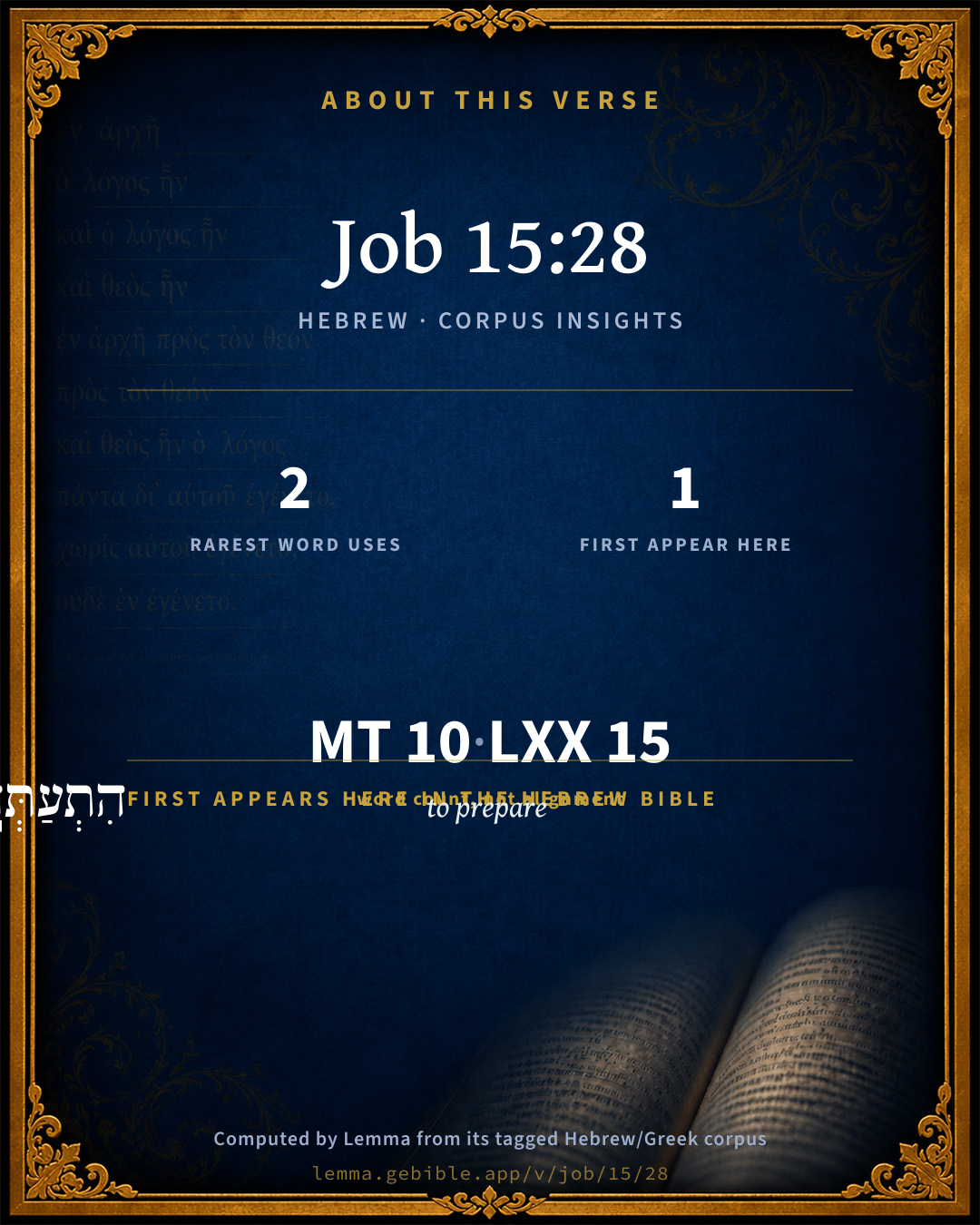
The rarest word here is הִתְעַתְּד֣וּ to prepare H6257 — appearing just 2 times in the whole Hebrew Bible.

First appearance in Scripture

This word makes its first canonical appearance in the Hebrew Bible here:

  • הִתְעַתְּד֣וּ to prepare H6257

Shared distinctive vocabulary

הִתְעַתְּד֣וּ to prepare H6257 occurs in 2 verses of the Hebrew Bible. Also found in:

Grammatical profile

  • 4 verbs
  • 3 nouns
  • 1 preposition
  • 2 particles

Verb forms

  • וַיִּשְׁכּ֤וֹן Qal · Sequential Imperfect
  • נִכְחָד֗וֹת Niphal · Participle Active
  • יֵ֣שְׁבוּ Qal · Imperfect
  • הִתְעַתְּד֣וּ Hithpael · Perfect

Hebrew & Septuagint length

In English translation the verse runs 18 words from the Hebrew and 22 from the Septuagint (LXX English) — closely comparable.

A rough comparison of the two English renderings, which tokenize alike — not a word-level alignment.

Word counts can differ between the Hebrew and the Greek without any difference in meaning — e.g. the Hebrew direct-object marker אֵת has no separate Greek word, and Greek often adds the article ὁ.

In the original languages it is 10 Hebrew tokens and 15 Greek tokens — but the two are counted differently (Hebrew bundles its prefixes and suffixes into one token; the Greek is in lemma form), so that isn’t a like-for-like length.

Cross-references

8

Topical passages linked to Job 15:28 in the Treasury of Scripture Knowledge — connected by theme and wording, ordered by reader-vote popularity; previews shown in the World English Bible.

  • Job 3:14 With kings and counselors of the earth, Who built up waste places for themselves;
  • Jeremiah 51:37 Babylon shall become heaps, a dwelling-place for jackals, an astonishment, and a hissing, without inhabitant.
  • Job 18:15 There shall dwell in his tent that which is none of his. Sulfur shall be scattered on his habitation.
  • Isaiah 5:8–10 Woe to those who join house to house, Who lay field to field, until there is no room, And you are made to dwell alone in the midst of the land!
  • Jeremiah 9:11 I will make Jerusalem heaps, a dwelling-place of jackals; and I will make the cities of Judah a desolation, without inhabitant.
  • Jeremiah 26:18 Micah the Morashtite prophesied in the days of Hezekiah king of Judah; and he spoke to all the people of Judah, saying, Thus says Yahweh of Hosts: Zion shall be plowed as a field, and Jerusalem shall become heaps, and the mountain of the house as the high places of a forest.
  • Micah 3:12 Therefore Zion for your sake will be plowed like a field, And Jerusalem will become heaps of rubble, And the mountain of the temple like the high places of a forest.
  • Micah 7:18 Who is a God like you, who pardons iniquity, And passes over the disobedience of the remnant of his heritage? He doesn't retain his anger forever, Because he delights in loving kindness.

Cross-references courtesy of OpenBible.info (CC BY 4.0).

Hebrew and Greek witnesses Masoretic Hebrew ↔ Greek Septuagint

The same verse in the two great witnesses to the Old Testament, shown verse-for-verse.

These are two independent witnesses, not word-aligned to each other, and the Septuagint is shown in lemma (dictionary) form.

Hebrew Job 15:28 Masoretic · Westminster Leningrad Codex

וַיִּשְׁכּ֤וֹן עָ֘רִ֤ים נִכְחָד֗וֹת בָּ֭תִּים לֹא יֵ֣שְׁבוּ לָ֑מוֹ אֲשֶׁ֖ר הִתְעַתְּד֣וּ לְגַלִּֽים

He has lived in desolate cities, In houses which no one inhabited, Which were ready to become heaps.

World English Bible · Public Domain

Greek LXX Job 15:28 Septuagint · lemma form

αὐλίζω δέ πόλις ἔρημος εἰςἔρχομαι δέ εἰς οἶκος ἀοίκητος ὅς δέ ἐκεῖνος ἑτοιμάζω ἄλλος ἀποφέρω

And let him lodge in desolate cities, and enter into houses without inhabitant: and what they have prepared, others shall carry away.

LXX2012 (modern English Septuagint) · Public Domain

Hebrew: Westminster Leningrad Codex (CC BY 4.0). Greek: Septuagint (public domain); English from LXX2012 (modern English Septuagint) (Public Domain). How the Septuagint differs from the Hebrew →

Commentary

Notes on Job 15:28 from classic Christian and Jewish commentators (each source and its license shown beneath its notes). The classic Christian expositions comment on the surrounding passage and are grouped to its opening verse, so a note may address several verses; the Jewish commentaries on the Tanakh (Rashi and others) are per-verse, so they appear only where the commentator wrote on this verse.

Lemma curates 59 commentaries, every one of them public domain or Creative Commons licensed, each selected and text-cleaned for this edition rather than reprinted as found. About our sources →

Trapp's Complete Commentary

John Trapp

Job 15:28 And he dwelleth in desolate cities, [and] in houses which no man inhabiteth, which are ready to become heaps.

Ver. 28. And he dwelleth in desolate cities] Such as had been before desolated, but are now by him edified again, to get him a name and a renown amongst men, and to make himself formidable, as those do who build themselves strongholds upon high rocks, as if they would wage war against heaven, Ad numinis contemptum et hominum terrorem (Merlin). Peradventure, saith Diodati here, he meaneth those kings of violent empires, who repaired or built great cities after the deluge, as Nimrod, Ashur, and others, Gen 10:8 Job 3:14 Isa 23:13, and raised themselves upon other men’s ruins. Eliphaz’s scope is to show that a man that hath great power amongst men begins to think himself strong enough for God also.

And in houses where no man inhabiteth] For he hath driven away the inhabitants through his oppressions. This is that crying sin of depopulators, who build themselves desolate places, Job 3:14; and enclosers, who betray towns, as Rome did Carthage, with a distinction, We will save the city, but destroy the town. This hath been noted as a great fault in our nation, and therefore Goropius thinks the English were called Angli, because they were good anglers, and had skill to lay various baits when they fished for other men’s livings. But that is his mistake, though perhaps wilful, for we were so called from the old Angli who came in with the Saxons, and were subdued by the Normans, whose duke, William the Conqueror, paid dearly for his depopulations at New Forest, wherein six and thirty parish churches had been demolished, and the inhabitants removed, to make room for beasts’ or dogs’ game. Various of his sons and nephews came there to untimely ends, so dangerous it is for men to prove Abaddons or destroyers.

Which are ready to become heaps] Heaps of stones: the strongest structures in the world are subject to ruin. Make sure of heaven, which the philosopher fondly dreamed to be made of stone (arch-work), and would one day come to ruin. But whatever becometh of the visible heavens, which shall be purified by the fire of the last day, upon the invisible we may well write, as Hippocrates telleth us it was engraven on the gates of a certain city, Intacta manet, it remaineth untouched. And as the Venetians boast of their city, that she is still a virgin, because from the first founding thereof (which is 1200 years since or near upon) it never came into the hands of a foreign enemy.

John Trapp, A Commentary or Exposition upon All the Books of the Old and New Testament (1647–1656) — public domain. Text from a community e-Sword module.

Joseph Benson's Commentary

Job 15:28-29. And he dwelleth — It should rather be translated, But he dwelleth in desolate places. This is fitly opposed to the prosperity last mentioned, and is the beginning of the description of his misery, which is continued in the following verses. Which are ready to become heaps — Which are ready to fall, and to be turned into heaps of stones. He shall not be rich — He shall not remain rich, but shall become poor. Neither shall his substance continue — He shall lose what he had gotten. Neither shall he prolong the perfection thereof — The perfection of his substance, or that complete estate and glory which he had attained, shall not be continued to him and his posterity. Or, neither shall their perfection (that is, that prosperity, wealth, and power, wherein they placed their perfection or happiness) spread itself, or be spread abroad; but shall be diminished and taken away. It is a metaphor from a tree. See Job 8:16.

Joseph Benson's Commentary on the Old and New Testaments (1811–1818) — public domain. Text from a community e-Sword module.

Geneva Bible (1599)

Geneva Bible translators

Though he build and repair ruinous places to get him fame, yet God shall bring all to naught, and turn his great prosperity into extreme misery.

Geneva Bible (1599) marginal notes — public domain. Text via Bolls.life.

Jamieson, Fausset & Brown

Robert Jamieson, A. R. Fausset & David Brown

The class of wicked here described is that of robbers who plunder "cities," and seize on the houses of the banished citizens (Isa 13:20). Eliphaz chooses this class because Job had chosen the same (Job 12:6).

heaps--of ruins.

Jamieson, Fausset & Brown — Commentary Critical and Explanatory on the Whole Bible (1871) — public domain (CC PDM 1.0). Text via the HelloAO Bible API.

Adam Clarke's Commentary

Verse 28. He dwelleth in desolate cities] It is sometimes the fate of a tyrant to be obliged to take up his habitation in some of those cities which have been ruined by his wars, and in a house so ruinous as to be ready to fall into heaps. Ancient and modern history afford abundance of examples to illustrate this.

Adam Clarke's Commentary on the Bible (1810–1826) — public domain. Text from a community e-Sword/MySword module.

Ellicott's Commentary for English Readers

(28) Which are ready to become heaps.—This completes the description of the haughty tyrant. He dwelt in cities that are to be desolate, or that are desolate, which are ready to become heaps. This may point either to what they were in his intention, or to what he had made them, or to what, in the opinion of the speaker, they were likely to become, notwithstanding his having fortified and dwelt in them.

A Bible Commentary for English Readers, edited by Charles John Ellicott (1878–1897) — public domain. Text from a community e-Sword module.

The Cambridge Bible for Schools and Colleges

gen. ed. J. J. S. Perowne

28. and he dwelleth] and he dwelt.

which no man inhabiteth] which should not be inhabited.

are ready to become] which were destined to be heaps. The idea seems to be that the wicked man settled in and rebuilt places that were under the curse of God, and destined by Him for perpetual desolation. Such places in the East are those on which God’s judgment has fallen because of some great wickedness perpetrated there. To settle in and rebuild such ruins indicates the extreme of impiety, cf. Deu_13:13 seq.; Jos_6:26; 1Ki_16:34.

The Cambridge Bible for Schools and Colleges (gen. ed. J. J. S. Perowne; Cambridge University Press, 1878–1918) — public domain. Text from a community e-Sword module.

John Gill's Exposition

He shall not be rich,.... Though his heart is set upon it, he is determined at any rate to be rich; he labours for it with all his might and main, and yet shall not attain what he is so desirous of; many, who take a great deal of pains to be rich, and even in a lawful way, and are men of understanding in trade and business, and yet riches are not their portion; and some who got a great deal, yet do not grow rich; what they get, they put into a bag of holes, and it drops through as fast as they put in; what they get in one sinful way they consume in another, and so are always poor; and others, though they have amassed together a vast substance, yet still are but poor men, not using what they have either for their own good, or the good of others; and not being content with what they have, but always craving more, and so are even poor in their own account, not having what they would have: however, such a man is not rich towards God; for in godly and spiritual things he is destitute of the true riches of grace, and has no title to the riches of glory; and as for his earthly riches, these shall not endure; though he may be rich for the present, he will not be always so; And this sense the next clause confirms:

neither shall his substance continue; or "his strength" (b) his power and might, a rich man's wealth being his strong city, in which he places his trust and confidence; riches are called "substance", though their are but a shadow, yea, mere nonentities, things that are not, in comparison of heavenly things; see Pro 23:5; at least they are not an enduring substance; they are uncertain things, here today, and gone tomorrow; that make themselves wings, and fly away from the owners of them; or they are taken away front them, and are not like the riches of grace, which are durable riches; or like those of glory; but by one means or another are taken out of the hands of the possessors of them, and they are reduced to poverty: and this "their substance shall not rise"; or rather, "not rise again" (c), as the word may be rendered; notwithstanding all the pains they may take, their substance shall not rise, grow, and increase; or not rise up to the former heights it did, but being fallen into poverty there they lie:

neither shall he prolong the perfection of it upon the earth; though, indeed, there is no perfection in the creature, nor in creature enjoyments, nor in outward riches and substance; such as have had the largest share of them, as David and Solomon, have declared they have seen an end of all perfection, and that all things, the highest enjoyments, are vanity and vexation of spirit; yet when men are got to the summit, and height, and perfection of outward happiness, as they or others may think, this is not prolonged, or continued long in the earth, or they continued in it; but often are suddenly cast down from the pinnacle of honour, wealth, and riches; hence some render the words, "and their prosperity shall not be fixed into the earth" (d); shall not take root, though it may seem to do, Jer 12:2; and so shall not spread itself as a tree well rooted does; and as does the spiritual prosperity, perfection, and fullness of good men, which they have in and by Christ; being rooted in the love of God, in the grace of Christ, and having the root of the matter in them, they cast forth their roots as Lebanon, and their branches spread, and they are full of the fruits and blessings of grace, Hos 14:5.

(b) "ejus robur", Mercerus; "potentia ejus", Drusius. (c) "neque resurgent opes ejus", Schmidt. (d) "nec mittet in terra radicem suam", V. L. "et non pangetur in terram prosperitas eorum", Schultens.

John Gill's Exposition of the Whole Bible (1746–1763) — public domain (CC PDM 1.0). Text via the HelloAO Bible API.

Albert Barnes' Notes on the Bible

And he dwelleth - Or rather, “therefore he shall dwell.” As a consequence of his opposing God, and devoting himself to a life of sensuality and ease, he shall dwell in a desolate place. Instead of living in affluence and in a splendid city, he shall be compelled to take up his abode in places that have been deserted and abandoned. Such places - like Petra or Babylon now - became the temporary lodgings of caravans and travelers, or the abodes of outcasts and robbers. The meaning here is, that the proud and wicked man shall be ejected from his palace, and compelled to seek a refuge far away from the usual haunts of men.

Which are ready to become heaps - Which are just ready to tumble into ruin.

Albert Barnes' Notes on the Bible (1834–1885) — public domain. Text from a community e-Sword/MySword module.

Haydock's Catholic Bible Commentary

Heaps, by his ambition and fury, (Calmet) and exactions, (Cajetan; Menochius) till the king chooses to rebuild the cities. (Vatable)

George Leo Haydock (1774–1849), Haydock's Catholic Family Bible and Commentary, 1859 edition — public domain. Excludes Psalms (Douay-Rheims chapter numbering differs from Protestant) and Deuterocanonical books (Catholic canon only).

Matthew Poole's English Annotations

He dwelleth in desolate cities: these words may note either,

1. His tyranny and cruelty, whereby he makes the places of his abode and dominion desolate by his frequent murders, spoils, and oppressions, wherewith he destroyeth great numbers of his people, and forceth others to flee out of his reach. Or,

2. His pride, and power, and wealth; which enabled and engaged him to build desolate houses and cities for his own glory, and safety, and conveniency; of which See Poole "Job 3:14". Or,

3. His punishment and misery; that for his impiety towards God, and oppression of men, he was driven out of his dominions and possessions, and forced to flee into desolate places for safety and a habitation. This seems best to agree with the Hebrew words, which run thus, But (for so the particle and is commonly used, as hath been oft said) he shall dwell, &c. And so this is fitly opposed to this last-mentioned prosperity, and is the beginning of the description of his misery, which is continued in the following verses.

Which are ready to become heaps; which were ready to fall, and to be turned into a heap of stones.

Matthew Poole's English Annotations on the Holy Bible (1683–1685) — public domain. Text from a community e-Sword/MySword module.

Whedon's Commentary on the Bible

Daniel D. Whedon

28. No man inhabiteth — Literally, which they should not inhabit for themselves. This “wicked man’s” defiance of God is manifested, as some think, by his preferring to dwell in cities that God has cursed. In blasphemy he chooses the ruins of a Sodom, Jericho, Tyre, or Babylon. This impiety is the more conspicuous as the people of the East have ever shrunk from inhabiting places on which they believe the frown of God rests. The Arab at the present day, as Consul Wetzstein informs us, hurries through the city of el Hijr (Medain Salih) without looking round, and muttering prayers, as does the great throng of pilgrims to Mecca, from fear of incurring the punishment of God by the slightest delay in the accursed city.

Daniel D. Whedon (gen. ed.), Commentary on the Old and New Testaments (1874–1909) — public domain. Text from a community e-Sword module.

The Pulpit Commentary

And he dwelleth in desolate cities. Blot only was he sensual and gluttenous, but he was covetous and rapacious also. He dwelt in cities which his hand had desolatedin houses which no man inhabiteth since he had driven their owners from them and which were ready to become heaps, i.e. were in a ruinous condition.

The Pulpit Commentary (1880–1919), ed. H.D.M. Spence-Jones & Joseph S. Exell — public domain. Text from a community e-Sword module.

John Wesley's Explanatory Notes

But - This is fitly opposed to the prosperity last mentioned, and is the beginning of the description of his misery.

John Wesley, Explanatory Notes Upon the Whole Bible (1754–1765) — public domain. Text via the GEBible commentary corpus.

Rashi

Rabbi Shlomo Yitzchaki (Rashi)

And he dwelt in ruined cities So is the custom of haughty people, to build ruins for a name.

Rashi on the Tanakh — English translations: “The Judaica Press complete Tanach with Rashi, translated by A. J. Rosenberg” (CC BY 4.0); “Pentateuch with Rashi's commentary by M. Rosenbaum and A.M. Silbermann, 1929-1934” (public domain); “The Metsudah Tanach series, Lakewood, N.J” (CC BY 4.0); and “The Book of Joshua, Metsudah Publications, 1997” (CC BY 4.0). Text via Sefaria.

Lesson kit

Teaching starters — assembled from the data on this page, not authored interpretation. Every prompt links to the verse data it draws on. Edit before teaching.

Job, in the Wisdom, opens this verse with 10 words (9 distinct Hebrew lemmas). Its most distinctive word is ʻâthad (“to prepare”). A historical commentator’s framing appears above. Read the whole chapter for the surrounding context.

Discussion questions

  1. What does “to prepare” (ʻâthad) contribute to the verse as a whole?
  2. This is the first place “to prepare” appears in Scripture (first appears here). What does its debut here establish?
  3. How does Proverbs 24:27, which shares the word «to prepare», read alongside this verse?
  4. The translations on this page render this verse differently — a whole-verse word diff, not a word-by-word alignment. What might account for the different wordings?
  5. «וַיִּשְׁכּ֤וֹן» is a Qal Sequential Imperfect verb. How does that grammatical form shape the action described?
  6. Compare how Trapp's Complete Commentary and Joseph Benson's Commentary read this verse. Where do they agree or differ?

Things to notice

Reading settings

Reading text

Shown beneath each verse's original-language words.

Old Testament
Old Testament edition

Read the OT as the Masoretic Hebrew (MT) or the Greek Septuagint (LXX).

English shown for the Greek Septuagint (in the Hebrew ↔ Greek comparison).

Comparing translations? Open the Compare panel on any verse page to stack up to four side by side.