
Psalms 37:29

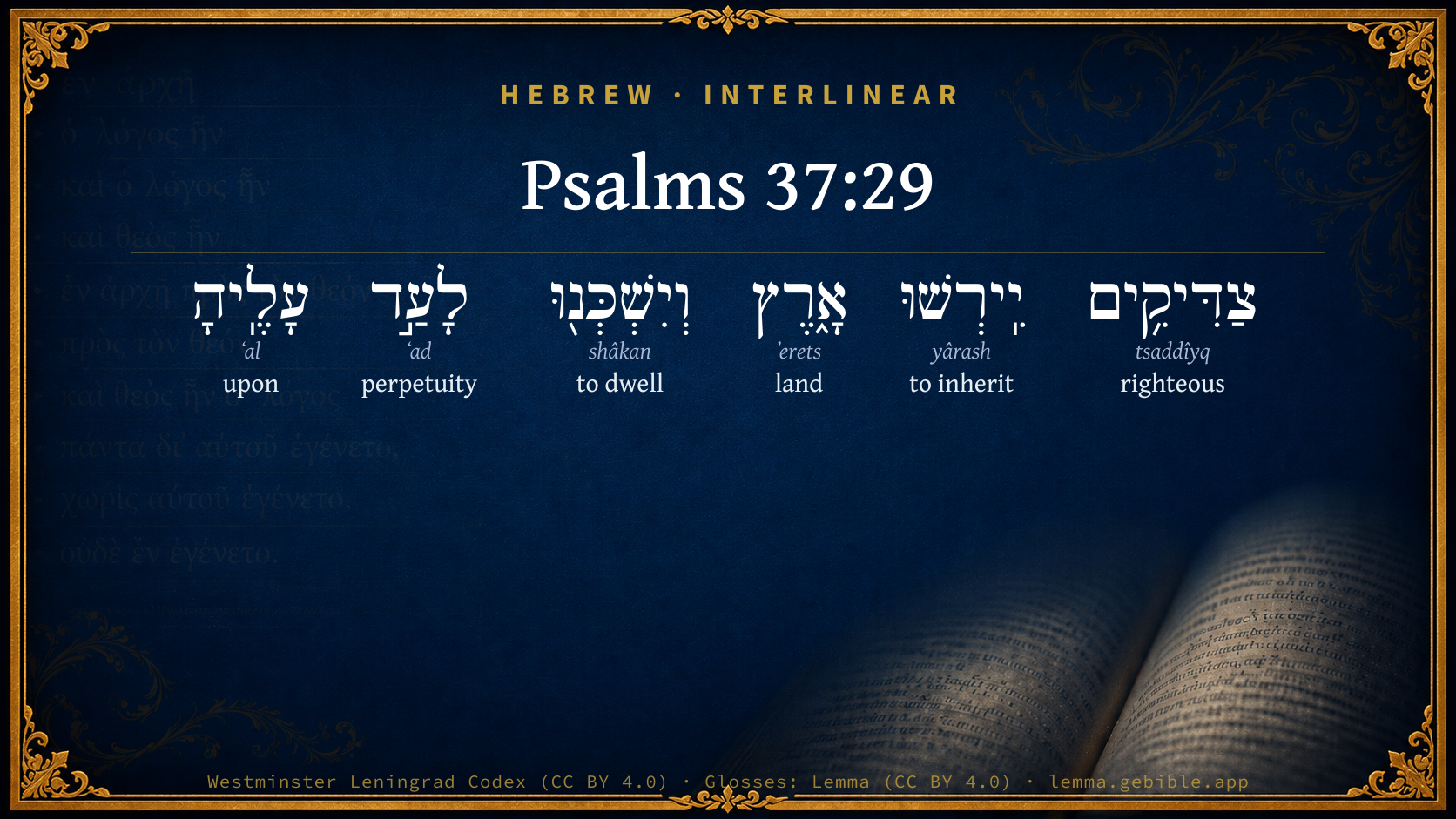
Hebrew (Westminster Leningrad Codex) Psalms 37:29 appears in the Hebrew Old Testament. The text above is from the Westminster Leningrad Codex. Each word links to its Strong’s number, a concise gloss, and parsing drawn from the Open Scriptures Hebrew Bible morphology. Click any word for its full Brown-Driver-Briggs (BDB) entry.
Download image
Cite this verse

Psalms 37:29 (World English Bible). Public Domain. Lemma interlinear Bible study tool, https://lemma.gebible.app/v/psalms/37/29.

Show BibTeX & RIS
BibTeX
RIS
English Translation
The righteous shall inherit the land, And live in it forever.
World English Bible · Public Domain
Download a study sheet

One document with this verse’s original text, its word-by-word gloss line, the meaning frame, cross-references with their text, attributed commentary, and full source and license credits — printable, and it pastes into notes with its structure intact.

This verse Autodidact and up

Study sheet (.html) Plain text (.txt)

A passage Seminary Student

Up to 50 verses in one chapter. A passage sheet keeps up to 6 commentary sources and 12 cross-references per verse, in the order this page ranks them, and says so on the sheet whenever that leaves anything out. Ask for a single verse and you get the Autodidact verse sheet above.

Everything on this page stays free to read, with no account — the sheet is a download of what is already on screen, not access to it.

Want to remove ads? Support Godless Engineer
Compare translations 3

The same verse in 3 English versions, stacked beneath the original-language interlinear above. Click any original word for its lexicon entry.

Each is an independent rendering of the whole verse — the interlinear is not word-aligned to these translations.

Highlighted words mark where these versions differ — a whole-verse word diff, not a word-by-word alignment.

  • World English Bible Public Domain
    The righteous shall inherit the land, And live in it forever.
  • King James Version Public Domain
    The righteous shall inherit the land, and dwell therein for ever.
  • unfoldingWord Literal Text CC BY-SA 4.0
    The righteous will inherit the land and will dwell forever upon it.

unfoldingWord Literal Text — © unfoldingWord, licensed CC BY-SA 4.0. Word-aligned USFM3 via Door43 (git.door43.org/unfoldingWord/en_ult).

Versions to compare (up to 4)

3 of 4 selected

Show all 18 translations

Every available English version of this verse, each an independent rendering of the whole verse.

  • World English Bible Public Domain
    The righteous shall inherit the land, And live in it forever.
  • Berean Standard Bible Public Domain
    The righteous will inherit the land and dwell in it forever.
  • Majority Standard Bible Public Domain
    The righteous will inherit the land and dwell in it forever.
  • King James Version Public Domain
    The righteous shall inherit the land, and dwell therein for ever.
  • American Standard Version (1901) Public Domain
    The righteous shall inherit the land, And dwell therein for ever.
  • Revised Version (1885) Public Domain
    The righteous shall inherit the land, and dwell therein for ever.
  • Geneva Bible (1599) Public Domain
    The righteous men shall inherit the lande, and dwell therein for euer.
  • Douay-Rheims (1899) Public Domain
    But the just shall inherit the land, and shall dwell therein for evermore.
  • Young's Literal Translation Public Domain
    The righteous possess the land, And they dwell for ever on it.
  • Literal Standard Version CC BY-SA 4.0
    The righteous possess the land, || And they dwell on it forever.
  • Unlocked Literal Bible CC BY-SA 4.0
    The righteous will inherit the land and live there forever.
  • unfoldingWord Literal Text CC BY-SA 4.0
    The righteous will inherit the land and will dwell forever upon it.
  • Darby Bible Public Domain
    The righteous shall possess the land, and dwell therein for ever.
  • World Messianic Bible Public Domain
    The righteous shall inherit the land, and live in it forever.
  • Webster's Bible Public Domain
    The righteous shall inherit the land, and dwell therein for ever.
  • Free Bible Version CC BY-SA 4.0
    Those who do right will own the land and will live there forever.
  • Bible in Basic English Public Domain
    The upright will have the earth for their heritage, and will go on living there for ever.
  • JPS Tanakh (1917) Public Domain
    The righteous shall inherit the land, and dwell therein for ever.

Literal Standard Version (2020), Covenant Press — licensed CC BY-SA 4.0. Text via the HelloAO Bible API (eBible.org). Unlocked Literal Bible (unfoldingWord) — licensed CC BY-SA 4.0. Text via the HelloAO Bible API (eBible.org). unfoldingWord Literal Text — © unfoldingWord, licensed CC BY-SA 4.0. Word-aligned USFM3 via Door43 (git.door43.org/unfoldingWord/en_ult). Free Bible Version, Dr. Jonathan Gallagher — licensed CC BY-SA 4.0. Text via the HelloAO Bible API (eBible.org).

Word by word

More ways to search: Search by grammar → Find every occurrence → Compare this word →

Practice this passage: Drill this verse → Learn its vocabulary →

About this verse

These counts appear in no published source. They are computed here, from the morphology-tagged text and Lemma’s own curated glosses. What Lemma adds →

6
words
6
distinct lemmas
Wisdom
section

Shared distinctive vocabulary

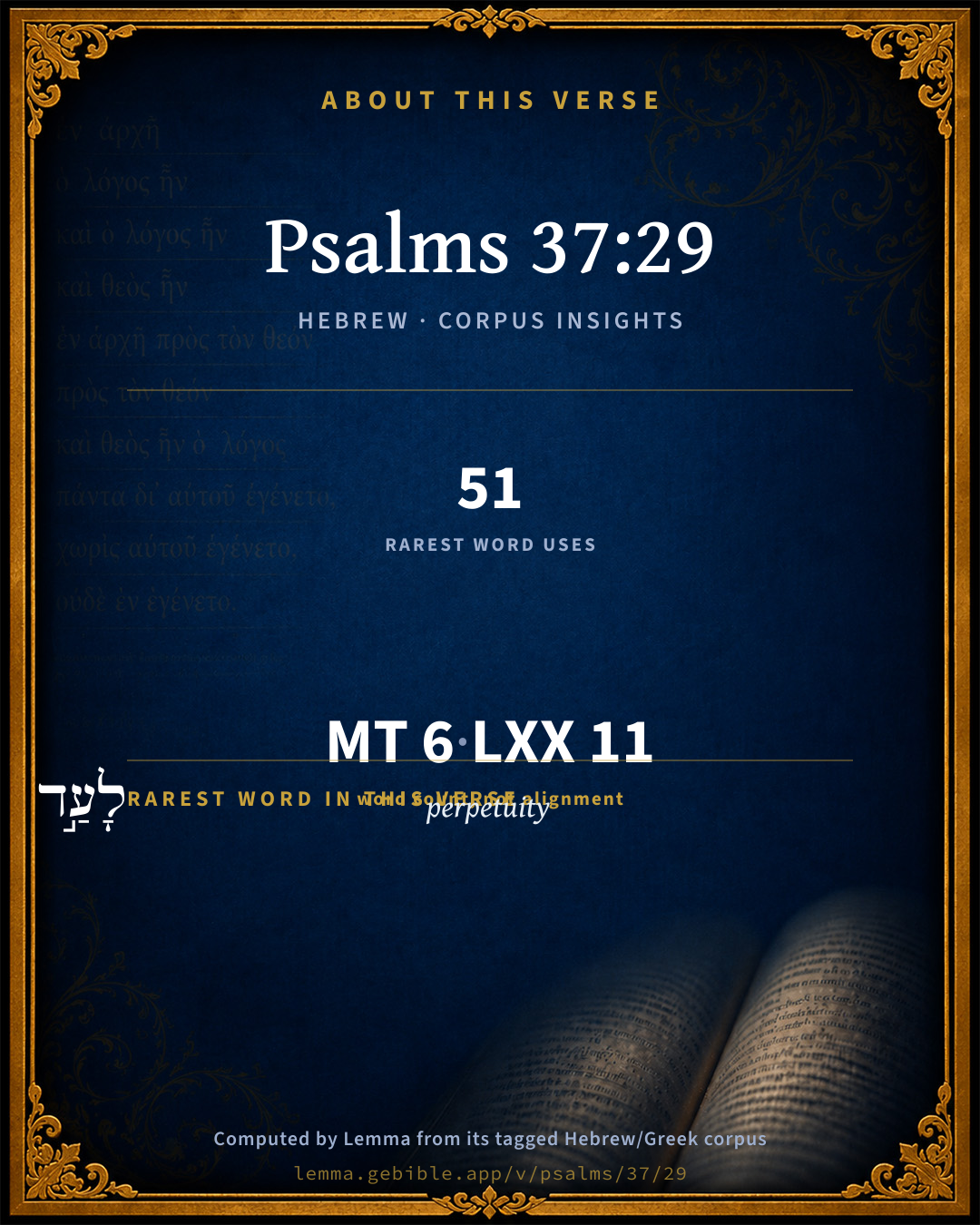
לָעַ֣ד perpetuity H5703 occurs in 49 verses of the Hebrew Bible. Also found in:

Grammatical profile

  • 2 verbs
  • 2 nouns
  • 1 adjective
  • 1 preposition

Verb forms

  • יִֽירְשׁוּ Qal · Imperfect
  • וְיִשְׁכְּנ֖וּ Qal · Imperfect

Hebrew & Septuagint length

In English translation the verse runs 11 words from the Hebrew and 13 from the Septuagint (LXX English) — closely comparable.

A rough comparison of the two English renderings, which tokenize alike — not a word-level alignment.

Word counts can differ between the Hebrew and the Greek without any difference in meaning — e.g. the Hebrew direct-object marker אֵת has no separate Greek word, and Greek often adds the article ὁ.

In the original languages it is 6 Hebrew tokens and 11 Greek tokens — but the two are counted differently (Hebrew bundles its prefixes and suffixes into one token; the Greek is in lemma form), so that isn’t a like-for-like length.

Cross-references

9

Topical passages linked to Psalms 37:29 in the Treasury of Scripture Knowledge — connected by theme and wording, ordered by reader-vote popularity; previews shown in the World English Bible.

  • Proverbs 2:21 For the upright will dwell in the land. The perfect will remain in it.
  • Psalms 37:9 For evildoers shall be cut off, But those who wait for Yahweh shall inherit the land.
  • 2 Peter 3:13 But, according to his promise, we look for new heavens and a new earth, in which dwells righteousness.
  • Psalms 37:11 But the humble shall inherit the land, And shall delight themselves in the abundance of peace.
  • Psalms 37:18 Yahweh knows the days of the perfect. Their inheritance shall be forever.
  • Revelation 21:7 He who overcomes, I will give him these things. I will be his God, and he will be my son.
  • Deuteronomy 30:20 to love Yahweh your God, to obey his voice, and to cleave to him; for he is your life, and the length of your days; that you may dwell in the land which Yahweh swore to your fathers, to Abraham, to Isaac, and to Jacob, to give them.
  • Revelation 21:3–4 I heard a loud voice out of heaven saying, "Behold, God's dwelling is with people, and he will dwell with them, and they will be his people, and God himself will be with them as their God.
  • Psalms 37:27 Depart from evil, and do good; Live securely forever.

Cross-references courtesy of OpenBible.info (CC BY 4.0).

Hebrew and Greek witnesses Masoretic Hebrew ↔ Greek Septuagint

The same verse in the two great witnesses to the Old Testament, shown verse-for-verse.

You’re reading Greek Psalm 36 (Hebrew Psalm 37). The Septuagint counts the superscription, so verse numbers can differ from the Hebrew — chapter-level alignment, not verse-by-verse. Numbering follows Rahlfs.

These are two independent witnesses, not word-aligned to each other, and the Septuagint is shown in lemma (dictionary) form.

Hebrew Psalms 37:29 Masoretic · Westminster Leningrad Codex

צַדִּיקִ֥ים יִֽירְשׁוּ אָ֑רֶץ וְיִשְׁכְּנ֖וּ לָעַ֣ד עָלֶֽיהָ

The righteous shall inherit the land, And live in it forever.

World English Bible · Public Domain

Greek LXX Greek Psalm 36:29 Septuagint · lemma form

δίκαιος δέ κληρονομέω γῆ καί κατασκηνόω εἰς αἰών αἰών ἐπί αὐτός

But the righteous shall inherit the earth, and dwell upon it for ever.

LXX2012 (modern English Septuagint) · Public Domain

On this verse, Whedon's Commentary on the Bible discusses the Septuagint’s reading. Read the note in Commentary ↓

Hebrew: Westminster Leningrad Codex (CC BY 4.0). Greek: Septuagint (public domain); English from LXX2012 (modern English Septuagint) (Public Domain). How the Septuagint differs from the Hebrew →

Commentary

Notes on Psalms 37:29 from classic Christian and Jewish commentators (each source and its license shown beneath its notes). The classic Christian expositions comment on the surrounding passage and are grouped to its opening verse, so a note may address several verses; the Jewish commentaries on the Tanakh (Rashi and others) are per-verse, so they appear only where the commentator wrote on this verse.

Lemma curates 59 commentaries, every one of them public domain or Creative Commons licensed, each selected and text-cleaned for this edition rather than reprinted as found. About our sources →

Trapp's Complete Commentary

John Trapp

Psa 37:29 The righteous shall inherit the land, and dwell therein for ever.

Ver. 29. The righteous shall inherit, &c.] This verse hath been expounded before, and is here repeated for more assurance, Verba toties inculcata viva sunt, vera sunt, sana sunt, plana sunt.

John Trapp, A Commentary or Exposition upon All the Books of the Old and New Testament (1647–1656) — public domain. Text from a community e-Sword module.

Whedon's Commentary on the Bible

Daniel D. Whedon

29. Dwell therein for ever—לעד, (la’adh,) to eternity; Septuagint, εις, αιωνα αιωνος, for ever and ever; Vulgate, ad seculum seculi, for ever and ever. See also le’olam, to eternity, Psa_37:18.It is no objection to the argument of duration that in Psa_37:29 the righteous are said to “inherit the land” for ever, and that in Psa_37:27, “dwell,” inhabit, has the same primary reference, for these are common Hebraistic forms for setting forth not only great prosperity, but eternal blessedness, of which the earthly abiding in the promised land was accepted as an earnest. So our Lord says, “The meek shall inherit the earth,” using the temporal as the earnest and pledge of the eternal. Mat_5:5, compare Gen_17:8. The above words always take the sense of endless duration, where, as here, the subject and scope allow it.

Daniel D. Whedon (gen. ed.), Commentary on the Old and New Testaments (1874–1909) — public domain. Text from a community e-Sword module.

J. A. Alexander on Psalms

Joseph Addison Alexander

29. (Psa 37:29) The righteous shall inherit the land, possess the land of promise by a filial right, and dwell, securely and in peace, for ever, to eternity, upon it. See the same expressions used and explained above, on Psa 37:3; Psa 37:9; Psa 37:18; Psa 37:22.

Joseph Addison Alexander, The Psalms Translated and Explained (1850) — public domain. Text from a community e-Sword module.

Geneva Bible (1599)

Geneva Bible translators

They shall continually be preserved under God’s wings, and have at least inward rest.

Geneva Bible (1599) marginal notes — public domain. Text via Bolls.life.

Adam Clarke's Commentary

Verse 29. The righteous shall inherit the land] If this be not another promise of return to their own land, from that of their captivity, it must be spiritually understood, and refer to their eternal dwelling with God in glory.

Adam Clarke's Commentary on the Bible (1810–1826) — public domain. Text from a community e-Sword/MySword module.

John Calvin's Commentaries

29 The righteous shall inherit the earth The repetition of the same doctrine here is not superfluous, since it is so very difficult to impress it deeply upon our minds. For while all men seek after happiness, scarcely one in a hundred looks for it from God, but rather all, on the contrary, in making provision for themselves, provoke the vengeance of God, as it were deliberately, and strive to excel each other in doing so, so that some of them stain themselves with fraud and perjury, some indulge in robbery and extortion, some practice all sorts of cruelty, and others commit violence and outrage even with the sword and poison. Moreover, I have just now, and on several other occasions, stated the sense in which this everlasting habitation upon the earth, which is here promised to the righteous, is to be understood, namely, that although they are surrounded by the troubles and changes which occur in this world, yet God preserves them under his wings; and although there is nothing lasting or stable under heaven, yet he keeps them in safety as if they were sheltered in a secure haven. And, finally, they enjoy in addition to this that inward peace of mind which is better than a hundred lives, and which is therefore justly regarded as a privilege surpassing in value and importance all others.

John Calvin's Commentaries (1540-1563) — public domain. Text from the Calvin Translation Society English edition (1840s-50s) via the Christian Classics Ethereal Library (ccel.org). Calvin's coverage is partial (roughly two-thirds of the Bible); uncommented books and verses are honest gaps, never fabricated. The 19th-century editor's footnotes and remarks are omitted so the notes are faithfully Calvin's own voice.

John Gill's Exposition

The mouth of the righteous speaketh wisdom,.... Or "meditateth wisdom" (a); that is, utters the wisdom he has been meditating upon; see Psa 69:3; he meditates and speaks of the wisdom of God, which appears in the works of creation, providence, and grace; and of Christ, who is wisdom itself, and the wisdom of God essentially; and who, as Mediator, has the spirit of wisdom resting on him, the treasures of wisdom hid in him, and is made wisdom to his people: and righteous men meditate upon and speak of the glories of his person, the fulness of his grace, and the works of his hands; as also of the Gospel, which is the wisdom of God, mysterious, hidden, ancient wisdom, ordained before the world for their glory; and likewise of that internal wisdom, and experience of divine grace, the Lord has made them to know in the hidden part; which lies in the knowledge of themselves, and in a spiritual, experimental, and saving knowledge of Christ, and the way of salvation by him; and his mouth delivers out wise sayings, and useful instructions, fetched out of the word of God, and founded on experience and observation;

and his tongue talketh of judgment; of the judgment which the righteous God ordinarily ministers in a providential way; and of his extraordinary and awful judgments, which have been or are in the earth; these he takes notice of for his own use, and observes them to others for their instruction; and also of the last judgment, the judgment to come, which he speaks of as sure and certain, as universal and inevitable, and at which he must appear before God: and he talks of judgment or righteousness; that is, of the righteousness of Christ; he makes mention of this only as his justifying righteousness before God; he rejoices and glories in it, and desires to be found in it living and dying, and at judgment; and whatsoever things are honest, just, pure, and of good report, he thinks and speaks of them, and instructs his family, his children and servants, in them, that they may do them; see Gen 18:19.

(a) Sept. "meditabitur", V. L. so Musculus: Junius & Tremellius, Piscator, Michaelis.

John Gill's Exposition of the Whole Bible (1746–1763) — public domain (CC PDM 1.0). Text via the HelloAO Bible API.

Albert Barnes' Notes on the Bible

The righteous shall inherit the land - See Psa 37:3. The word “inherit” suggests the idea that they are heirs, and that God will treat them as His children.

And dwell therein forever - Psa 37:3, Psa 37:18, Psa 37:27.

Albert Barnes' Notes on the Bible (1834–1885) — public domain. Text from a community e-Sword/MySword module.

Matthew Poole's English Annotations

Inherit the land: See Poole "Psa 37:3".

Dwell therein for ever: See Poole "Psa 37:18".

Matthew Poole's English Annotations on the Holy Bible (1683–1685) — public domain. Text from a community e-Sword/MySword module.

The Treasury of David

Charles H. Spurgeon

Ver. 29. The righteous shall inherit the land. As heirs with Jesus Christ, the Canaan above, which is the antitype of "the land, " shall be theirs with all covenant blessing. And dwell therein for ever. Tenures differ, but none can match the holding which believers have of heaven. Paradise is theirs for ever by inheritance, and they shall live for ever to enjoy it. Who would not be a saint on such terms? Who would fret concerning the fleeting treasures of the godless?

Ver. 29. The righteous shall inherit the land, or the earth. There is clearly an emphasis in the repetition of the same promise in the same terms which ought to have been uniformly rendered throughout Ps 37:9, 11, 22, 29, 34. And it cannot be doubted, that there is a reference to the new heavens and the new earth of Isa 56:17 2Pe 3:13. W. Wilson.

Ver. 29. The righteous shall inherit the land, etc. Compare Mt 5:5. Consider well this Bible truth, of the future exclusive possession of the earth by the righteous. The millennial kingdom furnishes a fuller explanation. T. C. Barth.

Ver. 29. Canaan as a type of the righteous man's inheritance.

Psalms 37:30*

Charles H. Spurgeon's The Treasury of David (1869–1885) — public domain. Psalms only. Text from a community e-Sword/MySword module.

The Pulpit Commentary

The righteous shall inherit the land, and dwell therein for over. (comp. vers. 3, 9, 11, 18, 22, 28, 34; and Pro_2:21) Bishop Butler sagaciously remarks that this is the natural tendency of things, if sufficient time be given, and accidental hindrances removed ("Analogy," pt. 1. ch. 4).

The Pulpit Commentary (1880–1919), ed. H.D.M. Spence-Jones & Joseph S. Exell — public domain. Text from a community e-Sword module.

Lesson kit

Teaching starters — assembled from the data on this page, not authored interpretation. Every prompt links to the verse data it draws on. Edit before teaching.

Psalms, in the Wisdom, opens this verse with 6 words (6 distinct Hebrew lemmas). Its most distinctive word is ʻad (“perpetuity”). A historical commentator’s framing appears above. Read the whole chapter for the surrounding context.

Discussion questions

  1. The word ʻad carries the sense “perpetuity.” How does it shape the verse?
  2. How does Exodus 15:18, which shares the word «perpetuity», read alongside this verse?
  3. These translations render this verse differently; the difference is in the English rendering, not the original. What questions does that raise?
  4. «יִֽירְשׁוּ» is a Qal Imperfect verb. How does that grammatical form shape the action described?
  5. Compare how Trapp's Complete Commentary and Whedon's Commentary on the Bible read this verse. Where do they agree or differ?

Things to notice

Reading settings

Reading text

Shown beneath each verse's original-language words.

Old Testament
Old Testament edition

Read the OT as the Masoretic Hebrew (MT) or the Greek Septuagint (LXX).

English shown for the Greek Septuagint (in the Hebrew ↔ Greek comparison).

Comparing translations? Open the Compare panel on any verse page to stack up to four side by side.