
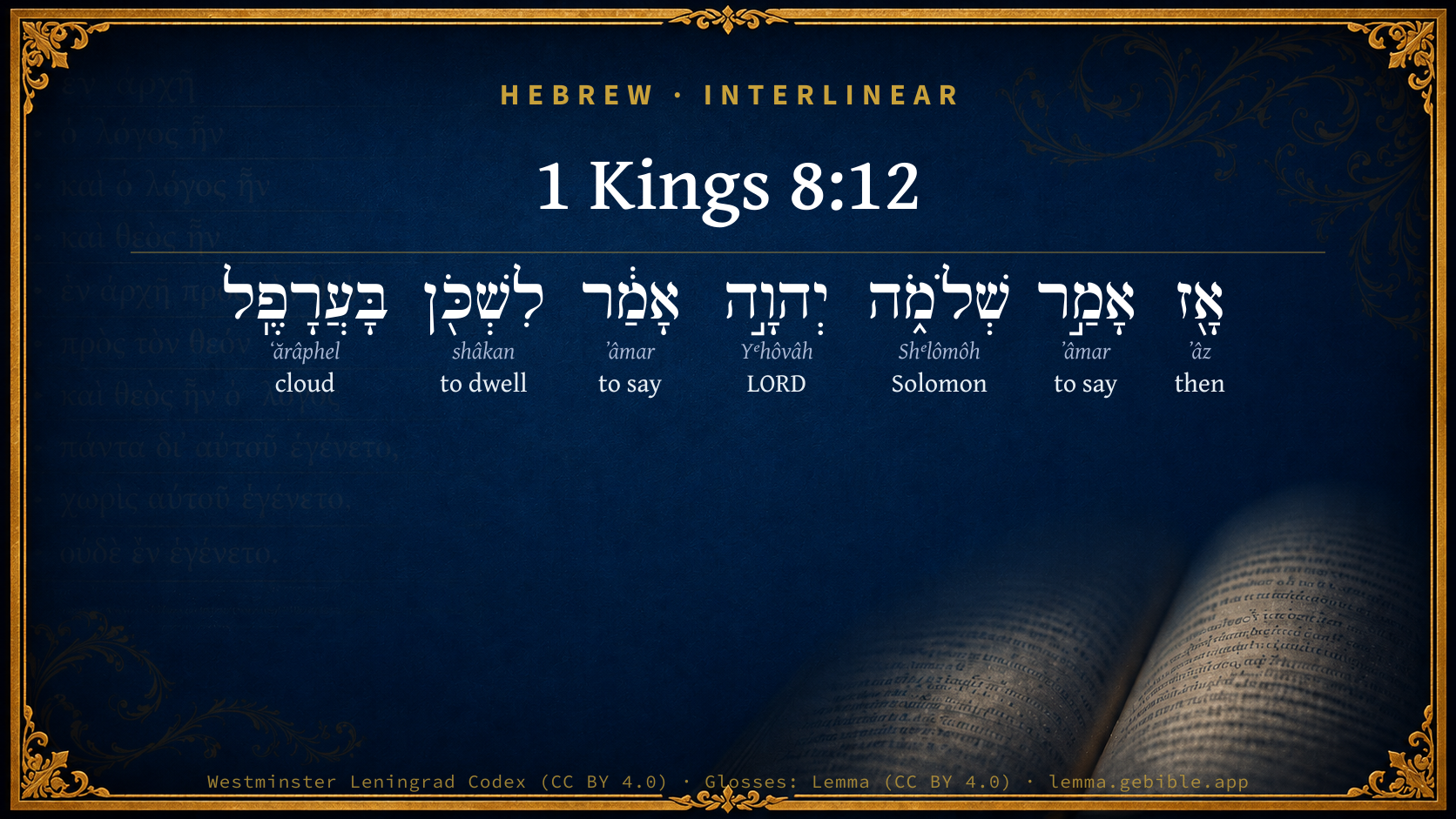
1 Kings 8:12

Hebrew (Westminster Leningrad Codex) 1 Kings 8:12 appears in the Hebrew Old Testament. The text above is from the Westminster Leningrad Codex. Each word links to its Strong’s number, a concise gloss, and parsing drawn from the Open Scriptures Hebrew Bible morphology. Click any word for its full Brown-Driver-Briggs (BDB) entry.
Download image
Cite this verse

1 Kings 8:12 (World English Bible). Public Domain. Lemma interlinear Bible study tool, https://lemma.gebible.app/v/1-kings/8/12.

Show BibTeX & RIS
BibTeX
RIS
English Translation
Then spoke Solomon, Yahweh has said that he would dwell in the thick darkness.
World English Bible · Public Domain
Download a study sheet

One document with this verse’s original text, its word-by-word gloss line, the meaning frame, cross-references with their text, attributed commentary, and full source and license credits — printable, and it pastes into notes with its structure intact.

This verse Autodidact and up

Study sheet (.html) Plain text (.txt)

A passage Seminary Student

Up to 50 verses in one chapter. A passage sheet keeps up to 6 commentary sources and 12 cross-references per verse, in the order this page ranks them, and says so on the sheet whenever that leaves anything out. Ask for a single verse and you get the Autodidact verse sheet above.

Everything on this page stays free to read, with no account — the sheet is a download of what is already on screen, not access to it.

Want to remove ads? Support Godless Engineer
Compare translations 3

The same verse in 3 English versions, stacked beneath the original-language interlinear above. Click any original word for its lexicon entry.

Each is an independent rendering of the whole verse — the interlinear is not word-aligned to these translations.

Highlighted words mark where these versions differ — a whole-verse word diff, not a word-by-word alignment.

  • World English Bible Public Domain
    Then spoke Solomon, Yahweh has said that he would dwell in the thick darkness.
  • King James Version Public Domain
    Then spake Solomon, The LORD said that he would dwell in the thick darkness.
  • unfoldingWord Literal Text CC BY-SA 4.0
    Then Solomon said, “Yahweh said he would dwell in a dark cloud.

unfoldingWord Literal Text — © unfoldingWord, licensed CC BY-SA 4.0. Word-aligned USFM3 via Door43 (git.door43.org/unfoldingWord/en_ult).

Versions to compare (up to 4)

3 of 4 selected

Show all 18 translations

Every available English version of this verse, each an independent rendering of the whole verse.

  • World English Bible Public Domain
    Then spoke Solomon, Yahweh has said that he would dwell in the thick darkness.
  • Berean Standard Bible Public Domain
    Then Solomon declared: “The LORD has said that He would dwell in the thick cloud.
  • Majority Standard Bible Public Domain
    Then Solomon declared: “The LORD has said that He would dwell in the thick cloud.
  • King James Version Public Domain
    Then spake Solomon, The LORD said that he would dwell in the thick darkness.
  • American Standard Version (1901) Public Domain
    Then spake Solomon, Jehovah hath said that he would dwell in the thick darkness.
  • Revised Version (1885) Public Domain
    Then spake Solomon, The LORD hath said that he would dwell in the thick darkness.
  • Geneva Bible (1599) Public Domain
    Then spake Salomon, The Lord said, that he woulde dwell in the darke cloude.
  • Douay-Rheims (1899) Public Domain
    Then Solomon said: The Lord said that he would dwell in a cloud.
  • Young's Literal Translation Public Domain
    Then said Solomon, `Jehovah hath said to dwell in thick darkness;
  • Literal Standard Version CC BY-SA 4.0
    Then Solomon said, “YHWH has said [He is] to dwell in thick darkness;
  • Unlocked Literal Bible CC BY-SA 4.0
    Then Solomon said, “Yahweh has said that he would live in thick darkness,
  • unfoldingWord Literal Text CC BY-SA 4.0
    Then Solomon said, “Yahweh said he would dwell in a dark cloud.
  • Darby Bible Public Domain
    Then said Solomon: Jehovah said that he would dwell in the thick darkness.
  • World Messianic Bible Public Domain
    Then Solomon said, “The LORD has said that he would dwell in the thick darkness.
  • Webster's Bible Public Domain
    Then spoke Solomon, The LORD said that he would dwell in the thick darkness.
  • Free Bible Version CC BY-SA 4.0
    Then Solomon said: “Lord, you said that you would live in the thick cloud.
  • Bible in Basic English Public Domain
    Then Solomon said, O Lord, to the sun you have given the heaven for a living-place, but your living-place was not seen by men;
  • JPS Tanakh (1917) Public Domain
    Then spoke Solomon: The LORD hath said that He would dwell in the thick darkness.

Literal Standard Version (2020), Covenant Press — licensed CC BY-SA 4.0. Text via the HelloAO Bible API (eBible.org). Unlocked Literal Bible (unfoldingWord) — licensed CC BY-SA 4.0. Text via the HelloAO Bible API (eBible.org). unfoldingWord Literal Text — © unfoldingWord, licensed CC BY-SA 4.0. Word-aligned USFM3 via Door43 (git.door43.org/unfoldingWord/en_ult). Free Bible Version, Dr. Jonathan Gallagher — licensed CC BY-SA 4.0. Text via the HelloAO Bible API (eBible.org).

Word by word

More ways to search: Search by grammar → Find every occurrence → Compare this word →

Practice this passage: Drill this verse → Learn its vocabulary →

About this verse

These counts appear in no published source. They are computed here, from the morphology-tagged text and Lemma’s own curated glosses. What Lemma adds →

7
words
6
distinct lemmas
Historical
section

Notable vocabulary

The rarest word here is בָּעֲרָפֶֽל cloud H6205 — appearing just 15 times in the whole Hebrew Bible.

Shared distinctive vocabulary

בָּעֲרָפֶֽל cloud H6205 occurs in 15 verses of the Hebrew Bible. Also found in:

Grammatical profile

  • 3 verbs
  • 3 nouns
  • 1 adverb

Verb forms

  • אָמַ֣ר Qal · Perfect
  • אָמַ֔ר Qal · Perfect
  • לִשְׁכֹּ֖ן Qal · Infinitive Construct

Repetition

A word recurs within this verse — often emphatic in Hebrew:

  • אָמַ֣ר to say H559 ×2

Cross-references

9

Topical passages linked to 1 Kings 8:12 in the Treasury of Scripture Knowledge — connected by theme and wording, ordered by reader-vote popularity; previews shown in the World English Bible.

  • Psalms 97:2 Clouds and darkness are around him. Righteousness and justice are the foundation of his throne.
  • 2 Chronicles 6:1–11 Then spoke Solomon, Yahweh has said that he would dwell in the thick darkness.
  • Leviticus 16:2 and Yahweh said to Moses, "Tell Aaron your brother, not to come at all times into the Most Holy Place within the veil, before the mercy seat which is on the ark; lest he die: for I will appear in the cloud on the mercy seat.
  • Isaiah 45:15 Most assuredly you are a God who hid yourself, God of Israel, the Savior.'
  • Exodus 20:21 The people stayed at a distance, and Moses drew near to the thick darkness where God was.
  • Psalms 18:8–11 Smoke went out of his nostrils. Consuming fire came out of his mouth. Coals were kindled by it.
  • Deuteronomy 5:22 These words Yahweh spoke to all your assembly on the mountain out of the midst of the fire, of the cloud, and of the thick darkness, with a great voice: and he added no more. He wrote them on two tables of stone, and gave them to me.
  • Hebrews 12:18 For you have not come to a mountain that might be touched, and that burned with fire, and to blackness, darkness, tempest,
  • Deuteronomy 4:11 You came near and stood under the mountain; and the mountain burned with fire to the heart of the sky, with darkness, cloud, and thick darkness.

Cross-references courtesy of OpenBible.info (CC BY 4.0).

Hebrew and Greek witnesses Masoretic Hebrew ↔ Greek Septuagint

The same verse in the two great witnesses to the Old Testament, shown verse-for-verse.

These are two independent witnesses, not word-aligned to each other, and the Septuagint is shown in lemma (dictionary) form.

Hebrew 1 Kings 8:12 Masoretic · Westminster Leningrad Codex

אָ֖ז אָמַ֣ר שְׁלֹמֹ֑ה יְהוָ֣ה אָמַ֔ר לִשְׁכֹּ֖ן בָּעֲרָפֶֽל

Then spoke Solomon, Yahweh has said that he would dwell in the thick darkness.

World English Bible · Public Domain

On this verse, Ellicott's Commentary for English Readers discusses the Septuagint’s reading. Read the note in Commentary ↓

Hebrew: Westminster Leningrad Codex (CC BY 4.0). Greek: Septuagint (public domain); English from a public-domain English Septuagint. How the Septuagint differs from the Hebrew →

Targum (Aramaic paraphrase)

1

The Targum is the ancient Jewish Aramaic paraphrase of the Hebrew Scriptures — an interpretive translation, not the Hebrew text itself. Onkelos (literal) and Pseudo-Jonathan (expansive) render the Torah, and Jonathan the Prophets. Coverage is partial: where no permissively-licensed English translation exists for a verse, only the Aramaic is shown. This is verse-level text, not a word-by-word alignment to the Hebrew.

  1. Targum Jonathan Prophets (Joshua–Malachi)
    בְּכֵן אֲמַר שְׁלֹמֹה יְיָ אִתְרְעֵי לְאַשְׁרָאָה שְׁכִנְתֵּיהּ בִּירוּשְׁלֵם:

    (no public-domain English translation for this verse)

    Targum Jonathan — Aramaic: “Mikraot Gedolot” (public domain). English: “Sefaria Community Translation” (CC0 1.0 (public-domain dedication)); “London "Chaldee Paraphrase," 1871” (public domain). Text via Sefaria.

Commentary

Notes on 1 Kings 8:12 from classic Christian and Jewish commentators (each source and its license shown beneath its notes). The classic Christian expositions comment on the surrounding passage and are grouped to its opening verse, so a note may address several verses; the Jewish commentaries on the Tanakh (Rashi and others) are per-verse, so they appear only where the commentator wrote on this verse.

Lemma curates 59 commentaries, every one of them public domain or Creative Commons licensed, each selected and text-cleaned for this edition rather than reprinted as found. About our sources →

Matthew Henry's Commentary

Here, I. Solomon encourages the priests, who came out of the temple from their ministration, much astonished at the dark cloud that overshadowed them. The disciples of Christ feared when they entered into the cloud, though it was a bright cloud (Luk 9:34), so did the priests when they found themselves wrapped in a thick cloud. To silence their fears, 1. He reminds them of that which they could not but know, that this was a token of God's presence (Kg1 8:12): The Lord said he would dwell in the thick darkness. It is so far from being a token of his displeasure that it is an indication of his favour; for he had said, I will appear in a cloud, Lev 16:2. Note, Nothing is more effectual to reconcile us to dark dispensations than to consider what God hath said, and to compare his word and works together; as Lev 10:3, This is that which the Lord hath said. God is light (Jo1 1:5), and he dwells in light (Ti1 6:16), but he dwells with men in the thick darkness, makes that his pavilion, because they could not bear the dazzling brightness of his glory. Verily thou art a God that hidest thyself. Thus our holy faith is exercised and our holy fear is increased. Where God dwells in light faith is swallowed up in vision and fear in love. 2. He himself bids it welcome, as worthy of all acceptation; and since God, by this cloud, came down to take possession, he does, in a few words, solemnly give him possession (Kg1 8:13): "Surely I come," says God. "Amen," says Solomon, "Even so, come, Lord,. The house is thy own, entirely thy own, I have surely built it for thee, and furnished it for thee; it is for ever thy own, a settled place for thee to abide in for ever; it shall never be alienated nor converted to any other use; the ark shall never be removed from it, never unsettled again." It is Solomon's joy that God has taken possession; and it is his desire that he would keep possession. Let not the priests therefore dread that in which Solomon so much triumphs.

II. He instructs the people, and gives them a plain account concerning this house, which they now saw God take possession of. He spoke briefly to the priests, to satisfy them (a word to the wise), but turned his face about (Kg1 8:14) from them to the congregation that stood in the outer court, and addressed himself to them largely.

1. He blessed them. When they saw the dark cloud enter the temple they blessed themselves, being astonished at it and afraid lest the thick darkness should be utter darkness to them. The amazing sight, such as they had never seen in their days, we may suppose, drove every man to his prayers, and the vainest minds were made serious by it. Solomon therefore set in with their prayers, and blessed them all, as one having authority (for the less is blessed of the better); in God's name, he spoke peace to them, and a blessing, like that with which the angel blessed Gideon when he was in a fright, upon a similar occasion. Jdg 6:22, Jdg 6:23, Peace be unto thee. Fear not; thou shalt not die. Solomon blessed them, that is, he pacified them, and freed them from the consternation they were in. To receive this blessing, they all stood up, in token of reverence and readiness to hear and accept it. It is a proper posture to be in when the blessing is pronounced.

2. He informed them concerning this house which he had built and was now dedicating.

(1.) He began his account with a thankful acknowledgment of the good hand of his God upon him hitherto: Blessed be the Lord God of Israel, Kg1 8:15. What we have the pleasure of God must have the praise of. He thus engaged the congregation to lift up their hearts in thanksgivings to God, which would help to still the tumult of spirit which, probably, they were in. "Come," says he, "let God's awful appearances not drive us from him, but draw us to him; let us bless the Lord God of Israel." Thus Job, under a dark scene, blessed the name of the Lord. Solomon here blessed God, [1.] For his promise which he spoke with his mouth to David. [2.] For the performance, that he had now fulfilled it with his hand. We have then the best sense of God's mercies, and most grateful both to ourselves and to our God, when we run up those streams to the fountain of the covenant, and compare what God does with what he has said.

(2.) Solomon is now making a solemn surrender or dedication of this house unto God, delivering it to God by his own act and deed. Grants and conveyances commonly begin with recitals of what has been before done, leading to what is now done: accordingly, here is a recital of the special causes and considerations moving Solomon to build this house. [1.] He recites the want of such a place. It was necessary that this should be premised; for, according to the dispensation they were under, there must be but one place in which they must expect God to record his name. If, therefore, there were any other chosen, this would be a usurpation. But he shows, from what God himself had said, that there was no other (Kg1 8:16): I chose no city to build a house in for my name; therefore there is occasion for the building of this. [2.] He recites David's purpose to build such a place. God chose the person first that should rule his people (I chose David, Kg1 8:16) and then put it into his heart to build a house for God's name, Kg1 8:17. It was not a project of his own, for the magnifying of himself; but his good father, of blessed memory, laid the first design of it, though he lived not to lay the first stone. [3.] He recites God's promise concerning himself. God approved his father's purpose (Kg1 8:18): Thou didst well, that it was in thy heart. Note, Sincere intentions to do good shall be graciously approved and accepted of God, though Providence prevent our putting them in execution. The desire of a man is his kindness. See Co2 8:12. God accepted David's good will, yet would not permit him to do the good work, but reserved the honour of it for his son (Kg1 8:19): He shall build the house to my name; so that what he had done was not of his own head, nor for his own glory, but the work itself was according to his father's design and his doing it was according to God's designation. [4.] He recites what he himself had done, and with what intention: I have built a house, not for my own name, but for the name of the Lord God of Israel (Kg1 8:20), and set there a place for the ark, Kg1 8:21. Thus all the right, title, interest, claim, and demand, whatsoever, which he or his had or might have in or to this house, or any of its appurtenances, he resigns, surrenders, and gives up, to God for ever. It is for his name, and his ark. In this, says he, the Lord hath performed his word that he spoke. Note, Whatever good we do, we must look upon it as the performance of God's promise to us, rather than the performance of our promises to him. The more we do for God the more we are indebted to him; for our sufficiency is of him, and not of ourselves.

Matthew Henry's Commentary on the Whole Bible (1708–1710) — public domain (CC PDM 1.0). Text via the HelloAO Bible API.

Jamieson, Fausset & Brown

Robert Jamieson, A. R. Fausset & David Brown

SOLOMON'S BLESSING. (Kg1 8:12-21)

Then spake Solomon--For the reassurance of the priests and people, the king reminded them that the cloud, instead of being a sign ominous of evil, was a token of approval.

The Lord said--not in express terms, but by a continuous course of action (Exo 13:21; Exo 24:16; Num 9:15).

Jamieson, Fausset & Brown — Commentary Critical and Explanatory on the Whole Bible (1871) — public domain (CC PDM 1.0). Text via the HelloAO Bible API.

Trapp's Complete Commentary

John Trapp

1Ki 8:12 Then spake Solomon, The LORD said that he would dwell in the thick darkness.

Ver. 12. The Lord hath said that he would dwell.] {Lev 16:1-2 Psa 18:11-12; Psa 97:2} He hath said it, and he hath often done it, for man’s sake, who can far less look upon God in his excellency, than he can upon the sun in rota, in the circle wherein it runneth. These words therefore Solomon uttereth in the rapture of his joy for that glorious sight of God which he beheld from the brazen scaffold that was built for him in the outward court. {2Ch 6:13}

John Trapp, A Commentary or Exposition upon All the Books of the Old and New Testament (1647–1656) — public domain. Text from a community e-Sword module.

Joseph Benson's Commentary

1Ki 8:12. Then spake Solomon — Perceiving both priests and people to be struck with consternation and horror at this supernatural and sudden darkness, he uttered the words which follow, to compose their minds and comfort them. The Lord said he would dwell in the thick darkness — This dark cloud, therefore, is not a sign of his displeasure, as some may imagine, but rather a token of his special presence with us, and approbation of us, and that he owns this for his house, and will dwell in it, according to his declaration respecting the tabernacle, that he would appear in a cloud upon the mercy-seat, Lev 16:2. See also Deu 4:11; Deu 5:22; Psa 97:2; Exo 40:35.

Joseph Benson's Commentary on the Old and New Testaments (1811–1818) — public domain. Text from a community e-Sword module.

Tyndale Open Study Notes

Tyndale Open Resources

8:12-21 Solomon began with prayer (8:12-13), then blessed the people while praising God for fulfilling his promises (8:14-21). As in many praise psalms, Solomon elevated God, subordinated himself, and testified to God’s great goodness.

8:12-13 thick cloud of darkness: Solomon recognized the cloud filling the inner sanctuary as a manifestation of God’s presence, but he also understood that God could not be contained in a man-made Temple (see 8:27). Solomon fulfilled his commission to build the Temple (8:19; 1 Chr 28:10), believing the promises that God would dwell in the sanctuary (see Exod 15:17).

Tyndale Open Study Notes — © Tyndale Open Resources, licensed CC BY-SA 4.0. Text via the HelloAO Bible API.

Adam Clarke's Commentary

Verse 12. The Lord said - he would dwell] It was under the appearance of a cloud that God showed himself present with Israel in the wilderness; see Ex 14:19-20. And at the dedication of the tabernacle in the wilderness, God manifested himself in the same way that he did here at the dedication of the temple; see Ex 40:34-35.

Adam Clarke's Commentary on the Bible (1810–1826) — public domain. Text from a community e-Sword/MySword module.

Ellicott's Commentary for English Readers

(12) The Lord said . . .—The words of Solomon, though—as is natural in a moment of mingled awe and thankfulness—somewhat broken and abrupt, are clear enough in their general meaning and connection. He refers to the frequent declarations made in old time that the cloud is the symbol of God’s indwelling presence (such as Exo_19:9, and Lev_16:2);

he recognises in the appearance of the cloud the sign that the Divine presence is granted to the Temple; and accordingly he exults in the proof that his foreordained work is accomplished by the building of a house, a “settled habitation” for the Lord. The description of the cloud as “thick darkness,” in no way contradicts the idea of the glory shining through it; for human eyes are easily “darkened by excess of light.” This mingled light and darkness symbolises—perhaps more strikingly than even the literal darkness of the Most Holy Place—the mystery which veils the presence of God, known to be, and to be infinitely glorious, but in its nature incomprehensible.

Thenius, from a single Chaldee version, suggests for “thick darkness” the correction “Jerusalem;” dwelling on the closer harmony of the reading with 1Ki_8:16, quoting the promise of Psa_132:13-14 (closely connected there with the great promise of David), and urging the likelihood of the citation of this promise by Solomon, and the greater simplicity thus given to his whole utterance. The suggestion is ingenious; but it lacks authority, both external and internal. The LXX., in the Alexandrine MS. (for the Vatican MS. omits the whole), and the Vulg. agree with the Hebrew text; and Josephus, though he gives a verbose paraphrase of the prayer, evidently had our reading before him, for he contrasts the mystery and ubiquity of the Divine presence with the material shrine. Nor is it easy to conceive how from a passage so simple and prosaic, as this would be with the reading “Jerusalem,” the more difficult, but far more striking, reading of the present text could have arisen.

A Bible Commentary for English Readers, edited by Charles John Ellicott (1878–1897) — public domain. Text from a community e-Sword module.

The Cambridge Bible for Schools and Colleges

gen. ed. J. J. S. Perowne

12–21. Solomon’s opening blessing (2Ch_6:1-11)

12. The Lord said that he would dwell in the thick darkness] Better, as in 2Ch_6:1, ‘The Lord hath said, &c.’ The king’s words are called forth by what he sees: the house enveloped in a thick cloud such that none could remain within nor enter. The allusion is to Lev_16:3, where God says ‘I will appear in the cloud upon the mercy seat.’ Cf. Psa_97:2, ‘Clouds and darkness are round about Him.’ So too God speaks of coming to Moses ‘in a thick cloud,’ Exo_19:9; Exo_20:21.

The Cambridge Bible for Schools and Colleges (gen. ed. J. J. S. Perowne; Cambridge University Press, 1878–1918) — public domain. Text from a community e-Sword module.

John Gill's Exposition

And then spake Solomon,.... Perceiving by this symbol that the Lord was come into his house, to take up his dwelling in it, and seeing the priests and people in consternation at it, spake the following words to their comfort:

the Lord said that he would dwell in the thick darkness; and now was fulfilling his promise, and therefore to be considered not as a token of his displeasure, but of his gracious presence; this was done for the greater awe of the divine Majesty, and to denote the darkness of the former dispensation; reference may be had to Lev 16:2 or rather this was now said by the Lord, that is, it appeared to be his resolution and determination to dwell in this manner; the Targum is,

"the Lord is pleased to cause his Shechinah or divine Majesty to dwell in Jerusalem,''

in the temple there. This was imitated by the Heathens; hence the Lacedemonians had a temple dedicated to Jupiter Scotitas, or the dark, as Pausanias (u) relates; and the Indian Pagans to this day affect darkness in their temples, and are very careful that no light enter into them but by the door, which is commonly strait and low, and by little crevices in the windows (w).

(u) Laconica, sive, I. 3. p. 178. (w) Agreement of Customs between the East-Indians and Jews, art. 5. p. 35.

John Gill's Exposition of the Whole Bible (1746–1763) — public domain (CC PDM 1.0). Text via the HelloAO Bible API.

Albert Barnes' Notes on the Bible

Rather, “The Lord spake of dwelling in the thick darkness” (margin reference). Solomon sees in the cloud the visible symbol of God’s presence, and accepts the token as a proof that He has taken possession of the house built for Him, and will thenceforth dwell there 1Ki 8:13.

Albert Barnes' Notes on the Bible (1834–1885) — public domain. Text from a community e-Sword/MySword module.

Haydock's Catholic Bible Commentary

Cloud. He alludes to Leviticus xvi. 2. (Menochius) --- God had so frequently appeared in this manner, that Solomon was authorized to consider it as the symbol of his presence, Exodus xiv. 19., xxiv. 16., and xl. 32., and Psalm xvii. 12. This luminous cloud filled the whole temple, to convince all that the Lord was pleased with the devotion of the king, and of his people. (Calmet)

George Leo Haydock (1774–1849), Haydock's Catholic Family Bible and Commentary, 1859 edition — public domain. Excludes Psalms (Douay-Rheims chapter numbering differs from Protestant) and Deuterocanonical books (Catholic canon only).

Matthew Poole's English Annotations

Perceiving both priests and people struck with horror and wonder at this darkness, he minds them that this was no sign of God’s dislike or disfavour, as some of them might possibly imagine; but a token of his approbation, and grace, and special presence among them.

The Lord said; not in express words, but by plain consequence, because he hath declared, both by his words and actions, that he would manifest his presence with and dwelling among his people by a dark cloud, in which he would appear. See Exo 13:21,22; 24:16; 40:35; Num 9:15; Deu 4:11; 5:22; Psa 18:12; 97:2.

Matthew Poole's English Annotations on the Holy Bible (1683–1685) — public domain. Text from a community e-Sword/MySword module.

Whedon's Commentary on the Bible

Daniel D. Whedon

12. The Lord said — A reference to such Scriptures as Exo_19:9; Exo_20:21; Lev_6:2; Deu_4:11; Deu_5:22. In some divine communication of his will to Solomon, like that recorded in 1Ki_6:11-13, Jehovah may also have repeated this declaration. The temple, like the tabernacle, was built according to Divine directions.

He would dwell in the thick darkness — He would have the most holy place, in which the symbol of his presence was to dwell, concealed in utter darkness. This fact had its typical significance, indicating that the depths of mystery in the Divine nature and power are past finding out. See on 1Ki_6:31; Psa_18:11; Psa_97:2.

Daniel D. Whedon (gen. ed.), Commentary on the Old and New Testaments (1874–1909) — public domain. Text from a community e-Sword module.

The Pulpit Commentary

Then spake Solomon in a transport of emotion at the sight. The cloud and the glory proved that his pious work was accepted. These blessed tokens assured him that "the Lord was there"; (Eze_48:35) that the incomprehensible Godhead had entered the earthly shrine he had prepared, and would dwell there, The Lord said that he would dwell in the thick darkness. Heb. lpr lit., darkness of clouds. When did God speak of dwelling in dark cloud? The reference, probably, is to Exo_19:9 Exo_20:21,de Exo_4:11 Exo_5:22 (note that, in the three last cited passages, this same word is used, and in the last two in connexion with cloud, which would appear to be a practically synonymous term), but especially to Lev_16:2, "I will appear in the cloud upon the mercy seat." Solomon had thus every warrant for connecting a theophany with the thick dark cloud. Cf. Psa_18:11 Psa_97:2. The words cannot refer to "the holy of holies not lighted by windows" (Wordsworth).

Chap. 6. ver. 7, and chap. 8. ver. 12.

The Silence and the Darkness.

In the first of these passages we are told that the house, built for the habitation of the Most High, was reared in profound silence; in the second, that the Most High Himself dwelleth in the thick darkness.

Now observe, first, that darkness stands in the same relation to sight that silence does to hearing. In the one, nothing is seen; in the other, nothing is heard. And, secondly, that the cloud and the house were alike the shrine and the dwelling place of Deity: the cloud the inner, the temple the outer abode. We learn, therefore, that the God who appears in the cloud Lev_16:2), and dwells in the thick gloom of the oracle, is One who shrouds Himself in silence and darkness. Hence, let us learn

I THAT HE IS A GOD THAT HIDETH HIMSELF. (Isa_45:15) "No man hath seen God at any time". (Joh_1:18 Mat_11:27 Deu_4:12) "Thick darkness is under his feet" Psa_18:9, Hebrews "Darkness is his secret place; dark waters and thick clouds his pavilion". (1Ki_8:11; of. Psa_97:2) And He hides Himself, not as Eastern kings have done (comp. Est_1:14, and Heb 3:84), to enhance their renown and dignity, and to increase the awe and reverence of their subjects omne ignotum pro magnifico but because we cannot see His face and live. (Exo_33:20) "Whom no man hath seen or can 1Ti_6:16). "Dwelling in the light which no man can approach unto" (ib.) Cf. Act_22:11.

II THAT WE CANNOT BY SEARCHING FIND OUT GOD. (Job_11:7) In one sense those are not so far wrong who speak of Him as "the Unknowable." The Quicunque vult describes Him as "Incomprehensible" (Latin, immensus, i.e., immeasureable). Man cannot understand the mysteries of his own existence, how much less the being of the Godhead. If we could understand God, we should be intellectually equal with God. (Gen_3:22) It is no argument against the doctrine of the Trinity, or the eternal generation of the Son, or the procession of the Holy Ghost, that each is a mystery. How could it be otherwise? We have "nothing to draw with, and the well is deep.

III THAT HIS WAYS ARE WRAPPED IS DARKNESS. See Rom_2:3 Deu_29:29 Ecc_11:5. His judgments are an abyss of which we cannot see the bottom. (Psa_36:6) His footsteps are not known. (Psa_77:19) As He dwells in the thick cloud, so are His judgments far above out of sight. (Psa_10:5) "It is the glory of God to conceal a thing". (Pro_25:2) Hence it is that His dealings are often so mysterious and painful, because what He does we know not now. (Joh_13:7) The disciples" feared when they entered into the cloud". (Luk_9:8) "Now we know in part." We only see, it has been said, as it were, the underside of the carpet, and so life is a confused and meaningless mixture. It is not God"s will that we should see the plan and pattern yet. Cf. (Col_1:26 Eph_3:9)

IV THAT HIS WORKS ARE WROUGHT IN SILENCE. He is Himself a God that keepeth silence; Psa_1:3 recognizes this. If silence be golden, the Eternal has observed this golden rule. Men blaspheme Him, defy Him, challenge Him to smite them dead as a well known atheist is said to have done etc., and He keeps silence. Amid "earth"s many voices," amid its everlasting Babel, His voice is never heard. Similarly, He works in the silence. At the creation, "He spake and it was done." "God said, Let there be light, and there was light." Creation moves in silence. We speak of "the music of the spheres; but it is buts beautiful conceit. On the contrary, "there is no speech, no language; their voice is not heard" Psa_19:8, Heb. Much truer is that exquisite conception

"And nightly to the listening earth Repeats the story of her birth.

The fact is that,

"In solemn silence, all Move round this dark terrestrial ball.

And in silence, too, is this planet sustained and ordered. How

"silently the springtime Her crown of verdure weaves, And all the trees on all the hills Open their thousand leaves.

Or as another, not less beautifully, puts it

"Soundless as chariots on the snow The saplings of the forest grow To trees of mighty girth: Each nightly star in silence burns, And every day in silence turns The axle of the earth.

"The silent frost, with mighty hand, Fetters the rivers and the land With universal chain; And, smitten by the silent sun, The chain is loosed, the rivers run, The lands are free again.

But for the discordant din of men, and but for the voices of beasts and birds, this earth would be a temple of silence. And it is in the silence that God reveals Himself. Not in the great and strong wind, not in the earthquake, not in the fire, but in the still small voice. (1Ki_19:12, 1Ki_19:18) "Let us be silent," says one, "that we may hear the whispers of the gods." In the silence, too, His Church has grown. His kingdom "cometh not with observation". (Luk_17:20) As silently as the seed grows, day and night, in the soil; as silently as the leaven works in the meal. And in the silence our Holy Lord will come again as a thief in the night, as a snare, as the lightning.

V THAT ALL THE EARTH SHOULD KEEP SILENCE BEFORE HIM. (Hab_2:20) It is not meant to preach here "the eternal duty of silence," nor that all worship should be "of the silent sort;" but that, in realizing the awful presence of God, men should be hushed into the profoundest awe. When we do "take upon ourselves to speak unto our Lord," we should remember that "we are but dust and ashes". (Gen_18:27) Our finger on our lips, our lips in the dust. It was this feeling, in part, led Solomon to build the temple in silence. And the feeling which found this expression in act he has elsewhere translated in words. (see Ecc_5:1, Ecc_5:2) It was with a similar feeling that our Lord acted. (Mar_11:16) And it is significant that we read of "silence in heaven". (Rev_8:1)

VI THAT GOD"S WORK MUST BE DONE IN SILENCE. "All real work is quiet work. It must be unobtrusive if it is to be fruitful. "The temple was thrown down with axes and hammers, and they that did it roared in the midst of the congregation, (Psa_74:4, Psa_74:6) but it was built up in silence" (M. Henry). A temple of the Lord, a temple of "living stones," is now being built. "O God, that the axes of schism or the hammers of furious contention should be heard within Thy sanctuary" (Hall). It is because of our unseemly cries and wranglings, because of the clash of controversy and the shouts of heated partizans, that this temple has made such poor progress. Not until we have been first hushed into silence can the headstone be brought forth with shouting. (Zec_4:7)

The Pulpit Commentary (1880–1919), ed. H.D.M. Spence-Jones & Joseph S. Exell — public domain. Text from a community e-Sword module.

John Wesley's Explanatory Notes

Then spake - Perceiving both priests and people struck with wonder at this darkness, he minds them, that this was no sign of God's disfavour, as some might possibly imagine; but a token of his approbation, and special presence among them. Said - He hath declared, that he would manifest his presence with, and dwelling among his people, by a dark cloud, in which he would appear.

John Wesley, Explanatory Notes Upon the Whole Bible (1754–1765) — public domain. Text via the GEBible commentary corpus.

Kretzmann's Popular Commentary

Paul E. Kretzmann

Solomon’s Address

v. 12. Then spake Solomon, evidently from the platform which he had prepared in the midst of the court, 2Ch 6:13, The Lord said that He would dwell in the thick darkness, Exo 19:9; Lev 16:2. The cloud which he beheld was to Solomon a sign that Jehovah had come down to dwell in the Temple.

v. 13. I have surely built Thee an house to dwell in, a settled place for Thee to abide in forever, a firmly established Sanctuary, He had in mind the merciful relation of Jehovah to the true Israel as it would continue, according to the Messianic promises, throughout eternity.

v. 14. And the king, who had uttered this exclamation with face turned toward the Sanctuary, turned his face about, and blessed all the congregation of Israel; (and all the congregation of Israel stood, out in the great court toward the east;)

v. 15. and he said, Blessed be the Lord God of Israel, which spake with His mouth unto David, my father, and hath with His hand fulfilled it, saying, Cf 2Sa 7:5-13,

v. 16. Since the day that I brought forth My people Israel out of Egypt, I chose no city out of all the tribes of Israel to build an house that My name might be therein, He had ordered only the Tabernacle to be built for His warship; but I chose David to be over My people Israel, under whom Israel entered into the full and quiet possession of the Promised Land.

v. 17. And it was in the heart of David, my father, to build an house for the name of the Lord God of Israel, 2Sa 7:2.

v. 18. And the Lord said unto David, my father, Whereas it was in thine heart to build an house unto My name, thou didst well that it was in thine heart.

v. 19. Nevertheless, thou shalt not build the house, but thy son that shall come forth out of thy loins, he shall build the house unto My name. Cf 2Sa 7:4-16; 1Ch 22:6-11; 1Ch 28:2-7.

v. 20. And the Lord hath performed His word that He spake, and I am risen up in the room of David, my father, and sit on the throne of Israel, as the Lord promised, and have built an house for the name of the Lord God of Israel. This explanation was given in such detail in order that the people might understand the situation exactly and appreciate the goodness and mercy of Jehovah.

v. 21. And I have set there a place for the ark wherein is the covenant of the Lord, for the Ten Commandments on the two tables of stone represented the core, or nucleus, of the entire covenant between Jehovah and Israel, which He made with our fathers when he brought them out of the land of Egypt. "It is worthy of notice that at the beginning and the conclusion of the address the building of the Temple is placed in relation to the deliverance from Egypt. " (Lange. )

Paul E. Kretzmann, Popular Commentary of the Bible (1921–1924) — public domain. Text from a community e-Sword module.

unfoldingWord translationNotes

Door43 World Missions Community

Yahweh has said ... darkness

Solomon speaks to Yahweh as if he were speaking to someone else to show that he respects Yahweh. (See: First, Second, or Third Person)

lofty residence

beautiful building in which someone very important lives

translationWords

life

darkness

eternity

unfoldingWord translationNotes — © Distant Shores Media and the Door43 World Missions Community, licensed CC BY-SA 4.0. Source: git.door43.org/Door43/en_tn.

Rashi

Rabbi Shlomo Yitzchaki (Rashi)

Then Shlomo declared. When he saw the cloud, he said, “Now I see that the Divine Presence is in the house which I built, for thus did He promise to come and dwell in it from the midst of a cloud and thick darkness.” And where did He say [this promise]? “For in the cloud will I appear upon the Ark cover.” Thus is this taught in Sifri.

Rashi on the Tanakh — English translations: “The Judaica Press complete Tanach with Rashi, translated by A. J. Rosenberg” (CC BY 4.0); “Pentateuch with Rashi's commentary by M. Rosenbaum and A.M. Silbermann, 1929-1934” (public domain); “The Metsudah Tanach series, Lakewood, N.J” (CC BY 4.0); and “The Book of Joshua, Metsudah Publications, 1997” (CC BY 4.0). Text via Sefaria.

Lesson kit

Teaching starters — assembled from the data on this page, not authored interpretation. Every prompt links to the verse data it draws on. Edit before teaching.

1 Kings, in the Historical, opens this verse with 7 words (6 distinct Hebrew lemmas). Its most distinctive word is ʻărâphel (“cloud”). A historical commentator’s framing appears above. Read the whole chapter for the surrounding context.

Discussion questions

  1. How does “cloud” (ʻărâphel) shape what this verse is saying?
  2. Exodus 20:21 shares the word «cloud» with this verse. How do the two illuminate each other?
  3. “to say” occurs 2× in this one verse. What is the effect of the repetition?
  4. These translations render this verse differently. What is at stake in choosing one wording over another?
  5. The verb «אָמַ֣ר» is Qal Perfect. How does its form color the action?
  6. Reading how Matthew Henry's Commentary and Jamieson, Fausset & Brown read this verse, where do the two commentators agree and where do they part?

Things to notice

  • These translations choose different wording for 9 words in this verse.
  • “to say” occurs 2× in this single verse.
  • 6 distinct Hebrew lemmas span 7 words in this verse.

Reading settings

Reading text

Shown beneath each verse's original-language words.

Old Testament
Old Testament edition

Read the OT as the Masoretic Hebrew (MT) or the Greek Septuagint (LXX).

English shown for the Greek Septuagint (in the Hebrew ↔ Greek comparison).

Comparing translations? Open the Compare panel on any verse page to stack up to four side by side.