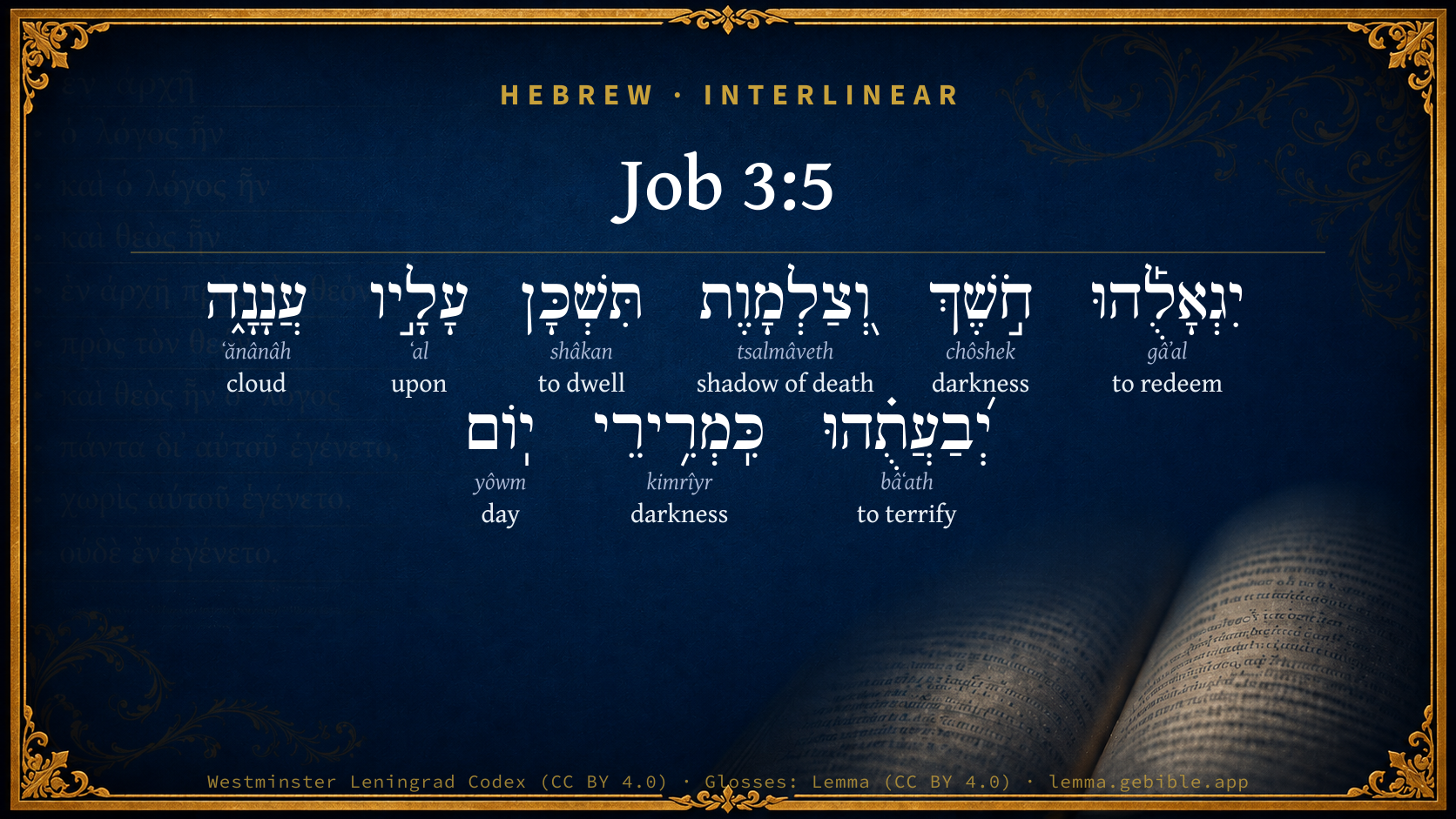
Job 3:5

Hebrew (Westminster Leningrad Codex) Job 3:5 appears in the Hebrew Old Testament. The text above is from the Westminster Leningrad Codex. Each word links to its Strong’s number, a concise gloss, and parsing drawn from the Open Scriptures Hebrew Bible morphology. Click any word for its full Brown-Driver-Briggs (BDB) entry.
Download image
Cite this verse

Job 3:5 (World English Bible). Public Domain. Lemma interlinear Bible study tool, https://lemma.gebible.app/v/job/3/5.

Show BibTeX & RIS
BibTeX
RIS
English Translation
Let darkness and the shadow of death claim it for their own. Let a cloud dwell on it. Let all that makes black the day terrify it.
World English Bible · Public Domain
Highlights Full analysis ↓
Download a study sheet

One document with this verse’s original text, its word-by-word gloss line, the meaning frame, cross-references with their text, attributed commentary, and full source and license credits — printable, and it pastes into notes with its structure intact.

This verse Autodidact and up

Study sheet (.html) Plain text (.txt)

A passage Seminary Student

Up to 50 verses in one chapter. A passage sheet keeps up to 6 commentary sources and 12 cross-references per verse, in the order this page ranks them, and says so on the sheet whenever that leaves anything out. Ask for a single verse and you get the Autodidact verse sheet above.

Everything on this page stays free to read, with no account — the sheet is a download of what is already on screen, not access to it.

Want to remove ads? Support Godless Engineer
Compare translations 3

The same verse in 3 English versions, stacked beneath the original-language interlinear above. Click any original word for its lexicon entry.

Each is an independent rendering of the whole verse — the interlinear is not word-aligned to these translations.

Highlighted words mark where these versions differ — a whole-verse word diff, not a word-by-word alignment.

  • World English Bible Public Domain
    Let darkness and the shadow of death claim it for their own. Let a cloud dwell on it. Let all that makes black the day terrify it.
  • King James Version Public Domain
    Let darkness and the shadow of death stain it; let a cloud dwell upon it; let the blackness of the day terrify it.
  • unfoldingWord Literal Text CC BY-SA 4.0
    May darkness and a dark shadow claim it; may a cloud dwell over it; may the blacknesses of the day terrify it.

unfoldingWord Literal Text — © unfoldingWord, licensed CC BY-SA 4.0. Word-aligned USFM3 via Door43 (git.door43.org/unfoldingWord/en_ult).

Versions to compare (up to 4)

3 of 4 selected

Show all 18 translations

Every available English version of this verse, each an independent rendering of the whole verse.

  • World English Bible Public Domain
    Let darkness and the shadow of death claim it for their own. Let a cloud dwell on it. Let all that makes black the day terrify it.
  • Berean Standard Bible Public Domain
    May darkness and gloom reclaim it, and a cloud settle over it; may the blackness of the day overwhelm it.
  • Majority Standard Bible Public Domain
    May darkness and gloom reclaim it, and a cloud settle over it; may the blackness of the day overwhelm it.
  • King James Version Public Domain
    Let darkness and the shadow of death stain it; let a cloud dwell upon it; let the blackness of the day terrify it.
  • American Standard Version (1901) Public Domain
    Let darkness and the shadow of death claim it for their own; Let a cloud dwell upon it; Let all that maketh black the day terrify it.
  • Revised Version (1885) Public Domain
    Let darkness and the shadow of death claim it for their own; let a cloud dwell upon it; let all that maketh black the day terrify it.
  • Geneva Bible (1599) Public Domain
    But let darkenesse, and the shadowe of death staine it: let the cloude remayne vpon it, and let them make it fearefull as a bitter day.
  • Douay-Rheims (1899) Public Domain
    Let darkness, and the shadow of death cover it, let a mist overspread it, and let it be wrapped up in bitterness.
  • Young's Literal Translation Public Domain
    Let darkness and death-shade redeem it, Let a cloud tabernacle upon it, Let them terrify it as the most bitter of days.
  • Literal Standard Version CC BY-SA 4.0
    Let darkness and death-shade redeem it, || Let a cloud dwell on it, || Let them terrify it as the most bitter of days.
  • Unlocked Literal Bible CC BY-SA 4.0
    May darkness and the shadow of death claim it for their own. May a cloud live over it; may everything that makes the day black truly terrify it.
  • unfoldingWord Literal Text CC BY-SA 4.0
    May darkness and a dark shadow claim it; may a cloud dwell over it; may the blacknesses of the day terrify it.
  • Darby Bible Public Domain
    Let darkness and the shadow of death claim it; let clouds dwell upon it; let darkeners of the day terrify it.
  • World Messianic Bible Public Domain
    Let darkness and the shadow of death claim it for their own. Let a cloud dwell on it. Let all that makes the day black terrify it.
  • Webster's Bible Public Domain
    Let darkness and the shades of death stain it; let a cloud dwell upon it; let the blackness of the day terrify it.
  • Free Bible Version CC BY-SA 4.0
    Take it back, darkness and death-shadow. A black cloud should overshadow it. It should be as terrifying as the darkness of an eclipse during the day.
  • Bible in Basic English Public Domain
    Let the dark and the black night take it for themselves; let it be covered with a cloud; let the dark shades of day send fear on it.
  • JPS Tanakh (1917) Public Domain
    Let darkness and the shadow of death claim it for their own; let a cloud dwell upon it; let all that maketh black the day terrify it.

Literal Standard Version (2020), Covenant Press — licensed CC BY-SA 4.0. Text via the HelloAO Bible API (eBible.org). Unlocked Literal Bible (unfoldingWord) — licensed CC BY-SA 4.0. Text via the HelloAO Bible API (eBible.org). unfoldingWord Literal Text — © unfoldingWord, licensed CC BY-SA 4.0. Word-aligned USFM3 via Door43 (git.door43.org/unfoldingWord/en_ult). Free Bible Version, Dr. Jonathan Gallagher — licensed CC BY-SA 4.0. Text via the HelloAO Bible API (eBible.org).

Word by word

More ways to search: Search by grammar → Find every occurrence → Compare this word →

Practice this passage: Drill this verse → Learn its vocabulary →

About this verse

These counts appear in no published source. They are computed here, from the morphology-tagged text and Lemma’s own curated glosses. What Lemma adds →

9
words
9
distinct lemmas
Wisdom
section

Notable vocabulary

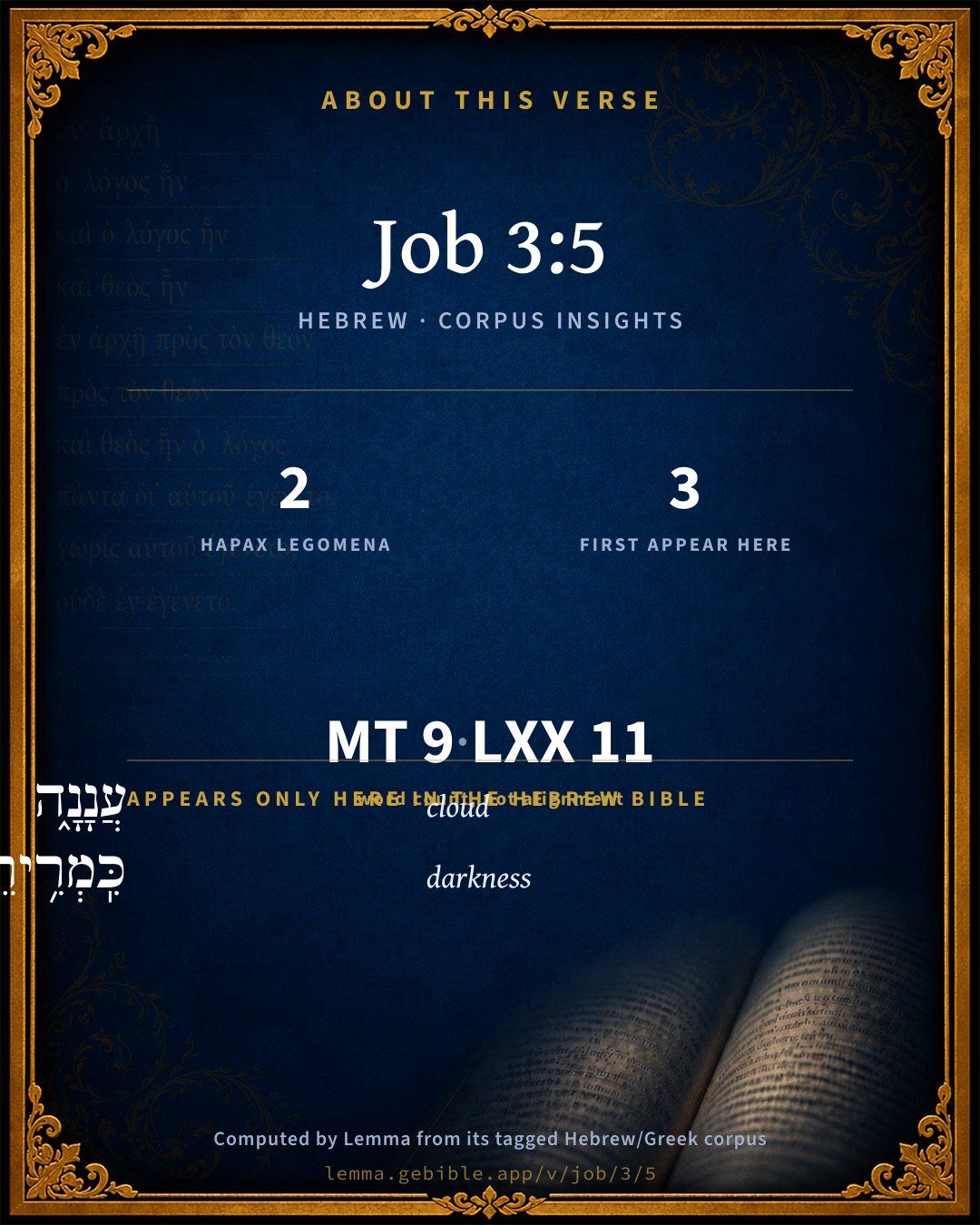
2 hapax legomena — words that appear only here in the entire Hebrew Bible:

  • עֲנָנָ֑ה cloud H6053
  • כִּֽמְרִ֥ירֵי darkness H3650

First appearance in Scripture

These words make their first canonical appearance in the Hebrew Bible here:

  • וְ֭צַלְמָוֶת shadow of death H6757
  • עֲנָנָ֑ה cloud H6053
  • כִּֽמְרִ֥ירֵי darkness H3650

Shared distinctive vocabulary

יְ֝בַעֲתֻ֗הוּ to terrify H1204 occurs in 16 verses of the Hebrew Bible. Also found in:

Grammatical profile

  • 3 verbs
  • 5 nouns
  • 1 preposition

Verb forms

  • יִגְאָלֻ֡הוּ Qal · Imperfect
  • תִּשְׁכָּן Qal · Imperfect
  • יְ֝בַעֲתֻ֗הוּ Piel · Imperfect

Hebrew & Septuagint length

In English translation the verse runs 27 words from the Hebrew and 15 from the Septuagint (LXX English) — the Septuagint runs noticeably shorter here. See the side-by-side →

A rough comparison of the two English renderings, which tokenize alike — not a word-level alignment.

Word counts can differ between the Hebrew and the Greek without any difference in meaning — e.g. the Hebrew direct-object marker אֵת has no separate Greek word, and Greek often adds the article ὁ.

In the original languages it is 9 Hebrew tokens and 11 Greek tokens — but the two are counted differently (Hebrew bundles its prefixes and suffixes into one token; the Greek is in lemma form), so that isn’t a like-for-like length.

Cross-references

22

Topical passages linked to Job 3:5 in the Treasury of Scripture Knowledge — connected by theme and wording, ordered by reader-vote popularity; previews shown in the World English Bible.

  • Job 10:21–22 Before I go where I shall not return from, To the land of darkness and of the shadow of death;
  • Job 28:3 Man sets an end to darkness, And searches out, to the furthest bound, The stones of obscurity and of thick darkness.
  • Psalms 23:4 Even though I walk through the valley of the shadow of death, I will fear no evil, for you are with me. Your rod and your staff, they comfort me.
  • Jeremiah 2:6 Neither said they, Where is Yahweh who brought us up out of the land of Egypt, who led us through the wilderness, through a land of deserts and of pits, through a land of drought and of the shadow of death, through a land that none passed through, and where no man lived?
  • Deuteronomy 4:11 You came near and stood under the mountain; and the mountain burned with fire to the heart of the sky, with darkness, cloud, and thick darkness.
  • Psalms 107:10 Some sat in darkness and in the shadow of death, Being bound in affliction and iron,
  • Psalms 107:14 He brought them out of darkness and the shadow of death, And broke their bonds in sunder.
  • Isaiah 9:2 The people who walked in darkness have seen a great light: those who lived in the land of the shadow of death, on them has the light shined.
  • Jeremiah 4:28 For this shall the earth mourn, and the heavens above be black; because I have spoken it, I have purposed it, and I have not repented, neither will I turn back from it.
  • Jeremiah 13:16 Give glory to Yahweh your God, before he cause darkness, and before your feet stumble on the dark mountains, and, while you look for light, he turn it into the shadow of death, and make it gross darkness.
  • Ezekiel 34:12 As a shepherd seeks out his flock in the day that he is among his sheep that are scattered abroad, so will I seek out my sheep; and I will deliver them out of all places where they have been scattered in the cloudy and dark day.
  • Job 16:16 My face is red with weeping. Deep darkness is on my eyelids.
  • Job 24:17 For the morning is to all of them like thick darkness, For they know the terrors of the thick darkness.
  • Job 38:17 Have the gates of death been revealed to you? Or have you seen the gates of the shadow of death?
  • Matthew 4:16 The people who sat in darkness saw a great light, To those who sat in the region and shadow of death, To them light has dawned."
  • Luke 1:79 To shine on those who sit in darkness and the shadow of death; To guide our feet into the way of peace."
  • Psalms 44:19 Though you have crushed us in the haunt of jackals, And covered us with the shadow of death.
  • Ezekiel 30:3 For the day is near, even the day of Yahweh is near; it shall be a day of clouds, a time of the nations.
  • Joel 2:2 A day of darkness and gloominess, A day of clouds and thick darkness. As the dawn spreading on the mountains, A great and strong people; There has never been the like, Neither will there be any more after them, Even to the years of many generations.
  • Amos 5:8 Seek him who made the Pleiades and Orion, And turns the shadow of death into the morning, And makes the day dark with night; Who calls for the waters of the sea, And pours them out on the surface of the earth, Yahweh is his name,
  • Amos 8:10 I will turn your feasts into mourning, And all your songs into lamentation; And I will make you wear sackcloth on all your bodies, And baldness on every head. I will make it like the mourning for an only son, And the end of it like a bitter day.
  • Hebrews 12:18 For you have not come to a mountain that might be touched, and that burned with fire, and to blackness, darkness, tempest,

Cross-references courtesy of OpenBible.info (CC BY 4.0).

Hebrew and Greek witnesses Masoretic Hebrew ↔ Greek Septuagint

The same verse in the two great witnesses to the Old Testament, shown verse-for-verse.

Here the Septuagint runs noticeably shorter than the Hebrew — LXX2012 (modern English Septuagint) 15 words vs World English Bible 27. A rough length comparison of the two English translations, not a word-level alignment — read both below.

These are two independent witnesses, not word-aligned to each other, and the Septuagint is shown in lemma (dictionary) form.

Hebrew Job 3:5 Masoretic · Westminster Leningrad Codex

יִגְאָלֻ֡הוּ חֹ֣שֶׁךְ וְ֭צַלְמָוֶת תִּשְׁכָּן עָלָ֣יו עֲנָנָ֑ה יְ֝בַעֲתֻ֗הוּ כִּֽמְרִ֥ירֵי יֽוֹם

Let darkness and the shadow of death claim it for their own. Let a cloud dwell on it. Let all that makes black the day terrify it.

World English Bible · Public Domain

Greek LXX Job 3:5 Septuagint · lemma form

ἐκλαμβάνω δέ αὐτός σκότος καί σκιά θάνατος ἐπιἔρχομαι ἐπί αὐτός γνόφος

But let darkness and the shadow of death seize it; let blackness come upon it;

LXX2012 (modern English Septuagint) · Public Domain

On this verse, Adam Clarke's Commentary discusses the Septuagint’s reading. Read the note in Commentary ↓

Hebrew: Westminster Leningrad Codex (CC BY 4.0). Greek: Septuagint (public domain); English from LXX2012 (modern English Septuagint) (Public Domain). How the Septuagint differs from the Hebrew →

Commentary

Notes on Job 3:5 from classic Christian and Jewish commentators (each source and its license shown beneath its notes). The classic Christian expositions comment on the surrounding passage and are grouped to its opening verse, so a note may address several verses; the Jewish commentaries on the Tanakh (Rashi and others) are per-verse, so they appear only where the commentator wrote on this verse.

Lemma curates 59 commentaries, every one of them public domain or Creative Commons licensed, each selected and text-cleaned for this edition rather than reprinted as found. About our sources →

Trapp's Complete Commentary

John Trapp

Job 3:5 Let darkness and the shadow of death stain it; let a cloud dwell upon it; let the blackness of the day terrify it.

Ver. 5. Let darkness and the shadow of death stain it] Let it be dies luctuosus et lethalis, such a deadly dark day, that each man may think it his last day, fatal and feral. Let there not be dimness only (such as appeareth through a painted glass, dyed with some obscure colour), but horrid and hideous darkness, such as was that at our Saviour’s passion, when the sun was totally eclipsed, and a great philosopher thereupon cried out, Either the God of Nature suffers, or the world is at an end. To darkness Job here emphatically addeth the shadow of death. The shadow is the dark part of the thing, so that the shadow of death is the darkest side of death, death in its blackest representation. Now let these stain it, saith he, or challenge it, or espouse it. In nocte funestatur mundi honor - Sordent, silent, stupent cuncta, saith Tertullian, elegantly.

Let a cloud dwell upon it] Crescit etiamnum per Auxesin oratio. Job heaps up words, like in sound, and not unlike in sense. Grief had made him eloquent; as hoping thereby to ease himself. "Let a cloud dwell upon it," a fixed cloud, not such a one as continually hangeth over the island of St Thomas, on the back side of Africa, wherewith the whole island is watered; nor such a cloud of grace as God promiseth to create upon every dwelling place of Mount Zion, and upon her assemblies, that upon all his glory may be a defence, Isa 4:5. But such as St Paul and his company were under before the shipwreck, Act 27:20, when neither sun nor star appeared for many days together, the heavens being wholly muffled, &c.

Let the blackness of the day terrify it] Or, Let the heat of the day terrify it; as it befalleth those that live under the torrid zone, where nothing prospereth. The Atlantes (a certain people) are said to curse the rising sun, it doth so torture them with extreme heat. When the dog star ariseth, those are in ill case who dwell in hot countries towards the east, they are troubled and terrified. Some take the word Chimrine, here rendered blackness, for those Chemarims mentioned by the prophets, those chimney chaplains of the heathen idols, and so render it thus, Let the priests of the day terrify it, Hinc forsan tenebrae Cimmeriae; that is, Let those who used to observe and distinguish days note it for a terrible day. Others understand it of the noon day devils, that should vex people on that day with hellish heats and fires: the Vulgate Latin hath it thus, Let, as it were, the bitternesses of the day terrify it: and to the same sense the Chaldee Paraphrast. Job still riseth in his discourse, making use of many poetical figures, and tragic phrases, picked out for the purpose.

John Trapp, A Commentary or Exposition upon All the Books of the Old and New Testament (1647–1656) — public domain. Text from a community e-Sword module.

Joseph Benson's Commentary

Job 3:5. Let darkness and the shadow of death — Let the most dismal darkness, like that of the place of the dead, which is a land of darkness, and where the light is darkness, Job 10:21-22; or darkness so gross and palpable, that its horrors are insupportable; stain it — Take away its beauty and glory, and render it abominable as a filthy thing; or, rather, challenge or claim it, as the word יגאלהו, jigaluhu, here used, may properly be rendered, the verb גאל, gaal, signifying, primarily, to avenge, redeem, rescue, deliver, claim, possess. Indeed, as Houbigant justly observes, “There enters nothing of pollution into the idea of darkness.” Let a cloud dwell upon it, &c. — Let the thickest clouds wholly possess it, and render it terrible to men. Dr. Waterland renders the last clause, Let the blackness make it hideous.

Joseph Benson's Commentary on the Old and New Testaments (1811–1818) — public domain. Text from a community e-Sword module.

Tyndale Open Study Notes

Tyndale Open Resources

3:5 Job longed for the sinister darkness of the underworld (Exod 10:22; Prov 4:19; Joel 2:2) and the gloom of death (Job 10:21-22; 38:17) to claim the day of his birth.

Tyndale Open Study Notes — © Tyndale Open Resources, licensed CC BY-SA 4.0. Text via the HelloAO Bible API.

Geneva Bible (1599)

Geneva Bible translators

That is, most obscure darkness, which maketh them afraid of death that are in it.

Geneva Bible (1599) marginal notes — public domain. Text via Bolls.life.

Jamieson, Fausset & Brown

Robert Jamieson, A. R. Fausset & David Brown

Let . . . the shadow of death--("deepest darkness," Isa 9:2).

stain it--This is a later sense of the verb [GESENIUS]; better the old and more poetic idea, "Let darkness (the ancient night of chaotic gloom) resume its rights over light (Gen 1:2), and claim that day as its own."

a cloud--collectively, a gathered mass of dark clouds.

the blackness of the day terrify it--literally, "the obscurations"; whatever darkens the day [GESENIUS]. The verb in Hebrew expresses sudden terrifying. May it be suddenly affrighted at its own darkness. UMBREIT explains it as "magical incantations that darken the day," forming the climax to the previous clauses; Job 3:8 speaks of "cursers of the day" similarly. But the former view is simpler. Others refer it to the poisonous simoom wind.

Jamieson, Fausset & Brown — Commentary Critical and Explanatory on the Whole Bible (1871) — public domain (CC PDM 1.0). Text via the HelloAO Bible API.

Adam Clarke's Commentary

Verse 5. Let darkness and the shadow of death stain it] יגאלהו yigaluhu, "pollute or avenge it," from גאל gaal, to vindicate, avenge, c. hence גאל goel, the nearest of kin, whose right it was to redeem an inheritance, and avenge the death of his relative by slaying the murderer. Let this day be pursued, overtaken, and destroyed. Let natural darkness, the total privation of the solar light, rendered still more intense by death's shadow projected over it, seize on and destroy this day, εκλαβοι αυτην, Septuagint; alluding, perhaps, says Mr. Parkhurst, to the avenger of blood seizing the offender.

Let a cloud dwell upon it] Let the dymme cloude fall upon it. - Coverdale. Let the thickest clouds have there their dwelling-place-let that be the period of time on which they shall constantly rest, and never be dispersed. This seems to be the import of the original, תשכן עליו אננה tishcan alaiv ananah. Let it be the place in which clouds shall be continually gathered together, so as to be the storehouse of the densest vapours, still in the act of being increasingly condensed.

Let the blackness of the day terrify it.] And let it be lapped in with sorrowe. - Coverdale. This is very expressive: lap signifies to fold up, or envelope any particular thing with fold upon fold, so as to cover it everywhere and secure it in all points. Leaving out the semicolon, we had better translate the whole clause thus: "Let the thickest cloud have its dwelling-place upon it, and let the bitterness of a day fill it with terror." A day similar to that, says the Targum, in which Jeremiah was distressed for the destruction of the house of the sanctuary; or like that in which Jonah was cast into the sea of Tarsis; such a day as that on which some great or national misfortune has happened: probably in allusion to that in which the darkness that might be felt enveloped the whole land of Egypt, and the night in which the destroying angel slew all the first-born in the land.

Adam Clarke's Commentary on the Bible (1810–1826) — public domain. Text from a community e-Sword/MySword module.

Ellicott's Commentary for English Readers

(5) Stain.—Literally, redeem—i.e., claim as their rightful inheritance. The other meaning enters into this word, as in Isa_63:3; Mal_1:7.

Blackness of the day—i.e., preternatural darkness, inopportune and unexpected darkness, like that of eclipses, &c.

A Bible Commentary for English Readers, edited by Charles John Ellicott (1878–1897) — public domain. Text from a community e-Sword module.

The Cambridge Bible for Schools and Colleges

gen. ed. J. J. S. Perowne

5. shadow of death stain it] Rather, claim it, lit. redeem it. Let it become part of the possession of darkness. The word, however, does not mean reclaim, as if the idea were that the day had been won from darkness by light and was to be reconquered. The translation “shadow of death” possibly rests on a false etymology; at the same time it is perhaps the best that can be given, and Hitzig’s conjecture that the Hebrews themselves came to see the word “death” in the termination of the form may not be far astray, comp. Job_38:17. The word originally means “deepest darkness.”

the blackness of the day] lit. blacknesses. The word probably means “all that makes black the day,” eclipses, supernatural obscurations and the like—all ominous darknesses that terrify a day.

The Cambridge Bible for Schools and Colleges (gen. ed. J. J. S. Perowne; Cambridge University Press, 1878–1918) — public domain. Text from a community e-Sword module.

John Gill's Exposition

Let darkness and the shadow of death stain it,.... Let there be such darkness on it as on persons when dying, or in the state of the dead; hence the sorest afflictions, and the state of man in unregeneracy, are compared unto it, Psa 23:4; let there be nothing but foul weather, dirt, and darkness in it, which may make it very uncomfortable and undesirable; some render the word, "let darkness and the shadow of death redeem it" (z), challenge and claim it as their own, and let light have no share or property in it:

let a cloud dwell upon it; as on Mount Sinai when the law was given; a thick dark cloud, even an assemblage of clouds, so thick and close together, that they seem but one cloud which cover the whole heavens, and obscure them, and hinder the light of the sun from shining on the earth; and this is wished to abide not for an hour or two, but to continue all the day:

let the blackness of the day terrify it; let it be frightful to itself; or rather, let the blackness be such, or the darkness of it such gross darkness, like that as was felt by the Egyptians; that the inhabitants of the earth may be terrified with it, as Moses and the Israelites were at Mount Sinai, at the blackness, tempest, thunders, and lightnings, there seen and heard: as some understand this of black vapours exhaled by the sun, with which the heavens might be filled, so others of sultry weather and scorching heat, which is intolerable: others render the words, "let them terrify it as the bitternesses of the day" (a); either with bitter cursings on it, or through bitter calamities in it; or, "as those who have a bitter (b) day", as in the margin of our Bibles, and in others.

(z) "vindicassent", Junius & Tremellius; "vendicent", Cocceius; "vindicent", Schultens. (a) "tanquam amaritudines dici", Schmidt, Michaelis; "velut amarulenta diei", Schultens; so the Targum. (b) "Velut amari diei", Mercerus; "tanquam amari diei", Montanus.

John Gill's Exposition of the Whole Bible (1746–1763) — public domain (CC PDM 1.0). Text via the HelloAO Bible API.

Albert Barnes' Notes on the Bible

Let darkness and the shadow of death - The Hebrew word צלמות tsalmâveth is exceedingly musical and poetical. It is derived from צל tsêl, “a shadow,” and מות mâveth, “death;” and is used to denote the deepest darkness; see the notes at Isa 9:2. It occurs frequently in the sacred Scriptures; compare Job 10:21-22; Psa 23:4; Job 12:22; Job 16:16; Job 24:17; Job 34:22; Job 38:17; Amo 5:8; Jer 2:6. It is used to denote the abode of departed spirits, described by Job as “a land of darkness, as darkness itself; of the shadow of death without any order, and where the light is as darkness;” Job 10:21-22. The idea seems to have been, that “death” was a dark and gloomy object that obstructed all light, and threw a baleful shade afar, and that that melancholy shade was thrown afar over the regions of the dead. The sense here is, that Job wished the deepest conceivable darkness to rest upon it.

Stain it - Margin, or “challenge.” Vulgate, “obscure it.” Septuagint, “take or occupy it,” Ἐκλάβοι Eklaboi, Dr. Good, “crush it.” Noyes, “redeem it.” Herder, “seize it.” This variety of interpretation has arisen in part from the twofold signification of the word used here, גאל gā'al. The word means either to “redeem,” or to “defile,” “pollute,” “stain.” These senses are not very closely connected, and I know not how the one has grown out of the other, unless it be that redemption was accomplishcd with blood, and that the frequent sprinkling of blood on an altar rendered it defiled, or unclean. In one sense, blood thus sprinkled would purify, when it took away sin; in another, it would render an object unclean or polluted. Gesenius says, that the latter signification occurs only in the later Hebrew. If the word here means to “redeem,” the sense is, that Job wished darknessto resume its dominion over the day, and rcdeem it to itself, and thus wholly to exclude the light.

If the word means to defile or pollute, the sense is, that he desired the death-shade to stain the day wholly black; to take out every ray of light, and to render it wholly obscure. Gesenius renders it in the former sense. The sense which Reiske and Dr. Good give to the word, “crush it,” is not found in the Hebrew. The word means to defile, stain, or pollute, in the following places, namely,: it is rendered “pollute” and “polluted” in Mal 1:7, Mal 1:12; Zep 3:1; Lam 4:14; Ezr 2:62; Neh 7:64; “defile” or “defiled” in Isa 59:3; Dan 1:8; Neh 13:29; and “stain” in Isa 63:3. It seems to me that this is the sense here, and that the meaning has been well explained by Schultens, that Job wished that his birthday should be involved in a deep “stain,” that it should be covered with clouds and storms, and made dark and dismal. This imprecation referred not only to the day on which he was born, but to each succeeding birthday. Instead of its being on its return a bright and cheerful day, he wished that it might be annually a day of tempests and of terrors; a day so marked that it wouId excite attention as especially gloomy and inauspicious. It was a day whose return conveyed no pleasure to his soul, and which he wished no one to observe with gratitude or joy.

Let a cloud dwell upon it - There is, as Dr. Good and others have remarked, much sublimity iu this expression. The Hebrew word rendered “a cloud” עננה ‛ănânâh occurs nowhere else in this form. It is the feminine form of the word ענן ‛ânân, “a cloud,” and is used “collectively” to denote “clouds;” that is, clouds piled on clouds; clouds “condensed, impacted, heaped together” (Dr. Good), and hence, the gathered tempest, the clouds assembled deep and dark, and ready to burst forth in the fury of a storm. Theodotion renders it συννεφέα sunnefea, “assembled clouds;” and hence, “darkness,” The Septuagint renders it γνόφος gnophos, “tempest,” or “thick darkness.” So Jerome, “caligo.” The word rendered “dwell upon it” שׁכן shâkan, means properly to “settle down,” and there to abide or dwell. Perhaps the original notion was that of fixing a tent, and so Schultens renders it, “tentorium figat super eo Nubes,” “Let the cloud pitch its tent over it;” rendered by Dr. Good, “The gathered tempest pavilion over it!” “This is an image,” says Schultens, “common among the Arabs.” The sense is, that Job wished clouds piled on clouds to settle down on the day permanently, to make that day their abode, and to involve it in deep and eternal night.

Let the blackness of the day terrify it - Margin, “Or, Let them terrify it as those who have a bitter day.” There has been great variety in the interpretation of this passage. Dr. Good renders it, “The blasts of noontide terrify it.” Noyes, “Let whatever darkens the day terrify it.” Herder, “The blackness of misfortune terrify it.” Jerome, Et involvatur amaritudine, “let it be involved in bitterness.” The Septuagint, καταραθείη ἡ ἡμέρα katarathein hē hēmera, “let the day be cursed.” This variety has arisen from the difficulty of determining the sense of the Hebrew word used here and rendered “blackness,” כמרירים kı̂mrı̂yrı̂ym. If it is supposed to be derived from the word כמר kâmar, to be warm, to be hot, to burn, then it would mean the deadly heats of the day, the dry and sultry blasts which prevail so much in sandy deserts. Some writers suppose that there is a reference here to the poisonous wind Samum or Samiel, which sweeps over those deserts, and which is so much dreaded in the beat of summer. “Men as well as animals are often suffocated with this wind. For during a great heat, a current of air often comes which is still hotter; and when human beings and animals are so exhausted that they almost faint away with the heat, it seems that this little addition quite deprives them of breath. When a man is suffocated with this wind, or when, as they say, his heart is burst blood is said to flow from his nose and ears two hours after his death. The body is said to remain long warm, to swell, to turn blue and green, and if the arm or leg is taken hold of to raise it up, the limb is said to come off.”

Burder’s Oriental customs, No. 176. From the testimony of recent travelers, however, it would seem that the injurious effects of this wind have been greatly exaggerated. If this interpretation be the true one, then Job wished the day of his birth to be frightful and alarming, as when such a poisonous blast should sweep along all day, and render it a day of terror and dread. But this interpretation does not well suit the parallelism. Others, therefore, understand by the word, “obscurations,” or whatever darkens the day. Such is the interpretation of Gesenius, Bochart, Noyes, and some others. According to this, the reference is to eclipses or fearful storms which cover the day in darkness. The noun here is not found elsewhere; but the “verb” כמר kâmar is used in the sense of being black and dark in Lain. v. 10: “Our skin was black like an oven, because of the terrible famine;” or perhaps more literally, “Our skin is scorched as with a furnace, from the burning heat of famine.”

That which is burned becomes black, and hence, the word may mean that which is dark, obscure, and gloomy. This meaning suits the parallelism, and is a sense which the Hebrew will bear. Another interpretation regards the Hebrew letter כ (k) used as a prefix before the word כמרירים kı̂mrı̂yrı̂ym “bitterness,” and then the sense is, “according to the bitterness of the day;” that is, the greatest calamities which can happen to a day. This sense is found in several of the ancient versions, and is adopted by Rosenmuller. To me it seems that the second interpretation proposed best suits the connection, and that the meaning is, that Job wished that everything which could render the day gloomy and obscure might rest upon it. The Chaldee adds here,” Let it be as the bitterness of day - the grief with which Jeremiah was afflicted in being cut off from the house of the sanctuary, and Jonah in being cast into the sea of Tarshish.”

Albert Barnes' Notes on the Bible (1834–1885) — public domain. Text from a community e-Sword/MySword module.

Matthew Poole's English Annotations

Darkness and the shadow of death, i.e. a black and dark shadow, like that of the place of the dead, which is a land of darkness, and where the light is darkness, as Job explains this very phrase, Job 10:21,22; or so gross and palpable darkness, that by its horrors and damps may take away men’s spirits and lives.

Stain it, i.e. take away its beauty and glory, and make it abominable, as a filthy thing. Or,

challenge it, i.e. take and keep the entire possession of it, so as the light may not have the least share in it.

Terrify it, to wit, the day, i.e. men in it. Let it be always observed as a frightful and dismal day.

Matthew Poole's English Annotations on the Holy Bible (1683–1685) — public domain. Text from a community e-Sword/MySword module.

Whedon's Commentary on the Bible

Daniel D. Whedon

5. The shadow of death — צלמות tsal-maweth, was regarded by the ancients as one of the very few Hebrew compound words; but now, by De Dieu and many moderns, it is taken to be a derivative from צלם, to be dark. Compare Arabic, Zalima, of the same meaning. Ewald and Dillmann point differently, and read tsalmouth, “black darkness;” the latter of whom looks upon the idea of shadow in connexion with sheol as a feeble word to express the extreme darkness of Orcus, (Sheol.) Its gradational use here in connexion with darkness, as well as elsewhere in Scripture, (chapters Job_10:21; Job_28:3; Job_34:22; Psa_107:14,) points to its true meaning of deep and terrible darkness, such as the popular imagination in that day associated with the regions of the dead. It also appears in contradistinction to light, (Job_12:22;) as an attributive of sheol, (Job_10:21;) and in connexion with the gates of the world of the dead, (Job_38:17.). It is also used metaphorically for affliction, Job_16:16; and for evil and calamity, Psa_44:19; Isa_9:2. On the supposition that it is a compound word, the idea of “shadow of death” may have sprung from the darkness so frequently noticed to creep over the sight of the dying, which even now strikes terror, if so be at evening time it be not light. Zec_14:7. (See note on Mat_4:16.)

Stain it — גאל, claim or redeem it, the common and accepted meaning of the word. Our translators, following the Targum, probably took their rendering from געל, a kindred form of the word. The day of Job’s birth was once their possession, (Gen_1:2,) and as kinsmen the primeval darkness and chaos have a right to redeem and bring it back, as belonging to them, and not to the light. (Lev_25:25.)

Cloud dwell upon it — “Let the cloud pitch its tent over it.” — Schultens. This is an image common among the Arabs, and is thus illustrated by Schultens from the Arabic history of Tamerlane: “And when the darkness of the night shall dissolve its tents, and the dawn, as if marching forth to banquet, shall unfold her banners.”

The blackness — כמרירי, (from כמר, “to be burnt,” “to be black,”) the darkenings or obscurations. The marginal rendering is that of Schultens, Mercer, etc. This is now of as little consideration as will be the proposed emendation of Hitzig, who changes the second רinto ד, thus making the expression similar to that of Job_24:13, (which see,) “like apostates from the light.” This view, which is not original, Furst had already condemned. The reading as above, “darkenings of the day,” is now generally accepted. Reference is supposed to be made to the darkness caused by an eclipse, which was thought by most ancient nations to forebode disaster. Thus Renan — “Let an eclipse, fill it with terror.”

Daniel D. Whedon (gen. ed.), Commentary on the Old and New Testaments (1874–1909) — public domain. Text from a community e-Sword module.

The Pulpit Commentary

Let darkness and the shadow of death. "The shadow of death" (twmlx) is a favourite expression in the Book of Job, where it occurs no fewer than nine times. Elsewhere it is rare, except in the Psalms, where it occurs four times. It is thought to be an archaic word. Stain it; rather, claim it, or claim it for their own (Revised Version). Let a cloud dwell upon it; let the blackness of the day terrify it. The hot, stifling "blackness" of the khamsin wind is probably meant, which suddenly turns the day into night, spreading all around a thick lurid darkness. When such a wind arises, we are told, "The sky instantly becomes black and heavy; the sun loses its splendour, and appears of a dim violet hue; a light, warm breeze is felt, which gradually increases in heat till it almost equals that of an oven. Though no vapour darkens the air, it becomes so grey and thick with the floating clouds of impalpable sand, that it is sometimes necessary to use candles at noonday" (Russell, "Ancient and Modern Egypt," p. 55).

The Pulpit Commentary (1880–1919), ed. H.D.M. Spence-Jones & Joseph S. Exell — public domain. Text from a community e-Sword module.

John Wesley's Explanatory Notes

Death - A black and dark shadow like that of the place of the dead, which is a land of darkness. Slain - Take away its beauty and glory. Terrify - That is, men in it. Let it be always observed as a frightful and dismal day.

John Wesley, Explanatory Notes Upon the Whole Bible (1754–1765) — public domain. Text via the GEBible commentary corpus.

Rashi

Rabbi Shlomo Yitzchaki (Rashi)

defile it Heb. יגאלהו, like (Malachi 1:7), “defiled (מגאל) bread”; “How have we defiled You (גאלנוך)?” an expression of contamination.

the shadow of death Heb. צלמות, the shadow of death, darkness that never lights up.

like demons of the day Heb. כמרירי, demons who rule at noon, like (Deut. 32: 34), “Ketev Meriri,” who rules at noon; as it is stated (Ps. 91:6): “from Ketev, who rules at noontime.”

Rashi on the Tanakh — English translations: “The Judaica Press complete Tanach with Rashi, translated by A. J. Rosenberg” (CC BY 4.0); “Pentateuch with Rashi's commentary by M. Rosenbaum and A.M. Silbermann, 1929-1934” (public domain); “The Metsudah Tanach series, Lakewood, N.J” (CC BY 4.0); and “The Book of Joshua, Metsudah Publications, 1997” (CC BY 4.0). Text via Sefaria.

Lesson kit

Teaching starters — assembled from the data on this page, not authored interpretation. Every prompt links to the verse data it draws on. Edit before teaching.

Job, in the Wisdom, opens this verse with 9 words (9 distinct Hebrew lemmas). Its most distinctive word is ʻănânâh (“cloud”). The Greek Septuagint runs shorter here. A historical commentator’s framing appears above. Read the whole chapter for the surrounding context.

Discussion questions

  1. The word ʻănânâh carries the sense “cloud.” How does it shape the verse?
  2. 2 words here appear nowhere else in the Hebrew Bible. Why might the author reach for such rare wording?
  3. 3 words make their first appearance in Scripture here. What does this debut establish?
  4. How does 1 Samuel 16:14, which shares the word «to terrify», read alongside this verse?
  5. The Septuagint runs shorter here than the Hebrew. What might account for the difference?
  6. The translations on this page render this verse differently — a whole-verse word diff, not a word-by-word alignment. What might account for the different wordings?
  7. «יִגְאָלֻ֡הוּ» is a Qal Imperfect verb. How does that grammatical form shape the action described?
  8. Compare how Trapp's Complete Commentary and Joseph Benson's Commentary read this verse. Where do they agree or differ?

Things to notice

Reading settings

Reading text

Shown beneath each verse's original-language words.

Old Testament
Old Testament edition

Read the OT as the Masoretic Hebrew (MT) or the Greek Septuagint (LXX).

English shown for the Greek Septuagint (in the Hebrew ↔ Greek comparison).

Comparing translations? Open the Compare panel on any verse page to stack up to four side by side.