Psalms 65:4

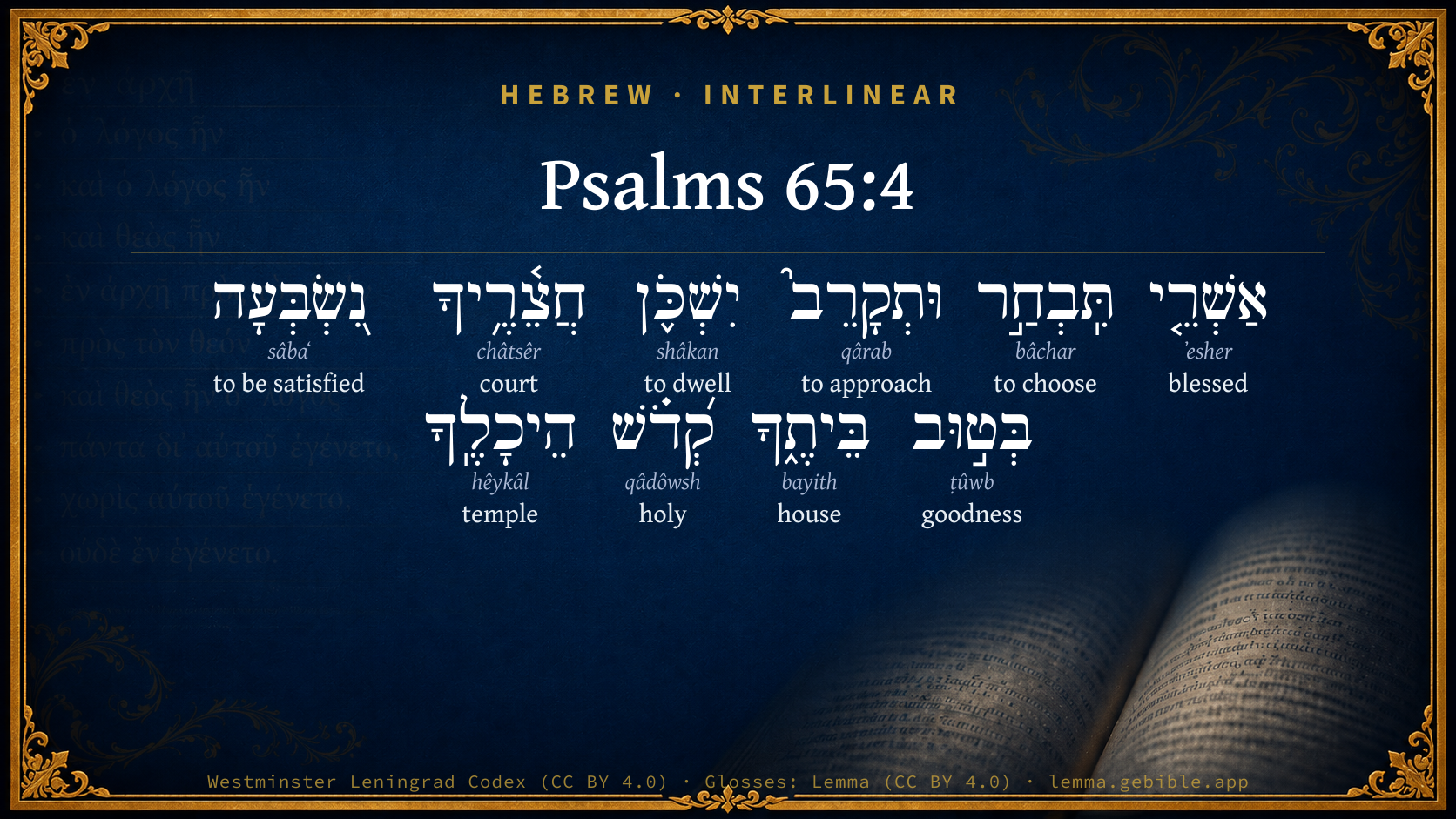
Hebrew (Westminster Leningrad Codex) Psalms 65:4 appears in the Hebrew Old Testament. The text above is from the Westminster Leningrad Codex. Each word links to its Strong’s number, a concise gloss, and parsing drawn from the Open Scriptures Hebrew Bible morphology. Click any word for its full Brown-Driver-Briggs (BDB) entry.
Download image
Cite this verse

Psalms 65:4 (World English Bible). Public Domain. Lemma interlinear Bible study tool, https://lemma.gebible.app/v/psalms/65/4.

Show BibTeX & RIS
BibTeX
RIS
English Translation
Blessed is one whom you choose, and cause to come near, That he may live in your courts. We will be filled with the goodness of your house, Your holy temple.
World English Bible · Public Domain
Download a study sheet

One document with this verse’s original text, its word-by-word gloss line, the meaning frame, cross-references with their text, attributed commentary, and full source and license credits — printable, and it pastes into notes with its structure intact.

This verse Autodidact and up

Study sheet (.html) Plain text (.txt)

A passage Seminary Student

Up to 50 verses in one chapter. A passage sheet keeps up to 6 commentary sources and 12 cross-references per verse, in the order this page ranks them, and says so on the sheet whenever that leaves anything out. Ask for a single verse and you get the Autodidact verse sheet above.

Everything on this page stays free to read, with no account — the sheet is a download of what is already on screen, not access to it.

Want to remove ads? Support Godless Engineer
Compare translations 3

The same verse in 3 English versions, stacked beneath the original-language interlinear above. Click any original word for its lexicon entry.

Each is an independent rendering of the whole verse — the interlinear is not word-aligned to these translations.

Highlighted words mark where these versions differ — a whole-verse word diff, not a word-by-word alignment.

  • World English Bible Public Domain
    Blessed is one whom you choose, and cause to come near, That he may live in your courts. We will be filled with the goodness of your house, Your holy temple.
  • King James Version Public Domain
    Blessed is the man whom thou choosest, and causest to approach unto thee, that he may dwell in thy courts: we shall be satisfied with the goodness of thy house, even of thy holy temple.
  • unfoldingWord Literal Text CC BY-SA 4.0
    The happinesses of you choose and bring near, that he may dwell your courts! May we be full of the goodness of your house, the holiness of your temple.

unfoldingWord Literal Text — © unfoldingWord, licensed CC BY-SA 4.0. Word-aligned USFM3 via Door43 (git.door43.org/unfoldingWord/en_ult).

Versions to compare (up to 4)

3 of 4 selected

Show all 18 translations

Every available English version of this verse, each an independent rendering of the whole verse.

  • World English Bible Public Domain
    Blessed is one whom you choose, and cause to come near, That he may live in your courts. We will be filled with the goodness of your house, Your holy temple.
  • Berean Standard Bible Public Domain
    Blessed is the one You choose and bring near to dwell in Your courts! We are filled with the goodness of Your house, the holiness of Your temple.
  • Majority Standard Bible Public Domain
    Blessed is the one You choose and bring near to dwell in Your courts! We are filled with the goodness of Your house, the holiness of Your temple.
  • King James Version Public Domain
    Blessed is the man whom thou choosest, and causest to approach unto thee, that he may dwell in thy courts: we shall be satisfied with the goodness of thy house, even of thy holy temple.
  • American Standard Version (1901) Public Domain
    Blessed is the man whom thou choosest, and causest to approach `unto thee', That he may dwell in thy courts: We shall be satisfied with the goodness of thy house, Thy holy temple.
  • Revised Version (1885) Public Domain
    Blessed is the man whom thou choosest, and causest to approach unto thee, that he may dwell in thy courts: we shall be satisfied with the goodness of thy house, the holy place of thy temple.
  • Geneva Bible (1599) Public Domain
    Blessed is he, whom thou chusest and causest to come to thee: he shall dwell in thy courtes, and we shall be satisfied with the pleasures of thine House, euen of thine holy Temple.
  • Douay-Rheims (1899) Public Domain
    The words of the wicked have prevailed over us: and thou wilt pardon our transgressions.
  • Young's Literal Translation Public Domain
    O the happiness of `him whom' Thou choosest, And drawest near, he inhabiteth Thy courts, We are satisfied with the goodness of Thy house, Thy holy temple.
  • Literal Standard Version CC BY-SA 4.0
    O the blessedness of [him whom] You choose, || And draw near, he inhabits Your courts, || We are satisfied with the goodness of Your house, || Your holy temple.
  • Unlocked Literal Bible CC BY-SA 4.0
    Blessed is the man whom you choose to bring near to you so that he may live in your courts. We will be satisfied with the goodness of your house, your holy temple.
  • unfoldingWord Literal Text CC BY-SA 4.0
    The happinesses of you choose and bring near, that he may dwell your courts! May we be full of the goodness of your house, the holiness of your temple.
  • Darby Bible Public Domain
    Blessed is he whom thou choosest and causest to approach: he shall dwell in thy courts. We shall be satisfied with the goodness of thy house, of thy holy temple.
  • World Messianic Bible Public Domain
    Blessed is the one whom you choose and cause to come near, that he may live in your courts. We will be filled with the goodness of your house, your holy temple.
  • Webster's Bible Public Domain
    \\65:3\\Iniquities prevail against me: as for our transgressions, thou shalt purge them away.
  • Free Bible Version CC BY-SA 4.0
    Happy are those you choose to keep close to you, those who live in your courts! We are delighted with the blessings we receive in your house, your holy Temple!
  • Bible in Basic English Public Domain
    Happy is the man of your selection, to whom you give a resting-place in your house; we will be full of the good things out of your holy place.
  • JPS Tanakh (1917) Public Domain
    (65-5) Happy is the man whom Thou choosest, and bringest near, that he may dwell in Thy courts; may we be satisfied with the goodness of Thy house, the holy place of Thy temple!

Literal Standard Version (2020), Covenant Press — licensed CC BY-SA 4.0. Text via the HelloAO Bible API (eBible.org). Unlocked Literal Bible (unfoldingWord) — licensed CC BY-SA 4.0. Text via the HelloAO Bible API (eBible.org). unfoldingWord Literal Text — © unfoldingWord, licensed CC BY-SA 4.0. Word-aligned USFM3 via Door43 (git.door43.org/unfoldingWord/en_ult). Free Bible Version, Dr. Jonathan Gallagher — licensed CC BY-SA 4.0. Text via the HelloAO Bible API (eBible.org).

Word by word

More ways to search: Search by grammar → Find every occurrence → Compare this word →

Practice this passage: Drill this verse → Learn its vocabulary →

בְּט֣וּב
ṭûwb
H2898
“in/at · goodness of”
Preposition + Noun, Common, Masculine, Singular, Construct
Part of Speech
Preposition + Noun
Type
Common
Gender
Masculine
Number
Singular
State
Construct
Full BDB Definition

Origin: from H2895

TWOT: 793b

goods, good things, goodness - good things - goods, property - fairness, beauty, joy, prosperity, goodness (abstract) - goodness (of taste, discernment) - goodness (of God) (abstract)
  1. אַשְׁרֵ֤י ʼesher H835 “blessed” Noun, Common, Masculine, Plural, Absolute
  2. תִּֽבְחַ֣ר bâchar H977 “to choose” Verb, Qal, Imperfect, 2nd Person, Masculine, Singular
  3. וּתְקָרֵב֮ qârab H7126 “and · to approach” Conjunction + Verb, Piel, Imperfect, 2nd Person, Masculine, Singular
  4. יִשְׁכֹּ֪ן shâkan H7931 “to dwell” Verb, Qal, Imperfect, 3rd Person, Masculine, Singular
  5. חֲצֵ֫רֶ֥יךָ châtsêr H2691 “courts · your” Noun, Common, Both, Plural, Construct + Suffix, Personal, 2nd Person, Masculine, Singular
  6. נִ֭שְׂבְּעָה sâbaʻ H7646 “to be satisfied” Verb, Qal, Cohortative, 1st Person, Common, Plural
  7. בֵּיתֶ֑ךָ bayith H1004 “house · your” Noun, Common, Masculine, Singular, Construct + Suffix, Personal, 2nd Person, Masculine, Singular
  8. קְ֝דֹ֗שׁ qâdôwsh H6918 “holy of” Adjective, Adjective, Masculine, Singular, Construct
  9. הֵיכָלֶֽךָ hêykâl H1964 “temple · your” Noun, Common, Masculine, Singular, Construct + Suffix, Personal, 2nd Person, Masculine, Singular

About this verse

These counts appear in no published source. They are computed here, from the morphology-tagged text and Lemma’s own curated glosses. What Lemma adds →

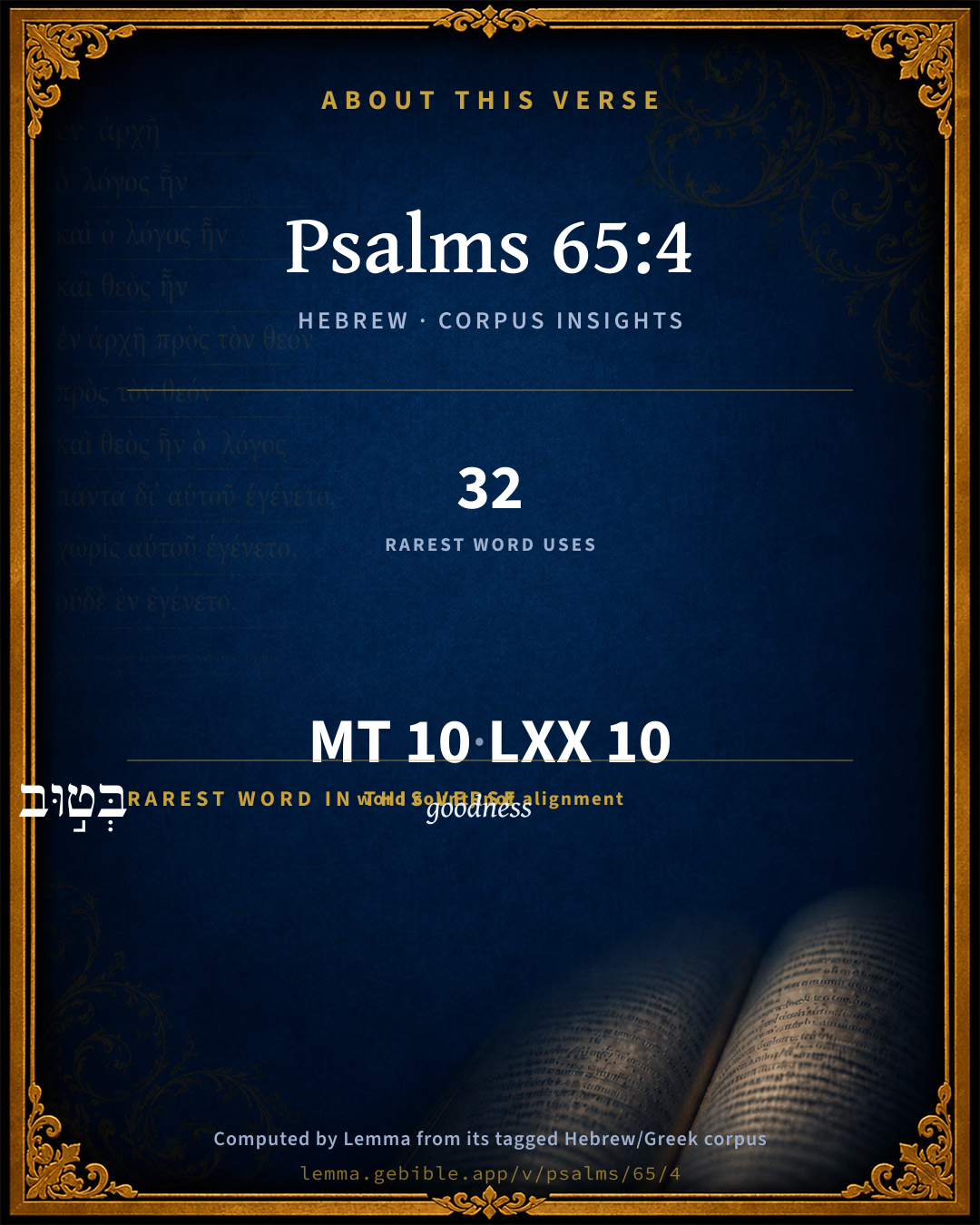
10
words
10
distinct lemmas
Wisdom
section

Shared distinctive vocabulary

בְּט֣וּב goodness H2898 occurs in 31 verses of the Hebrew Bible. Also found in:

Grammatical profile

  • 4 verbs
  • 5 nouns
  • 1 adjective

Verb forms

  • תִּֽבְחַ֣ר Qal · Imperfect
  • וּתְקָרֵב֮ Piel · Imperfect
  • יִשְׁכֹּ֪ן Qal · Imperfect
  • נִ֭שְׂבְּעָה Qal · Cohortative

Hebrew & Septuagint length

In English translation the verse runs 31 words from the Hebrew and 30 from the Septuagint (LXX English) — closely comparable.

A rough comparison of the two English renderings, which tokenize alike — not a word-level alignment.

Word counts can differ between the Hebrew and the Greek without any difference in meaning — e.g. the Hebrew direct-object marker אֵת has no separate Greek word, and Greek often adds the article ὁ.

In the original languages it is 10 Hebrew tokens and 10 Greek tokens — but the two are counted differently (Hebrew bundles its prefixes and suffixes into one token; the Greek is in lemma form), so that isn’t a like-for-like length.

Cross-references

19

Topical passages linked to Psalms 65:4 in the Treasury of Scripture Knowledge — connected by theme and wording, ordered by reader-vote popularity; previews shown in the World English Bible.

  • Ephesians 1:4 even as he chose us in him before the foundation of the world, that we would be holy and without blemish before him in love;
  • Psalms 23:6 Surely goodness and loving kindness shall follow me all the days of my life, And I shall dwell in Yahweh's house forever.
  • Psalms 84:4 Blessed are those who dwell in your house. They are always praising you. Selah.
  • Psalms 106:4–5 Remember me, Yahweh, with the favor that you show to your people. Visit me with your salvation,
  • Psalms 33:12 Blessed is the nation whose God is Yahweh, The people whom he has chosen for his own inheritance.
  • Psalms 36:8 They shall be abundantly satisfied with the abundance of your house. You will make them drink of the river of your pleasures.
  • Psalms 4:3 But know that Yahweh has set apart for himself him who is godly: Yahweh will hear when I call to him.
  • Revelation 3:12 He who overcomes, I will make him a pillar in the temple of my God, and he will go out from there no more. I will write on him the name of my God, and the name of the city of my God, the new Jerusalem, which comes down out of heaven from my God, and my own new name.
  • Jeremiah 31:25 For I have satiated the weary soul, and every sorrowful soul have I replenished.
  • Psalms 63:5 My soul shall be satisfied as with the richest food. My mouth shall praise you with joyful lips,
  • Psalms 15:1 Yahweh, who shall dwell in your sanctuary? Who shall live on your holy hill?
  • Psalms 17:15 As for me, I shall see your face in righteousness; I shall be satisfied, when I awake, with seeing your form.
  • Psalms 24:7 Lift up your heads, you gates; Be lifted up, you everlasting doors: The King of glory will come in.
  • Psalms 78:70–71 He also chose David his servant, And took him from the sheepfolds;
  • Revelation 21:3–4 I heard a loud voice out of heaven saying, "Behold, God's dwelling is with people, and he will dwell with them, and they will be his people, and God himself will be with them as their God.
  • Jeremiah 31:12–14 They shall come and sing in the height of Zion, and shall flow to the goodness of Yahweh, to the grain, and to the new wine, and to the oil, and to the young of the flock and of the herd: and their soul shall be as a watered garden; and they shall not sorrow any more at all.
  • Psalms 135:4 For Yah has chosen Jacob for himself; Israel for his own possession.
  • 2 Thessalonians 2:13 But we are bound to always give thanks to God for you, brothers loved by the Lord, because God chose you from the beginning for salvation through sanctification of the Spirit and belief in the truth;
  • Revelation 7:16–17 They will never be hungry, neither thirsty any more; neither will the sun beat on them, nor any heat;

Cross-references courtesy of OpenBible.info (CC BY 4.0).

Hebrew and Greek witnesses Masoretic Hebrew ↔ Greek Septuagint

The same verse in the two great witnesses to the Old Testament, shown verse-for-verse.

You’re reading Greek Psalm 64 (Hebrew Psalm 65). The Septuagint counts the superscription, so verse numbers can differ from the Hebrew — chapter-level alignment, not verse-by-verse. Numbering follows Rahlfs.

These are two independent witnesses, not word-aligned to each other, and the Septuagint is shown in lemma (dictionary) form.

Hebrew Psalms 65:4 Masoretic · Westminster Leningrad Codex

אַשְׁרֵ֤י תִּֽבְחַ֣ר וּתְקָרֵב֮ יִשְׁכֹּ֪ן חֲצֵ֫רֶ֥יךָ נִ֭שְׂבְּעָה בְּט֣וּב בֵּיתֶ֑ךָ קְ֝דֹ֗שׁ הֵיכָלֶֽךָ

Blessed is one whom you choose, and cause to come near, That he may live in your courts. We will be filled with the goodness of your house, Your holy temple.

World English Bible · Public Domain

Greek LXX Greek Psalm 64:4 Septuagint · lemma form

λόγος ἀνομία ὑπερδυναμόω ἐγώ καί ὁ ἀσέβεια ἐγώ σύ ἱλάσκομαι

Blessed is he whom you have chosen and adopted; he shall dwell in your courts; we shall be filled with the good things of your house; your temple is holy.

LXX2012 (modern English Septuagint) · Public Domain

Hebrew: Westminster Leningrad Codex (CC BY 4.0). Greek: Septuagint (public domain); English from LXX2012 (modern English Septuagint) (Public Domain). How the Septuagint differs from the Hebrew →

Commentary

Notes on Psalms 65:4 from classic Christian and Jewish commentators (each source and its license shown beneath its notes). The classic Christian expositions comment on the surrounding passage and are grouped to its opening verse, so a note may address several verses; the Jewish commentaries on the Tanakh (Rashi and others) are per-verse, so they appear only where the commentator wrote on this verse.

Lemma curates 59 commentaries, every one of them public domain or Creative Commons licensed, each selected and text-cleaned for this edition rather than reprinted as found. About our sources →

Trapp's Complete Commentary

John Trapp

Psa 65:4 Blessed [is the man whom] thou choosest, and causest to approach [unto thee, that] he may dwell in thy courts: we shall be satisfied with the goodness of thy house, [even] of thy holy temple.

Ver. 4. Blessed is the man whom thou choosest] Whom thou choosest for thy love, and then lovest him for thy choice.

And causest to approach unto thee] i.e. Effectually callest. Here vocation is fetched from the fountain (as is also justification in the former verse), viz. God’s free election. See that golden chain, Rom 8:30.

That he may dwell in thy courts] viz. To bear thy word, and partake of thine ordinances. For our Saviour telleth the Jews, He that is of God heareth God’s words; ye therefore hear him not, because ye are not of God, Joh 8:4; our worship scorners, then, have a black brand upon them.

We shall be satisfied] He maketh himself one of the number of God’s elect (as Paul also doth often), and therehence concludeth to himself and the rest a beatifical communion of all good things.

John Trapp, A Commentary or Exposition upon All the Books of the Old and New Testament (1647–1656) — public domain. Text from a community e-Sword module.

The Biblical Illustrator

Joseph S. Exell

Psa_65:4

Blessed is the man whom Thou choosest, and causest to approach unto Thee, that he may dwell in Thy courts.

Worship

This psalm includes a thanksgiving for Gods bounties in Providence, for the beauties of spring, and the natural supply of mans wants; but the privileges of the sanctuary are here made a special subject of grateful acknowledgment.

I. The psalmist here commends public worship--

1. As a peculiar privilege. Blessed is the man whom Thou choosest and causest to approach unto Thee. The opportunity of enjoying such an approach is not given to all, but brings special responsibility to those to whom God grants it.

2. As an approach unto God. God is never far from us, but when we meet in His courts we are able more distinctly to realize His nearness to us. We often have a deep and glad sense of His presence.

3. As the finding a new home. That he may dwell in Thy courts. There may be a reference here, as in other psalms, to the Levites who literally dwelt there that they might attend to the performances of the services; but the latter part of this verse implies that David claimed for himself a share in the privilege. The thought is--we, as dwellers in the courts of the Lord, shall be satisfied.

4. As an abundant provision. Here the wants both of the mind and of the heart are met.

5. As a holy service.

II. General remarks on public worship.

1. It is valuable for testimony. Christians thus witness for Christ, and confess their faith.

2. For its associations. What memories cluster round the sanctuaries where we have worshipped I

3. For communion with one another. Thus we are helped by association one with the other in the various acts of worship.

4. For the worship itself in its various parts--prayer, instruction, praise. Then, let us not forsake the assembling of ourselves together, and let us seek to make the highest use of the ordinances of religion. (Anon.)

The blessedness of approaching to God

Who is the happiest man? The miser says, Blessed is the man whose corn and wine are increased, The sensualist says, Blessed is he who has no Lord over him, and who walks after the ways of his heart, and the sight of his eyes, without the least control from any laws, human or divine. The ambitious man says, Blessed is he who is highest in favour at court; who is admitted to the confidence of his prince. But, Blessed is the man, says David (and so says every Christian), whom Thou choosest, and causest to approach unto Thee.

I. Explain the nature of this approach to God.

1. Consider what it is not. It is not bowing the knee, and saying a prayer, and putting on an appearance of seriousness at particular times; it is not going often to the house of the Lord, and coming and sitting before Him as His people; the humble, self-condemned publican, that stood afar off, approached nearer to God than the Pharisee, though he confidently pushed forward to the holy of holies. To approach Him is an act of the mind, not of the body. God is a spirit, and they that worship Him acceptably, must do it not merely with a bended knee, and a loud voice, and an uplifted eye, or a head hanging down like a bulrush. These things are comparatively indifferent; if unaccompanied with sincerity, they are worse than indifferent; they are offensive and abominable to God, who will be worshipped in spirit and in truth.

II. In what does the blessedness of approaching to God consist? In the honour, the pleasure, the profit we enjoy.

III. The hindrances to such approach.

1. Sin, this destroys our communion with God until we repent and return to Him.

2. The world.

3. Satan. (S. Lavington.)

The happiness of saints

The saints of God are blessed--

I. In feeling the joys of devotion.

II. In obtaining the forgiveness of sin.

III. In finding a retreat from affliction.

IV. In the anticipation of a better world. As the mariner who has been long tossed on a troubled ocean, or detained in a foreign country, is desirous to revisit his native shore, and, when he first discovers the hoary rocks of the green isle rising with rugged grandeur above the waves, his eye beams with joy; so the saint who has been sojourning many a tedious year in a waste howling desert, pants to behold the beauty of paradise, and darts his eye radiant with rapture towards the delightful abode. (T. Laurie, D. D.)

The blessedness of approaching to God

I. What is meant by approaching to God. There was a time when the Lord came down and conversed with man, as one friend does with another, when no thunder, and lightning, and tempest accompanied him, and when no conscious guilt inspired the human breast with terror; and a time will come again, dark and disconsolate though our condition now be, when the veil shall be removed, and we shall so behold the glory of the Lord, as to be completely changed into the same image. Now, sin interposes a dark cloud betwixt us and our God, so that we can have but a very imperfect view of His glory and majesty. We see as through a glass darkly. There are seasons, however, when the Christian is admitted, as it were, within the veil, when he sees the King in His beauty, and enjoys that delightful communion with Him, which is a foretaste of the heavenly bliss.

II. Wherein the happiness of approaching to God consists.

1. It is the highest honour; far superior to every dignity, an honour compared to which all the pomp and splendour of earthly greatness dwindle into insignificance.

2. It is a pleasure. God is the chief good. He is the source of life, and joy, and happiness. To go, therefore, to Him, and draw our enjoyments pure from the fountain from which they flow, must be peculiarly gratifying to every person who can properly distinguish between good and evil.

3. It is highly profitable.

III. Obstacles that prevent our approaching to God.

1. The corruption of our own heart. This may be regarded as the first and greatest of all, because while this continues unsubdued, we cannot advance a single step in our journey to heaven; whereas, if this be overcome, none of the rest will be able to obstruct our progress.

2. The world.

(1) How many, oppressed with the cares of this life, are wholly unconcerned about the joys of the life that is to come!

(2) How many are the slaves of unhallowed lusts! The world holds out to them the intoxicating cup of forbidden pleasures; they drink it, and the luscious draught diffuses its baneful influence over the soul.

(3) How many are deterred from the service of God by the fear of suffering! They would willingly serve God if they could do it with safety; but they cannot think of submitting to difficulties and trials in His service.

3. Another obstacle in the way of our approaching to God, is Satan. He is the deceiver and the destroyer.

Lessons--

1. They who do not approach to God will perish.

2. The value of the privilege we possess, of approaching to God in the ways of His appointment.

3. It is only through the mediation of Jesus Christ that we can approach to God. (John Ramsay, M. A.)

Delight in the presence of God

A nervous clergyman, who could only compose to advantage when absolutely alone and undisturbed, left his door unlocked, and his little three-year-old child softly opened the door and came in. He was disturbed, and a little impatiently asked, My child, what do you want? Nothing, papa. Then what do you come in here for? Just because I wanted to be with you, was the reply. To come into Gods presence and wait before Him, wanting nothing but to be with Him--how such an hour now and again would rest us.

The Biblical Illustrator, edited by Joseph S. Exell (c. 1880s–1900s) — public domain. Text from a community e-Sword module.

Joseph Benson's Commentary

Psa 65:4. Blessed is the man — The particular person, how poor and mean soever; whom thou choosest — To be one of thy peculiar people; and causest — That is, permittest and commandest; and by the disposal of thy providence, and the influence of thy grace, inclinest and enablest, to approach unto thee — To draw near to thee in thy house and ordinances, by prayer and praise, and other acts of communion with thee. That he may dwell in thy courts — In the courts of thy house; may frequently resort thither, and wait upon thee there, at all opportunities, among thy people. He mentions courts, because the people were permitted to go no further into God’s house. We shall be satisfied with the goodness of thy house — We shall enjoy solid satisfaction, such as all men desire, but which only thy true and genuine people obtain, in those spiritual and everlasting blessings there conferred upon them, namely, thy grace, and favour, and fellowship with thee. Observe, reader! remission of sins, renovation of heart and life, the knowledge of God and of ourselves, and of our duty and true interest, joy and peace through believing, with well-grounded hopes of eternal life, are the blessings included in the goodness of God’s house, or holy temple, which is here mentioned, in comparison of which all the enjoyments of this world are but dross and dung.

Joseph Benson's Commentary on the Old and New Testaments (1811–1818) — public domain. Text from a community e-Sword module.

J. A. Alexander on Psalms

Joseph Addison Alexander

5. (Psa 65:4). Happy (he whom) thou wilt choose and bring (him) near, i.e. admit him to thy presence and to intimate communion with thee, (so that) he shall inhabit thy courts; we shall be sated, satisfied or filled, with, the good, i.e. the pleasure, the enjoyment, of thy house, the holy (place) thy temple, or thy holy temple, thy sanctuary, an expression used both of the tabernacle and the temple properly so called. See above, on Psa 5:7. The privilege described is not merely that of public worship at the place of God's appointment, but of residence in his family and participation in the privileges of his household. See above, on Psa 15:1; Psa 23:6. The change from the third person singular to the first plural shows that the former was only an individualization of the church or chosen people.

Joseph Addison Alexander, The Psalms Translated and Explained (1850) — public domain. Text from a community e-Sword module.

Tyndale Open Study Notes

Tyndale Open Resources

65:4 those you choose to bring near: This includes people from Israel and from other nations. • Only those whom God sees as blameless live in his holy courts (Pss 15 and 24). • At the Temple, God’s earthly palace, all nations can gather to experience God’s holy presence. No structure can separate humans from God (see Rev 21:22).

Tyndale Open Study Notes — © Tyndale Open Resources, licensed CC BY-SA 4.0. Text via the HelloAO Bible API.

Jamieson, Fausset & Brown

Robert Jamieson, A. R. Fausset & David Brown

dwell in thy courts; . . . [and] satisfied with the goodness . . . temple--denote communion with God (Psa 15:1; Psa 23:6; compare Psa 5:7). This is a blessing for all God's people, as denoted by the change of number.

Jamieson, Fausset & Brown — Commentary Critical and Explanatory on the Whole Bible (1871) — public domain (CC PDM 1.0). Text via the HelloAO Bible API.

Adam Clarke's Commentary

Verse 4. Blessed is the man whom thou choosest] This is spoken in reference to the priests who were chosen of God to minister at the tabernacle; and who were permitted to approach, draw nigh, to the Divine Majesty by the various offerings and sacrifices which they presented.

We shall be satisfied with the goodness of thy house] Though we are not priests, and have not the great felicity to minister before thee in holy things; yet we can worship at thy temple, feel the outpouring of thy Spirit, and be made happy with the blessings which thou dispensest there to thy true worshippers.

Adam Clarke's Commentary on the Bible (1810–1826) — public domain. Text from a community e-Sword/MySword module.

John Calvin's Commentaries

4. Blessed is the man whom thou hast chosen Having already acknowledged that the people had separated themselves from God by their sins, and forfeited all right to be heard, he now takes refuge in the free grace of God, which secures the remission of sin amongst other blessings. He thus casts an additional light upon what he had said on the point of guilt being purged away, by pointing to the cause of God, as being favorable to poor sinners, which can only be found in his fatherly love leading him to welcome them into his presence, however undeserving. That pardon which we daily receive flows from our adoption, and on it also are all our prayers founded. How could the sinner venture into the sight of God, to obtain reconciliation with him, were he not persuaded of his being a Father? In the words before us, David does not speak of the grace of God as reaching to the Gentiles, (which he had done in a preceding part of the psalm,) but in terms which apply only to the times in which he wrote. The Church of God was confined to the Jews, and they only were admitted into the sanctuary; whereas now, when the distinction has been abolished, and other nations called to the same privilege, we are all at liberty to approach him with familiarity. Christ is our peace, (Ephesians 2:14,) who has united in one those who were far off, and those who were nigh.

What has been now said may show at once the scope of the Psalmist. The Church and chosen people of God being in possession of the promise of the remission of sin, he calls those blessed whom God has included within that number, and introduced into the enjoyment of such a distinguished privilege. His language intimates, that the election did not at that time terminate upon all; for he insists upon it as the special prerogative of the Jews, that they had been chosen by God in preference to the other nations. Were it supposed that man could do anything to anticipate the grace of God, the election would cease to be with God himself, although the right and power of it are expressly ascribed to him. But the Jews had no excellency above others, except in the one point of having enjoyed the distinguishing favor of God. The middle wall of partition is now broken down, that the Gentiles might be called in. It is evident, however, that all are not alike called; and observation proves the ignorance of those who will assert that the grace of God is extended to all in common, without any choice exerted on his part. Can any reason be imagined why God should not call all alike, except it be that his sovereign election distinguishes some from others? Faith and prayer may be means for procuring us an interest in the grace of God; but the source whence it flows is not within but without us. There is a blessedness in exercising trust upon God, and embracing his promises — a blessedness experienced when, through faith in Christ the Mediator, we apprehend him as our Father, and direct our prayers to him in that character; — but ere this faith and prayer can have any existence, it must be supposed that we who are estranged from God by nature have been brought near by an exercise of his favor. We are near him, not as having anticipated his grace, and come to him of ourselves, but because, in his condescension, he has stretched out his hand as far as hell itself to reach us. To speak more properly, he first elects us, and then testifies his love by calling us. It is noticeable, also, that though God separated the seed of Abraham to be a peculiar people, entitled as the circumcision to a place in his temple, there can be no question that David recognised a distinction even amongst those who were Jews, all not having been the subjects of God’s effectual calling, nor yet properly entitled to a place in his temple. The Psalmist alludes, indeed, to the outward sanctuary, when he speaks of the Jews as chosen to approach God; but we must remember (what was brought under our attention, Psalm 15:1 and Psalm 24:3) that all were not real members of the Church who trod the court of the temple, but that the great qualifications necessary were the pure heart and the clean hands. Accordingly, we must understand by those brought near to God, such as present themselves before him in the exercise of genuine faith, and not such as merely occupy a place in his temple as to outward appearance. But, again, the being chosen, and the being called to approach God, are two things mentioned here together, to correct any such vain idea as that the sheep of God’s flock are allowed to wander at will for any length of time, and not brought into the fold. This is one way by which our gratuitous adoption is evidenced, that we come to the sanctuary under the leading of the Holy Spirit.

The Psalmist insists upon the fruit springing out of the blessed privilege of which he had spoken, when he adds, that believers would be satisfied with the fullness of his temple. Hypocrites may go there, but they return empty and unsatisfied as to any spiritual blessing enjoyed. It is noticeable, that the person is changed in this part of the verse, and that David associates himself with other believers, preferring to speak upon this subject from personal experience. We are not to understand that believers are fully replenished with the goodness of God at any one moment; it is conveyed to them gradually; but while the influences of the Spirit are thus imparted in successive measures, each of them is enriched with a present sufficiency, till all be in due time advanced to perfection. I might remark here, that while it is true, as stated, (Psalm 103:5,) that “God satisfieth our mouth with good things,” at the same time it is necessary to remember what is said elsewhere, “Open thy mouth, and I will fill it.” Our contracted desires is the reason why we do not receive a more copious supply of blessings from God; he sees that we are straitened in ourselves, and accommodates the communications of his goodness to the measure of our expectations. By specifying particularly the goodness of the sanctuary, the Psalmist passes an implied commendation upon the outward helps which God has appointed for leading us into the enjoyment of heavenly blessings. In these former times God could have directly stretched out his hand from heaven to supply the wants of his worshippers, but saw fit to satisfy their souls by means of the doctrine of the law, sacrifices, and other rites and external aids to piety. Similar are the means which he employs in the Church still; and though we are not to rest in these, neither must we neglect them.

John Calvin's Commentaries (1540-1563) — public domain. Text from the Calvin Translation Society English edition (1840s-50s) via the Christian Classics Ethereal Library (ccel.org). Calvin's coverage is partial (roughly two-thirds of the Bible); uncommented books and verses are honest gaps, never fabricated. The 19th-century editor's footnotes and remarks are omitted so the notes are faithfully Calvin's own voice.

Ellicott's Commentary for English Readers

(4) Blessed.—The ellipse of the relative is common enough (see Psa_34:8, &c), but here the antecedent is wanting as well. Perhaps we ought to read, He whom thou choosest and bringest near shall dwell, &c

Courts.—From a root meaning to wall round; especially applied to the open space within the outer fence of the Tabernacle, or to the different courts of the Temple (Exo_27:9; 1Ki_6:36; 1Ki_7:12).

We shall be satisfied.—Better, Let us be refreshed.

Thy holy temple.—Literally, The holy of thy temple, which might mean “the holiness of thy temple.”

A Bible Commentary for English Readers, edited by Charles John Ellicott (1878–1897) — public domain. Text from a community e-Sword module.

The Cambridge Bible for Schools and Colleges

gen. ed. J. J. S. Perowne

4. Blessed &c.] Or, Happy is he whom thou choosest, as in Psa_1:1; &c. The language is that which is used of the priests who were ‘chosen,’ and ‘brought near’ to God (Num_16:5; cp. Jer_30:21; Zec_3:7). Here however it is not limited to the sons of Aaron, but applied to all the nation as ‘a kingdom of priests’ (Exo_19:6). They are God’s guests in His house, members of the ‘household of God.’ The visit to the Temple was for the devout Israelite a sacrament of his membership in God’s household, and the sacred feasts symbolised the spiritual blessings prepared by God for His people in fellowship with Him. Cp. Psa_15:1; Psa_23:5 f; Psa_27:4 f; Psa_36:8; Psa_63:5.

we shall be satisfied] Or, O let us be satisfied. Cp. Psa_17:15; Psa_22:16; Psa_63:5.

even of thy holy Temple] Better, as R.V., the holy place of thy temple. See Psa_46:4; and cp. Psa_63:2.

The Cambridge Bible for Schools and Colleges (gen. ed. J. J. S. Perowne; Cambridge University Press, 1878–1918) — public domain. Text from a community e-Sword module.

John Gill's Exposition

Blessed is the man whom thou choosest,.... In eternity; both to grace and glory; for such have true faith in Christ given them, called the faith of God's elect, and shall never perish: they are effectually called by the grace of God, and are justified by the righteousness of Christ, and shall be glorified; or in time, for there is a choice in time, as the fruit, effect, and evidence of the eternal choice, and is no other than effectual calling; see Joh 15:19, Co1 1:26; and happy are those who are both chosen and called; both election and the effectual calling are to grace and glory, and spring from the good will and pleasure of God; and the Targum in the king of Spain's Bible is,

"blessed is the man in whom thou art well pleased;''

and causest to approach unto thee; the same Targum supplies,

"unto the fear of thee;''

or unto thy fear and worship. The persons whom God has chosen for himself are, in their state of nature, at a distance from him by reason of sin; and through the blood and sacrifice of Christ, by which atonement is made, they are brought nigh to him; and in the faith of Christ the Mediator, their hearts are engaged to approach unto God, and come with boldness to his throne, and ask grace and mercy of him; and through the grace of Christ they have nearness to him, and communion with him, Eph 2:18;

that he may dwell in thy courts; or "he shall dwell" (l); the man that is chosen of God, and brought nigh by Christ; he shall not only come into the house of God, and tread in his courts, but he shall dwell there, ever abide, and never go out;

we shall be satisfied with the goodness of thy house; even all that are like this man, chosen by the grace of God, redeemed by the blood of Christ, brought into the house of God, and have a place and a name there, better than that of sons and daughters of men: by "the house" of God we are to understand the church of God; and by "the goodness" of it the provisions of grace in it, the word and ordinances, and the blessings of grace held forth in them, and especially Christ the bread of life, whose flesh is meat indeed, and whose blood is drink indeed; of which true believers may eat, and do to full satisfaction; and blessed are they that have such food, and appetites for it, and are filled with it. The Targum paraphrases it,

"the righteous shall say, we shall be satisfied with the goodness of shy house.''

It follows,

even of thy holy temple: which means the same as the house of God; namely, the church; see Eph 2:21. Some, as Aben Ezra observes, interpret it, "thou Holy One in thy temple"; as if it was an address to God, and a description of him as in his temple.

(l) "habitabit", Pagninus, Montanus, Tigurine version, Musculus.

John Gill's Exposition of the Whole Bible (1746–1763) — public domain (CC PDM 1.0). Text via the HelloAO Bible API.

Albert Barnes' Notes on the Bible

Blessed is the man whom thou choosest - That is, Happy is the man; or, “Oh, the happiness of the man whom thou dost thus permit to approach thee.” The construction here in the Hebrew is the same as in Psa 1:1. See the notes at that passage. The word choosest refers to the fact that true piety regards all such blessings as the result of the divine favor; the fruit of his electing grace and love. Compare the notes at Eph 1:3-4; notes at 1Pe 1:2-3. We approach God with confidence, with the spirit of true worshippers, with the spirit of his children, only as he inclines us to him, and calls us to partake of his favor. Compare Joh 6:44.

And causest to approach unto thee - That is, that he may worship thee. The idea is here recognized in the word “causest,” that it is only by a divine influence that people are led to worship God. The cause - the efficient reason - why any man worships his Maker at all, is to be found in God himself. This idea is fairly implied in the form of the word as it is used in the Hebrew.

That he may dwell in thy courts - That is, either temporarily for the purpose of worship; or permanently, that he may serve thee in the sanctuary. See Psa 23:6, note; Psa 27:4, note. Compare Psa 15:1. The word “courts” refers properly to the area around the tabernacle or the temple, and not to the tabernacle or temple itself. The worship of the people was offered in those courts, and not in the tabernacle or temple. See the notes at Mat 21:12.

We shall be satisfied with the goodness of thy house - Our souls will find thus what they need; what they long for. See the notes at Psa 36:8. It is the nature of religion to satisfy the mind; that is, the soul finds in religion what meets its needs, for religion leaves no necessity of its nature unsupplied. It may be added that nothing else will do this but religion. The word “house” here denotes a place where God dwells, and it might be applied to the temple, as it often is in the Scriptures (compare Isa 2:3; Isa 56:7; Mat 21:13; Mar 11:17; Luke 19:443; Joh 2:16; et al.); or to the tabernacle, before the temple was reared. Psa 42:4; Mat 12:4; Jdg 18:31; Jdg 20:18, Jdg 20:26, Jdg 20:31. The reference here is to the tabernacle or tent which David reared on Mount Zion, and where the worship of God was celebrated before the temple was built. “Even of thy holy temple.” The word “temple” is most commonly applied in the Scriptures to the structure which Solomon built for the worship of God; and it is on the ground that the Word is usually so applied, that DeWette and others have argued that this psalm could not have been written by David, but that it was composed after the temple was reared. But the word rendered “temple” - היכל hêykâl - is a word of so general a character that it may be applied to any house erected for the worship of God. It is not unfrequently applied to the tabernacle. See the notes at Psa 5:7. This psalm, therefore, may have been composed while the tabernacle was standing, and before the temple was built, and hence, may have been composed by David, as the title intimates.

Albert Barnes' Notes on the Bible (1834–1885) — public domain. Text from a community e-Sword/MySword module.

Matthew Poole's English Annotations

Thou choosest, out of the lump of mankind, to be one of thy peculiar people.

Causest, i.e. permittest and commandest, and by the disposal of thy providence, and the influences of thy grace, procurest and orderest.

To approach unto thee; to draw near to God in his house and ordinances by prayer and praises, and other acts of acquaintance and communion with him.

In thy courts; in the courts of thy house. He mentioneth courts, because the people were permitted to go no further into God’s house.

Shall be satisfied; for they only get that solid satisfaction which all men desire, but no other persons or people can find elsewhere.

With the goodness of thy house; with the spiritual and everlasting blessings there conferred upon thy people, the grace, and favour, and fellowship of God, remission of sins, renovation of heart and life, the knowledge of God, and of ourselves, and of our duty and true interest, joy, and peace, and well-grounded hopes or assurance of eternal life; in comparison whereof all the enjoyments of this world are but dross and dung.

Matthew Poole's English Annotations on the Holy Bible (1683–1685) — public domain. Text from a community e-Sword/MySword module.

The Treasury of David

Charles H. Spurgeon

Ver. 4. Blessed is the man whom thou choosest, and causest to approach unto thee. After cleansing comes benediction, and truly this is a very rich one. It comprehends both election, effectual calling, access, acceptance, and sonship. First, we are chosen of God, according to the good pleasure of his will, and this alone is blessedness. Then, since we cannot and will not come to God of ourselves, he works graciously in us, and attracts us powerfully; he subdues our unwillingness, and removes our inability by the almighty workings of his transforming grace. This also is no slight blessedness. Furthermore, we, by his divine drawings, are made nigh by the blood of his Son, and brought near by his spirit, into intimate fellowship; so that we have access with boldness, and are no longer as those who are afar off by wicked works: here also is unrivalled blessedness. To crown all, we do not come nigh in peril of dire destruction, as Nadab and Abihu did, but we approach as chosen and accepted ones, to become dwellers in the divine household: this is heaped up blessedness, vast beyond conception. But dwelling in the house we are treated as sons, for the servant abideth not in the house for ever, but the son abideth ever. Behold what manner of love and blessedness the Father has bestowed upon us that we may dwell in his house, and go no more out for ever. Happy men who dwell at home with God. May both writer and reader be such men.

That he may dwell in thy courts. Acceptance leads to abiding: God does not make a temporary choice, or give and take; his gifts and calling are without repentance. He who is once admitted to God's courts shall inhabit them for ever; he shall be

"No more a stranger or a guest,

But like a child at home."

Permanence gives preciousness. Terminating blessings are but half blessings. To dwell in the courts of the Great King is to be ennobled; to dwell there for ever is to be emparadised: yet such is the portion of every man whom God has chosen and caused to approach unto him, though once his iniquities prevailed against him.

Ver. 3-4. Now, soul, thou art molested with many lusts that infect thee, and obstruct thy commerce with heaven; yea, thou hast complained to thy God, what loss thou hast suffered by them; is it now presumption to expect relief from him, that he will rescue thee from them, that thou mayest serve him without fear, who is thy liege Lord? You have the saints for your precedents; who, when they have been in combat with their corruptions, yea, been foiled by them, have even then exercised their faith on God, and expected the ruin of those enemies, which, for the present, have overrun them. Iniquities prevail against me; he means his own sins; but see his faith; at the same time that they prevailed over him, he beholds God destroying them, as appears in the very next words, As for our transgressions, thou shalt purge them away. See here, poor Christian, who thinkest that thou shalt never get above deck, holy David has a faith, not only for himself, but also for all believers, of whose number I suppose thee one. And mark the ground he hath for this his confidence, taken from God's choosing act: Blessed is the man whom thou choosest, and causest to approach unto thee, that he may dwell in thy courts. As if he had said, Surely he will not let them be under the power of sin, or in want of his gracious succour, whom he sets so near himself. This is Christ's own argument against Satan, in the behalf of his people. "The Lord said unto Satan, the Lord rebuke thee." Zec 3:2. William Gurnall.

Ver. 4. Blessed is the man whom thou choosest. The benedictions of the Psalter advance in spirituality and indicate a growth. The first blessed the godly reader of the word. Ps 1:1. The second described the pardoned child. Ps 32:1. The third pronounced a blessing upon faith. Ps 34:8 40:4. The fourth commended the active and generous believer, abundant in deeds of charity (Ps 41:1); and this last mounting to the fountain head of all benediction, blesses the elect of God. C. H. S.

Ver. 4. The man whom thou choosest. Christ, whom God chose, and of whom he said, "This is my beloved Son in whom I am well pleased, " is, indeed, "over all, God blessed for ever; "but in him his elect are blessed too. For his sake, not for our own, are we chosen; in him, not in ourselves, are we received by God, being accepted in the Beloved; and, therefore, in him are we blessed: he is our blessing. With that High Priest who has ascended into the holy place and entered within the vail, we enter into the house of God; we learn to dwell therein; we are filled with its spiritual joys; we partake of its holy mysteries and sacraments of grace and love. From "A Plain Commentary on the Book of Psalms." 1859.

Ver. 4. We shall be satisfied with the goodness of thy house, even of thy holy temple. We shall be so filled, that nothing can be said to be wanting, we shall have nothing to look for outside. What can be wanting in the house of him who made everything, who is the master of everything, who will be all unto all, in whom is an inexhaustible treasure of good. Of him is said in Psalm 103, "Who satisfieth thy mouth with thy likeness." Robert Bellarmine (1542-1621).

Ver. 4. Satisfied with the goodness of thy house. There is an allusion here to the oblations which were devoted to God, of which, also, sacred persons partook. Hermann Venema.

Ver. 4. Nearness to God is the foundation of a creature's happiness. This doctrine appears in full evidence, while we consider the three chief ingredients of true felicity, viz., the contemplation of the noblest object, to satisfy all the powers of the understanding; the love of the supreme good, to answer the utmost propensities of the will, and the sweet and everlasting sensation and assurance of the love of an Almighty Friend, who will free us from all the evils which our nature can fear, and confer upon us all the good which a wise and innocent creature can desire. Thus all the capacities of man are employed in their highest and sweetest exercises and enjoyments. Isaac Watts.

Ver. 4. Election, effectual calling, access, adoption, final perseverance, satisfaction. This verse is a body of divinity in miniature.

Psalms 65:5*

Charles H. Spurgeon's The Treasury of David (1869–1885) — public domain. Psalms only. Text from a community e-Sword/MySword module.

Whedon's Commentary on the Bible

Daniel D. Whedon

4. Whom thou choosest—See Psa_4:3.

Causest to approach… thee—A priestly honour under the law, (Num_16:8,) but offered now to all. (Heb_10:19-22.)

Satisfied with the goodness of thy house—To be “satisfied” with God’s gifts and favour, so that the heart gratefully rests there, is the highest return we can make to him; while to profess his name and still seek our pleasure in the world is the greatest reproach to him and to the religion we profess.

Thy holy temple—The word is simply synonymous with the terms “thy courts” and “thy house” in this same verse, and is no proof that this psalm was of later date than David’s time. See its use in 1Sa_1:9; 1Sa_3:3, where it applies to the tabernacle.

Daniel D. Whedon (gen. ed.), Commentary on the Old and New Testaments (1874–1909) — public domain. Text from a community e-Sword module.

The Pulpit Commentary

Blessed is the man whom thou choosest. The "choosing" intended is certainly not that of the seed of Aaron, (Lev_8:1) or of the seed of Levi, (Num_18:21-23) but that act by which God "chose" Israel out of all the nations of the earth to be "a special people unto himself", (Deu_7:6) and gave them a distinct position, and peculiar privileges. And causest to approach unto thee, that he may dwell in thy courts. Among the peculiar privileges, one of the greatest was that of approaching God"s presence in his holy temple, and entering his "courts" and worshipping there. This all Israelites were not only permitted, but commanded to do, at least three times in the year, while the dwellers in Jerusalem, privileged above the rest, had constant opportunities of attending, and using to the full the means of grace provided for them in the sanctuary. We shall be satisfied with the goodness of thy house, even of thy holy temple. In "the goodness of God"s house" the psalmist includes, not only the delights there experienced, but also all the blessings which God gives to those who devoutly worship him there the forgiveness of sins to outward, temporal mercies" (Hengstenberg).

The Pulpit Commentary (1880–1919), ed. H.D.M. Spence-Jones & Joseph S. Exell — public domain. Text from a community e-Sword module.

John Wesley's Explanatory Notes

Approach - To draw near to God in his house and ordinance, by prayer and praise, and other acts of communion with him. Satisfied - With the blessings there conferred upon thy people, the favour and fellowship of God, remission of sins, renovation of heart and life, joy and peace, and well-grounded assurance of eternal life.

John Wesley, Explanatory Notes Upon the Whole Bible (1754–1765) — public domain. Text via the GEBible commentary corpus.

unfoldingWord translationNotes

Door43 World Missions Community

whom you choose ... your courts

The words "you" and "your" in this verse refer to Yahweh.

live in your courts

This exaggeration expresses that the man is in the temple very frequently to worship Yahweh. AT: "worship often in your courts" (See: Hyperbole and Generalization)

We will be satisfied with the goodness of your house, your holy temple

This can be stated in active form. AT: "The goodness of your house, your holy temple, will satisfy us" (See: Active or Passive)

We will be

Here the word "we" refers to David and the people of Israel, but not to God, to whom he is speaking. (See: Exclusive and Inclusive "We")

your house, your holy temple

"your house, which is your holy temple"

translationWords

bless

life

court

good

house

holy

temple

unfoldingWord translationNotes — © Distant Shores Media and the Door43 World Missions Community, licensed CC BY-SA 4.0. Source: git.door43.org/Door43/en_tn.

Rashi

Rabbi Shlomo Yitzchaki (Rashi)

Words of iniquities have overcome me and we cannot manage to arrange them all before You because they are many. However, we offer a general prayer before You that You atone for our transgressions.

Rashi on the Tanakh — English translations: “The Judaica Press complete Tanach with Rashi, translated by A. J. Rosenberg” (CC BY 4.0); “Pentateuch with Rashi's commentary by M. Rosenbaum and A.M. Silbermann, 1929-1934” (public domain); “The Metsudah Tanach series, Lakewood, N.J” (CC BY 4.0); and “The Book of Joshua, Metsudah Publications, 1997” (CC BY 4.0). Text via Sefaria.

Lesson kit

Teaching starters — assembled from the data on this page, not authored interpretation. Every prompt links to the verse data it draws on. Edit before teaching.

Psalms, in the Wisdom, opens this verse with 10 words (10 distinct Hebrew lemmas). Its most distinctive word is ṭûwb (“goodness”). A historical commentator’s framing appears above. Read the whole chapter for the surrounding context.

Discussion questions

  1. How does “goodness” (ṭûwb) shape what this verse is saying?
  2. How does Genesis 24:10, which shares the word «goodness», read alongside this verse?
  3. These translations render this verse differently; the difference is in the English rendering, not the original. What questions does that raise?
  4. «תִּֽבְחַ֣ר» is a Qal Imperfect verb. How does that grammatical form shape the action described?
  5. Compare how Trapp's Complete Commentary and The Biblical Illustrator read this verse. Where do they agree or differ?

Things to notice

Reading settings

Reading text

Shown beneath each verse's original-language words.

Old Testament
Old Testament edition

Read the OT as the Masoretic Hebrew (MT) or the Greek Septuagint (LXX).

English shown for the Greek Septuagint (in the Hebrew ↔ Greek comparison).

Comparing translations? Open the Compare panel on any verse page to stack up to four side by side.