Ezekiel 31:13

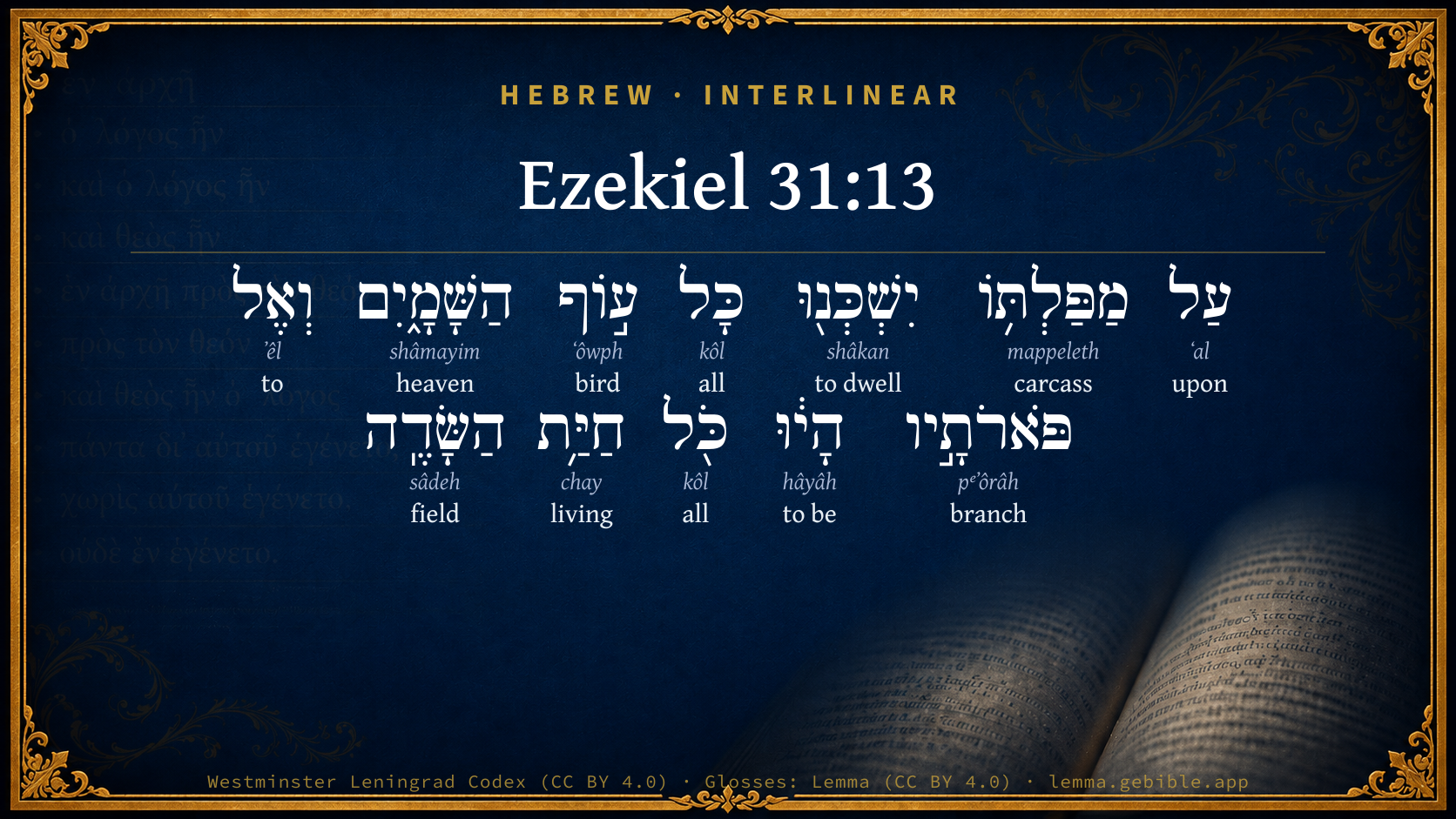
Hebrew (Westminster Leningrad Codex) Ezekiel 31:13 appears in the Hebrew Old Testament. The text above is from the Westminster Leningrad Codex. Each word links to its Strong’s number, a concise gloss, and parsing drawn from the Open Scriptures Hebrew Bible morphology. Click any word for its full Brown-Driver-Briggs (BDB) entry.
Download image
Cite this verse

Ezekiel 31:13 (World English Bible). Public Domain. Lemma interlinear Bible study tool, https://lemma.gebible.app/v/ezekiel/31/13.

Show BibTeX & RIS
BibTeX
RIS
English Translation
On his ruin all the birds of the sky shall dwell, and all the animals of the field shall be on his branches;
World English Bible · Public Domain
Download a study sheet

One document with this verse’s original text, its word-by-word gloss line, the meaning frame, cross-references with their text, attributed commentary, and full source and license credits — printable, and it pastes into notes with its structure intact.

This verse Autodidact and up

Study sheet (.html) Plain text (.txt)

A passage Seminary Student

Up to 50 verses in one chapter. A passage sheet keeps up to 6 commentary sources and 12 cross-references per verse, in the order this page ranks them, and says so on the sheet whenever that leaves anything out. Ask for a single verse and you get the Autodidact verse sheet above.

Everything on this page stays free to read, with no account — the sheet is a download of what is already on screen, not access to it.

Want to remove ads? Support Godless Engineer
Compare translations 3

The same verse in 3 English versions, stacked beneath the original-language interlinear above. Click any original word for its lexicon entry.

Each is an independent rendering of the whole verse — the interlinear is not word-aligned to these translations.

Highlighted words mark where these versions differ — a whole-verse word diff, not a word-by-word alignment.

  • World English Bible Public Domain
    On his ruin all the birds of the sky shall dwell, and all the animals of the field shall be on his branches;
  • King James Version Public Domain
    Upon his ruin shall all the fowls of the heaven remain, and all the beasts of the field shall be upon his branches:
  • unfoldingWord Literal Text CC BY-SA 4.0
    All the birds of the sky rested on the trunk of the fallen tree, and every animal of the field came to its branches.

unfoldingWord Literal Text — © unfoldingWord, licensed CC BY-SA 4.0. Word-aligned USFM3 via Door43 (git.door43.org/unfoldingWord/en_ult).

Versions to compare (up to 4)

3 of 4 selected

Show all 18 translations

Every available English version of this verse, each an independent rendering of the whole verse.

  • World English Bible Public Domain
    On his ruin all the birds of the sky shall dwell, and all the animals of the field shall be on his branches;
  • Berean Standard Bible Public Domain
    All the birds of the air nested on its fallen trunk, and all the beasts of the field lived among its boughs.
  • Majority Standard Bible Public Domain
    All the birds of the air nested on its fallen trunk, and all the beasts of the field lived among its boughs.
  • King James Version Public Domain
    Upon his ruin shall all the fowls of the heaven remain, and all the beasts of the field shall be upon his branches:
  • American Standard Version (1901) Public Domain
    Upon his ruin all the birds of the heavens shall dwell, and all the beasts of the field shall be upon his branches;
  • Revised Version (1885) Public Domain
    Upon his ruin all the fowls of the heaven shall dwell, and all the beasts of the field shall be upon his branches:
  • Geneva Bible (1599) Public Domain
    Vpon his ruine shall all the foules of the heauen remaine, and all the beastes of the fielde shall be vpon his branches,
  • Douay-Rheims (1899) Public Domain
    All the fowls of the air dwelt upon his ruins, and all the beasts of the field were among his branches.
  • Young's Literal Translation Public Domain
    On his ruin dwell do all fowls of the heavens, And on his boughs have been all the beasts of the field,
  • Literal Standard Version CC BY-SA 4.0
    Every bird of the heavens dwells on his ruin, || And all beasts of the field have been on his boughs,
  • Unlocked Literal Bible CC BY-SA 4.0
    All the birds of the sky rested on the trunk of the fallen tree, and every animal of the field came to its branches.
  • unfoldingWord Literal Text CC BY-SA 4.0
    All the birds of the sky rested on the trunk of the fallen tree, and every animal of the field came to its branches.
  • Darby Bible Public Domain
    Upon his fallen [trunk] do all the fowl of the heavens dwell, and all the beasts of the field are upon his branches:
  • World Messianic Bible Public Domain
    All the birds of the sky will dwell on his ruin, and all the animals of the field will be on his branches,
  • Webster's Bible Public Domain
    Upon his ruin shall all the fowls of the heaven remain, and all the beasts of the field shall be upon his branches:
  • Free Bible Version CC BY-SA 4.0
    Birds came to live on its fallen trunk, and wild animals hid among its fallen branches.
  • Bible in Basic English Public Domain
    All the birds of heaven have come to rest on his broken stem where it is stretched on the earth, and all the beasts of the field will be on his branches:
  • JPS Tanakh (1917) Public Domain
    Upon his carcass all the fowls of the heaven do dwell, and upon his branches are all the beasts of the field;

Literal Standard Version (2020), Covenant Press — licensed CC BY-SA 4.0. Text via the HelloAO Bible API (eBible.org). Unlocked Literal Bible (unfoldingWord) — licensed CC BY-SA 4.0. Text via the HelloAO Bible API (eBible.org). unfoldingWord Literal Text — © unfoldingWord, licensed CC BY-SA 4.0. Word-aligned USFM3 via Door43 (git.door43.org/unfoldingWord/en_ult). Free Bible Version, Dr. Jonathan Gallagher — licensed CC BY-SA 4.0. Text via the HelloAO Bible API (eBible.org).

Word by word

More ways to search: Search by grammar → Find every occurrence → Compare this word →

Practice this passage: Drill this verse → Learn its vocabulary →

מַפַּלְתּ֥וֹ
mappeleth
H4658
“carcass · his”
Noun, Common, Feminine, Singular, Construct + Suffix, Personal, 3rd Person, Masculine, Singular
Part of Speech
Noun
Type
Common
Gender
Feminine
Number
Singular
State
Construct
Full BDB Definition

Origin: from H5307

TWOT: 1392e

carcass, ruin, overthrow - carcass - ruin, overthrow
  1. עַל ʻal H5921 “upon” Preposition
  2. יִשְׁכְּנ֖וּ shâkan H7931 “to dwell” Verb, Qal, Imperfect, 3rd Person, Masculine, Plural
  3. כָּל kôl H3605 “all of” Noun, Common, Masculine, Singular, Construct
  4. ע֣וֹף ʻôwph H5775 “bird of” Noun, Common, Masculine, Singular, Construct
  5. הַשָּׁמָ֑יִם shâmayim H8064 “the · heaven(s)” Particle, Definite Article + Noun, Common, Masculine, Plural, Absolute
  6. וְאֶל ʼêl H413 “and · to” Conjunction + Preposition
  7. פֹּארֹתָ֣יו pᵉʼôrâh H6288 “branches · his” Noun, Common, Feminine, Plural, Construct + Suffix, Personal, 3rd Person, Masculine, Singular
  8. הָי֔וּ hâyâh H1961 “to be” Verb, Qal, Perfect, 3rd Person, Common, Plural
  9. כֹּ֖ל kôl H3605 “all of” Noun, Common, Masculine, Singular, Construct
  10. חַיַּ֥ת chay H2416 “living of” Noun, Common, Feminine, Singular, Construct
  11. הַשָּׂדֶֽה sâdeh H7704 “the · field” Particle, Definite Article + Noun, Common, Masculine, Singular, Absolute

About this verse

These counts appear in no published source. They are computed here, from the morphology-tagged text and Lemma’s own curated glosses. What Lemma adds →

12
words
11
distinct lemmas
Prophets
section

Notable vocabulary

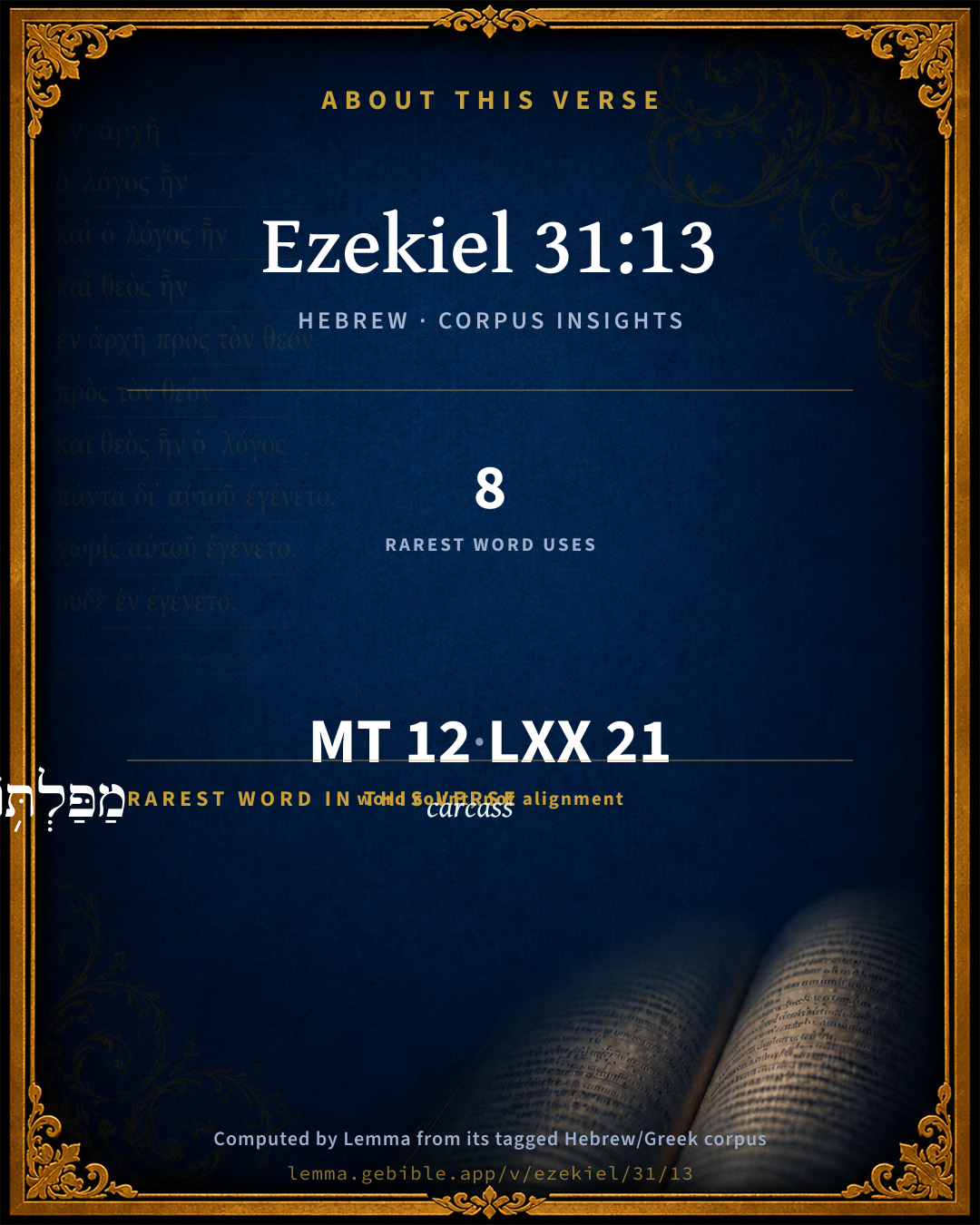
The rarest word here is מַפַּלְתּ֥וֹ carcass H4658 — appearing just 8 times in the whole Hebrew Bible.

Shared distinctive vocabulary

מַפַּלְתּ֥וֹ carcass H4658 occurs in 8 verses of the Hebrew Bible. Also found in:

Grammatical profile

  • 2 verbs
  • 8 nouns
  • 2 prepositions

Verb forms

  • יִשְׁכְּנ֖וּ Qal · Imperfect
  • הָי֔וּ Qal · Perfect

Repetition

A word recurs within this verse — often emphatic in Hebrew:

Hebrew & Septuagint length

In English translation the verse runs 23 words from the Hebrew and 24 from the Septuagint (LXX English) — closely comparable.

A rough comparison of the two English renderings, which tokenize alike — not a word-level alignment.

Word counts can differ between the Hebrew and the Greek without any difference in meaning — e.g. the Hebrew direct-object marker אֵת has no separate Greek word, and Greek often adds the article ὁ.

In the original languages it is 12 Hebrew tokens and 21 Greek tokens — but the two are counted differently (Hebrew bundles its prefixes and suffixes into one token; the Greek is in lemma form), so that isn’t a like-for-like length.

Cross-references

4

Topical passages linked to Ezekiel 31:13 in the Treasury of Scripture Knowledge — connected by theme and wording, ordered by reader-vote popularity; previews shown in the World English Bible.

  • Ezekiel 32:4 I will leave you on the land, I will cast you forth on the open field, and will cause all the birds of the sky to settle on you, and I will satisfy the animals of the whole earth with you.
  • Isaiah 18:6 They shall be left together to the ravenous birds of the mountains, and to the animals of the earth; and the ravenous birds shall summer on them, and all the animals of the earth shall winter on them.
  • Ezekiel 29:5 I will cast you forth into the wilderness, you and all the fish of your rivers: you shall fall on the open field; you shall not be brought together, nor gathered; I have given you for food to the animals of the earth and to the birds of the sky.
  • Revelation 19:17–18 I saw an angel standing in the sun. He cried with a loud voice, saying to all the birds that fly in the sky, "Come! Be gathered together to the great supper of God,

Cross-references courtesy of OpenBible.info (CC BY 4.0).

Hebrew and Greek witnesses Masoretic Hebrew ↔ Greek Septuagint

The same verse in the two great witnesses to the Old Testament, shown verse-for-verse.

These are two independent witnesses, not word-aligned to each other, and the Septuagint is shown in lemma (dictionary) form.

Hebrew Ezekiel 31:13 Masoretic · Westminster Leningrad Codex

עַל מַפַּלְתּ֥וֹ יִשְׁכְּנ֖וּ כָּל ע֣וֹף הַשָּׁמָ֑יִם וְאֶל פֹּארֹתָ֣יו הָי֔וּ כֹּ֖ל חַיַּ֥ת הַשָּׂדֶֽה

On his ruin all the birds of the sky shall dwell, and all the animals of the field shall be on his branches;

World English Bible · Public Domain

Greek LXX Ezekiel 31:13 Septuagint · lemma form

ἐπί ὁ πτῶσις αὐτός ἀναπαύω πᾶς ὁ πετεινόν ὁ οὐρανός καί ἐπί ὁ στέλεχος αὐτός γίγνομαι πᾶς ὁ θηρίον ὁ ἀγρός

All the birds of the sky have settled on his fallen trunk, and all the wild beasts of the field came upon his boughs:

LXX2012 (modern English Septuagint) · Public Domain

Hebrew: Westminster Leningrad Codex (CC BY 4.0). Greek: Septuagint (public domain); English from LXX2012 (modern English Septuagint) (Public Domain). How the Septuagint differs from the Hebrew →

Targum (Aramaic paraphrase)

1

The Targum is the ancient Jewish Aramaic paraphrase of the Hebrew Scriptures — an interpretive translation, not the Hebrew text itself. Onkelos (literal) and Pseudo-Jonathan (expansive) render the Torah, and Jonathan the Prophets. Coverage is partial: where no permissively-licensed English translation exists for a verse, only the Aramaic is shown. This is verse-level text, not a word-by-word alignment to the Hebrew.

  1. Targum Jonathan Prophets (Joshua–Malachi)
    עַל מַפָּלַת קְטִילוֹהִי שְׁרוֹ כָּל עוֹפָא דִשְׁמַיָא וְעַל פִּגְרֵי מַשִׁירְיָתֵיהּ נָחָא כָּל חַיַת בָּרָא:

    (no public-domain English translation for this verse)

    Targum Jonathan — Aramaic: “Mikraot Gedolot” (public domain). English: “Sefaria Community Translation” (CC0 1.0 (public-domain dedication)); “London "Chaldee Paraphrase," 1871” (public domain). Text via Sefaria.

Commentary

Notes on Ezekiel 31:13 from classic Christian and Jewish commentators (each source and its license shown beneath its notes). The classic Christian expositions comment on the surrounding passage and are grouped to its opening verse, so a note may address several verses; the Jewish commentaries on the Tanakh (Rashi and others) are per-verse, so they appear only where the commentator wrote on this verse.

Lemma curates 59 commentaries, every one of them public domain or Creative Commons licensed, each selected and text-cleaned for this edition rather than reprinted as found. About our sources →

Trapp's Complete Commentary

John Trapp

Eze 31:13 Upon his ruin shall all the fowls of the heaven remain, and all the beasts of the field shall be upon his branches:

Ver. 13. Upon his ruin shall all the fowls.] His dead body shall want decent burial, as afterward did great Alexander’s, great Pompey’s, our William the Conqueror’s, Richard III’s, &c.

John Trapp, A Commentary or Exposition upon All the Books of the Old and New Testament (1647–1656) — public domain. Text from a community e-Sword module.

Jamieson, Fausset & Brown

Robert Jamieson, A. R. Fausset & David Brown

Birds and beasts shall insult over his fallen trunk.

Jamieson, Fausset & Brown — Commentary Critical and Explanatory on the Whole Bible (1871) — public domain (CC PDM 1.0). Text via the HelloAO Bible API.

Adam Clarke's Commentary

Verse 13. Upon his ruin shall all the fowls] The fall of Egypt is likened to the fall of a great tree; and as the fowls and beasts sheltered under its branches before, Eze 31:6, so they now feed upon its ruins.

Adam Clarke's Commentary on the Bible (1810–1826) — public domain. Text from a community e-Sword/MySword module.

Ellicott's Commentary for English Readers

(13) Upon his ruin shall all the fowls.—There is no inconsistency between this and the previous verse. At the fall all nations and people rush away, to avoid becoming involved in the catastrophe; but as soon as the giant cedar is prostrate, they gather upon its trunk and branches to fatten upon its ruin.

A Bible Commentary for English Readers, edited by Charles John Ellicott (1878–1897) — public domain. Text from a community e-Sword module.

The Cambridge Bible for Schools and Colleges

gen. ed. J. J. S. Perowne

13. his ruin] i.e. his fallen trunk and branches, ch. Eze_32:4, Eze_39:17; Isa_18:6.

The Cambridge Bible for Schools and Colleges (gen. ed. J. J. S. Perowne; Cambridge University Press, 1878–1918) — public domain. Text from a community e-Sword module.

John Gill's Exposition

Upon his ruin shall all the fowls of the heaven remain,.... Or, "on his fall" (s); the fall of this tree: and all the beasts of the field shall be upon his branches as when a tree is cut down, and its lopped off branches and boughs lie here and there, either the birds and beasts that before dwelt in it or under it, though for a while frightened away, return unto it; or others come: the birds come and sit upon the boughs, and pick up what they can find on them; and the beasts browse upon the branches: this may signify that even those people who before put themselves under the protection of this monarch, or sought alliance with him, now preyed upon his dominions; or the Medes and Babylonians, the conquerors, seized on the provinces of the empire, and plundered them of their riches, The Targum understands it literally of the fowls of the heaven, and the beasts of the field, feeding upon the carcasses of the slain; which is no bad sense of the passage; thus,

"upon the fall of his slain all the fowls of heaven have dwelt, and upon the carcasses of his army all the beasts of the field have rested.''

(s) "super prolapse ejus", Cocceius; "super cadivum truncum ejus", Junius & Tremellius.

John Gill's Exposition of the Whole Bible (1746–1763) — public domain (CC PDM 1.0). Text via the HelloAO Bible API.

Haydock's Catholic Bible Commentary

Branches. The nations continued, but submitted to another master.

George Leo Haydock (1774–1849), Haydock's Catholic Family Bible and Commentary, 1859 edition — public domain. Excludes Psalms (Douay-Rheims chapter numbering differs from Protestant) and Deuterocanonical books (Catholic canon only).

Matthew Poole's English Annotations

His ruin; his broken state.

All the fowls, which built and breed there, shall now despise the tree, and triumph over it.

All the beasts; the same in another emblem, as Eze 31:6. Beasts, fowls, people, and nations, that were sheltered under the shadow of this tree, shall all, as is their custom, get from under it, and with the first insult and trample upon the body, boughs, and branches, fowls get on it, and both pick and defile, beasts rustle through it, and browse on the broken branches.

Matthew Poole's English Annotations on the Holy Bible (1683–1685) — public domain. Text from a community e-Sword/MySword module.

The Pulpit Commentary

Upon his ruin. The prophet, as it were, corrects his imagery. The birds and beasts are still there, but instead of dwelling in the boughs, they (vultures and owls, jackals and hyenas) hover and creep as over the carcass of the dead, decaying trunk.

The Pulpit Commentary (1880–1919), ed. H.D.M. Spence-Jones & Joseph S. Exell — public domain. Text from a community e-Sword module.

unfoldingWord translationNotes

Door43 World Missions Community

General Information:

Yahweh's parable about the cedar continues.

All the birds of the sky

"All the birds that fly in the sky"

rested on the trunk of the fallen tree

"rested on the remains of the cedar"

trunk

The trunk is a very thick part of the tree that comes out of the ground and holds up the rest of the tree.

every animal of the field came to its branches

"the wild animals lived in the branches of the cedar"

that no other trees that grow by the waters

"that no other trees that get a lot of water"

will lift up their foliage to the height of the tallest trees

"will grow taller than the branches of other trees." Some Bibles translate this as "will set their tops among the clouds."

that no other trees that grow beside the waters will reach up to that height

"that no other trees that get a lot of water will ever grow that tall again"

All of them have been assigned to death, to the earth below

This can be stated in active form. And the abstract noun "death" can be stated "die." AT: "For I made it so that they all will die and go deep under the ground" (See: Active or Passive and Abstract Nouns)

among the children of humanity, with those that go down to the pit

"to be with those people who have died and gone down to the grave"

the pit

This refers to the grave; because the grave was thought to be the entrance to the world of the dead, the pit also represents that world. See how you translated this in Ezekiel 26:20. (See: Metonymy)

translationWords

heaven

die

pit

unfoldingWord translationNotes — © Distant Shores Media and the Door43 World Missions Community, licensed CC BY-SA 4.0. Source: git.door43.org/Door43/en_tn.

Rashi

Rabbi Shlomo Yitzchaki (Rashi)

Upon its carcass...rested as the Targum paraphrases: Upon the carcass of his slain.

Rashi on the Tanakh — English translations: “The Judaica Press complete Tanach with Rashi, translated by A. J. Rosenberg” (CC BY 4.0); “Pentateuch with Rashi's commentary by M. Rosenbaum and A.M. Silbermann, 1929-1934” (public domain); “The Metsudah Tanach series, Lakewood, N.J” (CC BY 4.0); and “The Book of Joshua, Metsudah Publications, 1997” (CC BY 4.0). Text via Sefaria.

Lesson kit

Teaching starters — assembled from the data on this page, not authored interpretation. Every prompt links to the verse data it draws on. Edit before teaching.

Ezekiel, in the Prophets, opens this verse with 12 words (11 distinct Hebrew lemmas). Its most distinctive word is mappeleth (“carcass”). A historical commentator’s framing appears above. Read the whole chapter for the surrounding context.

Discussion questions

  1. What does “carcass” (mappeleth) contribute to the verse as a whole?
  2. How does Judges 14:8, which shares the word «carcass», read alongside this verse?
  3. What does the repetition of “all” (2× in this one verse) do in this verse?
  4. The translations on this page render this verse differently — a whole-verse word diff, not a word-by-word alignment. What might account for the different wordings?
  5. «יִשְׁכְּנ֖וּ» is a Qal Imperfect verb. How does that grammatical form shape the action described?
  6. Compare how Trapp's Complete Commentary and Jamieson, Fausset & Brown read this verse. Where do they agree or differ?

Things to notice

Reading settings

Reading text

Shown beneath each verse's original-language words.

Old Testament
Old Testament edition

Read the OT as the Masoretic Hebrew (MT) or the Greek Septuagint (LXX).

English shown for the Greek Septuagint (in the Hebrew ↔ Greek comparison).

Comparing translations? Open the Compare panel on any verse page to stack up to four side by side.