Ezekiel 43:9

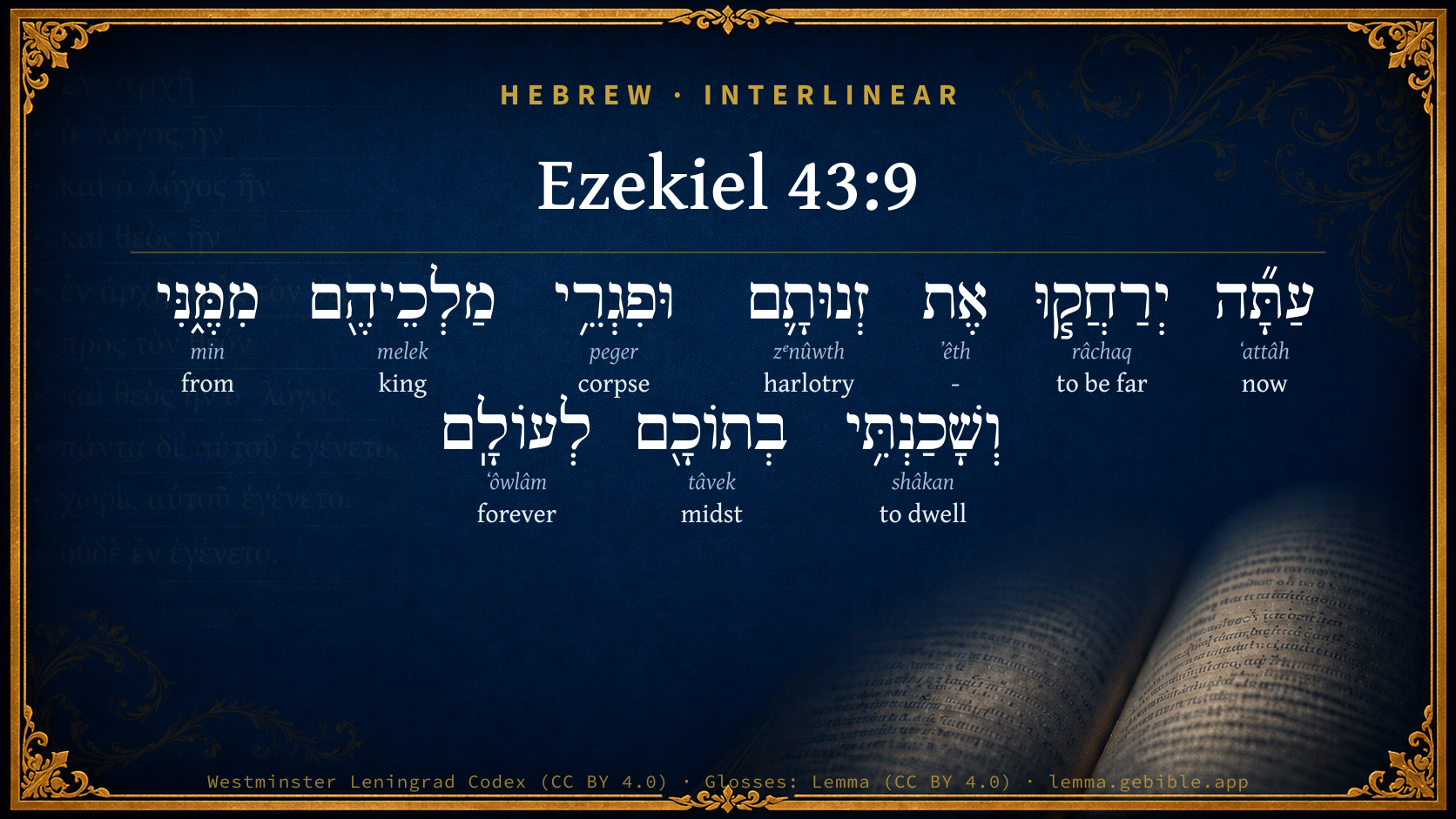
Hebrew (Westminster Leningrad Codex) Ezekiel 43:9 appears in the Hebrew Old Testament. The text above is from the Westminster Leningrad Codex. Each word links to its Strong’s number, a concise gloss, and parsing drawn from the Open Scriptures Hebrew Bible morphology. Click any word for its full Brown-Driver-Briggs (BDB) entry.
Download image
Cite this verse

Ezekiel 43:9 (World English Bible). Public Domain. Lemma interlinear Bible study tool, https://lemma.gebible.app/v/ezekiel/43/9.

Show BibTeX & RIS
BibTeX
RIS
English Translation
Now let them put away their prostitution, and the dead bodies of their kings, far from me; and I will dwell in the midst of them forever.
World English Bible · Public Domain
Download a study sheet

One document with this verse’s original text, its word-by-word gloss line, the meaning frame, cross-references with their text, attributed commentary, and full source and license credits — printable, and it pastes into notes with its structure intact.

This verse Autodidact and up

Study sheet (.html) Plain text (.txt)

A passage Seminary Student

Up to 50 verses in one chapter. A passage sheet keeps up to 6 commentary sources and 12 cross-references per verse, in the order this page ranks them, and says so on the sheet whenever that leaves anything out. Ask for a single verse and you get the Autodidact verse sheet above.

Everything on this page stays free to read, with no account — the sheet is a download of what is already on screen, not access to it.

Want to remove ads? Support Godless Engineer
Compare translations 3

The same verse in 3 English versions, stacked beneath the original-language interlinear above. Click any original word for its lexicon entry.

Each is an independent rendering of the whole verse — the interlinear is not word-aligned to these translations.

Highlighted words mark where these versions differ — a whole-verse word diff, not a word-by-word alignment.

  • World English Bible Public Domain
    Now let them put away their prostitution, and the dead bodies of their kings, far from me; and I will dwell in the midst of them forever.
  • King James Version Public Domain
    Now let them put away their whoredom, and the carcases of their kings, far from me, and I will dwell in the midst of them for ever.
  • unfoldingWord Literal Text CC BY-SA 4.0
    Now let them remove their faithlessness and the corpses of their kings from before me, and I will live in their midst forever.

unfoldingWord Literal Text — © unfoldingWord, licensed CC BY-SA 4.0. Word-aligned USFM3 via Door43 (git.door43.org/unfoldingWord/en_ult).

Versions to compare (up to 4)

3 of 4 selected

Show all 17 translations

Every available English version of this verse, each an independent rendering of the whole verse.

  • World English Bible Public Domain
    Now let them put away their prostitution, and the dead bodies of their kings, far from me; and I will dwell in the midst of them forever.
  • Berean Standard Bible Public Domain
    Now let them remove far from Me their prostitution and the funeral offerings for their kings, and I will dwell among them forever.
  • Majority Standard Bible Public Domain
    Now let them remove far from Me their prostitution and the funeral offerings for their kings, and I will dwell among them forever.
  • King James Version Public Domain
    Now let them put away their whoredom, and the carcases of their kings, far from me, and I will dwell in the midst of them for ever.
  • American Standard Version (1901) Public Domain
    Now let them put away their whoredom, and the dead bodies of their kings, far from me; and I will dwell in the midst of them for ever.
  • Revised Version (1885) Public Domain
    Now let them put away their whoredom, and the carcases of their kings, far from me, and I will dwell in the midst of them for ever.
  • Geneva Bible (1599) Public Domain
    Now therefore let them put away their fornication, and the carkeises of their Kings farre from me, and I will dwell among them for euer.
  • Young's Literal Translation Public Domain
    Now do they put far off their whoredom, And the carcases of their kings -- from Me, And I have dwelt in their midst to the age.
  • Literal Standard Version CC BY-SA 4.0
    Now they put their whoredom far off, || And the carcasses of their kings—from Me, || And I have dwelt in their midst for all time.
  • Unlocked Literal Bible CC BY-SA 4.0
    Now let them remove their faithlessness and the corpses of their kings from before me, and I will live in their midst forever.
  • unfoldingWord Literal Text CC BY-SA 4.0
    Now let them remove their faithlessness and the corpses of their kings from before me, and I will live in their midst forever.
  • Darby Bible Public Domain
    Now let them put away their fornication, and the carcases of their kings, far from me, and I will dwell in the midst of them for ever.
  • World Messianic Bible Public Domain
    Now let them put away their prostitution, and the dead bodies of their kings far from me. Then I will dwell among them forever.
  • Webster's Bible Public Domain
    Now let them put away their lewd deeds, and the carcasses of their kings, far from me, and I will dwell in the midst of them for ever.
  • Free Bible Version CC BY-SA 4.0
    Now if they get rid of their prostitution and their pagan honoring of their dead kings, and I will live with them forever.
  • Bible in Basic English Public Domain
    Now let them put their loose ways and the dead bodies of their kings far from me, and I will be among them for ever.
  • JPS Tanakh (1917) Public Domain
    Now let them put away their harlotry, and the carcasses of their kings, far from Me, and I will dwell in the midst of them for ever.

Literal Standard Version (2020), Covenant Press — licensed CC BY-SA 4.0. Text via the HelloAO Bible API (eBible.org). Unlocked Literal Bible (unfoldingWord) — licensed CC BY-SA 4.0. Text via the HelloAO Bible API (eBible.org). unfoldingWord Literal Text — © unfoldingWord, licensed CC BY-SA 4.0. Word-aligned USFM3 via Door43 (git.door43.org/unfoldingWord/en_ult). Free Bible Version, Dr. Jonathan Gallagher — licensed CC BY-SA 4.0. Text via the HelloAO Bible API (eBible.org).

Word by word

More ways to search: Search by grammar → Find every occurrence → Compare this word →

Practice this passage: Drill this verse → Learn its vocabulary →

זְנוּתָ֛ם
zᵉnûwth
H2184
“harlotry · their”
Noun, Common, Feminine, Singular, Construct + Suffix, Personal, 3rd Person, Masculine, Plural
Part of Speech
Noun
Type
Common
Gender
Feminine
Number
Singular
State
Construct
Full BDB Definition

Origin: from H2181

TWOT: 563b

fornication, harlotry
  1. עַתָּ֞ה ʻattâh H6258 “now” Adverb
  2. יְרַחֲק֧וּ râchaq H7368 “to be far” Verb, Piel, Jussive, 3rd Person, Masculine, Plural
  3. אֶת ʼêth H853 “-” Particle, Direct Object
  4. וּפִגְרֵ֥י peger H6297 “and · corpses of” Conjunction + Noun, Common, Masculine, Plural, Construct
  5. מַלְכֵיהֶ֖ם melek H4428 “kings · their” Noun, Common, Masculine, Plural, Construct + Suffix, Personal, 3rd Person, Masculine, Plural
  6. מִמֶּ֑נִּי min H4480 “from · me” Preposition + Suffix, Personal, 1st Person, Common, Singular
  7. וְשָׁכַנְתִּ֥י shâkan H7931 “and · to dwell” Conjunction + Verb, Qal, Sequential Perfect, 1st Person, Common, Singular
  8. בְתוֹכָ֖ם tâvek H8432 “in/at · midst · their” Preposition + Noun, Common, Masculine, Singular, Construct + Suffix, Personal, 3rd Person, Masculine, Plural
  9. לְעוֹלָֽם ʻôwlâm H5769 “to/for · forever” Preposition + Noun, Common, Masculine, Singular, Absolute

About this verse

These counts appear in no published source. They are computed here, from the morphology-tagged text and Lemma’s own curated glosses. What Lemma adds →

10
words
10
distinct lemmas
Prophets
section

Notable vocabulary

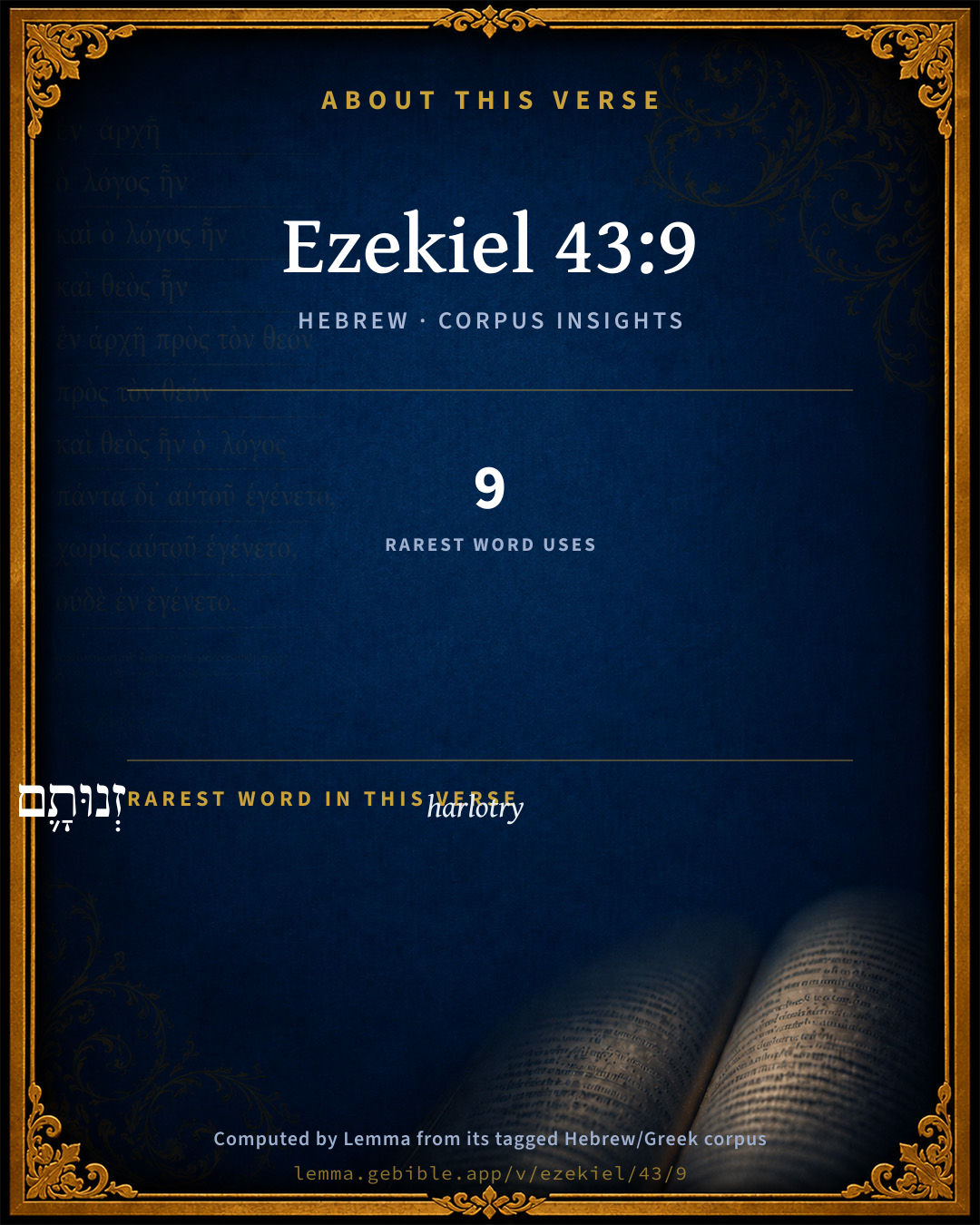
The rarest word here is זְנוּתָ֛ם harlotry H2184 — appearing just 9 times in the whole Hebrew Bible.

Shared distinctive vocabulary

זְנוּתָ֛ם harlotry H2184 occurs in 9 verses of the Hebrew Bible. Also found in:

Grammatical profile

  • 2 verbs
  • 5 nouns
  • 1 preposition
  • 1 adverb
  • 1 particle

Verb forms

  • יְרַחֲק֧וּ Piel · Jussive
  • וְשָׁכַנְתִּ֥י Qal · Sequential Perfect

Hebrew & Septuagint length

In English translation the verse runs 27 words from the Hebrew and 26 from the Septuagint (LXX English) — closely comparable.

A rough comparison of the two English renderings, which tokenize alike — not a word-level alignment.

Word counts can differ between the Hebrew and the Greek without any difference in meaning — e.g. the Hebrew direct-object marker אֵת has no separate Greek word, and Greek often adds the article ὁ.

Cross-references

7

Topical passages linked to Ezekiel 43:9 in the Treasury of Scripture Knowledge — connected by theme and wording, ordered by reader-vote popularity; previews shown in the World English Bible.

  • Ezekiel 43:7 He said to me, Son of man, [this is] the place of my throne, and the place of the soles of my feet, where I will dwell in the midst of the children of Israel forever. The house of Israel shall no more defile my holy name, neither they, nor their kings, by their prostitution, and by the dead bodies of their kings [in] their high places;
  • Ezekiel 18:30–31 Therefore I will judge you, house of Israel, everyone according to his ways, says the Lord Yahweh. Return you, and turn yourselves from all your transgressions; so iniquity shall not be your ruin.
  • Ezekiel 37:26–28 Moreover I will make a covenant of peace with them; it shall be an everlasting covenant with them; and I will place them, and multiply them, and will set my sanctuary in the midst of them forevermore.
  • Colossians 3:5–9 Put to death therefore your members which are on the earth: sexual immorality, uncleanness, depraved passion, evil desire, and covetousness, which is idolatry;
  • Ezekiel 37:23 neither shall they defile themselves any more with their idols, nor with their detestable things, nor with any of their transgressions; but I will save them out of all their dwelling-places, in which they have sinned, and will cleanse them: so shall they be my people, and I will be their God.
  • 2 Corinthians 6:16 What agreement has a temple of God with idols? For you are a temple of the living God. Even as God said, "I will dwell in them, and walk in them; and I will be their God, and they will be my people."
  • Hosea 2:2 Contend with your mother! Contend, for she is not my wife, Neither am I her husband; And let her put away her prostitution from her face, And her adulteries from between her breasts;

Cross-references courtesy of OpenBible.info (CC BY 4.0).

Hebrew and Greek witnesses Masoretic Hebrew ↔ Greek Septuagint

The same verse in the two great witnesses to the Old Testament, shown verse-for-verse.

These are two independent witnesses, not word-aligned to each other, and the Septuagint is shown in lemma (dictionary) form.

Hebrew Ezekiel 43:9 Masoretic · Westminster Leningrad Codex

עַתָּ֞ה יְרַחֲק֧וּ אֶת זְנוּתָ֛ם וּפִגְרֵ֥י מַלְכֵיהֶ֖ם מִמֶּ֑נִּי וְשָׁכַנְתִּ֥י בְתוֹכָ֖ם לְעוֹלָֽם

Now let them put away their prostitution, and the dead bodies of their kings, far from me; and I will dwell in the midst of them forever.

World English Bible · Public Domain

Greek LXX Ezekiel 43:9 Septuagint · lemma form

καί νῦν ἀποὠθέω ὁ πορνεία αὐτός καί ὁ φόνος ὁ ἡγέομαι αὐτός ἀπό ἐγώ καί κατασκηνόω ἐν μέσος αὐτός ὁ αἰών

And now let them put away from me their fornication, and the murders of their princes, and I will dwell in the midst of them forever.

LXX2012 (modern English Septuagint) · Public Domain

Hebrew: Westminster Leningrad Codex (CC BY 4.0). Greek: Septuagint (public domain); English from LXX2012 (modern English Septuagint) (Public Domain). How the Septuagint differs from the Hebrew →

Targum (Aramaic paraphrase)

1

The Targum is the ancient Jewish Aramaic paraphrase of the Hebrew Scriptures — an interpretive translation, not the Hebrew text itself. Onkelos (literal) and Pseudo-Jonathan (expansive) render the Torah, and Jonathan the Prophets. Coverage is partial: where no permissively-licensed English translation exists for a verse, only the Aramaic is shown. This is verse-level text, not a word-by-word alignment to the Hebrew.

  1. Targum Jonathan Prophets (Joshua–Malachi)
    כְּעַן יְרַחֲקוּן יַת טַעֲוָתְהוֹן וּפִגְרֵי מַלְכֵיהוֹן מִלְמֶחֱטֵי קֳדָמַי וְאַשְׁרֵי שְׁכִנְתִּי בֵינֵיהוֹן לַעֲלָם:

    (no public-domain English translation for this verse)

    Targum Jonathan — Aramaic: “Mikraot Gedolot” (public domain). English: “Sefaria Community Translation” (CC0 1.0 (public-domain dedication)); “London "Chaldee Paraphrase," 1871” (public domain). Text via Sefaria.

Commentary

Notes on Ezekiel 43:9 from classic Christian and Jewish commentators (each source and its license shown beneath its notes). The classic Christian expositions comment on the surrounding passage and are grouped to its opening verse, so a note may address several verses; the Jewish commentaries on the Tanakh (Rashi and others) are per-verse, so they appear only where the commentator wrote on this verse.

Lemma curates 59 commentaries, every one of them public domain or Creative Commons licensed, each selected and text-cleaned for this edition rather than reprinted as found. About our sources →

Trapp's Complete Commentary

John Trapp

Eze 43:9 Now let them put away their whoredom, and the carcases of their kings, far from me, and I will dwell in the midst of them for ever.

Ver. 9. Now let them put away their whoredom.] So shall all be well between us. See Jer 3:1 Isa 1:18. {See Trapp on "Jer 3:1"} {See Trapp on "Isa 1:18"} Piscator; Ictus sapiat. Some read it, Now they will put away, &c.; and so they did, after the captivity, but will not be yet drawn to worship the true God aright. The Lord persuade their hearts thereto. Fiat, Fiat! Do it, Do it!

And the carcases.] See on Eze 43:7.

And I will dwell in the midst of them for ever.] This is the same with that in Mat 28:20, "I am with you to the end of the world."

John Trapp, A Commentary or Exposition upon All the Books of the Old and New Testament (1647–1656) — public domain. Text from a community e-Sword module.

Jamieson, Fausset & Brown

Robert Jamieson, A. R. Fausset & David Brown

carcasses of their kings--It is supposed that some of their idolatrous kings were buried within the bounds of Solomon's temple [HENDERSON]. Rather, "the carcasses of their idols," here called "kings," as having had lordship over them in past times (Isa 26:13); but henceforth Jehovah, alone their rightful lord, shall be their king, and the idols that had been their "king" would appear but as "carcasses." Hence these defunct kings are associated with the "high places" in Eze 43:7 [FAIRBAIRN] Lev 26:30 and Jer 16:18, confirm this. Manasseh had built altars in the courts of the temple to the host of heaven (Kg2 21:5; Kg2 23:6).

I will dwell in the midst . . . for ever-- (Rev 21:3).

Jamieson, Fausset & Brown — Commentary Critical and Explanatory on the Whole Bible (1871) — public domain (CC PDM 1.0). Text via the HelloAO Bible API.

Adam Clarke's Commentary

Verse 9. Now let them put away their whoredom] Their idolatry.

And the carcasses of their kings] It appears that God was displeased with their bringing their kings so near his temple. David was buried in the city of David, which was on Mount Zion, near to the temple; and so were almost all the kings of Judah; but God requires that the place of his temple and its vicinity shall be kept unpolluted; and when they put away all kinds of defilement, then will he dwell among them.

Adam Clarke's Commentary on the Bible (1810–1826) — public domain. Text from a community e-Sword/MySword module.

Ellicott's Commentary for English Readers

(9) Now let them.—This is not an imperative, but a simple future, as in Eze_43:7. The house of Israel will now put away their abominations, and God will dwell in their midst for ever. Carcases = idols, as in Eze_43:7.

A Bible Commentary for English Readers, edited by Charles John Ellicott (1878–1897) — public domain. Text from a community e-Sword module.

John Gill's Exposition

Now let them put away their whoredom,.... Idolatry, superstition, and will worship, with which the corrupt church of Rome abounds; and whatever appearance thereof is in the reformed churches:

and the carcasses of their kings far from me; their idols; See Gill on Eze 43:7,

and I will dwell in the midst of them for ever; now though the Jews were never guilty of idolatry after their return from the Babylonish captivity, nor even to this day; yet the Lord has departed from them, and left them to blindness and stupidity, they having rejected the Messiah he sent unto them; which shows that this passage refers not to those times, but to future times; when the whole Israel of God shall be cleared of all corruptions in doctrine and worship, and the Lord will take up his abode with them, and no more depart from them.

John Gill's Exposition of the Whole Bible (1746–1763) — public domain (CC PDM 1.0). Text via the HelloAO Bible API.

Haydock's Catholic Bible Commentary

Carcasses. Literally, "ruins." (Haydock) --- The remains of the dead were probably not disturbed; but no more, that we know of, were placed on Sion. (Calmet) --- Kings may signify idols, Moloc, &c., which they had worshipped, and which some had even placed in the holy place, to the nation’s ruin. (Haydock)

George Leo Haydock (1774–1849), Haydock's Catholic Family Bible and Commentary, 1859 edition — public domain. Excludes Psalms (Douay-Rheims chapter numbering differs from Protestant) and Deuterocanonical books (Catholic canon only).

Matthew Poole's English Annotations

This verse is either prophetic or perceptive, it doth direct the Jew what he should in duty do under this temple, and foretell what the people of God will do under the gospel.

Put away; cast away, as impure and loathsome things should be cast away.

Their whoredom, & c.: see Eze 43:7.

Far from me, my temple and worship.

I will dwell in the midst of them, as their light, protection, and glory. The promises which are made in these cases enjoin us duty: men may sin away God’s presence and blessings. Cast away all sin, that God cast not you away.

For ever: see Eze 43:7.

Matthew Poole's English Annotations on the Holy Bible (1683–1685) — public domain. Text from a community e-Sword/MySword module.

The Pulpit Commentary

Now let them put away their whoredom, etc. What has just been declared to be the necessary consequence of Jehovah"s abiding in the midst of Israel is now enjoined upon Israel as an indispensable prerequisite of Jehovah"s taking up his residence amongst them. Ezekiel"s theology in this respect harmonizes with that of Old and New Testament writers generally, who invariably postulate purity of heart and life as a necessary condition of God"s abiding in the heart, while asserting that such Divine indwelling in the heart is the only certain creator of such purity. (comp. Eze_18:31 Eze_36:26; Isa_1:16, 25 26:12; Joh_14:23; 2Co_6:17; Jam_4:8)

The Pulpit Commentary (1880–1919), ed. H.D.M. Spence-Jones & Joseph S. Exell — public domain. Text from a community e-Sword module.

John Wesley's Explanatory Notes

Far from me - From my temple.

John Wesley, Explanatory Notes Upon the Whole Bible (1754–1765) — public domain. Text via the GEBible commentary corpus.

unfoldingWord translationNotes

Door43 World Missions Community

the corpses of their kings

The idols that the people's kings worshiped are spoken of as if they are corpses because the idols are not alive. See how you translated this in Ezekiel 43:7. AT: "the lifeless idols that their kings worshiped" (See: Metaphor)

translationWords

faithless

unfoldingWord translationNotes — © Distant Shores Media and the Door43 World Missions Community, licensed CC BY-SA 4.0. Source: git.door43.org/Door43/en_tn.

Rashi

Rabbi Shlomo Yitzchaki (Rashi)

Now perforce, they will distance [from Me] their harlotry, for I have put up, as a separation for Myself, an encompassment of a large border all around.

Rashi on the Tanakh — English translations: “The Judaica Press complete Tanach with Rashi, translated by A. J. Rosenberg” (CC BY 4.0); “Pentateuch with Rashi's commentary by M. Rosenbaum and A.M. Silbermann, 1929-1934” (public domain); “The Metsudah Tanach series, Lakewood, N.J” (CC BY 4.0); and “The Book of Joshua, Metsudah Publications, 1997” (CC BY 4.0). Text via Sefaria.

Lesson kit

Teaching starters — assembled from the data on this page, not authored interpretation. Every prompt links to the verse data it draws on. Edit before teaching.

Ezekiel, in the Prophets, opens this verse with 10 words (10 distinct Hebrew lemmas). Its most distinctive word is zᵉnûwth (“harlotry”). A historical commentator’s framing appears above. Read the whole chapter for the surrounding context.

Discussion questions

  1. How does “harlotry” (zᵉnûwth) shape what this verse is saying?
  2. How does Numbers 14:33, which shares the word «harlotry», read alongside this verse?
  3. These translations render this verse differently; the difference is in the English rendering, not the original. What questions does that raise?
  4. «יְרַחֲק֧וּ» is a Piel Jussive verb. How does that grammatical form shape the action described?
  5. Compare how Trapp's Complete Commentary and Jamieson, Fausset & Brown read this verse. Where do they agree or differ?

Things to notice

Reading settings

Reading text

Shown beneath each verse's original-language words.

Old Testament
Old Testament edition

Read the OT as the Masoretic Hebrew (MT) or the Greek Septuagint (LXX).

English shown for the Greek Septuagint (in the Hebrew ↔ Greek comparison).

Comparing translations? Open the Compare panel on any verse page to stack up to four side by side.