Jeremiah 11:23

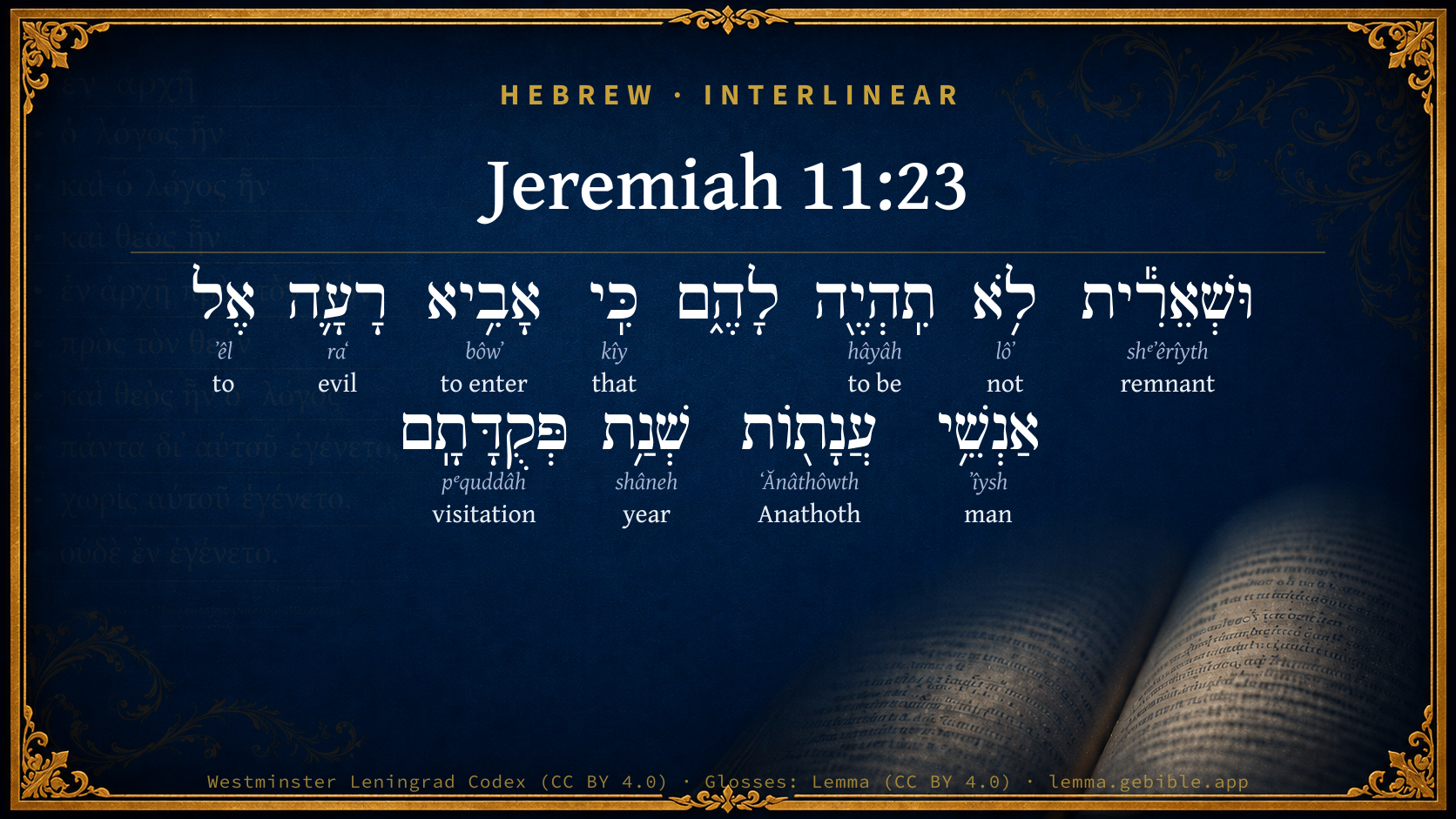
Hebrew (Westminster Leningrad Codex) Jeremiah 11:23 appears in the Hebrew Old Testament. The text above is from the Westminster Leningrad Codex. Each word links to its Strong’s number, a concise gloss, and parsing drawn from the Open Scriptures Hebrew Bible morphology. Click any word for its full Brown-Driver-Briggs (BDB) entry.
Download image
Cite this verse

Jeremiah 11:23 (World English Bible). Public Domain. Lemma interlinear Bible study tool, https://lemma.gebible.app/v/jeremiah/11/23.

Show BibTeX & RIS
BibTeX
RIS
English Translation
and there shall be no remnant to them: for I will bring evil on the men of Anathoth, even the year of their visitation.
World English Bible · Public Domain
Download a study sheet

One document with this verse’s original text, its word-by-word gloss line, the meaning frame, cross-references with their text, attributed commentary, and full source and license credits — printable, and it pastes into notes with its structure intact.

This verse Autodidact and up

Study sheet (.html) Plain text (.txt)

A passage Seminary Student

Up to 50 verses in one chapter. A passage sheet keeps up to 6 commentary sources and 12 cross-references per verse, in the order this page ranks them, and says so on the sheet whenever that leaves anything out. Ask for a single verse and you get the Autodidact verse sheet above.

Everything on this page stays free to read, with no account — the sheet is a download of what is already on screen, not access to it.

Want to remove ads? Support Godless Engineer
Compare translations 3

The same verse in 3 English versions, stacked beneath the original-language interlinear above. Click any original word for its lexicon entry.

Each is an independent rendering of the whole verse — the interlinear is not word-aligned to these translations.

Highlighted words mark where these versions differ — a whole-verse word diff, not a word-by-word alignment.

  • World English Bible Public Domain
    and there shall be no remnant to them: for I will bring evil on the men of Anathoth, even the year of their visitation.
  • King James Version Public Domain
    And there shall be no remnant of them: for I will bring evil upon the men of Anathoth, even the year of their visitation.
  • unfoldingWord Literal Text CC BY-SA 4.0
    and there will not be a remnant to them, for I will bring calamity on the men of Anathoth, year of their visitation.”

unfoldingWord Literal Text — © unfoldingWord, licensed CC BY-SA 4.0. Word-aligned USFM3 via Door43 (git.door43.org/unfoldingWord/en_ult).

Versions to compare (up to 4)

3 of 4 selected

Show all 18 translations

Every available English version of this verse, each an independent rendering of the whole verse.

  • World English Bible Public Domain
    and there shall be no remnant to them: for I will bring evil on the men of Anathoth, even the year of their visitation.
  • Berean Standard Bible Public Domain
    There will be no remnant, for I will bring disaster on the people of Anathoth in the year of their punishment.”
  • Majority Standard Bible Public Domain
    There will be no remnant, for I will bring disaster on the people of Anathoth in the year of their punishment.”
  • King James Version Public Domain
    And there shall be no remnant of them: for I will bring evil upon the men of Anathoth, even the year of their visitation.
  • American Standard Version (1901) Public Domain
    and there shall be no remnant unto them: for I will bring evil upon the men of Anathoth, even the year of their visitation.
  • Revised Version (1885) Public Domain
    and there shall be no remnant unto them: for I will bring evil upon the men of Anathoth, even the year of their visitation.
  • Geneva Bible (1599) Public Domain
    And none of them shall remaine: for I will bring a plague vpon the men of Anathoth, euen the yeere of their visitation.
  • Douay-Rheims (1899) Public Domain
    And there shall be no remains of them: for I will bring in evil upon the men of Anathoth, the year of their visitation.
  • Young's Literal Translation Public Domain
    And they have no remnant, For I bring evil unto the men of Anathoth, The year of their inspection!'
  • Literal Standard Version CC BY-SA 4.0
    And they have no remnant, || For I bring calamity to the men of Anathoth, || The year of their inspection!”
  • Unlocked Literal Bible CC BY-SA 4.0
    None of them will be left, because I am bringing disaster against the people of Anathoth, a year of their punishment.'”
  • unfoldingWord Literal Text CC BY-SA 4.0
    and there will not be a remnant to them, for I will bring calamity on the men of Anathoth, year of their visitation.”
  • Darby Bible Public Domain
    and there shall be no remnant of them; for I will bring evil upon the men of Anathoth, in the year of their visitation.
  • World Messianic Bible Public Domain
    There will be no remnant to them, for I will bring evil on the men of Anathoth, even the year of their visitation.’”
  • Webster's Bible Public Domain
    And there shall be no remnant of them: for I will bring evil upon the men of Anathoth, even the year of their visitation.
  • Free Bible Version CC BY-SA 4.0
    There won't be anyone left because I will bring disaster on the people of Anathoth at the time when they're punished.
  • Bible in Basic English Public Domain
    Not one of them will keep his life, for I will send evil on the men of Anathoth in the year of their punishment.
  • JPS Tanakh (1917) Public Domain
    And there shall be no remnant unto them; for I will bring evil upon the men of Anathoth, even the year of their visitation.

Literal Standard Version (2020), Covenant Press — licensed CC BY-SA 4.0. Text via the HelloAO Bible API (eBible.org). Unlocked Literal Bible (unfoldingWord) — licensed CC BY-SA 4.0. Text via the HelloAO Bible API (eBible.org). unfoldingWord Literal Text — © unfoldingWord, licensed CC BY-SA 4.0. Word-aligned USFM3 via Door43 (git.door43.org/unfoldingWord/en_ult). Free Bible Version, Dr. Jonathan Gallagher — licensed CC BY-SA 4.0. Text via the HelloAO Bible API (eBible.org).

Word by word

More ways to search: Search by grammar → Find every occurrence → Compare this word →

Practice this passage: Drill this verse → Learn its vocabulary →

עֲנָת֖וֹת
ʻĂnâthôwth
H6068
“Anathoth”
Noun, Proper
Part of Speech
Noun
Type
Proper
Full BDB Definition

Origin: pl. of H6067

TWOT: None

Anathoth = "answers to prayer" - son of Becher and grandson of Benjamin (noun proper masculine) - one of the heads of the people who signed the covenant with Nehemiah (noun proper masculine) - a city of Benjamin allotted to the priest; located approximately 3 miles (5 kilometers) from Jerusalem; birthplace of the prophet Jeremiah (noun proper locative)
  1. וּשְׁאֵרִ֕ית shᵉʼêrîyth H7611 “and · remnant” Conjunction + Noun, Common, Feminine, Singular, Absolute
  2. לֹ֥א lôʼ H3808 “not” Particle, Negative
  3. תִֽהְיֶ֖ה hâyâh H1961 “to be” Verb, Qal, Imperfect, 3rd Person, Feminine, Singular
  4. כִּֽי kîy H3588 “that” Conjunction
  5. אָבִ֥יא bôwʼ H935 “to enter” Verb, Hiphil, Imperfect, 1st Person, Common, Singular
  6. רָעָ֛ה raʻ H7451 “evil” Noun, Common, Feminine, Singular, Absolute
  7. אֶל ʼêl H413 “to” Preposition
  8. אַנְשֵׁ֥י ʼîysh H376 “men of” Noun, Common, Masculine, Plural, Construct
  9. שְׁנַ֥ת shâneh H8141 “year of” Noun, Common, Feminine, Singular, Construct
  10. פְּקֻדָּתָֽם pᵉquddâh H6486 “visitation · their” Noun, Common, Feminine, Singular, Construct + Suffix, Personal, 3rd Person, Masculine, Plural

About this verse

These counts appear in no published source. They are computed here, from the morphology-tagged text and Lemma’s own curated glosses. What Lemma adds →

12
words
11
distinct lemmas
Prophets
section

Notable vocabulary

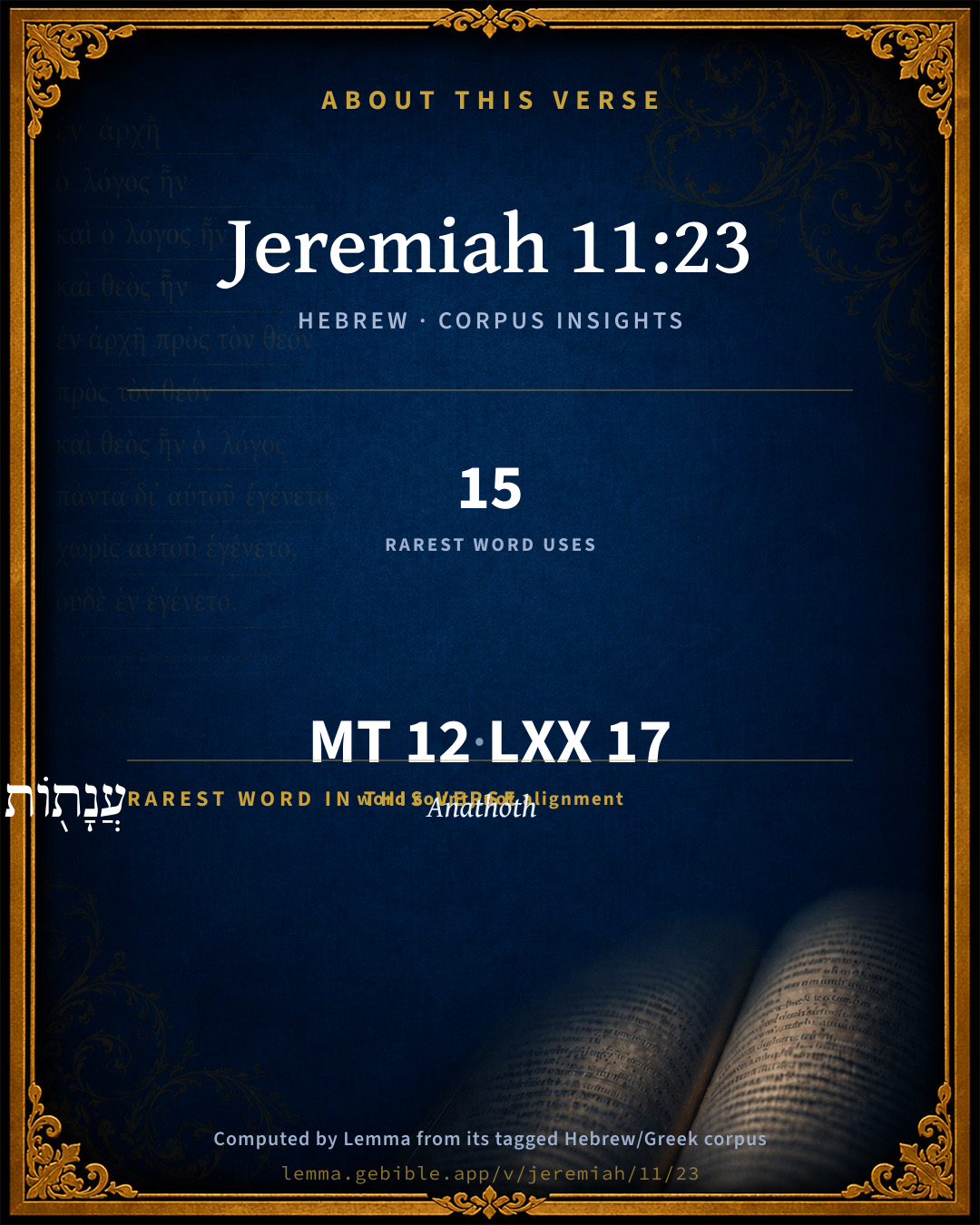
The rarest word here is עֲנָת֖וֹת Anathoth H6068 — appearing just 15 times in the whole Hebrew Bible.

Shared distinctive vocabulary

עֲנָת֖וֹת Anathoth H6068 occurs in 15 verses of the Hebrew Bible. Also found in:

Grammatical profile

  • 2 verbs
  • 6 nouns
  • 2 prepositions
  • 1 conjunction
  • 1 particle

Verb forms

  • תִֽהְיֶ֖ה Qal · Imperfect
  • אָבִ֥יא Hiphil · Imperfect

Hebrew & Septuagint length

In the original languages it is 12 Hebrew tokens and 17 Greek tokens — but the two are counted differently (Hebrew bundles its prefixes and suffixes into one token; the Greek is in lemma form), so that isn’t a like-for-like length.

Cross-references

14

Topical passages linked to Jeremiah 11:23 in the Treasury of Scripture Knowledge — connected by theme and wording, ordered by reader-vote popularity; previews shown in the World English Bible.

  • Jeremiah 23:12 Therefore their way shall be to them as slippery places in the darkness: they shall be driven on, and fall therein; for I will bring evil on them, even the year of their visitation, says Yahweh.
  • Jeremiah 50:27 Kill all her bulls; let them go down to the slaughter: woe to them! for their day is come, the time of their visitation.
  • Hosea 9:7 The days of visitation have come. The days of reckoning have come. Israel will consider the prophet to be a fool, And the man who is inspired to be insane, Because of the abundance of your sins, And because your hostility is great.
  • Micah 7:4 The best of them is like a brier. The most upright is worse than a thorn hedge. The day of your watchmen, Even your visitation, has come; Now is the time of their confusion.
  • Luke 19:44 and will dash you and your children within you to the ground. They will not leave in you one stone on another, because you didn't know the time of your visitation."
  • Isaiah 14:20–22 You shall not be joined with them in burial, because you have destroyed your land, you have killed your people; the seed of evil-doers shall not be named forever.
  • Jeremiah 5:9 Shall I not visit for these things? says Yahweh; and shall not my soul be avenged on such a nation as this?
  • Jeremiah 5:29 Shall I not visit for these things? says Yahweh; shall not my soul be avenged on such a nation as this?
  • Jeremiah 6:9 Thus says Yahweh of Hosts, They shall thoroughly glean the remnant of Israel as a vine: turn again your hand as a grape-gatherer into the baskets.
  • Jeremiah 8:12 Were they ashamed when they had committed abomination? nay, they were not at all ashamed, neither could they blush: therefore shall they fall among those who fall; in the time of their visitation they shall be cast down, says Yahweh.
  • Jeremiah 11:19 But I was like a gentle lamb that is led to the slaughter; and I didn't know that they had devised devices against me, [saying], Let us destroy the tree with the fruit of it, and let us cut him off from the land of the living, that his name may be no more remembered.
  • Jeremiah 44:27 Behold, I watch over them for evil, and not for good; and all the men of Judah who are in the land of Egypt shall be consumed by the sword and by the famine, until there be an end of them.
  • Jeremiah 46:21 Also her hired men in the midst of her are like calves of the stall; for they also are turned back, they are fled away together, they didn't stand: for the day of their calamity is come on them, the time of their visitation.
  • Jeremiah 48:44 He who flees from the fear shall fall into the pit; and he who gets up out of the pit shall be taken in the snare: for I will bring on him, even on Moab, the year of their visitation, says Yahweh.

Cross-references courtesy of OpenBible.info (CC BY 4.0).

Hebrew and Greek witnesses Masoretic Hebrew ↔ Greek Septuagint

The same verse in the two great witnesses to the Old Testament, shown verse-for-verse.

These are two independent witnesses, not word-aligned to each other, and the Septuagint is shown in lemma (dictionary) form.

Hebrew Jeremiah 11:23 Masoretic · Westminster Leningrad Codex

וּשְׁאֵרִ֕ית לֹ֥א תִֽהְיֶ֖ה לָהֶ֑ם כִּֽי אָבִ֥יא רָעָ֛ה אֶל אַנְשֵׁ֥י עֲנָת֖וֹת שְׁנַ֥ת פְּקֻדָּתָֽם

and there shall be no remnant to them: for I will bring evil on the men of Anathoth, even the year of their visitation.

World English Bible · Public Domain

Greek LXX Structure differs

In the Septuagint, Jeremiah is about an eighth shorter than the Hebrew and arranges its material differently — the Oracles Against the Nations (Hebrew chapters 46–51) appear in the middle of the Greek book, after 25:13. Because the chapter and verse boundaries do not line up, a verse-for-verse comparison with the Hebrew is not shown.

A verse-for-verse comparison isn’t shown here because the chapters and verses don’t line up. Switch to the LXX edition with the MT / LXX toggle above to read the Greek directly.

On this verse, Jamieson, Fausset & Brown discusses the Septuagint’s reading. Read the note in Commentary ↓

Hebrew: Westminster Leningrad Codex (CC BY 4.0). Greek: Septuagint (public domain); English from a public-domain English Septuagint. How the Septuagint differs from the Hebrew →

Targum (Aramaic paraphrase)

1

The Targum is the ancient Jewish Aramaic paraphrase of the Hebrew Scriptures — an interpretive translation, not the Hebrew text itself. Onkelos (literal) and Pseudo-Jonathan (expansive) render the Torah, and Jonathan the Prophets. Coverage is partial: where no permissively-licensed English translation exists for a verse, only the Aramaic is shown. This is verse-level text, not a word-by-word alignment to the Hebrew.

  1. Targum Jonathan Prophets (Joshua–Malachi)
    וּשְׁאָרָא לָא יְהֵי לְהוֹן אֲרֵי אַיְתִי בִּישְׁתָא עַל אֱנָשֵׁי עֲנָתוֹת שְׁנַת סוֹעֲרָן חוֹבֵיהוֹן:

    (no public-domain English translation for this verse)

    Targum Jonathan — Aramaic: “Mikraot Gedolot” (public domain). English: “Sefaria Community Translation” (CC0 1.0 (public-domain dedication)); “London "Chaldee Paraphrase," 1871” (public domain). Text via Sefaria.

Commentary

Notes on Jeremiah 11:23 from classic Christian and Jewish commentators (each source and its license shown beneath its notes). The classic Christian expositions comment on the surrounding passage and are grouped to its opening verse, so a note may address several verses; the Jewish commentaries on the Tanakh (Rashi and others) are per-verse, so they appear only where the commentator wrote on this verse.

Lemma curates 59 commentaries, every one of them public domain or Creative Commons licensed, each selected and text-cleaned for this edition rather than reprinted as found. About our sources →

Trapp's Complete Commentary

John Trapp

Jer 11:23 And there shall be no remnant of them: for I will bring evil upon the men of Anathoth, [even] the year of their visitation.

Ver. 23. And there shall be no remnant.] Behold the severity of God: their bloody design was to destroy Jeremiah’s stock and fruit, stalk and grain together. {Jer 11:19} God meteth unto them the self-same measure, leaveth them not a remnant. This is not ordinary justice. {Jer 4:27 Isa 1:9; Isa 10:20-22} A remnant shall be left, saith he; here not so. Let Rome, that shambles of the saints and prophets, especially look to it; God is now coming to make inquisition for blood, &c.

John Trapp, A Commentary or Exposition upon All the Books of the Old and New Testament (1647–1656) — public domain. Text from a community e-Sword module.

Jamieson, Fausset & Brown

Robert Jamieson, A. R. Fausset & David Brown

(Jer 23:12).

the year of . . . visitation--The Septuagint translates, "in the year of their," &c., that is, at the time when I shall visit them in wrath. JEROME supports English Version. "Year" often means a determined time.

He ventures to expostulate with Jehovah as to the prosperity of the wicked, who had plotted against his life (Jer 12:1-4); in reply he is told that he will have worse to endure, and that from his own relatives (Jer 12:5-6). The heaviest judgments, however, would be inflicted on the faithless people (Jer 12:7-13); and then on the nations co-operating with the Chaldeans against Judah, with, however, a promise of mercy on repentance (Jer 12:14-17).

Next: Jeremiah Chapter 12

Jamieson, Fausset & Brown — Commentary Critical and Explanatory on the Whole Bible (1871) — public domain (CC PDM 1.0). Text via the HelloAO Bible API.

Adam Clarke's Commentary

Verse 23. The year of their visitation.] This punishment shall come in that year in which I shall visit their iniquities upon them.

Adam Clarke's Commentary on the Bible (1810–1826) — public domain. Text from a community e-Sword/MySword module.

Ellicott's Commentary for English Readers

(23) There shall be no remnant of them.—In Ezr_2:23; Neh_7:27 we find that 128 of Anathoth returned from exile. The words must therefore be limited either to the men who had conspired against the prophet, or to the complete deportation of its inhabitants. The situation of Anathoth, about three or four miles north-east of Jerusalem, would expose it to the full fury of the invasion. The words are apparently spoken with reference to the ever-recurring burden of Isaiah’s prophecy that “a remnant “should return (Isa_1:9; Isa_6:13; Isa_10:21). The conspirators of Anathoth were excluded from that promise.

Even the year of their visitation.—See Notes on Jer_8:12; Jer_10:15.

A Bible Commentary for English Readers, edited by Charles John Ellicott (1878–1897) — public domain. Text from a community e-Sword module.

The Cambridge Bible for Schools and Colleges

gen. ed. J. J. S. Perowne

23. even the year] or, as mg. in the year.

The Cambridge Bible for Schools and Colleges (gen. ed. J. J. S. Perowne; Cambridge University Press, 1878–1918) — public domain. Text from a community e-Sword module.

Albert Barnes' Notes on the Bible

No remnant - 128 men of Anathoth returned from exile Ezr 2:23; Neh 7:27. Jeremiah’s denunciation was limited to those who had sought his life. The year of their visitation would be the year of the siege of Jerusalem, when Anathoth being in its immediate vicinity would have its share of the horrors of war.

Albert Barnes' Notes on the Bible (1834–1885) — public domain. Text from a community e-Sword/MySword module.

Haydock's Catholic Bible Commentary

Remains. All these priests shall perish, Psalm xxxvi. 28. (Haydock) --- He speaks of the wicked, as a remnant was still left, chap. iv., and Isaias x. (Worthington)

George Leo Haydock (1774–1849), Haydock's Catholic Family Bible and Commentary, 1859 edition — public domain. Excludes Psalms (Douay-Rheims chapter numbering differs from Protestant) and Deuterocanonical books (Catholic canon only).

Matthew Poole's English Annotations

The prayers of God’s prophets, though they may sometimes have too much passion and human infirmity mixed with them, yet are heard of God, and many times answered in righteousness by terrible things, as to those against whom they are directed. The same thing they designed to do against the prophet God threateneth to do against them, utterly to consume them, so as no remembrance of them should remain.

Matthew Poole's English Annotations on the Holy Bible (1683–1685) — public domain. Text from a community e-Sword/MySword module.

Whedon's Commentary on the Bible

Daniel D. Whedon

23. No remnant — They shall be utterly destroyed. But this language is not to be pressed to the extreme of mathematical nicety. It is not contradicted by the fact that a hundred and twenty-eight men of Anathoth returned from the exile. Ezr_2:23; Neh_7:27.

Daniel D. Whedon (gen. ed.), Commentary on the Old and New Testaments (1874–1909) — public domain. Text from a community e-Sword module.

The Pulpit Commentary

Even the year, etc.; better, in the year of their visitation (or, punishment), taking the accusative as that of time.

The Pulpit Commentary (1880–1919), ed. H.D.M. Spence-Jones & Joseph S. Exell — public domain. Text from a community e-Sword module.

Rashi

Rabbi Shlomo Yitzchaki (Rashi)

upon the men of Anathoth Heb. אל-אנשי ענתות, like על-אנשי ענתות, upon the men of Anathoth.

Rashi on the Tanakh — English translations: “The Judaica Press complete Tanach with Rashi, translated by A. J. Rosenberg” (CC BY 4.0); “Pentateuch with Rashi's commentary by M. Rosenbaum and A.M. Silbermann, 1929-1934” (public domain); “The Metsudah Tanach series, Lakewood, N.J” (CC BY 4.0); and “The Book of Joshua, Metsudah Publications, 1997” (CC BY 4.0). Text via Sefaria.

Lesson kit

Teaching starters — assembled from the data on this page, not authored interpretation. Every prompt links to the verse data it draws on. Edit before teaching.

Jeremiah, in the Prophets, opens this verse with 12 words (11 distinct Hebrew lemmas). Its most distinctive word is ʻĂnâthôwth (“Anathoth”). A historical commentator’s framing appears above. Read the whole chapter for the surrounding context.

Discussion questions

  1. What does “Anathoth” (ʻĂnâthôwth) contribute to the verse as a whole?
  2. Joshua 21:18 shares the word «Anathoth» with this verse. How do the two illuminate each other?
  3. These translations render this verse differently. What is at stake in choosing one wording over another?
  4. The verb «תִֽהְיֶ֖ה» is Qal Imperfect. How does its form color the action?
  5. Reading how Trapp's Complete Commentary and Jamieson, Fausset & Brown read this verse, where do the two commentators agree and where do they part?

Things to notice

Reading settings

Reading text

Shown beneath each verse's original-language words.

Old Testament
Old Testament edition

Read the OT as the Masoretic Hebrew (MT) or the Greek Septuagint (LXX).

English shown for the Greek Septuagint (in the Hebrew ↔ Greek comparison).

Comparing translations? Open the Compare panel on any verse page to stack up to four side by side.