
Jeremiah 47:4

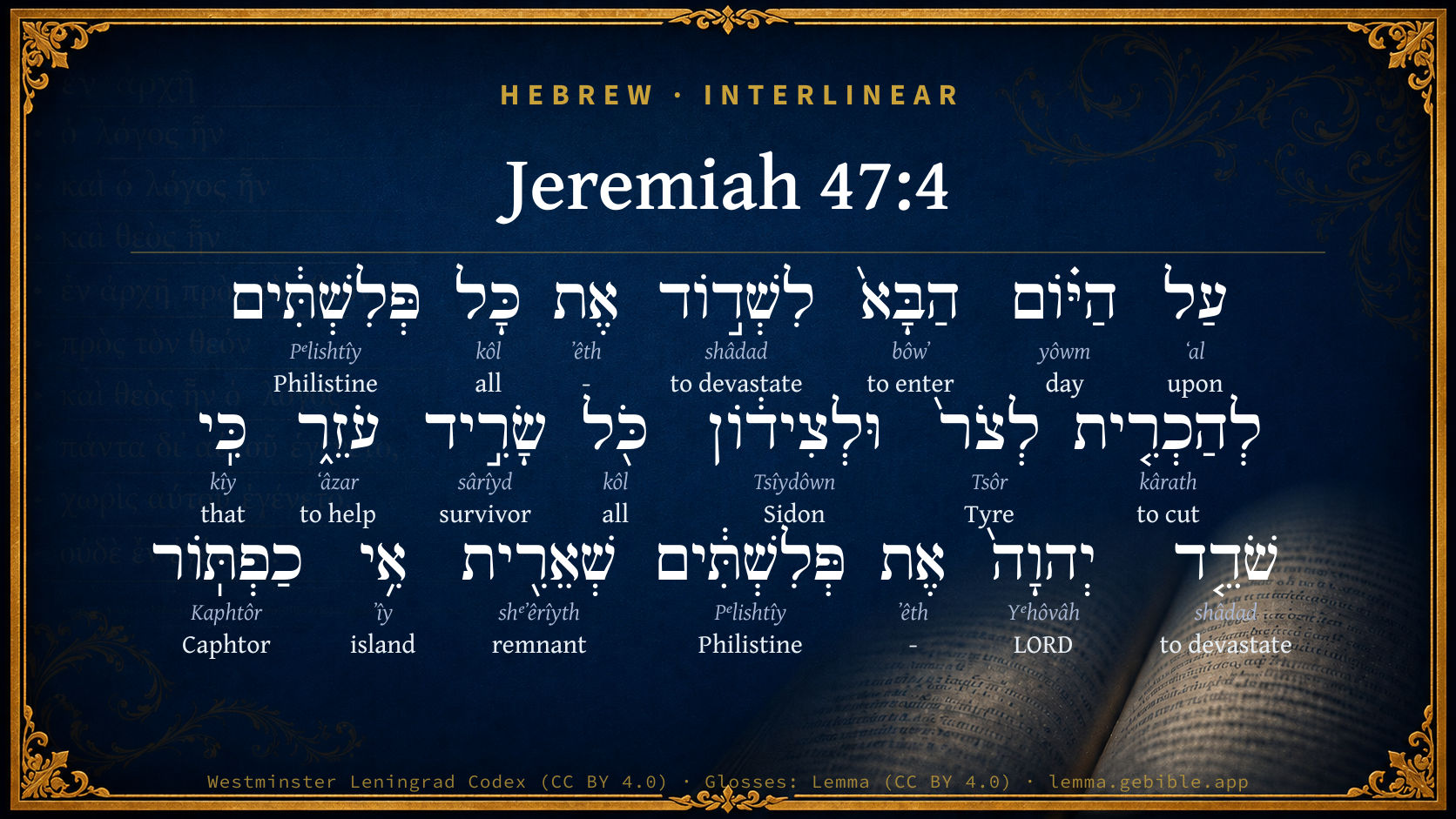
Hebrew (Westminster Leningrad Codex) Jeremiah 47:4 appears in the Hebrew Old Testament. The text above is from the Westminster Leningrad Codex. Each word links to its Strong’s number, a concise gloss, and parsing drawn from the Open Scriptures Hebrew Bible morphology. Click any word for its full Brown-Driver-Briggs (BDB) entry.
Download image
Cite this verse

Jeremiah 47:4 (World English Bible). Public Domain. Lemma interlinear Bible study tool, https://lemma.gebible.app/v/jeremiah/47/4.

Show BibTeX & RIS
BibTeX
RIS
English Translation
because of the day that comes to destroy all the Philistines, to cut off from Tyre and Sidon every helper who remains: for Yahweh will destroy the Philistines, the remnant of the isle of Caphtor.
World English Bible · Public Domain
Download a study sheet

One document with this verse’s original text, its word-by-word gloss line, the meaning frame, cross-references with their text, attributed commentary, and full source and license credits — printable, and it pastes into notes with its structure intact.

This verse Autodidact and up

Study sheet (.html) Plain text (.txt)

A passage Seminary Student

Up to 50 verses in one chapter. A passage sheet keeps up to 6 commentary sources and 12 cross-references per verse, in the order this page ranks them, and says so on the sheet whenever that leaves anything out. Ask for a single verse and you get the Autodidact verse sheet above.

Everything on this page stays free to read, with no account — the sheet is a download of what is already on screen, not access to it.

Want to remove ads? Support Godless Engineer
Compare translations 3

The same verse in 3 English versions, stacked beneath the original-language interlinear above. Click any original word for its lexicon entry.

Each is an independent rendering of the whole verse — the interlinear is not word-aligned to these translations.

Highlighted words mark where these versions differ — a whole-verse word diff, not a word-by-word alignment.

  • World English Bible Public Domain
    because of the day that comes to destroy all the Philistines, to cut off from Tyre and Sidon every helper who remains: for Yahweh will destroy the Philistines, the remnant of the isle of Caphtor.
  • King James Version Public Domain
    Because of the day that cometh to spoil all the Philistines, and to cut off from Tyrus and Zidon every helper that remaineth: for the LORD will spoil the Philistines, the remnant of the country of Caphtor.
  • unfoldingWord Literal Text CC BY-SA 4.0
    For the day is coming that will devastate all of the Philistines, to cut off from Tyre and Sidon every survivor who wants to help them. For Yahweh is devastating the Philistines, those who remain from the island of Caphtor.

unfoldingWord Literal Text — © unfoldingWord, licensed CC BY-SA 4.0. Word-aligned USFM3 via Door43 (git.door43.org/unfoldingWord/en_ult).

Versions to compare (up to 4)

3 of 4 selected

Show all 18 translations

Every available English version of this verse, each an independent rendering of the whole verse.

  • World English Bible Public Domain
    because of the day that comes to destroy all the Philistines, to cut off from Tyre and Sidon every helper who remains: for Yahweh will destroy the Philistines, the remnant of the isle of Caphtor.
  • Berean Standard Bible Public Domain
    For the day has come to destroy all the Philistines, to cut off from Tyre and Sidon every remaining ally. Indeed, the LORD is about to destroy the Philistines, the remnant from the coasts of Caphtor.
  • Majority Standard Bible Public Domain
    For the day has come to destroy all the Philistines, to cut off from Tyre and Sidon every remaining ally. Indeed, the LORD is about to destroy the Philistines, the remnant from the coasts of Caphtor.
  • King James Version Public Domain
    Because of the day that cometh to spoil all the Philistines, and to cut off from Tyrus and Zidon every helper that remaineth: for the LORD will spoil the Philistines, the remnant of the country of Caphtor.
  • American Standard Version (1901) Public Domain
    because of the day that cometh to destroy all the Philistines, to cut off from Tyre and Sidon every helper that remaineth: for Jehovah will destroy the Philistines, the remnant of the isle of Caphtor.
  • Revised Version (1885) Public Domain
    because of the day that cometh to spoil all the Philistines, to cut off from Tyre and Zidon every helper that remaineth: for the LORD will spoil the Philistines, the remnant of the isle of Caphtor.
  • Geneva Bible (1599) Public Domain
    Because of the day that commeth to destroy all the Philistims, and to destroy Tyrus, and Zidon, and all the rest that take their part: for the Lord will destroy the Philistims, the remnant of the yle of Caphtor.
  • Douay-Rheims (1899) Public Domain
    Because of the coming of the day, in which all the Philistines shall be laid waste, and Tyre and Sidon shall be destroyed, with all the rest of their helpers. For the Lord hath wasted the Philistines, the remnant of the isle of Cappadocia.
  • Young's Literal Translation Public Domain
    Because of the day that hath come to spoil all the Philistines, To cut off to Tyre and to Zidon every helping remnant. For Jehovah is spoiling the Philistines, The remnant of the isle of Caphtor.
  • Literal Standard Version CC BY-SA 4.0
    Because of the day that has come to spoil all the Philistines, || To cut off every helping remnant from Tyre and from Sidon. For YHWH is spoiling the Philistines, || The remnant of the island of Caphtor.
  • Unlocked Literal Bible CC BY-SA 4.0
    For the day is coming that will devastate all of the Philistines, to cut off from Tyre and Sidon every survivor who wants to help them. For Yahweh is devastating the Philistines, those who remain from the island of Caphtor.
  • unfoldingWord Literal Text CC BY-SA 4.0
    For the day is coming that will devastate all of the Philistines, to cut off from Tyre and Sidon every survivor who wants to help them. For Yahweh is devastating the Philistines, those who remain from the island of Caphtor.
  • Darby Bible Public Domain
    because of the day that cometh to lay waste all the Philistines, to cut off from Tyre and Sidon every helper that remaineth; for Jehovah will lay waste the Philistines, the remnant of the island of Caphtor.
  • World Messianic Bible Public Domain
    because of the day that comes to destroy all the Philistines, to cut off from Tyre and Sidon every helper who remains; for the LORD will destroy the Philistines, the remnant of the isle of Caphtor.
  • Webster's Bible Public Domain
    Because of the day that cometh to lay waste all the Philistines, and to cut off from Tyre and Zidon every helper that remaineth: for the LORD will lay waste the Philistines, the remnant of the country of Caphtor.
  • Free Bible Version CC BY-SA 4.0
    The day has arrived when all the Philistines will be destroyed, when Tyre and Sidon will have no more allies to help them. The Lord is going to destroy the Philistines, those who are left from the island of Crete.
  • Bible in Basic English Public Domain
    Because of the day which is coming with destruction on all the Philistines, cutting off from Tyre and Zidon the last of their helpers: for the Lord will send destruction on the Philistines, the rest of the sea-land of Caphtor.
  • JPS Tanakh (1917) Public Domain
    Because of the day that cometh to spoil all the Philistines, to cut off from Tyre and Zidon every helper that remaineth; for the LORD will spoil the Philistines, the remnant of the isle of Caphtor.

Literal Standard Version (2020), Covenant Press — licensed CC BY-SA 4.0. Text via the HelloAO Bible API (eBible.org). Unlocked Literal Bible (unfoldingWord) — licensed CC BY-SA 4.0. Text via the HelloAO Bible API (eBible.org). unfoldingWord Literal Text — © unfoldingWord, licensed CC BY-SA 4.0. Word-aligned USFM3 via Door43 (git.door43.org/unfoldingWord/en_ult). Free Bible Version, Dr. Jonathan Gallagher — licensed CC BY-SA 4.0. Text via the HelloAO Bible API (eBible.org).

Word by word

More ways to search: Search by grammar → Find every occurrence → Compare this word →

Practice this passage: Drill this verse → Learn its vocabulary →

כַפְתּֽוֹר
Kaphtôr
H3731
“Caphtor”
Noun, Proper
Part of Speech
Noun
Type
Proper
Full BDB Definition

Origin: apparently the same as H3730

TWOT: 1028

Caphtor = "a crown" - the original home of the Philistines, perhaps on the southwest coast of Asia Minor, maybe in Egypt or close by, or more probably on the island of Crete - (TWOT) the island of Crete, homeland or staging area of the Philistines
  1. עַל ʻal H5921 “upon” Preposition
  2. הַיּ֗וֹם yôwm H3117 “the · day” Particle, Definite Article + Noun, Common, Masculine, Singular, Absolute
  3. הַבָּא֙ bôwʼ H935 “the · entering” Particle, Definite Article + Verb, Qal, Participle Active, Masculine, Singular, Absolute
  4. לִשְׁד֣וֹד shâdad H7703 “to devastate” Preposition + Verb, Qal, Infinitive Construct
  5. אֶת ʼêth H853 “-” Particle, Direct Object
  6. כָּל kôl H3605 “all of” Noun, Common, Masculine, Singular, Construct
  7. פְּלִשְׁתִּ֔ים Pᵉlishtîy H6430 “Philistines” Noun, Gentilic, Masculine, Plural, Absolute
  8. לְהַכְרִ֤ית kârath H3772 “to cut” Preposition + Verb, Hiphil, Infinitive Construct
  9. לְצֹר֙ Tsôr H6865 “to/for · Tyre” Preposition + Noun, Proper
  10. וּלְצִיד֔וֹן Tsîydôwn H6721 “and · to/for · Sidon” Conjunction + Preposition + Noun, Proper
  11. כֹּ֖ל kôl H3605 “all” Noun, Common, Masculine, Singular, Absolute
  12. שָׂרִ֣יד sârîyd H8300 “survivor” Noun, Common, Masculine, Singular, Absolute
  13. עֹזֵ֑ר ʻâzar H5826 “helping” Verb, Qal, Participle Active, Masculine, Singular, Absolute
  14. כִּֽי kîy H3588 “that” Conjunction
  15. שֹׁדֵ֤ד shâdad H7703 “devastating” Verb, Qal, Participle Active, Masculine, Singular, Absolute
  16. יְהוָה֙ Yᵉhôvâh H3068 “LORD” Noun, Proper
  17. אֶת ʼêth H853 “-” Particle, Direct Object
  18. פְּלִשְׁתִּ֔ים Pᵉlishtîy H6430 “Philistines” Noun, Gentilic, Masculine, Plural, Absolute
  19. שְׁאֵרִ֖ית shᵉʼêrîyth H7611 “remnant of” Noun, Common, Feminine, Singular, Construct
  20. אִ֥י ʼîy H339 “island” Particle, Interjection

About this verse

These counts appear in no published source. They are computed here, from the morphology-tagged text and Lemma’s own curated glosses. What Lemma adds →

21
words
17
distinct lemmas
Prophets
section

Notable vocabulary

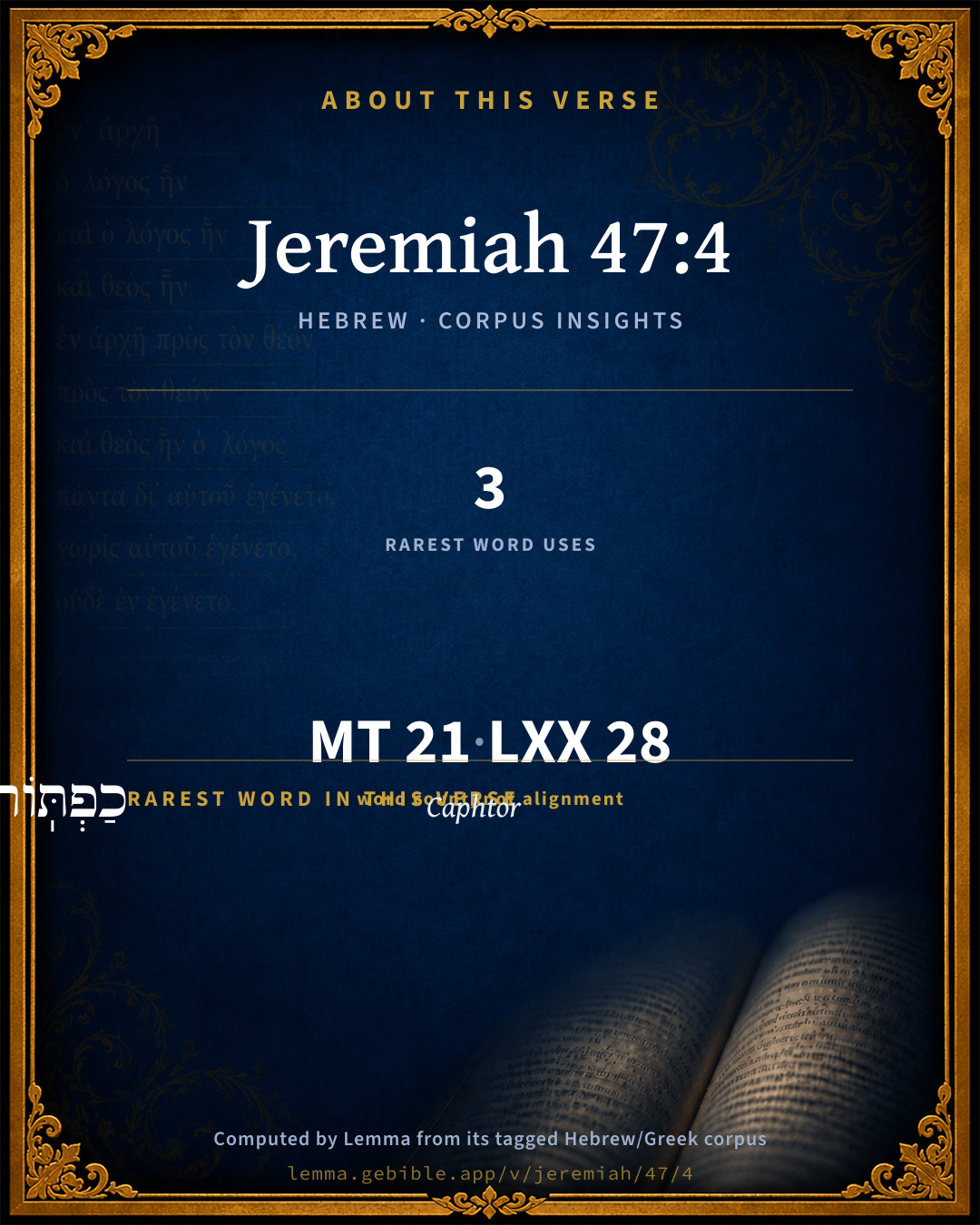
The rarest word here is כַפְתּֽוֹר Caphtor H3731 — appearing just 3 times in the whole Hebrew Bible.

Shared distinctive vocabulary

כַפְתּֽוֹר Caphtor H3731 occurs in 3 verses of the Hebrew Bible. Also found in:

Grammatical profile

  • 5 verbs
  • 11 nouns
  • 1 preposition
  • 1 conjunction
  • 3 particles

Verb forms

  • הַבָּא֙ Qal · Participle Active
  • לִשְׁד֣וֹד Qal · Infinitive Construct
  • לְהַכְרִ֤ית Hiphil · Infinitive Construct
  • עֹזֵ֑ר Qal · Participle Active
  • שֹׁדֵ֤ד Qal · Participle Active

Repetition

Words recur within this verse — often emphatic in Hebrew:

  • לִשְׁד֣וֹד to devastate H7703 ×2
  • כָּל all H3605 ×2
  • פְּלִשְׁתִּ֔ים Philistine H6430 ×2

Hebrew & Septuagint length

In the original languages it is 21 Hebrew tokens and 28 Greek tokens — but the two are counted differently (Hebrew bundles its prefixes and suffixes into one token; the Greek is in lemma form), so that isn’t a like-for-like length.

Cross-references

25

Topical passages linked to Jeremiah 47:4 in the Treasury of Scripture Knowledge — connected by theme and wording, ordered by reader-vote popularity; previews shown in the World English Bible.

  • Amos 9:7 Are you not like the children of the Ethiopians to me, children of Israel?" says Yahweh. "Haven't I brought up Israel out of the land of Egypt, and the Philistines from Caphtor, and the Syrians from Kir?
  • Deuteronomy 2:23 and the Avvim, who lived in villages as far as Gaza, the Caphtorim, who came forth out of Caphtor, destroyed them, and lived in their place.)
  • Isaiah 20:6 The inhabitant of this coast-land shall say in that day, Behold, such is our expectation, where we fled for help to be delivered from the king of Assyria: and we, how shall we escape?
  • Psalms 37:13 The Lord will laugh at him, For he sees that his day is coming.
  • Jeremiah 46:10 For that day is [a day] of the Lord, Yahweh of Hosts, a day of vengeance, that he may avenge him of his adversaries: and the sword shall devour and be satiate, and shall drink its fill of their blood; for the Lord, Yahweh of hosts, has a sacrifice in the north country by the river Euphrates.
  • Ezekiel 7:5–7 Thus says the Lord Yahweh: An evil, an only evil; behold, it comes.
  • Ezekiel 7:12 The time is come, the day draws near: don't let the buyer rejoice, nor the seller mourn; for wrath is on all the multitude of it.
  • Ezekiel 21:25 You, deadly wounded wicked one, the prince of Israel, whose day is come, in the time of the iniquity of the end,
  • Ezekiel 21:29 while they see for you false visions, while they divine lies to you, to lay you on the necks of the wicked who are deadly wounded, whose day is come in the time of the iniquity of the end.
  • Hosea 9:7 The days of visitation have come. The days of reckoning have come. Israel will consider the prophet to be a fool, And the man who is inspired to be insane, Because of the abundance of your sins, And because your hostility is great.
  • Amos 1:8–10 I will cut off the inhabitant from Ashdod, And him who holds the scepter from Ashkelon; And I will turn my hand against Ekron; And the remnant of the Philistines will perish," says the Lord Yahweh.
  • Genesis 10:13–14 Mizraim became the father of Ludim, Anamim, Lehabim, Naphtuhim,
  • Joshua 22:30 When Phinehas the priest, and the princes of the congregation, even the heads of the thousands of Israel that were with him, heard the words that the children of Reuben and the children of Gad and the children of Manasseh spoke, it pleased them well.
  • 1 Chronicles 1:12 and Pathrusim, and Casluhim (from whence came the Philistines), and Caphtorim.
  • Job 9:13 "God will not withdraw his anger; The helpers of Rahab stoop under him.
  • Isaiah 10:3 What will you do in the day of visitation, and in the desolation which shall come from far? to whom will you flee for help? and where will you leave your glory?
  • Isaiah 23:1–18 The burden of Tyre. Howl, you ships of Tarshish; for it is laid waste, so that there is no house, no entering in: from the land of Kittim it is revealed to them.
  • Isaiah 31:8 The Assyrian shall fall by the sword, not of man; and the sword, not of men, shall devour him; and he shall flee from the sword, and his young men shall become subject to forced labor.
  • Jeremiah 25:20–22 and all the mixed people, and all the kings of the land of the Uz, and all the kings of the Philistines, and Ashkelon, and Gaza, and Ekron, and the remnant of Ashdod;
  • Ezekiel 25:16 therefore thus says the Lord Yahweh, Behold, I will stretch out my hand on the Philistines, and I will cut off the Cherethites, and destroy the remnant of the sea coast.
  • Ezekiel 26:1–21 It happened in the eleventh year, in the first [day] of the month, that the word of Yahweh came to me, saying,
  • Ezekiel 30:8 They shall know that I am Yahweh, when I have set a fire in Egypt, and all her helpers are destroyed.
  • Joel 3:4–8 "Yes, and what are you to me, Tyre, and Sidon, And all the regions of Philistia? Will you repay me? And if you repay me, I will swiftly and speedily return your repayment on your own head.
  • Zechariah 9:2–5 And Hamath, also, which borders on it; Tyre and Sidon, because they are very wise.
  • Luke 21:22 For these are days of vengeance, that all things which are written may be fulfilled.

Cross-references courtesy of OpenBible.info (CC BY 4.0).

Hebrew and Greek witnesses Masoretic Hebrew ↔ Greek Septuagint

The same verse in the two great witnesses to the Old Testament, shown verse-for-verse.

These are two independent witnesses, not word-aligned to each other, and the Septuagint is shown in lemma (dictionary) form.

Hebrew Jeremiah 47:4 Masoretic · Westminster Leningrad Codex

עַל הַיּ֗וֹם הַבָּא֙ לִשְׁד֣וֹד אֶת כָּל פְּלִשְׁתִּ֔ים לְהַכְרִ֤ית לְצֹר֙ וּלְצִיד֔וֹן כֹּ֖ל שָׂרִ֣יד עֹזֵ֑ר כִּֽי שֹׁדֵ֤ד יְהוָה֙ אֶת פְּלִשְׁתִּ֔ים שְׁאֵרִ֖ית אִ֥י כַפְתּֽוֹר

because of the day that comes to destroy all the Philistines, to cut off from Tyre and Sidon every helper who remains: for Yahweh will destroy the Philistines, the remnant of the isle of Caphtor.

World English Bible · Public Domain

Greek LXX Structure differs

In the Septuagint, Jeremiah is about an eighth shorter than the Hebrew and arranges its material differently — the Oracles Against the Nations (Hebrew chapters 46–51) appear in the middle of the Greek book, after 25:13. Because the chapter and verse boundaries do not line up, a verse-for-verse comparison with the Hebrew is not shown.

A verse-for-verse comparison isn’t shown here because the chapters and verses don’t line up. Switch to the LXX edition with the MT / LXX toggle above to read the Greek directly.

On this verse, The Cambridge Bible for Schools and Colleges discusses the Septuagint’s reading. Read the note in Commentary ↓

Hebrew: Westminster Leningrad Codex (CC BY 4.0). Greek: Septuagint (public domain); English from a public-domain English Septuagint. How the Septuagint differs from the Hebrew →

Targum (Aramaic paraphrase)

1

The Targum is the ancient Jewish Aramaic paraphrase of the Hebrew Scriptures — an interpretive translation, not the Hebrew text itself. Onkelos (literal) and Pseudo-Jonathan (expansive) render the Torah, and Jonathan the Prophets. Coverage is partial: where no permissively-licensed English translation exists for a verse, only the Aramaic is shown. This is verse-level text, not a word-by-word alignment to the Hebrew.

  1. Targum Jonathan Prophets (Joshua–Malachi)
    עַל יוֹמָא דְאָתֵי לְמִבַּז יַת כָּל אַרְעָא פְּלִשְׁתָּאֵי לְשֵׁיצָאָה לְצוֹר וּלְצִידוֹן כָּל שְׁאַר סָעִיד אֲרֵי אַבֵּיז יְיָ יַת אֲרַע פְּלִשְׁתָּאֵי שְׁאַר נַגְוַת קַפּוּטְקָאֵי:

    (no public-domain English translation for this verse)

    Targum Jonathan — Aramaic: “Mikraot Gedolot” (public domain). English: “Sefaria Community Translation” (CC0 1.0 (public-domain dedication)); “London "Chaldee Paraphrase," 1871” (public domain). Text via Sefaria.

Commentary

Notes on Jeremiah 47:4 from classic Christian and Jewish commentators (each source and its license shown beneath its notes). The classic Christian expositions comment on the surrounding passage and are grouped to its opening verse, so a note may address several verses; the Jewish commentaries on the Tanakh (Rashi and others) are per-verse, so they appear only where the commentator wrote on this verse.

Lemma curates 59 commentaries, every one of them public domain or Creative Commons licensed, each selected and text-cleaned for this edition rather than reprinted as found. About our sources →

Trapp's Complete Commentary

John Trapp

Jer 47:4 Because of the day that cometh to spoil all the Philistines, [and] to cut off from Tyrus and Zidon every helper that remaineth: for the LORD will spoil the Philistines, the remnant of the country of Caphtor.

Ver. 4. Because of the day that cometh to spoil all the Philistines.] God will find a time of vengeance to fall upon the wicked enemies of his people, though he bear long with them. Patientia Dei quo diuturnior, eo minacior. "The wicked practiseth against the just, and guasheth upon him with his teeth. The Lord shall laugh at him, for he seeth that his day is coming." {Psa 37:12-13}

And to cut off from Tyrus and Sidon.] The inhabitants whereof were the Philistines’ kinsmen and confederates, but could not rescue them or deliver themselves from the Chaldean conqueror.

The remnant of the country of Caphtor.] These Caphtorim were neither the Cappadocians, the Cyprians, nor the Colchians, as sundry make them; but as of the same lineage with the Philistines, {Gen 10:13-14} so their complices and confederates, with whom therefore they were to fare alike.

John Trapp, A Commentary or Exposition upon All the Books of the Old and New Testament (1647–1656) — public domain. Text from a community e-Sword module.

Joseph Benson's Commentary

Jer 47:4. To cut off from Tyrus and Zidon every helper, &c. — The siege of Tyre by Nebuchadnezzar was an action famous in the histories of that age, the siege lasting thirteen years. Zidon was partaker of the same fate with Tyre, both in prosperity and adversity: see Isa 23:2; Isa 23:4. And her destruction is joined with that of Tyre by Ezekiel chap. 28. The remnant of the country of Caphtor — Or, the isle of Caphtor; called the remnant of the Philistines, Amo 1:8; and the remnant of the sea-coast, Eze 25:16. The expression denotes either a colony transplanted from Caphtor, or else that small remainder of the Philistines, after they had been almost all destroyed in former times, according to the judgments denounced against them by Amo 1:8, and Isa 14:19, &c., Caphtor, or Caphtorim, were the ancient inhabitants of Palestine: see Deu 2:23. The Caphtorim and Casluhim were two neighbouring nations, and nearly related to each other, being both descended from Misraim the father of the Egyptians: see Gen 10:13-14; which may be the reason why Moses there derives the pedigree of the Philistines from the latter of these two. The ancients generally suppose Caphtor to be the same with Cappadocia. These two nations might go out of Egypt, their native soil, and settle themselves in Cappadocia, where they passed under the general appellation of Caphtorim, and afterward return back to their own native country, and settle in Palestine.

Joseph Benson's Commentary on the Old and New Testaments (1811–1818) — public domain. Text from a community e-Sword module.

Tyndale Open Study Notes

Tyndale Open Resources

47:4 The time has come . . . the Lord is destroying: The Lord controlled what would happen, as well as when events would occur. • The Philistines had come into the southeastern coastal areas from the island of Crete between 1200 and 1100 BC. The northern cities, Tyre and Sidon, were colonized at about the same time by distant cousins of the Philistines who mixed with the native Canaanites.

Tyndale Open Study Notes — © Tyndale Open Resources, licensed CC BY-SA 4.0. Text via the HelloAO Bible API.

Geneva Bible (1599)

Geneva Bible translators

For the Caphtorims, which are also called Cappadocians, had destroyed in old time the Philistines, and dwelt in their land even to Gaza, Deut. 2:23.

Geneva Bible (1599) marginal notes — public domain. Text via Bolls.life.

Jamieson, Fausset & Brown

Robert Jamieson, A. R. Fausset & David Brown

every helper--The Philistines, being neighbors to the Phœnicians of Tyre and Sidon, would naturally make common cause with them in the case of invasion. These cities would have no helper left when the Philistines should be destroyed.

Caphtor--the Caphtorim and Philistines both came from Mizraim (Gen 10:13-14). The Philistines are said to have been delivered by God from Caphtor (Amo 9:7). Perhaps before the time of Moses they dwelt near and were subjugated by the Caphtorim (Deu 2:23) and subsequently delivered. "The remnant" means here those still left after the Egyptians had attacked Gaza and Palestine; or rather, those left of the Caphtorim after the Chaldeans had attacked them previous to their attack on the Philistines. Some identify Caphtor with Cappadocia; GESENIUS, with Crete (Eze 25:16, Cherethims); KITTO, Cyprus. Between Palestine and Idumea there was a city Caparorsa; and their close connection with Palestine on the one hand, and Egypt (Mizraim, Gen 10:13-14) on the other hand, makes this locality the most likely.

Jamieson, Fausset & Brown — Commentary Critical and Explanatory on the Whole Bible (1871) — public domain (CC PDM 1.0). Text via the HelloAO Bible API.

Adam Clarke's Commentary

Verse 4. To spoil all the Philistines] These people, of whom there were five seignories, occupied the coast of the Mediterranean Sea, to the south of the Phoenicians.

Tyrus and Zidon] Places sufficiently remarkable both in the Old and New Testament, and in profane history. They belonged to the Phoenicians; and at this time were depending on the succour of their allies, the Philistines. But their expectation was cut off.

The remnant of the country of Caphtor.] Crete, or Cyprus. Some think it was a district along the coast of the Mediterranean, belonging to the Philistines; others, that the Cappadocians are meant.

Adam Clarke's Commentary on the Bible (1810–1826) — public domain. Text from a community e-Sword/MySword module.

John Calvin's Commentaries

Jeremiah shews now more clearly, and without a figure, his meaning, even that destruction would come on the Philistines when their time was completed. And he mentions Tyre and Sidon, neighboring cities, and. formerly under their own jurisdiction. But Tyre in the time of Isaiah had its own king; yet afterwards in the time of Alexander the Great the city was free, as it is well known. These, however, were cities of Palestine, and the people called then Philistines were contiguous to these cities, so that the Prophet rightly includes them as it were in the same bundle. Coming, he says, is the day to destroy all the Philistines, and also to cut off the most opulent cities, even Tyre and Sidon

Sidon was more ancient than Tyre; but the daughter devoured the mother, according to the common proverb. For Tyre in time flourished, and Sidon became almost forsaken. It, however, always retained a name and also some wealth on account of its commodious harbor. But Tyre was an island in the time of Alexander the Great; and was therefore more commodious for ships, as it had many harbors. But the Prophet connects them both together, because they formed then a part of the land of the Philistines. There is no doubt but that the destruction was especially denounced on these cities, that the Jews might know that nothing would be safe throughout the whole land, inasmuch as these cities, the defenses, as it were, of the whole country, were destined to perish.

He farther adds, on account of the day which is coming against all the helping remnants, for Jehovah will destroy, that is, he will destroy the Philistines, who are the remnants (it is indeed another word, but means the same) of the island of Oaphtor He confirms here the same thing in other words, even that God’s hand would be on these cities and the whole land, though external aids might come; and these he calls all the remnants of courage, or auxiliaries. Though they might have many friends alive, ready to bring them help, yet the Lord would demolish them all, as it follows, for Jehovah will destroy the Philistines, the remnants of the island of Caphtor

By the island of Caphtor he no doubt means Palestine; but it is doubtful for what reason the Hebrews called the Cappadocians Caphtorim. As it is hardly credible that they who inhabited this land had come from so far a country, interpreters have supposed that others, and not Cappadocians, are here called Caphtorim. Yet Moses intimates (Deuteronomy 2:23) that those who inhabited the land from Gaza to Jordan, were not natives, that is, were not born in those places, but that they were a wandering people; for he says, that

“The Caphtorim went forth and dwelt there in the place of the natives.”

We may hence conclude that the Caphtorim were foreigners, who, wandering from their own country, sought an habitation elsewhere, and took possession of this land. Whether they were Cappadocians, I leave undecided; nor ought we to toil much on a subject of this kind. But as the Caphtorim had emigrated into Palestine, Jeremiah calls that region the remnants of the island of Caphtor It follows, —

John Calvin's Commentaries (1540-1563) — public domain. Text from the Calvin Translation Society English edition (1840s-50s) via the Christian Classics Ethereal Library (ccel.org). Calvin's coverage is partial (roughly two-thirds of the Bible); uncommented books and verses are honest gaps, never fabricated. The 19th-century editor's footnotes and remarks are omitted so the notes are faithfully Calvin's own voice.

Ellicott's Commentary for English Readers

(4) To cut off from Tyrus and Zidon.—The two Phœnician cities are coupled with Philistia. Both, as occupying the sea-board of Palestine, were to suffer from Nebuchadnezzar’s invasion. Psa_83:7 indicates that they were not unfrequently in alliance. In the “helper that remaineth” we have probably a reference to the foreign mercenaries, especially the Philistines, employed by the two great commercial cities. “Caphtor” has been identified with Crete, Cyprus, Caria, Cappadocia, and the delta of the Nile. On the latter view the name is held to be connected with Coptic. Amo_9:7 points to a migration of the people known as Philistines from that region, and there is accordingly a touch of scorn in the way in which Jeremiah speaks of them as the mere “remnant of Caphtor.” In agreement with the first view we find among David’s mercenaries the Cherethim and Pelethim (2Sa_8:18), the two names being probably modifications of Cretans and Philistines. The ethnological table of Gen_10:14 connects both the Philistines and the Caphtorim with Mizraim or Egypt, and is, so far as it goes, in favour of the Egyptian identification.

A Bible Commentary for English Readers, edited by Charles John Ellicott (1878–1897) — public domain. Text from a community e-Sword module.

The Cambridge Bible for Schools and Colleges

gen. ed. J. J. S. Perowne

4. The text is difficult, and may be corrupt. As Co. points out, the Hebrew for “that remaineth” is rather a survivor, one who has escaped. Moreover, he remarks that we have no reason from other sources to suppose that, as the v. implies, the Philistines were the chief allies of the Phoenicians (“Tyre and Zidon”). He therefore reads (changing slightly the MT.) “all the remnant of their excellency.” Both Gi. and Co. make the next clause (“for … Philistines”) a gloss. The LXX support this view, and render the last clause of the v. “and the Lord will destroy the remnant of the islands,” omitting “Caphtor.”

every helper that remaineth] in other words the Philistines, the other helpers having been already cut off.

the remnant of the isle of Caphtor] the few of the Philistine nation that still survive after the wars with Egypt and Assyria, from which they had long suffered. Caphtor is spoken of also in Deu_2:23; Amo_9:7, as the original abode of the Philistines. It is probably to be identified with Crete.

isle] For mg. sea coast See on Jer_25:22.

The Cambridge Bible for Schools and Colleges (gen. ed. J. J. S. Perowne; Cambridge University Press, 1878–1918) — public domain. Text from a community e-Sword module.

John Gill's Exposition

Because of the day that cometh to spoil all the Philistines,.... The time appointed by the Lord for their destruction, which should be universal:

and to cut off from Tyrus and Zidon every helper that remaineth; these were cities in Phoenicia, which bordered on the country of the Philistines, who were their auxiliaries in time of distress; but now, being wasted themselves, could give them no help when Nebuchadnezzar attacked them; as he did Tyre particularly, which he besieged thirteen years, and at last destroyed it, and Zidon with it:

for the Lord will spoil the Philistines, the remnant of the country of Caphtor; these last are not put by way of apposition, as if they were the same with the Philistines, though they were near of kin to them, coming from Casluhim; who were the posterity of Mizraim, as well as Caphtorim, Gen 10:13; indeed the Philistines are said to be brought from Caphtor, Amo 9:7; being very probably taken captive by them, but rescued from them; and now in confederacy with them, and like to share the same fate as they. The Targum renders it,

"the remnant of the island of the Cappadocians;''

and so the Vulgate Latin version. Some think the Colchi, others that the Cretians, are meant. R. Saadiah by Caphtor understands Damiata, a city in Egypt; which is the same with Pelusium or Sin, the strength of Egypt, Eze 30:15; and it is usual with the Jews (w) to call this place Caphutkia, the same with Caphtor, they say; and, in Arabic, Damiata.

(w) Misn. Cetubot, c. 13. sect. 11. & Maimon. & Bartenora in ib.

John Gill's Exposition of the Whole Bible (1746–1763) — public domain (CC PDM 1.0). Text via the HelloAO Bible API.

Albert Barnes' Notes on the Bible

Because of the day that cometh to spoil - “Because” the day has come “to devastate.”

The Philistines are called Tyre’s remaining (i. e., last) helper, because all besides who could have assisted her have already succumbed to the Chaldaean power. The judgment upon Philistia was in connection with that upon Tyre, and it was fulfilled by expeditions sent out by Nebuchadnezzar under him lieutenants to ravage the country and supply his main army with provisions.

The country of Caphtor - The coastland of Caphtor. The Philistines came from the coast of the Egyptian Delta, and are called “a remnant” because they had been greatly reduced in numbers, partly by the long war of Psammetichus against Ashdod, partly by the capture of Gaza Jer 47:1, and partly by Assyrian invasions.

Albert Barnes' Notes on the Bible (1834–1885) — public domain. Text from a community e-Sword/MySword module.

Haydock's Catholic Bible Commentary

Tyre. See chap. xlvii. 4., and Ezechiel xxvi., &c. --- Sidon. It had rejoiced at the downfall of its rival, (Isaias xxiii. 4.) and of the Jews, Joel iii. 4., and Ezechiel xxviii. 24. Artax Ochus punished it severely; (Calmet) and its own king, Tenner, betrayed his subjects, who were slain by the Persians, or burnt themselves in the conflagration of the city. (Diodorus, Olym. 177. a. 2.) --- Helpers; Philistines, who came originally from the isle of Caphtor, or Crete. --- Cappadocia was not an island, or near the sea, (Calmet) but at a distance from the Jews. (Sanctius)

George Leo Haydock (1774–1849), Haydock's Catholic Family Bible and Commentary, 1859 edition — public domain. Excludes Psalms (Douay-Rheims chapter numbering differs from Protestant) and Deuterocanonical books (Catholic canon only).

Matthew Poole's English Annotations

Because of the day that cometh to spoil all the Philistines; the day which God hath set and appointed for the ruin of the Philistines. Tyre and Zidon were neighbouring to the Philistines, as appears from Gen 10:14,15; Joe 3:4, and so were often called to their help. God threateneth both to destroy them, and also those that helped them. It appeareth, from Gen 10:14, that the Philistines and Caphtorims were related; for their first progenitors, Philistim and Caphtorim, were both the sons of Mizraim the son of Ham, one of the sons of Noah. It appears, from Deu 2:23, that they expelled the Avites, and dwelt in Hazerim to Azzah; whether their country be what was afterwards called Cappadocia or Damiata is not much material for us to know, they were a people confederate with the Philistines, whom God here threateneth to destroy with them.

Matthew Poole's English Annotations on the Holy Bible (1683–1685) — public domain. Text from a community e-Sword/MySword module.

Whedon's Commentary on the Bible

Daniel D. Whedon

4. The destruction is represented as falling upon the Philistines and Phenicians. This suggests an expedition directed against this whole region of country. The Philistines are called the remnant of the country of Caphtor. Caphtor has been, by different authors, identified with Cappadocia, Crete, Cyprus, and the Egyptian Delta. The last of these identifications is the best approved, as it is pretty well settled that the Philistines came from Egypt.

Country — Literally, coast land.

Daniel D. Whedon (gen. ed.), Commentary on the Old and New Testaments (1874–1909) — public domain. Text from a community e-Sword module.

The Pulpit Commentary

The day that cometh; rather, the day that hath come (i.e. shall have come). It is "the day of the Lord" that is meant, that revolutionary "shaking of all things", (to use Haggai"s expression, Hag_2:21) as to which see further in note on Jer_46:10. To cut off... every helper that remaineth; i.e. every ally on whom they could still reckon. This passage favours the view that the judgment upon the Philistines took place at the same time as that upon Tyre. Nebuchadnezzar"s object was to isolate Tyre and Sidon as completely as possible. The remnant. The Philistines had suffered so much from repeated invasions as to be only a "remnant" of the once powerful nation which oppressed Israel. (see on Jer_25:20) The country of Caphtor. Some would render "the coastland of Caphtor," but the idea of "coast" seems to be a secondary one, derived in certain passages from the context. Properly speaking, it is a poetic synonym for "land," and is generally applied to distant and (accidentally) maritime countries. "Caphtor" was understood by the old versions to be Cappadocia. But as the remains of the Cappadocian language point to a Persian origin of the population which spoke it, and as the Caphtorim originally came from Egypt, it is more plausible to suppose, with Ebers, that Caphtor was a coast district of North Egypt. Crete has also been thought of. (comp. Amo_9:7 Gen_10:14 Deu_2:23)

The Pulpit Commentary (1880–1919), ed. H.D.M. Spence-Jones & Joseph S. Exell — public domain. Text from a community e-Sword module.

John Wesley's Explanatory Notes

The day - Which God hath set, and appointed for their ruin. Caphtor - Tyre and Sidon were neighbours to the Philistines, and so were often called to their help. The Philistines and Caphtorim were related, for their first progenitors, Philistim and Caphtorim, were both the sons of Mizriam the son of Ham, one of the sons of Noah.

John Wesley, Explanatory Notes Upon the Whole Bible (1754–1765) — public domain. Text via the GEBible commentary corpus.

Rashi

Rabbi Shlomo Yitzchaki (Rashi)

to cut off from Tyre and Zidon The Philistines were aiding them against their enemies.

the island of Caphtor (Isls in O.F.)

Rashi on the Tanakh — English translations: “The Judaica Press complete Tanach with Rashi, translated by A. J. Rosenberg” (CC BY 4.0); “Pentateuch with Rashi's commentary by M. Rosenbaum and A.M. Silbermann, 1929-1934” (public domain); “The Metsudah Tanach series, Lakewood, N.J” (CC BY 4.0); and “The Book of Joshua, Metsudah Publications, 1997” (CC BY 4.0). Text via Sefaria.

Lesson kit

Teaching starters — assembled from the data on this page, not authored interpretation. Every prompt links to the verse data it draws on. Edit before teaching.

Jeremiah, in the Prophets, opens this verse with 21 words (17 distinct Hebrew lemmas). Its most distinctive word is Kaphtôr (“Caphtor”). A historical commentator’s framing appears above. Read the whole chapter for the surrounding context.

Discussion questions

  1. The word Kaphtôr carries the sense “Caphtor.” How does it shape the verse?
  2. Deuteronomy 2:23 shares the word «Caphtor» with this verse. How do the two illuminate each other?
  3. “to devastate” occurs 2× in this one verse. What is the effect of the repetition?
  4. The translations on this page render this verse differently — a whole-verse word diff, not a word-by-word alignment. What might account for the different wordings?
  5. The verb «הַבָּא֙» is Qal Participle Active. How does its form color the action?
  6. Reading how Trapp's Complete Commentary and Joseph Benson's Commentary read this verse, where do the two commentators agree and where do they part?

Things to notice

Reading settings

Reading text

Shown beneath each verse's original-language words.

Old Testament
Old Testament edition

Read the OT as the Masoretic Hebrew (MT) or the Greek Septuagint (LXX).

English shown for the Greek Septuagint (in the Hebrew ↔ Greek comparison).

Comparing translations? Open the Compare panel on any verse page to stack up to four side by side.