
Jeremiah 25:20

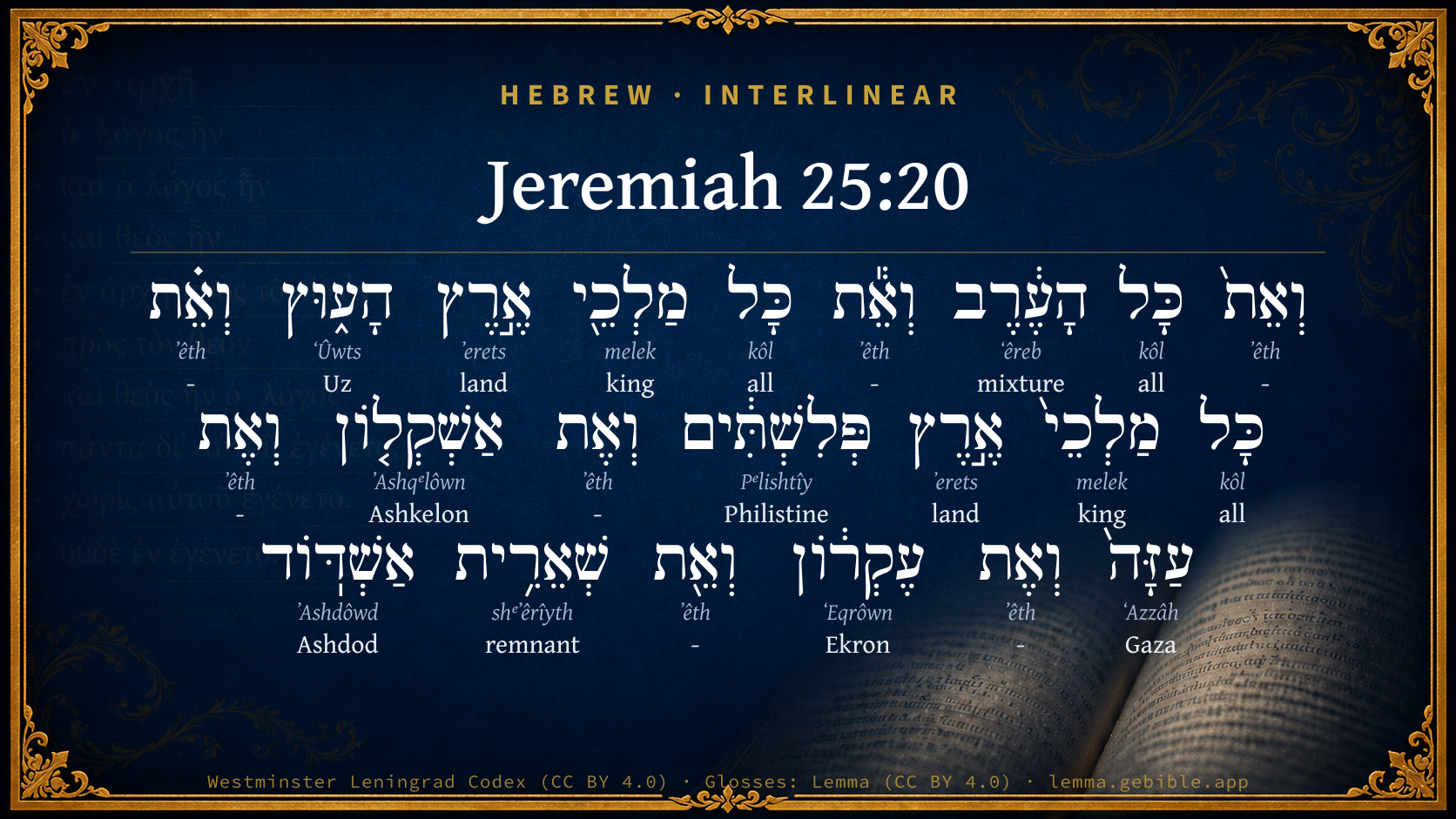
Hebrew (Westminster Leningrad Codex) Jeremiah 25:20 appears in the Hebrew Old Testament. The text above is from the Westminster Leningrad Codex. Each word links to its Strong’s number, a concise gloss, and parsing drawn from the Open Scriptures Hebrew Bible morphology. Click any word for its full Brown-Driver-Briggs (BDB) entry.
Download image
Cite this verse

Jeremiah 25:20 (World English Bible). Public Domain. Lemma interlinear Bible study tool, https://lemma.gebible.app/v/jeremiah/25/20.

Show BibTeX & RIS
BibTeX
RIS
English Translation
and all the mixed people, and all the kings of the land of the Uz, and all the kings of the Philistines, and Ashkelon, and Gaza, and Ekron, and the remnant of Ashdod;
World English Bible · Public Domain
Download a study sheet

One document with this verse’s original text, its word-by-word gloss line, the meaning frame, cross-references with their text, attributed commentary, and full source and license credits — printable, and it pastes into notes with its structure intact.

This verse Autodidact and up

Study sheet (.html) Plain text (.txt)

A passage Seminary Student

Up to 50 verses in one chapter. A passage sheet keeps up to 6 commentary sources and 12 cross-references per verse, in the order this page ranks them, and says so on the sheet whenever that leaves anything out. Ask for a single verse and you get the Autodidact verse sheet above.

Everything on this page stays free to read, with no account — the sheet is a download of what is already on screen, not access to it.

Want to remove ads? Support Godless Engineer
Compare translations 3

The same verse in 3 English versions, stacked beneath the original-language interlinear above. Click any original word for its lexicon entry.

Each is an independent rendering of the whole verse — the interlinear is not word-aligned to these translations.

Highlighted words mark where these versions differ — a whole-verse word diff, not a word-by-word alignment.

  • World English Bible Public Domain
    and all the mixed people, and all the kings of the land of the Uz, and all the kings of the Philistines, and Ashkelon, and Gaza, and Ekron, and the remnant of Ashdod;
  • King James Version Public Domain
    And all the mingled people, and all the kings of the land of Uz, and all the kings of the land of the Philistines, and Ashkelon, and Azzah, and Ekron, and the remnant of Ashdod,
  • unfoldingWord Literal Text CC BY-SA 4.0
    and all of the mixed people, and all of the kings of the land of Uz, and all of the kings of the land of the Philistines—Ashkelon and Gaza and Ekron and the remnant of Ashdod;

unfoldingWord Literal Text — © unfoldingWord, licensed CC BY-SA 4.0. Word-aligned USFM3 via Door43 (git.door43.org/unfoldingWord/en_ult).

Versions to compare (up to 4)

3 of 4 selected

Show all 18 translations

Every available English version of this verse, each an independent rendering of the whole verse.

  • World English Bible Public Domain
    and all the mixed people, and all the kings of the land of the Uz, and all the kings of the Philistines, and Ashkelon, and Gaza, and Ekron, and the remnant of Ashdod;
  • Berean Standard Bible Public Domain
    all the mixed tribes; all the kings of Uz; all the kings of the Philistines: Ashkelon, Gaza, Ekron, and the remnant of Ashdod;
  • Majority Standard Bible Public Domain
    all the mixed tribes; all the kings of Uz; all the kings of the Philistines: Ashkelon, Gaza, Ekron, and the remnant of Ashdod;
  • King James Version Public Domain
    And all the mingled people, and all the kings of the land of Uz, and all the kings of the land of the Philistines, and Ashkelon, and Azzah, and Ekron, and the remnant of Ashdod,
  • American Standard Version (1901) Public Domain
    and all the mingled people, and all the kings of the land of the Uz, and all the kings of the Philistines, and Ashkelon, and Gaza, and Ekron, and the remnant of Ashdod;
  • Revised Version (1885) Public Domain
    and all the mingled people, and all the kings of the land of Uz, and all the kings of the land of the Philistines, and Ashkelon, and Gaza, and Ekron, and the remnant of Ashdod;
  • Geneva Bible (1599) Public Domain
    And all sortes of people, and all the Kings of the lande of Vz: and all the Kings of the lande of the Philistims, and Ashkelon, and Azzah, and Ekron, and the remnant of Ashdod:
  • Douay-Rheims (1899) Public Domain
    And all in general: all the kings of the land of Ausitis, and all the kings of the land of the Philistines, and Ascalon, and Gaza, and Accaron, and the remnant of Azotus.
  • Young's Literal Translation Public Domain
    And all the mixed people, And all the kings of the land of Uz, And all the kings of the land of the Philistines, And Ashkelon, and Gazzah, and Ekron, And the remnant of Ashdod,
  • Literal Standard Version CC BY-SA 4.0
    And all the mixed people, || And all the kings of the land of Uz, || And all the kings of the land of the Philistines, || And Ashkelon, and Gaza, and Ekron, || And the remnant of Ashdod,
  • Unlocked Literal Bible CC BY-SA 4.0
    all people of mixed heritage and all the kings of the land of Uz; all the kings of the land of Philistia—Ashkelon, Gaza, Ekron, and the remnant of Ashdod;
  • unfoldingWord Literal Text CC BY-SA 4.0
    and all of the mixed people, and all of the kings of the land of Uz, and all of the kings of the land of the Philistines—Ashkelon and Gaza and Ekron and the remnant of Ashdod;
  • Darby Bible Public Domain
    and all the mingled people, and all the kings of the land of Uz, and all the kings of the land of the Philistines, and Ashkelon, and Gazah, and Ekron, and the remnant of Ashdod;
  • World Messianic Bible Public Domain
    and all the mixed people, and all the kings of the land of Uz, all the kings of the Philistines, Ashkelon, Gaza, Ekron, and the remnant of Ashdod;
  • Webster's Bible Public Domain
    And all the mingled people, and all the kings of the land of Uz, and all the kings of the land of the Philistines, and Ashkelon, and Azzah, and Ekron, and the remnant of Ashdod,
  • Free Bible Version CC BY-SA 4.0
    and all the foreigners living there; to all the kings of the country of Uz; to all the kings of the Philistines: Ashkelon, Gaza, Ekron, and what's left of Ashdod;
  • Bible in Basic English Public Domain
    And all the mixed people and all the kings of the land of Uz, and all the kings of the land of the Philistines, and Ashkelon and Gaza and Ekron and the rest of Ashdod;
  • JPS Tanakh (1917) Public Domain
    and all the mingled people; and all the kings of the land of Uz, and all the kings of the land of the Philistines, and Ashkelon, and Gaza, and Ekron, and the remnant of Ashdod;

Literal Standard Version (2020), Covenant Press — licensed CC BY-SA 4.0. Text via the HelloAO Bible API (eBible.org). Unlocked Literal Bible (unfoldingWord) — licensed CC BY-SA 4.0. Text via the HelloAO Bible API (eBible.org). unfoldingWord Literal Text — © unfoldingWord, licensed CC BY-SA 4.0. Word-aligned USFM3 via Door43 (git.door43.org/unfoldingWord/en_ult). Free Bible Version, Dr. Jonathan Gallagher — licensed CC BY-SA 4.0. Text via the HelloAO Bible API (eBible.org).

Word by word

More ways to search: Search by grammar → Find every occurrence → Compare this word →

Practice this passage: Drill this verse → Learn its vocabulary →

הָע֑וּץ
ʻÛwts
H5780
“the · Uz”
Particle, Definite Article + Noun, Proper
Part of Speech
Particle + Noun
Type
Proper
Full BDB Definition

Origin: apparently from H5779

TWOT: None

Uz = "wooded" - son of Aram and grandson of Seth (noun proper masculine) - son of Nahor by Milcah (noun proper masculine) - an Edomite, son of Dishan and grandson of Seir (noun proper masculine) - the country of Job; probably east and southeast of Palestine somewhere in the Arabian desert (noun proper locative)
  1. וְאֵת֙ ʼêth H853 “and · -” Conjunction + Particle, Direct Object
  2. כָּל kôl H3605 “all of” Noun, Common, Masculine, Singular, Construct
  3. הָעֶ֔רֶב ʻêreb H6154 “the · mixture” Particle, Definite Article + Noun, Common, Masculine, Singular, Absolute
  4. וְאֵ֕ת ʼêth H853 “and · -” Conjunction + Particle, Direct Object
  5. כָּל kôl H3605 “all of” Noun, Common, Masculine, Singular, Construct
  6. מַלְכֵ֖י melek H4428 “kings of” Noun, Common, Masculine, Plural, Construct
  7. אֶ֣רֶץ ʼerets H776 “land of” Noun, Common, Both, Singular, Construct
  8. וְאֵ֗ת ʼêth H853 “and · -” Conjunction + Particle, Direct Object
  9. כָּל kôl H3605 “all of” Noun, Common, Masculine, Singular, Construct
  10. מַלְכֵי֙ melek H4428 “kings of” Noun, Common, Masculine, Plural, Construct
  11. אֶ֣רֶץ ʼerets H776 “land of” Noun, Common, Both, Singular, Construct
  12. פְּלִשְׁתִּ֔ים Pᵉlishtîy H6430 “Philistines” Noun, Gentilic, Masculine, Plural, Absolute
  13. וְאֶת ʼêth H853 “and · -” Conjunction + Particle, Direct Object
  14. אַשְׁקְל֤וֹן ʼAshqᵉlôwn H831 “Ashkelon” Noun, Proper
  15. וְאֶת ʼêth H853 “and · -” Conjunction + Particle, Direct Object
  16. עַזָּה֙ ʻAzzâh H5804 “Gaza” Noun, Proper
  17. וְאֶת ʼêth H853 “and · -” Conjunction + Particle, Direct Object
  18. עֶקְר֔וֹן ʻEqrôwn H6138 “Ekron” Noun, Proper
  19. וְאֵ֖ת ʼêth H853 “and · -” Conjunction + Particle, Direct Object
  20. שְׁאֵרִ֥ית shᵉʼêrîyth H7611 “remnant of” Noun, Common, Feminine, Singular, Construct
  21. אַשְׁדּֽוֹד ʼAshdôwd H795 “Ashdod” Noun, Proper

About this verse

These counts appear in no published source. They are computed here, from the morphology-tagged text and Lemma’s own curated glosses. What Lemma adds →

22
words
12
distinct lemmas
Prophets
section

Notable vocabulary

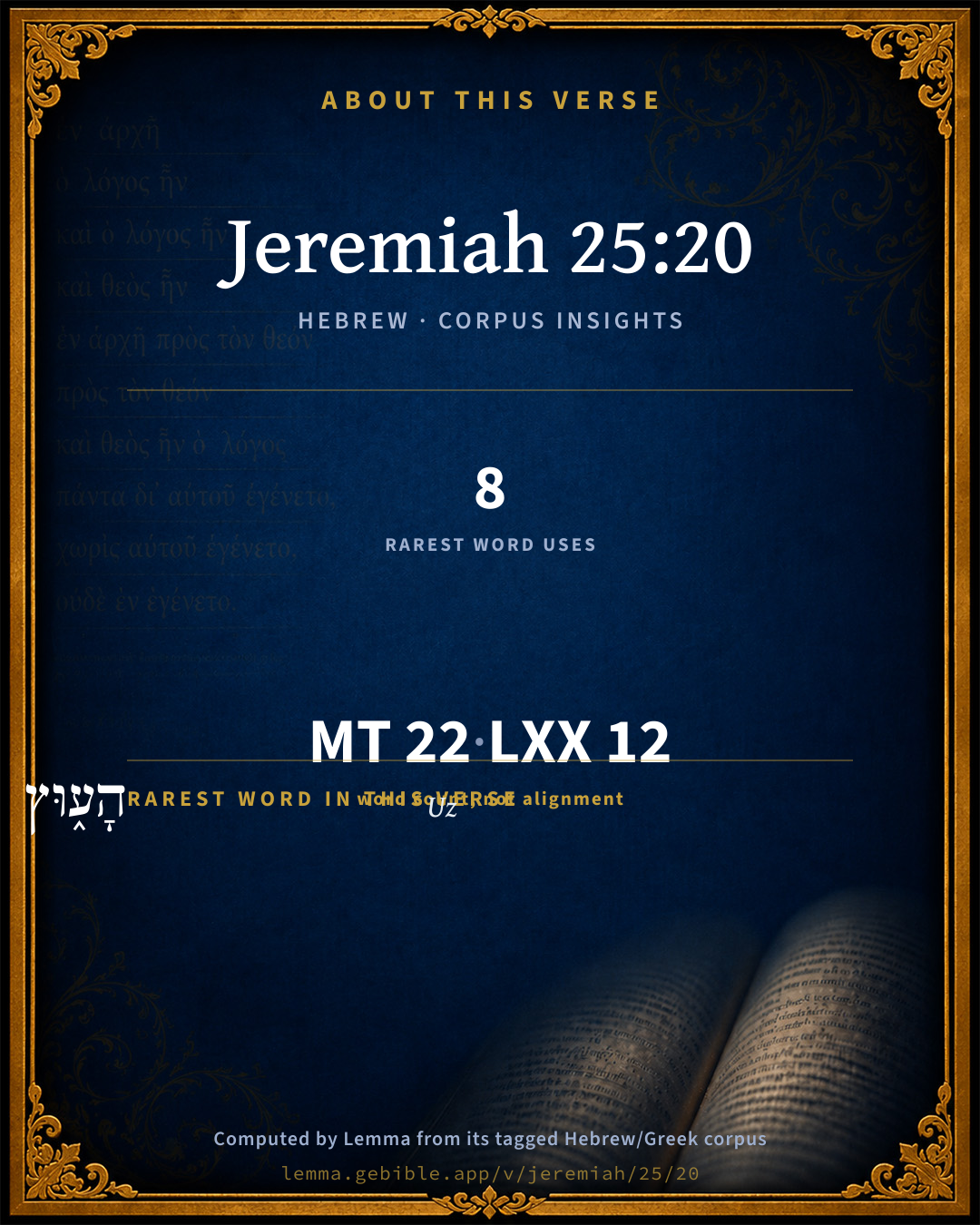
The rarest word here is הָע֑וּץ Uz H5780 — appearing just 8 times in the whole Hebrew Bible.

Shared distinctive vocabulary

הָע֑וּץ Uz H5780 occurs in 8 verses of the Hebrew Bible. Also found in:

Grammatical profile

  • 15 nouns
  • 7 particles

Repetition

Words recur within this verse — often emphatic in Hebrew:

  • כָּל all H3605 ×3
  • מַלְכֵ֖י king H4428 ×2
  • אֶ֣רֶץ land H776 ×2

Hebrew & Septuagint length

In the original languages it is 22 Hebrew tokens and 12 Greek tokens — but the two are counted differently (Hebrew bundles its prefixes and suffixes into one token; the Greek is in lemma form), so that isn’t a like-for-like length.

Cross-references

17

Topical passages linked to Jeremiah 25:20 in the Treasury of Scripture Knowledge — connected by theme and wording, ordered by reader-vote popularity; previews shown in the World English Bible.

  • Job 1:1 There was a man in the land of Uz, whose name was Job. That man was blameless and upright, and one who feared God, and turned away from evil.
  • Isaiah 20:1 In the year that Tartan came to Ashdod, when Sargon the king of Assyria sent him, and he fought against Ashdod and took it;
  • Jeremiah 50:37 A sword is on their horses, and on their chariots, and on all the mixed people who are in the midst of her; and they shall become as women: a sword is on her treasures, and they shall be robbed.
  • Lamentations 4:21 Rejoice and be glad, daughter of Edom, that dwell in the land of Uz: The cup shall pass through to you also; you shall be drunken, and shall make yourself naked.
  • Ezekiel 30:5 Ethiopia, and Put, and Lud, and all the mixed people, and Cub, and the children of the land that is in league, shall fall with them by the sword.
  • Exodus 12:38 A mixed multitude went up also with them, with flocks, herds, and even very much cattle.
  • Jeremiah 25:24 and all the kings of Arabia, and all the kings of the mixed people who dwell in the wilderness;
  • Jeremiah 47:1–7 The word of Yahweh that came to Jeremiah the prophet concerning the Philistines, before that Pharaoh struck Gaza.
  • Genesis 10:23 The sons of Aram: Uz, Hul, Gether, and Mash.
  • Genesis 22:21 Uz his firstborn, Buz his brother, Kemuel the father of Aram,
  • 1 Samuel 6:17 These are the golden tumors which the Philistines returned for a trespass-offering to Yahweh: for Ashdod one, for Gaza one, for Ashkelon one, for Gath one, for Ekron one;
  • 1 Chronicles 1:17 The sons of Shem: Elam, and Asshur, and Arpachshad, and Lud, and Aram, and Uz, and Hul, and Gether, and Meshech.
  • Nehemiah 13:23–27 In those days also saw I the Jews who had married women of Ashdod, of Ammon, [and] of Moab:
  • Ezekiel 25:15–17 Thus says the Lord Yahweh: Because the Philistines have dealt by revenge, and have taken vengeance with despite of soul to destroy with perpetual enmity;
  • Amos 1:6–8 Thus says Yahweh: "For three transgressions of Gaza, yes, for four, I will not turn away its punishment; Because they carried away captive the whole community, To deliver them up to Edom;
  • Zephaniah 2:4–7 For Gaza will be forsaken, and Ashkelon a desolation. They will drive out Ashdod at noonday, and Ekron will be rooted up.
  • Zechariah 9:5–7 Ashkelon will see it, and fear; Gaza also, and will writhe in agony; As will Ekron, for her expectation will be disappointed; And the king will perish from Gaza, And Ashkelon will not be inhabited.

Cross-references courtesy of OpenBible.info (CC BY 4.0).

Hebrew and Greek witnesses Masoretic Hebrew ↔ Greek Septuagint

The same verse in the two great witnesses to the Old Testament, shown verse-for-verse.

These are two independent witnesses, not word-aligned to each other, and the Septuagint is shown in lemma (dictionary) form.

Hebrew Jeremiah 25:20 Masoretic · Westminster Leningrad Codex

וְאֵת֙ כָּל הָעֶ֔רֶב וְאֵ֕ת כָּל מַלְכֵ֖י אֶ֣רֶץ הָע֑וּץ וְאֵ֗ת כָּל מַלְכֵי֙ אֶ֣רֶץ פְּלִשְׁתִּ֔ים וְאֶת אַשְׁקְל֤וֹן וְאֶת עַזָּה֙ וְאֶת עֶקְר֔וֹן וְאֵ֖ת שְׁאֵרִ֥ית אַשְׁדּֽוֹד

and all the mixed people, and all the kings of the land of the Uz, and all the kings of the Philistines, and Ashkelon, and Gaza, and Ekron, and the remnant of Ashdod;

World English Bible · Public Domain

Greek LXX Structure differs

In the Septuagint, Jeremiah is about an eighth shorter than the Hebrew and arranges its material differently — the Oracles Against the Nations (Hebrew chapters 46–51) appear in the middle of the Greek book, after 25:13. Because the chapter and verse boundaries do not line up, a verse-for-verse comparison with the Hebrew is not shown.

A verse-for-verse comparison isn’t shown here because the chapters and verses don’t line up. Switch to the LXX edition with the MT / LXX toggle above to read the Greek directly.

On this verse, Ellicott's Commentary for English Readers discusses the Septuagint’s reading. Read the note in Commentary ↓

Hebrew: Westminster Leningrad Codex (CC BY 4.0). Greek: Septuagint (public domain); English from a public-domain English Septuagint. How the Septuagint differs from the Hebrew →

Targum (Aramaic paraphrase)

1

The Targum is the ancient Jewish Aramaic paraphrase of the Hebrew Scriptures — an interpretive translation, not the Hebrew text itself. Onkelos (literal) and Pseudo-Jonathan (expansive) render the Torah, and Jonathan the Prophets. Coverage is partial: where no permissively-licensed English translation exists for a verse, only the Aramaic is shown. This is verse-level text, not a word-by-word alignment to the Hebrew.

  1. Targum Jonathan Prophets (Joshua–Malachi)
    וְיַת כָּל מַלְכֵי סוּמְכְוָתָא וְיַת כָּל מַלְכֵי אֲרַע עוּץ וְיַת כָּל מַלְכֵי אֲרַע פְלִשְׁתָּאֵי וְיַת אַשְׁקְלוֹן וְיַת עַזָה וְיַת עֶקְרוֹן וְיַת שְׁאָרָא דְאַשְׁדוֹד:

    (no public-domain English translation for this verse)

    Targum Jonathan — Aramaic: “Mikraot Gedolot” (public domain). English: “Sefaria Community Translation” (CC0 1.0 (public-domain dedication)); “London "Chaldee Paraphrase," 1871” (public domain). Text via Sefaria.

Commentary

Notes on Jeremiah 25:20 from classic Christian and Jewish commentators (each source and its license shown beneath its notes). The classic Christian expositions comment on the surrounding passage and are grouped to its opening verse, so a note may address several verses; the Jewish commentaries on the Tanakh (Rashi and others) are per-verse, so they appear only where the commentator wrote on this verse.

Lemma curates 59 commentaries, every one of them public domain or Creative Commons licensed, each selected and text-cleaned for this edition rather than reprinted as found. About our sources →

Trapp's Complete Commentary

John Trapp

Jer 25:20 And all the mingled people, and all the kings of the land of Uz, and all the kings of the land of the Philistines, and Ashkelon, and Azzah, and Ekron, and the remnant of Ashdod,

Ver. 20. The mixed people.] That lay scattered in the deserts, and had no certain abode; Scenitae and Hamaxobii.

And all the kings of the land of Uz.] Job’s country, called by the Greeks, Ausitis.

John Trapp, A Commentary or Exposition upon All the Books of the Old and New Testament (1647–1656) — public domain. Text from a community e-Sword module.

Geneva Bible (1599)

Geneva Bible translators

Read Job 1:1.

Which were cities of the Philistines.

Geneva Bible (1599) marginal notes — public domain. Text via Bolls.life.

Jamieson, Fausset & Brown

Robert Jamieson, A. R. Fausset & David Brown

mingled people--mercenary foreign troops serving under Pharaoh-hophra in the time of Jeremiah. The employment of these foreigners provoked the native Egyptians to overthrow him. Psammetichus, father of Pharaoh-necho, also had given a settlement in Egypt to Ionian and Carian adventurers [HERODOTUS, 2.152, 154]. See on Jer 50:37; Isa 19:2-3; Isa 20:1; Eze 30:5. The term is first found in Exo 12:38.

Uz--in the geographical order here, between Egypt and the states along the Mediterranean; therefore not the "Uz" of Job 1:1 (north of Arabia-Deserta), but the northern part of Arabia-Petræa, between the sea and Idumea (Lam 4:21; see Gen 36:20, Gen 36:28).

remnant of Ashdod--called a "remnant," because Ashdod had lost most of its inhabitants in the twenty-nine years siege by Psammetichus. Compare also see on Isa 20:1. Gath is not mentioned because it was overthrown in the same war.

Jamieson, Fausset & Brown — Commentary Critical and Explanatory on the Whole Bible (1871) — public domain (CC PDM 1.0). Text via the HelloAO Bible API.

Adam Clarke's Commentary

Verse 20. All the mingled people] The strangers and foreigners; Abyssinians and others who had settled in Egypt.

Land of Uz] A part of Arabia near to Idumea. See Clarke on Job 1:1.

Adam Clarke's Commentary on the Bible (1810–1826) — public domain. Text from a community e-Sword/MySword module.

John Calvin's Commentaries

Jeremiah, after having spoken of his own nation and of the Egyptians, now mentions other nations who were probably known by report to the Jews; for we see in the catalogue some who were afar off. He then does not only speak of neighboring nations, but also of others. His object, in short, was to shew that God’s vengeance was near, which would extend here and there, so as to include the whole world known to the Jews.

We stated yesterday the reason why he connected the Egyptians with the Jews; but now nothing certain can be assigned as a reason with regard to each of these nations; only it may be said in general, that the Jews were thus reminded, not only to acknowledge God’s judgment towards them as an evidence of his wrath, but also to extend their thoughts farther and to consider all the calamities, which would happen to nations far as well as nigh, in the same light, so that they might know that human events revolve, not by chance, but that God is a righteous judge, and that he sits in heaven to chastise men for their sins.

It is a common proverb, that it is a solace to the miserable to see many like them; but the Prophet had something very different in view; for it was not his object to alleviate the grief of his people by shewing that no nations would be free from calamities; but his intention was to shew them in due time that whatever happened would proceed from God; for if it had not been predicted that the Chaldeans would have the whole of the east under their dominion, it would have been commonly said, that the world was under the rule of blind fortune, and thus men would have become more and more hardened in their impiety; for it becomes the cause of obstinacy, when men imagine that all things happen by chance. And for this reason God severely reproves those who acknowledge not that he sends wars, famine, and pestilence, and that nothing adverse takes place except through his judgment. Hence the Jews were to learn before the time, that when God afflicted them and other nations, they might know that it had been predicted, and that therefore God was the author of these calamities, and that they might also examine themselves so as to acknowledge their sins; for they who dream that the world as to its evils is governed at random by fortune, do not perceive that God is displeased with them; and so they regard not what they suffer as a just punishment.

Many indeed confess God as the inflicter of punishment, and yet they complain against him. But these two things ought to be remembered, — that no adversity happens fortuitously, but that God is the author of all those things which men regard as evils, — and that he is so, because he is a righteous judge; which is the second thing. God then in claiming for himself the disposal of all events, and in declaring that the world is governed at his will, not only declares that the chief power and the supreme government is in his hand, but goes farther and shews, that things happening prosperously are evidences of his goodness and justice, and that calamities prove that he cannot endure the sins of men, but must punish them. To set forth this was the Prophet’s design.

He says that God threatened all the promiscuous multitude The word ערב, means a swarm of bees; and it means also any sort of mixture; and hence, when Moses said that many went up with the people, he used. this word. (Exodus 12:38.) Nehemiah also says that he separated such mixtures from the people of God, lest they who had become degenerated, should corrupt true religion. (Nehemiah 13:3.) That the Church, then, might remain true and faithful, he says that he took away ערב, oreb, or this mixture. Now as to this passage, I have no doubt but that the Prophet speaks thus generally of the common people; and I extend this name to all the kingdoms, of which he will hereafter speak. He then adds, And all the kings of the land of Uz. We know that this was an eastern land. I know not why Jerome rendered it “Ausitis,” and not as in the Book of Job, for the same word is found there, (Job 1:2) and we find that Job was born in the eastern part of the world, for he was plundered by his neighbors, who were men of the east. Some think that it was Armenia; but it could hardly be a country so far off, for Cilicia was, with regard to Judea, in the middle between them. I, then, rather think that Uz was directly east to Judea.

He adds, And all the kings of the land of the Philistines Whether Palestine had then many kings is uncertain; it seems indeed probable; but what seems doubtful to me, I leave as such. It is no objection that he mentions all the kings, since he afterwards speaks of all the kings of Tyre and Sidon, though neither Tyre nor Sidon had many kings; for they were only two cities. There is then no doubt, but that the Prophet in speaking of all the kings of the land, meant that though they succeeded one another, it was yet decreed in heaven, that all these nations should perish. He therefore intended to obviate every doubt; for the prophecy was not immediately fulfilled; but the nations, of whom he now speaks, retained for a time their state, so that the Prophet might have appeared false in his predictions. Hence he distinctly mentions all the kings, so that the faithful might suspend their judgment until the appointed time of God’s vengeance came.

He afterwards mentions Ashkelon; which was not a maritime city, though not far from the sea. Then he adds עזה, oze, which we call Gaza, for the Greek translators have so rendered it. But what the Greek and Latin writers have thought, that it was called Gaza, because Cyrus deposited there his treasures while carrying on war here and there, is wholly absurd; and it was a frivolous conjecture which occurred to their minds, because Gaza means a treasure, and the Greek translators rendered Oze, Gaza; but it was entertained without much thought. The situation of the city is well known. He then mentions Ekron, a neighboring city, not far from Azotus, which is also named. The Prophet says Ashdod, which the Greeks have rendered Azotus, and the Latins have followed them. We hence see that the Prophet refers to that part of the country which was towards Syria.

But it may be asked, why he names the remnant of Ashdod? Some think that he refers to neighboring towns, not so much known, as Gath, which is elsewhere named, but less celebrated But this exposition seems to me forced and absurd. The probability is, that Ashdod had been conquered, but that owing to its advantageous locality it was not wholly forsaken. For שארית, sharit, means what is left or remains after a slaughter. What remained then in Ashdod, he delivered up to God’s sword, that it might be destroyed. It follows, —

John Calvin's Commentaries (1540-1563) — public domain. Text from the Calvin Translation Society English edition (1840s-50s) via the Christian Classics Ethereal Library (ccel.org). Calvin's coverage is partial (roughly two-thirds of the Bible); uncommented books and verses are honest gaps, never fabricated. The 19th-century editor's footnotes and remarks are omitted so the notes are faithfully Calvin's own voice.

Ellicott's Commentary for English Readers

(20) All the mingled people.—The word is all but identical with that used in Exo_12:38 of the “mixed multitude” that accompanied the Israelites from Egypt, and in Neh_13:3 of the alien population of Jerusalem. It occurs again in Jer_25:24, Jer_50:37, and Eze_30:5, and is applied to the tribes of mixed races who were, in various degrees tributary to the state in connection with which they are named. Here the word probably refers to the Ionians or Carians whom Psammitichus, the father of Nechoh, had settled at Bubastis, and who served in his army as auxiliaries. (Herod. ii. 152, 154.)

Uz.—A district of Edom, famous as the scene of the great drama of the book of Job. It is commonly identified with the Arabia Deserta of classical geography. (See Notes on Job_1:1; Gen_10:23.)

The land of the Philistines.—The four cities that follow belong to the same region. “Azzah” is the same as Gaza, the translators of the Authorised Version having in this instance, and in Deu_2:23; 1Ki_4:24, adopted this instead of the more familiar form of the LXX. and Vulgate. “Gath,” which appears in the older lists of the five lords of the Philistines (1Sa_5:8; 1Sa_6:17; 1Sa_7:14), has disappeared, having possibly seceded from the confederacy. The “remnant of Ashdod” (the Greek Azotus) is a phrase characteristic of the prophet’s time, the Egyptian king Psammitichus having captured it, after a siege of twenty-nine years, in B.C. 630. (Herod. ii. 157.)

A Bible Commentary for English Readers, edited by Charles John Ellicott (1878–1897) — public domain. Text from a community e-Sword module.

The Cambridge Bible for Schools and Colleges

gen. ed. J. J. S. Perowne

20. and all the mingled people] here denoting foreigners living in Egypt. This phrase (and so in Jer_25:24) means those who sojourned in a country for commercial or other purposes without losing their own nationality. Cp. Jer_50:37 (referring to foreigners living in Babylon); Exo_12:38; 1Ki_10:15; Eze_30:5; Neh_13:3.

and all the kings of the land of Uz] very possibly a gloss (omitted by LXX). Uz was an Aramaean tribe, apparently E. or N.E. of Edom. Cp. Lam_4:21; Job_1:1. Co. suggests that it may have been familiarity with the latter passage that induced a copyist to insert the clause here, as naming a place better known than some of the others. For other mentions of Uz see Gen_10:23; Gen_22:21; Gen_34:28.

the remnant of Ashdod] It was captured after twenty-nine years’ siege by the Egyptian king Psammetichus (who reigned b.c. 666–610). See Rawlinson, Herod. II. 157. The expression “remnant” therefore has its significance.

The Cambridge Bible for Schools and Colleges (gen. ed. J. J. S. Perowne; Cambridge University Press, 1878–1918) — public domain. Text from a community e-Sword module.

John Gill's Exposition

And all the mingled people,.... Not the Arabians, who are mentioned afterwards, Jer 25:24; but rather a mixed people in the land of Egypt, such as came out of it along with the Israelites; or were near it, and bordered upon it, as the Targum; which renders it, all the bordering kings; or rather a mixture of people of different nations that dwelt by the sea coasts, either the Mediterranean, or the Red sea, as others think:

and all the kings of the land of Uz; not the country of Job, called by the Greeks Ausitis, as the Vulgate Latin version; but rather a country of Idumea, so called from Uz the son of Dishan, the son of Seir, Lam 4:21;

and all the kings of the land of the Philistines; the petty kings of it, called the lords of the Philistines elsewhere, who were great enemies to the people of the Jews: the prophecy of their destruction is in forty seventh chapter, and whose principal cities are next mentioned:

and Ashkelon, and Azzah, and Ekron, and the remnant of Ashdod; of Ashkelon, and the sword in it, and ruin, see Jer 47:5. "Azzah" is the same with Gaza, whose destruction is also foretold in Jer 47:1; see Act 8:26; "Ekron" was another of the cities of the Philistines; see Sa1 5:10; and "Ashdod" is the same with Azotus, another of their cities, Act 8:40; called "the remnant of Ashdod", because the remains only of a once very strong and fortified place; but was so weakened and wasted by Psammiticus, king of Egypt, in a blockade of it, for the space of nine and twenty years (k), before he took it, that when he had got in it, it was but as the carcass of a city, to what it was before (l).

(k) Herodot. l. 2. c. 157. (l) Vid. Prideaux, Connexion, part 1. B. 1. p. 34.

John Gill's Exposition of the Whole Bible (1746–1763) — public domain (CC PDM 1.0). Text via the HelloAO Bible API.

Albert Barnes' Notes on the Bible

The mingled people - Either auxiliaries; or, rather, a constituent portion of the people of Egypt, who were not of pure blood.

Azzah - i. e., Gaza.

The remnant of Ashdod - A sentence which none but a contemporary writer could have used. Psammetichus, after a siege of 29 years, had captured and destroyed Ashdod, except for a feeble remnant.

Albert Barnes' Notes on the Bible (1834–1885) — public domain. Text from a community e-Sword/MySword module.

Haydock's Catholic Bible Commentary

In. Hebrew, "the mixed multitude," (Exodus xii. 38.; Calmet) or "Arabs." (Grotius) --- Ausitis, near Palmyra, Job i. 1. --- Azorus, taken by the Egyptians, and afterwards by the Chaldeans, chap. xlvii. 2.

George Leo Haydock (1774–1849), Haydock's Catholic Family Bible and Commentary, 1859 edition — public domain. Excludes Psalms (Douay-Rheims chapter numbering differs from Protestant) and Deuterocanonical books (Catholic canon only).

Matthew Poole's English Annotations

It is of no great moment to determine whether God by

the mingled people, here mentioned, intended the various nations afterwards particularly expressed by their names, or some people that were not native Egyptians, but lived mingled with them, or some other people of several nations who lived near Judea or the Arabians.

By the kings of the land of Uz, it is most probably judged are to be understood those kings who ruled over that people, who descended from Dishan, Gen 36:28, and are judged to have inhabited some part of Arabia Petraea, near to Idumea. The cities of the Philistines are reckoned afterward.

Azzah, Ekron, Ashdod, and Ashkelon were four of them; the fifth, which was Gath, is not here named. See 1Sa 6:17. It had a king in former times, to whom David fled, 1Sa 21:10; but before this time it was destroyed, either by Psammeticus, father to Pharaoh-nechoh, or by Tartan, captain-general to Sargon king of Assyria, of whom read Isa 20:1, that he took Ashdod, which may be the reason that here mention is made of no more than

the remnant of Ashdod.

Matthew Poole's English Annotations on the Holy Bible (1683–1685) — public domain. Text from a community e-Sword/MySword module.

Whedon's Commentary on the Bible

Daniel D. Whedon

20. Uz — This passage falls in with Lam_4:21, in fixing the locality of this land somewhere between the Egyptian border and Palestine, probably in the neighbourhood of Idumea.

Philistines — The towns which are mentioned were probably capitals of separate principalities. Gath, which is elsewhere mentioned as one of the five royal cities of the Philistines, (Jos_13:3; 1Sa_6:17,) is not here mentioned, probably because it was no longer a capital city. The remnant of Ashdod was what had survived the twenty-nine years’ siege of Psammeticus, and its capture and destruction. (Herod. 2:157.)

Daniel D. Whedon (gen. ed.), Commentary on the Old and New Testaments (1874–1909) — public domain. Text from a community e-Sword module.

The Pulpit Commentary

The mingled people; Septuagint, kai pantav touktouv : Vulgate, et universes generaliter. The Hebrew erebh probably means, not "mingled i.e. "motley people," as the Authorized Version, but "foreign people," i.e. a body of men belonging to some particular nation intermixed or interspersed among those belonging to another. This explanation will account for the use of the word in all the passages in which it occurs. (here and in ver. 24; also Exo_12:38 Neh_13:3 1Ki_10:15 Jer_1:3-7 Eze_30:5; and perhaps 2Ch_9:14) The context here and in 1Ki_10:15 seems to imply that the name was given especially to the tribes (probably Bedawin tribes) on the frontier of Judah towards the desert, though in Eze_30:5 it is evidently applied to a people which in some sense belonged to Egypt. In Exo_12:38 it may be doubted whether the phrase is used from the point of view of Egypt or of the Israelites; in Jer_50:37 it is used of the foreigners in Babylon in 2Ch_9:14 the Massoretic critics have pointed the consonants of the text wrongly (arabh, Arabia, instead of erebh), but without injury to the sense; the Vulgate and Syriac have done the same in 1Ki_10:15. The notion that the word means "auxiliary troops" arises (as Thenius on 1Ki_10:15 remarks) from the free rendering of the Targum at 1Ki_10:15 and Jer_1:3-7. Uz. The land associated with the name of Job, and probably east or south-east of Palestine, and adjacent to the Edomites of Mount Seir. (Lam_4:21) Of the Philistines. Observe, Gath is alone omitted of the five Philistine towns. (1Sa_6:17) It had been reduced to complete insignificance, (Amo_6:2) through Uzziah"s having "broken down" its walls, (2Ch_26:6) and is equally passed over in Amos, (Amo_1:6-8) Zephaniah, (Zep_2:4) and Zechariah. (Zec_9:5, Zec_9:6) Azzah; i.e. Gaza, the Septuagint form (the G representing the initial ayin), which is everywhere else adopted by the Authorized Version. The remnant of Ashdod. A significant phrase, which can be explained from Herodotus (2:157): For twenty-nine years Psamnutichus "pressed the siege of Azotus without intermission." We can imagine that he would not be disposed to lenient dealings with the town upon its capture. (An earlier and shorter siege of Ashdod is mentioned in Isa 20)

The Pulpit Commentary (1880–1919), ed. H.D.M. Spence-Jones & Joseph S. Exell — public domain. Text from a community e-Sword module.

John Wesley's Explanatory Notes

Of Uz - Some part of Arabia Petraea, near to Idumaea. Of the Philistines - Uzzah, Ekron, Ashdod, and Askelon, were four of their cities, the fifth which was Gath is not here named. For before this time it was destroyed, either by Psammeticus, father to Pharaoh Necho, or by Tartan, captain general to Sargon, king of Assyria, of whom read, Isaiah xx, 1, that he took Ashdod, which may be the reason that here mention is made of no more than the remnant of Ashdod.

John Wesley, Explanatory Notes Upon the Whole Bible (1754–1765) — public domain. Text via the GEBible commentary corpus.

Scofield Reference Notes

C. I. Scofield

Uz

(See Scofield "Job 1:1").

The Scofield Reference Bible (1917 edition), notes by C. I. Scofield — public domain. Text from a community e-Sword module.

Rashi

Rabbi Shlomo Yitzchaki (Rashi)

And all the allies All the supports (סוּמְכְוָתָא) which are Pharaoh’s guarantee, and he leans upon them for aid. the allies Garantie in French.

Rashi on the Tanakh — English translations: “The Judaica Press complete Tanach with Rashi, translated by A. J. Rosenberg” (CC BY 4.0); “Pentateuch with Rashi's commentary by M. Rosenbaum and A.M. Silbermann, 1929-1934” (public domain); “The Metsudah Tanach series, Lakewood, N.J” (CC BY 4.0); and “The Book of Joshua, Metsudah Publications, 1997” (CC BY 4.0). Text via Sefaria.

Lesson kit

Teaching starters — assembled from the data on this page, not authored interpretation. Every prompt links to the verse data it draws on. Edit before teaching.

Jeremiah, in the Prophets, opens this verse with 22 words (12 distinct Hebrew lemmas). Its most distinctive word is ʻÛwts (“Uz”). A historical commentator’s framing appears above. Read the whole chapter for the surrounding context.

Discussion questions

  1. What does “Uz” (ʻÛwts) contribute to the verse as a whole?
  2. Genesis 10:23 shares the word «Uz» with this verse. How do the two illuminate each other?
  3. “all” occurs 3× in this one verse. What is the effect of the repetition?
  4. The translations on this page render this verse differently — a whole-verse word diff, not a word-by-word alignment. What might account for the different wordings?
  5. Reading how Trapp's Complete Commentary and Geneva Bible (1599) read this verse, where do the two commentators agree and where do they part?

Things to notice

Reading settings

Reading text

Shown beneath each verse's original-language words.

Old Testament
Old Testament edition

Read the OT as the Masoretic Hebrew (MT) or the Greek Septuagint (LXX).

English shown for the Greek Septuagint (in the Hebrew ↔ Greek comparison).

Comparing translations? Open the Compare panel on any verse page to stack up to four side by side.