
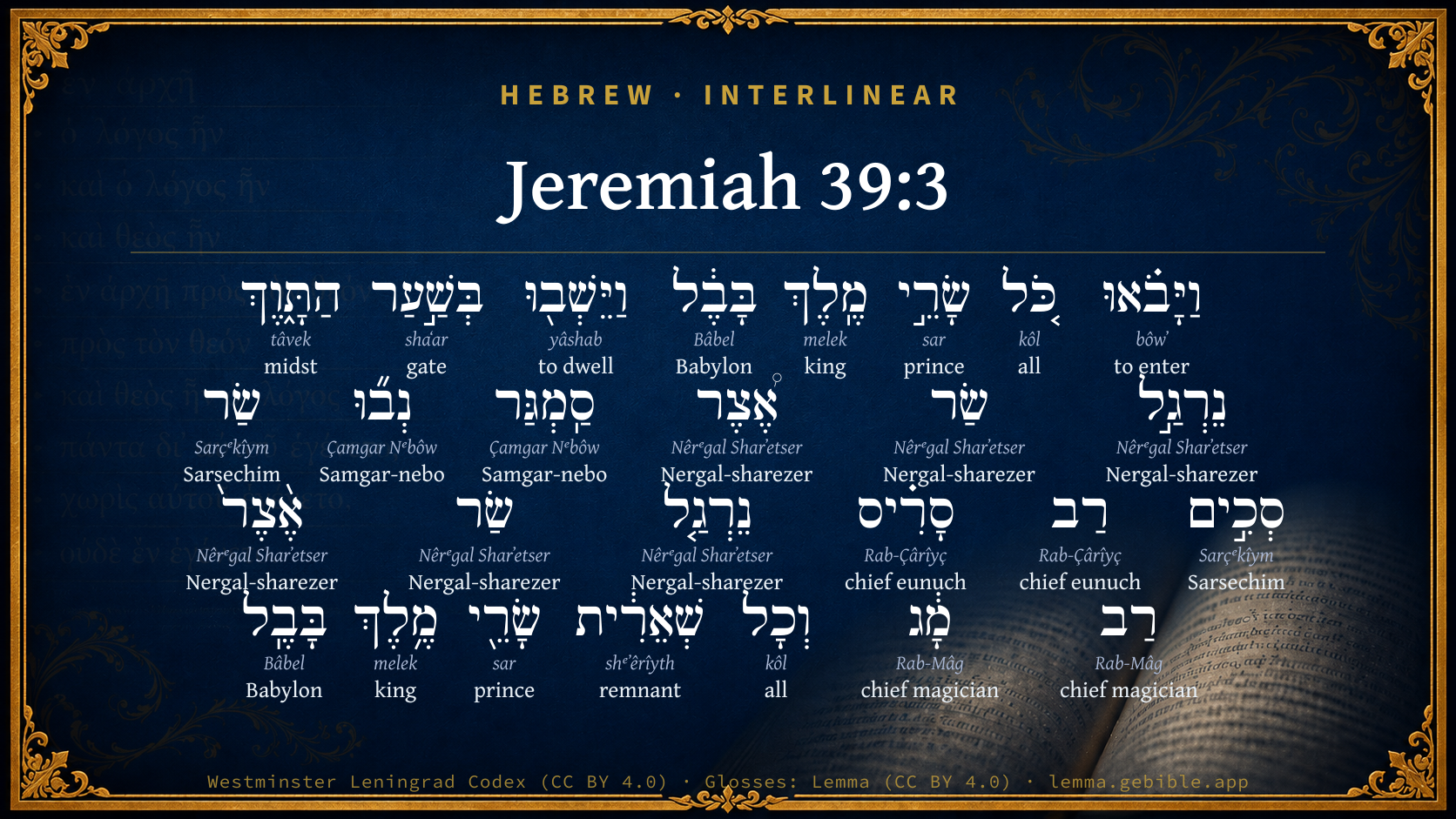
Jeremiah 39:3

Hebrew (Westminster Leningrad Codex) Jeremiah 39:3 appears in the Hebrew Old Testament. The text above is from the Westminster Leningrad Codex. Each word links to its Strong’s number, a concise gloss, and parsing drawn from the Open Scriptures Hebrew Bible morphology. Click any word for its full Brown-Driver-Briggs (BDB) entry.
Download image
Cite this verse

Jeremiah 39:3 (World English Bible). Public Domain. Lemma interlinear Bible study tool, https://lemma.gebible.app/v/jeremiah/39/3.

Show BibTeX & RIS
BibTeX
RIS
English Translation
that all the princes of the king of Babylon came in, and sat in the middle gate, [to wit], Nergal Sharezer, Samgar-nebo, Sarsechim, Rabsaris, Nergal Sharezer, Rabmag, with all the rest of the princes of the king of Babylon.
World English Bible · Public Domain
Highlights
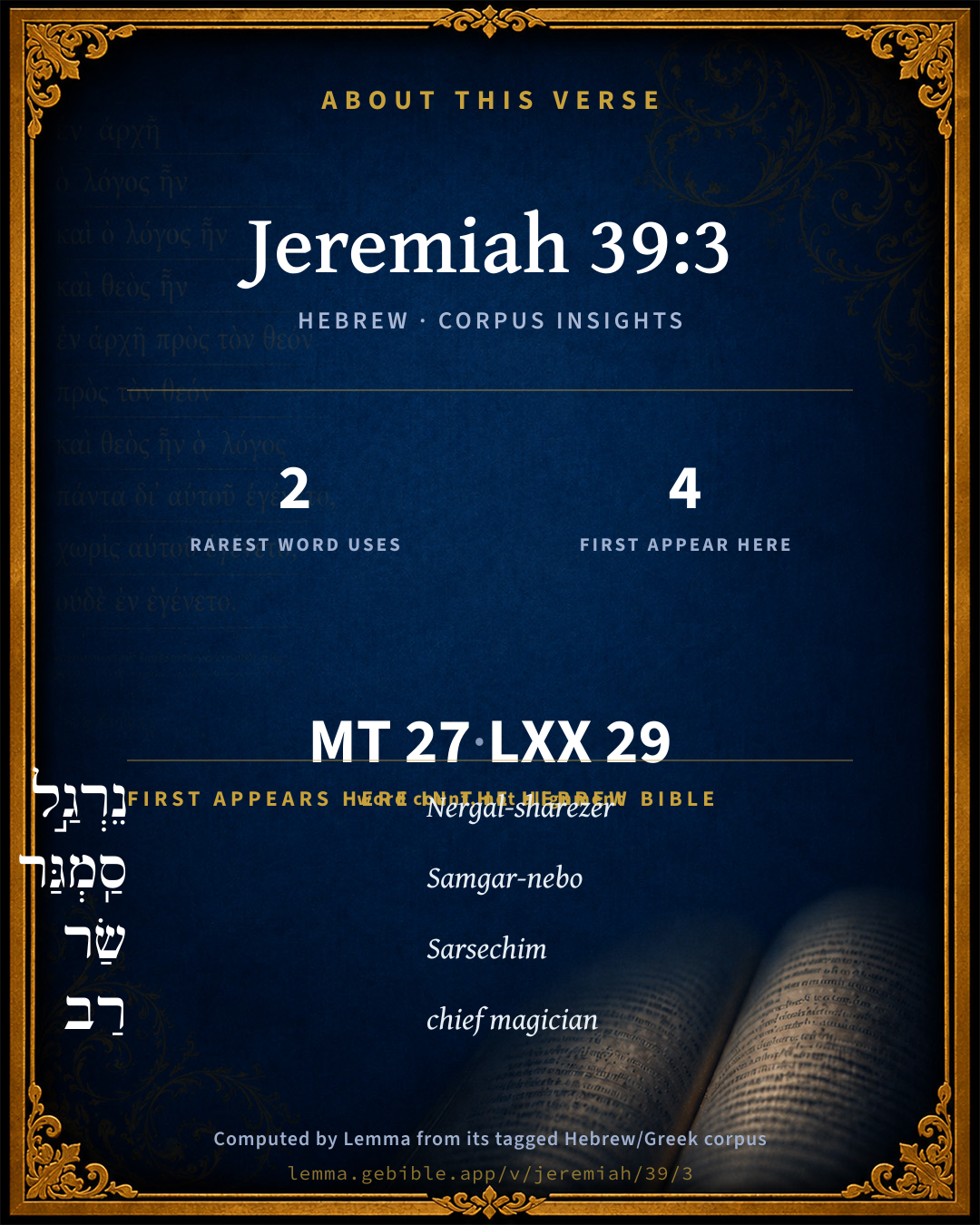
  • 4 first appearances in the Hebrew Bible
Full analysis ↓
Download a study sheet

One document with this verse’s original text, its word-by-word gloss line, the meaning frame, cross-references with their text, attributed commentary, and full source and license credits — printable, and it pastes into notes with its structure intact.

This verse Autodidact and up

Study sheet (.html) Plain text (.txt)

A passage Seminary Student

Up to 50 verses in one chapter. A passage sheet keeps up to 6 commentary sources and 12 cross-references per verse, in the order this page ranks them, and says so on the sheet whenever that leaves anything out. Ask for a single verse and you get the Autodidact verse sheet above.

Everything on this page stays free to read, with no account — the sheet is a download of what is already on screen, not access to it.

Want to remove ads? Support Godless Engineer
Compare translations 3

The same verse in 3 English versions, stacked beneath the original-language interlinear above. Click any original word for its lexicon entry.

Each is an independent rendering of the whole verse — the interlinear is not word-aligned to these translations.

Highlighted words mark where these versions differ — a whole-verse word diff, not a word-by-word alignment.

  • World English Bible Public Domain
    that all the princes of the king of Babylon came in, and sat in the middle gate, [to wit], Nergal Sharezer, Samgar-nebo, Sarsechim, Rabsaris, Nergal Sharezer, Rabmag, with all the rest of the princes of the king of Babylon.
  • King James Version Public Domain
    And all the princes of the king of Babylon came in, and sat in the middle gate, even Nergalsharezer, Samgarnebo, Sarsechim, Rabsaris, Nergalsharezer, Rabmag, with all the residue of the princes of the king of Babylon.
  • unfoldingWord Literal Text CC BY-SA 4.0
    Then all the officials of the king of Babylon came and sat in the middle gate: Nebo-Sarsekim, Samgar Nebo, and Sarsechim, an important official. Nebo-Sarsekim was a high official and all the rest were the officials of the king of Babylon.

unfoldingWord Literal Text — © unfoldingWord, licensed CC BY-SA 4.0. Word-aligned USFM3 via Door43 (git.door43.org/unfoldingWord/en_ult).

Versions to compare (up to 4)

3 of 4 selected

Show all 18 translations

Every available English version of this verse, each an independent rendering of the whole verse.

  • World English Bible Public Domain
    that all the princes of the king of Babylon came in, and sat in the middle gate, [to wit], Nergal Sharezer, Samgar-nebo, Sarsechim, Rabsaris, Nergal Sharezer, Rabmag, with all the rest of the princes of the king of Babylon.
  • Berean Standard Bible Public Domain
    Then all the officials of the king of Babylon entered and sat in the Middle Gate: Nergal-sharezer of Samgar, Nebo-sarsekim the Rabsaris, Nergal-sharezer the Rabmag, and all the rest of the officials of the king of Babylon.
  • Majority Standard Bible Public Domain
    Then all the officials of the king of Babylon entered and sat in the Middle Gate: Nergal-sharezer of Samgar, Nebo-sarsekim the Rabsaris, Nergal-sharezer the Rabmag, and all the rest of the officials of the king of Babylon.
  • King James Version Public Domain
    And all the princes of the king of Babylon came in, and sat in the middle gate, even Nergalsharezer, Samgarnebo, Sarsechim, Rabsaris, Nergalsharezer, Rabmag, with all the residue of the princes of the king of Babylon.
  • American Standard Version (1901) Public Domain
    that all the princes of the king of Babylon came in, and sat in the middle gate, `to wit', Nergal-sharezer, Samgar-nebo, Sarsechim, Rab-saris, Nergal-sharezer, Rab-mag, with all the rest of the princes of the king of Babylon.
  • Revised Version (1885) Public Domain
    that all the princes of the king of Babylon came in, and sat in the middle gate, even Nergal-sharezer, Samgar-nebo, Sarsechim, Rab-saris, Nergal-sharezer, Rab-mag, with all the rest of the princes of the king of Babylon.
  • Geneva Bible (1599) Public Domain
    And all the princes of the King of Babel came in, and sate in the middle gate, euen Neregal, Sharezer, Samgar-nebo, Sarsechim, Rab-saris, Neregal, Sharezer, Rab-mag with all the residue of the princes of the King of Babel.
  • Douay-Rheims (1899) Public Domain
    And all the princes of the king of Babylon came in, and sat in the middle gate: Neregel, Sereser, Semegarnabu, Sarsachim, Rabsares, Neregel, Serezer, Rebmag, and all the rest of the princes of the king of Babylon.
  • Young's Literal Translation Public Domain
    and come in do all the heads of the king of Babylon, and they sit at the middle gate, Nergal-Sharezer, Samgar-Nebo, Sarsechim, chief of the eunuchs, Nergal-Sharezer, chief of the Mages, and all the rest of the heads of the king of Babylon.
  • Literal Standard Version CC BY-SA 4.0
    and all the heads of the king of Babylon come in, and they sit at the middle gate, Nergal-Sharezer, Samgar-Nebo, Sarsechim, Rab-Saris, Nergal-Sharezer, chief magus, and all the rest of the heads of the king of Babylon.
  • Unlocked Literal Bible CC BY-SA 4.0
    Then all the officials of the king of Babylon came and sat in the middle gate: Nebo-Sarsekim, Samgar Nebo, and Sarsechim, an important official. Nebo-Sarsekim was a high official and all the rest were the officials of the king of Babylon.
  • unfoldingWord Literal Text CC BY-SA 4.0
    Then all the officials of the king of Babylon came and sat in the middle gate: Nebo-Sarsekim, Samgar Nebo, and Sarsechim, an important official. Nebo-Sarsekim was a high official and all the rest were the officials of the king of Babylon.
  • Darby Bible Public Domain
    and all the princes of the king of Babylon came in, and sat in the middle gate: Nergal-sharezer, Samgar-nebu, Sarsechim, chief chamberlain, Nergal-sharezer, chief magian, and all the rest of the princes of the king of Babylon.
  • World Messianic Bible Public Domain
    All the princes of the king of Babylon came in, and sat in the middle gate: Nergal Sharezer, Samgarnebo, Sarsechim the Rabsaris, Nergal Sharezer the Rabmag, with all the rest of the princes of the king of Babylon.
  • Webster's Bible Public Domain
    And all the princes of the king of Babylon came in, and sat in the middle gate, even Nergal-sharezer, Samgar-nebo, Sarsechim, Rab-saris, Nergal-sharezer, Rab-mag, with all the residue of the princes of the king of Babylon.
  • Free Bible Version CC BY-SA 4.0
    All the officials of the king of Babylon came in and took over the city, making their headquarters at the Middle Gate. They were Nergal-sharezer of Samgar, Nebo-sarsekim the Rabsaris, Nergal-sharezer the Rabmag, and all the other officials of the king of Babylon.
  • Bible in Basic English Public Domain
    All the captains of the king of Babylon came in and took their places in the middle doorway of the town, Nergal-shar-ezer, ruler of Sin-magir, the Rabmag, and Nebushazban, the Rab-saris, and all the captains of the king of Babylon.
  • JPS Tanakh (1917) Public Domain
    that all the princes of the king of Babylon came in, and sat in the middle gate, even Nergal-sarezer, Samgar-nebo, Sarsechim Rab-saris, Nergal-sarezer Rab-mag, with all the residue of the princes of the king of Babylon.

Literal Standard Version (2020), Covenant Press — licensed CC BY-SA 4.0. Text via the HelloAO Bible API (eBible.org). Unlocked Literal Bible (unfoldingWord) — licensed CC BY-SA 4.0. Text via the HelloAO Bible API (eBible.org). unfoldingWord Literal Text — © unfoldingWord, licensed CC BY-SA 4.0. Word-aligned USFM3 via Door43 (git.door43.org/unfoldingWord/en_ult). Free Bible Version, Dr. Jonathan Gallagher — licensed CC BY-SA 4.0. Text via the HelloAO Bible API (eBible.org).

Word by word

More ways to search: Search by grammar → Find every occurrence → Compare this word →

Practice this passage: Drill this verse → Learn its vocabulary →

סַֽמְגַּר
Çamgar Nᵉbôw
H5562
“Samgar-nebo”
Noun, Proper
Part of Speech
Noun
Type
Proper
Full BDB Definition

Origin: of foreign origin

TWOT: None

Samgar-nebo = "sword of Nebo" - one of the princes or generals of king Nebuchadnezzar of Babylon
  1. וַיָּבֹ֗אוּ bôwʼ H935 “and · to enter” Conjunction + Verb, Qal, Sequential Imperfect, 3rd Person, Masculine, Plural
  2. כֹּ֚ל kôl H3605 “all of” Noun, Common, Masculine, Singular, Construct
  3. שָׂרֵ֣י sar H8269 “princes of” Noun, Common, Masculine, Plural, Construct
  4. מֶֽלֶךְ melek H4428 “king of” Noun, Common, Masculine, Singular, Construct
  5. בָּבֶ֔ל Bâbel H894 “Babylon” Noun, Proper
  6. וַיֵּשְׁב֖וּ yâshab H3427 “and · to dwell” Conjunction + Verb, Qal, Sequential Imperfect, 3rd Person, Masculine, Plural
  7. בְּשַׁ֣עַר shaʻar H8179 “in/at · gate of” Preposition + Noun, Common, Masculine, Singular, Construct
  8. הַתָּ֑וֶךְ tâvek H8432 “the · midst” Particle, Definite Article + Noun, Common, Masculine, Singular, Absolute
  9. נֵרְגַ֣ל Nêrᵉgal Sharʼetser H5371 “Nergal-sharezer” Noun, Proper
  10. שַׂר Nêrᵉgal Sharʼetser H5371 “Nergal-sharezer” Noun, Proper
  11. אֶ֠צֶר Nêrᵉgal Sharʼetser H5371 “Nergal-sharezer” Noun, Proper
  12. נְב֞וּ Çamgar Nᵉbôw H5562 “Samgar-nebo” Noun, Proper
  13. שַׂר Sarçᵉkîym H8310 “Sarsechim” Noun, Proper
  14. סְכִ֣ים Sarçᵉkîym H8310 “Sarsechim” Noun, Proper
  15. רַב Rab-Çârîyç H7249 “chief eunuch of” Noun, Common, Masculine, Singular, Construct
  16. סָרִ֗יס Rab-Çârîyç H7249 “chief eunuch” Noun, Common, Masculine, Singular, Absolute
  17. נֵרְגַ֤ל Nêrᵉgal Sharʼetser H5371 “Nergal-sharezer” Noun, Proper
  18. שַׂר Nêrᵉgal Sharʼetser H5371 “Nergal-sharezer” Noun, Proper
  19. אֶ֨צֶר֙ Nêrᵉgal Sharʼetser H5371 “Nergal-sharezer” Noun, Proper
  20. רַב Rab-Mâg H7248 “chief magician” Noun, Common, Masculine, Singular, Absolute
  21. מָ֔ג Rab-Mâg H7248 “chief magician” Noun, Common, Masculine, Singular, Absolute
  22. וְכָל kôl H3605 “and · all of” Conjunction + Noun, Common, Masculine, Singular, Construct
  23. שְׁאֵרִ֔ית shᵉʼêrîyth H7611 “remnant of” Noun, Common, Feminine, Singular, Construct
  24. שָׂרֵ֖י sar H8269 “princes of” Noun, Common, Masculine, Plural, Construct
  25. מֶ֥לֶךְ melek H4428 “king of” Noun, Common, Masculine, Singular, Construct
  26. בָּבֶֽל Bâbel H894 “Babylon” Noun, Proper

About this verse

These counts appear in no published source. They are computed here, from the morphology-tagged text and Lemma’s own curated glosses. What Lemma adds →

27
words
14
distinct lemmas
Prophets
section

Notable vocabulary

The rarest word here is סַֽמְגַּר Samgar-nebo H5562 — appearing just 2 times in the whole Hebrew Bible.

First appearance in Scripture

These words make their first canonical appearance in the Hebrew Bible here:

  • נֵרְגַ֣ל Nergal-sharezer H5371
  • סַֽמְגַּר Samgar-nebo H5562
  • שַׂר Sarsechim H8310
  • רַב chief magician H7248

Grammatical profile

  • 2 verbs
  • 25 nouns

Verb forms

  • וַיָּבֹ֗אוּ Qal · Sequential Imperfect
  • וַיֵּשְׁב֖וּ Qal · Sequential Imperfect

Repetition

Words recur within this verse — often emphatic in Hebrew:

  • נֵרְגַ֣ל Nergal-sharezer H5371 ×6
  • כֹּ֚ל all H3605 ×2
  • שָׂרֵ֣י prince H8269 ×2
  • מֶֽלֶךְ king H4428 ×2
  • בָּבֶ֔ל Babylon H894 ×2
  • סַֽמְגַּר Samgar-nebo H5562 ×2
  • שַׂר Sarsechim H8310 ×2
  • רַב chief eunuch H7249 ×2
  • רַב chief magician H7248 ×2

Hebrew & Septuagint length

In the original languages it is 27 Hebrew tokens and 29 Greek tokens — but the two are counted differently (Hebrew bundles its prefixes and suffixes into one token; the Greek is in lemma form), so that isn’t a like-for-like length.

Cross-references

5

Topical passages linked to Jeremiah 39:3 in the Treasury of Scripture Knowledge — connected by theme and wording, ordered by reader-vote popularity; previews shown in the World English Bible.

  • Jeremiah 21:4 Thus says Yahweh, the God of Israel, Behold, I will turn back the weapons of war that are in your hands, with which you fight against the king of Babylon, and against the Chaldeans who besiege you, without the walls; and I will gather them into the midst of this city.
  • Jeremiah 38:17 Then said Jeremiah to Zedekiah, Thus says Yahweh, the God of hosts, the God of Israel: If you will go forth to the king of Babylon's princes, then your soul shall live, and this city shall not be burned with fire; and you shall live, and your house.
  • Jeremiah 1:15 For, behold, I will call all the families of the kingdoms of the north, says Yahweh; and they shall come, and they shall set everyone his throne at the entrance of the gates of Jerusalem, and against all the walls of it round about, and against all the cities of Judah.
  • Jeremiah 39:13 So Nebuzaradan the captain of the guard sent, and Nebushazban, Rabsaris, and Nergal Sharezer, Rabmag, and all the chief officers of the king of Babylon;
  • 2 Kings 17:30 The men of Babylon made Succoth-benoth, and the men of Cuth made Nergal, and the men of Hamath made Ashima,

Cross-references courtesy of OpenBible.info (CC BY 4.0).

Hebrew and Greek witnesses Masoretic Hebrew ↔ Greek Septuagint

The same verse in the two great witnesses to the Old Testament, shown verse-for-verse.

These are two independent witnesses, not word-aligned to each other, and the Septuagint is shown in lemma (dictionary) form.

Hebrew Jeremiah 39:3 Masoretic · Westminster Leningrad Codex

וַיָּבֹ֗אוּ כֹּ֚ל שָׂרֵ֣י מֶֽלֶךְ בָּבֶ֔ל וַיֵּשְׁב֖וּ בְּשַׁ֣עַר הַתָּ֑וֶךְ נֵרְגַ֣ל שַׂר אֶ֠צֶר סַֽמְגַּר נְב֞וּ שַׂר סְכִ֣ים רַב סָרִ֗יס נֵרְגַ֤ל שַׂר אֶ֨צֶר֙ רַב מָ֔ג וְכָל שְׁאֵרִ֔ית שָׂרֵ֖י מֶ֥לֶךְ בָּבֶֽל

that all the princes of the king of Babylon came in, and sat in the middle gate, [to wit], Nergal Sharezer, Samgar-nebo, Sarsechim, Rabsaris, Nergal Sharezer, Rabmag, with all the rest of the princes of the king of Babylon.

World English Bible · Public Domain

Greek LXX Structure differs

In the Septuagint, Jeremiah is about an eighth shorter than the Hebrew and arranges its material differently — the Oracles Against the Nations (Hebrew chapters 46–51) appear in the middle of the Greek book, after 25:13. Because the chapter and verse boundaries do not line up, a verse-for-verse comparison with the Hebrew is not shown.

A verse-for-verse comparison isn’t shown here because the chapters and verses don’t line up. Switch to the LXX edition with the MT / LXX toggle above to read the Greek directly.

On this verse, Haydock's Catholic Bible Commentary discusses the Septuagint’s reading. Read the note in Commentary ↓

Hebrew: Westminster Leningrad Codex (CC BY 4.0). Greek: Septuagint (public domain); English from a public-domain English Septuagint. How the Septuagint differs from the Hebrew →

Targum (Aramaic paraphrase)

1

The Targum is the ancient Jewish Aramaic paraphrase of the Hebrew Scriptures — an interpretive translation, not the Hebrew text itself. Onkelos (literal) and Pseudo-Jonathan (expansive) render the Torah, and Jonathan the Prophets. Coverage is partial: where no permissively-licensed English translation exists for a verse, only the Aramaic is shown. This is verse-level text, not a word-by-word alignment to the Hebrew.

  1. Targum Jonathan Prophets (Joshua–Malachi)
    וַאֲתוֹ כָּל רַבְרְבֵי מַלְכָּא דְבָבֶל וִיתִיבוּ בְּתַרְעָא מְצִיעֵיתָא נֵרְגַל שַׁרְאֶצַר סַמְגַר נְבוֹ שַׂרְסְכִים רַב סָרִיס נֵרְגַל שַׁרְאֶצֶר רַב מָג וְכָל שְׁאָר רַבְרְבֵי מַלְכָּא דְבָבֶל:

    (no public-domain English translation for this verse)

    Targum Jonathan — Aramaic: “Mikraot Gedolot” (public domain). English: “Sefaria Community Translation” (CC0 1.0 (public-domain dedication)); “London "Chaldee Paraphrase," 1871” (public domain). Text via Sefaria.

Commentary

Notes on Jeremiah 39:3 from classic Christian and Jewish commentators (each source and its license shown beneath its notes). The classic Christian expositions comment on the surrounding passage and are grouped to its opening verse, so a note may address several verses; the Jewish commentaries on the Tanakh (Rashi and others) are per-verse, so they appear only where the commentator wrote on this verse.

Lemma curates 59 commentaries, every one of them public domain or Creative Commons licensed, each selected and text-cleaned for this edition rather than reprinted as found. About our sources →

Trapp's Complete Commentary

John Trapp

Jer 39:3 And all the princes of the king of Babylon came in, and sat in the middle gate, [even] Nergalsharezer, Samgarnebo, Sarsechim, Rabsaris, Nergalsharezer, Rabmag, with all the residue of the princes of the king of Babylon.

Ver. 3. In the middle gate.] Called the second gate (Zep 2:10; see Jer 1:15). Jeremiah lived to see many of his prophecies fulfilled. Jerusalem was taken in or about the fortieth year of his prophesying, as it was afterwards by the Romans, in or about the fortieth year after our Saviour’s ministry started.

Even Nergalsharezer, Shamgarnebo.] Here we have a list of the Babylonian princes who first broke into the city. Their names are harsh and barbarous (such as are now to our ears the Turkish Bashaws, Beglerbegs, Sanzacks, &c.), but good enough for such to hear as would not yield to the sweet name and counsel of a gracious God. Those names that have Sar or Rab in them are deemed to be names of office; as Sarezer, master of the treasures; Rabinag, master of the magicians, &c.

John Trapp, A Commentary or Exposition upon All the Books of the Old and New Testament (1647–1656) — public domain. Text from a community e-Sword module.

Tyndale Open Study Notes

Tyndale Open Resources

39:3 High-ranking officers came into the city to oversee its destruction and sat in triumph at the Middle Gate, showing how important this victory was to the Babylonians. According to custom, victorious officials positioned themselves at one of the gates, since judicial and administrative matters were controlled at gateways.

Tyndale Open Study Notes — © Tyndale Open Resources, licensed CC BY-SA 4.0. Text via the HelloAO Bible API.

Jamieson, Fausset & Brown

Robert Jamieson, A. R. Fausset & David Brown

sat--expressing military occupation or encampment.

middle gate--the gate from the upper city (comprehending Mount Zion) to the lower city (north of the former and much lower); it was into the latter (the north side) that the Chaldeans forced an entry and took up their position opposite the gate of the "middle" wall, between the lower and upper city. Zedekiah fled in the opposite, that is, the south direction (Jer 39:4).

Nergalsharezer, Samgarnebo--proper names formed from those of the idols, Nergal and Nebo (Kg2 17:30; Isa 46:1).

Rab-saris--meaning "chief of the eunuchs."

Rab-mag--chief of the magi; brought with the expedition in order that its issue might be foreknown through his astrological skill. Mag is a Persian word, meaning "great," "powerful." The magi were a sacerdotal caste among the Medes, and supported the Zoroastrian religion.

Jamieson, Fausset & Brown — Commentary Critical and Explanatory on the Whole Bible (1871) — public domain (CC PDM 1.0). Text via the HelloAO Bible API.

Adam Clarke's Commentary

Verse 3. Sat in the middle gate] The city of Jerusalem stood upon two hills, Sion to the south, and Acra to the north, with a deep valley between them. The gate of the centre, as the term seems plainly to import, was a gate of communication in the middle of the valley, between the two parts of the city, sometimes called the higher and the lower city. The Chaldeans entered the city on the north side by a breach in the walls, and rushing forward and posting themselves in this gate, in the very heart or centre of the city, became thereby masters at will of the whole. Zedekiah with his troop, perceiving this, fled out of the opposite gate on the south side. See Blayney. This is likely; but we know nothing positively on this subject.

Nergal-sharezer] These were the principal commanders; but Dr. Blayney thinks that instead of six persons, we have in reality but three, as the name that follows each is a title of office. Thus, Nergal-sharezer, who was Samgar; Nebusarsechim, who was Rab-saris; and Nergal-sharezer, who was Rab-mag. As Nergal-sharezer occurs twice here, and we know that Nebuzaradan was general-in-chief, the first Nergal-sharezer is probably a mistake for Nebuzar-adan, or some other of the commanders. But these things are as uncertain as they are unimportant.

Adam Clarke's Commentary on the Bible (1810–1826) — public domain. Text from a community e-Sword/MySword module.

John Calvin's Commentaries

IT is proved here that the prophecy of Jeremiah was fulfilled; so that it became really evident that he had not spoken unadvisedly, but from the mouth of God. And thus was fulfilled also what is said as a common proverb, that fools become wise too late; for they never obey good and wise counsels while they may, but at length they are made to know by their own miseries and their teacher, experience, that what they despised is true, but without any benefit. This happened to Zedekiah, who had been often exhorted by the Prophet to surrender himself to King Nebuchadnezzar. As, then, he had obstinately refused the yoke, he was at length constrained to reap the fruit of his obstinacy.

Now Jeremiah says, that the princes of King Nebuchadnezzar, that is, those he had set over his forces, entered the city, the wall being broken down, and sat in the middle gate; for it was necessary for them to be wary, lest there should be ambushes; and even conquerors do not immediately penetrate into every part when a city is taken, but search whether all the places be free from enemies. This then was done by the leaders of the army, for they stood in the middle gate, that they might exercise authority over the city, and yet be safe from all ambushes. Jeremiah mentions some of them by name, but it is uncertain whether he adds a surname to some of them. But as this is doubtful and is of no great moment, it is enough for us that the chief of the leaders are named, in order to accredit the narrative.

John Calvin's Commentaries (1540-1563) — public domain. Text from the Calvin Translation Society English edition (1840s-50s) via the Christian Classics Ethereal Library (ccel.org). Calvin's coverage is partial (roughly two-thirds of the Bible); uncommented books and verses are honest gaps, never fabricated. The 19th-century editor's footnotes and remarks are omitted so the notes are faithfully Calvin's own voice.

Ellicott's Commentary for English Readers

(3) In the middle gate.—The term indicates a position in the line of walls between the citadel of Zion—the “upper city” of Josephus (Ant. v. 20. 2), which as yet was not surrendered (Jer_39:4)—and the lower city, in the walls of which a breach had been effected. Here an open space, originally used as a forum, or place of judgment, now gave the Chaldæan generals a central encampment, from which they could command both quarters of the city, and by taking their place in the heart of its life, formally assert their mastery. Each of the names that follow has a meaning and history of its own.

Nergal-sharezer.—The first half of the name appears in 2Ki_17:30 as that of a Cuthite, or Assyrian deity, and means the “great hero.” It occurs frequently in the inscriptions of Tiglath-pileser and Assur-banipal (e.g., Records of the Past, i. 77, 103). The whole name appears in Assyrian monuments as Nergal-shar-uzur. Two of the generals mentioned here bore the same name, and each apparently was distinguished by a special title.

Samgar–nebo.—Here the second half is the name of a Babylonian deity (Isa_46:1; Jer_48:1), possibly connected with the Hebrew Nabi (= prophet), and so answering to the Egyptian Thoth and the Greek Hermes. The great temple at Borsippa, known as Birs Nimroud, was dedicated to him (Records of the Past, vii. 77). The first half has been explained by some scholars as meaning “warrior,” by others as “cupbearer,” and so equivalent to Rabshakeh (Isa_36:2), and as such is attached to the foregoing name of Nergal-sharezer. As a rule, the name of Nebo appears always in the beginning of compound words, as in Nebuchadnezzar, Nebuzar-adan, &c.; and probably we should connect it here with the name that follows.

Sarsechim, Rab-saris.—Probably, as indicated in the previous Note, the name should stand as Nebo-sarsechim. The two names go together, the first as a proper name, the second as a title, meaning “the chief eunuch.” In Jer_39:13, Nebushasban appears as bearing the same title. In 2Ki_18:17 it appears simply as a title, as in Rabshakeh we have “the chief cupbearer.”

Nergal-sharezer, Rab-mag.—Here also the second name is the title of office, meaning probably “chief of the Magi,” or “chief of the priests.” The man thus named, who appears on the Assyrian monuments as Nergal-shar-uzur Rubu-emga, played a prominent part afterwards as murdering Evil-merodach, the son of Nebuchadnezzar, whose sister he had married. He reigned for three or four years, and appears in Berosus (Joseph. 100 Apion, i. 20) under the name of Neriglissar. The older name is found on the bricks of a palace at Babylon, on the right bank of the Euphrates (Smith’s Dict. of Bible. Art. Nergal-sharezer).

A Bible Commentary for English Readers, edited by Charles John Ellicott (1878–1897) — public domain. Text from a community e-Sword module.

John Gill's Exposition

And all the princes of the king of Babylon came in,.... Into the city: a breach being made in the walls to take possession of it:

and sat in the middle gate; according to Jarchi, this was a gate of the temple; the gate Nicanor, the eastern gate, which was between the gate of the court of the women and the gate of the temple; who observes, that their Rabbins say, the middle gate was the gate in which the wise men made their decrees and constitutions: so that, in "the place of judgment, wickedness was there"; as in Ecc 3:16; and Josephus (g) says, that the city was taken in the middle of the night, when the enemies' generals went into the temple; but rather, according to Kimchi, it was one of the gates of the city of Jerusalem; according to Abarbinel, Jerusalem had three walls, and this was the gate of the middle wall; but others take it to be the gate in the middle wall, between the upper and lower city; perhaps it is the same called the second gate, Zep 1:10; and might be the chief and principal gate where these princes placed their seats in triumph as victors, and so fulfilled the prophecy of Jeremiah, Jer 1:15; though they might have another reason for it, their own safety; here they sat till the city was well searched and cleared, lest there should be any ambush laid for them, and cut them off as they entered. The names of some of them were as follow:

even Nergalsharezer: according to Kimchi, these are two names of two distinct persons; but generally thought to be one name of the same person; so Josephus, who calls him Nergelearus. The first part of the name "Nergal" was the name of an idol with the Cushites, Kg2 17:30; and it was usual with the Heathens to give the names of their idols to their kings, princes, and great men. The other part, "Sharezer", is a name of one of Sennacherib's sons; and seems to be an Assyrian name, Isa 37:38. The next is called

Samgarnebo; though, according to Hillerus (h), this is a surname of the former, to distinguish him from another Nergalsharezer after mentioned, taken from his office: this name signifying the "strict keeper of Nebo", the temple of the idol Nebo; see Isa 46:1. The next is

Sarsechim Rabsaris; for these are not two names of different persons, but of the same person. The first is his proper name, which signifies the "prince of the Scythians"; the other his name of office, and signifies the "chief eunuch", or the "chief of the eunuchs". The last name is

Nergalsharezer Rabmag; these names belong to the same person, who is called from his office "Rabmag", the "chief magician", or the "chief of the magicians", to distinguish him from the other Nergalsharezer before mentioned: these,

with all the residue of the princes of the king of Babylon, entered the city and took it.

(g) Antiqu. l. 10. c. 8. sect. 2. (h) Onomastic. Sacr. p. 608.

Next: Jeremiah Chapter 40

John Gill's Exposition of the Whole Bible (1746–1763) — public domain (CC PDM 1.0). Text via the HelloAO Bible API.

Albert Barnes' Notes on the Bible

These princes were four:

(1) Nergal, Sharezer, i. e., Nirgal-sar-usur (May Nergal protect the king);

(2) Samgar-Nebo (Be gracious, O Nebo);

(3) Sarsechim. No explanation is given at present of this name. He was Rab-saris, i. e., chief of the eunuchs (2Ki 18:17 note).

(4) another Nergal-sharezer, who was Rab-mag, i. e., chief of the Magians. He is known in history as Neriglissar, the son-in-law of Nebuchadnezzar, and probably his vicegerent during his seven years of madness. Two years after his death Neriglissar murdered Evil-Merodach, Nebuchadnezzars son, and seized the crown, but after a reign of four years was slain in battle against Cyrus, when disputing with him the crown of Media. See Dan 5:1 note.

The middle gate - Probably that which separated the city of Zion from the lower town.

Albert Barnes' Notes on the Bible (1834–1885) — public domain. Text from a community e-Sword/MySword module.

Haydock's Catholic Bible Commentary

Neregel, Sereser. Perhaps Nabuzardan should be read, (ver. 13.; Haydock) or these names are mentioned twice, probably by mistake of transcribers. The former was an idol; (4 Kings xvii. 30.) the latter word means "treasurer." (Calmet) --- (Protestants) Nergal-Sharezer seems to be one person, as in Septuagint, or "treasurer of Nergel." (Haydock) --- Samgar-nebu, was "prefect of the temple of Nabo." --- Sarsachim, "prince of the sacæ, or Scythians." --- Rabsares, "master of the eunuchs," or officers within the palace. Such a one was employed by Sennacherib, 4 Kings xviii. 17. --- Rebmag, "chief of the magi," (Calmet) or "master of the camp." (Junius) --- These entered the first wall, chap i. 15., and Isaias xxii. 7.

George Leo Haydock (1774–1849), Haydock's Catholic Family Bible and Commentary, 1859 edition — public domain. Excludes Psalms (Douay-Rheims chapter numbering differs from Protestant) and Deuterocanonical books (Catholic canon only).

Matthew Poole's English Annotations

All the great men of Babylon that were employed in the conduct of the Babylonian army (the city being taken by storm or surprise) entered into it, but rested at the middle gate. The city, they say, was encompassed with two walls, before they came to the wall of the temple; the gate in the inner wall is supposed to have been that which is called the middle gate: they would not at first adventure in further; the city being large and well fortified, there might have been some traps laid for them; they would therefore have their soldiers first clear the streets, and search all places, that they might enter further into the city without hazarding their persons. Some interpreters have examined the signification of the names of these princes, but I know of no use it can be to us, whether they were the names of the persons, or significative of the offices they bare.

Matthew Poole's English Annotations on the Holy Bible (1683–1685) — public domain. Text from a community e-Sword/MySword module.

Whedon's Commentary on the Bible

Daniel D. Whedon

3. All the princes, etc. — As above intimated, (Jer_38:17,) the king of Babylon was absent at Riblah, and hence the attacking army was under the command of these “princes.” As to their names, certain difficulties have been pointed out by the expositors, such as: 1) One name is repeated. 2) Another has the name of the god Nebo at the end, while all other known compounds of this name place it at the beginning, as Nebuchadnezzar, etc. 3) From this name, too, is omitted the title of office, though it is used with the following. 4) In Jer_39:13 the Babylonian grandees are again spoken of, but there are three and not four. For such reasons as these, all of which are really very inconclusive, some have conjectured that the text here is corrupt. But this harsh conjecture is totally unwarranted. Two princes of a name are certainly by no means impossible, as history has abundantly illustrated.

Middle gate — The conjecture is, that this was a gate in the wall which divided Zion from the lower city.

From this point both divisions could be most easily commanded. FAITH OF ZEDEKIAH AND Jeremiah , 4-14.

Daniel D. Whedon (gen. ed.), Commentary on the Old and New Testaments (1874–1909) — public domain. Text from a community e-Sword module.

The Pulpit Commentary

And all the princes, etc.; rather, That all the princes, etc. (see Jer_38:28) The fact mentioned in this verse is not recorded in 2Ki 25 Jer 52; and its preciseness is a considerable pledge of its accuracy. The princes are four in number, and two of them have official titles attached. Nergal-sharezer is the Hebraized form of Nirgal-sarra-ucur, i.e. "Nirgal (or Nergal), protect (or perhaps, has created) the king the name, as often, is a prayer. Samgar-nebo is probably a modification of Sumgir-nabu, "Be gracious, Nebo;" but it has not yet been found in the inscriptions. Sarsechim has the appearance of being corrupt; the first part, however, may, perhaps, be the Babylonian for "king" ("prince" in Hebrew). Rab-saris has a meaning in Hebrew of the eunuchs;" but the analogies of "Rab-mag" and "Rab-shakeh" suggest that it is merely the Hebraized form of some Assyrian title. In any case, it would be better to render "the Rab-saris," and to attach it closely to the preceding name, Sarsechim being himself the official called Rab-saris (see, however, ver. 13). Rab-mag. This was "one of the highest titles in the state" (G. Smith). The etymology of the latter half of the phrase is uncertain; for the connection of "mag" with "Magi" is a mistake which has been exposed by Dr. Schrader, in his work, "Die Keilinschriften und das Alte Testament" (of which a translation is announced). The native form of the name may be rubu emga (Schrader) or rubu makhe (Friedr. Delitzsch), and the whole title will mean "high priest" or "chief of the sorcerers" (comp. Delitzsch, "The Hebrew Language viewed in the Light of Assyrian Research," Lond., 1883, p. 14). "The Rab-mag" would be more accurate, and the title ought to be attached to the preceding name, Nergal-sharezer. As a matter of fact, a Nirgal-sarra-ucur, who held the office of rubu emga, is mentioned in the cuneiform inscriptions, and we may plausibly conjecture that he is the person here mentioned among the "princes." He was afterwards raised to the throne by the conspirators who murdered Evil-merodach, the son of Nebuchadnezzar (he is better known as Neriglissar). It is singular that two Nergal-sharezers should be here mentioned; possibly the first mention is due to a mistake. The names are hardly recognizable in the Septuagint. The "princes" took up their station in the middle gate. The "breach" spoken of in ver. 2 enabled the Babylonians to occupy the whole of the lower city to the northeast of Zion. The "middle gate" probably separated these two parts of Jerusalem, and those who were posted there commanded the temple and the citadel.

The Pulpit Commentary (1880–1919), ed. H.D.M. Spence-Jones & Joseph S. Exell — public domain. Text from a community e-Sword module.

John Wesley's Explanatory Notes

The middle gate - The city was encompassed with two walls, before they came to the wall of the temple; the gate in the inner wall is supposed to have been that which is called the middle gate. They would not at first venture farther, 'till they might without hazarding their persons.

John Wesley, Explanatory Notes Upon the Whole Bible (1754–1765) — public domain. Text via the GEBible commentary corpus.

Rashi

Rabbi Shlomo Yitzchaki (Rashi)

And all the officers of the king of Babylon came and sat in the middle gate, etc. [This] tells [us] that here the above prophecy, “And they will come and place, each one his throne at the entrance of the gates of Jerusalem, etc.” (1:15) was fulfilled.

in the middle gate Heb. בשער התוך. Jonathan renders: in the middle gate, the gate of the Temple court, the Nicanor Gate, the Eastern Gate, and it is between the gate of the Women’s Court and the gate of the Temple proper. And our Rabbis (Sanh. 103a) said: The gate where the halachoth were decided (מחתכים). Concerning them, Scripture says. “The place of judgment there is wickedness” (Ecc. 3:16).

Rashi on the Tanakh — English translations: “The Judaica Press complete Tanach with Rashi, translated by A. J. Rosenberg” (CC BY 4.0); “Pentateuch with Rashi's commentary by M. Rosenbaum and A.M. Silbermann, 1929-1934” (public domain); “The Metsudah Tanach series, Lakewood, N.J” (CC BY 4.0); and “The Book of Joshua, Metsudah Publications, 1997” (CC BY 4.0). Text via Sefaria.

Lesson kit

Teaching starters — assembled from the data on this page, not authored interpretation. Every prompt links to the verse data it draws on. Edit before teaching.

Jeremiah, in the Prophets, opens this verse with 27 words (14 distinct Hebrew lemmas). Its most distinctive word is Çamgar Nᵉbôw (“Samgar-nebo”). A historical commentator’s framing appears above. Read the whole chapter for the surrounding context.

Discussion questions

  1. The word Çamgar Nᵉbôw carries the sense “Samgar-nebo.” How does it shape the verse?
  2. 4 words here appear for the first time in Scripture. What is being introduced at this debut?
  3. Jeremiah 21:4 shares this passage’s theme. How do the two illuminate each other?
  4. “Nergal-sharezer” occurs 6× in this one verse. What is the effect of the repetition?
  5. These translations render this verse differently. What is at stake in choosing one wording over another?
  6. The verb «וַיָּבֹ֗אוּ» is Qal Sequential Imperfect. How does its form color the action?
  7. Reading how Trapp's Complete Commentary and Tyndale Open Study Notes read this verse, where do the two commentators agree and where do they part?

Things to notice

Reading settings

Reading text

Shown beneath each verse's original-language words.

Old Testament
Old Testament edition

Read the OT as the Masoretic Hebrew (MT) or the Greek Septuagint (LXX).

English shown for the Greek Septuagint (in the Hebrew ↔ Greek comparison).

Comparing translations? Open the Compare panel on any verse page to stack up to four side by side.