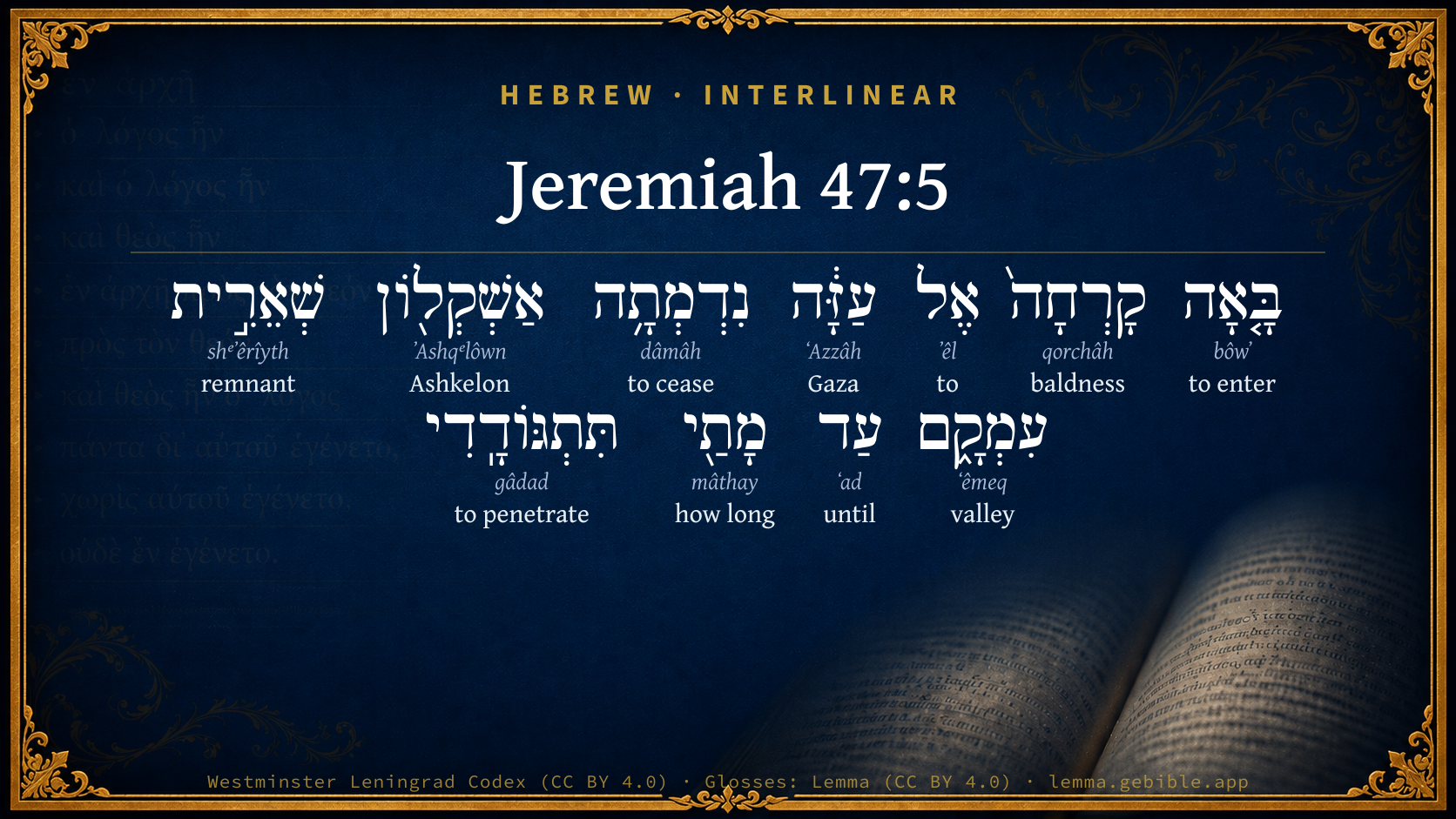
Jeremiah 47:5

Hebrew (Westminster Leningrad Codex) Jeremiah 47:5 appears in the Hebrew Old Testament. The text above is from the Westminster Leningrad Codex. Each word links to its Strong’s number, a concise gloss, and parsing drawn from the Open Scriptures Hebrew Bible morphology. Click any word for its full Brown-Driver-Briggs (BDB) entry.
Download image
Cite this verse

Jeremiah 47:5 (World English Bible). Public Domain. Lemma interlinear Bible study tool, https://lemma.gebible.app/v/jeremiah/47/5.

Show BibTeX & RIS
BibTeX
RIS
English Translation
Baldness is come on Gaza; Ashkelon is brought to nothing, the remnant of their valley: how long will you cut yourself?
World English Bible · Public Domain
Download a study sheet

One document with this verse’s original text, its word-by-word gloss line, the meaning frame, cross-references with their text, attributed commentary, and full source and license credits — printable, and it pastes into notes with its structure intact.

This verse Autodidact and up

Study sheet (.html) Plain text (.txt)

A passage Seminary Student

Up to 50 verses in one chapter. A passage sheet keeps up to 6 commentary sources and 12 cross-references per verse, in the order this page ranks them, and says so on the sheet whenever that leaves anything out. Ask for a single verse and you get the Autodidact verse sheet above.

Everything on this page stays free to read, with no account — the sheet is a download of what is already on screen, not access to it.

Want to remove ads? Support Godless Engineer
Compare translations 3

The same verse in 3 English versions, stacked beneath the original-language interlinear above. Click any original word for its lexicon entry.

Each is an independent rendering of the whole verse — the interlinear is not word-aligned to these translations.

Highlighted words mark where these versions differ — a whole-verse word diff, not a word-by-word alignment.

  • World English Bible Public Domain
    Baldness is come on Gaza; Ashkelon is brought to nothing, the remnant of their valley: how long will you cut yourself?
  • King James Version Public Domain
    Baldness is come upon Gaza; Ashkelon is cut off with the remnant of their valley: how long wilt thou cut thyself?
  • unfoldingWord Literal Text CC BY-SA 4.0
    Baldness will come upon Gaza. As for Ashkelon, the people who are left in their valley will be made silent. How long will you cut yourself in mourning?

unfoldingWord Literal Text — © unfoldingWord, licensed CC BY-SA 4.0. Word-aligned USFM3 via Door43 (git.door43.org/unfoldingWord/en_ult).

Versions to compare (up to 4)

3 of 4 selected

Show all 18 translations

Every available English version of this verse, each an independent rendering of the whole verse.

  • World English Bible Public Domain
    Baldness is come on Gaza; Ashkelon is brought to nothing, the remnant of their valley: how long will you cut yourself?
  • Berean Standard Bible Public Domain
    The people of Gaza will shave their heads in mourning; Ashkelon will be silenced. O remnant of their valley, how long will you gash yourself?
  • Majority Standard Bible Public Domain
    The people of Gaza will shave their heads in mourning; Ashkelon will be silenced. O remnant of their valley, how long will you gash yourself?
  • King James Version Public Domain
    Baldness is come upon Gaza; Ashkelon is cut off with the remnant of their valley: how long wilt thou cut thyself?
  • American Standard Version (1901) Public Domain
    Baldness is come upon Gaza; Ashkelon is brought to nought, the remnant of their valley: how long wilt thou cut thyself?
  • Revised Version (1885) Public Domain
    Baldness is come upon Gaza; Ashkelon is brought to nought, the remnant of their valley: how long wilt thou cut thyself?
  • Geneva Bible (1599) Public Domain
    Baldenes is come vpon Azzah: Ashkelon is cut vp with the rest of their valleys. Howe long wilt thou thy selfe?
  • Douay-Rheims (1899) Public Domain
    Baldness is come upon Gaza: Ascalon hath held her peace with the remnant of their valley: how long shalt thou cut thyself?
  • Young's Literal Translation Public Domain
    Come hath baldness unto Gaza, Cut off hath been Ashkelon, O remnant of their valley, Till when dost thou cut thyself?
  • Literal Standard Version CC BY-SA 4.0
    Baldness has come to Gaza, || Ashkelon has been cut off, || O remnant of their valley, || Until when do you cut yourself?
  • Unlocked Literal Bible CC BY-SA 4.0
    Baldness will come upon Gaza. As for Ashkelon, the people who are left in their valley will be made silent. How long will you cut yourself in mourning?
  • unfoldingWord Literal Text CC BY-SA 4.0
    Baldness will come upon Gaza. As for Ashkelon, the people who are left in their valley will be made silent. How long will you cut yourself in mourning?
  • Darby Bible Public Domain
    Baldness is come upon Gazah; Ashkelon is cut off, the remnant of their valley: how long wilt thou cut thyself?
  • World Messianic Bible Public Domain
    Baldness has come on Gaza; Ashkelon is brought to nothing. You remnant of their valley, how long will you cut yourself?
  • Webster's Bible Public Domain
    Baldness is come upon Gaza; Ashkelon is cut off with the remnant of their valley: how long wilt thou cut thyself?
  • Free Bible Version CC BY-SA 4.0
    The people of Gaza will shave their heads; the town of Ashkelon lies in ruins. You who are left on the coastal plain, how long will you go on cutting yourself?
  • Bible in Basic English Public Domain
    The hair is cut off from the head of Gaza; Ashkelon has come to nothing; the last of the Anakim are deeply wounding themselves.
  • JPS Tanakh (1917) Public Domain
    Baldness is come upon Gaza, Ashkelon is brought to nought, the remnant of their valley; how long wilt thou cut thyself?

Literal Standard Version (2020), Covenant Press — licensed CC BY-SA 4.0. Text via the HelloAO Bible API (eBible.org). Unlocked Literal Bible (unfoldingWord) — licensed CC BY-SA 4.0. Text via the HelloAO Bible API (eBible.org). unfoldingWord Literal Text — © unfoldingWord, licensed CC BY-SA 4.0. Word-aligned USFM3 via Door43 (git.door43.org/unfoldingWord/en_ult). Free Bible Version, Dr. Jonathan Gallagher — licensed CC BY-SA 4.0. Text via the HelloAO Bible API (eBible.org).

Word by word

More ways to search: Search by grammar → Find every occurrence → Compare this word →

Practice this passage: Drill this verse → Learn its vocabulary →

תִּתְגּוֹדָֽדִי
gâdad
H1413
“to penetrate”
Verb, Hithpolel, Imperfect, 2nd Person, Feminine, Singular
Part of Speech
Verb
Stem
Hithpolel
Form
Imperfect
Person
2nd Person
Gender
Feminine
Number
Singular
Full BDB Definition

Origin: a primitive root [compare H1464 ]

TWOT: 313

to penetrate, cut, attack, invade - (Qal) to penetrate, cut into - (Hithpoel) - to cut oneself - to gather in troops or crowds
  1. בָּ֤אָה bôwʼ H935 “to enter” Verb, Qal, Perfect, 3rd Person, Feminine, Singular
  2. קָרְחָה֙ qorchâh H7144 “baldness” Noun, Common, Feminine, Singular, Absolute
  3. אֶל ʼêl H413 “to” Preposition
  4. עַזָּ֔ה ʻAzzâh H5804 “Gaza” Noun, Proper
  5. נִדְמְתָ֥ה dâmâh H1820 “to cease” Verb, Niphal, Perfect, 3rd Person, Feminine, Singular
  6. אַשְׁקְל֖וֹן ʼAshqᵉlôwn H831 “Ashkelon” Noun, Proper
  7. שְׁאֵרִ֣ית shᵉʼêrîyth H7611 “remnant of” Noun, Common, Feminine, Singular, Construct
  8. עִמְקָ֑ם ʻêmeq H6010 “valley · their” Noun, Common, Masculine, Singular, Construct + Suffix, Personal, 3rd Person, Masculine, Plural
  9. עַד ʻad H5704 “until” Preposition
  10. מָתַ֖י mâthay H4970 “how long” Particle, Interrogative

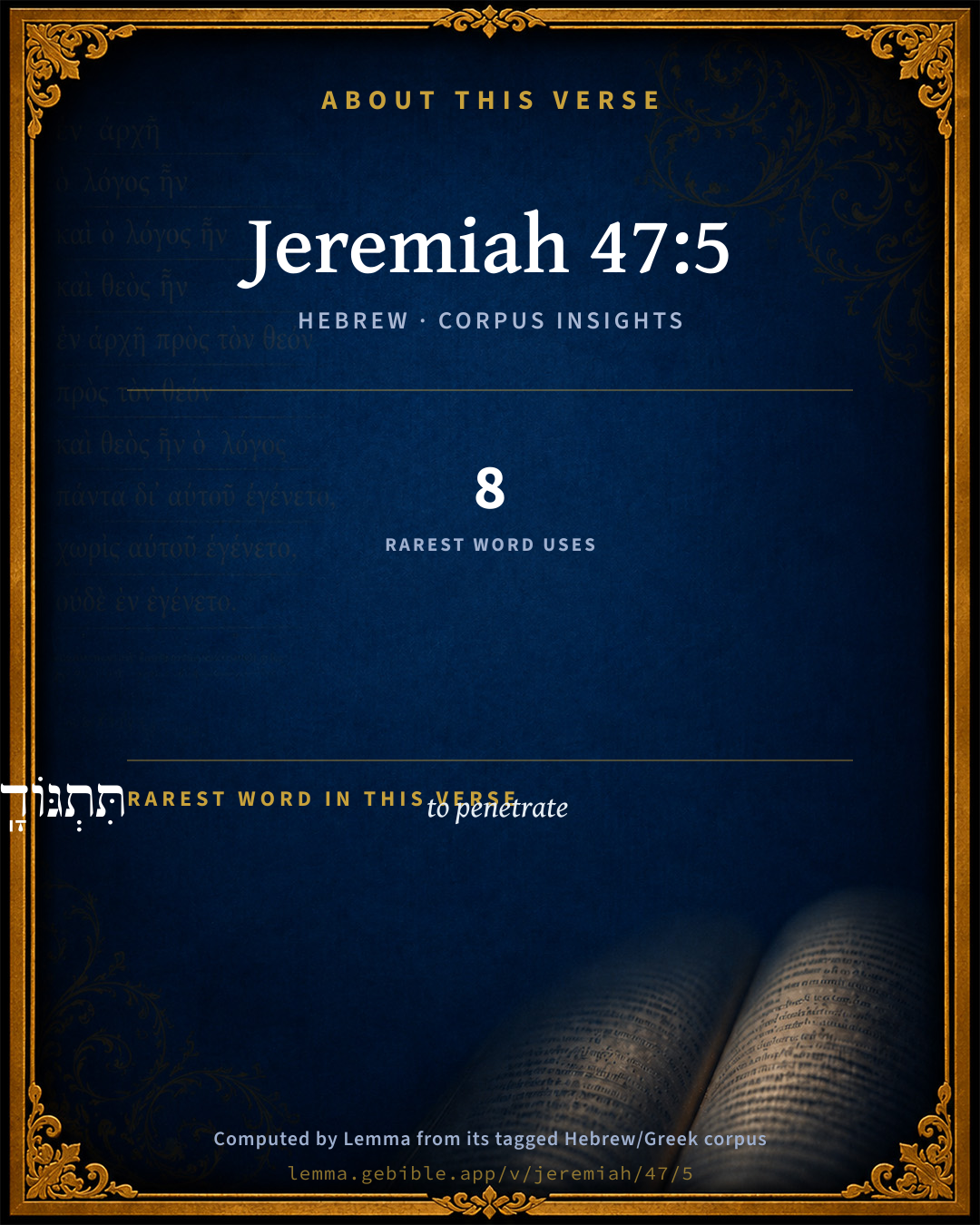
About this verse

These counts appear in no published source. They are computed here, from the morphology-tagged text and Lemma’s own curated glosses. What Lemma adds →

11
words
11
distinct lemmas
Prophets
section

Notable vocabulary

The rarest word here is תִּתְגּוֹדָֽדִי to penetrate H1413 — appearing just 8 times in the whole Hebrew Bible.

Shared distinctive vocabulary

תִּתְגּוֹדָֽדִי to penetrate H1413 occurs in 8 verses of the Hebrew Bible. Also found in:

Grammatical profile

  • 3 verbs
  • 5 nouns
  • 2 prepositions
  • 1 particle

Verb forms

  • בָּ֤אָה Qal · Perfect
  • נִדְמְתָ֥ה Niphal · Perfect
  • תִּתְגּוֹדָֽדִי Hithpolel · Imperfect

Cross-references

19

Topical passages linked to Jeremiah 47:5 in the Treasury of Scripture Knowledge — connected by theme and wording, ordered by reader-vote popularity; previews shown in the World English Bible.

  • Jeremiah 48:37 For every head is bald, and every beard clipped: on all the hands are cuttings, and on the loins sackcloth.
  • Jeremiah 25:20 and all the mixed people, and all the kings of the land of the Uz, and all the kings of the Philistines, and Ashkelon, and Gaza, and Ekron, and the remnant of Ashdod;
  • Jeremiah 41:5 that there came men from Shechem, from Shiloh, and from Samaria, even eighty men, having their beards shaved and their clothes torn, and having cut themselves, with meal-offerings and frankincense in their hand, to bring them to the house of Yahweh.
  • Micah 1:16 Shave your heads, And cut off your hair for the children of your delight. Enlarge your baldness like the vulture; For they have gone into captivity from you!
  • Leviticus 19:28 "'You shall not make any cuttings in your flesh for the dead, nor tattoo any marks on you. I am Yahweh.
  • Leviticus 21:5 "'They shall not shave their heads, neither shall they shave off the corners of their beards, nor make any cuttings in their flesh.
  • Deuteronomy 14:1 You are the children of Yahweh your God: you shall not cut yourselves, nor make any baldness between your eyes for the dead.
  • Judges 1:18 Also Judah took Gaza with the border of it, and Ashkelon with the border of it, and Ekron with the border of it.
  • 1 Kings 18:28 They cried aloud, and cut themselves after their manner with knives and lances, until the blood gushed out on them.
  • Isaiah 15:2 They are gone up to Bayith, and to Dibon, to the high places, to weep: Moab wails over Nebo, and over Medeba; on all their heads is baldness, every beard is cut off.
  • Jeremiah 16:1 The word of Yahweh came also to me, saying,
  • Jeremiah 47:1 The word of Yahweh that came to Jeremiah the prophet concerning the Philistines, before that Pharaoh struck Gaza.
  • Jeremiah 47:4 because of the day that comes to destroy all the Philistines, to cut off from Tyre and Sidon every helper who remains: for Yahweh will destroy the Philistines, the remnant of the isle of Caphtor.
  • Ezekiel 7:18 They shall also gird themselves with sackcloth, and horror shall cover them; and shame shall be on all faces, and baldness on all their heads.
  • Ezekiel 25:16 therefore thus says the Lord Yahweh, Behold, I will stretch out my hand on the Philistines, and I will cut off the Cherethites, and destroy the remnant of the sea coast.
  • Amos 1:6–8 Thus says Yahweh: "For three transgressions of Gaza, yes, for four, I will not turn away its punishment; Because they carried away captive the whole community, To deliver them up to Edom;
  • Zephaniah 2:4–7 For Gaza will be forsaken, and Ashkelon a desolation. They will drive out Ashdod at noonday, and Ekron will be rooted up.
  • Zechariah 9:5–7 Ashkelon will see it, and fear; Gaza also, and will writhe in agony; As will Ekron, for her expectation will be disappointed; And the king will perish from Gaza, And Ashkelon will not be inhabited.
  • Mark 5:5 Always, night and day, in the tombs and in the mountains, he was crying out, and cutting himself with stones.

Cross-references courtesy of OpenBible.info (CC BY 4.0).

Hebrew and Greek witnesses Masoretic Hebrew ↔ Greek Septuagint

The same verse in the two great witnesses to the Old Testament, shown verse-for-verse.

These are two independent witnesses, not word-aligned to each other, and the Septuagint is shown in lemma (dictionary) form.

Hebrew Jeremiah 47:5 Masoretic · Westminster Leningrad Codex

בָּ֤אָה קָרְחָה֙ אֶל עַזָּ֔ה נִדְמְתָ֥ה אַשְׁקְל֖וֹן שְׁאֵרִ֣ית עִמְקָ֑ם עַד מָתַ֖י תִּתְגּוֹדָֽדִי

Baldness is come on Gaza; Ashkelon is brought to nothing, the remnant of their valley: how long will you cut yourself?

World English Bible · Public Domain

Greek LXX Structure differs

In the Septuagint, Jeremiah is about an eighth shorter than the Hebrew and arranges its material differently — the Oracles Against the Nations (Hebrew chapters 46–51) appear in the middle of the Greek book, after 25:13. Because the chapter and verse boundaries do not line up, a verse-for-verse comparison with the Hebrew is not shown.

A verse-for-verse comparison isn’t shown here because the chapters and verses don’t line up. Switch to the LXX edition with the MT / LXX toggle above to read the Greek directly.

On this verse, Joseph Benson's Commentary discusses the Septuagint’s reading. Read the note in Commentary ↓

Hebrew: Westminster Leningrad Codex (CC BY 4.0). Greek: Septuagint (public domain); English from a public-domain English Septuagint. How the Septuagint differs from the Hebrew →

Targum (Aramaic paraphrase)

1

The Targum is the ancient Jewish Aramaic paraphrase of the Hebrew Scriptures — an interpretive translation, not the Hebrew text itself. Onkelos (literal) and Pseudo-Jonathan (expansive) render the Torah, and Jonathan the Prophets. Coverage is partial: where no permissively-licensed English translation exists for a verse, only the Aramaic is shown. This is verse-level text, not a word-by-word alignment to the Hebrew.

  1. Targum Jonathan Prophets (Joshua–Malachi)
    מְטַת פּוּרְעָנוּתָא לְיַתְבֵי עַזָה אִתְּבָר אַשְׁקְלָנָאֵי שְׁאַר תּוּקְפְהוֹן עַד אֵימָתַי תִתְהַמָמוּן:

    (no public-domain English translation for this verse)

    Targum Jonathan — Aramaic: “Mikraot Gedolot” (public domain). English: “Sefaria Community Translation” (CC0 1.0 (public-domain dedication)); “London "Chaldee Paraphrase," 1871” (public domain). Text via Sefaria.

Commentary

Notes on Jeremiah 47:5 from classic Christian and Jewish commentators (each source and its license shown beneath its notes). The classic Christian expositions comment on the surrounding passage and are grouped to its opening verse, so a note may address several verses; the Jewish commentaries on the Tanakh (Rashi and others) are per-verse, so they appear only where the commentator wrote on this verse.

Lemma curates 59 commentaries, every one of them public domain or Creative Commons licensed, each selected and text-cleaned for this edition rather than reprinted as found. About our sources →

Trapp's Complete Commentary

John Trapp

Jer 47:5 Baldness is come upon Gaza; Ashkelon is cut off [with] the remnant of their valley: how long wilt thou cut thyself?

Ver. 5. Baldness is come upon Gaza,] i.e., Extreme grief, which might have been prevented, had she profited by her former calamity. {Jer 47:1} But till God come in with sanctifying grace, afflictions, those hammers of his, do but beat upon cold iron. {Lev 19:27-28 Jer 16:6}

Ashkelon is cut off.] Or, Is silenced; which was wont to be full of singing, dancing, and loud luring. Here was born, they say, Herod the infanticide, surnamed therefore Ascalonita. {a}

With the remnant of their valley.] Palestine lay most of it low, and was yet to be laid lower.

{a} Adrichom.

John Trapp, A Commentary or Exposition upon All the Books of the Old and New Testament (1647–1656) — public domain. Text from a community e-Sword module.

The Biblical Illustrator

Joseph S. Exell

Jer_47:5

How long wilt thou cut thyself?

The tender inquiry of a friend

Travellers in the East tell us that among the most melancholy scenes they witness is the following:--Men inflict upon themselves very grievous, voluntary wounds, and then exhibit themselves in public. They even disfigure themselves with gashes m me presence of excited throngs. I am speaking of what has occurred even within, the last few years among the Moslems. When some great prophet or emir is coming that way, a certain number of fanatical Mahometans take swords, spears, and other sharp instruments, and gash themselves terribly therewith, cutting their breasts, their faces, their heads, and all parts of their bodies. Frequently they have taken care to dress themselves in white sheets, in order that, as the blood flows copiously from their bodies, it may be the more clearly seen, that they may become the more ghastly spectacles of misery, or the more fully display the religious excitement under which they labour. As everything in the East remains for ever the same, thin Moslem superstition carries us back to the olden times whereof we read in the Old Testament, when the priests of Baal, having cried in vain to their idol, cut themselves with lances and with knives. Our translators were probably afraid to write the harsher words, and so they translated the passage knives and lances, but they might have written swords and spears sharp instruments of a desperate character. Thus they displayed their inward zeal, and thus, perhaps, they hoped to move the pity of their god. The Lord expressly forbade His people, the Jews, to perpetrate such folly. They were not even to shave the corners of their beards, or to hack their hair, as the Orientals do in the hour of their grief; and then they were further prohibited from injuring their bodies by the command (Lev_19:28). Men in Eastern lands, not only in connection with fanaticism, but in reference to domestic affairs, will cut themselves to express their grief and anguish, or to make other people believe that they are feeling such grief and anguish. We may congratulate ourselves that we are free from at least one foolish custom. The prophet here speaks to the Philistines who were about to endure the tremendous judgments of God, and, indeed, to be crushed Out as a nation by the Egyptians and the Chaldeans; and he says to Philistia How long wilt thou cut thyself? How long would they continue to bring upon themselves such terrible judgments?

I. I shall ask this question very despairingly--How long wilt thou cut thyself?--for many are cutting themselves very terribly, and will have to feel the wounds thereof for a long time, neither can we induce them to cease therefrom.

1. I allude, first, to some professors of religion who have been Church members for ten, twenty, or more years, and yet have practically done nothing at all for the Saviour. If they were really to awaken to a sense of their neglect, I do not know how long- they would be in anguish, or how deep would be their distress; for if Titus mourned that he had lost a day when he had done no good action for twenty-four hours, and he but a heathen, what would happen to a Christian if he were really to see his responsibility before God, and to feel that he has not only lost a day but a year--perhaps many years? Have not some of you well-nigh lost a whole lifetime?

2. The same may be applied, and applied very solemnly, too, to those who backslide--who, in addition to being- useless, are injurious, because their example tends to hinder others from coming to Christ. Oh, if any of you that name the name of Jesus, and have been happy in His service, and have enjoyed high days and holy days in His presence, turn aside, I shall use this lamentation over you! You will do yourselves terrible injury, and I shall shudder as I see the edged tools of sin in your reckless hands. Every sin is a gash in the soul. The Lord will bring you back and save you, as I believe; but oh, how long will you cut yourselves?

3. There is one thing which comes after these, and comes in connection with them. If you and I should know that souls have been lost--lost as far as we are concerned--through our neglect, how long- shall we cut ourselves on that account? Fathers, if you have never sought to bring your children to repentance, how will you excuse yourselves? If you have never prayed with them, or wept with them--if you have never even instructed them in the things of God, what flattering unction will you lay to your guilty consciences? What will you say, mother, if your daughter passes into eternity unforgiven, and you have never tried to lead her to Jesus?

4. One other most solemn use may be made of this question God grant that it may never be so, but if any one of you should die in his sins, how long will you regret it, think you? Oh, thou who hast lost eternal life, how long wilt thou cut thyself? If thou shouldst miss Christ, and miss mercy, and miss heaven, and miss eternal glory, if there were naught else, how long wilt thou bemoan thyself? With what depth of anguish wilt thou smart to have lost all this--to have, in fact, lost all which makes up life and joy!

II. i shall ask this question hopefully, trusting that in many their sorrow is nearing- its end.

1. This text may be very profitably and prudently applied to those who have been bereaved, and who, being bereaved, sorrow, and sorrow to excess. How long wilt thou cut thyself? Is not thy child in Jesus bosom? Has not thy friend gone among the angels, to join the sweet singers of God? Is it not a gain to the departed, though it be a loss to thee, that they are translated to the place of everlasting bliss?

2. Turning to quite another character, I would use the same expression for another purpose. There are some persons with whom God is dealing in great love, and yet they are very rebellious. How long wilt thou cut thyself? Already they have met with great disasters and misfortunes: they will meet with many more when the dogs are out hunting, they run in packs. The plagues of Egypt are ten at least, and every one who plays the Pharaoh may expect the full number.

3. I might use this expression even to the Jewish nation itself. Ah, God, through what seas of trouble have they had to swim since the day when they said, His blood be on us, and on our children!

4. But, now, all this has rather kept me from my main design, which is to speak to those dear friends of ours who are afflicting their souls with needless fears. No good can possibly come by a continuance in their unhappy moods: they are cutting themselves quite needlessly. They might at once have peace, and rest, and joy if they were willing to accept the Lord s gracious way of salvation. Despairing and desponding are not commanded in the Gospel, but they are forbidden by it. Do not cultivate these gross follies, these deadly sins. Do not multiply these poisonous weeds--this hemlock and this darnel--as if they were fair flowers of paradise. (C. H. Spurgeon.)

The Biblical Illustrator, edited by Joseph S. Exell (c. 1880s–1900s) — public domain. Text from a community e-Sword module.

Joseph Benson's Commentary

Jer 47:5. Baldness is come upon Gaza; how long wilt thou cut thyself, &c. — Under great calamities, and for the loss of any near kindred, it was usual for men to express their grief by shaving their heads, and cutting their flesh. Instead of Ashkelon is cut off, &c., Blaney reads, Ashkelon is put to silence, observing, that “silence likewise is expressive of great affliction. Thus Job’s friends are said to have sat with him seven days and seven nights upon the ground without addressing a word to him, because they saw his grief was very great, Job 2:13. And so the Hebrew word here used, נדמה, is to be understood, (Isa 15:1,) of Moab’s being made speechless with grief and astonishment the night that its cities were spoiled: see chap. Jer 48:2.” With the remnant of their valley — Instead of this interpretation, the LXX. read οι καταλοιποι Ενακιμ, the remnant of the Anakims. And this reading may be thought to derive some countenance from what is said Jos 11:22. But we shall see reason to prefer the present reading of the text, if we consider the situation of Gaza and Ashkelon, about twelve miles distant from each other, near the sea, in a valley, of whose beauty and fertility an accurate traveller has given the following description: “We passed this day through the most pregnant and pleasant valley that ever eye beheld. On the right hand a ridge of high mountains; (whereon stands Hebron;) on the left hand the Mediterranean sea; bordered with continued hills, beset with variety of fruits. The champaign between, about twenty miles over, full of flowery hills, ascending leisurely, and not much surmounting their ranker valleys; with groves of olives, and other fruits, dispersedly adorned.” — Sandys’s Travels, book 3. p. 150. The author adds, that in his time, “this wealthy bottom (as are all the rest) was, for the most part, uninhabited, but only for a few small and contemptible villages” — a state of desolation, owing to the oppressions of a barbarous and ill-advised government. But we may easily conceive the populousness that must have prevailed there in its better days, especially if we consider the power which the Philistines once possessed, and the armies they brought into the field; although their country was scarcely forty English miles in length, and much longer than it was broad. — Blaney.

Joseph Benson's Commentary on the Old and New Testaments (1811–1818) — public domain. Text from a community e-Sword module.

Keil & Delitzsch

C. F. Keil & F. Delitzsch

The prophet sees, in the spirit, the threatened desolation as already come upon Philistia, and portrays it in its effects upon the people and the country. "Baldness (a sign of the deepest and most painful sorrow) has come upon Gaza;" cf. Mic 1:16. נדמתה is rendered by the Vulgate conticuit. After this Graf and Ngelsbach take the meaning of being "speechless through pain and sorrow;" cf. Lam 2:10. Others translate "to be destroyed." Both renderings are lexically permissible, for דּמה and דּמם have both meanings. In support of the first, the parallelism of the members has been adduced; but this is not decisive, for figurative and literal representations are often interchanged. On the whole, it is impossible to reach any definite conclusion; for both renderings give suitable ideas, and these not fundamentally different in reality the one from the other. שׁארית עמקם, "the rest of their valley" (the suffix referring to Gaza and Ashkelon), is the low country round about Gaza and Ashkelon, which are specially mentioned from their being the two chief fortresses of Philistia. עמק is suitably applied to the low-lying belt of the country, elsewhere called שׁפלה, "the low country," as distinguished from the hill-country; for עמק does not always denote a deep valley, but is also sometimes used, as in Jos 17:16, etc., of the plain of Jezreel, and of other plains which are far from being deeply-sunk valleys. Thus there is no valid reason for following the arbitrary translation of the lxx, καὶ τὰ κατάλοιπα ̓Ενακείμ, and changing עמקם into ענקים, as Hitzig and Graf do; more especially is it utterly improbable that in the Chaldean period Anakim were still to be found in Philistia. The mention of them, moreover, is out of place here; and still less can we follow Graf in his belief that the inhabitants of Gath are the "rest of the Anakim." In the last clause of Jer 47:5, Philistia is set forth as a woman, who tears her body (with her nails) in despair, makes incisions on her body; cf. Jer 16:6; Jer 41:5. The question, "How long dost thou tear thyself?" forms a transition to the plaintive request, "Gather thyself," i.e., draw thyself back into thy scabbard. But the seer replies, "How can it rest? for Jahveh hath given it a commission against Ashkelon and the Philistine sea-coast." For תּשׁקטי, in Jer 47:7, we must read the 3rd pers. fem. תּשׁקט, as the following להּ shows. The form probably got into the text from an oversight, through looking at תּשׁקטי in Jer 47:6. חוף, "the sea-coast," a designation of Philistia, as in Eze 25:16.

The prophecy concludes without a glance at the Messianic future. The threatened destruction of the Philistines has actually begun with the conquest of Philistia by Nebuchadnezzar, but has not yet culminated in the extermination of the people. The extermination and complete extirpation are thus not merely repeated by Ezek; Eze 25:15., but after the exile the threats are once more repeated against the Philistines by Zechariah (Zac 9:5): they only reached their complete fulfilment when, as Zechariah announces, in the addition made to Isa 14:30., their idolatry also was removed from them, and their incorporation into the Church of God was accomplished through judgment. Cf. the remarks on Zep 2:10.

Keil & Delitzsch — Biblical Commentary on the Old Testament (1861–1891) — public domain (CC PDM 1.0). Text via the HelloAO Bible API. (Old Testament only.)

Tyndale Open Study Notes

Tyndale Open Resources

47:5 Gaza was a major Philistine city. • head shaved bald: The city’s people expressed their grief by following this ritual (cp. Isa 15:2; Mic 1:16). • Ashkelon, another Philistine city a few miles north on the coast, would be emptied.

Tyndale Open Study Notes — © Tyndale Open Resources, licensed CC BY-SA 4.0. Text via the HelloAO Bible API.

Geneva Bible (1599)

Geneva Bible translators

They that pilled off their hair for sorrow and heaviness.

As the heathen used in their mourning, which the Lord forbade his people to do, Deut. 14:1.

Geneva Bible (1599) marginal notes — public domain. Text via Bolls.life.

Jamieson, Fausset & Brown

Robert Jamieson, A. R. Fausset & David Brown

Baldness . . . cut thyself--Palestine is represented as a female who has torn off her hair and cut her flesh, the heathenish (Lev 19:28) token of mourning (Jer 48:37).

their valley--the long strip of low plain occupied by the Philistines along the Mediterranean, west of the mountains of Judea. The Septuagint reads Anakim, the remains of whom were settled in those regions (Num 13:28). Joshua dislodged them so that none were left but in Gaza, Gath, and Ashdod (Jos 11:21-22). But the parallel (Jer 47:7), "Ashkelon . . . the sea-shore," established English Version here, "Ashkelon . . . their valley."

Jamieson, Fausset & Brown — Commentary Critical and Explanatory on the Whole Bible (1871) — public domain (CC PDM 1.0). Text via the HelloAO Bible API.

Adam Clarke's Commentary

Verse 5. Baldness is come upon Gaza] They have cut off their hair in token of deep sorrow and distress.

Ashkelon is cut off] Or put to silence; another mark of the deepest sorrow. Ashkelon was one of the five seignories of the Philistines, Gaza was another.

The remnant of their valley] Or plain; for the whole land of the Philistines was a vast plain, which extended along the coast of the Mediterranean Sea from Phoenicia to the frontiers of Egypt. The whole of this plain, the territory of the Philistines, shall be desolated.

Adam Clarke's Commentary on the Bible (1810–1826) — public domain. Text from a community e-Sword/MySword module.

John Calvin's Commentaries

The Prophet returns again to what is figurative, that he might more fully illustrate his prophecy, and more powerfully move the Jews. Now by baldness he points out a sign of mourning; for they were wont even to tear their faces with their nails, and to pluck off their hair. He then says that baldness, or the loss of hair, had come upon Gaza; because the inhabitants of the valley and of the whole land, according to what was usually done in despair, would pluck off their own hair. It is added, Destroyed is Ashkelon This city, we know, had a great name in the land of the Philistines, and was nigh Gaza, as it appears from many parts of Scripture. he mentions the remnants of their valley, or depth, for the word is עמק, omek: and though it means a valley, yet the Prophet, no doubt, alludes to the situation of that part, because they were hid, as it were, in a safe place, and they thought themselves secure as those who are hid in caverns, to which an access is not easy; and then Tyre and Sidon, as well as Gaza, were cities on the sea side. As then they dwelt in these deep and hidden places, they thought, themselves far away from every danger and trouble. The Prophet derides this confidence, and says that the remnants of their valley should perish; as though he had said, that there would be no place so deep and hidden where God’s vengeance would not penetrate.

He at length addresses the whole country, How long wilt thou tear thyself? By tearing he means, no doubt, mourning or lamentation; for they would tear their faces, as it has been said, with their nails, as in the greatest grief. The meaning is, that there would be no end to their calamities, because the Palestines would mourn perpetually: for otherwise they who are even most grievously afflicted do not perpetually mourn, for time alleviates grief and sorrow. The Prophet then shews that so dreadful would be God’s vengeance, that evils would be heaped on evils, and thus renewed daily to the Palestines would be the cause of mourning. He afterwards adds, —

John Calvin's Commentaries (1540-1563) — public domain. Text from the Calvin Translation Society English edition (1840s-50s) via the Christian Classics Ethereal Library (ccel.org). Calvin's coverage is partial (roughly two-thirds of the Bible); uncommented books and verses are honest gaps, never fabricated. The 19th-century editor's footnotes and remarks are omitted so the notes are faithfully Calvin's own voice.

Ellicott's Commentary for English Readers

(5) Baldness is come upon Gaza.—The baldness is the outward sign of extremest mourning (Jer_48:37; Isa_15:2-3), perhaps, also, of extremest desolation (Isa_7:20).

Ashkelon is cut off . . .—Better, perhaps, Ashkelon is speechless. The LXX. apparently followed a different text, and gives “the remnant of the Anakim” instead of “the remnant of their valley.” Hitzig adopts this rendering, and connects it with the known fact that a remnant of the old gigantic non-Semitic race had taken refuge among the Philistines (1Sa_17:4; 2Sa_21:22; 1Ch_20:5-8) after they had been driven from Hebron (Jos_14:12-15; Jos_15:13-14). Others, without adopting the LXX. reading, interpret the word rendered “their valley” as meaning, as in Isa_33:19, those that speak an unintelligible language, barbarians (Amakim), and suppose this form to have passed in the LXX. into the more familiar form of Anakim. The English version, however, is accepted by many critics, and may refer to Ashkelon and Gaza as the “remnant,” the last resource of the valley (Emek) or low-country of the Philistines, more commonly known as the Shephelah.

How long wilt thou cut thyself?—The words point to a ritual of supplication, like that of the priests of Baal in 1Ki_18:28, as prevailing among the Philistines.

A Bible Commentary for English Readers, edited by Charles John Ellicott (1878–1897) — public domain. Text from a community e-Sword module.

The Cambridge Bible for Schools and Colleges

gen. ed. J. J. S. Perowne

5. Baldness] in token of mourning. See on Jer_16:6.

Gaza] important from its situation at the junction of the roads for caravans from Egypt and Arabia.

Ashkelon] mentioned again in Jer_47:7. Co., however, proposes to substitute here Ashdod, while Rothstein thinks that the latter has fallen out through the similarity of the two words. Peake suggests that, if so, it should not precede but follow Ashkelon on account of its connexion (Jos_11:22) with the Anakim. See next note.

the remnant of their valley] better, as LXX, the remainder of the Anakim (the old race of giants, see Num_13:33; Deu_2:10, and elsewhere). This avoids the unsuitable description of the country referred to as a “valley.” But with a change of one consonant Co. conjectures (for “their valley”) Ekron, and cps. Amo_1:7-8.

cut thyself] in mourning. See on Jer_16:6; cp. Deu_14:1. The question is addressed to the survivors.

The Cambridge Bible for Schools and Colleges (gen. ed. J. J. S. Perowne; Cambridge University Press, 1878–1918) — public domain. Text from a community e-Sword module.

John Gill's Exposition

Baldness is come upon Gaza,.... The Targum is,

"vengeance is come to the inhabitants of Gaza.''

It is become like a man whose hair is fallen from his head, or is clean shaved off; its houses were demolished; its inhabitants slain, and their wealth plundered; a pillaged and depopulated place. Some understand this of shaving or tearing off the hair for grief, and mourning because of their calamities; which agrees with the latter clause of the verse:

Ashkelon is cut off with the remnant of their valley; this was one of the live cities of the Philistines; it lay north of Gaza. Herodotus (x) calls Ashkelon a city of Syria, in which was the temple of Urania Venus, destroyed by the Scythians; said to be built by Lydus Ascalus, and called so after his name (y). Of this city was Herod the king, and therefore called an Ashkelonite; it was now destroyed by Nebuchadnezzar, but afterwards rebuilt and inhabited; and with it were destroyed the remainder of the cities, towns, and villages, in the valley, adjoining to that and Gaza; or Ashkelon and Gaza, now destroyed, were all that remained of the cities of the valley, and shared the same fate with them. The Targum is,

"the remnant of their strength;''

so Kimchi, who interprets it of the multitude of their wealth and power;

how long wilt thou cut thyself? their faces, arms, and other parts of their body, mourning and lamenting their sad condition; the words of the prophet signifying hereby the dreadfulness of it, and its long continuance.

(x) Clio, sive l. 1. c. 105. (y) Vid. Bochart. Phaleg l. 2. c. 12. p. 88.

John Gill's Exposition of the Whole Bible (1746–1763) — public domain (CC PDM 1.0). Text via the HelloAO Bible API.

Albert Barnes' Notes on the Bible

Baldness - Extreme mourning (see Jer 16:6).

Is cut off - Others render, is speechless through grief.

With the remnant of their valley - Others, O remnant of their valley, how long wilt thou cut thyself? Their valley is that of Gaza and Ashkelon, the low-lying plain, usually called the Shefelah, which formed the territory of the Philistines. The reading of the Septuagint is remarkable: “the remnant of the Anakim,” which probably would mean Gath, the home of giants 1Sa 17:4.

Jer 47:6. Or, Alas, Sword of Yahweh, how long wilt thou not rest? For the answer, see Jer 47:7.

Albert Barnes' Notes on the Bible (1834–1885) — public domain. Text from a community e-Sword/MySword module.

Haydock's Catholic Bible Commentary

Baldness, the sign of mourning, (Calmet) or captivity. (Haydock) --- Peace. Hebrew, "shall be destroyed." Septuagint, "cast away." She has afforded no assistance to Gaza. (Haydock) --- Valley, along the Mediterranean. (Calmet) --- Literally, "And ye remnants of their valley, how?" &c. --- Cut, in despair or grief, chap. xli. 5. Septuagint, "Remnants of the Enakeim, (giants) how long wilt thou make incisions?" (Haydock) --- The race of Enack dwelt in those parts; though ankim seems to have been mistaken for ankom. (Calmet)

George Leo Haydock (1774–1849), Haydock's Catholic Family Bible and Commentary, 1859 edition — public domain. Excludes Psalms (Douay-Rheims chapter numbering differs from Protestant) and Deuterocanonical books (Catholic canon only).

Matthew Poole's English Annotations

Both

Gaza and

Ashkelon were two principal cities belonging to the Philistines taken by Judah, Jdg 1:18; we read of them 1Sa 6:17; both Amos, Zephaniah, and Zechariah prophesied their ruin, Amo 1:8; Zep 2:4,7; Zec 9:5, as well as this prophet. By

the remnant of their valley, most understand those who lived in the valleys near about Ashkelon. Concerning the last clause in this verse there is some difference, whether the words should be joined with the next verse, and read,

how long wilt thou cut thyself, O thou sword of the Lord? or as they lie in our Bibles; and then the sense is, Why will you in so desperate a case afflict yourselves, when all your mourning will do you no good.

Matthew Poole's English Annotations on the Holy Bible (1683–1685) — public domain. Text from a community e-Sword/MySword module.

Whedon's Commentary on the Bible

Daniel D. Whedon

5. Baldness — A sign of the deepest grief and calamity.

How long wilt thou cut thyself — Philistia is represented as a woman tearing her own body in grief and despair.

Daniel D. Whedon (gen. ed.), Commentary on the Old and New Testaments (1874–1909) — public domain. Text from a community e-Sword module.

The Pulpit Commentary

Vers. 5-7. The prophet changes his style. In ecstasy or imagination, he sees the calamity which he has foretold already come to pass. Philistia is not, indeed, altogether annihilated; it was not the will of God to make a full end as yet with any of the nations round about. But it is reduced to extremities, and fears the worst.

Baldness. A sign of the deepest sorrow. (comp. on Jer_16:6) Ashkelon is cut off. Ruins of Ashkelon are still visible. "It is evident that the walls of the old city were built on a semicircular range of rocky hills, which ended in perpendicular cliffs of various heights on the seashore. Wherever nature failed, the weak places were strengthened by the help of earthworks or masonry. On the southern and south-eastern sides, the sand has penetrated the city by means of breaches in the walls, and every day it covers the old fortifications more and more, both within and without. The ancient towns alone rise distinctly, like rocky islands, out of the sea of sand. The ruins on the north are bordered by plantations of trees. They lie in such wild confusion that one might suppose that they were thrown down by an earthquake. There is no secure landing place; the strip of sand at the foot of the western wall is covered at high tide, when the waves beat against the cliffs. Still J.G. Kinnear, in 1841, found some remains of a mole, and this discovery is confirmed by Schick the able German architect now at Jerusalem." Thus writes Dr. Guthe, in the Journal of the German Palestine Exploration Society (1880), remarking further that, in a few generations, the ruins of Ashkelon will be buried under the drifting sand. It is partly the sand hills, partly the singular fragmentariness of the ruins of Ashkelon, which gives such an air of desolation to the scene, though, where the deluge of sand has not invaded, the gardens and orchards are luxuriant. Dr. W.M. Thomson, in the enlarged edition of "The Land and the Book" (London, 1881, p. 173), observes that "the walls and towers must have been blown to pieces by powder, for not even earthquakes could throw these gigantic masses of masonry into such extraordinary attitudes. No site in this country has so deeply impressed my mind with sadness." With the remnant of their valley. "With" should rather be "even." "Their valley" means primarily the valley of Ashkelon; but this was not different from the valley or low-lying plain (more commonly called the Shefelah) of the other Philistian towns; and the whole phrase is an enigmatical, poetic way of saying "the still surviving population of Philistia." But this addition certainly weakens the passage, and leaves the second half of the verse abnormally short. It is far better to violate the Massoretic tradition, and attach "the remnant," etc., to the second verse half. But "their valley" is still a rather feeble expression; a proper name is what we look for to make this clause correspond to those which have gone before. The Septuagint reads differently, for it renders kai ta katam . We know Jos_11:22 that some of the Anakim were left "in Gaza, in Gath, and in Ashdod;" and in David"s time the Philistines could still point to giants in their midst, (1Sa_17:4 2Sa_21:16-22) who, like the Anakim, (Deu_2:20) are called in the Hebrew, Rephaim. It may be objected, indeed (as it is by Keil), that the Anakim would not be traceable so late as Jeremiah"s time; but Jeremiah was presumably a learned man, and was as likely to call the Philistines Anakim, as an English poet to call his countrymen Britons. No one who has given special attention to the phenomena of the Hebrew text elsewhere can doubt that "their valley" is a corruption; the choice lies between the "Anakim" of the Septuagint and the plausible correction of a Jewish scholar (A. Krochmal), "Ekron." How long wilt thou cut thyself? Shall thy lamentation never cease? (comp. on Jer_16:6) The question is in appearance addressed to "the remnant" (personified as a woman), but in reality the judicial Providence who sends the calamity.

HOMILIES BY A.F. MUIR Ver. 5. The sorrow of the ungodly.

The allusion is to a fashion common to the Philistines and other idolatrous nations in appealing to their gods. We perceive a similar tendency in the natural mind in its first moral concerns and spiritual troubles. It is the sorrow of the world to which, as to the Philippian jailor, the injunction has to be addressed, "Do thyself no harm." Notice

I THE PRINCIPLE IN HUMAN NATURE. It is that self-inflicted suffering or deprivation will be of spiritual advantage and secure Divine favour. This is the secret of penance, pilgrimages, monastic life, and asceticism in general. The saying, often uttered of losses or pains over which one has no control, "Ah, well! it will be set down to our credit!" witnesses to the same idea. Remorse is largely explained on the same principle.

II THAT IT IS FOUNDED ON A MISCONCEPTION OF THE DIVINE NATURE. Baal was a cruel god a huge abortion and monstrosity. Not less cruel are the ideas of God"s character entertained by many reputedly religious persons.

1. The gospel declares that "God is love." Such self-inflictions are but folly, and have no religious value in view of this great truth. "Sacrifice and offering thou wouldest not... Lo, I come... I delight to do thy will, O my; (Psa_40:6-8 Heb_10:5-7) "I will have mercy, and not sacrifice"; (Mat_9:13; cf. Hos_6:6) and "Wherewithal shall I come before the Lord,... he hath showed thee, O man, what is good; and what doth the Lord require of thee, but to do justly, and to love mercy, and to walk humbly with thy God?, (Mic_6:6-8) are the expressions of the spirit of true religion, which alone harmonizes with the doctrine of a loving God.

2. God himself in the person of his Son has "borne our griefs and carried our sorrows. The worship which is alone acceptable to the Father must begin with the recognition of this. There is a "godly sorrow," but its advantage consists in its moral influence on ourselves, making us hate sin and follow after righteousness, etc.

3. Everything which ignores the merit of Christ"s sufferings and God"s revelation of himself must needs be hateful to him, and bring upon its authors his wrath and curse. M.

The Pulpit Commentary (1880–1919), ed. H.D.M. Spence-Jones & Joseph S. Exell — public domain. Text from a community e-Sword module.

John Wesley's Explanatory Notes

The remnant - Those who lived in the valleys near Ashkelon. But thyself - Why will you afflict yourselves, when all your mourning will do you no good.

John Wesley, Explanatory Notes Upon the Whole Bible (1754–1765) — public domain. Text via the GEBible commentary corpus.

unfoldingWord translationNotes

Door43 World Missions Community

Baldness will come upon Gaza

The abstract noun "baldness" can be stated as "bald." "Gaza" represents the people. AT: "The people of Gaza will shave their heads bald" (See: Abstract Nouns and Metonymy)

Baldness

The shaving of the entire head or portions of the head is a sign of great sorrow practiced by idol worshipers in nations such as Philistia. (See: Symbolic Action)

the people ... will be made silent

Possible meanings are 1) the people will be silent because they are mourning or 2) this is a euphemism that means the enemy soldiers will kill them. (See: Euphemism)

How long will you cut yourself in mourning?

Yahweh uses a question to emphasize that the people of Ashkelon will never stop mourning. Yahweh speaks to the people as if he were speaking to one woman, who is a metaphor for the city itself. This question can be translated as a statement. AT: "You will forever cut yourselves in mourning." (See: Rhetorical Question and Metaphor and Apostrophe)

cut yourself in mourning

The cutting of one's skin was another practice done by the idol worshipers when they mourn the dead. (See: Symbolic Action)

Woe ... the sea?"

The Philistines seem to be speaking here. AT: "The Philistines say, 'Woe ... the sea.'" (See: Assumed Knowledge and Implicit Information)

sword of Yahweh! How long will it be until you become silent? Go back to your scabbard! Stop and be silent.

The Philistines speak to the sword of Yahweh as if it were a person who could hear them. AT: "Yahweh, you who are holding your sword! When will you stop striking us with your sword? Stop your sword and put it back in its scabbard!" (See: Personification)

sword of Yahweh

Yahweh punishing the Philistines by sending the army from the north is spoken of as if Yahweh were striking them with a sword. (See: Metaphor)

How long will it be until you become silent?

The people of the Philistines use this question to express their deep frustration about the devastation caused by their enemies. This may be translated as a statement. AT: "Please be silent!" or "Please, Yahweh, stop striking us with your sword!" (See: Rhetorical Question)

you become silent

A sword makes a noise as it slashes back and forth. Asking the sword to be silent means to ask it to stop slashing and killing. AT: "you rest" or "you stop slashing" (See: Idiom)

scabbard

This is the case used to protect the blade of a sword.

How can it rest ... along the sea

Here Jeremiah is speaking. He continues speaking of the sword of Yahweh as if it were a person who could rest. Yahweh punishing the Philistines by sending the army of the north is spoken of as if Yahweh were striking the people with a sword. (See: Personification and Metaphor)

How can it rest when Yahweh has commanded it

Jeremiah uses a question to mean that the sword cannot stop since Yahweh has commanded it to continue killing. This question can be translated as a statement. AT: "It cannot stop, for Yahweh has commanded it" (See: Rhetorical Question)

translationWords

Gaza

Ashkelon

mourn

woe

sword

Yahweh

command

unfoldingWord translationNotes — © Distant Shores Media and the Door43 World Missions Community, licensed CC BY-SA 4.0. Source: git.door43.org/Door43/en_tn.

Rashi

Rabbi Shlomo Yitzchaki (Rashi)

has become a waste Heb. נדמתה.

will you tear your flesh Will you tear your flesh in mourning and in weeping?

Rashi on the Tanakh — English translations: “The Judaica Press complete Tanach with Rashi, translated by A. J. Rosenberg” (CC BY 4.0); “Pentateuch with Rashi's commentary by M. Rosenbaum and A.M. Silbermann, 1929-1934” (public domain); “The Metsudah Tanach series, Lakewood, N.J” (CC BY 4.0); and “The Book of Joshua, Metsudah Publications, 1997” (CC BY 4.0). Text via Sefaria.

Lesson kit

Teaching starters — assembled from the data on this page, not authored interpretation. Every prompt links to the verse data it draws on. Edit before teaching.

Jeremiah, in the Prophets, opens this verse with 11 words (11 distinct Hebrew lemmas). Its most distinctive word is gâdad (“to penetrate”). A historical commentator’s framing appears above. Read the whole chapter for the surrounding context.

Discussion questions

  1. The word gâdad carries the sense “to penetrate.” How does it shape the verse?
  2. How does Deuteronomy 14:1, which shares the word «to penetrate», read alongside this verse?
  3. These translations render this verse differently. What is at stake in choosing one wording over another?
  4. «בָּ֤אָה» is a Qal Perfect verb. How does that grammatical form shape the action described?
  5. Compare how Trapp's Complete Commentary and The Biblical Illustrator read this verse. Where do they agree or differ?

Things to notice

Reading settings

Reading text

Shown beneath each verse's original-language words.

Old Testament
Old Testament edition

Read the OT as the Masoretic Hebrew (MT) or the Greek Septuagint (LXX).

English shown for the Greek Septuagint (in the Hebrew ↔ Greek comparison).

Comparing translations? Open the Compare panel on any verse page to stack up to four side by side.