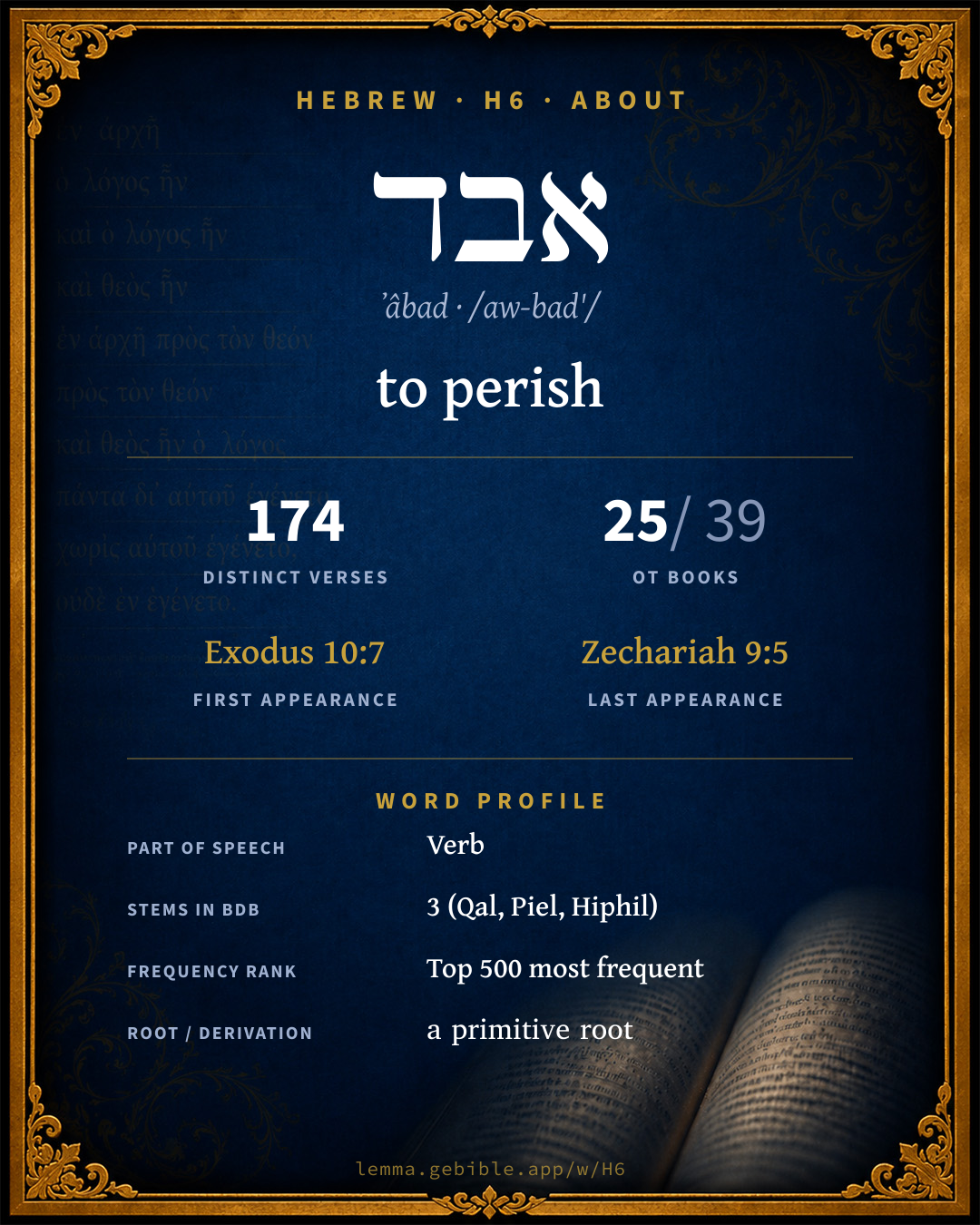
אָבַד
to perish
‘to perish’ is one of 9 main senses fuller range ↓
Full lexicon entry — Brown-Driver-Briggs (BDB)
From Brown-Driver-Briggs (BDB)
Where this word appears
See every Piel verb in the Hebrew Bible →
Grammar key — what these labels mean
Part of speech
- Verb
- An action or state-of-being word.
Stem
- Qal
- The basic, simple active stem — the plain form of the verb (“he wrote”). Here: ‘perish’
- Hiphil
- The causative active stem (“he caused / brought about”). Here: ‘destroy’
- Piel
- An intensive or resultative active stem. Here: ‘cause to perish’
Form
- Imperfect
- An incomplete, ongoing, or future action (“he will / would write”).
- Perfect
- A completed action or state — Hebrew marks aspect (completeness) more than strict tense (“he wrote”).
- Sequential Perfect
- A perfect with prefixed waw continuing a preceding imperfect or command (waw-consecutive perfect).
- Participle Active
- A verbal adjective expressing ongoing or characteristic action (“writing / one who writes”).
- Infinitive Construct
- A bound verbal noun, frequently with prepositions (“to write / in writing”).
- Infinitive Absolute
- An unbound verbal noun, often intensifying or standing in for a finite verb.
- Sequential Imperfect
- An imperfect with prefixed waw — the standard past-narrative form (waw-consecutive imperfect).
- Cohortative
- A first-person volitional form expressing wish or resolve (“let me / let us write”).
State
- Absolute
- The independent form of a noun, not bound to a following word.
- Construct
- A noun bound to a following noun in a possessive / “of” relationship (the construct chain).
Person
- 3rd Person
- The one spoken about (“he / she / it / they”).
- 1st Person
- The speaker (“I / we”).
- 2nd Person
- The one addressed (“you”).
Gender
- Masculine
- Grammatically masculine.
- Feminine
- Grammatically feminine.
- Common
- Either gender — not distinguished for this form.
Number
- Plural
- More than one (in Hebrew, generally three or more).
- Singular
- One.
Every verse where H6 appears in the Book of 2 Kings — 7 distinct verses. Click any verse to open its interlinear word-by-word view. Verse text shown in the World English Bible for context — . Each verse’s Hebrew form is shown with its reference; the English is not keyword-highlighted, since the data carries no word-level English alignment. Use “Compare translations” on any verse to read it across multiple English versions. This concordance covers the Hebrew Bible; Septuagint (Greek Old Testament) occurrences are not indexed here.
2 Kings
- 2 Kings 9:8 וְ/אָבַ֖ד conj + Qal wpf 3ms For the whole house of Ahab shall perish; and I will cut off from Ahab every man-child, and him who is shut up and him who is left at large in Israel.
- 2 Kings 10:19 הַאֲבִ֖יד Hiphil inf.cs Now therefore call to me all the prophets of Baal, all his worshippers, and all his priests; let none be wanting: for I have a great sacrifice [to do] to Baal; whoever shall be wanting, he shall not live. But Jehu did it in subtlety, to the intent that he might destroy the worshippers of Baal.
- 2 Kings 11:1 וַ/תְּאַבֵּ֔ד conj + Piel wimpf 3fs Now when Athaliah the mother of Ahaziah saw that her son was dead, she arose and destroyed all the seed royal.
- 2 Kings 13:7 אִבְּדָ/ם֙ Piel pf 3ms + sfx pers 3mp For he didn't leave to Jehoahaz of the people save fifty horsemen, and ten chariots, and ten thousand footmen; for the king of Syria destroyed them, and made them like the dust in threshing.
- 2 Kings 19:18 וַֽ/יְאַבְּדֽוּ/ם conj + Piel wimpf 3mp + sfx pers 3mp and have cast their gods into the fire; for they were no gods, but the work of men's hands, wood and stone; therefore they have destroyed them.
- 2 Kings 21:3 אִבַּ֖ד Piel pf 3ms For he built again the high places which Hezekiah his father had destroyed; and he reared up altars for Baal, and made an Asherah, as did Ahab king of Israel, and worshiped all the host of the sky, and served them.
- 2 Kings 24:2 לְ/הַֽאֲבִיד֑/וֹ prep + Hiphil inf.cs + sfx pers 3ms Yahweh sent against him bands of the Chaldeans, and bands of the Syrians, and bands of the Moabites, and bands of the children of Ammon, and sent them against Judah to destroy it, according to the word of Yahweh, which he spoke by his servants the prophets.
About this entry
At a glance — auto-summarized from this page’s data, not written by a person. Every figure links to its source below. This summary describes the numbers; it doesn’t interpret them.
“to perish” is the headline sense of the Hebrew verb אבד (ʼâbad). Where the King James Version says “destroy,” newer translations reach for “will perish” (Berean Standard Bible); the renderings breakdown has the detail. It appears 174 verses across 25 books of the Hebrew Bible, among its common vocabulary. First canonically at Exodus 10:7, it enters the text early. The verb spans 3 stems, from Qal to Piel. The sections below give every sense, occurrence, and version rendering.
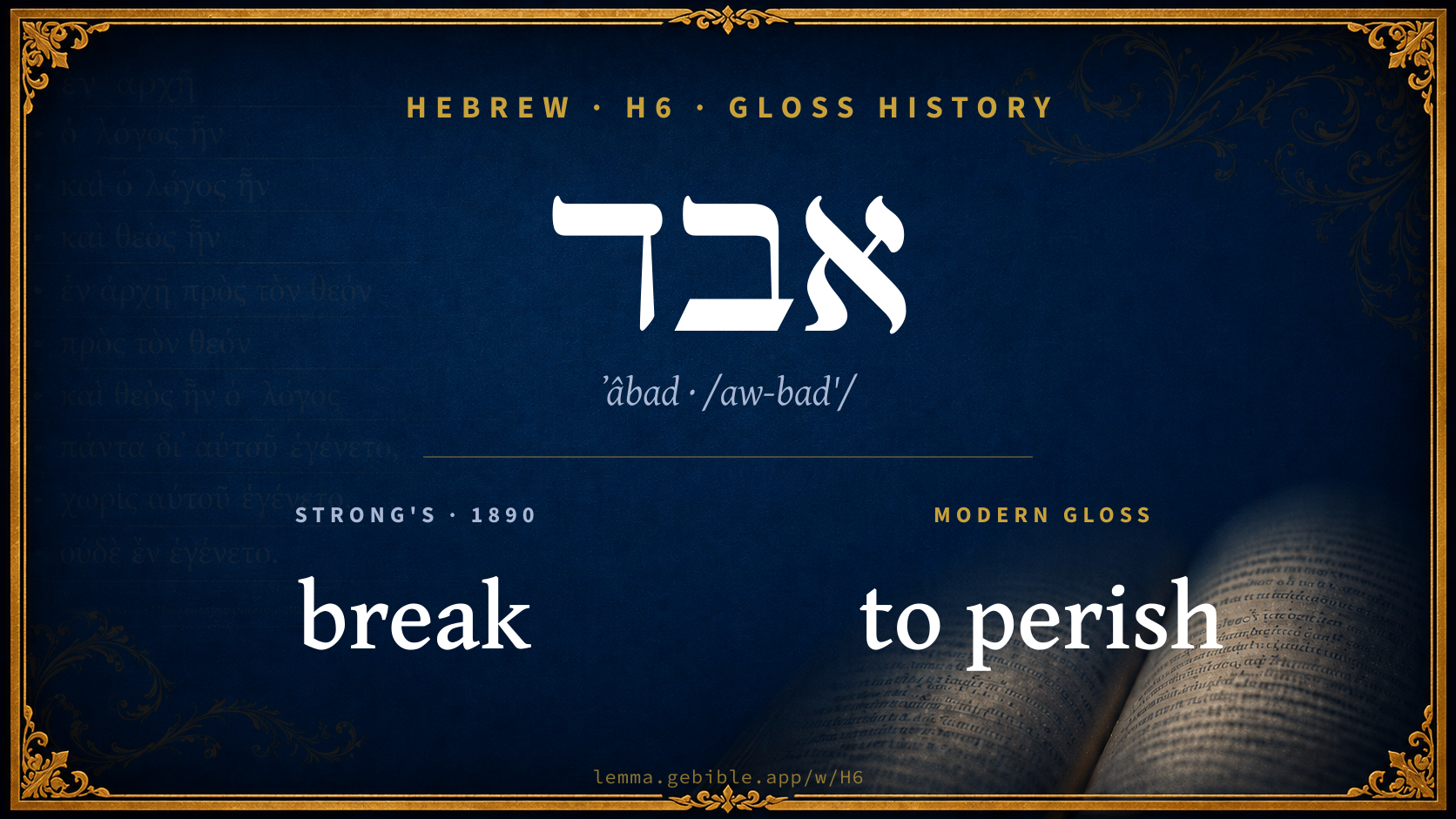
Gloss history
Strong's 1890 vs modern scholarship
About this word
Strong's H6 catalogs a Hebrew word from the Hebrew Old Testament.
These counts are not copied from any lexicon or concordance. They are computed here, from the morphology-tagged Hebrew Old Testament. What Lemma adds →
- 174
- distinct verses
- The word appears in 174 distinct verses.
- 25 / 39
- OT books
- The word appears in 25 of 39 Old Testament books.
- #252
- by frequency
- Top 500 most frequent Hebrew words (rank 252 of 8,640 Hebrew words by occurrence).
View all 174 occurrences in the concordance →
Most concentrated in
- Psalms 26 verses 15%
- Jeremiah 26 verses 15%
- Deuteronomy 19 verses 11%
By section of the Old Testament
By traditional corpus
Conventional, traditional groupings — biblical authorship is debated, so this is a traditional corpus grouping, not an authorship claim. Each share is this word’s portion of its verses in that division of the Hebrew canon. Each figure is a share of the word’s 174 distinct verses.
- Prophets (Nevi'im) 77 verses · 44%
- Writings (Ketuvim) 69 verses · 40%
- Torah (Pentateuch) 28 verses · 16%
How translations render this word
Counts come from each version’s own published word-to-Strong’s tagging or interlinear alignment — an approximate guide to how each version renders this word, not a word-level alignment the data otherwise carries. Because each total is that version’s own tagged count, the per-version totals vary from one another and need not match the appearance or distinct-verse counts above. These counts may also differ from a printed concordance because Lemma counts each distinctly tagged rendering and does not collapse phrase taggings into a single head-word total. This is a fixed set of word-tagged versions (KJV, ASV, BSB, ULT) and does not change with the reading translation you choose elsewhere. Each version’s license is shown beside its name below (and on Sources).
- King James Version: Destroy 22×, Shall perish 19×, Perish 17×
- American Standard Version: Perish 17×, Shall perish 17×, Destroy 14×
- Berean Standard Bible: Will perish 17×, Destroy 15×, Perish 14×
- unfoldingWord Literal Text: Will perish 21×, Perish 20×, Destroy 11×
King James Version Public Domain
Renders H6 across 184 tagged occurrences — most commonly:
Plus other, less common renderings. Plus 66 renderings that appear only once — usually multi-word phrases or single function words the recovered tagging swept in, not distinct renderings.
American Standard Version Public Domain
Renders H6 across 183 tagged occurrences — most commonly:
Plus other, less common renderings. Plus 87 renderings that appear only once — usually multi-word phrases or single function words the recovered tagging swept in, not distinct renderings.
Berean Standard Bible Public Domain
Renders H6 across 178 tagged occurrences — most commonly:
Plus other, less common renderings. Plus 74 renderings that appear only once — usually multi-word phrases or single function words the recovered tagging swept in, not distinct renderings. Not rendered by a distinct English word in 6 further occurrences.
unfoldingWord Literal Text CC BY-SA 4.0
Renders H6 across 199 tagged occurrences — most commonly:
Plus other, less common renderings. Plus 61 renderings that appear only once — usually multi-word phrases or single function words the recovered tagging swept in, not distinct renderings.
11 senses and sub-senses in the full BDB
Hebrew verbs can shift meaning by stem (binyan): Qal is the basic action, Niphal is often passive or reflexive, Piel often intensifies or makes it factitive, and Hiphil is typically causative. The senses below are grouped under the stem BDB assigns to each.
What do BDB’s symbols mean?
BDB uses these scholarly abbreviations:
| Symbol | Meaning |
|---|---|
| 𝔊 | the Septuagint (the ancient Greek translation, LXX) |
| 𝔙 | the Vulgate (the Latin translation) |
| 𝔖 | the Syriac version (the Peshitta) |
| 𝔗 | the Targum (the Aramaic translation) |
| ψ | the Psalms |
| √ | root (the underlying root or stem) |
| ‖ | parallel passage (a synonymous or contrasted parallel) |
| † | the dagger: every passage where the word occurs is cited |
The 11 senses and sub-senses the full Brown-Driver-Briggs lexicon distinguishes for this word, in lexicon order (not ranked by frequency), with BDB’s own verbatim wording and sub-sense lettering. Shown in Hebrew script with BDB’s own scholarly abbreviations. The condensed entry is in the Lexicon Entry tab. See also the Forms in the corpus table below.
Qal
- Pf. א׳ Nu 21:30 +; אָֽבְדוּ ψ 10:16 + (+ Ez 6:3 𝔊 Co) etc.; Impf. יֹאבַד Jb 3:3 Je 4:9; יֹאבֵ֑ד Jb 20:7 + 2 times; 3 fs. תֹּאבַד Dt 22:3 + 4 times; תֹּאבֵ֑ד Jb 8:13 + 3 times; יֹאבְדוּ Ju 5:31 + 3 times; יֹאבֵ֑דוּ Jb 4:9 +; 3 fpl. וַתֹּאבַדְנָה 1 S 9:3; תֹּאבֵדוּן Dt 4:26 +; נֹאבֵ֑ד Jn 1:6; 3:9; נֹאבְדָה Jon 1:14 etc.; Inf. abs. אָבֹד Dt 4:26 + 2 times; cstr. אֲבֹד Dt 7:20 Pr 11:10; אֲבָדְךָ Dt 28:20; אָבְדֶ֑ךָ Dt 28:22; אֲבָדְכֶם Jos 23:13; אָבְדָם Ob 12 Pr 28:28; Pt. אֹבֵד אוֹבֵד Dt 26:5 + 7 times; cstr. אֹבַד Dt 32:28 (v. Di Bö§ 378); etc. e.g. Numbers 21:30
- 1. perish, die, of individuals (mostly late) Nu 17:27 (‖ גוע & (v 28 מות), (also Dt 26:5? cf. infr.) Jon 1:6, 14 Jb 31:19 cf. 29:13 Pr 31:6 Est 4:14, 16(×2) Mi 4:9 Je 40:15 cf. Is 57:1 Pr 11:10; 28:28 Ec 7:15 ψ 119:92; emphasis on mortality Jb 4:20 ψ 146:4 Ec 9:6; Saul & Jonath., under fig. of weapons 2 S 1:27; lion Jb 4:11; caravan Jb 6:18 (cf. Di); cf. מִן־הָאָרֶץ א׳ הָסִיד Mi 7:2, וא׳ מֶלֶךְ מֵעַזָּה Zc 9:5; perish, be exterminated (judgment for sin), of Israel Lv 26:38 Dt 8:19(×2), 20; 28:20, 22; 30:18(×2) Je 27:10, 15 cf. 6:21, Ob 12 cf. ψ 80:17 Is 27:13; other nations Dt 7:20 Je 10:15; 51:18 ψ 2:12; 10:16; 83:18 cf. 9:4 Am 1:8 Is 41:11; 60:12 cf. Jon 3:9 v. also Ex 10:7 Nu 21:29, 30 (JE) Je 48:46; house of Ahab 2 K 9:8; wicked in general Ju 5:31 Jb 4:9 cf. v 7, ψ 37:20; 49:11; 68:3 (‖ sim. of melting wax), 73:27; 92:10; also Pr 19:9; 21:28; לָנֶצַח א׳ Jb 20:7; cf. דֶּרֶךְ רְשָׁעִים א׳ ψ 1:6; sq. מֵעַל הָאָ֑רֶץ (of annihilation of Isr.) Dt 4:26(×2), 11:17 Jos 23:13, 16 (D); sq. מִתּוֹךְ הַקָּהָל (of Korah’s company) Nu 16:33 (JE); perish, be ruined, destroyed, of inanimate things, e.g. land Je 9:11 (‖ נִצְּתָה כַמִּדְבָּר) cf. 48:8; harvest Jo 1:11; Jonah’s gourd Jon 4:10; riches Je 48:36 Ec 5:13; vessel ψ 31:13; houses Am 3:15 (so often Assyrian DlW); city Ez 26:17 (but del. 𝔊 Co); cf. bamôth Ez 6:3 𝔊 Co; heavens & earth ψ 102:27. e.g. Numbers 17:27
- 2. fig. perish, vanish, subj. memory Jb 18:17 ψ 9:7; name ψ 41:6 (i.e. be forgotten); vigour Jb 30:2; wisdom Is 29:14; cf. אֹבַד עֵצוֹת Dt 32:28; אֱמוּנָה Je 7:28 (‖ נִכְרְתָה); חָזוֹן Ez 12:22; יוֹם Jb 3:3 (i.e. be blotted out); לֵב Je 4:9 (i.e. courage fail); תִּקְוָה ψ 9:19 Pr 10:28; 11:7 Ez 19:5; 37:11 Jb 8:13; so תַּאֲוָה ψ 112:10 (i.e. comes to naught); תּוֹחֶלֶת Pr 11:7, sq. מִן + agent La 3:18; תורה + עצה + דבר sq. מן + persons negligent Je 18:18 (cf. 49:7 Ez 7:26), especially א׳ מָנוֹס מִן־ (i.e. they could not escape) Am 2:14 Je 25:35 Jb 11:20 ψ 142:5. e.g. Job 18:17
- 3. be lost, property Dt 22:3; strayed, beasts 1 S 9:3, 20 Je 50:6 Ez 34:4, 16 ψ 119:176 (fig. of erring men); perhaps Dt 26:5. e.g. Deuteronomy 22:3
Piel
- caus. of Qal.—Pf. אִבַּד 2 K 21:3 + 2 times; sf. וְאִבַּדְךָ Co Ez 28:16 cf. infr.; אִבַּדְתִּי Je 15:7; וְאִבַּדְתִּ֫י Ez 6:3 (𝔊 Co וְאָֽבְדוּ) etc.; Impf. יְאַבֵּד Ec 9:18; וִיאַבֵּד Ec 7:7 Zp 2:13; 1 s. sf. וָאַבֶּדְךָ Ez 28:16 (for וָאֲאַבּ׳ Ew§ 72 c Ol§ 79 a KöI 338 Ges§ 68 fin; but Co 3 ms.; v. also Co 38:14); תְּאַבְּדוּן Dt 12:2 etc.; Inf. abs. אַבֵּד Dt 12:2 + 3 times; cstr. id. Ez 22:27 + etc.; Pt. מְאַבְּדִים Je 23:1. e.g. 2 Kings 21:3
- 1. cause to perish, destroy, kill, obj. pers. (mostly late) 2 K 11:1 Est 3:9; 4:7; 8:5; 9:24; ‖ הרג 9:6, 12; ‖ הרג + השׁמיד 3:13; 7:4; 8:11; ‖ המם 9:24; cf. ψ 119:95; obj. נְפָשׁוֹת Ez 22:27 (del. 𝔊 Co); in judgment, subj. י׳ ψ 5:7; cf. Pr 1:32; sq. מִתּוֹךְ Ez 28:16; obj. a people 2 K 13:7 2 K 19:18 = Is 37:19; Jb 12:23; in judgment Dt 11:4 Je 12:17; 15:7 Zp 2:13 ψ 9:6 cf. 21:11; obj. inanimate things especially idols, bamôth etc., Nu. 33:52(×2) (J) Dt 12:2(×2) 2 K 21:3 Ez 6:3 (but cf. 𝔊 Co supr.); bars of Zion La 2:9 (‖ שִׁבַּר). e.g. 2 Kings 11:1
- 2. fig. cause to vanish, blot out, do away with names of idols Dt 12:3; voice of Babylon Je 51:55; memory of dead Is 26:14; substance Pr 29:3; understanding Ec 7:7; good (טוֹבָה q.v.) Ec 9:18. e.g. Deuteronomy 12:3
- 3. cause to stray, lose; obj. Isr. under fig. of flock Je 23:1 (‖ הֵפִיץ); abs. Ec 3:6 (‖ בִּקֵּשׁ). e.g. Jeremiah 23:1
Hiphil
- Pf. וְהֶאֱבִיד Nu 24:19; הֶאֱבַ֑דְתָּ Jb 14:19 etc.; Impf. אֹבִידָה Je 46:8 (Ges§ 68, 2 R. 1). Inf. cstr. הַאֲבִיד 2 K 10:19 + etc.; Pt. מַאֲבִיד Dt 8:20. e.g. Numbers 24:19
- 1. destroy, put to death, in judgment, (subj. י׳) obj. pers. Lv 23:30 (sq. מִקֶּרֶב עַמָּהּ; ‖ כָּרַת v 29); Je 49:38 (sq. מִשָּׁם); Ob 8 (sq. מֵאֱדוֹם); obj. nation, Ammon Ez 25:7 (sq. מן־הארצות; ‖ כָּרַת), cf. v 16; Canaanites Dt 8:20 (sq. מִפְּנֵיכֶם); Canaan = Philistines Zp 2:5 (‖ כָּרַת); especially Isr. Dt 28:51, 63 (‖ הִשְׁמִיד), cf. Js 7:7; also abs. Je 18:7 (‖ לִנְתוֹשׁ וְלִנְתוֹץ); = 1:10 (+ וְלַהֲרוֹס) = 31:28 (+ וּלְהָרֵעַ); animals Ez 32:13 (sq. מֵעַל מַיִם רַבִּים); cf. Dt 7:10; ψ 143:12 (‖ הִצְמִית); (human subj.), obj. servants of Baal 2 K 10:19, obj. nation Dt 9:3, cf. Nu 24:19 (E; sq. מֵעִיר); 2 K 24:2; cf. Je 46:8; obj. inanimate, chariots Mi 5:9; idols Ez 30:13 (del. BCo). e.g. Leviticus 23:30
- 2. fig., obj. name of kings Dt 7:24 (sq. מִתַּחַת הַשָּׁמַיִם); hope Jb 14:19; voice of mirth etc. Je 25:10 (cf. 51:55 Pi. supr.) e.g. Deuteronomy 7:24
Senses from the full Brown-Driver-Briggs lexicon (Brown, Driver, Briggs; Oxford 1906 — public domain), digitized via Sefaria, supplemented by the OpenScriptures HebrewLexicon (CC BY 4.0). Full attribution on Sources.
Word origin
vb. perish (MI אבד, Assyrian abâtu DlW184 Aramaic אֲבַד, ܐܶܒܰܕ.—
— Brown-Driver-Briggs (Oxford 1906, public domain), digitized via Sefaria, supplemented by the OpenScriptures HebrewLexicon (CC BY 4.0). See Sources.
Origin: a primitive root
Jastrow Dictionary
A second Hebrew/Aramaic lexicon for comparison, covering Aramaic and post-biblical (Talmudic, Targumic, Midrashic) usage that the biblical-Hebrew BDB does not. Matched by lemma rather than by Strong’s number, so a lemma may carry more than one Jastrow headword (shown separately below), and the entries cover usage well beyond the Bible.
אָבַד
- , v. אבב) to be pressed, go around in despair (v. Prov. XXXI, 6; Deut. XXVI, 6) to be given up, whence e.g. Proverbs 31:6
- 1. to be lost, perish; to be beyond recognition. Sifré Deut. 301 (ref. to Deut. XXVI, 5) לא ירד … אלא לאובד (read לוֹבֵד or לֶאֱבוֹד; Yalk. Deut. a. l. לאבדם prob. לאַבְרָּן; Ms. Zer. Abr. 3 לֵיאָבֵר) Jacob went to Aram with no hope but to perish (be a slave &c.). Ohol. XVII, 3 a field שא׳ בו קבר in which there is a grave that cannot be located. Keth. XIII, 7 אָבְדָה דרך וכ׳ the path to his field cannot be traced. Gen. R. s. 91 אבידה א׳ לנו we have lost something; a. fr. e.g. Deuteronomy 26:5
- 2. to lose. Ib. ואנו שאָבַדְנוּ ר׳ ס׳ and we who have lost (mourn for) R. S.; a. fr.—Part. pass. אָבוּד lost, irretrievable, perishing, decayed. Keth. 108ᵃ על הא׳ on a contribution to the Temple which has been lost on the road. Y. Shebi. IX, 38ᵈ top מאיליהן הן אֲבוּדִין they perish of themselves (they decay naturally); a. fr.
- to be lost, perish. Keth. 104ᵃ; a. fr. Sifré Deut. 301 לֵיאָבֵד, v. supra.
- 1. to waste, lose, forfeit, destroy. Ned. 33ᵇ אי׳ את מעותיו he wasted his money, (cannot reclaim it). Keth. XIII, 6 אי׳ את זכותו he forfeited his claim. Ab. Zar. 55ᵃ אנו נְאַבֵּד וכ׳ shall we give up our honest dealing? Ib. IV, 7 יְאַבֵּד עולמו shall He destroy His world? Ḥag. 3ᵃ ובקשתם לאַבְּדָהּ ממני and you wanted to deprive me of it? Ib. 4ᵃ זה המְאַבֵּד וכ׳ one who destroys what is given to him.—א׳ עצמו לדעת to commit suicide wilfully. Gen. R. s. 82; a. fr.
- 2. to drop from memory, to forget. Aboth V, 12; a. e.
אֲבַּד
- to be lost. Targ. I Sam. IX, 3; a. fr.—Snh. 111ᵃ; a. fr.—Y. Pes. IX, 37ᵃ כאָבִיד הוא it is to be looked upon as lost.
- to destroy. Targ. II Kings, XIX, 18; a. fr.
- 1. = Pa. Targ. Deut. XXVI, 5; a. fr.—Y. Kidd. III, 64ᶜ bot. אובדתא חיין וכ׳ thou hast ruined this man’s (my) life. Gen. R. s. 56 אובדת ליבך thou hast lost thy wits; a. fr.
- 2. to be lost, to go to ruin. Targ. Ps. XLI, 6; a. e.—Y. Ḥag. II, 77ᵇ ווי דמובדין alas for the lost (deceased)! Y. M. Kat. I, beg. 80ᵃ ויובדן and decay.
- to be lost. Lev. R. s. 34 מִתְאַבְּדִין if they should be lost.—מִתְּבִיד = מִתְאֲבִיד Pes. 5ᵇ; a. e. [Lam. R., to IV, 21 לאיבדא, read לאיעבדא, v. עֲבַד.]
אָבֵד
- perishable, irretrievable. דבר הא׳ a business which cannot be postponed without irretrievable loss. M. Kat. 11ᵃ; a. fr.
יְבַד
- Y. Shebi. IX, 38ᵈ אפי׳ צפור … לא יָבְדָּא even a bird perishes not without the will of God; [Gen. R. s. 79, a. e. מתצדא, מצדיא, v. צדי; Midr. Till. to Ps. XVII אתיא (ed. Bub. אתאי); read: אתציד;] Esth. R. to I, 9; Koh. R. to X, 8 יברח (corr. יָבְדָּה).
- to ruin. Targ. Prov. XII, 4 מְיַבְּדָא (ed. Wil. מֵיבְדָא).
- , v. אֲבַד
A Dictionary of the Targumim, the Talmud Babli and Yerushalmi, and the Midrashic Literature (Marcus Jastrow; London, Luzac, 1903) — Public Domain. Digitized via Sefaria. Digitized via Sefaria. Full attribution on Sources.
Forms in the corpus
The 151 distinct written forms H6 takes in the Hebrew Bible, most frequent first — each parse links to that stem’s occurrences in the concordance. Hebrew forms include their vowel points and cantillation, so a single lemma takes many written forms.
The 60 most common forms are shown; 91 rarer forms follow in the full concordance.
Same root — word family
Other BDB entries built from the same root as H6, grouped by Strong’s listed origin. These share a root / origin per the lexicon — not necessarily a shared meaning. Each links to that word’s own entry.
Derived from this word
- אבד ʼăbad H7 to perish
- אבד ʼôbêd H8 destruction
- אבדה ʼăbêdâh H9 lost thing
- אבדן ʼabdân H12 destruction
- אבדן ʼobdan H13 destruction
Proper names from this root
People and places named from this root — a name, not an additional meaning of the word.
Compare all same-root words → Showing 4 of 7 — not the complete family. 1 of the same-root words is a proper name (a person or place). They share a root, not necessarily a meaning.
Septuagint verse parallels
This word appears in 158 verses that also exist in the Greek Old Testament (Septuagint), out of the 174 Hebrew verses it occurs in. You can read those verses in Greek by switching the Old Testament edition to the Septuagint.
Read these verses in the Septuagint
- Exodus 10:7
- Leviticus 23:30
- Numbers 16:33
- Deuteronomy 4:26
- Joshua 7:7
- Judges 5:31
- 1 Samuel 9:3
- 2 Samuel 1:27
- 2 Kings 9:8
- Esther 3:9
- Job 3:3
- Psalms 1:6
This is a verse-level parallel only — the same verses exist in both the Hebrew and Greek Old Testaments. No word-level Hebrew↔Greek correspondence is claimed: the data carries no such alignment, so no Greek word is shown as this Hebrew word’s translation. Coverage is not total — the Septuagint omits the deuterocanon and renumbers the Psalms, so some Hebrew verses have no direct Greek parallel.