
Zechariah 9:5

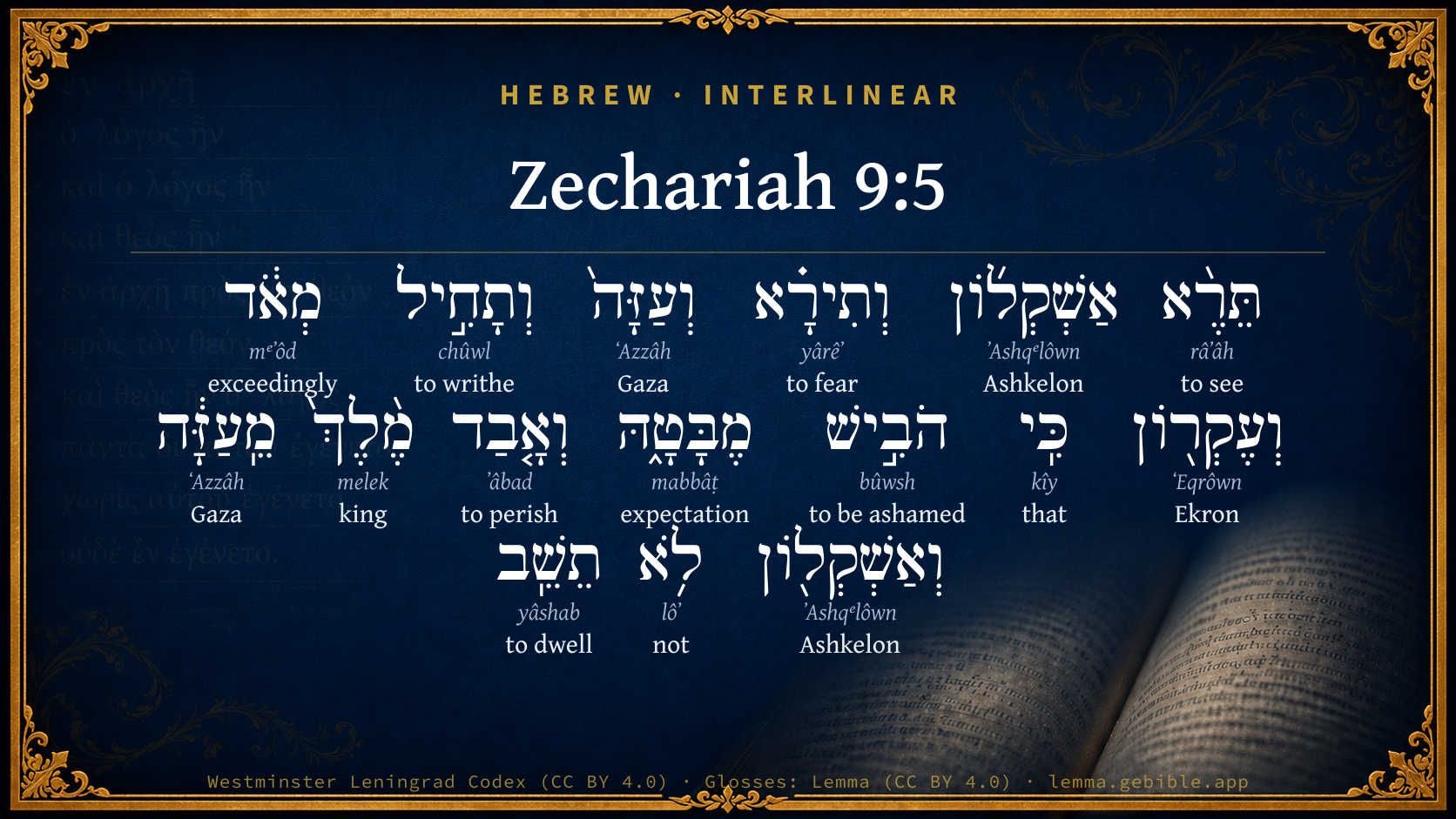
Hebrew (Westminster Leningrad Codex) Zechariah 9:5 appears in the Hebrew Old Testament. The text above is from the Westminster Leningrad Codex. Each word links to its Strong’s number, a concise gloss, and parsing drawn from the Open Scriptures Hebrew Bible morphology. Click any word for its full Brown-Driver-Briggs (BDB) entry.
Download image
Cite this verse

Zechariah 9:5 (World English Bible). Public Domain. Lemma interlinear Bible study tool, https://lemma.gebible.app/v/zechariah/9/5.

Show BibTeX & RIS
BibTeX
RIS
English Translation
Ashkelon will see it, and fear; Gaza also, and will writhe in agony; As will Ekron, for her expectation will be disappointed; And the king will perish from Gaza, And Ashkelon will not be inhabited.
World English Bible · Public Domain
Download a study sheet

One document with this verse’s original text, its word-by-word gloss line, the meaning frame, cross-references with their text, attributed commentary, and full source and license credits — printable, and it pastes into notes with its structure intact.

This verse Autodidact and up

Study sheet (.html) Plain text (.txt)

A passage Seminary Student

Up to 50 verses in one chapter. A passage sheet keeps up to 6 commentary sources and 12 cross-references per verse, in the order this page ranks them, and says so on the sheet whenever that leaves anything out. Ask for a single verse and you get the Autodidact verse sheet above.

Everything on this page stays free to read, with no account — the sheet is a download of what is already on screen, not access to it.

Want to remove ads? Support Godless Engineer
Compare translations 3

The same verse in 3 English versions, stacked beneath the original-language interlinear above. Click any original word for its lexicon entry.

Each is an independent rendering of the whole verse — the interlinear is not word-aligned to these translations.

Highlighted words mark where these versions differ — a whole-verse word diff, not a word-by-word alignment.

  • World English Bible Public Domain
    Ashkelon will see it, and fear; Gaza also, and will writhe in agony; As will Ekron, for her expectation will be disappointed; And the king will perish from Gaza, And Ashkelon will not be inhabited.
  • King James Version Public Domain
    Ashkelon shall see it, and fear; Gaza also shall see it, and be very sorrowful, and Ekron; for her expectation shall be ashamed; and the king shall perish from Gaza, and Ashkelon shall not be inhabited.
  • unfoldingWord Literal Text CC BY-SA 4.0
    Ashkelon will see and be afraid! Gaza also will tremble greatly! Ekron, her hopes will be disappointed! The king will perish from Gaza, and Ashkelon shall no longer be inhabited!

unfoldingWord Literal Text — © unfoldingWord, licensed CC BY-SA 4.0. Word-aligned USFM3 via Door43 (git.door43.org/unfoldingWord/en_ult).

Versions to compare (up to 4)

3 of 4 selected

Show all 18 translations

Every available English version of this verse, each an independent rendering of the whole verse.

  • World English Bible Public Domain
    Ashkelon will see it, and fear; Gaza also, and will writhe in agony; As will Ekron, for her expectation will be disappointed; And the king will perish from Gaza, And Ashkelon will not be inhabited.
  • Berean Standard Bible Public Domain
    Ashkelon will see and fear; Gaza will writhe in agony, as will Ekron, for her hope will wither. There will cease to be a king in Gaza, and Ashkelon will be uninhabited.
  • Majority Standard Bible Public Domain
    Ashkelon will see and fear; Gaza will writhe in agony, as will Ekron, for her hope will wither. There will cease to be a king in Gaza, and Ashkelon will be uninhabited.
  • King James Version Public Domain
    Ashkelon shall see it, and fear; Gaza also shall see it, and be very sorrowful, and Ekron; for her expectation shall be ashamed; and the king shall perish from Gaza, and Ashkelon shall not be inhabited.
  • American Standard Version (1901) Public Domain
    Ashkelon shall see it, and fear; Gaza also, and shall be sore pained; and Ekron, for her expectation shall be put to shame; and the king shall perish from Gaza, and Ashkelon shall not be inhabited.
  • Revised Version (1885) Public Domain
    Ashkelon shall see it, and fear; Gaza also, and shall be sore pained; and Ekron, for her expectation shall be ashamed: and the king shall perish from Gaza, and Ashkelon shall not be inhabited.
  • Geneva Bible (1599) Public Domain
    Ashkelon shall see it, and feare, and Azzah also shalbe very sorowfull, and Ekron: for her countenance shalbe ashamed, and the King shall perish from Azzah, and Ashkelon shall not be inhabited.
  • Douay-Rheims (1899) Public Domain
    Ascalon shall see, and shall fear, and Gaza, and shall be very sorrowful: and Accaron, because her hope is confounded: and the king shall perish from Gaza, and Ascalon shall not be inhabited.
  • Young's Literal Translation Public Domain
    See doth Ashkelon and fear, Also Gaza, and she is exceedingly pained, Also Ekron -- for her expectation dried up, And perished hath a king from Gaza, And Ashkelon doth not remain,
  • Literal Standard Version CC BY-SA 4.0
    Ashkelon sees and fears, || Also Gaza, and she is exceedingly pained, || Also Ekron—for her expectation dried up, || And a king has perished from Gaza, || And Ashkelon does not remain,
  • Unlocked Literal Bible CC BY-SA 4.0
    Ashkelon will see and be afraid! Gaza also will tremble greatly! Ekron, her hopes will be disappointed! The king will perish from Gaza, and Ashkelon shall no longer be inhabited!
  • unfoldingWord Literal Text CC BY-SA 4.0
    Ashkelon will see and be afraid! Gaza also will tremble greatly! Ekron, her hopes will be disappointed! The king will perish from Gaza, and Ashkelon shall no longer be inhabited!
  • Darby Bible Public Domain
    Ashkelon shall see [it], and fear; Gazah also, and she shall be greatly pained; Ekron also, for her expectation shall be put to shame: and the king shall perish from Gazah, and Ashkelon shall not be inhabited.
  • World Messianic Bible Public Domain
    Ashkelon will see it, and fear; Gaza also, and will writhe in agony; as will Ekron, for her expectation will be disappointed; and the king will perish from Gaza, and Ashkelon will not be inhabited.
  • Webster's Bible Public Domain
    Ashkelon shall see it, and fear; Gaza also shall see it, and be very sorrowful, and Ekron; for her expectation shall be ashamed; and the king shall perish from Gaza, and Ashkelon shall not be inhabited.
  • Free Bible Version CC BY-SA 4.0
    The people of Ashkelon will see this and be terrified; those in Gaza will thrash around in agony like a woman giving birth; and the people of Ekron too, because their hopes are shattered. The king of Gaza will be killed, and Ashkelon will be deserted.
  • Bible in Basic English Public Domain
    Ashkelon will see it with fear, and Gaza, bent with pain; and Ekron, for her hope will be shamed: and the king will be cut off from Gaza, and Ashkelon will be unpeopled.
  • JPS Tanakh (1917) Public Domain
    Ashkelon shall see it, and fear, Gaza also, and shall be sore pained, and Ekron, for her expectation shall be ashamed; and the king shall perish from Gaza, and Ashkelon shall not be inhabited.

Literal Standard Version (2020), Covenant Press — licensed CC BY-SA 4.0. Text via the HelloAO Bible API (eBible.org). Unlocked Literal Bible (unfoldingWord) — licensed CC BY-SA 4.0. Text via the HelloAO Bible API (eBible.org). unfoldingWord Literal Text — © unfoldingWord, licensed CC BY-SA 4.0. Word-aligned USFM3 via Door43 (git.door43.org/unfoldingWord/en_ult). Free Bible Version, Dr. Jonathan Gallagher — licensed CC BY-SA 4.0. Text via the HelloAO Bible API (eBible.org).

Word by word

More ways to search: Search by grammar → Find every occurrence → Compare this word →

Practice this passage: Drill this verse → Learn its vocabulary →

מֶבָּטָ֑הּ
mabbâṭ
H4007
“expectation · her”
Noun, Common, Masculine, Singular, Construct + Suffix, Personal, 3rd Person, Feminine, Singular
Part of Speech
Noun
Type
Common
Gender
Masculine
Number
Singular
State
Construct
Full BDB Definition

Origin: from H5027

TWOT: 1282a

expectation, object of hope or confidence
  1. תֵּרֶ֨א râʼâh H7200 “to see” Verb, Qal, Imperfect, 3rd Person, Feminine, Singular
  2. אַשְׁקְל֜וֹן ʼAshqᵉlôwn H831 “Ashkelon” Noun, Proper
  3. וְתִירָ֗א yârêʼ H3372 “and · to fear” Conjunction + Verb, Qal, Imperfect, 3rd Person, Feminine, Singular
  4. וְעַזָּה֙ ʻAzzâh H5804 “and · Gaza” Conjunction + Noun, Proper
  5. וְתָחִ֣יל chûwl H2342 “and · to writhe” Conjunction + Verb, Qal, Imperfect, 3rd Person, Feminine, Singular
  6. מְאֹ֔ד mᵉʼôd H3966 “exceedingly” Adverb
  7. וְעֶקְר֖וֹן ʻEqrôwn H6138 “and · Ekron” Conjunction + Noun, Proper
  8. כִּֽי kîy H3588 “that” Conjunction
  9. הֹבִ֣ישׁ bûwsh H954 “to be ashamed” Verb, Hiphil, Perfect, 3rd Person, Masculine, Singular
  10. וְאָ֤בַד ʼâbad H6 “and · to perish” Conjunction + Verb, Qal, Perfect, 3rd Person, Masculine, Singular
  11. מֶ֨לֶךְ֙ melek H4428 “king” Noun, Common, Masculine, Singular, Absolute
  12. מֵֽעַזָּ֔ה ʻAzzâh H5804 “from · Gaza” Preposition + Noun, Proper
  13. וְאַשְׁקְל֖וֹן ʼAshqᵉlôwn H831 “and · Ashkelon” Conjunction + Noun, Proper
  14. לֹ֥א lôʼ H3808 “not” Particle, Negative
  15. תֵשֵֽׁב yâshab H3427 “to dwell” Verb, Qal, Imperfect, 3rd Person, Feminine, Singular

About this verse

These counts appear in no published source. They are computed here, from the morphology-tagged text and Lemma’s own curated glosses. What Lemma adds →

16
words
14
distinct lemmas
Prophets
section

Notable vocabulary

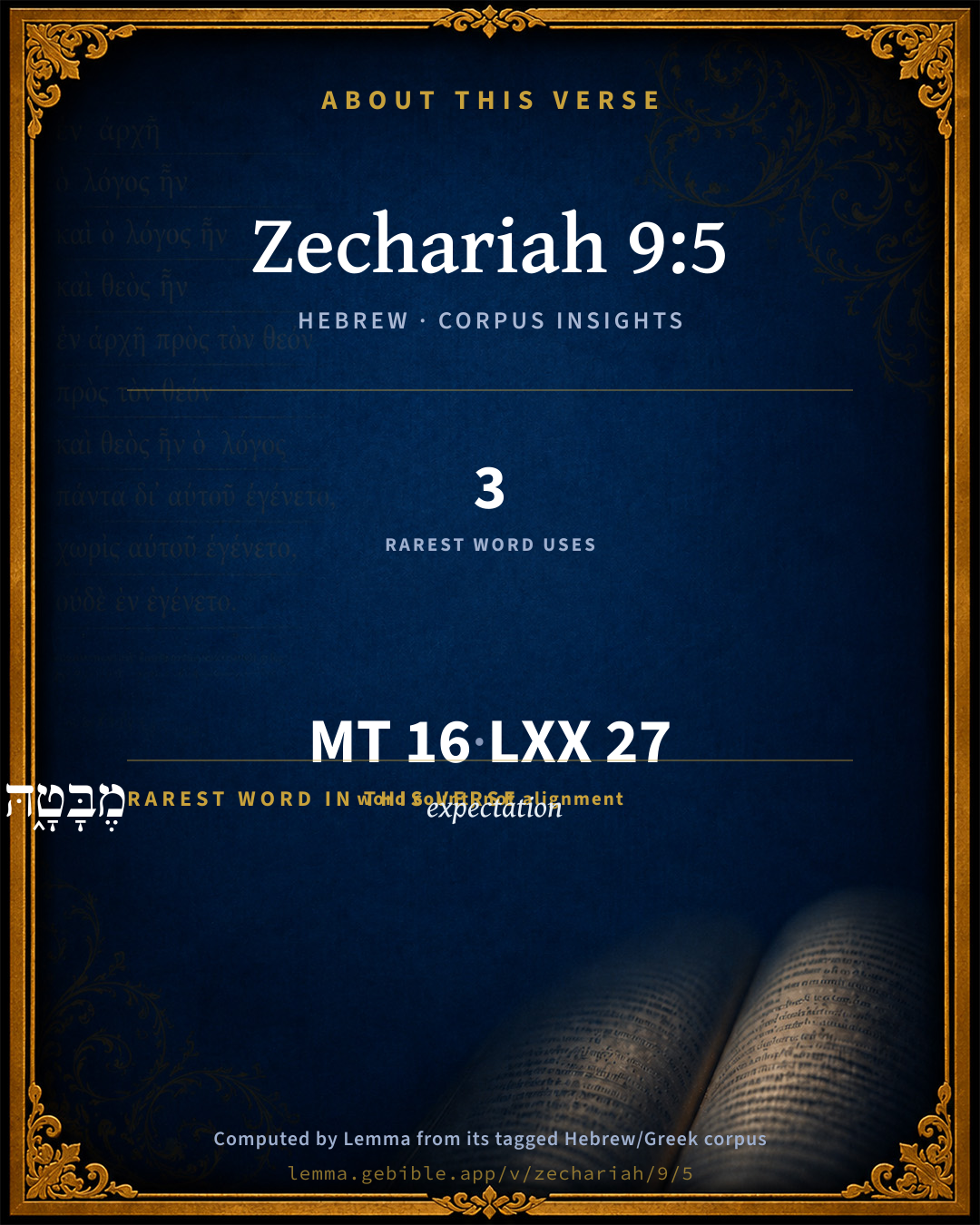
The rarest word here is מֶבָּטָ֑הּ expectation H4007 — appearing just 3 times in the whole Hebrew Bible.

Shared distinctive vocabulary

מֶבָּטָ֑הּ expectation H4007 occurs in 3 verses of the Hebrew Bible. Also found in:

Grammatical profile

  • 6 verbs
  • 7 nouns
  • 1 conjunction
  • 1 adverb
  • 1 particle

Verb forms

  • תֵּרֶ֨א Qal · Imperfect
  • וְתִירָ֗א Qal · Imperfect
  • וְתָחִ֣יל Qal · Imperfect
  • הֹבִ֣ישׁ Hiphil · Perfect
  • וְאָ֤בַד Qal · Perfect
  • תֵשֵֽׁב Qal · Imperfect

Repetition

Words recur within this verse — often emphatic in Hebrew:

  • אַשְׁקְל֜וֹן Ashkelon H831 ×2
  • וְעַזָּה֙ Gaza H5804 ×2

Hebrew & Septuagint length

In English translation the verse runs 35 words from the Hebrew and 34 from the Septuagint (LXX English) — closely comparable.

A rough comparison of the two English renderings, which tokenize alike — not a word-level alignment.

Word counts can differ between the Hebrew and the Greek without any difference in meaning — e.g. the Hebrew direct-object marker אֵת has no separate Greek word, and Greek often adds the article ὁ.

In the original languages it is 16 Hebrew tokens and 27 Greek tokens — but the two are counted differently (Hebrew bundles its prefixes and suffixes into one token; the Greek is in lemma form), so that isn’t a like-for-like length.

Cross-references

12

Topical passages linked to Zechariah 9:5 in the Treasury of Scripture Knowledge — connected by theme and wording, ordered by reader-vote popularity; previews shown in the World English Bible.

  • Acts 8:26 But an angel of the Lord spoke to Philip, saying, "Arise, and go toward the south to the way that goes down from Jerusalem to Gaza. This is a desert."
  • Jeremiah 47:1 The word of Yahweh that came to Jeremiah the prophet concerning the Philistines, before that Pharaoh struck Gaza.
  • Zephaniah 2:4–7 For Gaza will be forsaken, and Ashkelon a desolation. They will drive out Ashdod at noonday, and Ekron will be rooted up.
  • Revelation 18:9–17 The kings of the earth, who committed sexual immorality and lived wantonly with her, will weep and wail over her, when they look at the smoke of her burning,
  • Isaiah 14:29–31 Don't rejoice, O Philistia, all of you, because the rod that struck you is broken; for out of the serpent's root shall come forth an adder, and his fruit shall be a fiery flying serpent.
  • Isaiah 20:5–6 They shall be dismayed and confounded, because of Ethiopia their expectation, and of Egypt their glory.
  • Jeremiah 47:4–7 because of the day that comes to destroy all the Philistines, to cut off from Tyre and Sidon every helper who remains: for Yahweh will destroy the Philistines, the remnant of the isle of Caphtor.
  • Ezekiel 25:15–17 Thus says the Lord Yahweh: Because the Philistines have dealt by revenge, and have taken vengeance with despite of soul to destroy with perpetual enmity;
  • Ezekiel 26:15–21 Thus says the Lord Yahweh to Tyre: shall not the isles shake at the sound of your fall, when the wounded groan, when the slaughter is made in the midst of you?
  • Philippians 1:20 according to my earnest expectation and hope, that I will in no way be disappointed, but with all boldness, as always, now also Christ will be magnified in my body, whether by life, or by death.
  • Jeremiah 51:8–9 Babylon is suddenly fallen and destroyed: wail for her; take balm for her pain, if so be she may be healed.
  • Romans 5:5 and hope doesn't disappoint us, because God's love has been poured out into our hearts through the Holy Spirit who was given to us.

Cross-references courtesy of OpenBible.info (CC BY 4.0).

Hebrew and Greek witnesses Masoretic Hebrew ↔ Greek Septuagint

The same verse in the two great witnesses to the Old Testament, shown verse-for-verse.

These are two independent witnesses, not word-aligned to each other, and the Septuagint is shown in lemma (dictionary) form.

Hebrew Zechariah 9:5 Masoretic · Westminster Leningrad Codex

תֵּרֶ֨א אַשְׁקְל֜וֹן וְתִירָ֗א וְעַזָּה֙ וְתָחִ֣יל מְאֹ֔ד וְעֶקְר֖וֹן כִּֽי הֹבִ֣ישׁ מֶבָּטָ֑הּ וְאָ֤בַד מֶ֨לֶךְ֙ מֵֽעַזָּ֔ה וְאַשְׁקְל֖וֹן לֹ֥א תֵשֵֽׁב

Ashkelon will see it, and fear; Gaza also, and will writhe in agony; As will Ekron, for her expectation will be disappointed; And the king will perish from Gaza, And Ashkelon will not be inhabited.

World English Bible · Public Domain

Greek LXX Zechariah 9:5 Septuagint · lemma form

ὁράω ἀσκαλών καί φοβέω καί γάζα καί ὀδυναω σφόδρα καί ακκαρων ὅτι αἰσχύνω ἐπί ὁ παράπτωμα αὐτός καί ἀποὀλλύω βασιλεύς ἐκ γάζα καί ἀσκαλών οὐ μή καταοἰκέω

Ascalon shall see, and fear; Gaza also, and shall be greatly pained, and Accaron; for she is ashamed at her trespass; and the king shall perish from Gaza, and Ascalon shall not be inhabited.

LXX2012 (modern English Septuagint) · Public Domain

Hebrew: Westminster Leningrad Codex (CC BY 4.0). Greek: Septuagint (public domain); English from LXX2012 (modern English Septuagint) (Public Domain). How the Septuagint differs from the Hebrew →

Targum (Aramaic paraphrase)

1

The Targum is the ancient Jewish Aramaic paraphrase of the Hebrew Scriptures — an interpretive translation, not the Hebrew text itself. Onkelos (literal) and Pseudo-Jonathan (expansive) render the Torah, and Jonathan the Prophets. Coverage is partial: where no permissively-licensed English translation exists for a verse, only the Aramaic is shown. This is verse-level text, not a word-by-word alignment to the Hebrew.

  1. Targum Jonathan Prophets (Joshua–Malachi)
    תֶּחֱזֵי אַשְׁקְלוֹן וְתִדְחֵל וְעַזָה וּתְזִיעַ לַחֲדָא וְעֶקְרוֹן אֲרֵי בְהִיתַת מִבֵּית רוֹחְצָנֵיהּ וְיֵיבַד מַלְכָּא מֵעַזָה וְאַשְׁקְלוֹן לָא תִתְיְתֵיב:

    (no public-domain English translation for this verse)

    Targum Jonathan — Aramaic: “Mikraot Gedolot” (public domain). English: “Sefaria Community Translation” (CC0 1.0 (public-domain dedication)); “London "Chaldee Paraphrase," 1871” (public domain). Text via Sefaria.

Commentary

Notes on Zechariah 9:5 from classic Christian and Jewish commentators (each source and its license shown beneath its notes). The classic Christian expositions comment on the surrounding passage and are grouped to its opening verse, so a note may address several verses; the Jewish commentaries on the Tanakh (Rashi and others) are per-verse, so they appear only where the commentator wrote on this verse.

Lemma curates 59 commentaries, every one of them public domain or Creative Commons licensed, each selected and text-cleaned for this edition rather than reprinted as found. About our sources →

The Cambridge Bible for Schools and Colleges

gen. ed. J. J. S. Perowne

5. her expectation] The cities of Philistia, to which (Zec_9:5-7) after the subjugation of Syria (Zec_9:1-2) and Phœnicia (Zec_9:3-4), the scourge passed, had naturally looked to Tyre to check the course of the invader and so save them from his onslaught.

the king shall perish from Gaza] Rather, a king. The prediction is, not that the then reigning monarch should perish, but that monarchical government should cease. No argument can be drawn from this in favour of the ante-captivity date of this prophecy. It had been the policy of the Assyrians, Chaldæans and Persians to leave tributary kings in the countries which they subdued. Hence their own monarchs assumed the title of “king of kings” (Ezr_7:12; Eze_26:7; Dan_2:37), and as Herodotus states it was the custom of the Persians to put honour upon the sons of the kings whom they had deposed and promote them to the sovereignty of their fathers (iii. 15). Alexander on the contrary pursued an entirely different plan and aimed at a consolidated empire. Such tributary monarchies were therefore abolished by him. Hegesias, a writer contemporary with Alexander, states that the king of Gaza was brought alive to the conqueror after the capture of the city, which in spite of the fate of Tyre had held out for five months. There is considerable difficulty in reconciling the statements of different writers on this point, but there seems no reason to doubt that the ruler of Gaza bore the title of “king” at that time.

The Cambridge Bible for Schools and Colleges (gen. ed. J. J. S. Perowne; Cambridge University Press, 1878–1918) — public domain. Text from a community e-Sword module.

Trapp's Complete Commentary

John Trapp

Zec 9:5 Ashkelon shall see [it], and fear; Gaza also [shall see it], and be very sorrowful, and Ekron; for her expectation shall be ashamed; and the king shall perish from Gaza, and Ashkelon shall not be inhabited.

Ver. 5. Ashkelon shall see it and fear] For, iam proximus ardet Ucalegon, her next neighbour’s house was now on fire; and she might well fear she should be dashed at least with the tail of that overflowing storm that had swept away Tyre. The sword was now in commission; it was riding circuit, Eze 14:17, and God had given it a special charge against Ashkelon, and against the sea shore; there he had appointed it, Jer 47:6-7. Now Ashkelon, Gaza, and Ekron were situated all along the sea coast, southward of Tyre and Sidon. All these were bitter enemies to the Church; and were therefore destroyed by Alexander the Great, that man of God’s hand.

Gaza also shall see it, and be very sorrowful] Like a travailing woman, as Isa 26:17-18, where the same word is used; her heart shall ache and quake within her; she shall have sore throes and throbs.

And Ekron; for her expectation shall be ashamed] Her hope hath abused her, her confidence is cut off, her countenance is covered with confusion. She looked that Tyre should have been a bulwark to her: or at least a refuge, if need were, but now she seeth her expectation shamed: "The expectation of the wicked shall perish." They look out of the window with Sisera’s mother, and say, "Have they not sped? have they not divided the prey," &c.? But what saith the Church? "So let thine enemies perish, O Lord," Jdg 5:30-31.

And the king shall perish from Gaza] Rex, id est, Regulus; The King, it is Regulus. for there were five princes of the Philistines; each great city having a prince over it. The Prince of Gaza that is here designed to destruction may very well be that Betis, whom Darius, the last King of Persia, had set over Gaza. He having kept out Alexander for two months, was at length taken up by him together with the city, and put to a cruel death, as Curtius testifieth.

And Ashkelon shall not be inhabited] It was so wasted by war and depopulated that it became cottages for shepherds and folds for sheep. See Zep 2:4; Zep 2:6. Howbeit after this it was reinhabited; for that bloody Herod that slew the infants was born there, being surnamed Ascalonita; and at this day it is a strong garrison of the Saracens. Saladin pulled down the walls of it; but our Richard I set them up again, as Adrichomius telleth us out of Gul. Tyrius.

John Trapp, A Commentary or Exposition upon All the Books of the Old and New Testament (1647–1656) — public domain. Text from a community e-Sword module.

The Preacher's Complete Homiletical Commentary

Joseph S. Exell (gen. ed.)

CRITICAL NOTES.]

Zec_9:5.] Principal cities of the Philistines given. Gath only left out, probably owing to its situation inland, lying out of the route of the army. The fall of Tyre terrified these capitals of different districts. If Tyre could not stand how could they? Expect.] Ekron, furthest north, expected Alexander would be checked at Tyre. Gaza] captured after a siege of two months. Betis, its governor, was bound to a chariot, and dragged round the city.

Zec_9:6. Ashdod] A bastard (foreigner or stranger) of the conqueror’s nominated ruler.

Zec_9:7. Blood] of sacrifices, which heathens often drank. Abominations] Idolatrous offerings. “A prediction of future conversion of the Philistines to the knowledge and service of the true God. Their abandonment of idolatry, and their embracing the true religion, is represented by no longer drinking blood, and eating things sacrificed to idols, both of which were common among pagans, but prohibited by the Mosaic law, and by the apostles” (Num_25:2; Lev_7:6; Act_15:29) [Henderson]. He] The Philistines regarded as one. Left] Many Philistines became proselytes to Judaism, says Josephus. Governor] Philistine princes shall be like tribe-princes (chiliarchs) in Judah. There will be no distinction between proselytes and native Jews—all will enjoy equal honours and privileges. Jebusites] Original inhabitants of Jerusalem, subjugated by David, incorporated among Jews, and enjoyed their privileges (2Sa_24:16).

Zec_9:8. House] Jews, not to be injured by the army of Alexander on its march to or from Egypt. Fulfilled to the letter. Samaritans punished, but Jews escaped [cf. Henderson]. Seen] Lit. Now do I look with mine eyes. They were indebted to God’s providence only.

Zec_9:9.] A royal personage to appear without armies, and to reign without destructive judgments. Daughter] Theocratic nation to rejoice at the appearance of her king (Psa_2:11). Thine] i.e. the one promised and long expected. Just] in his official and personal character. An attribute of the Messiah in connection with salvation (Isa_45:21; Isa_53:11; Jer_23:5-6). Lowly] Expressing his general character, not merely his humiliation in first advent. Colt] A rough unbroken colt. An ass was not a mean and despised animal, but in triumphant processions horses were chosen, and arrayed in costly caparisons.

HOMILETICS

JUDGMENTS UPON PHILISTIA.—Zec_9:5-7

The prophet now turns to the inveterate enemies of Israel, and mentions four capitals of the Philistines. Their country lay between Tyre (or Phœnicia) and Egypt, the south-east of the Mediterranean Sea. What is said of one may be said of all, and the fate of the different cities corresponds with the prediction.

I. The cities lost their rulers. “The king shall perish from Gaza.” The Persians set up petty kings as vassals to their superior control. Notwithstanding two months’ siege, Gaza was taken, its inhabitants sold, and put to death. Betis, its brave king, was most cruelly fastened to the chariot of the conqueror, and dragged through the streets.

II. The cities were depopulated. “A foreigner shall sit as ruler in Ashdod.” They lost their native people, and were filled with a mongrel breed. At first a stranger was nominated to govern in Ashdod; but eventually “the inhabitant shall be cut off from Ashdod.” Ashkelon, once noted for its figs and fertility, though dismantled and re-fortified several times, is now surrounded with desolate ruins of former grandeur.

III. The cities were bereft of their religion. They shall no longer glut themselves with bloodsheddings. The prey of their gods was taken from their mouths. “I will take away his blood out of his mouth, and his abominations from between his teeth.” There was not mere suspension but total abolition of their idolatry. They lost their religion and their nationality, and were incorporated with the Jews.

IV. The cities were desolated. “I will cut off the pride of the Philistines.” Their hopes were “cut off;” for Tyre did not check Alexander’s triumphant march. Their fortifications were “cut off,” and levelled to the ground. Everything in which they prided themselves, strength, situation, wealth, and nationality, were “cut off.” The day of wrath came, and all was swept like chaff before the whirlwind. The desolate ruins now declare that God is a consuming fire. “For Gaza shall be forsaken, and Ashkelon a desolation; they shall drive out Ashdod at the noon-day, and Ekron shall be rooted up” (Zep_2:4).

A CONVERTED REMNANT OF PHILISTIA.—Zec_9:7

Just as God left a remnant for himself in Israel when judgment fell upon them, so a remnant shall be left for God in Philistia. “But he that remaineth, even he, shall be for our God.”

I. The remnant was preserved from destruction. Some remained after judgments had swept the land, and were converted to God. Monuments of grace and mercy set apart for him. From all nations God will gather his people. Nothing shall be a barrier to acceptance with him. “The son of the stranger that hath joined himself to the Lord” (Isa_56:3).

II. The remnant was incorporated with Israel. There would be no distinction between the Israelite and the Philistine.

1. Dignity would be conferred upon them. Their honour and elevation before God and the people “shall be as a governor in Judah.”

2. Equal privileges would be conferred upon them. “And Ekron as a Jebusite.” Jebusites were incorporated with Jews, and enjoyed equal honours and rights (2Sa_24:16). In Christ Jesus there is no distinction of race nor sect. All are one in him, and alike welcome to him. The proselytes under the Maccabean dynasty, were only a partial fulfilment of the text. Heathens shall yet be converted, and be joined to God’s people. “The strangers shall be joined with them, and they shall cleave to the house of Jacob” (cf. Isa_14:1; Isa_56:8).

THE DIVINE ENCAMPMENT.—Zec_9:8-9

While neighbouring nations are destroyed, a promise of Divine protection is made to the Jews. Their nationality would be preserved, and all their sufferings would turn out for good. For this they were indebted to God, who encamped about them, and watched over them.

I. The Christian Church is surrounded by enemies. She is in the battle-field, and at war with all ungodliness. Enemies seek to oppress and subdue her—pass by and return. There is marching and counter-marching, with a design to attack. Powers of darkness invade our spheres of action, and encamp within us. In this moral campaign the fight is indispensable, holy, and severe. “The good fight of faith.”

II. The Christian Church is defended by God. “I will encamp about mine house.” It is not a mere visit, but an encampment, a dwelling or settlement.

1. God watches over her. “Now have I seen with mine eyes.” Some think that he does not see at all, or only looks when he interferes. But he ever beholds the insolence of the enemy, and the sufferings of his people—will judge the one and avenge the other. “Awake to help me, and behold.”

2. God delivers her. “No oppressor shall pass through them any more.” Alexander punished the Samaritans, but favoured the Jews. No foreigners invaded the land before the advent of Messiah, as Assyrians and Chaldeans had done of old. God guarded them, like “the chariots of fire and horses of fire round about Elisha.” The power and goodness of God are pledged for the triumph and salvation of his Church. On every side the watch is kept with sleepless eyes. None can resist the Captain of the Lord of Hosts. “The Angel of the Lord encampeth round about them that fear him, and delivereth them.”

III. The Christian Church should rejoice in this defence. To show the magnitude and the consequences of this salvation, Zion is called upon to “rejoice” and “shout” for joy in the prospect before her (Zec_9:9). If the presence of Alexander, Cæsar, or Wellington, created joy in the camp; what confidence should the presence of God inspire! Napoleon’s oversight was remarkable, Cromwell’s interest in his men was great; but God says, “Rejoice greatly.” Cowardice in God’s presence is doubly criminal. “Cowards falter,” said Queen Elizabeth, “but danger is often overcome by those who nobly dare.” “Fear not, daughter of Sion” (Joh_12:15).

HOMILETIC HINTS AND OUTLINES

Zec_9:7. He that remaineth. The elect remnant.

1. From whom chosen.

2. To what promoted. Ekron as a Jebusite, as a denizen of Jerusalem; no longer an enemy, or a stranger and foreigner, but a fellow-citizen with the saints, and of the household of God. Two things in this promise.

1. It is a great thing to be a Jebusite. One of the highest of all privileges to “come to Mount Zion, the city of the living God.” What a governor have these citizens! What a charter have they! What can equal their safety, liberty, and defence?—their commerce, wealth, happiness, and peace? Their joy is unspeakable, and full of glory.

2. Jebusites may be derived from Ekronites. The thing has been done; and most unlikely characters have furnished pious converts—Manasseh, the dying thief, and the murderers of Jesus, prove this. What surpassed the guilt and depravity of the Corinthians? What says Paul of his own conversion? What triumphs of the riches, freeness, and power of Divine grace! Let none despair, however desperate his own case—nor despond with regard to any of our fellow-creatures. God is able of these stones to raise up children unto Abraham [Jay].

Zec_9:8. The house of Jehovah. The workmanship, the residence, and the property of God. The camp of God, the deliverance of the good. “Seen with mine eyes.” With God, compassion is so intrinsic an attribute, that he is pictured as looking away when he does not put it forth. With God, to behold is to help [Pusey]. Hence God sees with approval and tender consideration—with a design to help his people, and punish their foes. He is an observant God—eyes and ears are set upon men—“in every place beholding the evil and the good.”

ILLUSTRATIONS TO CHAPTER 9

Zec_9:7. The happy effect of this humiliation of the great worldly powers of Persia, Syria, and Philistia, was this—that they lost their confidence in their own false deities, and were prepared to receive a purer faith. The prophet foretells this, and predicts also, that there will be a faithful remnant among those nations, which will turn to the true God; and many among the heathens will become governors in Judah; many who were once Gentiles will become preachers and missionaries in Christ’s Church. Even Ekron itself will become a Jebusite, a dweller in Jerusalem, the Church of God [Wordsworth].

Zec_9:8. Encamp. On every side the watch is kept by warriors of sleep less eyes, and the Captain of the Host is one whose prowess none can resist. We little know how many providential deliverances we owe to those unseen hands which are charged to bear us up, lest we dash our foot against a stone [Spurgeon].

Zec_9:9-10. Thy king. Christ as a mere man was great—great in intellect, heart, purpose, action; as a Mediator, supremely great. But how does this great Being, Prince of the powers of the earth, enter Jerusalem? In a triumphal chariot?—on a stately, prancing steed, accompanied by a magnificent cavalcade? No! On an ass. The more truly kingly a man is, the less he cares for conventional pageantry. Your great men have never cared for jewellery. The more ornaments are coveted, and dress is studied, the more mean and impoverished the soul. Heart of oak requires neither veneer nor varnish. A great age has never been an age of millinery and gold rings. The kingly soul does not care for the rose or the crown [Dr. Thomas].

The Preacher's Complete Homiletical Commentary (gen. ed. Joseph S. Exell; Funk & Wagnalls, c. 1892) — public domain (pre-1929). A full-Bible homiletical/sermon-outline anthology covering 65 of 66 books (2 John is absent from the source module). Text from a community e-Sword module.

Keil & Delitzsch

C. F. Keil & F. Delitzsch

Zac 9:5. "Ashkelon shall see it, and fear; Gaza, and tremble greatly; and Ekron, for her hope has been put to shame; and the king will perish out of Gaza, and Ashkelon will not dwell. Zac 9:6. The bastard will dwell in Ashdod; and I shall destroy the pride of the Philistines. Zac 9:7. And I shall take away his blood out of his mouth, and his abominations from between his teeth; and he will also remain to our God, and will be as a tribe-prince in Judah, and Ekron like the Jebusite." From the Phoenicians the threat turns against the Philistines. The fall of the mighty Tyre shall fill the Philistian cities with fear and trembling, because all hope of deliverance from the threatening destruction is thereby taken away (cf. Isa 23:5). תּרא is jussive. The effect, which the fall of Tyre will produce upon the Philistian cities, is thus set forth as intended by God. The description is an individualizing one in this instance also. The several features in this effect are so distributed among the different cities, that what is said of each applies to all. They will not only tremble with fear, but will also lose their kingship, and be laid waste. Only four of the Philistian capitals are mentioned, Gath being passed over, as in Amo 1:6, Amo 1:8; Zep 2:4, and Jer 25:20; and they occur in the same order as in Jeremiah, whose prophecy Zechariah had before his mind. To ועזּה we must supply תּרא from the parallel clause; and to עקרון not only תּרא, but also ותירא. The reason for the fear is first mentioned in connection with Ekron, - namely, the fact that the hope is put to shame. הובישׁ is the hiphil of בּושׁ (Ewald, 122, e), in the ordinary sense of this hiphil, to be put to shame. מבּט with seghol stands for מבּט (Ewald, 88, d, and 160, d), the object of hope or confidence. Gaza loses its king. Melekh without the article is the king as such, not the particular king reigning at the time of the judgment; and the meaning is, "Gaza will henceforth have no king," i.e., will utterly perish, answering to the assertion concerning Ashkelon: לא תשׁב, she will not dwell, i.e., will not come to dwell, a poetical expression for be inhabited (see at Joe 3:20). The reference to a king of Gaza does not point to times before the captivity. The Babylonian and Persian emperors were accustomed to leave to the subjugated nations their princes or kings, if they would only submit as vassals to their superior control. They therefore bore the title of "kings of kings" (Eze 26:7; cf. Herod. iii. 15; Stark, Gaza, pp. 229, 230; and Koehler, ad h. l.). In Ashdod will mamzēr dwell. This word, the etymology of which is obscure (see at Deu 23:3, the only other passage in which it occurs), denotes in any case one whose birth has some blemish connected with it; so that he is not an equal by birth with the citizens of a city or the inhabitants of a land. Hengstenberg therefore renders it freely, though not inappropriately, by Gesindel (rabble). The dwelling of the bastard in Ashdod is not at variance with the fact that Ashkelon "does not dwell," notwithstanding the individualizing character of the description, according to which what is affirmed of one city also applies to the other. For the latter simply states that the city will lose its native citizens, and thus forfeit the character of a city. The dwelling of bastards or rabble in Ashdod expresses the deep degradation of Philistia, which is announced in literal terms in the second hemistich. The pride of the Philistines shall be rooted out, i.e., everything shall be taken from them on which as Philistines they based their pride, viz., their power, their fortified cities, and their nationality. "These words embrace the entire contents of the prophecy against the Philistines, affirming of the whole people what had previously been affirmed of the several cities" (Hengstenberg).

A new and important feature is added to this in Zac 9:7. Their religious peculiarity - namely, their idolatry - shall also be taken from them, and their incorporation into the nation of God brought about through this judgment. The description in Zac 9:7 is founded upon a personification of the Philistian nation. the suffixes of the third pers. sing. and the pronoun הוּא in Zac 9:7 do not refer to the mamzēr (Hitzig), but to pelishtı̄m (the Philistines), the nation being comprehended in the unity of a single person. This person appears as an idolater, who, when keeping a sacrificial feast, has the blood and flesh of the sacrificial animals in his mouth and between his teeth. Dâmı̄m is not human blood, but the blood of sacrifices; and shiqqutsı̄m, abominations, are not the idols, but the idolatrous sacrifices, and indeed their flesh. Taking away the food of the idolatrous sacrifices out of their mouth denotes not merely the interruption of the idolatrous sacrificial meals, but the abolition of idolatry generally. He also (the nation of the Philistines regarded as a person) will be left to our God. The gam refers not to the Phoenicians and Syrians mentioned before, of whose being left nothing was said in Zac 9:1-4, but to the idea of "Israel" implied in לאלהינוּ, our God. Just as in the case of Israel a "remnant" of true confessors of Jehovah is left when the judgment falls upon it, so also will a remnant of the Philistines be left for the God of Israel. The attitude of this remnant towards the people of God is shown in the clauses which follow. He will be like an 'alluph in Judah. This word, which is applied in the earlier books only to the tribe-princes of the Edomites and Horites (Gen 36:15-16; Exo 15:15; Ch1 1:51.), is transferred by Zechariah to the tribe-princes of Judah. It signifies literally not a phylarch, the head of an entire tribe (matteh, φυλή), but a chiliarch, the head of an 'eleph, one of the families into which the tribes were divided. The meaning "friend," which Kliefoth prefers (cf. Mic 7:5), is unsuitable here; and the objection, that "all the individuals embraced in the collective הוּא cannot receive the position of tribe-princes in Judah" (Kliefoth), does not apply, because הוּא is not an ordinary collective, but the remnant of the Philistines personified as a man. Such a remnant might very well assume the position of a chiliarch of Judah. This statement is completed by the addition "and Ekron," i.e., the Ekronite "will be like the Jebusite." The Ekronite is mentioned fore the purpose of individualizing in the place of all the Philistines. "Jebusite" is not an epithet applied to the inhabitants of Jerusalem, but stands for the former inhabitants of the citadel of Zion, who adopted the religion of Israel after the conquest of this citadel by David, and were incorporated into the nation of the Lord. This is evident from the example of the Jebusite Araunah, who lived in the midst of the covenant nation, according to Sa2 24:16., Ch1 21:15., as a distinguished man of property, and not only sold his threshing-floor to king David as a site for the future temple, but also offered to present the oxen with which he had been ploughing, as well as the plough itself, for a burnt-offering. On the other hand, Koehler infers, from the conventional mode of expression employed by the subject when speaking to his king, "thy God," and the corresponding words of David, "my God" instead of our God, that Araunah stood in the attitude of a foreigner towards the God of Israel; but he is wrong in doing so. And there is quite as little ground for the further inference drawn by this scholar from the fact that the servants of Solomon and the Nethinim are reckoned together in Ezr 2:58 and Neh 7:60, in connection with the statement that Solomon had levied bond-slaves for his buildings from the remnants of the Canaanitish population (Kg1 9:20), viz., that the Jebusites reappeared in the Nethinim of the later historical books, and that the Nethinim "given by David and the princes" were chiefly Jebusites, according to which "Ekron's being like a Jebusite is equivalent to Ekron's not only meeting with reception into the national fellowship of Israel through circumcision, but being appointed, like the Jebusites, to service in the sanctuary of Jehovah." On the contrary, the thought is simply this: The Ekronites will be melted up with the people of God, like the Jebusites with the Judaeans. Kliefoth also observes quite correctly, that "there is no doubt that what is specially affirmed of the Philistians is also intended to apply to the land of Chadrach, to Damascus, etc., as indeed an absolute generalization follows expressly in Zac 9:10.... Just as in what precedes, the catastrophe intended for all these lands and nations is specially described in the case of Tyre alone; so here conversion is specially predicted of the Philistines alone."

If we inquire now into the historical allusion or fulfilment of this prophecy, it seems most natural to think of the divine judgment, which fell upon Syria, Phoenicia, and Philistia through the march of Alexander the Great from Asia Minor to Egypt. After the battle at Issus in Cilicia, Alexander sent one division of his army under Parmenio to Damascus, to conquer this capital of Coele-Syria. On this expedition Hamath must also have been touched and taken. Alexander himself marched from Cilicia direct to Phoenicia, where Sidon and the other Phoenician cities voluntarily surrendered to him; and only Tyre offered so serious a resistance in its confidence in its own security, that it was not till after a seven months' siege and very great exertions that he succeeded in taking this fortified city by storm. On his further march the fortified city of Gaza also offered a prolonged resistance, but it too was eventually taken by storm (cf. Arrian, ii. 15ff.; Curtius, iv. 12, 13, and 2-4; and Stark, Gaza, p. 237ff.). On the basis of these facts, Hengstenberg observes (Christol. iii. p. 369), as others have done before him, that "there can be no doubt that in Zac 9:1-8 we have before us a description of the expedition of Alexander as clear as it was possible for one to be given, making allowance for the difference between prophecy and history." But Koehler has already replied to this, that the prophecy in Zac 9:7 was not fulfilled by the deeds of Alexander, since neither the remnant of the Phoenicians nor the other heathen dwelling in the midst of Israel were converted to Jehovah through the calamities connected with Alexander's expedition; and on this ground he merely regards the conquests of Alexander as the commencement of the fulfilment, which was then continued throughout the calamities caused by the wars of succession, the conflicts between the Egyptians, Syrians, and Romans, until it was completed by the fact that the heathen tribes within the boundaries of Israel gradually disappeared as separate tribes, and their remnants were received into the community of those who confessed Israel's God and His anointed. But we must go a step further, and say that the fulfilment has not yet reached its end, but is still going on, and will until the kingdom of Christ shall attain that complete victory over the heathen world which is foretold in Zac 9:8.

Keil & Delitzsch — Biblical Commentary on the Old Testament (1861–1891) — public domain (CC PDM 1.0). Text via the HelloAO Bible API. (Old Testament only.)

Tyndale Open Study Notes

Tyndale Open Resources

9:5-6 Ashkelon . . . Gaza . . . Ekron . . . Ashdod: These Philistine cities, located on the coastal plain of Israel, were defeated by David (2 Sam 5:17-25) but later regained some autonomy. The prophets Amos and Zephaniah pronounced similar judgments against the same four cities (Amos 1:6-8; Zeph 2:4-7).

Tyndale Open Study Notes — © Tyndale Open Resources, licensed CC BY-SA 4.0. Text via the HelloAO Bible API.

Jamieson, Fausset & Brown

Robert Jamieson, A. R. Fausset & David Brown

Ashkelon, &c.--Gath alone is omitted, perhaps as being somewhat inland, and so out of the route of the advancing conqueror.

Ekron . . . expectation . . . ashamed--Ekron, the farthest north of the Philistine cities, had expected Tyre would withstand Alexander, and so check his progress southward through Philistia to Egypt. This hope being confounded ("put to shame"), Ekron shall "fear."

king shall perish from Gaza--Its government shall be overthrown. In literal fulfilment of this prophecy, after a two month's siege, Gaza was taken by Alexander, ten thousand of its inhabitants slain, and the rest sold as slaves. Betis the satrap, or petty "king," was bound to a chariot by thongs thrust through the soles of his feet, and dragged round the city.

Jamieson, Fausset & Brown — Commentary Critical and Explanatory on the Whole Bible (1871) — public domain (CC PDM 1.0). Text via the HelloAO Bible API.

Adam Clarke's Commentary

Verse 5. Ashkelon shall see it, and fear] All these prophecies seem to have been fulfilled before the days of Zechariah; another evidence that these last chapters were not written by him.

Her expectation shalt be ashamed] The expectation of being succoured by Tyre.

Adam Clarke's Commentary on the Bible (1810–1826) — public domain. Text from a community e-Sword/MySword module.

John Calvin's Commentaries

In this verse also is described the devastation of those cities which the Prophet names; as though he had said, that all those cities which had risen up against God’s people were devoted to extreme vengeance. Zechariah says that none would be exempt from punishment, since the hand of God would be stretched forth, and extend everywhere, so that it might be easily concluded, that all those who had unjustly harassed the Church would be thus rewarded for their cruelty. This is the import of what is here said.

He says that Ascalon would see and fear; for at that time the Ascalonites were hostile to the Jews. He speaks the same of Aza, which the Greeks called Gaza; but they were deceived in thinking it was a name given to it by Cambyses, for the reason that Gaza means a treasure in the Persian language. This is childish. It is indeed certain that it has been owing to a change in the pronunciation of one letter; for ע, oin, is guttural among the Hebrews, and was formerly so pronounced, like our g: as they called Amorrah, Gomorrah, so Aza is Gaza. We have spoken of this elsewhere.

Now it appears from geography that these cities were near the sea, or not far from the sea, and having this advantage they gathered much wealth. But as wealth commonly generates pride and cruelty, all these nations were very troublesome to the Jews. This is the reason why the Prophet says that grief would come on Gaza, and then on Ekron and on other cities. He adds, Because ashamed shall be her expectation. There is no doubt but they had placed their trust in Tyrus, which was thought to be impregnable; for though enemies might have subdued the whole land, there a secure station remained. Since they all looked to Tyrus, the Prophet says that their hope would be confounded, when Tyrus was overthrown and destroyed. The sum of the whole is, that the beginning of the vengeance would be at Tyrus, which was situated as it were beyond the world, so as not to be exposed to any evils. He says then that the beginning of the calamity would be in that city, to which no misfortunes, as it was thought, could find an access. And then he mentions that other cities, on seeing Tyrus visited with ruin, would be terrified, as their confidence would be thus subverted. He afterwards adds, Perish shall the king from Gaza, and Ascalon shall not be inhabited; that is, such a change will take place as will almost obliterate the appearance of these cities. It follows —

John Calvin's Commentaries (1540-1563) — public domain. Text from the Calvin Translation Society English edition (1840s-50s) via the Christian Classics Ethereal Library (ccel.org). Calvin's coverage is partial (roughly two-thirds of the Bible); uncommented books and verses are honest gaps, never fabricated. The 19th-century editor's footnotes and remarks are omitted so the notes are faithfully Calvin's own voice.

Ellicott's Commentary for English Readers

(5) See it, and fear.—Well might Philistia fear and tremble on hearing of the destruction of Tyre. Ashkelon and Ekron, it is true, are not mentioned in connection with this march of Alexander, but they must necessarily have been occupied by his troops. But Gaza was certainly taken, after a siege of five months; and special mention is made by Hegesias (a contemporary of Alexander) of the “king” of Gaza being brought alive to Alexander after the capture of that city.

Not be inhabited.—Or, not remain.

A Bible Commentary for English Readers, edited by Charles John Ellicott (1878–1897) — public domain. Text from a community e-Sword module.

John Gill's Exposition

Ashkelon shall see it, and fear,.... That is, as Kimchi explains it, when Ashkelon shall see that Tyre humbles herself and submits, she shall humble herself and submit also: and the sense may be, that the inhabitants of Ashkelon, seeing that Tyre, with all her wisdom and strong reasoning, could not stand before the power of the Gospel, but submitted and embraced the Christian religion, were induced, through the efficacy of divine grace, to do the same; and certain it is that this place became Christian; we read (h) of a bishop of Ashkelon, in the synod of Nice, and of other bishops of this place in later councils: it belonged to Palestine, and was one of the five lordships of the Philistines, Jos 13:3.

Gaza also shall see it, and be very sorrowful; this was a city of Palestine, near to Ashkelon; they are mentioned together, Jdg 1:18 the Gentile inhabitants of this place, when they saw the progress the Gospel made in Tyre, Zidon, and Ashkelon, were grieved at it, but many among them submitted to it: very likely Philip the evangelist first preached the Gospel here; see Act 8:26 there was a Christian bishop of this place in the Nicene council, and others in after ones (i).

And Ekron; for her expectation shall be ashamed; this was also one of the five lordships of the Philistines, Jos 13:3 which, being near to Tyre, had its dependence on that, expecting it could never be taken; but when they saw that it was taken by Alexander, it was ashamed of its vain expectation, hope, and confidence: and so the inhabitants of this place, when the Gospel came to it, were "ashamed of the house of their confidence", as the Targum paraphrases the words; the confidence they had in their idols, and in the works of their own hands; and were also "ashamed because of their iniquities", as the Arabic version renders them; being convinced of them, and humbled for them, and betaking themselves to Christ for salvation from them. It is probable, that Philip preached the Gospel here, seeing it was not far from Azotus or Ashdod, next mentioned, where Philip is heard of after the baptism of the eunuch: and if Ekron is the same with Caesarea, that was called Strato's tower, as say the Jews (k); and which also Jerom (l) observes, some say are the same it is certain that Philip was there, Act 8:40 there were several Christian bishops of this place in later times (m).

And the king shall perish from Gaza; some understand this of Batis, who was governor of Gaza, when it was taken by Alexander; who was fastened to a chariot, and dragged about the city, as Curtius (n) relates; but this man was not a king, but governor of the city under one: I rather think the idol Marnes, which signifies "the lord of man", and was worshipped in this place, is here meant; which when it became Christian was destroyed, and a Christian church built in the room of it, as is reported by Jerom (o).

And Ashkelon shall not be inhabited; by Heathens, but by Christians.

(h) Reland. Palestina Illustrata, l. 3. p. 594. (i) Ib. p. 795. (k) T. Bab. Megilla, fol. 6. 1. (l) De locis Hebraicis, fol. 88. D. (m) Reland. ib. p. 676, &c. (n) Hist. l. 4. c. 6. (o) Comment in Isa. xvii. tom. 5. fol. 39. H. Epist. ad Laetam, tom. 1. fol. 19. E.

John Gill's Exposition of the Whole Bible (1746–1763) — public domain (CC PDM 1.0). Text via the HelloAO Bible API.

Albert Barnes' Notes on the Bible

Ashkelon shall see and fear - The words express that to see and fear shall be as one. The mightiest and wealthiest, Tyre, having fallen, the neighbor cities of Philistia who had hoped that her might should be their stay, shall stand in fear and shame. Tyre, being a merchant-city, the mother-city of the cities of the African coast and in Spain, its desolation caused the more terror Isa 23:5-11.

And the - (a) king shall perish from Gaza - that is it shall have no more kings. It had been the policy of the world-empires to have tributary kings in the petty kingdoms which they conquered, thus providing lot their continued tranquil submission to themselves . The internal government remained as before: the people felt no difference, except as to the payment of the tribute. The policy is expressed by the title “king of kings,” which they successively bore. Sennacherib speaks of the kings of Ascalon, Ekron and Gaza .

A contemperary of Alexander mentions, that the king of Gaza was brought alive to Alexander on its capture. Alexander’s policy was essentially different from that of the world-monarchs before him. They desired only to hold an empire as wide as possible, leaving the native kings, if they could; and only, if these were intractable, placing their own lieutenants. Alexander’s policy was to blend East and West into one. . These petty sovereignties, so many insulated centers of mutual repulsion, were essentially at variance with this plan, and so this remnant of sovereignty of 1,500 years was taken away by him, when, after a siege in which he himself was twice wounded, he took it. Alexander wholly depopulated it, and repeopled the city with strangers.

And Ashkelon shall not be inhabited - Ashkelon yielded at once to Jonathan, when he “camped against it” (1 Macc. 10:86), after he had taken and “burned Ashdod and the cities round about it.” In another expedition of Jonathan its inhabitants “met him honorably,” while “they of Gaza shut him out” at first (1 Macc. 11:60, 61). “Simon - passed through the country unto Ascalon, and the holds there adjoining,” without resistance, whereas “he turned aside to Joppe, and won it” (1 Macc. 12:33). He placed Jews in Gaza, but of Ascalon nothing is said. The ruins of a Christian city, built on its site, “khirbet-Ascalon,” have been lately discovered in the hills near Tell Zakariyeh, , and so, a little south of Timnath, a Philistine city in the days of Samson, whence Samson went to it, to gain the 30 changes of raiment Jdg 14:19. Commentators have assigned reasons, why Samson might have gone so far as the maritime Ascalon, whereas, in fact, he went to a city close by.

That city, in 536 a.d., had its Bishop . : “The site shows the remains of an early Christian Church or convent:” as a great lintel of stone , resembling somewhat the Maltese Cross, lies on the ground.” It was probably destroyed by the inundation of Muslim conquest. In 1163 a.d. it was a ruin. The distance of the ruins from the Ascalon Maiumas corresponds to that assigned by Benjamin of Tudela, being twice the distance of that city from Ashdod ; but since he was at Beth Jibrin, he must have been not far from the spot where it has been recently discovered . The Ashkelon, which was Herod’s birth-place and which he beautified, must have been the well-known city by the sea; since the distance from Jerusalem assigned by Josephus is too great for the old Ashkelon, and he speaks of it as on the sea .

Albert Barnes' Notes on the Bible (1834–1885) — public domain. Text from a community e-Sword/MySword module.

Haydock's Catholic Bible Commentary

Ascalon was ruined. The other cities opened their gates, as Jerusalem did. (Josephus, Antiquities xi. ultra) --- Batis alone resolved to defend Gaza. He was dragged round the city when it was taken, after a siege of two months; the inhabitants were slaughtered or sold, and others brought in their stead. (Curtius iv.; Diodorus Oly. cxii.)

George Leo Haydock (1774–1849), Haydock's Catholic Family Bible and Commentary, 1859 edition — public domain. Excludes Psalms (Douay-Rheims chapter numbering differs from Protestant) and Deuterocanonical books (Catholic canon only).

Matthew Poole's English Annotations

Ashkelon, threatened by Zephaniah, Zep 2:4, which threat was executed by the Babylonians soon after the Jews’ captivity, when Nebuchadnezzar wasted the seacoast, and besieged and took Tyre; but this threat of Zechariah was fully executed by Alexander the Great, as is most likely.

Shall see it; as cities see the fall of neighbouring cities, they shall have the news of it, and know it; perhaps some Ashkelonites may be there, and see the siege, and tell it.

And fear; as men that have no power to defend themselves, nor means left of fleeing from the enemy.

Gaza; another strong town, a principality of the Philistines, enemy to Israel; which in Nebuchadnezzar’s time suffered with Tyre, Zep 2:4, and shall again so suffer in Alexander’s time, as here foretold.

Be very sorrowful; at the news of Tyre’s fall shall take a fright, and fall into sorrows of a travailing woman, as the word imports.

Ekron, a city famous for idolatry, see Zep 2:4, shall as much fear and grieve as Ashkelon or Gaza.

Her expectation, her hope that Tyre would break Alexander’s power, or hold out against it, and be a refuge to her citizens, who could not hope to withstand the conqueror,

shall be ashamed; turned into shame and confusion.

The king shall perish from Gaza; the government be overthrown; and perhaps this literally was fulfilled when Alexander the Great took Gaza after two months’ siege, and two slight wounds received, and finding Boetis, the king or roitelet, advanced to that dignity by Darius, thought good to put him to a cruel death, as Curtius, l. 4.

Ashkelon shall not be inhabited, i.e. for some years it shall be as waste, or as it was laid by the Babylonian, according to Zep 2:4.

Matthew Poole's English Annotations on the Holy Bible (1683–1685) — public domain. Text from a community e-Sword/MySword module.

Whedon's Commentary on the Bible

Daniel D. Whedon

5. Ashkelon… Gaza… Ekron… Ashdod — Four of the five chief cities of Philistia. Here as in Amo_1:6-8; Zep_2:4; Jer_25:20, Gath is omitted (see further on Amo_1:6-8). The order in which the cities are mentioned here is the same as in Jer_25:20, which passage may be in the mind of the prophet.

Shall see… fear — Only with Ashkelon are both these verbs found; shall see it must be supplied with Gaza, and shall see it and fear with Ekron. The cities will see the destruction of the northern cities and they will be afraid that a similar fate will befall them.

Very sorrowful — R.V., “sore pained”; or, tremble greatly in terror.

For her expectation shall be ashamed — R.V., “shall be put to shame.”

These words explain the terror. What is asserted of Ekron was equally true of the other Philistian cities. They expected the strong cities in the north to hold out; as long as they did so the Philistines had nothing to fear, but their fall will bring to naught all hopes and expectations. Their fear is well founded, for the enemy will soon be upon them.

The king shall perish from Gaza — Gaza will lose her independence.

Ashkelon shall not be inhabited — The population will be destroyed or carried into exile.

Daniel D. Whedon (gen. ed.), Commentary on the Old and New Testaments (1874–1909) — public domain. Text from a community e-Sword module.

The Pulpit Commentary

Ashkelon shall see it. The ruin of so mighty a city as Tyre naturally filled neighbouring people with dismay. The prophet directs his attention to Philistia, and threatens its chief cities. The cities are enumerated in the same order as in Jer_25:20. Gath is omitted, as in Amo_1:6-8 and Zep_2:4. It seems never to have recovered its destruction by Uzziah. (2Ch_26:6) (For Ashkelon, Gaza, and Ekron, see note on Amo_1:6) Her expectation shall be ashamed. The hope of aid from Tyre shall not be fulfilled. After the fall of Tyre, Alexander continued his march southwards towards Egypt, subduing the cities on his way. The siege of Gaze delayed him some months; and when it was taken, it shared the treatment of Tyre. Its governor, one Batis, a eunuch, was tied alive to the conqueror"s chariot, and dragged round the walls, in cruel imitation of the fate of Hector. The king shall perish from Gaza. No particular king is meant; but the prediction says that henceforward no king should reign in Gaze. In contrast with the Eastern policy of allowing conquered nations to retain their own rulers as tributary sovereigns, Alexander always deposed or slew reigning monarchs, and consolidated his empire by replacing them with governors of his own. The various chastisements are meted out by the prophet among the various cities, though they equally apply to all.

The Pulpit Commentary (1880–1919), ed. H.D.M. Spence-Jones & Joseph S. Exell — public domain. Text from a community e-Sword module.

John Wesley's Explanatory Notes

Her expectation - Her hope that Tyre would break Alexander's power, or hold out against it. Ashamed - Turned into shame and confusion. The king - The government shall be overthrown. Shall not be inhabited - For many years.

John Wesley, Explanatory Notes Upon the Whole Bible (1754–1765) — public domain. Text via the GEBible commentary corpus.

unfoldingWord translationNotes

Door43 World Missions Community

Ashkelon ... Gaza ... Ekron, her hopes

These cities each refer to the people who live in them. AT: "The people of Ashkelon ... the people of Gaza ... the hopes of the people of Ekron" (See: Metonymy)

will see

"will see Tyre be destroyed"

Strangers will make their homes in Ashdod

"Foreigners will take over Ashdod and live there"

I will cut off the pride of the Philistines

Here "cut off" is an idiom that means to stop their pride. AT: "I will make the Philistines to be proud of themselves no longer" (See: Idiom)

I will remove their blood from their mouths and their abominations from between their teeth

Here "blood" is a metonym for meat with blood in it, and "abominations" is a metonym for meat offered to idols. AT: "I will no longer allow them to eat meat that still has blood in it, and I will forbid them to eat food that they offered to idols" (See: Metonymy)

translationWords

Ashkelon

fear

Gaza

Ekron

king

perish

Ashdod

cut off

Philistines

blood

abomination

remnant

God

clan

Judah

Jebus

unfoldingWord translationNotes — © Distant Shores Media and the Door43 World Missions Community, licensed CC BY-SA 4.0. Source: git.door43.org/Door43/en_tn.

Rashi

Rabbi Shlomo Yitzchaki (Rashi)

Ashkelon shall see the downfall of Tyre and fear.

and Ekron too, shall fear.

for the one to whom she looked was ashamed For [Ashkelon] relied on Tyre, which was the head of the sons of Esau, and Ekron, too, belonged to Edom, as our Sages said in tractate Megillah (6a): “Ekron shall be uprooted (Zeph. 2:4).” This is Caesarea, which belongs to Edom, and it originally belonged to the Philistines.

Rashi on the Tanakh — English translations: “The Judaica Press complete Tanach with Rashi, translated by A. J. Rosenberg” (CC BY 4.0); “Pentateuch with Rashi's commentary by M. Rosenbaum and A.M. Silbermann, 1929-1934” (public domain); “The Metsudah Tanach series, Lakewood, N.J” (CC BY 4.0); and “The Book of Joshua, Metsudah Publications, 1997” (CC BY 4.0). Text via Sefaria.

Lesson kit

Teaching starters — assembled from the data on this page, not authored interpretation. Every prompt links to the verse data it draws on. Edit before teaching.

Zechariah, in the Prophets, opens this verse with 16 words (14 distinct Hebrew lemmas). Its most distinctive word is mabbâṭ (“expectation”). A historical commentator’s framing appears above. Read the whole chapter for the surrounding context.

Discussion questions

  1. The word mabbâṭ carries the sense “expectation.” How does it shape the verse?
  2. How does Isaiah 20:5, which shares the word «expectation», read alongside this verse?
  3. What does the repetition of “Ashkelon” (2× in this one verse) do in this verse?
  4. The translations on this page render this verse differently — a whole-verse word diff, not a word-by-word alignment. What might account for the different wordings?
  5. «תֵּרֶ֨א» is a Qal Imperfect verb. How does that grammatical form shape the action described?
  6. Compare how The Cambridge Bible for Schools and Colleges and Trapp's Complete Commentary read this verse. Where do they agree or differ?

Things to notice

Reading settings

Reading text

Shown beneath each verse's original-language words.

Old Testament
Old Testament edition

Read the OT as the Masoretic Hebrew (MT) or the Greek Septuagint (LXX).

English shown for the Greek Septuagint (in the Hebrew ↔ Greek comparison).

Comparing translations? Open the Compare panel on any verse page to stack up to four side by side.