

Job 6:18

Hebrew (Westminster Leningrad Codex) Job 6:18 appears in the Hebrew Old Testament. The text above is from the Westminster Leningrad Codex. Each word links to its Strong’s number, a concise gloss, and parsing drawn from the Open Scriptures Hebrew Bible morphology. Click any word for its full Brown-Driver-Briggs (BDB) entry.
Download image
Cite this verse

Job 6:18 (World English Bible). Public Domain. Lemma interlinear Bible study tool, https://lemma.gebible.app/v/job/6/18.

Show BibTeX & RIS
BibTeX
RIS
English Translation
The caravans that travel beside them turn aside; They go up into the waste, and perish.
World English Bible · Public Domain
Download a study sheet

One document with this verse’s original text, its word-by-word gloss line, the meaning frame, cross-references with their text, attributed commentary, and full source and license credits — printable, and it pastes into notes with its structure intact.

This verse Autodidact and up

Study sheet (.html) Plain text (.txt)

A passage Seminary Student

Up to 50 verses in one chapter. A passage sheet keeps up to 6 commentary sources and 12 cross-references per verse, in the order this page ranks them, and says so on the sheet whenever that leaves anything out. Ask for a single verse and you get the Autodidact verse sheet above.

Everything on this page stays free to read, with no account — the sheet is a download of what is already on screen, not access to it.

Want to remove ads? Support Godless Engineer
Compare translations 3

The same verse in 3 English versions, stacked beneath the original-language interlinear above. Click any original word for its lexicon entry.

Each is an independent rendering of the whole verse — the interlinear is not word-aligned to these translations.

Highlighted words mark where these versions differ — a whole-verse word diff, not a word-by-word alignment.

  • World English Bible Public Domain
    The caravans that travel beside them turn aside; They go up into the waste, and perish.
  • King James Version Public Domain
    The paths of their way are turned aside; they go to nothing, and perish.
  • unfoldingWord Literal Text CC BY-SA 4.0
    Caravans turn themselves aside from their way; they go up into wasteland and they perish.

unfoldingWord Literal Text — © unfoldingWord, licensed CC BY-SA 4.0. Word-aligned USFM3 via Door43 (git.door43.org/unfoldingWord/en_ult).

Versions to compare (up to 4)

3 of 4 selected

Show all 18 translations

Every available English version of this verse, each an independent rendering of the whole verse.

  • World English Bible Public Domain
    The caravans that travel beside them turn aside; They go up into the waste, and perish.
  • Berean Standard Bible Public Domain
    Caravans turn aside from their routes; they go into the wasteland and perish.
  • Majority Standard Bible Public Domain
    Caravans turn aside from their routes; they go into the wasteland and perish.
  • King James Version Public Domain
    The paths of their way are turned aside; they go to nothing, and perish.
  • American Standard Version (1901) Public Domain
    The caravans `that travel' by the way of them turn aside; They go up into the waste, and perish.
  • Revised Version (1885) Public Domain
    The caravans that travel by the way of them turn aside; they go up into the waste, and perish.
  • Geneva Bible (1599) Public Domain
    Or they depart from their way and course, yea, they vanish and perish.
  • Douay-Rheims (1899) Public Domain
    The paths of their steps are entangled: they shall walk in vain, and shall perish.
  • Young's Literal Translation Public Domain
    Turn aside do the paths of their way, They ascend into emptiness, and are lost.
  • Literal Standard Version CC BY-SA 4.0
    The paths turn aside of their way, || They ascend into emptiness, and are lost.
  • Unlocked Literal Bible CC BY-SA 4.0
    The caravans that travel by their way turn aside for water; they wander into barren land and then perish.
  • unfoldingWord Literal Text CC BY-SA 4.0
    Caravans turn themselves aside from their way; they go up into wasteland and they perish.
  • Darby Bible Public Domain
    They wind about in the paths of their course, they go off into the waste and perish.
  • World Messianic Bible Public Domain
    The caravans that travel beside them turn away. They go up into the waste, and perish.
  • Webster's Bible Public Domain
    The paths of their way are turned aside; they go to nothing, and perish.
  • Free Bible Version CC BY-SA 4.0
    Camel caravans turn aside to look for water, but don't find any and they die.
  • Bible in Basic English Public Domain
    The camel-trains go out of their way; they go up into the waste and come to destruction.
  • JPS Tanakh (1917) Public Domain
    The paths of their way do wind, they go up into the waste, and are lost.

Literal Standard Version (2020), Covenant Press — licensed CC BY-SA 4.0. Text via the HelloAO Bible API (eBible.org). Unlocked Literal Bible (unfoldingWord) — licensed CC BY-SA 4.0. Text via the HelloAO Bible API (eBible.org). unfoldingWord Literal Text — © unfoldingWord, licensed CC BY-SA 4.0. Word-aligned USFM3 via Door43 (git.door43.org/unfoldingWord/en_ult). Free Bible Version, Dr. Jonathan Gallagher — licensed CC BY-SA 4.0. Text via the HelloAO Bible API (eBible.org).

Word by word

More ways to search: Search by grammar → Find every occurrence → Compare this word →

Practice this passage: Drill this verse → Learn its vocabulary →

About this verse

These counts appear in no published source. They are computed here, from the morphology-tagged text and Lemma’s own curated glosses. What Lemma adds →

6
words
6
distinct lemmas
Wisdom
section

Notable vocabulary

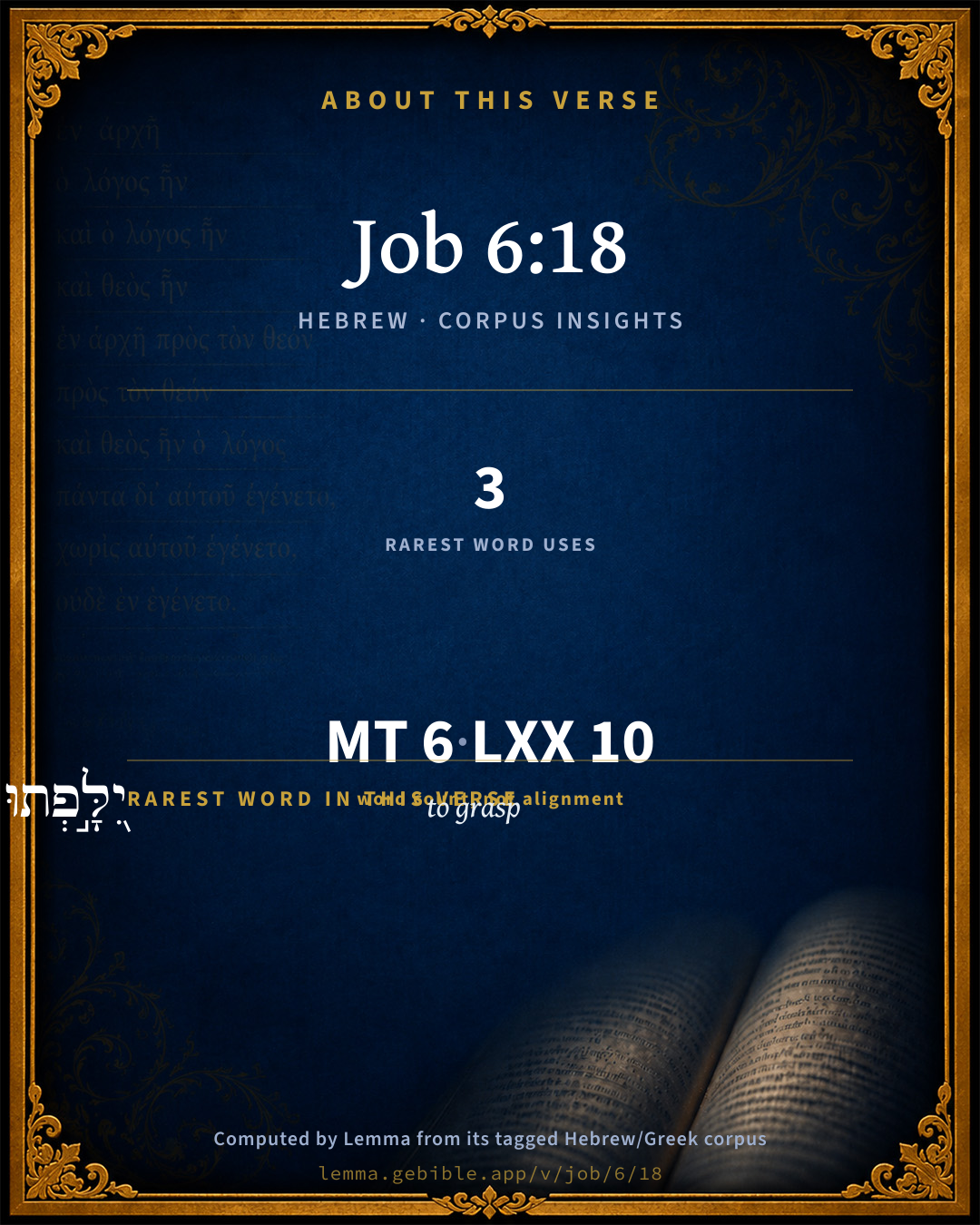
The rarest word here is יִ֭לָּ֣פְתוּ to grasp H3943 — appearing just 3 times in the whole Hebrew Bible.

Shared distinctive vocabulary

יִ֭לָּ֣פְתוּ to grasp H3943 occurs in 3 verses of the Hebrew Bible. Also found in:

Grammatical profile

  • 3 verbs
  • 3 nouns

Verb forms

  • יִ֭לָּ֣פְתוּ Niphal · Imperfect
  • יַעֲל֖וּ Qal · Imperfect
  • וְיֹאבֵֽדוּ Qal · Imperfect

Hebrew & Septuagint length

In English translation the verse runs 16 words from the Hebrew and 16 from the Septuagint (LXX English) — the same length.

A rough comparison of the two English renderings, which tokenize alike — not a word-level alignment.

Word counts can differ between the Hebrew and the Greek without any difference in meaning — e.g. the Hebrew direct-object marker אֵת has no separate Greek word, and Greek often adds the article ὁ.

In the original languages it is 6 Hebrew tokens and 10 Greek tokens — but the two are counted differently (Hebrew bundles its prefixes and suffixes into one token; the Greek is in lemma form), so that isn’t a like-for-like length.

Hebrew and Greek witnesses Masoretic Hebrew ↔ Greek Septuagint

The same verse in the two great witnesses to the Old Testament, shown verse-for-verse.

These are two independent witnesses, not word-aligned to each other, and the Septuagint is shown in lemma (dictionary) form.

Hebrew Job 6:18 Masoretic · Westminster Leningrad Codex

יִ֭לָּ֣פְתוּ אָרְח֣וֹת דַּרְכָּ֑ם יַעֲל֖וּ בַתֹּ֣הוּ וְיֹאבֵֽדוּ

The caravans that travel beside them turn aside; They go up into the waste, and perish.

World English Bible · Public Domain

Greek LXX Job 6:18 Septuagint · lemma form

οὕτως καΐἐγώ καταλείπω ὑπό πᾶς ἀποὀλλύω δέ καί ἔξοικος γίγνομαι

Thus I also have been deserted of all; and I am ruined, and become an outcast.

LXX2012 (modern English Septuagint) · Public Domain

Hebrew: Westminster Leningrad Codex (CC BY 4.0). Greek: Septuagint (public domain); English from LXX2012 (modern English Septuagint) (Public Domain). How the Septuagint differs from the Hebrew →

Commentary

Notes on Job 6:18 from classic Christian and Jewish commentators (each source and its license shown beneath its notes). The classic Christian expositions comment on the surrounding passage and are grouped to its opening verse, so a note may address several verses; the Jewish commentaries on the Tanakh (Rashi and others) are per-verse, so they appear only where the commentator wrote on this verse.

Lemma curates 59 commentaries, every one of them public domain or Creative Commons licensed, each selected and text-cleaned for this edition rather than reprinted as found. About our sources →

The Cambridge Bible for Schools and Colleges

gen. ed. J. J. S. Perowne

18. they go to nothing] Rather, they go up into the waste. The expression go up in Heb. is used when no ascent in the strict sense is meant; it signifies to go inland, into the interior of a region. The streams of these brooks flow out and wind into the desert and are consumed by the heat or lost in the sand. A somewhat different sense is drawn from the words by many writers. The word paths, Job_6:18, is the same as troops or caravans, Job_6:19, and they assume that the reference to the caravans is already made in Job_6:18, rendering: the caravans that go by the way of them (the streams) turn aside, they go up into the desert and perish. In favour of this interpretation it is urged that there is something unnatural in the use of the same word in different senses in two consecutive verses; and that it is customary in the Poets to express a general idea first (Job_6:18) and then to particularize and exemplify it (Job_6:19). On the other hand Ibn Ezra has already remarked that it is not usual for caravans to leave the route and “turn aside” in search of water, a route is selected and formed rather because water is found on it. The danger of the caravan is that it be exhausted before it reach the place where water is known to be, or, as here, that the water may be found dried up.

The Cambridge Bible for Schools and Colleges (gen. ed. J. J. S. Perowne; Cambridge University Press, 1878–1918) — public domain. Text from a community e-Sword module.

Trapp's Complete Commentary

John Trapp

Job 6:18 The paths of their way are turned aside; they go to nothing, and perish.

Ver. 18. The paths of their way are turned aside] i.e. They being (as it were) cut into divers small rivers running here and there, by little and little, and being resolved into vapours, at length quite vanish away (Beza).

They go to nothing, and perish] Metaphora insignis et hieroglyphicum, saith an interpreter; this is an excellent metaphor, and a lively picture of the vanity of such as make a great show of piety and charity, which yet floweth not from the spring of true faith; and therefore cannot but, after a while, go to nothing and perish. A failing brook, saith another, is a clear emblem of a false heart, both to God and man. Lavater thus explaineth the comparison: 1. As brooks run with waters then when there is least need of them; so false friends are most officious when their courtesy might best be spared. 2. As the ice of such brooks is so condensed and hardened that it beareth men, horses, and other things of great weight; so counterfeit friends promise and pretend to be ready to do their utmost to suffer anything for our good and comfort. 3. But as those brooks are dried up in summer, and frozen up in winter, so that we can set no sight on them; in like sort these are not to be found when we are in distress and affliction. 4. As brooks in winter are covered with snow and ice; so these would seem to be whiter than snow when their affections towards us are colder than ice. 5. Lastly, as the ice that was hard and firm, upon a thaw breaketh and melteth; so false friends leave us many times upon very small or no dislikes; as being constant only in their unconstancy.

John Trapp, A Commentary or Exposition upon All the Books of the Old and New Testament (1647–1656) — public domain. Text from a community e-Sword module.

Whedon's Commentary on the Bible

Daniel D. Whedon

Third strophe — Job draws a picture of caravans perishing miserably for the want of water, Job_6:18-20.

18. The paths of their way — Delitzsch, Barnes, Wordsworth, and Zockler, substantially adopt our authorized version. They understand Job still to speak of the streams, that “they wind about;” (are turned aside;) “they go up into the waste (tohu) and vanish.” Others, (Ewald, Dillmann, Noyes, Renan, etc.) more satisfactorily, read, caravans turn aside their course, they go up into the wastes and perish, making a slight change in the pointing of the Hebrew — thus, ארחות, orhhoth, caravans, as in Isa_21:13, instead of ארחות, orhhoth, ways. Delitzsch pertinently puts the argument for the rendering “ways,” by asking “if it be likely that the poet would let the caravans perish in Job_6:18, and in Job_6:19, sq., still live? If so, the feebler figure follows the stronger.” On the other hand it may be replied, 1) That the same objection holds against the rendering of “ways.” The streams have been consumed, “extinguished,” and if they reappear here on their winding way it must be at the creative touch of the poetic wand. 2) Two different and entirely inapposite meanings must be given to substantially the same word, orhhoth, in two successive verses, the 18th and 19th. 3) To say of torrents, even though they wind about, that they go up (עלה) into the waste, is quite absurd, and can here apply only to caravans. Zockler’s conceit, (in Lange,) that they go up in vapours and clouds, does not relieve the difficulty, as tohu does not justify such rendering. 4) The objection of tautology Evans thus happily answers: that the chief motive of the description just given is not to excite pity for the fate of such a caravan, but to justify Job’s resentment at the treachery of which the dry wady is the type. Hence in the verses following, Job emphasizes the disappointment which the caravans of Tema and Sheba (named by way of vivid individualization) would feel in such a plight. See note on next verse.

Daniel D. Whedon (gen. ed.), Commentary on the Old and New Testaments (1874–1909) — public domain. Text from a community e-Sword module.

Keil & Delitzsch

C. F. Keil & F. Delitzsch

18 The paths of their course are turned about,

They go up in the waste and perish.

19 The travelling bands of Tma looked for them,

The caravans of Saba hoped for them;

20 They were disappointed on account of their trust,

They came thus far, and were red with shame.

As the text is pointed, ארחות, Job 6:18, are the paths of the torrents. Hitz., Ew., and Schlottm., however, correct ארחות, caravans, which Hahn even thinks may be understood without correction, since he translates: the caravans of their way are turned about (which is intended to mean: aside from the way that they are pursuing), march into the desert and perish (i.e., because the streams on which they reckoned are dried up). So, in reality, all modern commentators understand it; but is it likely that the poet would let the caravans perish in Job 6:18, and in Job 6:19. still live? With this explanation, Job 6:19. drag along tautologically, and the feebler figure follows the stronger. Therefore we explain as follows: the mountain streams, נחלים, flow off in shallow serpentine brooks, and the shallow waters completely evaporate by the heat of the sun. בתּהוּ עלה signifies to go up into nothing (comp. Isa 40:23), after the analogy of בעשׁן כּלה, to pass away in smoke. Thus e.g., also Mercier: in auras abeunt, in nihilum rediguntur. What next happens is related as a history, Job 6:19., hence the praett. Job compares his friends to the wady swollen by ice and snow water, and even to the travelling bands themselves languishing for water. He thirsts for friendly solace, but the seeming comfort which his friends utter is only as the scattered meandering waters in which the mountain brook leaks out. The sing. בּטח individualizes; it is unnecessary with Olsh. to read בּטחוּ.

Keil & Delitzsch — Biblical Commentary on the Old Testament (1861–1891) — public domain (CC PDM 1.0). Text via the HelloAO Bible API. (Old Testament only.)

Jamieson, Fausset & Brown

Robert Jamieson, A. R. Fausset & David Brown

turned aside--rather, "caravans" (Hebrew, "travellers") turn aside from their way, by circuitous routes, to obtain water. They had seen the brook in spring full of water: and now in the summer heat, on their weary journey, they turn off their road by a devious route to reach the living waters, which they remembered with such pleasure. But, when "they go," it is "into a desert" [NOYES and UMBREIT]. Not as English Version, "They go to nothing," which would be a tame repetition of the drying up of the waters in Job 6:17; instead of waters, they find an "empty wilderness"; and, not having strength to regain their road, bitterly disappointed, they "perish." The terse brevity is most expressive.

Jamieson, Fausset & Brown — Commentary Critical and Explanatory on the Whole Bible (1871) — public domain (CC PDM 1.0). Text via the HelloAO Bible API.

Adam Clarke's Commentary

Verse 18. The paths of their way] They sometimes forsake their ancient channels, which is a frequent case with the river Ganges; and growing smaller and smaller from being divided into numerous streams, they go to nothing and perish - are at last utterly lost in the sands.

Adam Clarke's Commentary on the Bible (1810–1826) — public domain. Text from a community e-Sword/MySword module.

Ellicott's Commentary for English Readers

(18) They go to nothing.—It is doubtful whether this applies to the streams or to the caravans. Thus, “The paths of their way are turned aside and come to nought;” or, “The caravans that travel by the way of them turn aside, and go into the waste and perish.” The nineteenth verse seems to suggest the latter as the more probable.

A Bible Commentary for English Readers, edited by Charles John Ellicott (1878–1897) — public domain. Text from a community e-Sword module.

John Gill's Exposition

The troops of Tema looked,.... A city in Arabia, so called from Tema a son of Ishmael, Gen 25:15; these troops or companies were travelling ones, either that travelled to Tema, or that went from thence to other places for merchandise, see Isa 21:13; these, as they passed along in their caravans, as the Turks their successors now do, looked at those places where in the wintertime they observed large waters frozen over, and covered with snow, and expected to have been supplied from thence in the summer season, for the extinguishing of their thirst:

the companies of Sheba waited for them: another people in Arabia, which went in companies through the deserts, where being in great want of water for their refreshment, waited patiently till they came to those places, where they hoped to find water to relieve them, which they had before marked in the wintertime.

John Gill's Exposition of the Whole Bible (1746–1763) — public domain (CC PDM 1.0). Text via the HelloAO Bible API.

Albert Barnes' Notes on the Bible

The paths of their way are turned aside - Noyes renders this, “The caravans turn aside to them on their way.” Good, “The outlets of their channel wind about.” Rosenmuller, “The bands of travelers direct their journey to them.” Jerome, “Involved are the paths of their steps.” According to the interpretation of Rosenmuller, Noyes, Umbreit, and others, it means that the caravans on their journey turn aside from their regular way in order to find water there; and that in doing it they go up into a desert and perish. According to the other interpretation, it means that the channels of the stream wind along until they diminish and come to nothing. This latter I take to be the true sense of the passage, as it is undoubtedly the most poetical. It is a representation of the stream winding along in its channels, or making new channels as it flows from the mountain, until it diminishes by evaporation, and finally comes to nothing.

They go to nothing - Noyes renders this very singularly, “into the desert,” - meaning that the caravans, when they suppose they are going to a place of refreshment, actually go to a desert, and thus perish. The word used here, however תהוּ tôhû, does not occur in the sense of a desert elsewhere in the Scriptures. It denotes nothingness, emptiness, vanity (see Gen 1:2), and very appropriately expresses the nothingness into which a stream vanishes when it is dried up or lost in the sand. The sense is, that those streams wander along until they become smaller and smaller, and then wholly disappear. They deceive the traveler who hoped to find refreshment there. Streams depending on snows and storms, and having no permanent fountains, cannot be confided in. Pretended friends are like them. In times of prosperity they are full of professions, and their aid is proffered to us. But we go to them when we need their assistance, when we are like the weary and thirsty traveler, and they disappear like deceitful streams in the sands of the desert.

Albert Barnes' Notes on the Bible (1834–1885) — public domain. Text from a community e-Sword/MySword module.

Haydock's Catholic Bible Commentary

Entangled. Like meandering streams, my friends act crookedly. (Menochius)

George Leo Haydock (1774–1849), Haydock's Catholic Family Bible and Commentary, 1859 edition — public domain. Excludes Psalms (Douay-Rheims chapter numbering differs from Protestant) and Deuterocanonical books (Catholic canon only).

Matthew Poole's English Annotations

i.e. The course of those waters is changed, they are gone out of their channel, flowing hither and thither, till they be quite consumed; as it here follows.

Matthew Poole's English Annotations on the Holy Bible (1683–1685) — public domain. Text from a community e-Sword/MySword module.

The Pulpit Commentary

The paths of their way are turned aside; rather, as in the Revised Version, the caravans that travel by the way of them turn aside. It seems impossible that the streams can be intended, since their paths are never "turned aside they simply shrink, fail, and dry up. But nothing is commoner than for caravans short of water to go out of their way in order to reach a wady, where they expect to be able to replenish their water-skins. If they are disappointed, if the wady is dry, they may be brought into great straits, and may even possibly perish. (For a probable instance, where dependence on a wady would, but for a miracle, have led to a great disaster, see 2Ki_3:9-20) They go to nothing, and perish; rather, they go up into the wasteand perish. Having vainly sought water in the dry wady, they ascend out of it, and enter the broad waste of the desert, where they too often miserably perish.

The Pulpit Commentary (1880–1919), ed. H.D.M. Spence-Jones & Joseph S. Exell — public domain. Text from a community e-Sword module.

John Wesley's Explanatory Notes

Perish - They are gone out of their channel, flowing hither and thither, 'till they are quite consumed.

John Wesley, Explanatory Notes Upon the Whole Bible (1754–1765) — public domain. Text via the GEBible commentary corpus.

unfoldingWord translationNotes

Door43 World Missions Community

Connecting Statement:

Job is continuing his description of his friends being as unreliable as streams that dry up. (See: Metaphor)

The caravans that travel by their way turn aside for water

"The caravans turn aside from the routes to find water" or "The caravans change course looking for water"

The caravans

A caravan is a large group of travelers riding camels across the desert.

barren land

"wasteland" or "empty land"

Tema ... Sheba

These are the names of places. The people of these places used caravans to trade things with people from other lands. (See: How to Translate Names)

while companies of Sheba

"while caravans from Sheba"

hoped in them

"hoped for them" or "put their hope in them"

but they were deceived

This can be stated in active form. AT: "but they were disappointed" or "but they were not satisfied" (See: Active or Passive)

translationWords

turn

water

barren

perish

hope

confidence

deceive

unfoldingWord translationNotes — © Distant Shores Media and the Door43 World Missions Community, licensed CC BY-SA 4.0. Source: git.door43.org/Door43/en_tn.

Rashi

Rabbi Shlomo Yitzchaki (Rashi)

are held Heb. ילפתו. They hold the paths of their way, as in (Jud. 16:29), “And Samson grasped (וילפת),” and similarly (Ruth 3:8), “and the man quaked and was taken around (וילפת),” for the woman embraced him.

Rashi on the Tanakh — English translations: “The Judaica Press complete Tanach with Rashi, translated by A. J. Rosenberg” (CC BY 4.0); “Pentateuch with Rashi's commentary by M. Rosenbaum and A.M. Silbermann, 1929-1934” (public domain); “The Metsudah Tanach series, Lakewood, N.J” (CC BY 4.0); and “The Book of Joshua, Metsudah Publications, 1997” (CC BY 4.0). Text via Sefaria.

Lesson kit

Teaching starters — assembled from the data on this page, not authored interpretation. Every prompt links to the verse data it draws on. Edit before teaching.

Job, in the Wisdom, opens this verse with 6 words (6 distinct Hebrew lemmas). Its most distinctive word is lâphath (“to grasp”). A historical commentator’s framing appears above. Read the whole chapter for the surrounding context.

Discussion questions

  1. What does “to grasp” (lâphath) contribute to the verse as a whole?
  2. Judges 16:29 shares the word «to grasp» with this verse. How do the two illuminate each other?
  3. These translations render this verse differently; the difference is in the English rendering, not the original. What questions does that raise?
  4. The verb «יִ֭לָּ֣פְתוּ» is Niphal Imperfect. How does its form color the action?
  5. Reading how The Cambridge Bible for Schools and Colleges and Trapp's Complete Commentary read this verse, where do the two commentators agree and where do they part?

Things to notice

Reading settings

Reading text

Shown beneath each verse's original-language words.

Old Testament
Old Testament edition

Read the OT as the Masoretic Hebrew (MT) or the Greek Septuagint (LXX).

English shown for the Greek Septuagint (in the Hebrew ↔ Greek comparison).

Comparing translations? Open the Compare panel on any verse page to stack up to four side by side.