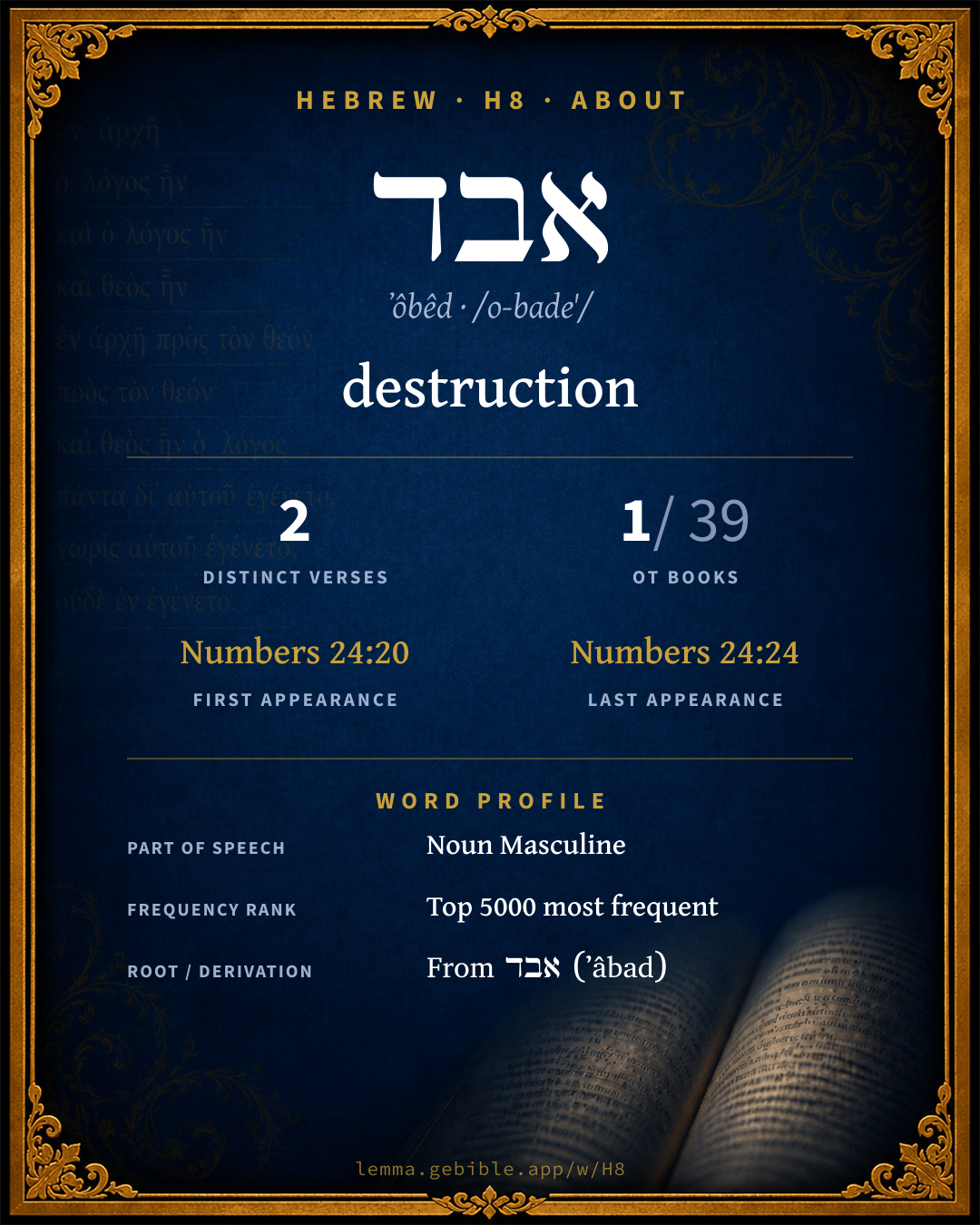
אֹבֵד
destruction
Full lexicon entry — Brown-Driver-Briggs (BDB)
From Brown-Driver-Briggs (BDB)
Where this word appears
Grammar key — what these labels mean
Part of speech
- Noun
- A naming word — a person, place, thing, or idea.
Noun type
- Common
- A common noun — a general class of person, place, or thing (“king,” “city,” “water”), not a specific name.
State
- Absolute
- The independent form of a noun, not bound to a following word.
Gender
- Masculine
- Grammatically masculine.
Number
- Singular
- One.
Every verse where H8 appears — 2 distinct verses across 1 book. Click any verse to open its interlinear word-by-word view. Verse text shown in the World English Bible for context — . Each verse’s Hebrew form is shown with its reference; the English is not keyword-highlighted, since the data carries no word-level English alignment. Use “Compare translations” on any verse to read it across multiple English versions. This concordance covers the Hebrew Bible; Septuagint (Greek Old Testament) occurrences are not indexed here.
Numbers 2 verses
- Numbers 24:20 אֹבֵֽד n c ms He looked at Amalek, and took up his parable, and said, Amalek was the first of the nations; But his latter end shall come to destruction.
- Numbers 24:24 אֹבֵֽד n c ms But ships [shall come] from the coast of Kittim, They shall afflict Asshur, and shall afflict Eber; He also shall come to destruction.
About this entry
At a glance — auto-summarized from this page’s data, not written by a person. Every figure links to its source below. This summary describes the numbers; it doesn’t interpret them.
“destruction” is the headline sense of the Hebrew noun אבד (ʼôbêd). A scarce word — 2 verses in all of the Hebrew Bible. It clusters heavily in Numbers, which alone accounts for 100% of its uses. Scripture first uses it in Numbers 24:20. From the same root come אבד, אבד and אבדה. See the sense tree, 2-verse concordance, and the renderings breakdown below.
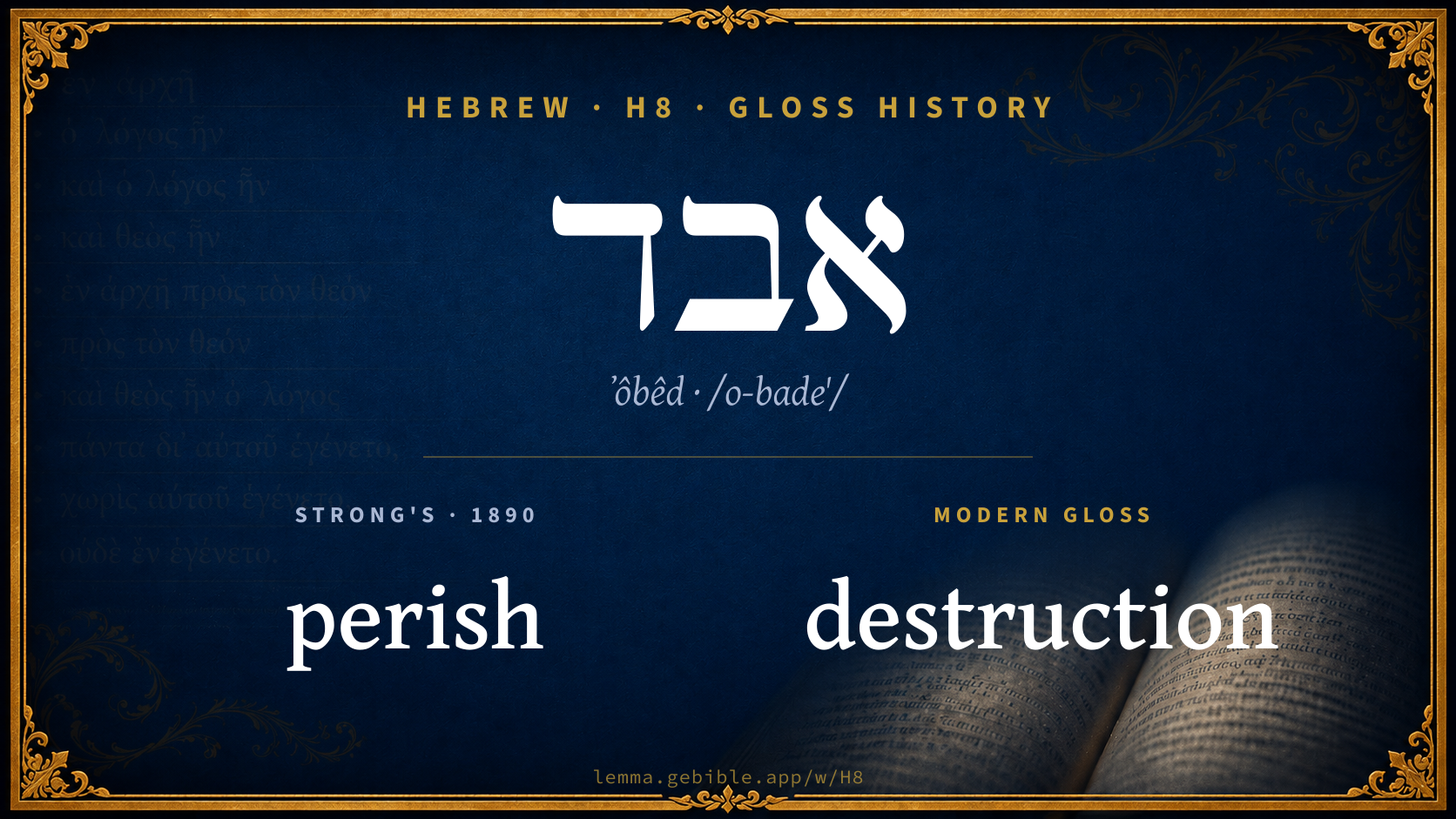
Gloss history
Strong's 1890 vs modern scholarship
About this word
Strong's H8 catalogs a Hebrew word from the Hebrew Old Testament.
These counts are not copied from any lexicon or concordance. They are computed here, from the morphology-tagged Hebrew Old Testament. What Lemma adds →
- 2
- distinct verses
- The word appears in 2 distinct verses.
- 1 / 39
- OT books
- The word appears in 1 of 39 Old Testament books.
- #4,807
- by frequency
- Top 5000 most frequent Hebrew words (rank 4,807 of 8,640 Hebrew words by occurrence).
View all 2 occurrences in the concordance →
Most concentrated in
- Numbers 2 verses 100%
By section of the Old Testament
By traditional corpus
Conventional, traditional groupings — biblical authorship is debated, so this is a traditional corpus grouping, not an authorship claim. Each share is this word’s portion of its verses in that division of the Hebrew canon. Each figure is a share of the word’s 2 distinct verses.
- Torah (Pentateuch) 2 verses · 100%
How translations render this word
Counts come from each version’s own published word-to-Strong’s tagging or interlinear alignment — an approximate guide to how each version renders this word, not a word-level alignment the data otherwise carries. Because each total is that version’s own tagged count, the per-version totals vary from one another and need not match the appearance or distinct-verse counts above. These counts may also differ from a printed concordance because Lemma counts each distinctly tagged rendering and does not collapse phrase taggings into a single head-word total. This is a fixed set of word-tagged versions (KJV, ASV, BSB, ULT) and does not change with the reading translation you choose elsewhere. Each version’s license is shown beside its name below (and on Sources).
- King James Version: End shall be that he perish 1×, He also shall perish 1×
- American Standard Version: Destruction 2×
- Berean Standard Bible: Destruction 1×, Will perish 1×
- unfoldingWord Literal Text: Destruction 2×
King James Version Public Domain
Renders H8 across 2 tagged occurrences — most commonly:
American Standard Version Public Domain
Renders H8 across 2 tagged occurrences — most commonly:
Berean Standard Bible Public Domain
Renders H8 across 2 tagged occurrences — most commonly:
unfoldingWord Literal Text CC BY-SA 4.0
Renders H8 across 2 tagged occurrences — most commonly:
Senses in BDB
The 1 sense BDB distinguishes for this word, in lexicon order (not ranked by frequency or importance). The full entry — with sub-senses — is in the Lexicon Entry tab.
- destruction
Word origin
n.[m.] destruction, עֲדֵי א׳ Nu 24:20, 24 (JE; on form with abstract sense v. BaNB 149).
— Brown-Driver-Briggs (Oxford 1906, public domain), digitized via Sefaria, supplemented by the OpenScriptures HebrewLexicon (CC BY 4.0). See Sources.
Derived from אבד (ʼâbad) (H6) — to perish.
Jastrow Dictionary
A second Hebrew/Aramaic lexicon for comparison, covering Aramaic and post-biblical (Talmudic, Targumic, Midrashic) usage that the biblical-Hebrew BDB does not. Matched by lemma rather than by Strong’s number, so a lemma may carry more than one Jastrow headword (shown separately below), and the entries cover usage well beyond the Bible.
אָבַד
- , v. אבב) to be pressed, go around in despair (v. Prov. XXXI, 6; Deut. XXVI, 6) to be given up, whence e.g. Proverbs 31:6
- 1. to be lost, perish; to be beyond recognition. Sifré Deut. 301 (ref. to Deut. XXVI, 5) לא ירד … אלא לאובד (read לוֹבֵד or לֶאֱבוֹד; Yalk. Deut. a. l. לאבדם prob. לאַבְרָּן; Ms. Zer. Abr. 3 לֵיאָבֵר) Jacob went to Aram with no hope but to perish (be a slave &c.). Ohol. XVII, 3 a field שא׳ בו קבר in which there is a grave that cannot be located. Keth. XIII, 7 אָבְדָה דרך וכ׳ the path to his field cannot be traced. Gen. R. s. 91 אבידה א׳ לנו we have lost something; a. fr. e.g. Deuteronomy 26:5
- 2. to lose. Ib. ואנו שאָבַדְנוּ ר׳ ס׳ and we who have lost (mourn for) R. S.; a. fr.—Part. pass. אָבוּד lost, irretrievable, perishing, decayed. Keth. 108ᵃ על הא׳ on a contribution to the Temple which has been lost on the road. Y. Shebi. IX, 38ᵈ top מאיליהן הן אֲבוּדִין they perish of themselves (they decay naturally); a. fr.
- to be lost, perish. Keth. 104ᵃ; a. fr. Sifré Deut. 301 לֵיאָבֵד, v. supra.
- 1. to waste, lose, forfeit, destroy. Ned. 33ᵇ אי׳ את מעותיו he wasted his money, (cannot reclaim it). Keth. XIII, 6 אי׳ את זכותו he forfeited his claim. Ab. Zar. 55ᵃ אנו נְאַבֵּד וכ׳ shall we give up our honest dealing? Ib. IV, 7 יְאַבֵּד עולמו shall He destroy His world? Ḥag. 3ᵃ ובקשתם לאַבְּדָהּ ממני and you wanted to deprive me of it? Ib. 4ᵃ זה המְאַבֵּד וכ׳ one who destroys what is given to him.—א׳ עצמו לדעת to commit suicide wilfully. Gen. R. s. 82; a. fr.
- 2. to drop from memory, to forget. Aboth V, 12; a. e.
אֲבַּד
- to be lost. Targ. I Sam. IX, 3; a. fr.—Snh. 111ᵃ; a. fr.—Y. Pes. IX, 37ᵃ כאָבִיד הוא it is to be looked upon as lost.
- to destroy. Targ. II Kings, XIX, 18; a. fr.
- 1. = Pa. Targ. Deut. XXVI, 5; a. fr.—Y. Kidd. III, 64ᶜ bot. אובדתא חיין וכ׳ thou hast ruined this man’s (my) life. Gen. R. s. 56 אובדת ליבך thou hast lost thy wits; a. fr.
- 2. to be lost, to go to ruin. Targ. Ps. XLI, 6; a. e.—Y. Ḥag. II, 77ᵇ ווי דמובדין alas for the lost (deceased)! Y. M. Kat. I, beg. 80ᵃ ויובדן and decay.
- to be lost. Lev. R. s. 34 מִתְאַבְּדִין if they should be lost.—מִתְּבִיד = מִתְאֲבִיד Pes. 5ᵇ; a. e. [Lam. R., to IV, 21 לאיבדא, read לאיעבדא, v. עֲבַד.]
אָבֵד
- perishable, irretrievable. דבר הא׳ a business which cannot be postponed without irretrievable loss. M. Kat. 11ᵃ; a. fr.
יְבַד
- Y. Shebi. IX, 38ᵈ אפי׳ צפור … לא יָבְדָּא even a bird perishes not without the will of God; [Gen. R. s. 79, a. e. מתצדא, מצדיא, v. צדי; Midr. Till. to Ps. XVII אתיא (ed. Bub. אתאי); read: אתציד;] Esth. R. to I, 9; Koh. R. to X, 8 יברח (corr. יָבְדָּה).
- to ruin. Targ. Prov. XII, 4 מְיַבְּדָא (ed. Wil. מֵיבְדָא).
- , v. אֲבַד
A Dictionary of the Targumim, the Talmud Babli and Yerushalmi, and the Midrashic Literature (Marcus Jastrow; London, Luzac, 1903) — Public Domain. Digitized via Sefaria. Digitized via Sefaria. Full attribution on Sources.
Same root — word family
Other BDB entries built from the same root as H8, grouped by Strong’s listed origin. These share a root / origin per the lexicon — not necessarily a shared meaning. Each links to that word’s own entry.
Derives from
Shares the same root
- אבד ʼăbad H7 to perish
- אבדה ʼăbêdâh H9 lost thing
- אבדן ʼabdân H12 destruction
- אבדן ʼobdan H13 destruction
Proper names from this root
People and places named from this root — a name, not an additional meaning of the word.
Compare all same-root words → Showing 4 of 7 — not the complete family. 1 of the same-root words is a proper name (a person or place). They share a root, not necessarily a meaning.
Septuagint verse parallels
This word appears in 2 verses that also exist in the Greek Old Testament (Septuagint), out of the 2 Hebrew verses it occurs in. You can read those verses in Greek by switching the Old Testament edition to the Septuagint.
Read these verses in the Septuagint
This is a verse-level parallel only — the same verses exist in both the Hebrew and Greek Old Testaments. No word-level Hebrew↔Greek correspondence is claimed: the data carries no such alignment, so no Greek word is shown as this Hebrew word’s translation. Coverage is not total — the Septuagint omits the deuterocanon and renumbers the Psalms, so some Hebrew verses have no direct Greek parallel.