

Job 29:13

Hebrew (Westminster Leningrad Codex) Job 29:13 appears in the Hebrew Old Testament. The text above is from the Westminster Leningrad Codex. Each word links to its Strong’s number, a concise gloss, and parsing drawn from the Open Scriptures Hebrew Bible morphology. Click any word for its full Brown-Driver-Briggs (BDB) entry.
Download image
Cite this verse

Job 29:13 (World English Bible). Public Domain. Lemma interlinear Bible study tool, https://lemma.gebible.app/v/job/29/13.

Show BibTeX & RIS
BibTeX
RIS
English Translation
The blessing of him who was ready to perish came on me, And I caused the widow's heart to sing for joy.
World English Bible · Public Domain
Download a study sheet

One document with this verse’s original text, its word-by-word gloss line, the meaning frame, cross-references with their text, attributed commentary, and full source and license credits — printable, and it pastes into notes with its structure intact.

This verse Autodidact and up

Study sheet (.html) Plain text (.txt)

A passage Seminary Student

Up to 50 verses in one chapter. A passage sheet keeps up to 6 commentary sources and 12 cross-references per verse, in the order this page ranks them, and says so on the sheet whenever that leaves anything out. Ask for a single verse and you get the Autodidact verse sheet above.

Everything on this page stays free to read, with no account — the sheet is a download of what is already on screen, not access to it.

Want to remove ads? Support Godless Engineer
Compare translations 3

The same verse in 3 English versions, stacked beneath the original-language interlinear above. Click any original word for its lexicon entry.

Each is an independent rendering of the whole verse — the interlinear is not word-aligned to these translations.

Highlighted words mark where these versions differ — a whole-verse word diff, not a word-by-word alignment.

  • World English Bible Public Domain
    The blessing of him who was ready to perish came on me, And I caused the widow's heart to sing for joy.
  • King James Version Public Domain
    The blessing of him that was ready to perish came upon me: and I caused the widow's heart to sing for joy.
  • unfoldingWord Literal Text CC BY-SA 4.0
    The blessing of the one perishing came upon me, and I gladdened the heart of the widow.

unfoldingWord Literal Text — © unfoldingWord, licensed CC BY-SA 4.0. Word-aligned USFM3 via Door43 (git.door43.org/unfoldingWord/en_ult).

Versions to compare (up to 4)

3 of 4 selected

Show all 18 translations

Every available English version of this verse, each an independent rendering of the whole verse.

  • World English Bible Public Domain
    The blessing of him who was ready to perish came on me, And I caused the widow's heart to sing for joy.
  • Berean Standard Bible Public Domain
    The dying man blessed me, and I made the widow’s heart sing for joy.
  • Majority Standard Bible Public Domain
    The dying man blessed me, and I made the widow’s heart sing for joy.
  • King James Version Public Domain
    The blessing of him that was ready to perish came upon me: and I caused the widow's heart to sing for joy.
  • American Standard Version (1901) Public Domain
    The blessing of him that was ready to perish came upon me; And I caused the widow's heart to sing for joy.
  • Revised Version (1885) Public Domain
    The blessing of him that was ready to perish came upon me: and I caused the widow’s heart to sing for joy.
  • Geneva Bible (1599) Public Domain
    The blessing of him that was ready to perish, came vpon me, and I caused the widowes heart to reioyce.
  • Douay-Rheims (1899) Public Domain
    The blessing of him that was ready to perish came upon me, and I comforted the heart of the widow.
  • Young's Literal Translation Public Domain
    The blessing of the perishing cometh on me, And the heart of the widow I cause to sing.
  • Literal Standard Version CC BY-SA 4.0
    The blessing of the perishing comes on me, || And I cause the heart of the widow to sing.
  • Unlocked Literal Bible CC BY-SA 4.0
    The blessing of him who was about to perish came on me; I caused the widow's heart to sing for joy.
  • unfoldingWord Literal Text CC BY-SA 4.0
    The blessing of the one perishing came upon me, and I gladdened the heart of the widow.
  • Darby Bible Public Domain
    The blessing of him that was perishing came upon me, and I caused the widow's heart to sing for joy.
  • World Messianic Bible Public Domain
    the blessing of him who was ready to perish came on me, and I caused the widow’s heart to sing for joy.
  • Webster's Bible Public Domain
    The blessing of him that was ready to perish came upon me: and I caused the widow's heart to sing for joy.
  • Free Bible Version CC BY-SA 4.0
    Those who were about to die blessed me; I made the widow sing for joy.
  • Bible in Basic English Public Domain
    The blessing of him who was near to destruction came on me, and I put a song of joy into the widow's heart.
  • JPS Tanakh (1917) Public Domain
    The blessing of him that was ready to perish came upon me; and I caused the widow's heart to sing for joy.

Literal Standard Version (2020), Covenant Press — licensed CC BY-SA 4.0. Text via the HelloAO Bible API (eBible.org). Unlocked Literal Bible (unfoldingWord) — licensed CC BY-SA 4.0. Text via the HelloAO Bible API (eBible.org). unfoldingWord Literal Text — © unfoldingWord, licensed CC BY-SA 4.0. Word-aligned USFM3 via Door43 (git.door43.org/unfoldingWord/en_ult). Free Bible Version, Dr. Jonathan Gallagher — licensed CC BY-SA 4.0. Text via the HelloAO Bible API (eBible.org).

Word by word

More ways to search: Search by grammar → Find every occurrence → Compare this word →

Practice this passage: Drill this verse → Learn its vocabulary →

אַרְנִֽן
rânan
H7442
“to shout”
Verb, Hiphil, Imperfect, 1st Person, Common, Singular
Part of Speech
Verb
Stem
Hiphil
Form
Imperfect
Person
1st Person
Gender
Common
Number
Singular
Full BDB Definition

Origin: a primitive root

TWOT: 2134 , 2179

to overcome - (Hithpolel) to be overcome - to cry out, shout for joy, give a ringing cry - (Qal) - to give a ringing cry (in joy, exaltation, distress) - to cry aloud (in summons, exhortation of wisdom) - (Piel) to give a ringing cry (in joy, exultation, praise - (Pual) ringing cry, singing out (passive) - (Hiphil) to cause to ring or sing out (for joy) - (Hithpolel) rejoicing (participle)
  1. בִּרְכַּ֣ת Bᵉrâkâh H1293 “blessing of” Noun, Common, Feminine, Singular, Construct
  2. אֹ֭בֵד ʼâbad H6 “perishing” Verb, Qal, Participle Active, Masculine, Singular, Absolute
  3. עָלַ֣י ʻal H5921 “upon · me” Preposition + Suffix, Personal, 1st Person, Common, Singular
  4. תָּבֹ֑א bôwʼ H935 “to enter” Verb, Qal, Imperfect, 3rd Person, Feminine, Singular
  5. וְלֵ֖ב lêb H3820 “and · heart of” Conjunction + Noun, Common, Masculine, Singular, Construct
  6. אַלְמָנָ֣ה ʼalmânâh H490 “widow” Noun, Common, Feminine, Singular, Absolute

About this verse

These counts appear in no published source. They are computed here, from the morphology-tagged text and Lemma’s own curated glosses. What Lemma adds →

7
words
7
distinct lemmas
Wisdom
section

Shared distinctive vocabulary

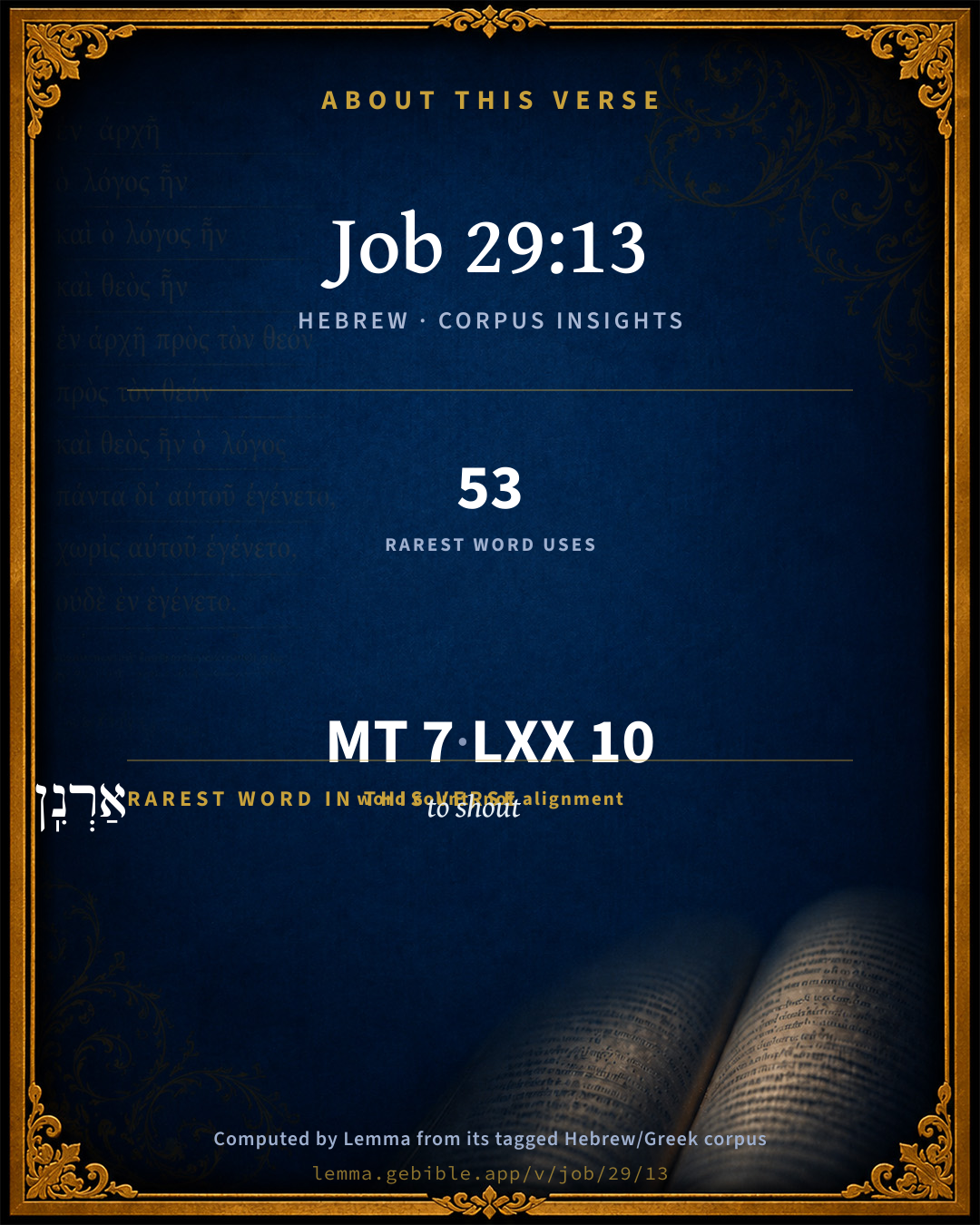
אַרְנִֽן to shout H7442 occurs in 53 verses of the Hebrew Bible. Also found in:

Grammatical profile

  • 3 verbs
  • 3 nouns
  • 1 preposition

Verb forms

  • אֹ֭בֵד Qal · Participle Active
  • תָּבֹ֑א Qal · Imperfect
  • אַרְנִֽן Hiphil · Imperfect

Hebrew & Septuagint length

In English translation the verse runs 22 words from the Hebrew and 19 from the Septuagint (LXX English) — closely comparable.

A rough comparison of the two English renderings, which tokenize alike — not a word-level alignment.

Word counts can differ between the Hebrew and the Greek without any difference in meaning — e.g. the Hebrew direct-object marker אֵת has no separate Greek word, and Greek often adds the article ὁ.

In the original languages it is 7 Hebrew tokens and 10 Greek tokens — but the two are counted differently (Hebrew bundles its prefixes and suffixes into one token; the Greek is in lemma form), so that isn’t a like-for-like length.

Cross-references

14

Topical passages linked to Job 29:13 in the Treasury of Scripture Knowledge — connected by theme and wording, ordered by reader-vote popularity; previews shown in the World English Bible.

  • Job 22:9 You have sent widows away empty, And the arms of the fatherless have been broken.
  • Job 31:19–20 If I have seen any perish for want of clothing, Or that the needy had no covering;
  • Isaiah 27:13 It shall happen in that day, that a great trumpet shall be blown; and they shall come who were ready to perish in the land of Assyria, and those who were outcasts in the land of Egypt; and they shall worship Yahweh in the holy mountain at Jerusalem.
  • 2 Timothy 1:16–18 May the Lord grant mercy to the house of Onesiphorus, for he often refreshed me, and was not ashamed of my chain,
  • Philemon 1:7 For we have much joy and comfort in your love, because the hearts of the saints have been refreshed through you, brother.
  • Deuteronomy 16:11 and you shall rejoice before Yahweh your God, you, and your son, and your daughter, and your man-servant, and your maid-servant, and the Levite who is within your gates, and the foreigner, and the fatherless, and the widow, who are in the midst of you, in the place which Yahweh your God shall choose, to cause his name to dwell there.
  • Deuteronomy 24:13 you shall surely restore to him the pledge when the sun goes down, that he may sleep in his garment, and bless you: and it shall be righteousness to you before Yahweh your God.
  • Deuteronomy 26:5 You shall answer and say before Yahweh your God, A Syrian ready to perish was my father; and he went down into Egypt, and sojourned there, few in number; and he became there a nation, great, mighty, and populous.
  • Nehemiah 8:10–12 Then he said to them, Go your way, eat the fat, and drink the sweet, and send portions to him for whom nothing is prepared; for this day is holy to our Lord: neither be you grieved; for the joy of Yahweh is your strength.
  • Psalms 67:4 Oh let the nations be glad and sing for joy, For you will judge the peoples with equity, And govern the nations on earth. Selah.
  • Proverbs 31:6–9 Give strong drink to him who is ready to perish; And wine to the bitter in soul:
  • Isaiah 65:14 behold, my servants shall sing for joy of heart, but you shall cry for sorrow of heart, and shall wail for vexation of spirit.
  • Acts 9:39–41 Peter got up and went with them. When he had come, they brought him into the upper chamber. All the widows stood by him weeping, and showing the coats and garments which Dorcas had made while she was with them.
  • 2 Corinthians 9:12–14 For this service of giving that you perform not only makes up for lack among the saints, but abounds also through many givings of thanks to God;

Cross-references courtesy of OpenBible.info (CC BY 4.0).

Hebrew and Greek witnesses Masoretic Hebrew ↔ Greek Septuagint

The same verse in the two great witnesses to the Old Testament, shown verse-for-verse.

These are two independent witnesses, not word-aligned to each other, and the Septuagint is shown in lemma (dictionary) form.

Hebrew Job 29:13 Masoretic · Westminster Leningrad Codex

בִּרְכַּ֣ת אֹ֭בֵד עָלַ֣י תָּבֹ֑א וְלֵ֖ב אַלְמָנָ֣ה אַרְנִֽן

The blessing of him who was ready to perish came on me, And I caused the widow's heart to sing for joy.

World English Bible · Public Domain

Greek LXX Job 29:13 Septuagint · lemma form

εὐλογία ἀποὀλλύω ἐπί ἐγώ ἔρχομαι στόμα δέ χήρα ἐγώ εὐλογέω

Let the blessing of the perishing one come upon me; yes, the mouth of the widow has blessed me.

LXX2012 (modern English Septuagint) · Public Domain

Hebrew: Westminster Leningrad Codex (CC BY 4.0). Greek: Septuagint (public domain); English from LXX2012 (modern English Septuagint) (Public Domain). How the Septuagint differs from the Hebrew →

Commentary

Notes on Job 29:13 from classic Christian and Jewish commentators (each source and its license shown beneath its notes). The classic Christian expositions comment on the surrounding passage and are grouped to its opening verse, so a note may address several verses; the Jewish commentaries on the Tanakh (Rashi and others) are per-verse, so they appear only where the commentator wrote on this verse.

Lemma curates 59 commentaries, every one of them public domain or Creative Commons licensed, each selected and text-cleaned for this edition rather than reprinted as found. About our sources →

Trapp's Complete Commentary

John Trapp

Job 29:13 The blessing of him that was ready to perish came upon me: and I caused the widow’s heart to sing for joy.

Ver. 13. The blessing of him that was ready to perish came upon me] Such poor creatures as were destined to destruction, and seasonably delivered by my means, gave me their good words and wishes; yea, they cried me up for their gracious deliverer, with a courage, as the Grecians did Flaminius, the Roman general, as the Christian captives did Hunniades, who had set them at liberty from Turkish slavery; as the drowning man pulled out of the water by King Alphonsus, cried, Arragon, Arragon; and as the Italian prisoners in ‘88, released and sent home by Queen Elizabeth, sainted her, and said, That although they were Papists, yet they would worship no saint but her.

And I caused the widow’s heart to sing for joy] sc. By ready righting her upon her adversary; and this out of conscience of duty, and not for her importunity, as that unjust judge, Luk 18:5, or because she conjured him to it, as that widow did Adrian the emperor, to whom, when he had answered, That he was not at leisure to hear her cause, she boldly replied, Kαι μη Bασιλευε, Then lay down the empire. Whereupon he turned again, and did her right, and sent her away a joyful woman (Dio in Adrian).

John Trapp, A Commentary or Exposition upon All the Books of the Old and New Testament (1647–1656) — public domain. Text from a community e-Sword module.

The Biblical Illustrator

Joseph S. Exell

Job_29:13

The blessing of him that was ready to perish.

The blessedness of doing good

I. Job had the blessing of those ready to perish.

1. A man may be ready to perish through adverse circumstances.

2. Or by some imminent danger and peril to which he is exposed.

3. In such cases men of pure benevolence interpose to save the poor unhappy wretch who is ready to perish.

4. How many in the moral world are ready to perish by their sins and iniquities. The blessing of him who is ready to perish comes on the man who relieves the needy, rescues them that are exposed to danger, and who converteth a sinner from the error of his ways.

II. Job had caused the widows heart to sing for joy.

1. Widows are placed in very distressing circumstances.

2. Often she has a large family left to her care.

3. The world is ever ready to take advantage of a desolate widow.

4. Job was kind to widows in the days of his prosperity. His conduct was generous and noble, and worthy of a great and good man. Let us imitate the example of Job. Inferences--

(1) Acts of benevolence are good proofs of a renewed heart.

(2) Those who are kind to others will be abundantly repaid.

(3) In the day of judgment works of mercy will be brought forward as evidences of piety. (Sketches of Four Hundred Sermons.)

Rescue the perishing

I. An urgent necessity. Ready to perish. Oh that we all might go to the help of the poor, who are ready to perish in the midst of the ocean of drunkenness, misery, and wretchedness. There is a want of sympathy. We find it in all classes. Men are perishing about us for want of the power of the Gospel.

II. An assured recompense. There is a sure recompense, if you will do Gods bidding. Be an enthusiast. Seek out the perishing people, and risk yourselves in the service of the Lord Jesus Christ.

III. A personal enjoyment. There has been One who, in order to save you, gave Himself. Let your blessing come upon Him as you stand in faith at the foot of the Cross. This personal enjoyment can only come to us when we are true Christians. (William Birch.)

The Biblical Illustrator, edited by Joseph S. Exell (c. 1880s–1900s) — public domain. Text from a community e-Sword module.

Joseph Benson's Commentary

Job 29:13. The blessing of him that was ready to perish — Who was in danger of losing his life or estate, by the malice and tyranny of wicked men; came upon me — Both he, and others for his sake, blessed me, and begged that God would bless me. I caused the widow’s heart to sing for joy — For her great and unexpected deliverance. Widows are the common objects of injuries and oppressions, because they are generally unable to defend themselves from the violence of their oppressors, or to offend those who molest them.

Joseph Benson's Commentary on the Old and New Testaments (1811–1818) — public domain. Text from a community e-Sword module.

Geneva Bible (1599)

Geneva Bible translators

That is, I did succor him that was in distress, and so he had cause to praise me.

Geneva Bible (1599) marginal notes — public domain. Text via Bolls.life.

Jamieson, Fausset & Brown

Robert Jamieson, A. R. Fausset & David Brown

So far was I from sending "widows" away empty (Job 22:9).

ready to perish-- (Pro 31:6).

Jamieson, Fausset & Brown — Commentary Critical and Explanatory on the Whole Bible (1871) — public domain (CC PDM 1.0). Text via the HelloAO Bible API.

John Gill's Exposition

The blessing of him that was ready to perish came upon me,.... That were ready to perish through the oppression of others, or through want of the necessaries of life, or through false charges brought, and through false witness bore against them, and so liable to a sentence of condemnation to death, or having it passed upon them; but Job taking their part, and searching thoroughly into their cause, not only respited them from destruction, but cleared them from the charges laid against them, and which brought the blessing of those persons on him; who blessed God for him, and blessed him, wished a blessing on him in their prayers to God, who had been such a happy instrument of their deliverance from ruin and destruction; see Pro 24:11;

and I caused the widow's heart to sing for joy; by relieving her wants, defending her cause, and punishing those that oppressed her; which is the reverse of the character Eliphaz gives of Job, Job 22:9.

John Gill's Exposition of the Whole Bible (1746–1763) — public domain (CC PDM 1.0). Text via the HelloAO Bible API.

Albert Barnes' Notes on the Bible

The blessing of him that was ready to perish ... - Of the man who was falsely accused, and who was in danger of being condemned, or of him who was exposed to death by poverty and want.

And I caused the widow’s heart to sing for joy - By becoming her patron and friend; by vindicating her cause, and saving her from the oppressive exactions of others; compare Isa 1:17.

Albert Barnes' Notes on the Bible (1834–1885) — public domain. Text from a community e-Sword/MySword module.

Matthew Poole's English Annotations

The blessing, wherewith both he and others for his sake blessed me, and begged that God would bless me.

To perish; to lose his life or estate by the malice and tyranny of wicked men.

The widow’s heart; who are the common objects of injuries and oppressions, because for the most part they are unable, either to offend those who molest them, or to defend themselves from their violence.

To sing for joy, for her great and unexpected deliverance.

Matthew Poole's English Annotations on the Holy Bible (1683–1685) — public domain. Text from a community e-Sword/MySword module.

The Pulpit Commentary

The blessing of him that was ready to perish came upon me (comp. ver. 11). Oppression in the East sometimes drives its victims to actual starvation or to suicide. Isaiah calls the oppressors against whom he inveighs "murderers". (Isa_1:21) These "perishing" ones Job often saved, and they "blessed" him. And I caused the widow"s heart to sing for joy. How cold are the words of Ameni, "No widow have I oppressed," compared with these! Job was not content with mere abstinence from evil, mere negative virtue. He so actively and effectually relieved distress that affliction was turned into happiness, and lamentation into rejoicing.

"The blessing of him that was ready to perish.

I WHY IT IS VALUABLE. We cannot but be struck with this beautiful trait in Job"s autobiographical sketch. It is better than all renown. The clamours of the multitude are poor plaudits compared with the blessing of the poor. Many people may be indifferent to it. They may be satisfied if only they can grasp power, and compel the homage of the great, although their path is followed by "curses not loud, but deep." Cruel conquerors, ruthless tyrants, hard-hearted men of the world, know nothing of the blessing Job here describes. Yet it is solid and teal.

1. It springs from true appreciation. This is no superficial praise required by custom or prompted by shallow motives. It arises out of a genuine perception of goodness.

2. It is characterized by gratitude. Thus it con-talus warmer feelings than those of admiration. An element of awakening affection enters into it. Now, it is better to be loved by the obscure than to be merely honoured by the great; it is better to be loved by a few than to be applauded by a multi-rode.

3. It is accompanied by the approval of Christ. He tells us that what we do to one of the least of his brethren we do to him. He commends the good Samaritan to us as an approved example. Therefore the gratitude of the humble poor carries with it the smile of Heaven.

4. It is powerful for good. Men try to win the favour of the great who can do much for them, and selfishly disregard the opinions of the poor who seem to have power to do them but little good or harm. Yet the blessings of the helpless are prayers to the great Friend of the helpless. They bring down the blessings of God. Happy is the man who lives under these conditions!

II HOW IT IS EARNED.

1. By means of genuine goodness. Clamours of applause may be won by very equivocal conduct. Superficial things may excite extraordinary admiration. People rush to stare and shout after any celebrity. But they want to know more before they will bless one. This devout well-wishing and praying for a person which we call blessing can only be earned by real and solid goodness.

2. Through the exercise of sympathy. The helpless and perishing may be constrained to avail themselves of favours tossed to them from a distance by a hand of proud patronage, and perhaps even of scornful contempt, But if there is no grace in the gift there will be little gratitude in the reception of it. If we would earn the blessing of the helpless we must win their love, and in order to do that we must manifest love to them. Sympathy unlocks the fountains of the heart.

3. In deeds of active helpfulness. If the sympathy is genuine it will lead spontaneously to such deeds. We cannot truly sympathize with a person in trouble without desiring to help him. Now, the active helpfulness will be the sign and seal of the sympathy. This it was that secured Job"s place in the heart of the poor. Men have heaped honours on the head of the "Happy Warrior." The time has come when we should revive the better glories of Job"s days. If we desire to win a position in the world, let us save our ambition from sordid or even wicked aims. Let him be first in love and service who would be first in honour. This is Christ"s rule. W.F.A. (Mar_9:35)

The Pulpit Commentary (1880–1919), ed. H.D.M. Spence-Jones & Joseph S. Exell — public domain. Text from a community e-Sword module.

Rashi

Rabbi Shlomo Yitzchaki (Rashi)

The blessing of the lost who died because of his iniquity and was banished.

would come upon me because I would sustain his children and his wife. Our Sages said, however, that he [Job] would rob the orphans of their field, improve it and [then] return it to them (Baba Bathra 16a). But the simple meaning of the verse does not appear to be so, for no one is called אובד, but a thing that is itself lost, like (Ps. 31:13), “like a lost vessel”; and so (ibid. 119:176), “I have gone astray like a lost sheep”, (Jer. 50:6), “lost sheep.”

and I would make the widow’s heart sing for joy for he would attach his name to widows, saying, “She is my kinswoman,” or “I will marry her,” in order that men should be anxious to marry her.

Rashi on the Tanakh — English translations: “The Judaica Press complete Tanach with Rashi, translated by A. J. Rosenberg” (CC BY 4.0); “Pentateuch with Rashi's commentary by M. Rosenbaum and A.M. Silbermann, 1929-1934” (public domain); “The Metsudah Tanach series, Lakewood, N.J” (CC BY 4.0); and “The Book of Joshua, Metsudah Publications, 1997” (CC BY 4.0). Text via Sefaria.

Lesson kit

Teaching starters — assembled from the data on this page, not authored interpretation. Every prompt links to the verse data it draws on. Edit before teaching.

Job, in the Wisdom, opens this verse with 7 words (7 distinct Hebrew lemmas). Its most distinctive word is rânan (“to shout”). A historical commentator’s framing appears above. Read the whole chapter for the surrounding context.

Discussion questions

  1. How does “to shout” (rânan) shape what this verse is saying?
  2. Leviticus 9:24 shares the word «to shout» with this verse. How do the two illuminate each other?
  3. These translations render this verse differently; the difference is in the English rendering, not the original. What questions does that raise?
  4. The verb «אֹ֭בֵד» is Qal Participle Active. How does its form color the action?
  5. Reading how Trapp's Complete Commentary and The Biblical Illustrator read this verse, where do the two commentators agree and where do they part?

Things to notice

Reading settings

Reading text

Shown beneath each verse's original-language words.

Old Testament
Old Testament edition

Read the OT as the Masoretic Hebrew (MT) or the Greek Septuagint (LXX).

English shown for the Greek Septuagint (in the Hebrew ↔ Greek comparison).

Comparing translations? Open the Compare panel on any verse page to stack up to four side by side.