

Job 31:19

Hebrew (Westminster Leningrad Codex) Job 31:19 appears in the Hebrew Old Testament. The text above is from the Westminster Leningrad Codex. Each word links to its Strong’s number, a concise gloss, and parsing drawn from the Open Scriptures Hebrew Bible morphology. Click any word for its full Brown-Driver-Briggs (BDB) entry.
Download image
Cite this verse

Job 31:19 (World English Bible). Public Domain. Lemma interlinear Bible study tool, https://lemma.gebible.app/v/job/31/19.

Show BibTeX & RIS
BibTeX
RIS
English Translation
If I have seen any perish for want of clothing, Or that the needy had no covering;
World English Bible · Public Domain
Download a study sheet

One document with this verse’s original text, its word-by-word gloss line, the meaning frame, cross-references with their text, attributed commentary, and full source and license credits — printable, and it pastes into notes with its structure intact.

This verse Autodidact and up

Study sheet (.html) Plain text (.txt)

A passage Seminary Student

Up to 50 verses in one chapter. A passage sheet keeps up to 6 commentary sources and 12 cross-references per verse, in the order this page ranks them, and says so on the sheet whenever that leaves anything out. Ask for a single verse and you get the Autodidact verse sheet above.

Everything on this page stays free to read, with no account — the sheet is a download of what is already on screen, not access to it.

Want to remove ads? Support Godless Engineer
Compare translations 3

The same verse in 3 English versions, stacked beneath the original-language interlinear above. Click any original word for its lexicon entry.

Each is an independent rendering of the whole verse — the interlinear is not word-aligned to these translations.

Highlighted words mark where these versions differ — a whole-verse word diff, not a word-by-word alignment.

  • World English Bible Public Domain
    If I have seen any perish for want of clothing, Or that the needy had no covering;
  • King James Version Public Domain
    If I have seen any perish for want of clothing, or any poor without covering;
  • unfoldingWord Literal Text CC BY-SA 4.0
    If I have seen one perishing from lack of clothing or there was not a covering for the needy,

unfoldingWord Literal Text — © unfoldingWord, licensed CC BY-SA 4.0. Word-aligned USFM3 via Door43 (git.door43.org/unfoldingWord/en_ult).

Versions to compare (up to 4)

3 of 4 selected

Show all 18 translations

Every available English version of this verse, each an independent rendering of the whole verse.

  • World English Bible Public Domain
    If I have seen any perish for want of clothing, Or that the needy had no covering;
  • Berean Standard Bible Public Domain
    if I have seen one perish for lack of clothing, or a needy man without a cloak,
  • Majority Standard Bible Public Domain
    if I have seen one perish for lack of clothing, or a needy man without a cloak,
  • King James Version Public Domain
    If I have seen any perish for want of clothing, or any poor without covering;
  • American Standard Version (1901) Public Domain
    If I have seen any perish for want of clothing, Or that the needy had no covering;
  • Revised Version (1885) Public Domain
    If I have seen any perish for want of clothing, or that the needy had no covering;
  • Geneva Bible (1599) Public Domain
    If I haue seene any perish for want of clothing, or any poore without couering,
  • Douay-Rheims (1899) Public Domain
    If I have despised him that was perishing for want of clothing, and the poor man that had no covering:
  • Young's Literal Translation Public Domain
    If I see `any' perishing without clothing, And there is no covering to the needy,
  • Literal Standard Version CC BY-SA 4.0
    If I see [any] perishing without clothing, || And there is no covering for the needy,
  • Unlocked Literal Bible CC BY-SA 4.0
    If I have seen anyone perish for lack of clothing, or if I have seen that a needy man had no clothing;
  • unfoldingWord Literal Text CC BY-SA 4.0
    If I have seen one perishing from lack of clothing or there was not a covering for the needy,
  • Darby Bible Public Domain
    If I have seen any perishing for want of clothing, or any needy without covering;
  • World Messianic Bible Public Domain
    if I have seen any perish for want of clothing, or that the needy had no covering;
  • Webster's Bible Public Domain
    If I have seen any perish for want of clothing, or any poor without covering;
  • Free Bible Version CC BY-SA 4.0
    If ever I saw someone needing clothes, the poor without anything to wear,
  • Bible in Basic English Public Domain
    If I saw one near to death for need of clothing, and that the poor had nothing covering him;
  • JPS Tanakh (1917) Public Domain
    If I have seen any wanderer in want of clothing, or that the needy had no covering;

Literal Standard Version (2020), Covenant Press — licensed CC BY-SA 4.0. Text via the HelloAO Bible API (eBible.org). Unlocked Literal Bible (unfoldingWord) — licensed CC BY-SA 4.0. Text via the HelloAO Bible API (eBible.org). unfoldingWord Literal Text — © unfoldingWord, licensed CC BY-SA 4.0. Word-aligned USFM3 via Door43 (git.door43.org/unfoldingWord/en_ult). Free Bible Version, Dr. Jonathan Gallagher — licensed CC BY-SA 4.0. Text via the HelloAO Bible API (eBible.org).

Word by word

More ways to search: Search by grammar → Find every occurrence → Compare this word →

Practice this passage: Drill this verse → Learn its vocabulary →

About this verse

These counts appear in no published source. They are computed here, from the morphology-tagged text and Lemma’s own curated glosses. What Lemma adds →

8
words
8
distinct lemmas
Wisdom
section

Notable vocabulary

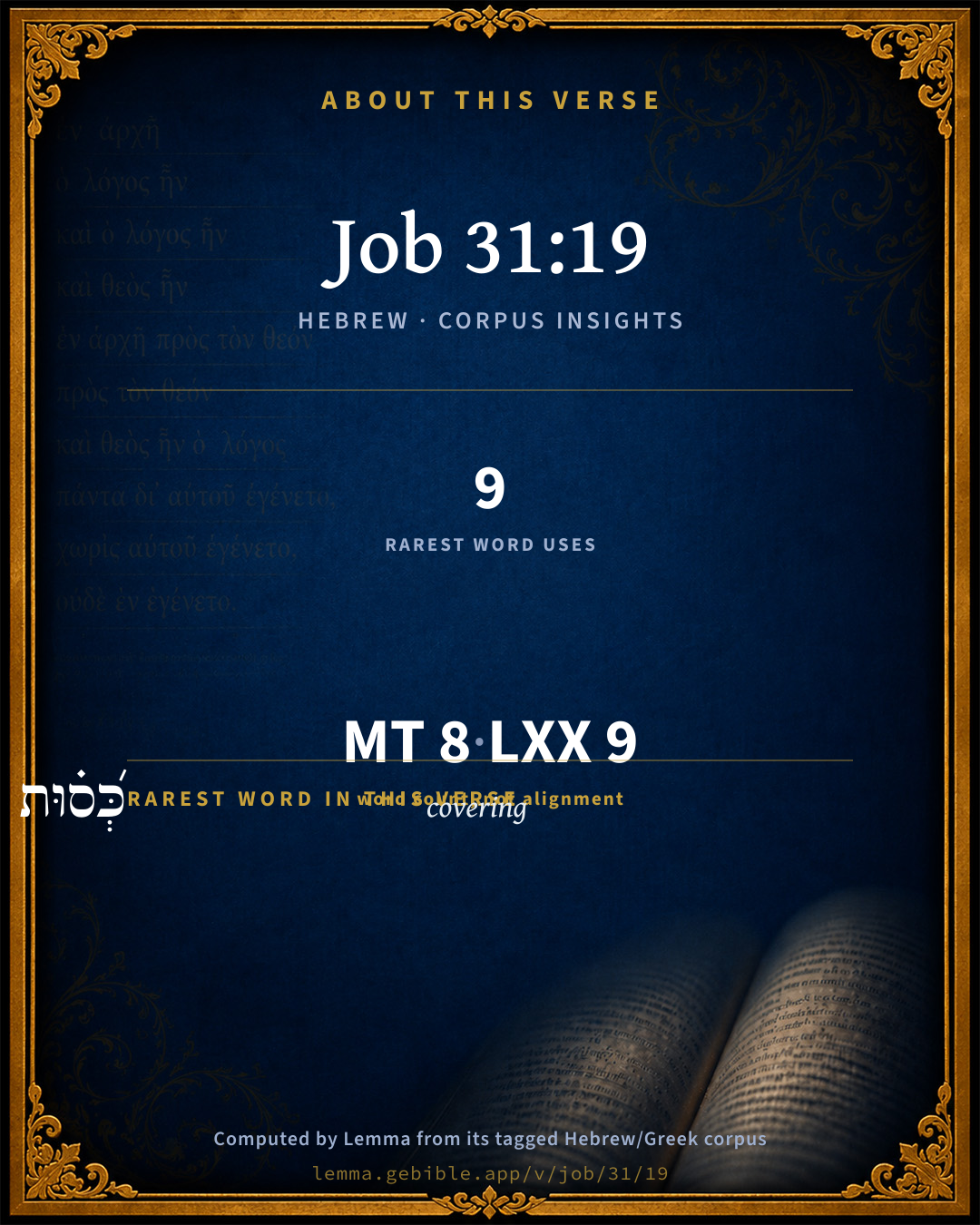
The rarest word here is כְּ֝ס֗וּת covering H3682 — appearing just 9 times in the whole Hebrew Bible.

Shared distinctive vocabulary

כְּ֝ס֗וּת covering H3682 occurs in 8 verses of the Hebrew Bible. Also found in:

Grammatical profile

  • 2 verbs
  • 3 nouns
  • 1 adjective
  • 1 conjunction
  • 1 particle

Verb forms

  • אֶרְאֶ֣ה Qal · Imperfect
  • א֭וֹבֵד Qal · Participle Active

Hebrew & Septuagint length

In English translation the verse runs 17 words from the Hebrew and 16 from the Septuagint (LXX English) — closely comparable.

A rough comparison of the two English renderings, which tokenize alike — not a word-level alignment.

Word counts can differ between the Hebrew and the Greek without any difference in meaning — e.g. the Hebrew direct-object marker אֵת has no separate Greek word, and Greek often adds the article ὁ.

In the original languages it is 8 Hebrew tokens and 9 Greek tokens — but the two are counted differently (Hebrew bundles its prefixes and suffixes into one token; the Greek is in lemma form), so that isn’t a like-for-like length.

Cross-references

11

Topical passages linked to Job 31:19 in the Treasury of Scripture Knowledge — connected by theme and wording, ordered by reader-vote popularity; previews shown in the World English Bible.

  • Job 22:6 For you have taken pledges from your brother for nothing, And stripped the naked of their clothing.
  • 1 John 3:18 My little children, let's not love in word only, neither with the tongue only, but in deed and truth.
  • 2 Chronicles 28:15 The men who have been mentioned by name rose up, and took the captives, and with the spoil clothed all who were naked among them, and arrayed them, and shod them, and gave them to eat and to drink, and anointed them, and carried all the feeble of them on donkeys, and brought them to Jericho, the city of palm trees, to their brothers: then they returned to Samaria.
  • Job 24:4 They turn the needy out of the way. The poor of the earth all hide themselves.
  • Job 29:13 The blessing of him who was ready to perish came on me, And I caused the widow's heart to sing for joy.
  • Isaiah 58:7 Isn't it to deal your bread to the hungry, and that you bring the poor who are cast out to your house? when you see the naked, that you cover him; and that you not hide yourself from your own flesh?
  • Matthew 25:36 naked, and you clothed me; I was sick, and you visited me; I was in prison, and you came to me.'
  • Matthew 25:43 I was a stranger, and you didn't take me in; naked, and you didn't clothe me; sick, and in prison, and you didn't visit me.'
  • Luke 3:11 He answered them, "He who has two coats, let him give to him who has none. He who has food, let him do likewise."
  • Acts 9:39 Peter got up and went with them. When he had come, they brought him into the upper chamber. All the widows stood by him weeping, and showing the coats and garments which Dorcas had made while she was with them.
  • James 2:16 and one of you tells them, "Go in peace, be warmed and filled;" and yet you didn't give them the things the body needs, what good is it?

Cross-references courtesy of OpenBible.info (CC BY 4.0).

Hebrew and Greek witnesses Masoretic Hebrew ↔ Greek Septuagint

The same verse in the two great witnesses to the Old Testament, shown verse-for-verse.

These are two independent witnesses, not word-aligned to each other, and the Septuagint is shown in lemma (dictionary) form.

Hebrew Job 31:19 Masoretic · Westminster Leningrad Codex

אִם אֶרְאֶ֣ה א֭וֹבֵד מִבְּלִ֣י לְב֑וּשׁ וְאֵ֥ין כְּ֝ס֗וּת לָאֶבְיֽוֹן

If I have seen any perish for want of clothing, Or that the needy had no covering;

World English Bible · Public Domain

Greek LXX Job 31:19 Septuagint · lemma form

εἰ δέ καί ὑπερὁράω γυμνός ἀποὀλλύω καί οὐ ἀμφιάζω

And if too I overlooked the naked as he was perishing, and did not clothe him;

LXX2012 (modern English Septuagint) · Public Domain

On this verse, Keil & Delitzsch discusses the Septuagint’s reading. Read the note in Commentary ↓

Hebrew: Westminster Leningrad Codex (CC BY 4.0). Greek: Septuagint (public domain); English from LXX2012 (modern English Septuagint) (Public Domain). How the Septuagint differs from the Hebrew →

Commentary

Notes on Job 31:19 from classic Christian and Jewish commentators (each source and its license shown beneath its notes). The classic Christian expositions comment on the surrounding passage and are grouped to its opening verse, so a note may address several verses; the Jewish commentaries on the Tanakh (Rashi and others) are per-verse, so they appear only where the commentator wrote on this verse.

Lemma curates 59 commentaries, every one of them public domain or Creative Commons licensed, each selected and text-cleaned for this edition rather than reprinted as found. About our sources →

Trapp's Complete Commentary

John Trapp

Job 31:19 If I have seen any perish for want of clothing, or any poor without covering;

Ver. 19. If I have seen any perish for want of clothing] Job was ad omnem humanitatem effectus atque assuefactus. This liberal man devised liberal things; and as he dealt his bread to the hungry, so when he saw the naked he covered him; he hid not himself from his own flesh, Isa 58:7. Giles, of Brussels, and Mr Wiseheart, the Scot, are famous among the martyrs for their charity in this kind. And so is Mr Fox, the martyrologer, of whom it is reported, that as he gave away his horse at one time to a poor man when he had no money to give him; so at another, having bestowed his wife’s money in a petticoat, and meeting by the way home with a poor woman that wanted clothing, he freely gave it to her; telling his wife that he had sent it to heaven before her. The poor man’s belly is surely the best cupboard, and his back the best wardrobe; Ubi non pereunt, sed parturiunt, where they rot not, as those moth eaten ones in St James, Jas 5:2, but remain for ever. Great Alexander believed this far better than most among us, for when he had given away all almost, and his friends asked him, where it was? he pointed to the poor and said, In scriniis, in my chests. And when he was further asked, what he kept for himself.; he answered, Spem maiorum et meliorum, The hope of greater and better things. And another of his name, viz. Pope Alexander V, was so liberal to the poor, that he left nothing to himself; so that he would merrily say, that he was a rich bishop, a poor cardinal, and a beggarly pope, Wποποι. It was wont to be said,

Pauperibus sun dat gratis, nec munera curat

Curia Papalis; quod modo percipimus.

But this distich must be read backwards, saith mine author (Heidfeld.), thus, Percipimus modo quod Papalis, &c. This Pope Alexander then was a rare bird at Rome.

Or any poor without covering] Whether he craved it of me or not, if I did but see it, the poor creature was sure of it. The liberal man helps the poor and needy, Psa 41:1. Praeoccupat vocem petituri, so Augustine expounds that text in Psa 103:1-22 He stays not till he is asked a good turn, but ministereth to the uses, not only to the necessities, of the saints, as the apostle’s word is in the original, Rom 12:13, ταις χρειαις. So did Dr Taylor, martyr, when he visited the almshouse in his parish once a fortnight to see what they lacked, and to supply them. And so did Mr Fox, when, unasked, he gave the poor woman the petticoat, as above said.

John Trapp, A Commentary or Exposition upon All the Books of the Old and New Testament (1647–1656) — public domain. Text from a community e-Sword module.

The Biblical Illustrator

Joseph S. Exell

Job_31:19

If I have seen any perish for want of clothing.

A good mans righteousness

These words do in general set forth the practice of a good man in the acts of mercy and righteousness, which do, above all others, declare him a follower of our blessed Lord. But chiefly they do imply something concerning the nature, manner, and object of those acts. In vulgar practice indeed men care not much for any acquaintance with the needy, and are all for doing kindnesses to them whose fortunes do not require it, or who can return the same again; but the good mans behaviour is like that of Job. If we care not to approve ourselves to God, by doing all the good we can to our brethren, we are so far sunk into the miserable state of hell. To prevent this misery we must be watchful over our minds, that they do not fall into a covetous humour, which is a stain to the soul, that can hardly be got out. Covetousness ever presses upon the sinner, and leaves no room for a sober or a relenting thought. Mankind seem to be distinguished into higher and lower ranks by Divine wisdom and providence, in order to the exercise of an universal charity. Such a charity as sweetens mens spirits, and from being rough and sour, makes them kind and affable to the meanest person, ready to oblige everyone with a gentle and humble compliance. Such a charity as envies no man, but is pleased at the prosperity of others, is made better by their health, and rejoices at seeing them cheerful. Such a charity as never domineers, but scorns that usual insolence which is the spring of many disorders, and of much contempt of the poor. Such a charity as doth never demean itself haughtily or with reproach in words or gestures, but calmly debates all matters, that it may not behave itself unseemly. In fine, such a charity as thinks nothing too great to undertake, or too hard to undergo, for the good of mankind. Now if this kind of charity did but get ground in the world, it would very much better the condition and the manners of it. A thorough reformation must be expected only from them who make others better, by their counsel, and by their example. The best arguments for our giving of alms are, that it is the only course we can take.

1. To be like our blessed Saviour.

2. To do services acceptable to God.

3. To save our souls forever. Wherefore, if ye know these things, happy are ye if ye do them. (John Hartcliffe, B. D.)

The poor mans plea heeded

Some one expressed surprise to Eveillon, Canon and Archdeacon of Angers, that none of his rooms were carpeted. He answered, When I enter my house in wintertime the floors do not tell me that they are cold; but the poor, who are trembling at my gate, tell me they want clothes.

The Biblical Illustrator, edited by Joseph S. Exell (c. 1880s–1900s) — public domain. Text from a community e-Sword module.

Joseph Benson's Commentary

Job 31:19-22. If I have seen any perish — When it was in my power to help them. If his loins have not blessed me — That is, if my covering his loins hath not given him occasion to bless me, and to pray to God to bless me; the loins being put for the whole body. If he were not warmed, &c. — With clothing made of my wool. If I have lifted up my hand against the fatherless — An expression signifying an act of power and hostility. If I have ever beaten or ill used him; if I have brought him to the judgment- seat, that, under the colour of justice, I might take away his right, or any ways to threaten, injure, or crush him; when I saw my help in the gate — When I saw myself superior in the gate, Houbigant. That is, superior in authority. When I understood my advantage against him, and that I could influence the judges to do what I pleased. Then let mine arm fall, &c. — I am contented that that arm which hath been so wickedly employed, may either rot off or fall out of joint, and so be useless and burdensome to me.

Joseph Benson's Commentary on the Old and New Testaments (1811–1818) — public domain. Text from a community e-Sword module.

Keil & Delitzsch

C. F. Keil & F. Delitzsch

19 If I saw one perishing without clothing,

And that the needy had no covering;

20 If his loins blessed me not,

And he did not warm himself from the hide of my lambs;

21 If I have lifted up my hand over the orphan,

Because I saw my help in the gate:

22 Let my shoulder fall out of its shoulder-blade,

And mine arm be broken from its bone;

23 For terror would come upon me, the destruction of God,

And before His majesty I should not be able to stand.

On אובד comp. on Job 4:11; Job 29:13; he who is come down from his right place and is perishing (root בד, to separate, still perfectly visible through the Arab. bâda, ba‛ida, to perish), or also he who is already perished, periens and perditus. The clause, Job 31:19, forms the second obj. to אם אראה, which otherwise signifies si video, but here, in accordance with the connection, signifies si videbam. The blessing of the thankful (Job 29:13) is transferred from the person to the limbs in Job 31:20, which need and are benefited by the warmth imparted. אם־לא here is not an expression of an affirmative asseveration, but a negative turn to the continuation of the hypothetical antecedents. The shaking, הניף, of the hand, Job 31:21, is intended, like Isa 11:15; Isa 19:16 (comp. the Pilel, Isa 10:32), Zac 2:13, as a preparation for a crushing stroke. Job refrained himself from such designs upon the defenceless orphan, even when he saw his help in the gate, i.e., before the tribunal (Job 29:7), i.e., even when he had a certain prospect or powerful assistance there. If he has acted otherwise, his כּתף, i.e., his upper arm together with the shoulder, must fall out from its שׁכם, i.e., the back which bears it together with the shoulder-blades, and his אזרע, upper and lower arm, which is considered here according to its outward flesh, must be broken out of its קנה, tube, i.e., the reed-like hollow bone which gives support to it, i.e., be broken asunder from its basis (Syr. a radice sua), this sinning arm, which did not compassionate the naked, and mercilessly threatened the defenceless and helpless. The ת raphatum which follows in both cases, and the express testimony of the Masora, show that משּׁכמה and מקּנה have no Mappik. The He quiescens, however, is in both instances softened from the He mappic. of the suff., Ew. 21,f. פּחד in Job 31:23 is taken by most expositors as predicate: for terror is (was) to me evil as God, the righteous judge, decrees it. But אלי is not favourable to this. It establishes the particular thing which he imprecates upon himself, and that consequently which, according to his own conviction and perception, ought justly to overtake him out of the general mass, viz., that terror ought to come upon him, a divine decreed weight of affliction. איד אל is a permutative of פחד = פחד אלהים, and אלי with Dech equivalent to אלי (יבא) יהיה, comp. Jer 2:19 (where it is to be interpreted: and that thou lettest no fear before me come over thee). Thus also Job 31:23 is suitably connected with the preceding: and I should not overcome His majesty, i.e., I should succumb to it. The מן corresponds to the prae in praevalerem; שׂאת (lxx falsely, λῆμμα, judgment, decision = משׂא, Jer. pondus) is not intended otherwise than Job 13:11 (parall. פחד as here).

Keil & Delitzsch — Biblical Commentary on the Old Testament (1861–1891) — public domain (CC PDM 1.0). Text via the HelloAO Bible API. (Old Testament only.)

Jamieson, Fausset & Brown

Robert Jamieson, A. R. Fausset & David Brown

perish--that is, ready to perish (Job 29:13).

Jamieson, Fausset & Brown — Commentary Critical and Explanatory on the Whole Bible (1871) — public domain (CC PDM 1.0). Text via the HelloAO Bible API.

Ellicott's Commentary for English Readers

(19) If I have seen any perish for want of.—Or, any wanderer without.

A Bible Commentary for English Readers, edited by Charles John Ellicott (1878–1897) — public domain. Text from a community e-Sword module.

The Cambridge Bible for Schools and Colleges

gen. ed. J. J. S. Perowne

19. seen any perish] Rather, perishing, or ready to perish, ch. Job_29:13.

The Cambridge Bible for Schools and Colleges (gen. ed. J. J. S. Perowne; Cambridge University Press, 1878–1918) — public domain. Text from a community e-Sword module.

John Gill's Exposition

If his loins have not blessed me,.... Which were girded and covered with garments he gave him; which, as often as he put on and girded his loins with, put him in mind of his generous benefactor, and this put him upon sending up an ejaculatory wish to heaven, that all happiness and blessedness might attend him, who had so comfortably clothed him; see Job 29:13;

and if he were not warmed with the fleece of my sheep; not with a fleece of wool as taken off the back of the sheep, or with a sheep's skin, having the wool on it, but with it, as made up into cloth; with a woollen garment, which was a kind of clothing that very early obtained, and is what is warm and comfortable, see Deu 22:11. Job clothed the naked, not with gay apparel, which was not necessary, but with decent and useful raiment, and not with the fleece of other men's sheep, but with the fleece of his own sheep, or with cloth made of the wool of his own flock, giving what was his own and not others; which always should be observed in acts of charity; see Sa2 12:4. Thus Christ, the antitype of Job, feeds the poor and the fatherless whom he finds, though he does not leave them so; it is at his own table, and with his own bread, with provisions of his own making; and clothes them with the robe of his righteousness, and garments of salvation, which is a clothing and a covering to them, and secures them from perishing, and causes joy and gladness in them, Isa 61:10.

John Gill's Exposition of the Whole Bible (1746–1763) — public domain (CC PDM 1.0). Text via the HelloAO Bible API.

Albert Barnes' Notes on the Bible

If I have seen any perish ... - He turns to another virtue of the same general class - that of providing for the poor. The meaning is clear, that he had always assisted the poor and needy.

Albert Barnes' Notes on the Bible (1834–1885) — public domain. Text from a community e-Sword/MySword module.

Matthew Poole's English Annotations

When it was in my power to clothe and arm them against cold and nakedness.

Matthew Poole's English Annotations on the Holy Bible (1683–1685) — public domain. Text from a community e-Sword/MySword module.

The Pulpit Commentary

If I have seen any perish for want of clothing. (Job_22:6, where Eliphaz taxes Job with so acting; and, on the duty of clothing the naked, see Isa_58:7 Eze_18:7, 16 Mat_25:36) Or any poor without covering. A pleonastic parallelism.

The Pulpit Commentary (1880–1919), ed. H.D.M. Spence-Jones & Joseph S. Exell — public domain. Text from a community e-Sword module.

John Wesley's Explanatory Notes

Perish - When it was in my power to help them.

John Wesley, Explanatory Notes Upon the Whole Bible (1754–1765) — public domain. Text via the GEBible commentary corpus.

unfoldingWord translationNotes

Door43 World Missions Community

General Information:

Job continues describing situations in which he would deserve God's punishment, but he knows they are not true. (See: Hypothetical Situations)

if his heart has not blessed me

The phrase "his heart" represents the poor man who needs clothing. AT: "if he has not blessed me" (See: Synecdoche)

because he has not been warmed with the wool of my sheep

Here "the wool of my sheep" represents blankets or clothing made from the wool of Job's sheep. This can be stated in active form. AT: "because the wool of my sheep has not warmed him" or "because I have not given him clothing made from the wool of my sheep" (See: Metonymy and Active or Passive)

if I have lifted up my hand against fatherless people

Lifting up the hand against someone represents threatening to harm him. AT: "if I have threatened to harm fatherless people" (See: Metonymy)

I saw my support in the city gate

Here "saw" is a metaphor for "knew," "support" is a metaphor for "approval," and "the city gate" is a metonym for the leaders who sit at the city gate. AT: "I knew that the leaders at the city gate would approve of me" (See: Metaphor and Metonymy)

in the city gate

This is where the important men of the city would gather to make decisions.

then bring charges against me

This phrase is not in the original language or in other versions of the Bible. It was added here to help preserve the meaning of Job's statement in this long sentence.

translationWords

perish

bless

ewe

hand

gate

unfoldingWord translationNotes — © Distant Shores Media and the Door43 World Missions Community, licensed CC BY-SA 4.0. Source: git.door43.org/Door43/en_tn.

Lesson kit

Teaching starters — assembled from the data on this page, not authored interpretation. Every prompt links to the verse data it draws on. Edit before teaching.

Job, in the Wisdom, opens this verse with 8 words (8 distinct Hebrew lemmas). Its most distinctive word is kᵉçûwth (“covering”). A historical commentator’s framing appears above. Read the whole chapter for the surrounding context.

Discussion questions

  1. What does “covering” (kᵉçûwth) contribute to the verse as a whole?
  2. How does Genesis 20:16, which shares the word «covering», read alongside this verse?
  3. These translations render this verse differently. What is at stake in choosing one wording over another?
  4. «אֶרְאֶ֣ה» is a Qal Imperfect verb. How does that grammatical form shape the action described?
  5. Compare how Trapp's Complete Commentary and The Biblical Illustrator read this verse. Where do they agree or differ?

Things to notice

Reading settings

Reading text

Shown beneath each verse's original-language words.

Old Testament
Old Testament edition

Read the OT as the Masoretic Hebrew (MT) or the Greek Septuagint (LXX).

English shown for the Greek Septuagint (in the Hebrew ↔ Greek comparison).

Comparing translations? Open the Compare panel on any verse page to stack up to four side by side.