Jeremiah 15:7

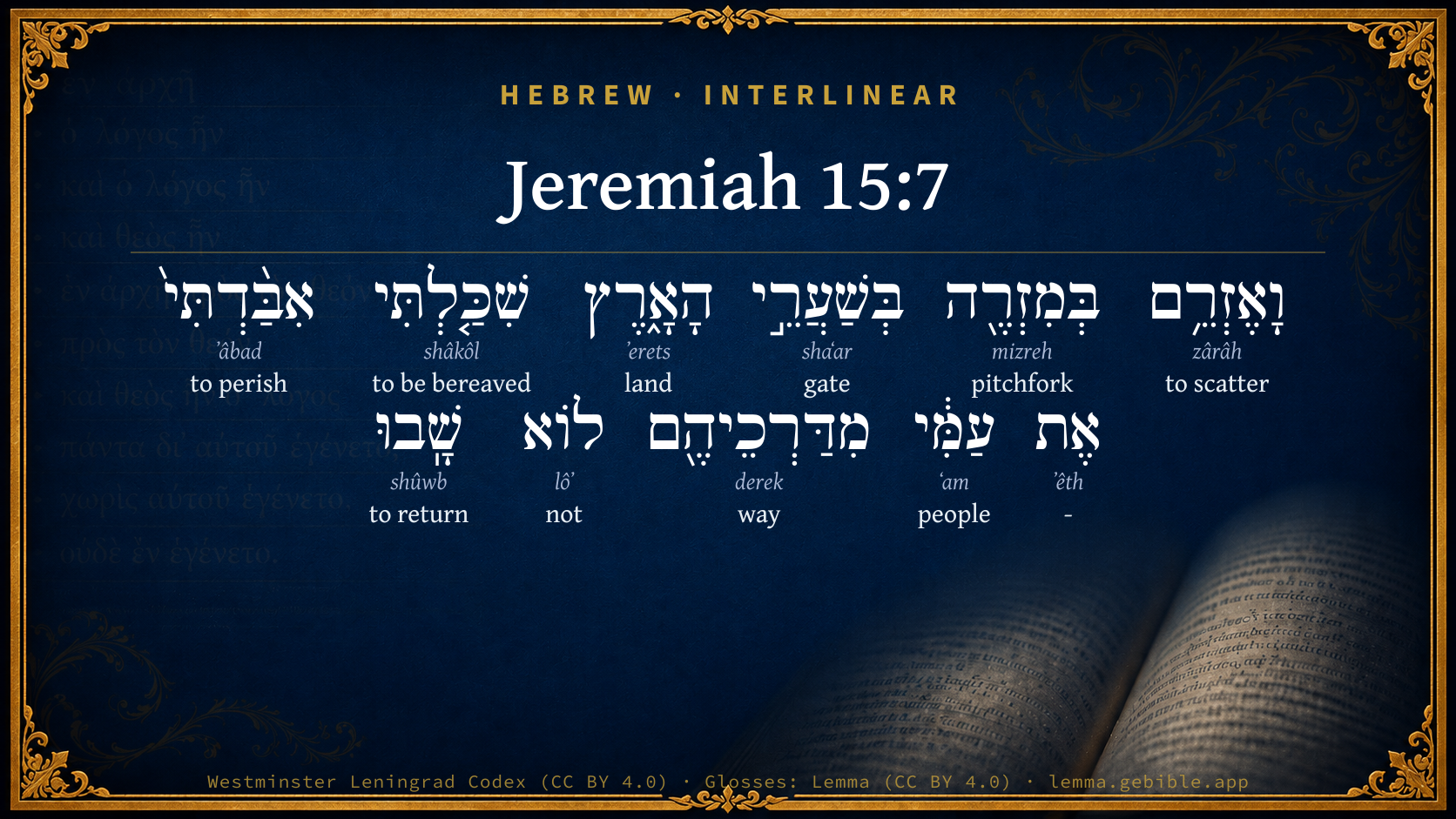
Hebrew (Westminster Leningrad Codex) Jeremiah 15:7 appears in the Hebrew Old Testament. The text above is from the Westminster Leningrad Codex. Each word links to its Strong’s number, a concise gloss, and parsing drawn from the Open Scriptures Hebrew Bible morphology. Click any word for its full Brown-Driver-Briggs (BDB) entry.
Download image
Cite this verse

Jeremiah 15:7 (World English Bible). Public Domain. Lemma interlinear Bible study tool, https://lemma.gebible.app/v/jeremiah/15/7.

Show BibTeX & RIS
BibTeX
RIS
English Translation
I have winnowed them with a fan in the gates of the land; I have bereaved [them] of children, I have destroyed my people; they didn't return from their ways.
World English Bible · Public Domain
Download a study sheet

One document with this verse’s original text, its word-by-word gloss line, the meaning frame, cross-references with their text, attributed commentary, and full source and license credits — printable, and it pastes into notes with its structure intact.

This verse Autodidact and up

Study sheet (.html) Plain text (.txt)

A passage Seminary Student

Up to 50 verses in one chapter. A passage sheet keeps up to 6 commentary sources and 12 cross-references per verse, in the order this page ranks them, and says so on the sheet whenever that leaves anything out. Ask for a single verse and you get the Autodidact verse sheet above.

Everything on this page stays free to read, with no account — the sheet is a download of what is already on screen, not access to it.

Want to remove ads? Support Godless Engineer
Compare translations 3

The same verse in 3 English versions, stacked beneath the original-language interlinear above. Click any original word for its lexicon entry.

Each is an independent rendering of the whole verse — the interlinear is not word-aligned to these translations.

Highlighted words mark where these versions differ — a whole-verse word diff, not a word-by-word alignment.

  • World English Bible Public Domain
    I have winnowed them with a fan in the gates of the land; I have bereaved [them] of children, I have destroyed my people; they didn't return from their ways.
  • King James Version Public Domain
    And I will fan them with a fan in the gates of the land; I will bereave them of children, I will destroy my people since they return not from their ways.
  • unfoldingWord Literal Text CC BY-SA 4.0
    And I will winnow them with a winnowing fork in the gates of the land. I will bereave of children; I will destroy my people they do not turn back from their ways.

unfoldingWord Literal Text — © unfoldingWord, licensed CC BY-SA 4.0. Word-aligned USFM3 via Door43 (git.door43.org/unfoldingWord/en_ult).

Versions to compare (up to 4)

3 of 4 selected

Show all 18 translations

Every available English version of this verse, each an independent rendering of the whole verse.

  • World English Bible Public Domain
    I have winnowed them with a fan in the gates of the land; I have bereaved [them] of children, I have destroyed my people; they didn't return from their ways.
  • Berean Standard Bible Public Domain
    I will scatter them with a winnowing fork at the gates of the land. I will bereave and destroy My people who have not turned from their ways.
  • Majority Standard Bible Public Domain
    I will scatter them with a winnowing fork at the gates of the land. I will bereave and destroy My people who have not turned from their ways.
  • King James Version Public Domain
    And I will fan them with a fan in the gates of the land; I will bereave them of children, I will destroy my people since they return not from their ways.
  • American Standard Version (1901) Public Domain
    And I have winnowed them with a fan in the gates of the land; I have bereaved `them' of children, I have destroyed my people; they returned not from their ways.
  • Revised Version (1885) Public Domain
    And I have fanned them with a fan in the gates of the land; I have bereaved them of children, I have destroyed my people; they have not returned from their ways.
  • Geneva Bible (1599) Public Domain
    And I wil scatter them with the fanne in the gates of the earth I haue wasted, and destroyed my people, yet they would not returne from their wayes.
  • Douay-Rheims (1899) Public Domain
    And I will scatter them with a fan in the gates of the land: I have killed and destroyed my people, and yet they are not returned form their ways.
  • Young's Literal Translation Public Domain
    And I scatter them with a fan, in the gates the land, I bereaved, I have destroyed My people, From their ways they turned not back.
  • Literal Standard Version CC BY-SA 4.0
    And I scatter them with a fan, || In the gates of the land, || I have bereaved [them], || I have destroyed My people, || They did not turn back from their ways.
  • Unlocked Literal Bible CC BY-SA 4.0
    So I will winnow them with a pitchfork at the gates of the land. I will bereave them. I will destroy my people since they will not turn from their ways.
  • unfoldingWord Literal Text CC BY-SA 4.0
    And I will winnow them with a winnowing fork in the gates of the land. I will bereave of children; I will destroy my people they do not turn back from their ways.
  • Darby Bible Public Domain
    And I will fan them with a fan in the gates of the land; I will bereave of children [and] destroy my people: they have not returned from their ways.
  • World Messianic Bible Public Domain
    I have winnowed them with a fan in the gates of the land. I have bereaved them of children. I have destroyed my people. They didn’t return from their ways.
  • Webster's Bible Public Domain
    And I will fan them with a fan in the gates of the land; I will bereave them of children, I will destroy my people, since they return not from their ways.
  • Free Bible Version CC BY-SA 4.0
    I will scatter you with a winnowing fork from every town in the country. I will destroy my people and take away their children because they refuse to give up their evil ways.
  • Bible in Basic English Public Domain
    And I have sent a cleaning wind on them in the public places of the land; I have taken their children from them; I have given my people to destruction; they have not been turned from their ways.
  • JPS Tanakh (1917) Public Domain
    And I fan them with a fan in the gates of the land; I bereave them of children, I destroy My people, since they return not from their ways.

Literal Standard Version (2020), Covenant Press — licensed CC BY-SA 4.0. Text via the HelloAO Bible API (eBible.org). Unlocked Literal Bible (unfoldingWord) — licensed CC BY-SA 4.0. Text via the HelloAO Bible API (eBible.org). unfoldingWord Literal Text — © unfoldingWord, licensed CC BY-SA 4.0. Word-aligned USFM3 via Door43 (git.door43.org/unfoldingWord/en_ult). Free Bible Version, Dr. Jonathan Gallagher — licensed CC BY-SA 4.0. Text via the HelloAO Bible API (eBible.org).

Word by word

More ways to search: Search by grammar → Find every occurrence → Compare this word →

Practice this passage: Drill this verse → Learn its vocabulary →

בְּמִזְרֶ֖ה
mizreh
H4214
“in/at · pitchfork”
Preposition + Noun, Common, Masculine, Singular, Absolute
Part of Speech
Preposition + Noun
Type
Common
Gender
Masculine
Number
Singular
State
Absolute
Full BDB Definition

Origin: from H2219

TWOT: 579a

pitchfork
  1. וָאֶזְרֵ֥ם zârâh H2219 “and · to scatter · them” Conjunction + Verb, Qal, Sequential Imperfect, 1st Person, Common, Singular + Suffix, Personal, 3rd Person, Masculine, Plural
  2. בְּשַׁעֲרֵ֣י shaʻar H8179 “in/at · gates of” Preposition + Noun, Common, Masculine, Plural, Construct
  3. הָאָ֑רֶץ ʼerets H776 “the · land” Particle, Definite Article + Noun, Common, Both, Singular, Absolute
  4. שִׁכַּ֤לְתִּי shâkôl H7921 “to be bereaved” Verb, Piel, Perfect, 1st Person, Common, Singular
  5. אִבַּ֨דְתִּי֙ ʼâbad H6 “to perish” Verb, Piel, Perfect, 1st Person, Common, Singular
  6. אֶת ʼêth H853 “-” Particle, Direct Object
  7. עַמִּ֔י ʻam H5971 “people · my” Noun, Common, Masculine, Singular, Construct + Suffix, Personal, 1st Person, Common, Singular
  8. מִדַּרְכֵיהֶ֖ם derek H1870 “from · ways · their” Preposition + Noun, Common, Both, Plural, Construct + Suffix, Personal, 3rd Person, Masculine, Plural
  9. לוֹא lôʼ H3808 “not” Particle, Negative
  10. שָֽׁבוּ shûwb H7725 “to return” Verb, Qal, Perfect, 3rd Person, Common, Plural

About this verse

These counts appear in no published source. They are computed here, from the morphology-tagged text and Lemma’s own curated glosses. What Lemma adds →

11
words
11
distinct lemmas
Prophets
section

Notable vocabulary

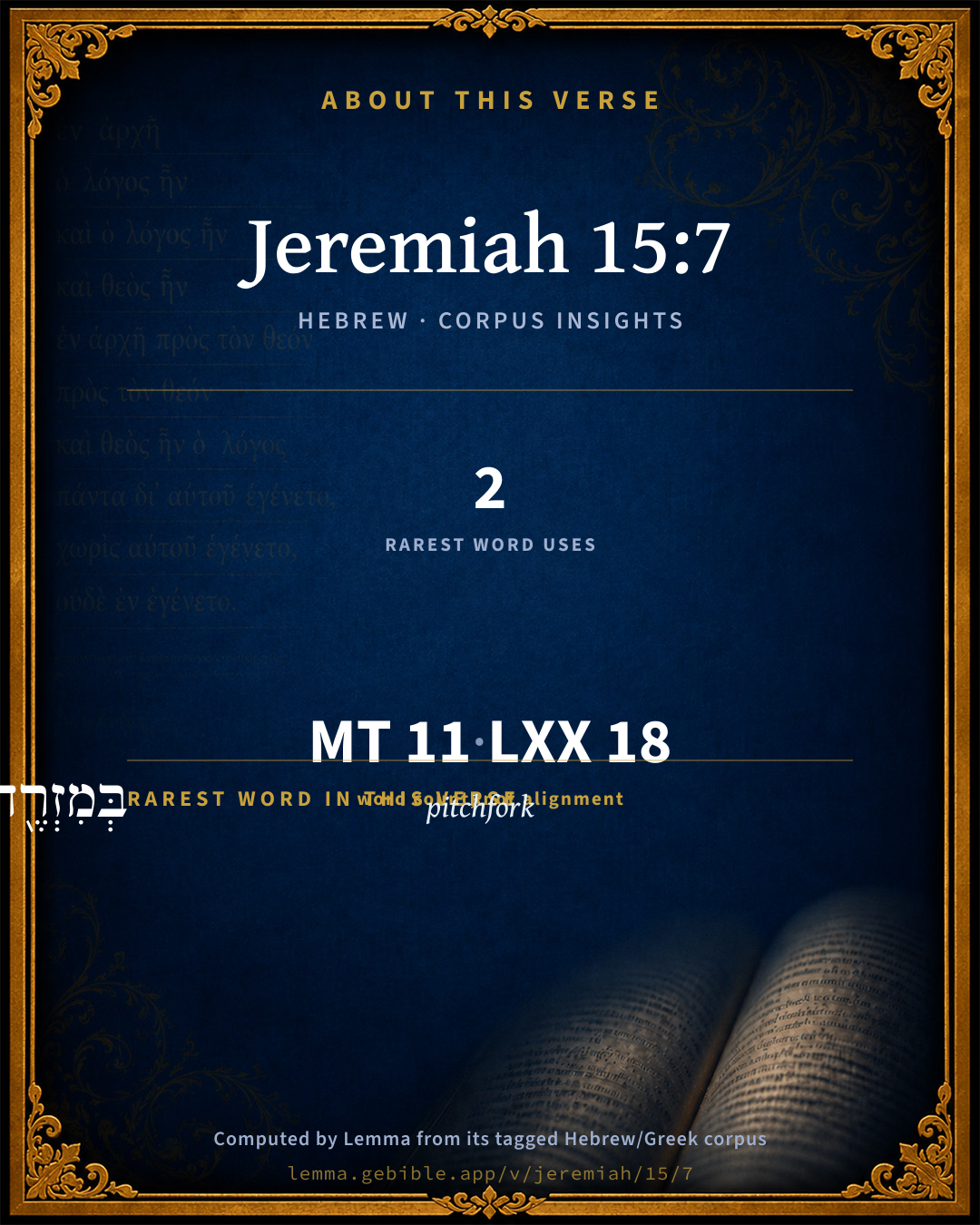
The rarest word here is בְּמִזְרֶ֖ה pitchfork H4214 — appearing just 2 times in the whole Hebrew Bible.

Shared distinctive vocabulary

בְּמִזְרֶ֖ה pitchfork H4214 occurs in 2 verses of the Hebrew Bible. Also found in:

Grammatical profile

  • 4 verbs
  • 5 nouns
  • 2 particles

Verb forms

  • וָאֶזְרֵ֥ם Qal · Sequential Imperfect
  • שִׁכַּ֤לְתִּי Piel · Perfect
  • אִבַּ֨דְתִּי֙ Piel · Perfect
  • שָֽׁבוּ Qal · Perfect

Hebrew & Septuagint length

In the original languages it is 11 Hebrew tokens and 18 Greek tokens — but the two are counted differently (Hebrew bundles its prefixes and suffixes into one token; the Greek is in lemma form), so that isn’t a like-for-like length.

Cross-references

19

Topical passages linked to Jeremiah 15:7 in the Treasury of Scripture Knowledge — connected by theme and wording, ordered by reader-vote popularity; previews shown in the World English Bible.

  • Jeremiah 51:2 I will send to Babylon strangers, who shall winnow her; and they shall empty her land: for in the day of trouble they shall be against her round about.
  • Matthew 3:12 His winnowing fork is in his hand, and he will thoroughly cleanse his threshing floor. He will gather his wheat into the barn, but the chaff he will burn up with unquenchable fire."
  • Isaiah 9:13 Yet the people have not turned to him who struck them, neither have they sought Yahweh of Hosts.
  • Isaiah 41:16 You shall winnow them, and the wind shall carry them away, and the whirlwind shall scatter them; and you shall rejoice in Yahweh, you shall glory in the Holy One of Israel.
  • Jeremiah 5:3 O Yahweh, don't your eyes look on truth? you have stricken them, but they were not grieved; you have consumed them, but they have refused to receive correction: they have made their faces harder than a rock; they have refused to return.
  • Psalms 1:4 The wicked are not so, But are like the chaff which the wind drives away.
  • Jeremiah 8:4–5 Moreover you shall tell them, Thus says Yahweh: Shall men fall, and not rise up again? Shall one turn away, and not return?
  • Jeremiah 18:21 Therefore deliver up their children to the famine, and give them over to the power of the sword; and let their wives become childless, and widows; and let their men be slain of death, [and] their young men struck of the sword in battle.
  • Deuteronomy 28:41 You shall father sons and daughters, but they shall not be yours; for they shall go into captivity.
  • Jeremiah 4:11–12 At that time shall it be said to this people and to Jerusalem, A hot wind from the bare heights in the wilderness toward the daughter of my people, not to winnow, nor to cleanse;
  • Ezekiel 24:25 You, son of man, shall it not be in the day when I take from them their strength, the joy of their glory, the desire of their eyes, and that whereupon they set their heart, their sons and their daughters,
  • Hosea 9:12–17 Though they bring up their children, Yet I will bereave them, so that not a man shall be left. Indeed, woe also to them when I depart from them!
  • Amos 4:10–12 I sent plagues among you like I did Egypt. I have slain your young men with the sword, And have carried away your horses; And I filled your nostrils with the stench of your camp Yet you haven't returned to me," says Yahweh.
  • Zechariah 1:4 Don't you be like your fathers, to whom the former prophets proclaimed, saying: Thus says Yahweh of hosts, 'Return now from your evil ways, and from your evil doings;' but they did not hear, nor listen to me, says Yahweh.
  • Deuteronomy 28:18 Cursed shall be the fruit of your body, and the fruit of your ground, the increase of your cattle, and the young of your flock.
  • Deuteronomy 28:32 Your sons and your daughters shall be given to another people; and your eyes shall look, and fail with longing for them all the day: and there shall be nothing in the power of your hand.
  • Deuteronomy 28:53–56 You shall eat the fruit of your own body, the flesh of your sons and of your daughters, whom Yahweh your God has given you, in the siege and in the distress with which your enemies shall distress you.
  • Jeremiah 9:21 For death is come up into our windows, it is entered into our palaces; to cut off the children from outside, [and] the young men from the streets.
  • Ezekiel 24:21 Speak to the house of Israel, Thus says the Lord Yahweh: Behold, I will profane my sanctuary, the pride of your power, the desire of your eyes, and that which your soul pities; and your sons and your daughters whom you have left behind shall fall by the sword.

Cross-references courtesy of OpenBible.info (CC BY 4.0).

Hebrew and Greek witnesses Masoretic Hebrew ↔ Greek Septuagint

The same verse in the two great witnesses to the Old Testament, shown verse-for-verse.

These are two independent witnesses, not word-aligned to each other, and the Septuagint is shown in lemma (dictionary) form.

Hebrew Jeremiah 15:7 Masoretic · Westminster Leningrad Codex

וָאֶזְרֵ֥ם בְּמִזְרֶ֖ה בְּשַׁעֲרֵ֣י הָאָ֑רֶץ שִׁכַּ֤לְתִּי אִבַּ֨דְתִּי֙ אֶת עַמִּ֔י מִדַּרְכֵיהֶ֖ם לוֹא שָֽׁבוּ

I have winnowed them with a fan in the gates of the land; I have bereaved [them] of children, I have destroyed my people; they didn't return from their ways.

World English Bible · Public Domain

Greek LXX Structure differs

In the Septuagint, Jeremiah is about an eighth shorter than the Hebrew and arranges its material differently — the Oracles Against the Nations (Hebrew chapters 46–51) appear in the middle of the Greek book, after 25:13. Because the chapter and verse boundaries do not line up, a verse-for-verse comparison with the Hebrew is not shown.

A verse-for-verse comparison isn’t shown here because the chapters and verses don’t line up. Switch to the LXX edition with the MT / LXX toggle above to read the Greek directly.

On this verse, The Cambridge Bible for Schools and Colleges discusses the Septuagint’s reading. Read the note in Commentary ↓

Hebrew: Westminster Leningrad Codex (CC BY 4.0). Greek: Septuagint (public domain); English from a public-domain English Septuagint. How the Septuagint differs from the Hebrew →

Targum (Aramaic paraphrase)

1

The Targum is the ancient Jewish Aramaic paraphrase of the Hebrew Scriptures — an interpretive translation, not the Hebrew text itself. Onkelos (literal) and Pseudo-Jonathan (expansive) render the Torah, and Jonathan the Prophets. Coverage is partial: where no permissively-licensed English translation exists for a verse, only the Aramaic is shown. This is verse-level text, not a word-by-word alignment to the Hebrew.

  1. Targum Jonathan Prophets (Joshua–Malachi)
    וּכְמָא דְדָרַן בִּמְדִירַיָא כֵּן אֲבַדֵר יַת עַמִי בְּקִרְוֵי אַרְעָא תַּכְלִית אַבְּדֵית יַת עַמִי מֵאוֹרְחַתְהוֹן לָא תָבוּ:

    (no public-domain English translation for this verse)

    Targum Jonathan — Aramaic: “Mikraot Gedolot” (public domain). English: “Sefaria Community Translation” (CC0 1.0 (public-domain dedication)); “London "Chaldee Paraphrase," 1871” (public domain). Text via Sefaria.

Commentary

Notes on Jeremiah 15:7 from classic Christian and Jewish commentators (each source and its license shown beneath its notes). The classic Christian expositions comment on the surrounding passage and are grouped to its opening verse, so a note may address several verses; the Jewish commentaries on the Tanakh (Rashi and others) are per-verse, so they appear only where the commentator wrote on this verse.

Lemma curates 59 commentaries, every one of them public domain or Creative Commons licensed, each selected and text-cleaned for this edition rather than reprinted as found. About our sources →

Trapp's Complete Commentary

John Trapp

Jer 15:7 And I will fan them with a fan in the gates of the land; I will bereave [them] of children, I will destroy my people, [since] they return not from their ways.

Ver. 7. And I will fan them with a fan.] Not of purgation {a} {as Jer 6:29-30} but of perdition. Such as that, Jer 51:2.

In the gates of the land.] As men use to winnow grain at a windy door, where the chaff is blown quite away.

{a} Deo gratias quod lingua Petiliani non sit ventilabrum Christi. - Jerome.

John Trapp, A Commentary or Exposition upon All the Books of the Old and New Testament (1647–1656) — public domain. Text from a community e-Sword module.

Geneva Bible (1599)

Geneva Bible translators

Meaning, the cities.

Geneva Bible (1599) marginal notes — public domain. Text via Bolls.life.

Jamieson, Fausset & Brown

Robert Jamieson, A. R. Fausset & David Brown

fan--tribulation--from tribulum, a threshing instrument, which separates the chaff from the wheat (Mat 3:12).

gates of the land--that is, the extreme bounds of the land through which the entrance to and exit from it lie. MAURER translates, "I will fan," that is, cast them forth "to the gates of the land" (Nah 3:13). "In the gates"; English Version draws the image from a man cleaning corn with a fan; he stands at the gate of the threshing-floor in the open air, to remove the wheat from the chaff by means of the wind; so God threatens to remove Israel out of the bounds of the land [HOUBIGANT].

Jamieson, Fausset & Brown — Commentary Critical and Explanatory on the Whole Bible (1871) — public domain (CC PDM 1.0). Text via the HelloAO Bible API.

Adam Clarke's Commentary

Verse 7. I will fan them with a fan] There is no pure grain; all is chaff.

In the gates of the land] The places of public justice: and there it shall be seen that the judgments that have fallen upon them have been highly merited. And from these places of fanning they shall go out into their captivity.

Adam Clarke's Commentary on the Bible (1810–1826) — public domain. Text from a community e-Sword/MySword module.

John Calvin's Commentaries

He confirms here the same truth. The verb which I have rendered in the future may be rendered in the past tense, but I still think it to be a prediction of what was to come. But as to what follows, I have bereaved, I have destroyed, it must, I have no doubt, be referred to time past.

He then says, I will fan or scatter them, for the verb. זרה zare, means to scatter, but as with a fan follows, (the word is derived from the same root) I wish to retain the repetition. Then it is, I will fan them with a fan through all the gates of the earth Many give the meaning, “through the cities,” which I do not approve, as it seems a frigid explanation. On the contrary the Prophet means by “the gates of the earth,” all countries, for the Jews thought that they should be always safe and quiet in their own cities. By taking a part for the whole, gates do indeed, as it appears elsewhere, signify cities; but as the Jews trusted in their own defences, and thought that they could never be drawn out from these quiet nests, the word gates is in a striking manner transferred to signify any kind of exit; I will fan you, says God, but where? through all gates of the earth, or through all countries and through all deserts; wherever there is a region open for you there you must pass through. Ye are wont to pass in and out through your gates, and ye have there your quiet homes, but there shall be hereafter to you other cities, other gates, even all countries and all deserts, all ways, and, in short, every sort of passage.

Then follows, I have bereaved, I have destroyed my people; they have not returned from their own ways Here no doubt he condemns the Jews for their sottishhess, because they had not repented after having been warned by grievous judgments, which God had executed partly on them and partly on their brethren. For the kingdom of Israel had been cut off: when they saw the ten tribes driven into exile ought they not to have been terrified by such an example? Hence also another Prophet says,

“There is no one who mourns for the bruising of Joseph.” (Amos 6:6)

God had set before their eyes a sad and dreadful spectacle; they ought then to have acknowledged in the destruction of Israel what they themselves deserved, and to have turned to God. It is then this extreme hardness that God upbraids them with, for though he had bereaved his people, the ten tribes, and destroyed them, and though also the kingdom of Judah had been in a great measure depressed, yet they returned not from their own ways. It hence appeared more fully evident that they deserved the severest judgments, as they were become wholly irreclaimable. He then adds —

John Calvin's Commentaries (1540-1563) — public domain. Text from the Calvin Translation Society English edition (1840s-50s) via the Christian Classics Ethereal Library (ccel.org). Calvin's coverage is partial (roughly two-thirds of the Bible); uncommented books and verses are honest gaps, never fabricated. The 19th-century editor's footnotes and remarks are omitted so the notes are faithfully Calvin's own voice.

Ellicott's Commentary for English Readers

(7) I will fan them with a fan.—The image is, of course, the familiar one of the threshing-floor and the winnowing-fan or shovel (Psa_1:4; Psa_35:5; Mat_3:12). The tenses should be past in both clauses—I have winnowed . . . I have bereaved . . . I have destroyed.

In the gates of the land . . .—Possibly the “gates” stand for the fortified cities of Judah, the chief part being taken for the whole, more probably for the “approaches” of the land. So the Greeks spoke of the passes of the Taurus as the Cilician gates, and so we speak of the Khyber and Bolam passes as “the gates of India.”

Since they return not.—The insertion of the conjunction, which has nothing corresponding to it in the original, weakens the vigour of the abruptness of the clause, and probably suggests a wrong sequence of thought. Jehovah had chastened them, but it was in vain. They returned not from their ways. Yet, as in the Vulgate, rather than “since,” is the implied conjunction.

A Bible Commentary for English Readers, edited by Charles John Ellicott (1878–1897) — public domain. Text from a community e-Sword module.

The Cambridge Bible for Schools and Colleges

gen. ed. J. J. S. Perowne

7. I have fanned them with a fan] “Fan, whether verb or noun, is now practically obsolete in the sense here intended.” Dr. p. 360. We should rather render, Have winnowed them with a winnowing-fork. The Arabic word midhra, corresponding to the Heb. mizreh here and in Isa_30:24, is “in use in modern Syria, and denotes a wooden fork almost six feet in length, with five or six prongs, bound together by fresh hide, which, on shrinking, forms a tight band.… The wooden shovel of Isa_30:24 was used with it. The mixture of corn, chaff, and broken straw, produced by threshing, was shaken about with these two implements, usually in some exposed spot, when a wind was blowing (generally in the afternoon or evening, Rth_3:2), and the wind carried away the chaff and the straw (Psa_1:4). If however the wind was too violent it would blow away the corn as well: hence the point of Jer_4:11.” Ibid.

the gates of the land] the borders (the parts by which men enter and leave the country). Cp. Nah_3:13.

they have not returned from their ways] LXX have, on account of their evils (wicked deeds), probably meant as a free paraphrase, unless we suppose the word for evils to have fallen out of MT.

The Cambridge Bible for Schools and Colleges (gen. ed. J. J. S. Perowne; Cambridge University Press, 1878–1918) — public domain. Text from a community e-Sword module.

John Gill's Exposition

I will fan them with a fan in the gates of the land,.... Either of their own land, the land of Judea; and so the Septuagint version, "in the gates of my people"; alluding to the custom of winnowing corn in open places; and by fanning is meant the dispersion of the Jews, and their being carried captive out of their own land into other countries: or of the land of the enemy, into their cities, as the Targum paraphrases it; gates being put for them frequently; whither they should be scattered by the fan of the Lord; for what was done by the enemy, as an instrument, is ascribed to him:

I will bereave them of children; which shall die of famine, or pestilence, or by the sword, or in captivity: I will destroy my people; which must be when children are cut off, by which families, towns, cities, and kingdoms, are continued and kept up; and this he was resolved to do, though they were his people:

since they return not from their ways; their evil ways, which they had gone into, forsaking the ways of God, and his worship: or,

yet they return not from their ways (d); though fanned with the fan of affliction, bereaved of their children, and threatened with destruction: it expresses their obstinate continuance in their evil ways, and the reason of God's dealing with them as above.

(d) "et tamen a viis suis non sunt reversi", V. L. Diodatus, Genevenses.

John Gill's Exposition of the Whole Bible (1746–1763) — public domain (CC PDM 1.0). Text via the HelloAO Bible API.

Albert Barnes' Notes on the Bible

I will fan them ... - Or, “I have winnowed them with a winnowing shovel.” The “gates of the land” mean the places by which men enter or leave it. As God winnows them they are driven out of the land through all its outlets in every direction.

I will bereave - Rather, “I have bereaved, I have destroyed my people.” Omit “of children.”

Since they return not ... - Rather, “from their ways they have not returned.”

Albert Barnes' Notes on the Bible (1834–1885) — public domain. Text from a community e-Sword/MySword module.

Haydock's Catholic Bible Commentary

Will, or "have scattered" the ten tribes, and many of Juda, before the last siege. (Calmet)

George Leo Haydock (1774–1849), Haydock's Catholic Family Bible and Commentary, 1859 edition — public domain. Excludes Psalms (Douay-Rheims chapter numbering differs from Protestant) and Deuterocanonical books (Catholic canon only).

Matthew Poole's English Annotations

I will fan them with a fan in the gates of the land; not a purging fan by affliction, to separate their chaff and dross from them, but a scattering fan. Some translate it into the gates of the earth; so it is the same that God had before said, that he would remove them into all nations (gates being put for cities): but it is more probable that this is added in pursuit of the metaphor of fanning, men usually choosing barn-doors to fan at, that they may have the advantage of the wind.

I will bereave them of children; of children is not in the Hebrew, and is needlessly supplied; it may as well be, of any or all their comforts or good things.

I will destroy my people, since they return not from their ways; their privilege claimed of being my people shall not protect them, so long as they go on in their lewd and sinful courses.

Matthew Poole's English Annotations on the Holy Bible (1683–1685) — public domain. Text from a community e-Sword/MySword module.

Whedon's Commentary on the Bible

Daniel D. Whedon

7. Will fan, etc. — The verb is a preterite used prophetically.

Gates of the land — Frequently used in the sense of cities, but here in the more ordinary sense of places of ingress and egress. The sense of the verse is: With my winnowing shovel I will drive the people out of the land.

Daniel D. Whedon (gen. ed.), Commentary on the Old and New Testaments (1874–1909) — public domain. Text from a community e-Sword module.

The Pulpit Commentary

The gates of the land. The phrase might mean either the cities in general (comp. Mic_5:5 Isa_3:26) or the fortresses commanding the entrance into the land. (comp. Nah_3:13) The context decides in favor of the latter view. Ewald"s explanation, "borders of the earth" (i.e. the most distant countries), seems less natural. I will bereave them, etc. The proper object of the verb is my people (personified as a mother). The population are to fall in war. (comp. the same figure in Eze_5:17) The tense is the perfect of prophetic certitude; literally, I have bereaved, etc.

The Pulpit Commentary (1880–1919), ed. H.D.M. Spence-Jones & Joseph S. Exell — public domain. Text from a community e-Sword module.

John Wesley's Explanatory Notes

A fan - Not a purging fan by affliction, to separate their chaff and dross from them, but a scattering fan. In the gates - This is added in pursuit of the metaphor of fanning, men usually chusing barn-doors to fan at, that they may have the advantage of the wind.

John Wesley, Explanatory Notes Upon the Whole Bible (1754–1765) — public domain. Text via the GEBible commentary corpus.

Rashi

Rabbi Shlomo Yitzchaki (Rashi)

with a sieve A sieve called (van in French), like one who winnows barley, so that they should not all be exiled to one place.

Rashi on the Tanakh — English translations: “The Judaica Press complete Tanach with Rashi, translated by A. J. Rosenberg” (CC BY 4.0); “Pentateuch with Rashi's commentary by M. Rosenbaum and A.M. Silbermann, 1929-1934” (public domain); “The Metsudah Tanach series, Lakewood, N.J” (CC BY 4.0); and “The Book of Joshua, Metsudah Publications, 1997” (CC BY 4.0). Text via Sefaria.

Lesson kit

Teaching starters — assembled from the data on this page, not authored interpretation. Every prompt links to the verse data it draws on. Edit before teaching.

Jeremiah, in the Prophets, opens this verse with 11 words (11 distinct Hebrew lemmas). Its most distinctive word is mizreh (“pitchfork”). A historical commentator’s framing appears above. Read the whole chapter for the surrounding context.

Discussion questions

  1. The word mizreh carries the sense “pitchfork.” How does it shape the verse?
  2. Isaiah 30:24 shares the word «pitchfork» with this verse. How do the two illuminate each other?
  3. These translations render this verse differently; the difference is in the English rendering, not the original. What questions does that raise?
  4. The verb «וָאֶזְרֵ֥ם» is Qal Sequential Imperfect. How does its form color the action?
  5. Reading how Trapp's Complete Commentary and Geneva Bible (1599) read this verse, where do the two commentators agree and where do they part?

Things to notice

Reading settings

Reading text

Shown beneath each verse's original-language words.

Old Testament
Old Testament edition

Read the OT as the Masoretic Hebrew (MT) or the Greek Septuagint (LXX).

English shown for the Greek Septuagint (in the Hebrew ↔ Greek comparison).

Comparing translations? Open the Compare panel on any verse page to stack up to four side by side.