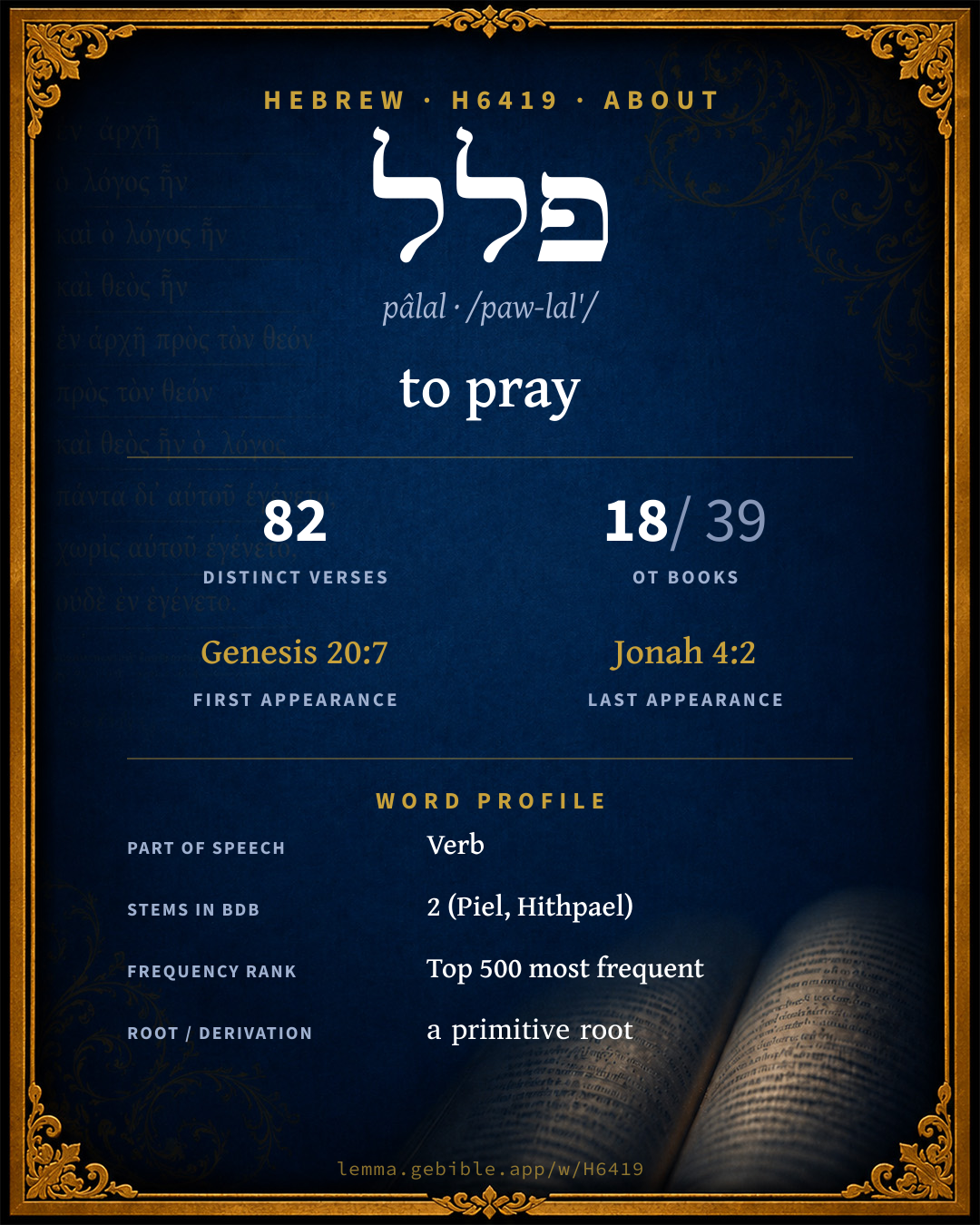
פָּלַל
to pray
‘to pray’ is one of 2 main senses fuller range ↓
Full lexicon entry — Brown-Driver-Briggs (BDB)
From Brown-Driver-Briggs (BDB)
Where this word appears
See every Hithpael verb in the Hebrew Bible →
Grammar key — what these labels mean
Part of speech
- Verb
- An action or state-of-being word.
Stem
- Hithpael
- The reflexive or reciprocal stem (the subject acts on itself). Here: ‘intercede’
- Piel
- An intensive or resultative active stem.
Form
- Sequential Imperfect
- An imperfect with prefixed waw — the standard past-narrative form (waw-consecutive imperfect).
- Sequential Perfect
- A perfect with prefixed waw continuing a preceding imperfect or command (waw-consecutive perfect).
- Infinitive Construct
- A bound verbal noun, frequently with prepositions (“to write / in writing”).
- Imperfect
- An incomplete, ongoing, or future action (“he will / would write”).
- Participle Active
- A verbal adjective expressing ongoing or characteristic action (“writing / one who writes”).
- Imperative
- A direct command (“write!”).
- Jussive
- A third- or second-person volitional form expressing wish or command (“let him write”).
- Perfect
- A completed action or state — Hebrew marks aspect (completeness) more than strict tense (“he wrote”).
State
- Absolute
- The independent form of a noun, not bound to a following word.
Person
- 3rd Person
- The one spoken about (“he / she / it / they”).
- 1st Person
- The speaker (“I / we”).
- 2nd Person
- The one addressed (“you”).
Gender
- Masculine
- Grammatically masculine.
- Common
- Either gender — not distinguished for this form.
- Feminine
- Grammatically feminine.
Number
- Singular
- One.
- Plural
- More than one (in Hebrew, generally three or more).
Grammatical forms 24 distinct
- Verb, Hithpael, Sequential Imperfect, 3rd Person, Masculine, Singular 16 times (19%)
- Verb, Hithpael, Infinitive Construct 10 times (12%)
- Verb, Hithpael, Sequential Perfect, 3rd Person, Common, Plural 9 times (11%)
- Verb, Hithpael, Imperfect, 3rd Person, Masculine, Singular 7 times (8%)
- Verb, Hithpael, Participle Active, Masculine, Singular, Absolute 6 times (7%)
- Verb, Hithpael, Imperative, 2nd Person, Masculine, Singular 6 times (7%)
- Verb, Hithpael, Sequential Imperfect, 1st Person, Common, Singular 5 times (6%)
- Verb, Hithpael, Imperfect, 3rd Person, Masculine, Plural 4 times (5%)
+16 more forms (21 occurrences)
Parsed forms decoded from the imported morphology (morphhb / Westminster Leningrad Codex — WLC text public domain, morphhb tagging CC BY 4.0), counted across 84 parsed occurrences — not distinct verses.
Every verse where H6419 appears — 82 distinct verses across 18 books. Click any verse to open its interlinear word-by-word view. Verse text shown in the World English Bible for context — . Each verse’s Hebrew form is shown with its reference; the English is not keyword-highlighted, since the data carries no word-level English alignment. Use “Compare translations” on any verse to read it across multiple English versions. This concordance covers the Hebrew Bible; Septuagint (Greek Old Testament) occurrences are not indexed here.
Genesis 3 verses
- Genesis 20:7 וְ/יִתְפַּלֵּ֥ל conj + Hithpael impf 3ms Now therefore, restore the man's wife. For he is a prophet, and he will pray for you, and you will live. If you don't restore her, know for sure that you will die, you, and all who are yours."
- Genesis 20:17 וַ/יִּתְפַּלֵּ֥ל conj + Hithpael wimpf 3ms Abraham prayed to God. God healed Abimelech, and his wife, and his maid-servants, and they bore children.
- Genesis 48:11 פִלָּ֑לְתִּי Piel pf 1cs Israel said to Joseph, "I didn't think I would see your face, and, behold, God has let me see your seed also."
Numbers 2 verses
- Numbers 11:2 וַ/יִּתְפַּלֵּ֤ל conj + Hithpael wimpf 3ms The people cried to Moses; and Moses prayed to Yahweh, and the fire abated.
- Numbers 21:7 הִתְפַּלֵּל֙ וַ/יִּתְפַּלֵּ֥ל Hithpael impv 2ms conj + Hithpael wimpf 3ms The people came to Moses, and said, We have sinned, because we have spoken against Yahweh, and against you; pray to Yahweh, that he take away the serpents from us. Moses prayed for the people.
Deuteronomy 2 verses
- Deuteronomy 9:20 וָֽ/אֶתְפַּלֵּ֛ל conj + Hithpael wimpf 1cs Yahweh was very angry with Aaron to destroy him: and I prayed for Aaron also at the same time.
- Deuteronomy 9:26 וָ/אֶתְפַּלֵּ֣ל conj + Hithpael wimpf 1cs I prayed to Yahweh, and said, Lord Yahweh, don't destroy your people and your inheritance, that you have redeemed through your greatness, that you have brought forth out of Egypt with a mighty hand.
1 Samuel 10 verses
- 1 Samuel 1:10 וַ/תִּתְפַּלֵּ֥ל conj + Hithpael wimpf 3fs She was in bitterness of soul, and prayed to Yahweh, and wept sore.
- 1 Samuel 1:12 לְ/הִתְפַּלֵּ֖ל prep + Hithpael inf.cs It happened, as she continued praying before Yahweh, that Eli marked her mouth.
- 1 Samuel 1:26 לְ/הִתְפַּלֵּ֖ל prep + Hithpael inf.cs She said, Oh, my lord, as your soul lives, my lord, I am the woman who stood by you here, praying to Yahweh.
- 1 Samuel 1:27 הִתְפַּלָּ֑לְתִּי Hithpael pf 1cs For this child I prayed; and Yahweh has given me my petition which I asked of him:
- 1 Samuel 2:1 וַ/תִּתְפַּלֵּ֤ל conj + Hithpael wimpf 3fs Hannah prayed, and said: My heart exults in Yahweh; My horn is exalted in Yahweh; My mouth is enlarged over my enemies; Because I rejoice in your salvation.
- 1 Samuel 2:25 וּ/פִֽלְל֣/וֹ יִתְפַּלֶּל conj + Piel wpf 3ms + sfx pers 3ms Hithpael impf 3ms If one man sin against another, God shall judge him; but if a man sin against Yahweh, who shall entreat for him? Notwithstanding, they didn't listen to the voice of their father, because Yahweh was minded to kill them.
- 1 Samuel 7:5 וְ/אֶתְפַּלֵּ֥ל conj + Hithpael impf 1cs Samuel said, Gather all Israel to Mizpah, and I will pray for you to Yahweh.
- 1 Samuel 8:6 וַ/יִּתְפַּלֵּ֥ל conj + Hithpael wimpf 3ms But the thing displeased Samuel, when they said, Give us a king to judge us. Samuel prayed to Yahweh.
- 1 Samuel 12:19 הִתְפַּלֵּ֧ל Hithpael impv 2ms All the people said to Samuel, Pray for your servants to Yahweh your God, that we not die; for we have added to all our sins [this] evil, to ask us a king.
- 1 Samuel 12:23 לְ/הִתְפַּלֵּ֣ל prep + Hithpael inf.cs Moreover as for me, far be it from me that I should sin against Yahweh in ceasing to pray for you: but I will instruct you in the good and the right way.
2 Samuel 1 verse
1 Kings 10 verses
- 1 Kings 8:28 מִתְפַּלֵּ֥ל Hithpael ptcp.act ms Yet have respect for the prayer of your servant, and for his supplication, Yahweh my God, to listen to the cry and to the prayer which your servant prays before you this day;
- 1 Kings 8:29 יִתְפַּלֵּ֣ל Hithpael impf 3ms that your eyes may be open toward this house night and day, even toward the place of which you have said, My name shall be there; to listen to the prayer which your servant shall pray toward this place.
- 1 Kings 8:30 יִֽתְפַּֽלְל֖וּ Hithpael impf 3mp Listen you to the supplication of your servant, and of your people Israel, when they shall pray toward this place: yes, hear in heaven, your dwelling-place; and when you hear, forgive.
- 1 Kings 8:33 וְ/הִֽתְפַּֽלְל֧וּ conj + Hithpael wpf 3cp When your people Israel are struck down before the enemy, because they have sinned against you; if they turn again to you, and confess your name, and pray and make supplication to you in this house:
- 1 Kings 8:35 וְ/הִֽתְפַּֽלְל֞וּ conj + Hithpael wpf 3cp When the sky is shut up, and there is no rain, because they have sinned against you; if they pray toward this place, and confess your name, and turn from their sin, when you do afflict them:
- 1 Kings 8:42 וְ/הִתְפַּלֵּ֖ל conj + Hithpael wpf 3ms (for they shall hear of your great name, and of your mighty hand, and of your outstretched arm); when he shall come and pray toward this house;
- 1 Kings 8:44 וְ/הִתְפַּֽלְל֣וּ conj + Hithpael wpf 3cp If your people go out to battle against their enemy, by whatever way you shall send them, and they pray to Yahweh toward the city which you have chosen, and toward the house which I have built for your name;
- 1 Kings 8:48 וְ/הִֽתְפַּֽלְל֣וּ conj + Hithpael wpf 3cp if they return to you with all their heart and with all their soul in the land of their enemies, who carried them captive, and pray to you toward their land, which you gave to their fathers, the city which you have chosen, and the house which I have built for your name:
- 1 Kings 8:54 לְ/הִתְפַּלֵּל֙ prep + Hithpael inf.cs It was so, that when Solomon had made an end of praying all this prayer and supplication to Yahweh, he arose from before the altar of Yahweh, from kneeling on his knees with his hands spread forth toward heaven.
- 1 Kings 13:6 וְ/הִתְפַּלֵּ֣ל conj + Hithpael impv 2ms The king answered the man of God, Entreat now the favor of Yahweh your God, and pray for me, that my hand may be restored me again. The man of God entreated Yahweh, and the king's hand was restored him again, and became as it was before.
2 Kings 6 verses
- 2 Kings 4:33 וַ/יִּתְפַּלֵּ֖ל conj + Hithpael wimpf 3ms He went in therefore, and shut the door on them both, and prayed to Yahweh.
- 2 Kings 6:17 וַ/יִּתְפַּלֵּ֤ל conj + Hithpael wimpf 3ms Elisha prayed, and said, Yahweh, Please open his eyes, that he may see. Yahweh opened the eyes of the young man; and he saw: and, behold, the mountain was full of horses and chariots of fire round about Elisha.
- 2 Kings 6:18 וַ/יִּתְפַּלֵּ֨ל conj + Hithpael wimpf 3ms When they came down to him, Elisha prayed to Yahweh, and said, Please smite this people with blindness. He struck them with blindness according to the word of Elisha.
- 2 Kings 19:15 וַ/יִּתְפַּלֵּ֨ל conj + Hithpael wimpf 3ms Hezekiah prayed before Yahweh, and said, Yahweh, the God of Israel, who sit [above] the cherubim, you are the God, even you alone, of all the kingdoms of the earth; you have made heaven and earth.
- 2 Kings 19:20 הִתְפַּלַּ֧לְתָּ Hithpael pf 2ms Then Isaiah the son of Amoz sent to Hezekiah, saying, Thus says Yahweh, the God of Israel, Whereas you have prayed to me against Sennacherib king of Assyria, I have heard [you].
- 2 Kings 20:2 וַ/יִּ֨תְפַּלֵּ֔ל conj + Hithpael wimpf 3ms Then he turned his face to the wall, and prayed to Yahweh, saying,
1 Chronicles 1 verse
2 Chronicles 14 verses
- 2 Chronicles 6:19 מִתְפַּלֵּ֥ל Hithpael ptcp.act ms Yet have you respect to the prayer of your servant, and to his supplication, Yahweh my God, to listen to the cry and to the prayer which your servant prays before you;
- 2 Chronicles 6:20 יִתְפַּלֵּ֣ל Hithpael impf 3ms that your eyes may be open toward this house day and night, even toward the place where you have said that you would put your name there; to listen to the prayer which your servant shall pray toward this place.
- 2 Chronicles 6:21 יִֽתְפַּֽלְל֖וּ Hithpael impf 3mp Listen you to the petitions of your servant, and of your people Israel, when they shall pray toward this place: yes, hear from your dwelling-place, even from heaven; and when you hear, forgive.
- 2 Chronicles 6:24 וְ/הִתְפַּֽלְל֧וּ conj + Hithpael wpf 3cp If your people Israel be struck down before the enemy, because they have sinned against you, and shall turn again and confess your name, and pray and make supplication before you in this house;
- 2 Chronicles 6:26 וְ/הִֽתְפַּלְל֞וּ conj + Hithpael wpf 3cp When the sky is shut up, and there is no rain, because they have sinned against you; if they pray toward this place, and confess your name, and turn from their sin, when you do afflict them:
- 2 Chronicles 6:32 וְ/הִֽתְפַּלְל֖וּ conj + Hithpael wpf 3cp Moreover concerning the foreigner, who is not of your people Israel, when he shall come from a far country for your great name's sake, and your mighty hand, and your outstretched arm; when they shall come and pray toward this house:
- 2 Chronicles 6:34 וְ/הִתְפַּֽלְל֣וּ conj + Hithpael wpf 3cp If your people go out to battle against their enemies, by whatever way you shall send them, and they pray to you toward this city which you have chosen, and the house which I have built for your name;
- 2 Chronicles 6:38 וְ/הִֽתְפַּֽלְל֗וּ conj + Hithpael wpf 3cp if they return to you with all their heart and with all their soul in the land of their captivity, where they have carried them captive, and pray toward their land, which you gave to their fathers, and the city which you have chosen, and toward the house which I have built for your name:
- 2 Chronicles 7:1 לְ/הִתְפַּלֵּ֔ל prep + Hithpael inf.cs Now when Solomon had made an end of praying, the fire came down from heaven, and consumed the burnt offering and the sacrifices; and the glory of Yahweh filled the house.
- 2 Chronicles 7:14 וְ/יִֽתְפַּֽלְלוּ֙ conj + Hithpael impf 3mp if my people, who are called by my name, shall humble themselves, and pray, and seek my face, and turn from their wicked ways; then will I hear from heaven, and will forgive their sin, and will heal their land.
- 2 Chronicles 30:18 הִתְפַּלֵּ֨ל Hithpael pf 3ms For a multitude of the people, even many of Ephraim and Manasseh, Issachar and Zebulun, had not cleansed themselves, yet did they eat the Passover otherwise than it is written. For Hezekiah had prayed for them, saying, The good Yahweh pardon everyone
- 2 Chronicles 32:20 וַ/יִּתְפַּלֵּ֞ל conj + Hithpael wimpf 3ms Hezekiah the king, and Isaiah the prophet the son of Amoz, prayed because of this, and cried to heaven.
- 2 Chronicles 32:24 וַ/יִּתְפַּלֵּל֙ conj + Hithpael wimpf 3ms In those days Hezekiah was sick even to death: and he prayed to Yahweh; and he spoke to him, and gave him a sign.
- 2 Chronicles 33:13 וַ/יִּתְפַּלֵּ֣ל conj + Hithpael wimpf 3ms He prayed to him; and he was entreated of him, and heard his supplication, and brought him again to Jerusalem into his kingdom. Then Manasseh knew that Yahweh he was God.
Ezra 1 verse
Nehemiah 4 verses
- Nehemiah 1:4 וּ/מִתְפַּלֵּ֔ל conj + Hithpael ptcp.act ms It happened, when I heard these words, that I sat down and wept, and mourned certain days; and I fasted and prayed before the God of heaven,
- Nehemiah 1:6 מִתְפַּלֵּ֨ל Hithpael ptcp.act ms Let your ear now be attentive, and your eyes open, that you may listen to the prayer of your servant, which I pray before you at this time, day and night, for the children of Israel your servants while I confess the sins of the children of Israel, which we have sinned against you. Yes, I and my father's house have sinned:
- Nehemiah 2:4 וָֽ/אֶתְפַּלֵּ֔ל conj + Hithpael wimpf 1cs Then the king said to me, For what do you make request? So I prayed to the God of heaven.
- Nehemiah 4:9 וַ/נִּתְפַּלֵּ֖ל conj + Hithpael wimpf 1cp But we made our prayer to our God, and set a watch against them day and night, because of them.
Job 2 verses
- Job 42:8 יִתְפַּלֵּ֖ל Hithpael impf 3ms Now therefore, take to yourselves seven bulls and seven rams, and go to my servant Job, and offer up for yourselves a burnt offering; and my servant Job shall pray for you, for I will accept him, that I not deal with you according to your folly. For you have not spoken of me the thing that is right, as my servant Job has."
- Job 42:10 בְּ/הִֽתְפַּֽלְל֖/וֹ prep + Hithpael inf.cs + sfx pers 3ms Yahweh turned the captivity of Job, when he prayed for his friends. Yahweh gave Job twice as much as he had before.
Psalms 4 verses
- Psalms 5:2 אֶתְפַּלָּֽל Hithpael impf 1cs Listen to the voice of my cry, my King and my God; For to you do I pray.
- Psalms 32:6 יִתְפַּלֵּ֬ל Hithpael impf 3ms For this, let everyone who is godly pray to you in a time when you may be found. Surely when the great waters overflow, they shall not reach to him.
- Psalms 72:15 וְ/יִתְפַּלֵּ֣ל conj + Hithpael juss 3ms They shall live, and to him shall be given of the gold of Sheba. Men shall pray for him continually. They shall bless him all day long.
- Psalms 106:30 וַ/יְפַלֵּ֑ל conj + Piel wimpf 3ms Then Phinehas stood up, and executed judgment, So the plague was stopped.
Isaiah 7 verses
- Isaiah 16:12 לְ/הִתְפַּלֵּ֖ל prep + Hithpael inf.cs It shall happen, when Moab presents himself, when he wearies himself on the high place, and shall come to his sanctuary to pray, that he shall not prevail.
- Isaiah 37:15 וַ/יִּתְפַּלֵּל֙ conj + Hithpael wimpf 3ms Hezekiah prayed to Yahweh, saying,
- Isaiah 37:21 הִתְפַּלַּ֣לְתָּ Hithpael pf 2ms Then Isaiah the son of Amoz sent to Hezekiah, saying, Thus says Yahweh, the God of Israel, Whereas you have prayed to me against Sennacherib king of Assyria,
- Isaiah 38:2 וַ/יִּתְפַּלֵּ֖ל conj + Hithpael wimpf 3ms Then Hezekiah turned his face to the wall, and prayed to Yahweh,
- Isaiah 44:17 וְ/יִתְפַּלֵּ֣ל conj + Hithpael impf 3ms The residue of it he makes a god, even his engraved image; he falls down to it and worships, and prays to it, and says, Deliver me; for you are my god.
- Isaiah 45:14 יִתְפַּלָּ֔לוּ Hithpael impf 3mp Thus says Yahweh: "The labor of Egypt, and the merchandise of Ethiopia, and the Sabeans, men of stature, shall come over to you, and they shall be yours. They shall go after you. In chains they shall come over; and they shall fall down to you. They shall make supplication to you: 'Surely God is in you; and there is none else, there is no other god.
- Isaiah 45:20 וּ/מִתְפַּלְלִ֔ים conj + Hithpael ptcp.act mp Assemble yourselves and come; draw near together, you who have escaped from the nations: they have no knowledge who carry the wood of their engraved image, and pray to a god that can't save.
Jeremiah 10 verses
- Jeremiah 7:16 תִּתְפַּלֵּ֣ל Hithpael juss 2ms Therefore don't you pray for this people, neither lift up a cry nor prayer for them, neither make intercession to me; for I will not hear you.
- Jeremiah 11:14 תִּתְפַּלֵּל֙ Hithpael juss 2ms Therefore don't you pray for this people, neither lift up cry nor prayer for them; for I will not hear them in the time that they cry to me because of their trouble.
- Jeremiah 14:11 תִּתְפַּלֵּ֛ל Hithpael juss 2ms Yahweh said to me, Don't pray for this people for [their] good.
- Jeremiah 29:7 וְ/הִתְפַּֽלְל֥וּ conj + Hithpael impv 2mp Seek the peace of the city where I have caused you to be carried away captive, and pray to Yahweh for it; for in the peace of it shall you have peace.
- Jeremiah 29:12 וְ/הִתְפַּלַּלְתֶּ֖ם conj + Hithpael wpf 2mp You shall call on me, and you shall go and pray to me, and I will listen to you.
- Jeremiah 32:16 וָ/אֶתְפַּלֵּ֖ל conj + Hithpael wimpf 1cs Now after I had delivered the deed of the purchase to Baruch the son of Neriah, I prayed to Yahweh, saying,
- Jeremiah 37:3 הִתְפַּלֶּל Hithpael impv 2ms Zedekiah the king sent Jehucal the son of Shelemiah, and Zephaniah the son of Maaseiah, the priest, to the prophet Jeremiah, saying, Pray now to Yahweh our God for us.
- Jeremiah 42:2 וְ/הִתְפַּלֵּ֤ל conj + Hithpael impv 2ms and said to Jeremiah the prophet, Let, we pray you, our supplication be presented before you, and pray for us to Yahweh your God, even for all this remnant; for we are left but a few of many, as your eyes do see us:
- Jeremiah 42:4 מִתְפַּלֵּ֛ל Hithpael ptcp.act ms Then Jeremiah the prophet said to them, I have heard you; behold, I will pray to Yahweh your God according to your words; and it shall happen that whatever thing Yahweh shall answer you, I will declare it to you; I will keep nothing back from you.
- Jeremiah 42:20 הִתְפַּלֵּ֣ל Hithpael impv 2ms For you have dealt deceitfully against your own souls; for you sent me to Yahweh your God, saying, Pray for us to Yahweh our God; and according to all that Yahweh our God shall say, so declare to us, and we will do it:
Ezekiel 1 verse
Daniel 2 verses
- Daniel 9:4 וָֽ/אֶתְפַּֽלְלָ֛/ה conj + Hithpael wimpf 1cs + sfx h I prayed to Yahweh my God, and made confession, and said, Oh, Lord, the great and dreadful God, who keeps covenant and loving kindness with those who love him and keep his commandments,
- Daniel 9:20 וּ/מִתְפַּלֵּ֔ל conj + Hithpael ptcp.act ms While I was speaking, and praying, and confessing my sin and the sin of my people Israel, and presenting my supplication before Yahweh my God for the holy mountain of my God;
Jonah 2 verses
- Jonah 2:1 וַ/יִּתְפַּלֵּ֣ל conj + Hithpael wimpf 3ms Then Jonah prayed to Yahweh, his God, out of the fish's belly.
- Jonah 4:2 וַ/יִּתְפַּלֵּ֨ל conj + Hithpael wimpf 3ms He prayed to Yahweh, and said, "Please, Yahweh, wasn't this what I said when I was still in my own country? Therefore I hurried to flee to Tarshish, for I knew that you are a gracious God, and merciful, slow to anger, and abundant in loving kindness, and you repent of the evil.
About this entry
At a glance — auto-summarized from this page’s data, not written by a person. Every figure links to its source below. This summary describes the numbers; it doesn’t interpret them.
The Hebrew verb פלל centers on the idea of “to pray.” First canonically at Genesis 20:7, it enters the text early. The Hebrew Bible uses it across 82 verses — moderately common. The verb spans 2 stems, from Piel to Hithpael. Related forms include פליל, תפלה and אפלל. Dig into 82-verse concordance and the renderings breakdown below.
Gloss history
Strong's 1890 vs modern scholarship

About this word
Strong's H6419 catalogs a Hebrew word from the Hebrew Old Testament.
These counts are not copied from any lexicon or concordance. They are computed here, from the morphology-tagged Hebrew Old Testament. What Lemma adds →
- 82
- distinct verses
- The word appears in 82 distinct verses.
- 18 / 39
- OT books
- The word appears in 18 of 39 Old Testament books.
- #483
- by frequency
- Top 500 most frequent Hebrew words (rank 483 of 8,640 Hebrew words by occurrence).
View all 82 occurrences in the concordance →
Most concentrated in
- 2 Chronicles 14 verses 17%
- 1 Samuel 10 verses 12%
- 1 Kings 10 verses 12%
By section of the Old Testament
By traditional corpus
Conventional, traditional groupings — biblical authorship is debated, so this is a traditional corpus grouping, not an authorship claim. Each share is this word’s portion of its verses in that division of the Hebrew canon. Each figure is a share of the word’s 82 distinct verses.
- Prophets (Nevi'im) 47 verses · 57%
- Writings (Ketuvim) 28 verses · 34%
- Torah (Pentateuch) 7 verses · 9%
How translations render this word
Counts come from each version’s own published word-to-Strong’s tagging or interlinear alignment — an approximate guide to how each version renders this word, not a word-level alignment the data otherwise carries. Because each total is that version’s own tagged count, the per-version totals vary from one another and need not match the appearance or distinct-verse counts above. These counts may also differ from a printed concordance because Lemma counts each distinctly tagged rendering and does not collapse phrase taggings into a single head-word total. This is a fixed set of word-tagged versions (KJV, ASV, BSB, ULT) and does not change with the reading translation you choose elsewhere. Each version’s license is shown beside its name below (and on Sources).
- King James Version: Prayed 19×, Pray 18×, I prayed 6×
- American Standard Version: Pray 16×, Prayed 14×, He prayed 4×
- Berean Standard Bible: Pray 19×, Prayed 14×, They pray 8×
- unfoldingWord Literal Text: Pray 15×, Prayed 13×, And 9×
King James Version Public Domain
Renders H6419 across 84 tagged occurrences — most commonly:
Plus 27 renderings that appear only once — usually multi-word phrases or single function words the recovered tagging swept in, not distinct renderings.
American Standard Version Public Domain
Renders H6419 across 84 tagged occurrences — most commonly:
Plus other, less common renderings. Plus 24 renderings that appear only once — usually multi-word phrases or single function words the recovered tagging swept in, not distinct renderings.
Berean Standard Bible Public Domain
Renders H6419 across 84 tagged occurrences — most commonly:
Plus 18 renderings that appear only once — usually multi-word phrases or single function words the recovered tagging swept in, not distinct renderings.
unfoldingWord Literal Text CC BY-SA 4.0
Renders H6419 across 95 tagged occurrences — most commonly:
Plus other, less common renderings. Plus 20 renderings that appear only once — usually multi-word phrases or single function words the recovered tagging swept in, not distinct renderings.
Senses in the full BDB
Hebrew verbs can shift meaning by stem (binyan): Qal is the basic action, Niphal is often passive or reflexive, Piel often intensifies or makes it factitive, and Hiphil is typically causative. The senses below are grouped under the stem BDB assigns to each. This entry also uses Hithpael (reflexive or reciprocal).
What do BDB’s symbols mean?
BDB uses these scholarly abbreviations:
| Symbol | Meaning |
|---|---|
| 𝔊 | the Septuagint (the ancient Greek translation, LXX) |
| 𝔙 | the Vulgate (the Latin translation) |
| 𝔖 | the Syriac version (the Peshitta) |
| 𝔗 | the Targum (the Aramaic translation) |
| ψ | the Psalms |
| √ | root (the underlying root or stem) |
| ‖ | parallel passage (a synonymous or contrasted parallel) |
| † | the dagger: every passage where the word occurs is cited |
The 5 senses and sub-senses the full Brown-Driver-Briggs lexicon distinguishes for this word, in lexicon order (not ranked by frequency), with BDB’s own verbatim wording and sub-sense lettering. Shown in Hebrew script with BDB’s own scholarly abbreviations. The condensed entry is in the Lexicon Entry tab. See also the Forms in the corpus table below.
Piel
- . mediate, judge
Hithpael
- 1. specif. intercede
- 2. gen. pray
- 3. pray
- 4. of poetical, liturgical prayer
Senses from the full Brown-Driver-Briggs lexicon (Brown, Driver, Briggs; Oxford 1906 — public domain), digitized via Sefaria, supplemented by the OpenScriptures HebrewLexicon (CC BY 4.0). Full attribution on Sources.
Word origin
[ פָּלַל ] 84 vb. prob. intervene, interpose
— Brown-Driver-Briggs (Oxford 1906, public domain), digitized via Sefaria, supplemented by the OpenScriptures HebrewLexicon (CC BY 4.0). See Sources.
Origin: a primitive root
Jastrow Dictionary
A second Hebrew/Aramaic lexicon for comparison, covering Aramaic and post-biblical (Talmudic, Targumic, Midrashic) usage that the biblical-Hebrew BDB does not. Matched by lemma rather than by Strong’s number, so a lemma may carry more than one Jastrow headword (shown separately below), and the entries cover usage well beyond the Bible.
פָּלַל
- (b. h.) to separate, divide.
- to arbitrate, intercede; trnsf. to pray. Sabb. 55ᵇ (ref. to פ̇ח̇ז̇, Gen. XLIX, 4) פִּ֗ילַּלְתָּה ח̇לתה ז̇רחה וכ׳ thou didst plead, thou didst pray, thy prayer rose &c. e.g. Genesis 49:4
- (denom. of תְּפִלָּה) to pray. Ber. V, 1 להִתְפַּלֵּל, v. כּוֹבֶד. Ib. היו שוהים … ומִתְפַּלְּלִים used to tarry a while (in meditation) and then say the prayers. Ib. IV, 3 יִתְפַּלֵּל שמונה עשרה should pray the eighteen benedictions. Ib. 4 מִתְפַּלֵּל תפלה קצרה says a short prayer. Y. ib. 8ᵇ top ספק נתפ׳ ספק לא נ׳ if he is in doubt whether he has or has not said his prayers; a. v. fr.
פְּלַל
- , to argue, debate (v. פלפל). Y. Shebi. VIII, 38ᵇ top מאן גדם לך דלא פַלְתָּה עם חביריך what brought it on thee (that thou couldst not solve that problem)? That thou didst not hold debates with thy fellow students; Y. Ned. XI, 42ᶜ bot. ילפתה (corr. acc.).
A Dictionary of the Targumim, the Talmud Babli and Yerushalmi, and the Midrashic Literature (Marcus Jastrow; London, Luzac, 1903) — Public Domain. Digitized via Sefaria. Digitized via Sefaria. Full attribution on Sources.
Forms in the corpus
The 66 distinct written forms H6419 takes in the Hebrew Bible, most frequent first — each parse links to that stem’s occurrences in the concordance. Hebrew forms include their vowel points and cantillation, so a single lemma takes many written forms.
The 60 most common forms are shown; 6 rarer forms follow in the full concordance.
Same root — word family
Other BDB entries built from the same root as H6419, grouped by Strong’s listed origin. These share a root / origin per the lexicon — not necessarily a shared meaning. Each links to that word’s own entry.
Derived from this word
Proper names from this root
People and places named from this root — a name, not an additional meaning of the word.
Compare all same-root words → Showing 4 of 6 — not the complete family. 3 of the same-root words are proper names (people or places). They share a root, not necessarily a meaning.
Septuagint verse parallels
This word appears in 75 verses that also exist in the Greek Old Testament (Septuagint), out of the 82 Hebrew verses it occurs in. You can read those verses in Greek by switching the Old Testament edition to the Septuagint.
Read these verses in the Septuagint
- Genesis 20:7
- Numbers 11:2
- Deuteronomy 9:20
- 1 Samuel 1:10
- 2 Samuel 7:27
- 1 Kings 8:28
- 2 Kings 4:33
- 1 Chronicles 17:25
- 2 Chronicles 6:19
- Ezra 10:1
- Job 42:8
- Psalms 5:2
This is a verse-level parallel only — the same verses exist in both the Hebrew and Greek Old Testaments. No word-level Hebrew↔Greek correspondence is claimed: the data carries no such alignment, so no Greek word is shown as this Hebrew word’s translation. Coverage is not total — the Septuagint omits the deuterocanon and renumbers the Psalms, so some Hebrew verses have no direct Greek parallel.