
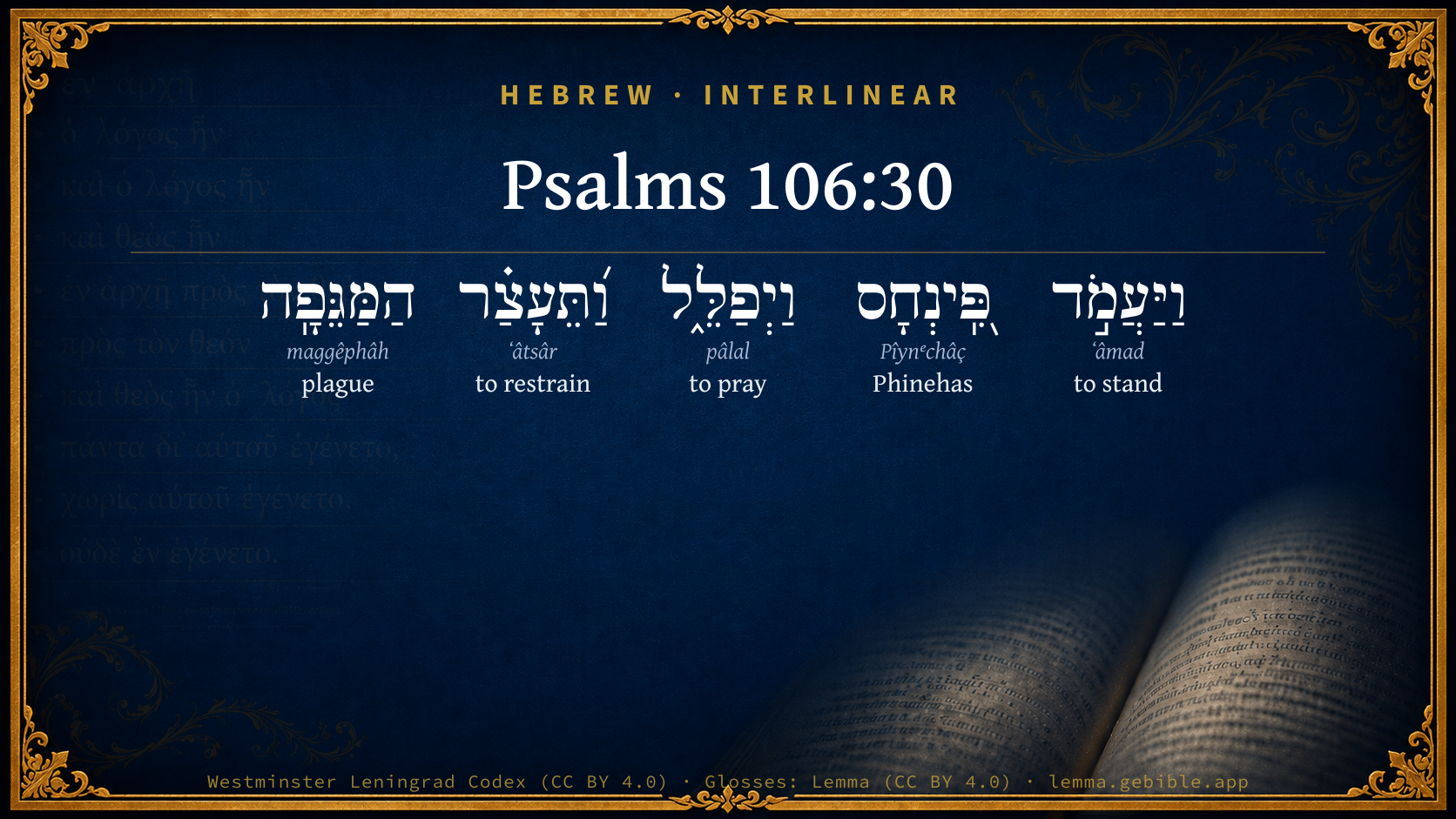
Psalms 106:30

Hebrew (Westminster Leningrad Codex) Psalms 106:30 appears in the Hebrew Old Testament. The text above is from the Westminster Leningrad Codex. Each word links to its Strong’s number, a concise gloss, and parsing drawn from the Open Scriptures Hebrew Bible morphology. Click any word for its full Brown-Driver-Briggs (BDB) entry.
Download image
Cite this verse

Psalms 106:30 (World English Bible). Public Domain. Lemma interlinear Bible study tool, https://lemma.gebible.app/v/psalms/106/30.

Show BibTeX & RIS
BibTeX
RIS
English Translation
Then Phinehas stood up, and executed judgment, So the plague was stopped.
World English Bible · Public Domain
Download a study sheet

One document with this verse’s original text, its word-by-word gloss line, the meaning frame, cross-references with their text, attributed commentary, and full source and license credits — printable, and it pastes into notes with its structure intact.

This verse Autodidact and up

Study sheet (.html) Plain text (.txt)

A passage Seminary Student

Up to 50 verses in one chapter. A passage sheet keeps up to 6 commentary sources and 12 cross-references per verse, in the order this page ranks them, and says so on the sheet whenever that leaves anything out. Ask for a single verse and you get the Autodidact verse sheet above.

Everything on this page stays free to read, with no account — the sheet is a download of what is already on screen, not access to it.

Want to remove ads? Support Godless Engineer
Compare translations 3

The same verse in 3 English versions, stacked beneath the original-language interlinear above. Click any original word for its lexicon entry.

Each is an independent rendering of the whole verse — the interlinear is not word-aligned to these translations.

Highlighted words mark where these versions differ — a whole-verse word diff, not a word-by-word alignment.

  • World English Bible Public Domain
    Then Phinehas stood up, and executed judgment, So the plague was stopped.
  • King James Version Public Domain
    Then stood up Phinehas, and executed judgment: and so the plague was stayed.
  • unfoldingWord Literal Text CC BY-SA 4.0
    Then Phinehas stood and intervened, and the plague was restrained.

unfoldingWord Literal Text — © unfoldingWord, licensed CC BY-SA 4.0. Word-aligned USFM3 via Door43 (git.door43.org/unfoldingWord/en_ult).

Versions to compare (up to 4)

3 of 4 selected

Show all 18 translations

Every available English version of this verse, each an independent rendering of the whole verse.

  • World English Bible Public Domain
    Then Phinehas stood up, and executed judgment, So the plague was stopped.
  • Berean Standard Bible Public Domain
    But Phinehas stood and intervened, and the plague was restrained.
  • Majority Standard Bible Public Domain
    But Phinehas stood and intervened, and the plague was restrained.
  • King James Version Public Domain
    Then stood up Phinehas, and executed judgment: and so the plague was stayed.
  • American Standard Version (1901) Public Domain
    Then stood up Phinehas, and executed judgment; And so the plague was stayed.
  • Revised Version (1885) Public Domain
    Then stood up Phinehas, and executed judgment: and so the plague was stayed.
  • Geneva Bible (1599) Public Domain
    But Phinehas stoode vp, and executed iudgement, and the plague was staied.
  • Douay-Rheims (1899) Public Domain
    Then Phinees stood up, and pacified him: and the slaughter ceased.
  • Young's Literal Translation Public Domain
    And Phinehas standeth, and executeth judgment, And the plague is restrained,
  • Literal Standard Version CC BY-SA 4.0
    And Phinehas stands, and executes judgment, || And the plague is restrained,
  • Unlocked Literal Bible CC BY-SA 4.0
    Then Phinehas rose to intervene, and the plague subsided.
  • unfoldingWord Literal Text CC BY-SA 4.0
    Then Phinehas stood and intervened, and the plague was restrained.
  • Darby Bible Public Domain
    Then stood up Phinehas and executed judgment, and the plague was stayed;
  • World Messianic Bible Public Domain
    Then Phinehas stood up and executed judgment, so the plague was stopped.
  • Webster's Bible Public Domain
    Then stood up Phinehas, and executed judgment: and so the plague was stayed.
  • Free Bible Version CC BY-SA 4.0
    But Phinehas took a stand for the Lord and intervened, and the plague was stopped in its tracks.
  • Bible in Basic English Public Domain
    Then Phinehas got up, and made prayer for them; and the disease went no farther.
  • JPS Tanakh (1917) Public Domain
    Then stood up Phinehas, and wrought judgment, and so the plague was stayed.

Literal Standard Version (2020), Covenant Press — licensed CC BY-SA 4.0. Text via the HelloAO Bible API (eBible.org). Unlocked Literal Bible (unfoldingWord) — licensed CC BY-SA 4.0. Text via the HelloAO Bible API (eBible.org). unfoldingWord Literal Text — © unfoldingWord, licensed CC BY-SA 4.0. Word-aligned USFM3 via Door43 (git.door43.org/unfoldingWord/en_ult). Free Bible Version, Dr. Jonathan Gallagher — licensed CC BY-SA 4.0. Text via the HelloAO Bible API (eBible.org).

Word by word

More ways to search: Search by grammar → Find every occurrence → Compare this word →

Practice this passage: Drill this verse → Learn its vocabulary →

About this verse

These counts appear in no published source. They are computed here, from the morphology-tagged text and Lemma’s own curated glosses. What Lemma adds →

5
words
5
distinct lemmas
Wisdom
section

Notable vocabulary

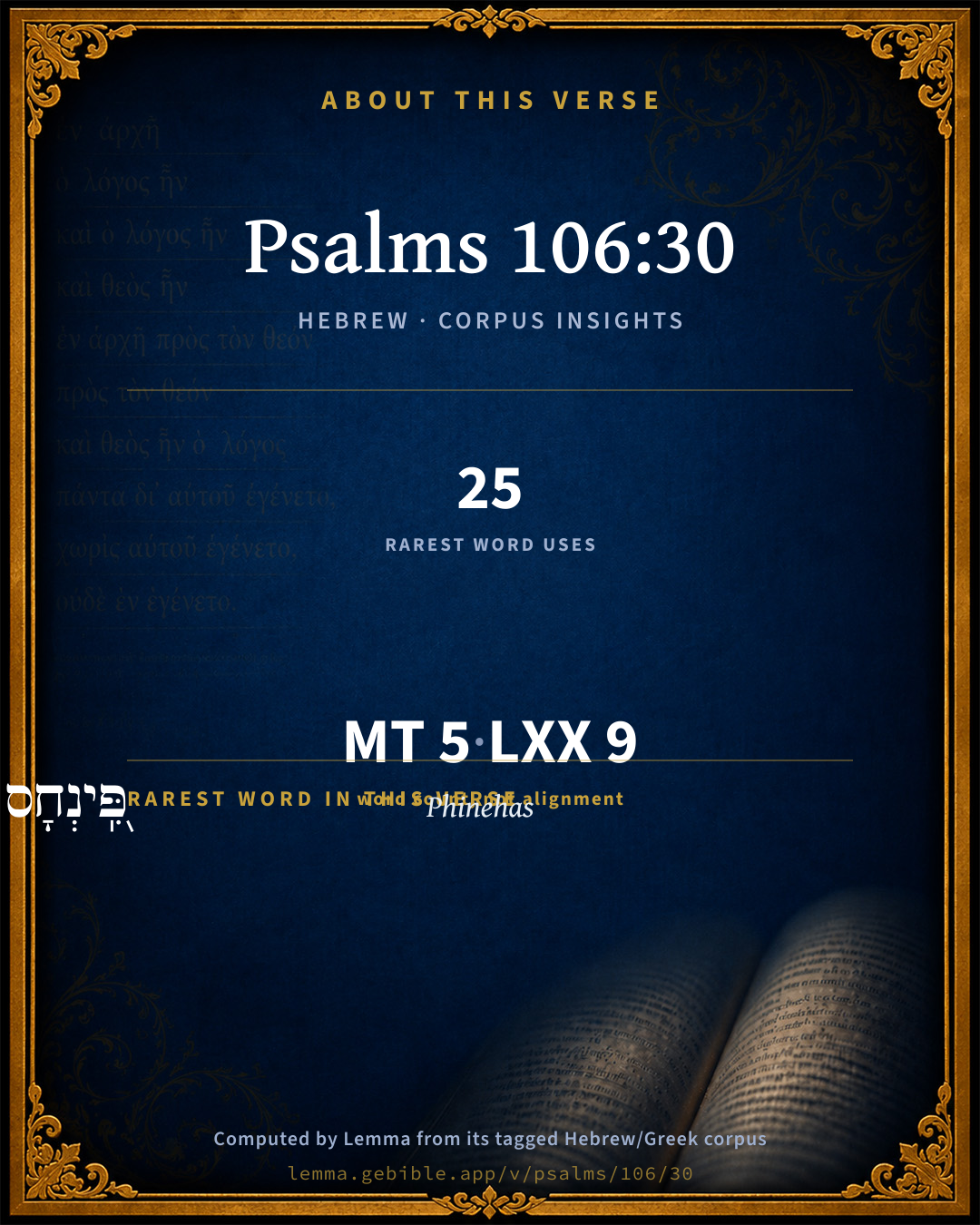
The rarest word here is פִּֽ֭ינְחָס Phinehas H6372 — appearing just 25 times in the whole Hebrew Bible.

Shared distinctive vocabulary

פִּֽ֭ינְחָס Phinehas H6372 occurs in 24 verses of the Hebrew Bible. Also found in:

Grammatical profile

  • 3 verbs
  • 2 nouns

Verb forms

  • וַיַּעֲמֹ֣ד Qal · Sequential Imperfect
  • וַיְפַלֵּ֑ל Piel · Sequential Imperfect
  • וַ֝תֵּעָצַ֗ר Niphal · Sequential Imperfect

Hebrew & Septuagint length

In English translation the verse runs 12 words from the Hebrew and 11 from the Septuagint (LXX English) — closely comparable.

A rough comparison of the two English renderings, which tokenize alike — not a word-level alignment.

Word counts can differ between the Hebrew and the Greek without any difference in meaning — e.g. the Hebrew direct-object marker אֵת has no separate Greek word, and Greek often adds the article ὁ.

In the original languages it is 5 Hebrew tokens and 9 Greek tokens — but the two are counted differently (Hebrew bundles its prefixes and suffixes into one token; the Greek is in lemma form), so that isn’t a like-for-like length.

Cross-references

7

Topical passages linked to Psalms 106:30 in the Treasury of Scripture Knowledge — connected by theme and wording, ordered by reader-vote popularity; previews shown in the World English Bible.

  • Numbers 25:6–8 Behold, one of the children of Israel came and brought to his brothers a Midianite woman in the sight of Moses, and in the sight of all the congregation of the children of Israel, while they were weeping at the door of the tent of meeting.
  • Numbers 25:14–15 Now the name of the man of Israel that was slain, who was slain with the Midianite woman, was Zimri, the son of Salu, a prince of a fathers' house among the Simeonites.
  • Joshua 7:12 Therefore the children of Israel can't stand before their enemies; they turn their backs before their enemies, because they are become accursed: I will not be with you any more, except you destroy the devoted thing from among you.
  • Deuteronomy 13:9–11 but you shall surely kill him; your hand shall be first on him to put him to death, and afterwards the hand of all the people.
  • 1 Kings 18:40–41 and Elijah said to them, Take the prophets of Baal; don't let one of them escape. They took them; and Elijah brought them down to the brook Kishon, and killed them there.
  • Jonah 1:12–15 He said to them, "Take me up, and throw me into the sea. Then the sea will be calm for you; for I know that because of me this great tempest is on you."
  • Deuteronomy 13:15–17 you shall surely strike the inhabitants of that city with the edge of the sword, destroying it utterly, and all that is therein and the cattle of it, with the edge of the sword.

Cross-references courtesy of OpenBible.info (CC BY 4.0).

Hebrew and Greek witnesses Masoretic Hebrew ↔ Greek Septuagint

The same verse in the two great witnesses to the Old Testament, shown verse-for-verse.

You’re reading Greek Psalm 105 (Hebrew Psalm 106). The Septuagint counts the superscription, so verse numbers can differ from the Hebrew — chapter-level alignment, not verse-by-verse. Numbering follows Rahlfs.

These are two independent witnesses, not word-aligned to each other, and the Septuagint is shown in lemma (dictionary) form.

Hebrew Psalms 106:30 Masoretic · Westminster Leningrad Codex

וַיַּעֲמֹ֣ד פִּֽ֭ינְחָס וַיְפַלֵּ֑ל וַ֝תֵּעָצַ֗ר הַמַּגֵּפָֽה

Then Phinehas stood up, and executed judgment, So the plague was stopped.

World English Bible · Public Domain

Greek LXX Greek Psalm 105:30 Septuagint · lemma form

καί ἵστημι φινεες καί ἐκἱλάσκομαι καί κοπάζω ὁ θραῦσις

Then Phinees stood up, and made atonement: and the plague ceased.

LXX2012 (modern English Septuagint) · Public Domain

On this verse, Ellicott's Commentary for English Readers discusses the Septuagint’s reading. Read the note in Commentary ↓

Hebrew: Westminster Leningrad Codex (CC BY 4.0). Greek: Septuagint (public domain); English from LXX2012 (modern English Septuagint) (Public Domain). How the Septuagint differs from the Hebrew →

Commentary

Notes on Psalms 106:30 from classic Christian and Jewish commentators (each source and its license shown beneath its notes). The classic Christian expositions comment on the surrounding passage and are grouped to its opening verse, so a note may address several verses; the Jewish commentaries on the Tanakh (Rashi and others) are per-verse, so they appear only where the commentator wrote on this verse.

Lemma curates 59 commentaries, every one of them public domain or Creative Commons licensed, each selected and text-cleaned for this edition rather than reprinted as found. About our sources →

Trapp's Complete Commentary

John Trapp

Psa 106:30 Then stood up Phinehas, and executed judgment: and [so] the plague was stayed.

Ver. 30. Then stood up Phinehas] Animose surrexit (Vatab.). By a secret, heroical, and extraordinary motion of God’s Spirit, such as may not be drawn into example. All things reported and commended in Scripture may not be imitated. One Birchet, by example of Phinehas and Ehud, thought he might have killed a great personage in this land, whom he looked upon as a naughty man, and God’s enemy. A particular example will afford a general instruction, when the equity of the thing done is universal, and the cause common, otherwise not, saith learned Junius.

And executed judyment] Not tarrying for the sentence of the judges. The Chaldee rendereth it, And prayed. Execution of justice is that actual, magisterial, and majestical kind of prayer that will stay the plague when nothing else will.

John Trapp, A Commentary or Exposition upon All the Books of the Old and New Testament (1647–1656) — public domain. Text from a community e-Sword module.

J. A. Alexander on Psalms

Joseph Addison Alexander

30. (Psa 106:30) Then stood up Phinehas and judged, and (so) was stayed the plague. He stood (or rose) up from among the rest, presented himself before the people. He judged, i.e. assumed the office and discharged the duty, from which the regular official judges seemed to shrink. The verb includes the act both of pronouncing and of executing judgment. See the narrative in Numbers 25. The form of expression in the last clause is borrowed from Num 17:13; Num 16:48.

Joseph Addison Alexander, The Psalms Translated and Explained (1850) — public domain. Text from a community e-Sword module.

Tyndale Open Study Notes

Tyndale Open Resources

106:30-33 Phinehas, who executed a flagrantly apostate Israelite man (Num 25:3-8), is an even better model of a righteous man than Moses, who failed at Meribah (Num 20:11-13).

Tyndale Open Study Notes — © Tyndale Open Resources, licensed CC BY-SA 4.0. Text via the HelloAO Bible API.

Geneva Bible (1599)

Geneva Bible translators

When all others neglected God’s glory, he in his zeal killed the adulterers and prevented God’s wrath.

Geneva Bible (1599) marginal notes — public domain. Text via Bolls.life.

Ellicott's Commentary for English Readers

(30) Executed judgment.—The Prayer Book has “prayed,” following the Chaldee and Syriac. The LXX. and Vulg. have “appeased.”

A Bible Commentary for English Readers, edited by Charles John Ellicott (1878–1897) — public domain. Text from a community e-Sword module.

The Cambridge Bible for Schools and Colleges

gen. ed. J. J. S. Perowne

30. Then stood up Phinehas] Cp. Num_25:7; and for ‘stood,’ Num_16:48.

and executed judgment] So rightly Jerome, diiudicavit. P.B.V. prayed follows the Syr. and Targ.; but this is not the regular meaning of the form of the verb, and does not agree with the history.

and so the plague was stayed] From Num_25:8.

The Cambridge Bible for Schools and Colleges (gen. ed. J. J. S. Perowne; Cambridge University Press, 1878–1918) — public domain. Text from a community e-Sword module.

John Gill's Exposition

Then stood up Phinehas, and executed judgment,.... When none else would, he rose up in great zeal for the Lord of hosts; and took on him the work of a civil magistrate, and slew two persons of noble birth in the very act of fornication. The Targum is,

"he prayed''

and so the Syriac version

"he interceded with the Lord, that the plague might stop.''

This he might do, as well as the other, though it is not elsewhere recorded, and in which he succeeded: but in the Talmud (y) it is observed that it is not said (that is, "he prayed"), but from whence may be learned, if it is proper to say so, that he executed judgments with his Maker. The Septuagint and Vulgate Latin versions render it, "he appeased"; made atonement for propitiation; and this is said of him, Num 25:13.

And so the plague was stayed; it was restrained from proceeding further; no more execution was done by it. In this he was a type of Christ, who, by doing righteousness, by the atoning sacrifice of himself, and by his intercession, has appeased the wrath of God, and satisfied divine justice so that there is no condemnation to them that are interested in him; no evil of punishment shall befall them, nor plague come nigh them.

(y) T. Bab. Sanhedrin, fol. 82. 2.

John Gill's Exposition of the Whole Bible (1746–1763) — public domain (CC PDM 1.0). Text via the HelloAO Bible API.

Albert Barnes' Notes on the Bible

Then stood up Phinehas, and executed judgment ... - Inflicted summary punishment upon a principal offender. Num 25:7-8.

Albert Barnes' Notes on the Bible (1834–1885) — public domain. Text from a community e-Sword/MySword module.

The Treasury of David

Charles H. Spurgeon

Ver. 30. Then stood up Phinehas, and executed judgment: and so the plague was stayed. God has his champions left in the worst times, and they will stand up when the time comes for them to come forth to battle. This righteous indignation moved him to a quick execution of two open offenders. His honest spirit could not endure that lewdness should be publicly practised at a time when a fast had been proclaimed. Such daring defiance of God and of all law he could not brook, and so with his sharp javelin he transfixed the two guilty ones in the very act. It was a holy passion which inflamed him, and no enmity to either of the persons whom he slew. The circumstances were so remarkable and the sin so flagrant that it would have involved great sin in a public man to have stood still and seen God thus defied, and Israel thus polluted. Phinehas was not of this mind, he was no trimmer, or palliator of sin, his heart was sound in God's statutes, and his whole nature was ablaze with zeal for God's glory, and therefore, though a priest, and therefore not obliged to be an executioner, he undertook the unwelcome task, and though both transgressors were of princely stock he had no respect of persons, but dealt justice upon them as if they had been the lowest of the people. This brave and decided deed was so acceptable to God as a proof that there were some sincere souls in Israel that the deadly visitation went no further. Two deaths had sufficed to save the lives of the multitude.

Ver. 30. Then stood up Phinehas. All Israel saw the bold lewdness of Zimri, but their hearts and eyes were so full of grief, that they had not room enough for indignation. Phinehas looked on with the rest, but with other affections. When he saw this defiance bidden to God, and this insult upon the sorrow of his people (that while they were wringing their hands, a proud miscreant durst outface their humiliation with his wicked dalliance), his heart boils with a desire of a holy revenge; and now that hand, which was used to a censer and sacrificing knife, takes tip his javelin, and, with one stroke, joins these two bodies in their death, which were joined in their sin, and in the very flagrance of their lust, makes a new way for their souls to their own place. O noble and heroical courage of Phinehas! Which, as it was rewarded of God, so is worthy to be admired of men. He doth not stand casting of scruples: Who am I to do this? The son of the high priest. My place is all for peace and mercy: it is for me to sacrifice, and pray for the sin of the people, not to sacrifice any of the people for their sin. My duty calls me to appease the anger of God what I may, not to revenge the sins of men; to pray for their conversion, not to work the confusion of any sinner. And who are these? Is not the one a great prince in Israel, the other a princess of Midian? Can the death of two so famous personages go unrevenged? Or, if it be safe and fit, why doth my uncle Moses rather shed his own tears than their blood? I will mourn with the rest; let them revenge whom it concerneth. But the zeal of God hath barred out all weak deliberations; and he holds it now both his duty and his glory, to be an executioner of so shameless a pair of offenders...

Now the sin is punished, the plague ceaseth. The revenge of God sets out ever after the sin; but if the revenge of men (which commonly comes later) can overtake it, God gives over the chase. How oft hath the infliction of a less punishment avoided a greater! There are none so good friends to the state, as courageous and impartial ministers of justice: these are the reconcilers of God and the people, more than the prayers of them that sit still and do nothing. Joseph Hall.

Ver. 30. Then stood up Phinehas, etc. Mark the mighty principle, which rolled like a torrent in the heart of Phinehas. The Spirit leaves it not obscure. The praise is this, "He was zealous for his God", Nu 25:13. He could not fold his arms, and see God's law insulted, his rule defied, his majesty and empire scorned. The servant's heart blazed in one blaze of godly indignation. He must be up to vindicate his Lord. His fervent love, his bold resolve, fear nothing in a righteous cause. The offending Zimri was a potent prince: nevertheless he spared him not. Believer, can you read this and feel no shame? Do your bold efforts testify your zeal? Sinners blaspheme God's name. Do you rebuke? His Sabbaths are profaned. Do you protest? False principles are current? Do you expose the counterfeits? Vice stalks in virtue's garb. Do you tear down the mask? Satan enthrals the world. Do you resist? Nay, rather are you not dozing unconcerned? Whether Christ's cause succeeds, or be cast down, you little care. If righteous zeal girded your loins, and braced your nerves, and moved the rudder of your heart, and swelled your sails of action, would God be so unknown, and blasphemy so daring?

Mark, next, the zeal of Phinehas is sound minded. It is not as a courser without rein, a torrent unembanked, a hurricane let loose. Its steps are set in order's path. It executes God's own will in God's own way. The mandate says, let the offenders die. He aims a death blow, then, with obedient hand. The zeal, which heaven kindles, is always a submissive grace. Henry Law, in "Christ is All", 1858.

Ver. 30. Stood up, as valiantly to do his work of zeal, as Moses had done to discharge the office of intercessor, and because he alone rose to set the example of resistance to the foul rites of Baal Peor. Cassiodorus, quoted by Neale and Littledale.

Ver. 30. So the plague was stayed. God himself puts this peculiar honour of staying the plague (when he was about to destroy the whole camp) upon this fact of Phinehas, saying, "He hath turned away my wrath", Nu 25:10-11, because he was acted with the same zeal for God's glory and Israel's good, as God himself is acted with for them, and feared not to lose his life in God's cause, by putting to death a prince and a princess in the very flagrancy of their lust at one blow. There is such an accent and such an emphasis put by the Lord on this act, (as the Jewish Rabbis observe), that here they begin the forty-first section or lecture of the Law, or (as Vatablus saith) the seventh section of the book, which they call Phinehas. Moreover, it teacheth us, that zeal of justice in the cause of God is an hopeful means to remove God's wrath from, and to procure his mercy to, man. Thus David also made an atonement by doing justice on Saul's house, 2Sa 21:3, etc...

Phinehas by virtue of this promise of the priesthood (Nu 25:12-13) lived himself to a great old age, even (as some say) to three hundred years, as appeareth by Jud 20:28, where he then is found alive, for his zeal at this time. He lived so long that some of the Rabbis are of opinion that he died not at all, but is still alive, whom they suppose to be the Elias that is to come before the coming of Christ; but this notion is confuted by others of their Rabbis, and by the mention of his seed succeeding him in sacred Scripture. However, though few after the Flood did near attain to any such age, yet must Phinehas be very old in that time of Israel's warring with Benjamin...Phinehas's priesthood is called "everlasting", not in his person, but in his posterity, whose sons were successively high priests till the captivity of Babylon, 1Ch 6:4-16; and at the return out of captivity, Ezra, the great priest and scribe, was of his line, Ezr 7:1-6; and so it continued in that line until, or very near, the approach of our evangelical High Priest (as Christ is called, Heb 5:6), who was of the order of Melchizedek. Christopher Ness.

Ver. 30. Why is the pacifying of God's wrath, and the staying of the plague ascribed to Phinehas, having a blush of irregularity in it, rather than to the acts of Moses and the judges, which were by express command from God and very regular? For answer, the acts of Moses and the judges slaked the fire of God's wrath, that of Phinehas quenched it; again, the acts of Moses and the judges had a rise from a spark, that of Phinehas from a flame of zeal and holy indignation in him; hence the Lord, who is exceedingly taken with the springs and roots of actions, sets the crown upon the head of Phinehas. Edmund Staunton, in a Sermon preached before the House of Lords, 1644.

Ver. 30. So the plague was stayed. A man doth not so live by his own faith, but in temporal respects the faith of another man may do him good. Masters by their faith obtained healing for their servants, parents for their children, Mt 15:28. "Oh, man, great is thy faith!" "Jesus seeing their faith", healed the sick of the palsy. God's people for the town or place where they live: "The innocent" (i.e., the faithful doer) "shall deliver the island", Job 22:30. Ge 18:32, "If ten righteous persons shall be found there, I will not destroy it for ten's sake." Especially in Magistrates, Moses, Nu 14:1-45; Hezekiah, Isa 37:1-38, put up prayers, and God saved the people and places, they prayed for: Then Phinehas executed judgment (appeased God by faith) and so the plague was stayed. Matthew Lawrence.

3. Elevation of mind and sweetness of spirit are pearls of great price, and if we wish to preserve them we had better intrust them to God's own keeping. If Moses lost his faith, it was by first losing self command: and if a man lose this, it is hard to say what next he may lose: like the mad warrior who makes a missile of his shield and hurls it at the head of all enemy, he is henceforward open to every fiery dart, to the cut and thrust of every assailant. But, as John Newton remarks, "The grace of God is as necessary to create a right temper in a Christian on the breaking of a china plate as on the death of an only son"; and as no man can tell on any dawning day but what that may be the most trying day in all his life, how wise to pray without ceasing, "uphold me according unto thy word. Hold thou me up, and I shall be safe." "Set a watch, O Lord, before my mouth: keep the door of my lips." "Who can understand his errors? Cleanse thou me from secret faults. Keep back thy servant also from presumptuous sins; let them not have dominion over me: then shall I be upright, and I shall be innocent from the great transgression." James Hamilton.

Ver. 30-31. The effects of one decisive act for God; immediate, personal, and for posterity.

Psalms 106:31*

Charles H. Spurgeon's The Treasury of David (1869–1885) — public domain. Psalms only. Text from a community e-Sword/MySword module.

The Pulpit Commentary

Then stood up Phinehas, and executed judgment. (see Num_25:7, Num_25:8) Some critics, however, translate llpy, by "mediated" (Kay, Cheyne). And so the plague was stayed. (comp. Num_25:8)

The atonement of Phinehas. (See Num_25:11-13)

"Phinehas, himself perhaps a judge in authority, became the type of a righteous zeal, exercising summary vengeance, informal and unbidden, against outrage on decency and on reverence for God" (Dr. Barry). "It is a picture of the one zealous man rising up from the midst of the inactive multitude, who sit still and make no effort." The incident occurred toward the close of the wanderings, when the Israelites were in the neighbourhood of Moab. Unable to gain the right to curse Israel as Balsam wished, and as it would have paid him well to do Balsam persuaded King Balak to allow free intercourse between his people and them. "Let the Israelites fall into immorality and sin, and then their God will destroy them, and your end will be accomplished." The scheme succeeded. The vice and iniquity of Israel was full in God"s sight, and the immediate execution of the Divine judgment was commanded. Some great public act of vindication was called for; such a manifest upholding of the Divine authority and holiness as would make a sin-cover, occupy the Divine attention, gain the Divine approval, and be a basis on which judgment might be stayed. Phinehas was the man to do it. A flagrant case of unlawful intercourse had occurred, and when he saw the wicked couple he "rose up from among the congregation, and took a javelin in his hand, and he went after the man of Israel into the tent, and thrust both of them through, the man of Israel and the woman. So the plague was stayed from the children of Israel.

I PHINEHAS WAS ZEALOUS FOR THE HONOUR OF JEHOVAH.

II HIS PUBLIC ACT OF VINDICATION MADE A SIN-COVER.

III BECAUSE OF THAT SIN-COVER, JEHOVAH"S JUDGMENT MIGHT BE STAYED.

See, then, what we must look for in the great atonement, made for us by the Son of God, is some fitting vindication of the outraged honour of God our Father, and so restored relations. Reconciliation can only come with solemn honouring of God"s authority and claim by some public act of loyalty. Scripture presents to us different things that made atonement. A man"s prayer made atonement (case of Moses). An act of official duty made atonement (case of Aaron). An act of judgment made atonement (case of Phinehas). We are left to think what act of Christ"s made atonement for us all. R.T.

The Pulpit Commentary (1880–1919), ed. H.D.M. Spence-Jones & Joseph S. Exell — public domain. Text from a community e-Sword module.

unfoldingWord translationNotes

Door43 World Missions Community

Then Phinehas rose to intervene

Phinehas intervened among the people, punishing them for their sin. This can be made clear. AT: "Then Phinehas rose to intervene among the people because of their sin" (See: Assumed Knowledge and Implicit Information)

It was counted to him as a righteous deed

This can be stated in active form. AT: "People credited it to him as a righteous deed" (See: Active or Passive)

translationWords

Phinehas

raise

righteous

works

generation

eternity

unfoldingWord translationNotes — © Distant Shores Media and the Door43 World Missions Community, licensed CC BY-SA 4.0. Source: git.door43.org/Door43/en_tn.

Lesson kit

Teaching starters — assembled from the data on this page, not authored interpretation. Every prompt links to the verse data it draws on. Edit before teaching.

Psalms, in the Wisdom, opens this verse with 5 words (5 distinct Hebrew lemmas). Its most distinctive word is Pîynᵉchâç (“Phinehas”). A historical commentator’s framing appears above. Read the whole chapter for the surrounding context.

Discussion questions

  1. What does “Phinehas” (Pîynᵉchâç) contribute to the verse as a whole?
  2. Exodus 6:25 shares the word «Phinehas» with this verse. How do the two illuminate each other?
  3. These translations render this verse differently. What is at stake in choosing one wording over another?
  4. The verb «וַיַּעֲמֹ֣ד» is Qal Sequential Imperfect. How does its form color the action?
  5. Reading how Trapp's Complete Commentary and J. A. Alexander on Psalms read this verse, where do the two commentators agree and where do they part?

Things to notice

Reading settings

Reading text

Shown beneath each verse's original-language words.

Old Testament
Old Testament edition

Read the OT as the Masoretic Hebrew (MT) or the Greek Septuagint (LXX).

English shown for the Greek Septuagint (in the Hebrew ↔ Greek comparison).

Comparing translations? Open the Compare panel on any verse page to stack up to four side by side.