
Jeremiah 7:16

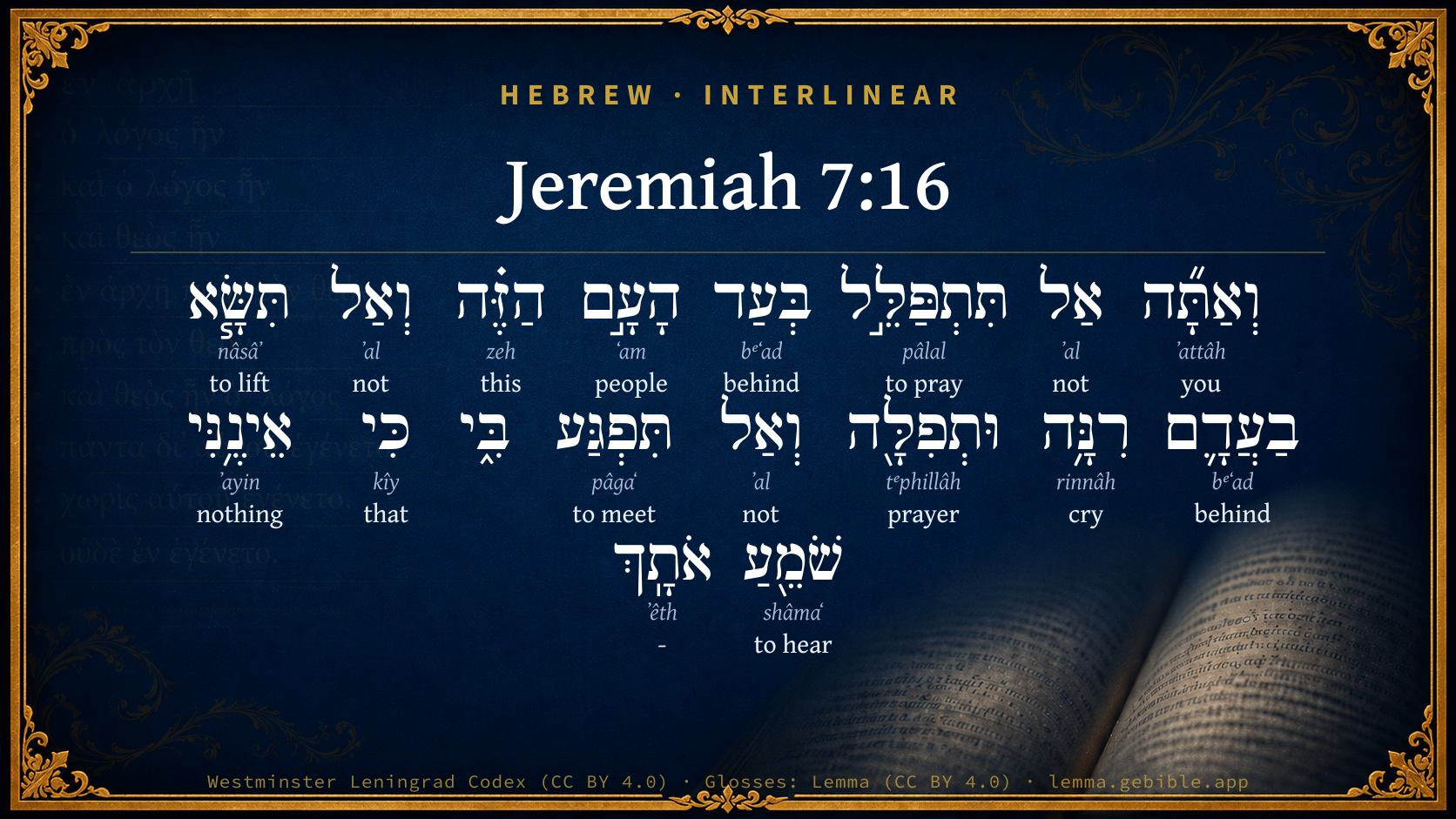
Hebrew (Westminster Leningrad Codex) Jeremiah 7:16 appears in the Hebrew Old Testament. The text above is from the Westminster Leningrad Codex. Each word links to its Strong’s number, a concise gloss, and parsing drawn from the Open Scriptures Hebrew Bible morphology. Click any word for its full Brown-Driver-Briggs (BDB) entry.
Download image
Cite this verse

Jeremiah 7:16 (World English Bible). Public Domain. Lemma interlinear Bible study tool, https://lemma.gebible.app/v/jeremiah/7/16.

Show BibTeX & RIS
BibTeX
RIS
English Translation
Therefore don't you pray for this people, neither lift up a cry nor prayer for them, neither make intercession to me; for I will not hear you.
World English Bible · Public Domain
Download a study sheet

One document with this verse’s original text, its word-by-word gloss line, the meaning frame, cross-references with their text, attributed commentary, and full source and license credits — printable, and it pastes into notes with its structure intact.

This verse Autodidact and up

Study sheet (.html) Plain text (.txt)

A passage Seminary Student

Up to 50 verses in one chapter. A passage sheet keeps up to 6 commentary sources and 12 cross-references per verse, in the order this page ranks them, and says so on the sheet whenever that leaves anything out. Ask for a single verse and you get the Autodidact verse sheet above.

Everything on this page stays free to read, with no account — the sheet is a download of what is already on screen, not access to it.

Want to remove ads? Support Godless Engineer
Compare translations 3

The same verse in 3 English versions, stacked beneath the original-language interlinear above. Click any original word for its lexicon entry.

Each is an independent rendering of the whole verse — the interlinear is not word-aligned to these translations.

Highlighted words mark where these versions differ — a whole-verse word diff, not a word-by-word alignment.

  • World English Bible Public Domain
    Therefore don't you pray for this people, neither lift up a cry nor prayer for them, neither make intercession to me; for I will not hear you.
  • King James Version Public Domain
    Therefore pray not thou for this people, neither lift up cry nor prayer for them, neither make intercession to me: for I will not hear thee.
  • unfoldingWord Literal Text CC BY-SA 4.0
    As for you, do not pray for this people, and do not lift up a cry or a prayer for them, and do not plead with me, for I shall not hear you.

unfoldingWord Literal Text — © unfoldingWord, licensed CC BY-SA 4.0. Word-aligned USFM3 via Door43 (git.door43.org/unfoldingWord/en_ult).

Versions to compare (up to 4)

3 of 4 selected

Show all 18 translations

Every available English version of this verse, each an independent rendering of the whole verse.

  • World English Bible Public Domain
    Therefore don't you pray for this people, neither lift up a cry nor prayer for them, neither make intercession to me; for I will not hear you.
  • Berean Standard Bible Public Domain
    As for you, do not pray for these people, do not offer a plea or petition on their behalf, and do not beg Me, for I will not listen to you.
  • Majority Standard Bible Public Domain
    As for you, do not pray for these people, do not offer a plea or petition on their behalf, and do not beg Me, for I will not listen to you.
  • King James Version Public Domain
    Therefore pray not thou for this people, neither lift up cry nor prayer for them, neither make intercession to me: for I will not hear thee.
  • American Standard Version (1901) Public Domain
    Therefore pray not thou for this people, neither lift up cry nor prayer for them, neither make intercession to me; for I will not hear thee.
  • Revised Version (1885) Public Domain
    Therefore pray not thou for this people, neither lift up cry nor prayer for them, neither make intercession to me: for I will not hear thee.
  • Geneva Bible (1599) Public Domain
    Therfore thou shalt not pray for this people, neither lift vp crie or praier for them neither intreat me, for I will not heare thee.
  • Douay-Rheims (1899) Public Domain
    Therefore, do not thou pray for this people, nor take to thee praise and supplication for them: and do not withstand me: for I will not hear thee.
  • Young's Literal Translation Public Domain
    And thou dost not pray for this people, Nor lift up for them crying and prayer, Nor intercede with Me, for I hear thee not.
  • Literal Standard Version CC BY-SA 4.0
    And you do not pray for this people, || Nor lift up crying and prayer for them, || Nor intercede with Me, for I do not hear you.
  • Unlocked Literal Bible CC BY-SA 4.0
    As for you, Jeremiah, do not pray for this people, and do not lift up a lamenting wail or say a prayer on their behalf, and do not petition me, for I will not listen to you.
  • unfoldingWord Literal Text CC BY-SA 4.0
    As for you, do not pray for this people, and do not lift up a cry or a prayer for them, and do not plead with me, for I shall not hear you.
  • Darby Bible Public Domain
    And thou, pray not for this people, neither lift up cry nor prayer for them, and make not intercession to me; for I will not hear thee.
  • World Messianic Bible Public Domain
    “Therefore don’t pray for this people. Don’t lift up a cry or prayer for them or make intercession to me; for I will not hear you.
  • Webster's Bible Public Domain
    Therefore pray not thou for this people, neither lift up cry nor prayer for them, neither make intercession to me: for I will not hear thee.
  • Free Bible Version CC BY-SA 4.0
    You, Jeremiah, are not to pray for these people. Don't cry out to me in prayer for them, don't plead with me on their behalf, because I won't listen to you.
  • Bible in Basic English Public Domain
    And as for you (Jeremiah), make no prayers for this people, send up no cry or prayer for them, make no request for them to me: for I will not give ear.
  • JPS Tanakh (1917) Public Domain
    Therefore pray not thou for this people, neither lift up cry nor prayer for them, neither make intercession to Me; for I will not hear thee.

Literal Standard Version (2020), Covenant Press — licensed CC BY-SA 4.0. Text via the HelloAO Bible API (eBible.org). Unlocked Literal Bible (unfoldingWord) — licensed CC BY-SA 4.0. Text via the HelloAO Bible API (eBible.org). unfoldingWord Literal Text — © unfoldingWord, licensed CC BY-SA 4.0. Word-aligned USFM3 via Door43 (git.door43.org/unfoldingWord/en_ult). Free Bible Version, Dr. Jonathan Gallagher — licensed CC BY-SA 4.0. Text via the HelloAO Bible API (eBible.org).

Word by word

More ways to search: Search by grammar → Find every occurrence → Compare this word →

Practice this passage: Drill this verse → Learn its vocabulary →

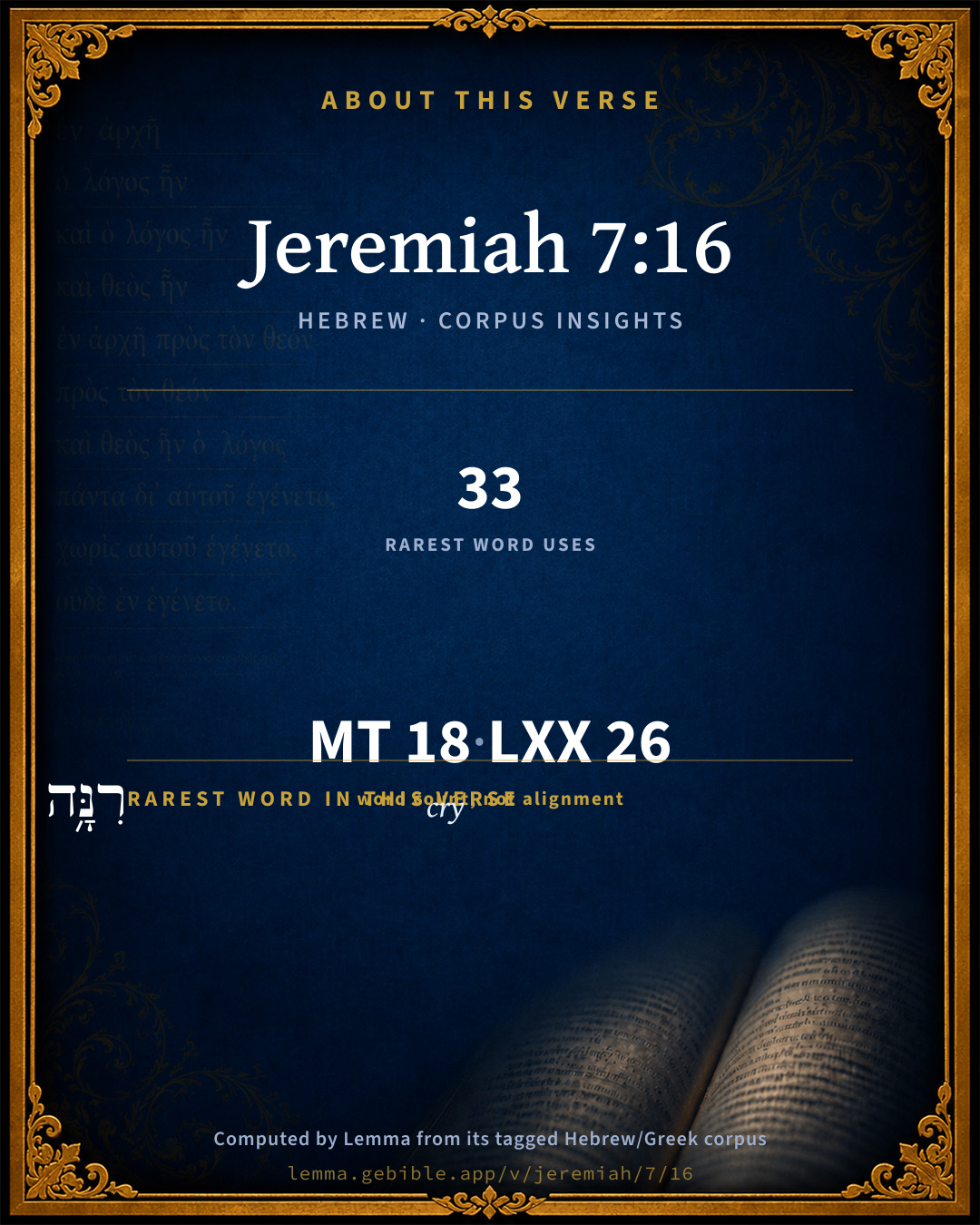
רִנָּ֥ה
rinnâh
H7440
“cry”
Noun, Common, Feminine, Singular, Absolute
Part of Speech
Noun
Type
Common
Gender
Feminine
Number
Singular
State
Absolute
Full BDB Definition

Origin: from H7442

TWOT: 2179c

ringing cry - of entreaty, supplication - in proclamation, joy, praise
  1. וְאַתָּ֞ה ʼattâh H859 “and · you” Conjunction + Pronoun, Personal, 2nd Person, Masculine, Singular
  2. אַל ʼal H408 “not” Particle, Negative
  3. תִּתְפַּלֵּ֣ל pâlal H6419 “to pray” Verb, Hithpael, Jussive, 2nd Person, Masculine, Singular
  4. בְּעַד bᵉʻad H1157 “behind” Preposition
  5. הָעָ֣ם ʻam H5971 “the · people” Particle, Definite Article + Noun, Common, Masculine, Singular, Absolute
  6. הַזֶּ֗ה zeh H2088 “the · this” Particle, Definite Article + Pronoun, Demonstrative, Masculine, Singular
  7. וְאַל ʼal H408 “and · not” Conjunction + Particle, Negative
  8. תִּשָּׂ֧א nâsâʼ H5375 “to lift” Verb, Qal, Jussive, 2nd Person, Masculine, Singular
  9. בַעֲדָ֛ם bᵉʻad H1157 “behind · them” Preposition + Suffix, Personal, 3rd Person, Masculine, Plural
  10. וּתְפִלָּ֖ה tᵉphillâh H8605 “and · prayer” Conjunction + Noun, Common, Feminine, Singular, Absolute
  11. וְאַל ʼal H408 “and · not” Conjunction + Particle, Negative
  12. תִּפְגַּע pâgaʻ H6293 “to meet” Verb, Qal, Jussive, 2nd Person, Masculine, Singular
  13. כִּי kîy H3588 “that” Conjunction
  14. אֵינֶ֥נִּי ʼayin H369 “nothing · me” Particle, Negative + Suffix, Personal, 1st Person, Common, Singular
  15. שֹׁמֵ֖עַ shâmaʻ H8085 “hearing” Verb, Qal, Participle Active, Masculine, Singular, Absolute
  16. אֹתָֽךְ ʼêth H853 “- · you” Particle, Direct Object + Suffix, Personal, 2nd Person, Feminine, Singular

About this verse

These counts appear in no published source. They are computed here, from the morphology-tagged text and Lemma’s own curated glosses. What Lemma adds →

18
words
14
distinct lemmas
Prophets
section

Shared distinctive vocabulary

רִנָּ֥ה cry H7440 occurs in 33 verses of the Hebrew Bible. Also found in:

Grammatical profile

  • 4 verbs
  • 3 nouns
  • 2 pronouns
  • 3 prepositions
  • 1 conjunction
  • 5 particles

Verb forms

  • תִּתְפַּלֵּ֣ל Hithpael · Jussive
  • תִּשָּׂ֧א Qal · Jussive
  • תִּפְגַּע Qal · Jussive
  • שֹׁמֵ֖עַ Qal · Participle Active

Repetition

Words recur within this verse — often emphatic in Hebrew:

  • בְּעַד behind H1157 ×2
  • אַל not H408 ×3

Hebrew & Septuagint length

In the original languages it is 18 Hebrew tokens and 26 Greek tokens — but the two are counted differently (Hebrew bundles its prefixes and suffixes into one token; the Greek is in lemma form), so that isn’t a like-for-like length.

Cross-references

10

Topical passages linked to Jeremiah 7:16 in the Treasury of Scripture Knowledge — connected by theme and wording, ordered by reader-vote popularity; previews shown in the World English Bible.

  • Jeremiah 11:14 Therefore don't you pray for this people, neither lift up cry nor prayer for them; for I will not hear them in the time that they cry to me because of their trouble.
  • Jeremiah 14:11–12 Yahweh said to me, Don't pray for this people for [their] good.
  • Isaiah 1:15 When you spread forth your hands, I will hide my eyes from you; Yes, when you make many prayers, I will not hear. Your hands are full of blood.
  • Jeremiah 15:1 Then said Yahweh to me, Though Moses and Samuel stood before me, yet my mind would not be toward this people: cast them out of my sight, and let them go forth.
  • Ezekiel 14:14–20 though these three men, Noah, Daniel, and Job, were in it, they should deliver but their own souls by their righteousness, says the Lord Yahweh.
  • Exodus 32:10 Now therefore leave me alone, that my wrath may burn hot against them, and that I may consume them; and I will make of you a great nation."
  • Jeremiah 18:20 Shall evil be recompensed for good? for they have dug a pit for my soul. Remember how I stood before you to speak good for them, to turn away your wrath from them.
  • Micah 3:4 Then they will cry to Yahweh, But he will not answer them. Yes, he will hide his face from them at that time, Because they made their deeds evil."
  • Deuteronomy 9:14 let me alone, that I may destroy them, and blot out their name from under the sky; and I will make of you a nation mightier and greater than they.
  • 1 John 5:16 If anyone sees his brother sinning a sin not leading to death, he shall ask, and God will give him life for those who sin not leading to death. There is a sin leading to death. I don't say that he should make a request concerning this.

Cross-references courtesy of OpenBible.info (CC BY 4.0).

Hebrew and Greek witnesses Masoretic Hebrew ↔ Greek Septuagint

The same verse in the two great witnesses to the Old Testament, shown verse-for-verse.

These are two independent witnesses, not word-aligned to each other, and the Septuagint is shown in lemma (dictionary) form.

Hebrew Jeremiah 7:16 Masoretic · Westminster Leningrad Codex

וְאַתָּ֞ה אַל תִּתְפַּלֵּ֣ל בְּעַד הָעָ֣ם הַזֶּ֗ה וְאַל תִּשָּׂ֧א בַעֲדָ֛ם רִנָּ֥ה וּתְפִלָּ֖ה וְאַל תִּפְגַּע בִּ֑י כִּי אֵינֶ֥נִּי שֹׁמֵ֖עַ אֹתָֽךְ

Therefore don't you pray for this people, neither lift up a cry nor prayer for them, neither make intercession to me; for I will not hear you.

World English Bible · Public Domain

Greek LXX Structure differs

In the Septuagint, Jeremiah is about an eighth shorter than the Hebrew and arranges its material differently — the Oracles Against the Nations (Hebrew chapters 46–51) appear in the middle of the Greek book, after 25:13. Because the chapter and verse boundaries do not line up, a verse-for-verse comparison with the Hebrew is not shown.

A verse-for-verse comparison isn’t shown here because the chapters and verses don’t line up. Switch to the LXX edition with the MT / LXX toggle above to read the Greek directly.

On this verse, Keil & Delitzsch discusses the Septuagint’s reading. Read the note in Commentary ↓

Hebrew: Westminster Leningrad Codex (CC BY 4.0). Greek: Septuagint (public domain); English from a public-domain English Septuagint. How the Septuagint differs from the Hebrew →

Targum (Aramaic paraphrase)

1

The Targum is the ancient Jewish Aramaic paraphrase of the Hebrew Scriptures — an interpretive translation, not the Hebrew text itself. Onkelos (literal) and Pseudo-Jonathan (expansive) render the Torah, and Jonathan the Prophets. Coverage is partial: where no permissively-licensed English translation exists for a verse, only the Aramaic is shown. This is verse-level text, not a word-by-word alignment to the Hebrew.

  1. Targum Jonathan Prophets (Joshua–Malachi)
    וְאַתְּ לָא תְצַלֵי עַל עַמָא הָדֵין וְלָא תִתְחַנֵן עֲלֵיהוֹן בְּבָעוּ וּצְלוֹ וְלָא תִבְעֵי מִן קָדָמַי אֲרֵי לָא רַעֲוָא קֳדָמַי לְקַבָּלָא צְלוֹתָךְ:

    (no public-domain English translation for this verse)

    Targum Jonathan — Aramaic: “Mikraot Gedolot” (public domain). English: “Sefaria Community Translation” (CC0 1.0 (public-domain dedication)); “London "Chaldee Paraphrase," 1871” (public domain). Text via Sefaria.

Commentary

Notes on Jeremiah 7:16 from classic Christian and Jewish commentators (each source and its license shown beneath its notes). The classic Christian expositions comment on the surrounding passage and are grouped to its opening verse, so a note may address several verses; the Jewish commentaries on the Tanakh (Rashi and others) are per-verse, so they appear only where the commentator wrote on this verse.

Lemma curates 59 commentaries, every one of them public domain or Creative Commons licensed, each selected and text-cleaned for this edition rather than reprinted as found. About our sources →

Matthew Henry's Commentary

God had shown them, in the foregoing verses, that the temple and the service of it, of which they boasted and in which they trusted, should not avail to prevent the judgment threatened. But there was another thing which might stand them in some stead, and which yet they had no value for, and that was the prophet's intercession for them; his prayers would do them more good than their own pleas: now here that support is taken from them; and their case is said indeed who have lost their interest in the prayers of God's ministers and people.

I. God here forbids the prophet to pray for them (Jer 7:16): "The decree has gone forth, their ruin is resolved on, therefore pray not thou for this people, that is, pray not for the preventing of this judgment threatened; they have sinned unto death, and therefore pray not for their life, but for the life of their souls," Jo1 5:16. See here, 1. That God's prophets are praying men; Jeremiah foretold the destruction of Judah and Jerusalem, and yet prayed for their preservation, not knowing that the decree was absolute; and it is the will of God that we pray for the peace of Jerusalem. Even when we threaten sinners with damnation we must pray for their salvation, that they may turn and live. Jeremiah was hated, and persecuted, and reproached, by the children of his people, and yet he prayed for them; for it becomes us to render good for evil. 2. That God's praying prophets have a great interest in heaven, how little soever they have on earth. When God has determined to destroy this people, he bespeaks the prophet not to pray for them, because he would not have his prayers to lie (as prophets' prayers seldom did) unanswered. God said to Moses, Let me alone, Exo 22:10. 3. It is an ill omen to a people when God restrains the spirits of his ministers and people from praying for them, and gives them to see their case so desperate that they have no heart to speak a good word for them. 4. Those that will not regard good ministers' preaching cannot expect any benefit by their praying. If you will not hear us when we speak from God to you, God will not hear us when we speak to him for you.

II. He gives him a reason for this prohibition. Praying breath is too precious a thing to be lost and thrown away upon a people hardened in sin and marked for ruin.

1. They are resolved to persist in their rebellion against God, and will not be turned back by the prophet's preaching. For this he appeals to the prophet himself, and his own inspection and observation (Jer 7:17): Seest thou not what they do openly and publicly, without either shame or fear, in the cities of Judah and in the streets of Jerusalem? This intimates both that the sin was evident and could not be denied and that the sinners were impudent and would not be reclaimed; they committed their wickedness even in the prophet's presence and under his eye; he saw what they did, and yet they did it, which was an affront to his office, and to him whose officer he was, and bade defiance to both. Now observe,

(1.) What the sin is with which they are here charged - it is idolatry, Jer 7:18. Their idolatrous respects are paid to the queen of heaven, the moon, either in an image or in the original, or both. They worshipped it probably under the name of Ashtaroth, or some other of their goddesses, being in love with the brightness in which they saw the moon walk, and thinking themselves indebted to her for her benign influences or fearing her malignant ones, Job 31:26. The worshipping of the moon was much in use among the heathen nations, Jer 44:17, Jer 44:19. Some read it the frame or workmanship of heaven. The whole celestial globe with all its ornaments and powers was the object of their adoration. They worshipped the host of heaven, Act 7:42. The homage they should have paid to their Prince they paid to the statues that beautified the frontispiece of his palace; they worshipped the creatures instead of him that made them, the servants instead of him that commands them, and the gifts instead of him that gave them. With the queen of heaven they worshipped other gods, images of things not only in heaven above, but in earth beneath, and in the waters under the earth; for those that forsake the true God wander endlessly after false ones. To these deities of their own making they offer cakes for meat-offerings, and pour out drink-offerings, as if they had their meat and drink from them and were obliged to make to them their acknowledgments: and see how busy they are, and how every hand is employed in the service of these idols, according as they used to be employed in their domestic services. The children were sent to gather wood; the fathers kindled the fire to heat the oven, being of the poorer sort that could not afford to keep servants to do it, yet they would rather do it themselves than it should be undone; the women kneaded the dough with their own hands, for perhaps, though they had servants to do it, they took a pride in showing their zeal for their idols by doing it themselves. Let us be instructed, even by this bad example, in the service of our God. [1.] Let us honour him with our substance, as those that have our subsistence from him, and eat and drink to the glory of him from whom we have our meat and drink. [2.] Let us not decline the hardest services, nor disdain to stoop to the meanest, by which God may be honoured; for none shall kindle a fire on God's altar for nought. Let us think it an honour to be employed in any work for God. [3.] Let us bring up our children in the acts of devotion; let them, as they are capable, be employed in doing something towards the keeping up of religious exercises.

(2.) What is the direct tendency of this sin: "It is that they may provoke me to anger; they cannot design any thing else in it. But (Jer 7:19) do they provoke me to anger? Is it because I am hard to be pleased, or easily provoked? Or am I to bear the blame of the resentment? No; it is their own doing; they may thank themselves, and they alone shall bear it." Is it against God that they provoke him to wrath? Is he the worse for it? Does it do him any real damage? No; is it not against themselves, to the confusion of their own faces? It is malice against God, but it is impotent malice; it cannot hurt him: nay, it is foolish malice; it will hurt themselves. They show their spite against God, but they do the spite to themselves. Canst thou think any other than that a people, thus desperately set upon their own ruin, should be abandoned?

2. God is resolved to proceed in his judgments against them, and will not be turned back by the prophet's prayers (Jer 7:20): Thus saith the Lord God, and what he saith he will not unsay, nor can all the world gainsay it; hear it therefore, and tremble. "Behold, my anger and my fury shall be poured out upon this place, as the flood of waters was upon the old world or the shower of fire and brimstone upon Sodom; since they will anger me, let them see what will come of it." They shall soon find, (1.) That there is no escaping this deluge of fire, either by flying from it or fencing against it; it shall be poured out on this place, though it be a holy place, the Lord's house. It shall reach both man and beast, like the plagues of Egypt, and, like some of them, shall destroy the trees of the field and the fruit of the ground, which they had designed and prepared for Baal, and of which they had made cakes to the queen of heaven. (2.) There is no extinguishing it: It shall burn and shall not be quenched; prayers and tears shall then avail nothing. When his wrath is kindled but a little, much more when it is kindled to such a degree, there shall be no quenching it. God's wrath is that fire unquenchable which eternity itself will not see the period of. Depart, you cursed, into everlasting fire.

Matthew Henry's Commentary on the Whole Bible (1708–1710) — public domain (CC PDM 1.0). Text via the HelloAO Bible API.

Trapp's Complete Commentary

John Trapp

Jer 7:16 Therefore pray not thou for this people, neither lift up cry nor prayer for them, neither make intercession to me: for I will not hear thee.

Ver. 16. Therefore pray not thou for this people.] For I am unchangeably resolved upon their ruin, and I would not have thy prayers, those honeydrops, spilt upon them. Their day of grace is past, their sins are full, the decree is now gone forth, and it is irreversible, therefore pray not for this deplored people; there is a sin unto death, and who knows but their sin was such? Sure it is the prophet was silenced here, and that was a sad symptom.

Neither lift up cry.] Verbum aptum precibus est; lift up is a very fit expression, and the word rendered cry comes from a root {a} that signifieth clamare voce contenta et efficaci, to set up the note to some tune, as we say.

Neither make intercession to me.] Interdicit ei ne intercedat. Here and elsewhere God flatly forbids the prophet to pray. See Jer 14:7; Jer 14:11; and yet he is at it again. {Jer 7:19-22} So Exo 32:11-13, Let me alone, saith God. The Chaldee there hath it, Cease thy prayer; but Moses would not. These were men of prayer, and could truly say of themselves, as David once did, {Psa 109:4} But I gave myself to prayer. Where the Hebrew hath it, But I, prayer; as if he had been made up of it, and had minded little else. The Lord also, they knew, was a prayer hearing God. "Oh thou that art hearing prayers" - so the Hebrew hath it {Psa 65:2} - always hearing some, and ready to hear the rest. Our God is not like Jupiter of Crete, that had no ears; nor as those other heathen deities of whom Cicero sadly complaineth to his brother Quintus in these words: I would pray to the gods for those things, but that they have given over to hear my prayers. Jeremiah could upon better ground pray, than ever he in Plato did,

“Zευ βασιλευ τα μεν εσθλα, ”{ b} &c.

In English thus:

"Great God, the good thou hast to give,

Whether we ask’t or no,

Let’s still receive: no mischief thrive

To work our overthrow."

{a} Ranan; unde ranae, ut aliqui volunt.

{b} Plat. in Alcibiad.

John Trapp, A Commentary or Exposition upon All the Books of the Old and New Testament (1647–1656) — public domain. Text from a community e-Sword module.

The Biblical Illustrator

Joseph S. Exell

Jer_7:16

Pray not thou for this people.

Intercessory prayer forbidden

1. Gods prophets are praying men.

2. Gods praying prophets have a great interest in heaven, how little soever they have on earth.

3. It is an ill omen to a people when God restrains the spirits of His ministers and people from praying for those condemned.

4. Those that will not regard good ministers preaching cannot expect any benefit by their praying. If you will not hear us when we speak from God to you, God will not hear us when we speak to Him for you. (M. Henry, D. D.)

The Biblical Illustrator, edited by Joseph S. Exell (c. 1880s–1900s) — public domain. Text from a community e-Sword module.

Joseph Benson's Commentary

Jer 7:16. Therefore pray not thou for this people — God had been wont to suffer himself to be prevailed with to spare his people by the mediation of his servants, as of Moses, Exo 32:11; Exo 32:14; Num 14:19-20; but now he will admit of no intercession. See also chap. Jer 15:1; Eze 14:20. Nothing but a universal reformation, which God foresaw would not take place, could preserve the Jews from that captivity and desolation which he had threatened to bring upon them. This decree of God to destroy them, unless they repented and were reformed, being irrevocable, the prophet is forbid to interpose by his prayers for the reversing of it. But still he might beseech God not to proceed to an utter destruction of his people, but, in remembrance of his covenant with Abraham and his seed, might spare a remnant, and accordingly we find he did pray to that effect, Jer 14:7-9.

Joseph Benson's Commentary on the Old and New Testaments (1811–1818) — public domain. Text from a community e-Sword module.

Keil & Delitzsch

C. F. Keil & F. Delitzsch

This punishment will be turned aside, neither by intercession, because the people re2fuses to give up its idolatry, nor by sacrifice, which God desires not, because for long they have turned to Him the back and not the face, and have not hearkened to His words. - Jer 7:16. "But thou, pray not for this people, and lift not up for them cry and prayer; and urge me not, for I do not hear thee. Jer 7:17. Seest thou not what they do in the cities of Judah, and in the streets of Jerusalem? Jer 7:18. The sons gather sticks, and the fathers kindle the fire, and the women knead dough, to make cakes for the Queen of heaven, and to pour out drink-offerings unto other gods, to provoke me. Jer 7:19. Provoke they me, saith Jahveh, not themselves, to the shaming of their face? Jer 7:20. Therefore thus saith the Lord Jahveh, Behold, mine anger and my fury shall be poured out on this place, upon man, upon beast, upon the trees of the field, and upon the fruit of the ground; and shall burn, and not be quenched. Jer 7:21. Thus saith Jahveh of hosts, the God of Israel: Your burnt-offerings add to your slain-offerings, and eat flesh. Jer 7:22. For I spake not with your fathers, nor commanded them in the day that I brought them out of the land of Egypt, concerning the matters of burnt-offering or slain-offering. Jer 7:23. But this word commanded I them, saying, Hearken to my voice, and I will be your God, and ye shall be my people; and walk in the way which I command you, that it may be well with you. Jer 7:24. But they hearkened not, nor inclined their ear, and walked in the counsels, in the stubbornness of their evil heart, and turned to me the back, and not the face. Jer 7:25. Since the day that your fathers went forth of the land of Egypt until this day, I sent to you all my servants the prophets, daily from early morn sending them; Jer 7:26. But they hearkened not to me, nor inclined their ear, and were stiffnecked, and did worse than their fathers. Jer 7:27. And though thou speakest all these words unto them, yet will they not hearken unto thee; and though thou callest unto them, yet will they not answer thee. Jer 7:28. Thus speak to them: This is the people that hearken not unto the voice of Jahveh its God, and that receive not correction. Perished is faithfulness, cut off from their mouth."

The purport of Jer 7:16, that God will not suffer Himself to be moved by any entreaties to revoke the doom pronounced on the wicked people, is expressed by way of a command from God to the prophet not to pray for the people. That Jeremiah did sometimes pray thus, however, we see from Jer 14:19. (cf. Jer 18:20), when to his prayer the same answer is given as we have here, and all intercession for the corrupt race is characterized as in vain. The second clause: lift not up for them crying, i.e., supplicatory prayer, expresses the same, only more strongly; while the third clause: urge me not, cuts off all hope of success from even the most importunate intercession. The reason for this command to desist is shown in Jer 7:17, by a reference to the idolatry which was openly practised throughout the land by young and old, men and women. Each takes part according to strength and capacity: the sons gather wood together, the fathers set the fire in order, etc. The deity so zealously worshipped by the people is called the Queen of heaven, and is mentioned only by Jeremiah. Besides here, there is reference to her in Jer 44:17, where we see that her worship was very diligently cultivated, and that she was adored as the bestower of earthly possessions. (מלכת is stat. constr., either from the Chald. form מלך, or from מליכה, after the analogy of גּברת, st. constr. of גּבירה; but perhaps it has מלכת in stat. abs.) This worship was combined with that of the stars, the host of heaven, which especially prevailed under Manasseh (Kg2 21:5). Thence it may be presumed that the Queen of heaven was one of the deities who came to Western Asia with the Assyrians, and that she corresponds to the Assyrian-Persian Tanais and Artemis, who in the course of time took the place once occupied by the closely related Phoenician Astarte. She is originally a deification of the moon, the Assyrian Selene and Virgo caelestis, who, as supreme female deity, was companion to Baal-Moloch as sun-god; cf. Movers, Phnizier, i. S. 623ff. With this accords the statement of Steph. Byz., that σελήνη is also πήπανον τι τῷ ἄστρω παραπλήσιον. The offerings which, acc. to this verse and Jer 44:19, were brought to her, are called כּוּנים, a word which would appear to have come to the Hebrews along with the foreign cultus. By the lxx it was Grecized into χαυῶνας, for which we find in glossators and codd. καυῶνας and χαβῶνας. They were, acc. to the Etymol. magn. and Suidas, ἄρτοι ἐλαίῳ ἀναφυραθέντες or λάχανα ὄπτα (? cooked vegetables); acc. to Jerome, χαυῶνας, quas nos placentas interpretati sumus. In any case, they were some kind of sacrificial cakes, which Vitr. put alongside of the πόπανα of Aristophanes and Lucian; cf. the various interpretations in Schleussner, Lexic. in lxx s.v. χαυών. These cakes were kindled on the altar (cf. מקטּרים, Jer 44:19) as a kind of Minchah (meat-offering), and with this Minchah a libation or drink-offering (נסכים) was combined. הסּך corresponds to לעשׂות, so that ל has to be repeated; cf. Jer 44:19, Jer 44:25, where we find libations poured out to the Queen of heaven. In the 18th verse the expression is generalized into "other gods," with reference to the fact that the service of the Queen of heaven was but one kind of idolatry along with others, since other strange gods were worshipped by sacrifices and libations. To provoke me; cf. Deu 31:29; Deu 32:16, etc.

Keil & Delitzsch — Biblical Commentary on the Old Testament (1861–1891) — public domain (CC PDM 1.0). Text via the HelloAO Bible API. (Old Testament only.)

Tyndale Open Study Notes

Tyndale Open Resources

7:16 The Lord commanded Jeremiah not to pray . . . for these people because it would not do any good (15:1; cp. Exod 32:10; Deut 9:14).

Tyndale Open Study Notes — © Tyndale Open Resources, licensed CC BY-SA 4.0. Text via the HelloAO Bible API.

Geneva Bible (1599)

Geneva Bible translators

To assure them that God had determined with himself to punish their wickedness, he showeth that the prayer of the godly can nothing avail them, whiles they remain in their obstinacy against God, and will not use the means that he useth to call them to repentance, Jer. 11:14 and 14:11.

Geneva Bible (1599) marginal notes — public domain. Text via Bolls.life.

Jamieson, Fausset & Brown

Robert Jamieson, A. R. Fausset & David Brown

When people are given up to judicial hardness of heart, intercessory prayer for them is unavailing (Jer 11:14; Jer 14:11; Jer 15:1; Exo 32:10; Jo1 5:16).

Jamieson, Fausset & Brown — Commentary Critical and Explanatory on the Whole Bible (1871) — public domain (CC PDM 1.0). Text via the HelloAO Bible API.

Adam Clarke's Commentary

Verse 16. Therefore pray not thou for this people] They have filled up the measure of their iniquity, and they must become examples of my justice. How terrible must the state of that place be, where God refuses to pour out the spirit of supplication on his ministers and people in its behalf!

Adam Clarke's Commentary on the Bible (1810–1826) — public domain. Text from a community e-Sword/MySword module.

John Calvin's Commentaries

God, in order to exonerate his servant from every ill-will, forbids him to pray for the people. This might have been done for the sake of the Prophet, as well as of the whole people; for no doubt Jeremiah regarded the ruin of his own nation with great grief and sorrow: as we shall see elsewhere, he had not divested himself of all human feelings. He was doubtless anxious for the safety of his brethren, and he condoled with the miserable, when he saw that they were already given up to destruction. But God strengthens him, that he might courageously discharge his office; for pity has often melted the hearts of men so as not to be able, as they ought, to perform their office. Jeremiah might have been more tardy or more temperate in denouncing God’s vengeance, had not all impediments, which checked his alacrity, been removed. Hence then he is bidden to divest himself of sympathy, so that he might rise above all human feelings, and remember that he was set a judge over the people, or a herald to denounce their final doom. There is yet no doubt but that God had respect to the people also, — to make it known to them that Jeremiah was constrained to perform his part, however unpleasant it might be to him. Hence, as I have said, he was thus relieved from the charge of ill-will, lest he should exasperate his own nation while treating them with so much severity.

Pray not, he says, for this people; and then, Raise not up a prayer Some read, “Take not up a prayer.” The verb נשא, nesha, properly means to raise up. We have spoken of this phrase elsewhere; for there are two different ways of speaking when prayer is the subject. The Scripture sometimes says of the faithful, that they cast a prayer before God; and thus is set forth their humility, when they come as suppliants, and dare not lift upwards their eyes, like the publican, of whom Christ speaks. (Luke 18:13.) We are then said to cast a prayer before God, when we humbly seek pardon, and stand before him with shame and self — reproach. We are also said, for another reason, to raise up a prayer; for when our hearts sink and ascend not to God in faith, it is certain that our prayers are not real: hence the faithful, on account of the fervor of their desire, are said to raise up their prayers. Even so the meaning is here, Raise not up for them a cry and a prayer

Then he says, Intercede not, for I will not hear thee There is yet no doubt but that the Prophet, as we shall see, continued in his prayers; but still as one knowing that the safety of the city and kingdom would no longer be granted by God: for he might have prayed for two things, — that God would reverse his decree; and this he was forbidden to do; — and, that God would be mindful of his covenant in preserving a remnant; and this was done; for the name of the people, though the city and the Temple were destroyed, has never been obliterated. Some people then survived, though without any distinction or renown. And hence at the restoration of the Church God calls its subjects a new people, as in Psalm 102:19,

“A people who shall be created,” that is, a new people, “shall praise the Lord,”

as though he intimated that the Babylonian exile would be the ruin of his ancient people. God has, however, preserved a remnant, as Paul says in Romans 10 and Romans 11. So for the whole body of the people, and for the kingdom, the Prophet was not to pray, because he knew that it was all over with the people. But on this subject we shall speak more at large in another place. It follows —

John Calvin's Commentaries (1540-1563) — public domain. Text from the Calvin Translation Society English edition (1840s-50s) via the Christian Classics Ethereal Library (ccel.org). Calvin's coverage is partial (roughly two-thirds of the Bible); uncommented books and verses are honest gaps, never fabricated. The 19th-century editor's footnotes and remarks are omitted so the notes are faithfully Calvin's own voice.

Ellicott's Commentary for English Readers

(16) Pray not thou.—The words imply that a prayer of intercession, like that which Moses had offered of old (Exo_32:10), was rising up in the heart of the prophet. He is told that he must check it. Judgment must have its way. The discipline must be left to do its work. A like impulse met by a like repression is found in Jer_11:14; Jer_14:11. It is obvious that the utterance of the conflict between his human affections and the Divine will made the sentence which he pronounced more terrible than ever.

A Bible Commentary for English Readers, edited by Charles John Ellicott (1878–1897) — public domain. Text from a community e-Sword module.

The Cambridge Bible for Schools and Colleges

gen. ed. J. J. S. Perowne

16. pray not thou] So in ch. Jer_14:7 f. when Jeremiah does intercede, the prayer is refused (Jer_7:11), and in ch. Jer_15:1 even the intercession of Moses and Samuel it is declared would be of no avail, although the former had more than once interceded with success (Num_11:2; Num_14:22; Num_16:22 ff.).

16–20. See introd. note on the section and cp. Jer_15:1. It is hardly probable that this formed part of Jeremiah’s address, seeing that it gives us in fact Jehovah’s words to His prophet abruptly inserted, without any introductory formula. According to some commentators, e.g. Co., the kind of idolatry here spoken of was not practised as late as Jehoiakim’s reign. It is mentioned, however, in Jer_19:13, which may belong to that date. It is true that in ch. 44 the people ascribe their misfortunes to the neglect of it, but it is a question whether the women who there speak are not contrasting their present with their own past practice and not with that of a previous generation. Jeremiah’s tone of hopelessness also points in the direction of the later period, rather than in that of Josiah’s reforms.

The Cambridge Bible for Schools and Colleges (gen. ed. J. J. S. Perowne; Cambridge University Press, 1878–1918) — public domain. Text from a community e-Sword module.

John Gill's Exposition

Therefore pray not thou for this people,.... These are the words of the Lord to the Prophet Jeremiah, forbidding him to pray for the people of the Jews; which he either was doing, or about to do, and which, from the great affection he had for them, he was inclined unto; wherefore, to show how much the Lord was displeased with them, and how determined he was to punish them with captivity, he orders the prophet not to make any supplication for them:

neither lift up cry nor prayer for them; referring to the gestures of lifting up the eyes and hands in prayer, and also to the frame of the heart, in the exercise of faith and holy confidence: "cry" and "prayer" are put together, because prayer is sometimes made, especially when persons are in great distress, with strong cryings and tears; see Heb 5:7,

neither make intercession to me; or, "meet me" (o); or come between him and this people, and so act the part of a mediator, of which office intercession is a branch; it properly belongs to Christ. The Jews say (p) there is no "meeting", but prayer, or that is always intended by it; for proof of which they cite this passage:

for I will not hear thee; on the behalf of them, being so highly provoked by them, and determined they should go into captivity; see Jer 15:1.

(o) "et ne oecurras mihi", Calvin; "et ne obsistas mihi", V. L. "et ne intervenias apud me", Tigurine version. (p) T. Bab. Beracot, fol. 26. 2. Taanith, fol. 7. 2. & 8. 1. Sota, fol. 14. 1. & Sanhedrin, fol. 95. 2.

John Gill's Exposition of the Whole Bible (1746–1763) — public domain (CC PDM 1.0). Text via the HelloAO Bible API.

Albert Barnes' Notes on the Bible

They had reached that stage in which men sin without any sense of guilt (see 1Jo 5:16).

Neither make intercession to me - In Jer 14:7-9 we have an intercessory prayer offered by Jeremiah, but not heard. The intercession of Moses prevailed with God Num 11:2; Num 14:13-20; Num 16:22, because the progress of the people then wins upward; the progress now was from bad to worse, and therefore in Jer 15:1 we read that the intercession even of Moses and Samuel (see 1Sa 12:23) would profit nothing.

Albert Barnes' Notes on the Bible (1834–1885) — public domain. Text from a community e-Sword/MySword module.

Haydock's Catholic Bible Commentary

Praise, offered to appease my wrath. (Haydock) --- This admirably shews the force of the saints’ intercession, which God does not reject, but rather encourages by such declarations. Abraham and Moses did not leave off praying for the guilty, (Genesis xviii. 23., and Exodus xxxii. 10.) and the Lord complains that there was none to withhold him, Isaias lxiv. 7., and Ezechiel xxii. 30. (Calmet)

George Leo Haydock (1774–1849), Haydock's Catholic Family Bible and Commentary, 1859 edition — public domain. Excludes Psalms (Douay-Rheims chapter numbering differs from Protestant) and Deuterocanonical books (Catholic canon only).

Matthew Poole's English Annotations

God forbids his prophets to pray for them in any kind by any cry or intercession; or, running upon me, which shows that God is resolved to root them out, seeing he will admit of no intercession; according as he charged Moses, Exo 32:10, and the like Jer 11:14. For God had been wont to suffer himself to be prevailed with by the mediation of his servants, as of Moses, Exo 32:11,14; Num 14:19,20; but now he would admit of no intercession. See Eze 14:14,20, and Jer 15:1, and the next words. This charge seems to be laid upon the prophet, partly to take off the envy of the people from him, when they knew he was commanded to do no otherwise; partly to embolden him in this unpleasing work, laying aside all compassion. But certainly the prophet did pray that God would mind his covenant in saving a remnant, though not that God would revoke his decree, and to save the body of them.

Matthew Poole's English Annotations on the Holy Bible (1683–1685) — public domain. Text from a community e-Sword/MySword module.

The Pulpit Commentary

Vers. 16-20. The hypocrisy of the worship of Jehovah proved; its punishment.

Pray not thou for this people. Abraham prayed for Sodom; (Gen_18:23-32) Moses and Samuel for Israel; (Exo_32:11-14 Exo_17:11 Num_14:13-20 Psa_106:23 1Sa_7:9, 10 12:17, 18, 23) and Jeremiah would fain perform the same pious duty to his people. We have a specimen of his intercession in Jeremiah, (Jer_14:19-22 Jer_18:20) followed immediately by a rejection of his prayer, parallel in thought to the present passage. Verbal parallels are Jer_11:14 Jer_14:11. Cry; i.e. cry for help (see on Jer_14:12); parallel with "prayer," as Jer_11:14 Psa_17:1 Psa_61:1.

Forbidden prayers.

Certain prayers must be regarded as unlawful.

I PRAYERS OF POSITIVE DEMAND. Many men pray as though they were dictating to God. Prayer is petition, not command. The suppliant should assume the attitude of a mendicant.

II PRAYERS WHICH AIM AT TURNING THE WILL OF GOD. We may believe that God will do in answer to prayer what he would not do apart from prayer, because the very prayer may be the one essential condition which makes that fitting which would not be fitting without it. But this must be in accordance with God"s will, which is always perfect, while ours is often evil.

IV PRAYERS FOR WHAT IS WRONG IN ITSELF. God cannot grant such prayers. We may pray for all men, but we may not pray for every imaginable favor to be given to all men. Thus it is wrong to pray that the impenitent wicked should not be punished. The purpose of the text seems to be just to forbid this prayer. Jeremiah is not to pray that the calamities he sees approaching may not fall on the guilty people. It would be bad for them and an outrage on justice that, while they refused to hear the Divine voice warning them of their danger and inviting them to the way of safety, God should hear the voice of any intercessor pleading that the threat should not be accomplished, and that the wicked people should be saved from just punishment.

Prohibited prayers.

The text a distinct instance. We remark

I SUCH PROHIBITION OF PRAYER SEEMS VERY STRANGE. Are we not bidden "pray without ceasing," "in all things by prayer and supplication... make our requests known unto God?" Are we not promised, "Ask, and ye shall receive?" Did not the Lord say, "Men ought always to pray, and not to faint?" And, in a case more nearly resembling the one before us in the text, did not Samuel say to the rebellious people of his day, "But God forbid that I should sin against the Lord in ceasing to pray for you?

II IT IS NEVERTHELESS A FACT. And this prohibition is repeated. (Jer_11:14 Jer_14:11; cf. also Exo_32:10)

III AND WE HAVE WHAT IS SIMILAR NOW. There is no express command not to pray for the reversal of the laws of nature. But yet we never do pray for such things. David"s servants wondered that when his child was dead he should altogether cease from fasting and prayer; but he answered, "Wherefore should I fast? can I bring him back again?". (2Sa_12:23) And even before death has actually taken place, when there is no hope of life, we find it all but impossible to pray for such life. And so in regard to what we know would be derogatory to the honor of God and his righteousness; we should never think of praying for aught like that. Or for what cannot be in the nature of things. Now, in all these things it is as if we had been prohibited to pray for them, seeing that we never do so pray. As children give over praying their parents to do this or that when they see by the expression of their countenance that it cannot be, and, on the contrary, when they see the faintest look of "yes," they urge their request with a renewed importunity of clamor; so is it in our prayers before God. We must see the look of "yes" on the face of God in more or less degree, or our prayers die down. But if it be seen, then they rise up, press on and forward with a vigor unknown before. This is a law of all prayer. And in regard to prayer for such as are told of in the text, it may be that Jeremiah was not expressly told in so many words that he was not to pray for them, but it was borne in upon his mind that he could not. And it is sadly possible that such conviction may be borne in upon the minds of God"s people now concerning" some reprobate ones. There comes, over the soul the deep feeling that such and such a one "is joined to his idols, and that you can only "let him alone" The disciples of the Lord were bidden, when their message was spurned, to cast off the dust of their feet as a testimony against them. Paul did so with the hardened Jews. And such solemn conviction as to the utter godlessness of any on the part of a company of God"s people is that "binding on earth" which will be ratified by, because it is but the result of, the "binding in heaven." They of whom the Church feels deeply that "their sins are retained," those sins are retained. And so through this solemn conviction, this despair of the soul"s turning to God, prayer for such soul may become impossible. God has practically said concerning such to his people, "Pray not thou for this people, neither," etc.

IV THIS IS A FACT OF MOST MOMENTOUS IMPORT TO THOSE WHOM IT CONCERNS. To be given up by God"s servants may be the token that you are given up by God. Their feeling about you may be we do not say necessarily is, but may be but the reflection of God"s. Happy are they who put joy and gladness into the hearts of God"s servants, and for whom they with earnestness and strong faith can pray. But sad is the outlook of those for whom those same servants of God feel they cannot pray. Oh, pray that prayers for you may never be counted by God or by his people as amongst prohibited prayers! C.

Prohibited prayers.

The text a distinct instance. We remark

I SUCH PROHIBITION OF PRAYER SEEMS VERY STRANGE. Are we not bidden "pray without ceasing," "in all things by prayer and supplication... make our requests known unto God?" Are we not promised, "Ask, and ye shall receive?" Did not the Lord say, "Men ought always to pray, and not to faint?" And, in a case more nearly resembling the one before us in the text, did not Samuel say to the rebellious people of his day, "But God forbid that I should sin against the Lord in ceasing to pray for you?

II IT IS NEVERTHELESS A FACT. And this prohibition is repeated. (Jer_11:14 Jer_14:11; cf. also Exo_32:10)

III AND WE HAVE WHAT IS SIMILAR NOW. There is no express command not to pray for the reversal of the laws of nature. But yet we never do pray for such things. David"s servants wondered that when his child was dead he should altogether cease from fasting and prayer; but he answered, "Wherefore should I fast? can I bring him back again?". (2Sa_1:23) And even before death has actually taken place, when there is no hope of life, we find it all but impossible to pray for such life. And so in regard to what we know would be derogatory to the honor of God and his righteousness; we should never think of praying for aught like that. Or for what cannot be in the nature of things. Now, in all these things it is as if we had been prohibited to pray for them, seeing that we never do so pray. As children give over praying their parents to do this or that when they see by the expression of their countenance that it cannot be, and, on the contrary, when they see the faintest look of "yes," they urge their request with a renewed importunity of clamor; so is it in our prayers before God. We must see the look of "yes" on the face of God in more or less degree, or our prayers die down. But if it be seen, then they rise up, press on and forward with a vigor unknown before. This is a law of all prayer. And in regard to prayer for such as are told of in the text, it may be that Jeremiah was not expressly told in so many words that he was not to pray for them, but it was borne in upon his mind that he could not. And it is sadly possible that such conviction may be borne in upon the minds of God"s people now concerning" some reprobate ones. There comes, over the soul the deep feeling that such and such a one "is joined to his idols, and that you can only "let him alone" The disciples of the Lord were bidden, when their message was spurned, to cast off the dust of their feet as a testimony against them. Paul did so with the hardened Jews. And such solemn conviction as to the utter godlessness of any on the part of a company of God"s people is that "binding on earth" which will be ratified by, because it is but the result of, the "binding in heaven." They of whom the Church feels deeply that "their sins are retained," those sins are retained. And so through this solemn conviction, this despair of the soul"s turning to God, prayer for such soul may become impossible. God has practically said concerning such to his people, "Pray not thou for this people, neither," etc.

IV THIS IS A FACT OF MOST MOMENTOUS IMPORT TO THOSE WHOM IT CONCERNS. To be given up by God"s servants may be the token that you are given up by God. Their feeling about you may be we do not say necessarily is, but may be but the reflection of God"s. Happy are they who put joy and gladness into the hearts of God"s servants, and for whom they with earnestness and strong faith can pray. But sad is the outlook of those for whom those same servants of God feel they cannot pray. Oh, pray that prayers for you may never be counted by God or by his people as amongst prohibited prayers! C.

The Pulpit Commentary (1880–1919), ed. H.D.M. Spence-Jones & Joseph S. Exell — public domain. Text from a community e-Sword module.

John Wesley's Explanatory Notes

Pray not - Certainly the prophet did pray that God would save a remnant, though not that he would revoke his decree; or save the body of them.

John Wesley, Explanatory Notes Upon the Whole Bible (1754–1765) — public domain. Text via the GEBible commentary corpus.

Kretzmann's Popular Commentary

Paul E. Kretzmann

The Idolatry and Disobedience of the Jews

v. 16. Therefore pray not thou for this people, the Lord expressly forbidding the prophet to make intercession for the reprobate nation, neither lift up cry nor prayer for them, neither make intercession to Me; for I will not hear thee. As strong as the prayers of the righteous are in holding back the wrath of God, the time will come when they are unavailing, due to the hardness of men’s hearts, which provokes the punishment of the Lord.

v. 17. Seest thou not what they do in the cities of Judah and in the streets of Jerusalem? The wickedness which Jeremiah was obliged to witness wherever he looked was bound to convince him that the course of the Lord was right, that He was fully justified in rejecting all prayers made in behalf of the apostate Jews. The extent of their idolatry is now described.

v. 18. The children gather wood, and the fathers kindle the fire, and the women knead their dough to make cakes to the queen of heaven, the female goddess Ashtoreth, or Astarte, the counterpart of the male idol Baal, in whose honor the cakes, made of honey, fine flour, and other ingredients, bore a round, flat surface to resemble the disk of the moon, and to pour out drink-offerings, the libations made as sacrifices, unto other gods that they may provoke Me to anger, the expression implying design on their part, the deliberate intention to arouse His wrath.

v. 19. Do they provoke Me to anger? saith the Lord. Do they truly believe that they can aggrieve Him by such acts? Will they reduce the bliss which He enjoys? Do they not provoke themselves, bringing grief and sorrow upon their own heads, to the confusion of their own, faces? That is ever the consequence of sin: the perfect blessedness of God is not reduced by man’s transgression, but his own peace of mind is disturbed, and he loads grief and sorrow upon himself.

v. 20. Therefore, thus saith the Lord God, Jehovah, the All-powerful: Behold, Mine anger and My fury shall be poured out upon this place, upon Jerusalem, as the center of His nation and from there over the entire land, upon man, and upon beast, on the cattle owned by them, and upon the trees of the field, and upon the fruit of the ground, that resulting from its tilling by the hand of man; and it, the fury of the Lord, shall burn and shall not be quenched, the very irrational and inanimate creation being included in the Lord’s punishment, in order to strike terror to the heart of men.

v. 21. Thus saith the Lord of hosts, the God of Israel, still the Lord of those who are truly His Israel, His people, but who here addresses the apostate nation: Put your burnt offerings unto your sacrifices, the former, which were required to be wholly burned, being mingled with the latter, of which only parts were placed on the altar of burnt offerings, and eat flesh. It is a cry of disgust: So far as I am concerned, you may treat the one the same as the other; they are both equally loathsome to Me, since I despise your entire worship.

v. 22. For I spake not unto your fathers nor commanded them in the day that I brought them out of the land of Egypt concerning burnt offerings or sacrifices, it was not His object to establish a mere external worship without true piety of the heart,

v. 23. but this thing commanded I them, saying, Obey My voice, and I will be your God, and ye shall be My people, that being the fundamental principle upon which the entire relation between God and Israel was built up, and walk ye in all the ways that I have commanded you that it may be well unto you. All the Jewish rites and ceremonies presupposed faith and obedience on the part of the people. God required no sacrifice, unless it was the outgrowth of obedience grounded in faith. The actual claims of the Moral Law always preceded the ordinances pertaining to the outward form of worship. Cf 1Sa 15:22.

v. 24. But they hearkened not, they ignored the Lord and His precepts entirely, nor inclined their ear, they did not even attempt to listen, but walked in the counsels and in the imagination, the stubbornness, of their evil heart and went backward and not forward, literally, "they were to the back and not to the face," that is, they turned their backs to the Lord.

v. 25. Since the day that your fathers came forth out of the land of Egypt unto this day, beginning with Moses, the servant of Jehovah, I have even sent unto you all My servants, the prophets, daily rising up early and sending them, with unremitting diligence and eager kindliness;

v. 26. yet they hearkened not unto Me nor inclined their ear, but hardened their neck, like a stubborn ox under the yoke, Deu 31:27; they did worse than their fathers, the later generations, particularly that now addressed, being much farther removed from the true service of Jehovah than the generation of the Exodus.

v. 27. Therefore thou shall speak all these words unto them, but they will not hearken to thee, Jeremiah would have as little success as the other prophets had had; thou shall also call unto them, but they will not answer thee, being utterly indifferent to the Word of the Lord.

v. 28. But thou shalt say unto them, This is a nation that obeyeth not the voice of the Lord, their God, being therefore classed with the Gentile nations, nor receiveth correction, hardened to the point that all rebukes make no impression upon them; truth is perished, all reliability, all fidelity is lost, and is cut off from their mouth. There is a fine bit of sarcasm in this phrase, for the Jews confessed the Lord with their mouths only, and not with their hearts. The use of God’s name for the purpose of mouth-worship only is a flagrant offense against the Second Commandment and is bound to bring down the wrath of God upon the offenders.

Paul E. Kretzmann, Popular Commentary of the Bible (1921–1924) — public domain. Text from a community e-Sword module.

unfoldingWord translationNotes

Door43 World Missions Community

General Information:

Yahweh speaks to Jeremiah about the people of Judah. In these verses, "this people" refers to the people of Judah.

do not pray for this people, and do not lift up a lamenting wail or say a prayer on their behalf, and do not petition me

These four clauses each mean about the same thing and are repeated for emphasis. (See: Parallelism)

lift up a lamenting wail

"cry out with sadness"

on their behalf

"for their benefit" or "for them"

petition me

"plead with me"

Do you not see what they are doing in the cities of Judah and in the streets of Jerusalem?

This question expects a positive answer and is asked to bring these things to Jeremiah's attention. They can be expressed as a statement. AT: "Look at what they are doing in the cities of Judah and in the streets of Jerusalem!" (See: Rhetorical Question)

kindling the fire

"starting the fire"

kneading dough

mixing dough by hand

dough

a thick mixture of flour and liquid used for baking

the queen of the heavens

This was the name of a false god. AT: "the false god known as 'the queen of the heavens'" (See: Assumed Knowledge and Implicit Information)

will provoke me

"will anger me"

translationWords

Jeremiah

pray

people group

lament

Judah

Jerusalem

ancestor

fire

heaven

drink offering

unfoldingWord translationNotes — © Distant Shores Media and the Door43 World Missions Community, licensed CC BY-SA 4.0. Source: git.door43.org/Door43/en_tn.

Lesson kit

Teaching starters — assembled from the data on this page, not authored interpretation. Every prompt links to the verse data it draws on. Edit before teaching.

Jeremiah, in the Prophets, opens this verse with 18 words (14 distinct Hebrew lemmas). Its most distinctive word is rinnâh (“cry”). A historical commentator’s framing appears above. Read the whole chapter for the surrounding context.

Discussion questions

  1. How does “cry” (rinnâh) shape what this verse is saying?
  2. How does 1 Kings 8:28, which shares the word «cry», read alongside this verse?
  3. What does the repetition of “behind” (2× in this one verse) do in this verse?
  4. These translations render this verse differently; the difference is in the English rendering, not the original. What questions does that raise?
  5. «תִּתְפַּלֵּ֣ל» is a Hithpael Jussive verb. How does that grammatical form shape the action described?
  6. Compare how Matthew Henry's Commentary and Trapp's Complete Commentary read this verse. Where do they agree or differ?

Things to notice

Reading settings

Reading text

Shown beneath each verse's original-language words.

Old Testament
Old Testament edition

Read the OT as the Masoretic Hebrew (MT) or the Greek Septuagint (LXX).

English shown for the Greek Septuagint (in the Hebrew ↔ Greek comparison).

Comparing translations? Open the Compare panel on any verse page to stack up to four side by side.