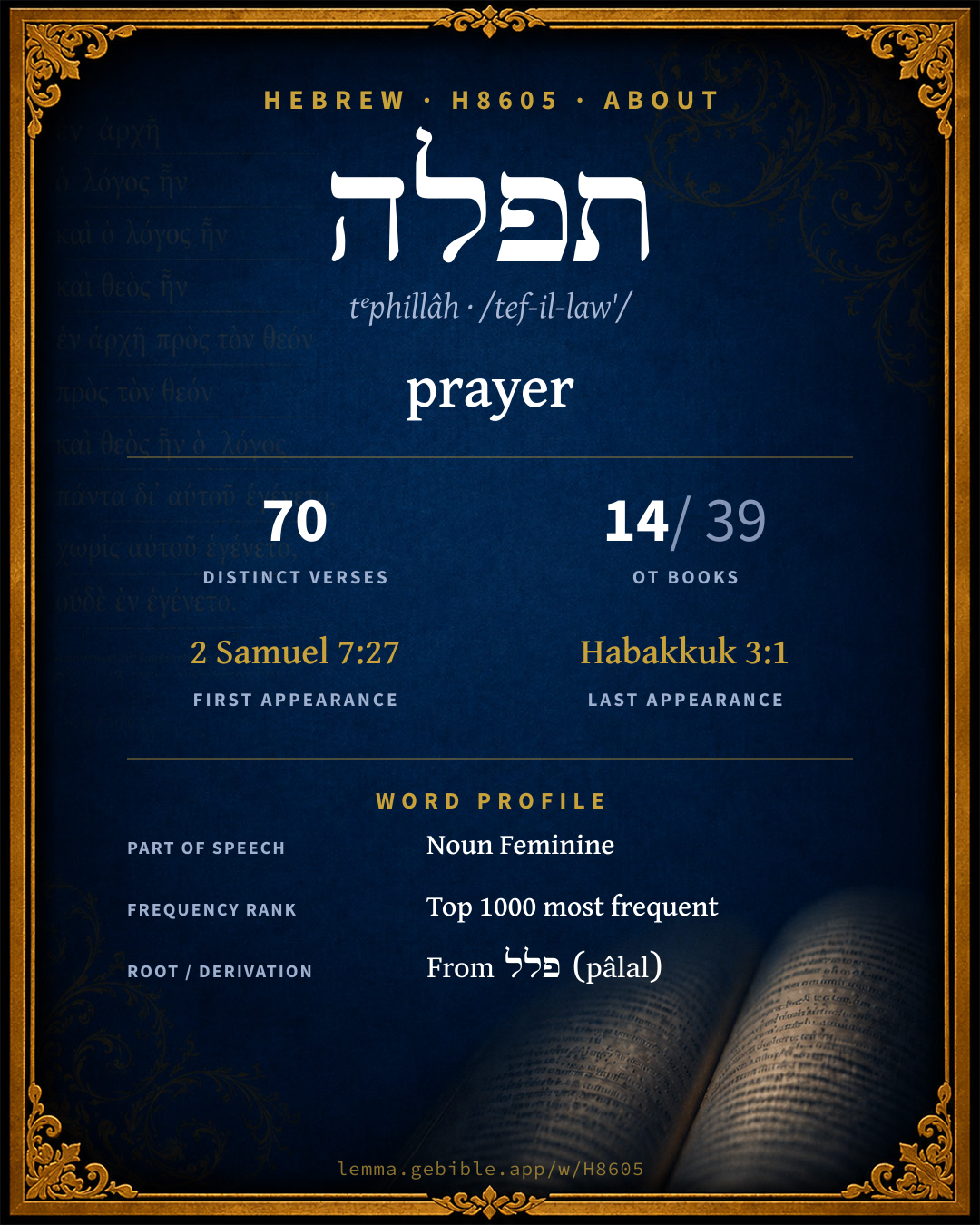
תְּפִלָּה
prayer
‘prayer’ is one of 5 main senses fuller range ↓
Full lexicon entry — Brown-Driver-Briggs (BDB)
From Brown-Driver-Briggs (BDB)
Where this word appears
See every Construct-state word in the Hebrew Bible →
Grammar key — what these labels mean
Part of speech
- Noun
- A naming word — a person, place, thing, or idea.
Noun type
- Common
- A common noun — a general class of person, place, or thing (“king,” “city,” “water”), not a specific name.
State
- Construct
- A noun bound to a following noun in a possessive / “of” relationship (the construct chain).
- Absolute
- The independent form of a noun, not bound to a following word.
Gender
- Feminine
- Grammatically feminine.
Number
- Singular
- One.
- Plural
- More than one (in Hebrew, generally three or more).
Grammatical forms
- Noun, Common, Feminine, Singular, Construct 49 times (64%)
- Noun, Common, Feminine, Singular, Absolute 27 times (35%)
- Noun, Common, Feminine, Plural, Construct 1 time (1%)
Parsed forms decoded from the imported morphology (morphhb / Westminster Leningrad Codex — WLC text public domain, morphhb tagging CC BY 4.0), counted across 77 parsed occurrences — not distinct verses.
Every verse where H8605 appears — 70 distinct verses across 14 books. Click any verse to open its interlinear word-by-word view. Verse text shown in the World English Bible for context — . Each verse’s Hebrew form is shown with its reference; the English is not keyword-highlighted, since the data carries no word-level English alignment. Use “Compare translations” on any verse to read it across multiple English versions. This concordance covers the Hebrew Bible; Septuagint (Greek Old Testament) occurrences are not indexed here.
2 Samuel 1 verse
1 Kings 7 verses
- 1 Kings 8:28 תְּפִלַּ֧ת הַ/תְּפִלָּ֔ה n c fs cs ptcl def.art + n c fs Yet have respect for the prayer of your servant, and for his supplication, Yahweh my God, to listen to the cry and to the prayer which your servant prays before you this day;
- 1 Kings 8:29 הַ/תְּפִלָּ֔ה ptcl def.art + n c fs that your eyes may be open toward this house night and day, even toward the place of which you have said, My name shall be there; to listen to the prayer which your servant shall pray toward this place.
- 1 Kings 8:38 תְּפִלָּ֣ה n c fs whatever prayer and supplication be made by any man, [or] by all your people Israel, who shall know every man the plague of his own heart, and spread forth his hands toward this house:
- 1 Kings 8:45 תְּפִלָּתָ֖/ם n c fs cs + sfx pers 3mp then hear in heaven their prayer and their supplication, and maintain their cause.
- 1 Kings 8:49 תְּפִלָּתָ֖/ם n c fs cs + sfx pers 3mp then hear you their prayer and their supplication in heaven, your dwelling-place, and maintain their cause;
- 1 Kings 8:54 הַ/תְּפִלָּ֥ה ptcl def.art + n c fs It was so, that when Solomon had made an end of praying all this prayer and supplication to Yahweh, he arose from before the altar of Yahweh, from kneeling on his knees with his hands spread forth toward heaven.
- 1 Kings 9:3 תְּפִלָּתְ/ךָ֣ n c fs cs + sfx pers 2ms Yahweh said to him, I have heard your prayer and your supplication, that you have made before me: I have made this house holy, which you have built, to put my name there forever; and my eyes and my heart shall be there perpetually.
2 Kings 2 verses
- 2 Kings 19:4 תְפִלָּ֔ה n c fs It may be Yahweh your God will hear all the words of Rabshakeh, whom the king of Assyria his master has sent to defy the living God, and will rebuke the words which Yahweh your God has heard. Therefore lift up your prayer for the remnant that is left.
- 2 Kings 20:5 תְּפִלָּתֶ֔/ךָ n c fs cs + sfx pers 2ms Turn back, and tell Hezekiah the prince of my people, Thus says Yahweh, the God of David your father, I have heard your prayer, I have seen your tears: behold, I will heal you; on the third day you shall go up to the house of Yahweh.
2 Chronicles 11 verses
- 2 Chronicles 6:19 תְּפִלַּ֧ת הַ/תְּפִלָּ֔ה n c fs cs ptcl def.art + n c fs Yet have you respect to the prayer of your servant, and to his supplication, Yahweh my God, to listen to the cry and to the prayer which your servant prays before you;
- 2 Chronicles 6:20 הַ/תְּפִלָּ֔ה ptcl def.art + n c fs that your eyes may be open toward this house day and night, even toward the place where you have said that you would put your name there; to listen to the prayer which your servant shall pray toward this place.
- 2 Chronicles 6:29 תְּפִלָּ֣ה n c fs whatever prayer and supplication be made by any man, or by all your people Israel, who shall know every man his own plague and his own sorrow, and shall spread forth his hands toward this house:
- 2 Chronicles 6:35 תְּפִלָּתָ֖/ם n c fs cs + sfx pers 3mp then hear from heaven their prayer and their supplication, and maintain their cause.
- 2 Chronicles 6:39 תְּפִלָּתָ/ם֙ n c fs cs + sfx pers 3mp then hear from heaven, even from your dwelling-place, their prayer and their petitions, and maintain their cause, and forgive your people who have sinned against you.
- 2 Chronicles 6:40 לִ/תְפִלַּ֖ת prep + n c fs cs Now, my God, let, I beg you, your eyes be open, and let your ears be attentive, to the prayer that is made in this place.
- 2 Chronicles 7:12 תְּפִלָּתֶ֔/ךָ n c fs cs + sfx pers 2ms Yahweh appeared to Solomon by night, and said to him, I have heard your prayer, and have chosen this place to myself for a house of sacrifice.
- 2 Chronicles 7:15 לִ/תְפִלַּ֖ת prep + n c fs cs Now my eyes shall be open, and my ears attentive, to the prayer that is made in this place.
- 2 Chronicles 30:27 תְפִלָּתָ֛/ם n c fs cs + sfx pers 3mp Then the priests the Levites arose and blessed the people: and their voice was heard, and their prayer came up to his holy habitation, even to heaven.
- 2 Chronicles 33:18 וּ/תְפִלָּת֣/וֹ conj + n c fs cs + sfx pers 3ms Now the rest of the acts of Manasseh, and his prayer to his God, and the words of the seers who spoke to him in the name of Yahweh, the God of Israel, behold, they are written among the acts of the kings of Israel.
- 2 Chronicles 33:19 וּ/תְפִלָּת֣/וֹ conj + n c fs cs + sfx pers 3ms His prayer also, and how [God] was entreated of him, and all his sin and his trespass, and the places in which he built high places, and set up the Asherim and the engraved images, before he humbled himself: behold, they are written in the history of Hozai.
Nehemiah 3 verses
- Nehemiah 1:6 תְּפִלַּ֣ת n c fs cs Let your ear now be attentive, and your eyes open, that you may listen to the prayer of your servant, which I pray before you at this time, day and night, for the children of Israel your servants while I confess the sins of the children of Israel, which we have sinned against you. Yes, I and my father's house have sinned:
- Nehemiah 1:11 תְּפִלַּ֨ת תְּפִלַּ֣ת n c fs cs n c fs cs Lord, I beg you, let now your ear be attentive to the prayer of your servant, and to the prayer of your servants, who delight to fear your name; and please prosper your servant this day, and grant him mercy in the sight of this man. Now I was cup bearer to the king.
- Nehemiah 11:17 לַ/תְּפִלָּ֔ה prep det + n c fs and Mattaniah the son of Mica, the son of Zabdi, the son of Asaph, who was the chief to begin the thanksgiving in prayer, and Bakbukiah, the second among his brothers; and Abda the son of Shammua, the son of Galal, the son of Jeduthun.
Job 1 verse
Psalms 29 verses
- Psalms 4:1 תְּפִלָּתִֽ/י n c fs cs + sfx pers 1cs Answer me when I call, God of my righteousness. Give me relief from my distress. Have mercy on me, and hear my prayer.
- Psalms 6:9 תְּֽפִלָּתִ֥/י n c fs cs + sfx pers 1cs Yahweh has heard my supplication. Yahweh accepts my prayer.
- Psalms 17:1 תְּפִלָּ֗ה תְפִלָּתִ֑/י n c fs n c fs cs + sfx pers 1cs Hear, Yahweh, my righteous plea; Give ear to my prayer, that doesn't go out of deceitful lips.
- Psalms 35:13 וּ֝/תְפִלָּתִ֗/י conj + n c fs cs + sfx pers 1cs But as for me, when they were sick, my clothing was sackcloth. I afflicted my soul with fasting. My prayer returned into my own bosom.
- Psalms 39:12 תְפִלָּתִ֨/י n c fs cs + sfx pers 1cs "Hear my prayer, Yahweh, and give ear to my cry. Don't be silent at my tears. For I am a stranger with you, A foreigner, as all my fathers were.
- Psalms 42:8 תְּ֝פִלָּ֗ה n c fs Yahweh will command his loving kindness in the daytime. In the night his song shall be with me: A prayer to the God of my life.
- Psalms 54:2 תְּפִלָּתִ֑/י n c fs cs + sfx pers 1cs Hear my prayer, God. Listen to the words of my mouth.
- Psalms 55:1 תְּפִלָּתִ֑/י n c fs cs + sfx pers 1cs Listen to my prayer, God. Don't hide yourself from my supplication.
- Psalms 61:1 תְּפִלָּתִֽ/י n c fs cs + sfx pers 1cs Hear my cry, God. Listen to my prayer.
- Psalms 65:2 תְּפִלָּ֑ה n c fs You who hear prayer, To you all men will come.
- Psalms 66:19 תְּפִלָּתִֽ/י n c fs cs + sfx pers 1cs But most assuredly, God has listened. He has heard the voice of my prayer.
- Psalms 66:20 תְּפִלָּתִ֥/י n c fs cs + sfx pers 1cs Blessed be God, who has not turned away my prayer, Nor his loving kindness from me.
- Psalms 69:13 תְפִלָּתִֽ/י n c fs cs + sfx pers 1cs But as for me, my prayer is to you, Yahweh, in an acceptable time. God, in the abundance of your loving kindness, answer me in the truth of your salvation.
- Psalms 72:20 תְפִלּ֑וֹת n c fp cs This ends the prayers by David, the son of Jesse.
- Psalms 80:4 בִּ/תְפִלַּ֥ת prep + n c fs cs Yahweh God of hosts, How long will you be angry against the prayer of your people?
- Psalms 84:8 תְפִלָּתִ֑/י n c fs cs + sfx pers 1cs Yahweh, God of hosts, hear my prayer. Listen, God of Jacob. Selah.
- Psalms 86:1 תְּפִלָּ֗ה n c fs Hear, Yahweh, and answer me, For I am poor and needy.
- Psalms 86:6 תְּפִלָּתִ֑/י n c fs cs + sfx pers 1cs Hear, Yahweh, my prayer. Listen to the voice of my petitions.
- Psalms 88:2 תְּפִלָּתִ֑/י n c fs cs + sfx pers 1cs Let my prayer enter into your presence. Turn your ear to my cry.
- Psalms 88:13 תְּֽפִלָּתִ֥/י n c fs cs + sfx pers 1cs But to you, Yahweh, I have cried. In the morning, my prayer comes before you.
- Psalms 90:1 תְּפִלָּה֮ n c fs Lord, you have been our dwelling place for all generations.
- Psalms 102:1 תְּ֭פִלָּה תְפִלָּתִ֑/י n c fs n c fs cs + sfx pers 1cs Hear my prayer, Yahweh! Let my cry come to you.
- Psalms 102:17 תְּפִלַּ֣ת תְּפִלָּתָֽ/ם n c fs cs n c fs cs + sfx pers 3mp He has responded to the prayer of the destitute, And has not despised their prayer.
- Psalms 109:4 תְפִלָּֽה n c fs In return for my love, they are my adversaries; But I am in prayer.
- Psalms 109:7 וּ֝/תְפִלָּת֗/וֹ conj + n c fs cs + sfx pers 3ms When he is judged, let him come forth guilty. Let his prayer be turned into sin.
- Psalms 141:2 תְּפִלָּתִ֣/י n c fs cs + sfx pers 1cs Let my prayer be set before you like incense; The lifting up of my hands like the evening sacrifice.
- Psalms 141:5 וּ֝/תְפִלָּתִ֗/י conj + n c fs cs + sfx pers 1cs Let the righteous strike me, it is kindness; Let him reprove me, it is like oil on the head; Don't let my head refuse it; Yet my prayer is always against evil deeds.
- Psalms 142:1 תְפִלָּֽה n c fs I cry with my voice to Yahweh. With my voice, I ask Yahweh for mercy.
- Psalms 143:1 תְּפִלָּתִ֗/י n c fs cs + sfx pers 1cs Hear my prayer, Yahweh. Listen to my petitions. In your faithfulness and righteousness, relieve me.
Proverbs 3 verses
- Proverbs 15:8 וּ/תְפִלַּ֖ת conj + n c fs cs The sacrifice made by the wicked is an abomination to Yahweh, But the prayer of the upright is his delight.
- Proverbs 15:29 וּ/תְפִלַּ֖ת conj + n c fs cs Yahweh is far from the wicked, But he hears the prayer of the righteous.
- Proverbs 28:9 תְּ֝פִלָּת֗/וֹ n c fs cs + sfx pers 3ms He who turns away his ear from hearing the law, Even his prayer is an abomination.
Isaiah 4 verses
- Isaiah 1:15 תְפִלָּ֖ה n c fs When you spread forth your hands, I will hide my eyes from you; Yes, when you make many prayers, I will not hear. Your hands are full of blood.
- Isaiah 37:4 תְפִלָּ֔ה n c fs It may be Yahweh your God will hear the words of Rabshakeh, whom the king of Assyria his master has sent to defy the living God, and will rebuke the words which Yahweh your God has heard. Therefore lift up your prayer for the remnant that is left.
- Isaiah 38:5 תְּפִלָּתֶ֔/ךָ n c fs cs + sfx pers 2ms Go, and tell Hezekiah, Thus says Yahweh, the God of David your father, I have heard your prayer, I have seen your tears: behold, I will add to your days fifteen years.
- Isaiah 56:7 תְּפִלָּתִ֔/י תְּפִלָּ֥ה n c fs cs + sfx pers 1cs n c fs even them will I bring to my holy mountain, and make them joyful in my house of prayer: their burnt offerings and their sacrifices shall be accepted on my altar; for my house shall be called a house of prayer for all peoples.
Jeremiah 2 verses
- Jeremiah 7:16 וּ/תְפִלָּ֖ה conj + n c fs Therefore don't you pray for this people, neither lift up a cry nor prayer for them, neither make intercession to me; for I will not hear you.
- Jeremiah 11:14 וּ/תְפִלָּ֑ה conj + n c fs Therefore don't you pray for this people, neither lift up cry nor prayer for them; for I will not hear them in the time that they cry to me because of their trouble.
Lamentations 2 verses
Daniel 3 verses
- Daniel 9:3 תְּפִלָּ֖ה n c fs I set my face to the Lord God, to seek by prayer and petitions, with fasting and sackcloth and ashes.
- Daniel 9:17 תְּפִלַּ֤ת n c fs cs Now therefore, our God, listen to the prayer of your servant, and to his petitions, and cause your face to shine on your sanctuary that is desolate, for the Lord's sake.
- Daniel 9:21 בַּ/תְּפִלָּ֑ה prep det + n c fs yes, while I was speaking in prayer, the man Gabriel, whom I had seen in the vision at the beginning, being caused to fly swiftly, touched me about the time of the evening offering.
Jonah 1 verse
Habakkuk 1 verse
About this entry
At a glance — auto-summarized from this page’s data, not written by a person. Every figure links to its source below. This summary describes the numbers; it doesn’t interpret them.
The Hebrew noun תפלה centers on the idea of “prayer.” The lexicon spreads it across several senses; see its full sense range. It appears 70 verses across 14 books of the Hebrew Bible, among its moderately common vocabulary. The word gravitates to Psalms (41%), then 2 Chronicles and 1 Kings. Debuting at 2 Samuel 7:27, it then recurs through the corpus. Dig into 70-verse concordance and the renderings breakdown below.
Gloss history
Strong's 1890 vs modern scholarship
About this word
Strong's H8605 catalogs a Hebrew word from the Hebrew Old Testament.
These counts are not copied from any lexicon or concordance. They are computed here, from the morphology-tagged Hebrew Old Testament. What Lemma adds →
- 70
- distinct verses
- The word appears in 70 distinct verses.
- 14 / 39
- OT books
- The word appears in 14 of 39 Old Testament books.
- #519
- by frequency
- Top 1000 most frequent Hebrew words (rank 519 of 8,640 Hebrew words by occurrence).
View all 70 occurrences in the concordance →
Most concentrated in
- Psalms 29 verses 41%
- 2 Chronicles 11 verses 16%
- 1 Kings 7 verses 10%
By section of the Old Testament
By traditional corpus
Conventional, traditional groupings — biblical authorship is debated, so this is a traditional corpus grouping, not an authorship claim. Each share is this word’s portion of its verses in that division of the Hebrew canon. Each figure is a share of the word’s 70 distinct verses.
- Writings (Ketuvim) 52 verses · 74%
- Prophets (Nevi'im) 18 verses · 26%
How translations render this word
Counts come from each version’s own published word-to-Strong’s tagging or interlinear alignment — an approximate guide to how each version renders this word, not a word-level alignment the data otherwise carries. Because each total is that version’s own tagged count, the per-version totals vary from one another and need not match the appearance or distinct-verse counts above. These counts may also differ from a printed concordance because Lemma counts each distinctly tagged rendering and does not collapse phrase taggings into a single head-word total. This is a fixed set of word-tagged versions (KJV, ASV, BSB, ULT) and does not change with the reading translation you choose elsewhere. Each version’s license is shown beside its name below (and on Sources).
- King James Version: Prayer 64×, Let my prayer 2×, Prayers 2×
- American Standard Version: Prayer 51×, Hearken unto the prayer 2×, I have heard thy prayer 2×
- Berean Standard Bible: Prayer 61×, Prayers 5×, May my prayer 2×
- unfoldingWord Literal Text: Prayer 58×, Prayer of 12×, And 2×
King James Version Public Domain
Renders H8605 across 77 tagged occurrences — most commonly:
Plus 9 renderings that appear only once — usually multi-word phrases or single function words the recovered tagging swept in, not distinct renderings.
American Standard Version Public Domain
Renders H8605 across 72 tagged occurrences — most commonly:
Plus 15 renderings that appear only once — usually multi-word phrases or single function words the recovered tagging swept in, not distinct renderings.
Berean Standard Bible Public Domain
Renders H8605 across 76 tagged occurrences — most commonly:
Plus 8 renderings that appear only once — usually multi-word phrases or single function words the recovered tagging swept in, not distinct renderings. Not rendered by a distinct English word in 1 further occurrence.
unfoldingWord Literal Text CC BY-SA 4.0
Renders H8605 across 78 tagged occurrences — most commonly:
Plus 4 renderings that appear only once — usually multi-word phrases or single function words the recovered tagging swept in, not distinct renderings.
6 senses and sub-senses in the full BDB
What do BDB’s symbols mean?
BDB uses these scholarly abbreviations:
| Symbol | Meaning |
|---|---|
| 𝔊 | the Septuagint (the ancient Greek translation, LXX) |
| 𝔙 | the Vulgate (the Latin translation) |
| 𝔖 | the Syriac version (the Peshitta) |
| 𝔗 | the Targum (the Aramaic translation) |
| ψ | the Psalms |
| √ | root (the underlying root or stem) |
| ‖ | parallel passage (a synonymous or contrasted parallel) |
| † | the dagger: every passage where the word occurs is cited |
The 6 senses and sub-senses the full Brown-Driver-Briggs lexicon distinguishes for this word, in lexicon order (not ranked by frequency), with BDB’s own verbatim wording and sub-sense lettering. Shown in Hebrew script with BDB’s own scholarly abbreviations. The condensed entry is in the Lexicon Entry tab. See also the Forms in the corpus table below.
- 1.
- a. prayer, 1 K 8:38 = 2 Ch 6:29; Is 1:15 ψ 35:13; 80:5 +. e.g. 1 Kings 8:38
- b. pray a prayer, הִתְפ׳ ת׳ 2 S 7:27; 1 K 8:54 (cf. v 28, 29 = 2 Ch 6:19, 20); דִּבֶּר בַּתּ׳ Dn 9:21; specif. of intercession, נשׂא ת׳, c. בְּעַד in behalf of 2 K 19:4 = Is 37:4; Je 7:16; 11:14. e.g. 2 Samuel 7:27
- c. ת׳ אֶל־אֱלֹהִים 2 Ch 33:18, לְאֵל ψ 42:9, cf. 69:14; c. vb. + לפני 88:3; 141:2; תּ׳ תְּקַדְּמֶ֑ךָּ 88:14. e.g. 2 Chronicles 33:18
- d. בית ת׳ Is 56:7(×2) house of prayer (temple); c. vb. + אֶל־י׳ + אל־היכל Jon 2:8; c. vb. + למעון קדשׁו 2 Ch 30:27. e.g. Isaiah 56:7
- e. hear prayer is ת׳ (אֶת־) שׁמע 1 K 8:45, 49 = 2 Ch 6:35, 39, 1 K 9:3 ψ 4:2; 39:13 + 9 times; שׁמע אֶל־ת׳ 1 K 8:28, 29 = 2 Ch 6:19, 20; Ne 1:6; Dn 9:17; פנה אל ת׳ 1 K 8:28 = 2 Ch 6:19, ψ 102:18; אָזְנֶיךָ קַשֻּׁבוֹת לת׳ 2 Ch 6:40; 7:15, cf. Ne 1:11 (אֶל), הַקְשִׁיבָה ת׳ ψ 61:2; הִקְשִׁיב בְּקוֹל ת׳ 66:19; הַאֲזִינָה ת׳ 17:1; 55:2; 86:6; לקח ת׳ 6:10; cf. 66:20; 102:18b. e.g. 1 Kings 8:45
- 2. in ψ-titles, poetic, liturgical prayer ψ 17:1; 86:1; 90:1; 102:1; 142:1 Hb 3:1; of Davidic Psalter, תפלות דוד ψ 72:20. e.g. Psalms 17:1
Senses from the full Brown-Driver-Briggs lexicon (Brown, Driver, Briggs; Oxford 1906 — public domain), digitized via Sefaria, supplemented by the OpenScriptures HebrewLexicon (CC BY 4.0). Full attribution on Sources.
Word origin
n.f. prayer;—ת׳ Is 1:15 +, cstr. תְּפִלַּת ψ 80:5 +; sf. תְּפִלָּתִי 4:2 +, etc.; pl. תְּפִלּוֹת 72:20;—
— Brown-Driver-Briggs (Oxford 1906, public domain), digitized via Sefaria, supplemented by the OpenScriptures HebrewLexicon (CC BY 4.0). See Sources.
Derived from פלל (pâlal) (H6419) — to pray.
Jastrow Dictionary
A second Hebrew/Aramaic lexicon for comparison, covering Aramaic and post-biblical (Talmudic, Targumic, Midrashic) usage that the biblical-Hebrew BDB does not. Matched by lemma rather than by Strong’s number, so a lemma may carry more than one Jastrow headword (shown separately below), and the entries cover usage well beyond the Bible.
תִּפְלָה
- [mud, slime,] frivolity, trivial cause; impropriety, indecency. Ab. Zar. 63ᵇ (in Chald. dict.) כל למעוטי תי׳ שפיר דמי anything to diminish folly (idolatry) is right. Ib. 64ᵃ ואלו למעט את הת׳ שפיר דמי Ms. M. (ed. ואלו למעוטי ת׳ שרי) but in this case, as it serves to diminish folly (the sin of כִּלְאַיִם), it is right. Tosef. Sot. VI, 8 אי אפשר לעמוד על תִּיפְלָתָם Var. (ed. Zuck. התָּפֵל) it is impossible to understand their frivolous ways; a. e.—Lam. R. to II, 14 נאמר בנביאי שומרון ת׳ … ירושלים ת׳ of the prophets of Samaria the word tiflah is used (Jer. XXIII, 13) …, and of the prophets of Jerusalem the word tiflah (tafel) is used (Lam. l. c.). e.g. Jeremiah 23:13
תְּפִלָּה
- [intercession, pleading,] prayer, esp. T’fillah, the Prayer of Benedictions to be said three times every day, four times on the Sabbath and the festivals (v. מוּסַף), and five times on the Day of Atonement and public fast-days (v. נְעִילָה). Taan. 2ᵃ ומנלן דבת׳ and whence do you prove that the mention of, and the prayer for rain must be inserted in the T’fillah? Ib. עבודה שבלב זו ת׳, v. עֲבוֹדָה. Ber. IV, 1 תְּפִלַּת השחר the morning T’fillah, ת׳ המנחה the afternoon T’fillah &c. (v. respective determinants). Ib. 5ᵃ אלו הם יסורין … בטול ת׳ sufferings of love are those with which no cessation of prayer is connected. Ib. 6ᵇ הקובע מקום לתְפִלָּתוֹ he that has a regular place for his prayers. Ib. 31ᵇ שאסור לישב … של ת׳ that it is forbidden to sit down within four cubits distance from one in prayer; a. v. fr.—Ib. 31ᵃ, a. fr. שומע ת׳ (abbrev. ש"ת) ‘hearer of prayer’, the fifteenth section of the Prayer of Benedictions which closes with, ‘blessed be thou, O Lord, the hearer of prayer.’—Pl. תְּפִלּוֹת, תְּפִי׳. Ib. 26ᵇ ת׳ אבות תקנום the patriarchs introduced regular prayers. Ib. ת׳ כנגד תמידין תקנום prayers (T’filloth) have been instituted so as to correspond to the daily offerings. Sabb. 30ᵃ כמה ת׳ ותחנונים ever so many prayers and supplications; a. v. fr.
תְּפִלָּה ²
- II f., sing. of תְּפִלִּין, q. v.
A Dictionary of the Targumim, the Talmud Babli and Yerushalmi, and the Midrashic Literature (Marcus Jastrow; London, Luzac, 1903) — Public Domain. Digitized via Sefaria. Digitized via Sefaria. Full attribution on Sources.
Forms in the corpus
The 48 distinct written forms H8605 takes in the Hebrew Bible, most frequent first — each parse links to that state’s occurrences in the concordance. Hebrew forms include their vowel points and cantillation, so a single lemma takes many written forms.
Same root — word family
Other BDB entries built from the same root as H8605, grouped by Strong’s listed origin. These share a root / origin per the lexicon — not necessarily a shared meaning. Each links to that word’s own entry.
Derives from
Shares the same root
Proper names from this root
People and places named from this root — a name, not an additional meaning of the word.
Compare all same-root words → Showing 4 of 6 — not the complete family. 3 of the same-root words are proper names (people or places). They share a root, not necessarily a meaning.
Septuagint verse parallels
This word appears in 63 verses that also exist in the Greek Old Testament (Septuagint), out of the 70 Hebrew verses it occurs in. You can read those verses in Greek by switching the Old Testament edition to the Septuagint.
Read these verses in the Septuagint
- 2 Samuel 7:27
- 1 Kings 8:28
- 2 Kings 19:4
- 2 Chronicles 6:19
- Job 16:17
- Psalms 4:1
- Proverbs 15:8
- Isaiah 1:15
- Jeremiah 7:16
- Lamentations 3:8
- Daniel 9:3
- Jonah 2:7
This is a verse-level parallel only — the same verses exist in both the Hebrew and Greek Old Testaments. No word-level Hebrew↔Greek correspondence is claimed: the data carries no such alignment, so no Greek word is shown as this Hebrew word’s translation. Coverage is not total — the Septuagint omits the deuterocanon and renumbers the Psalms, so some Hebrew verses have no direct Greek parallel.