
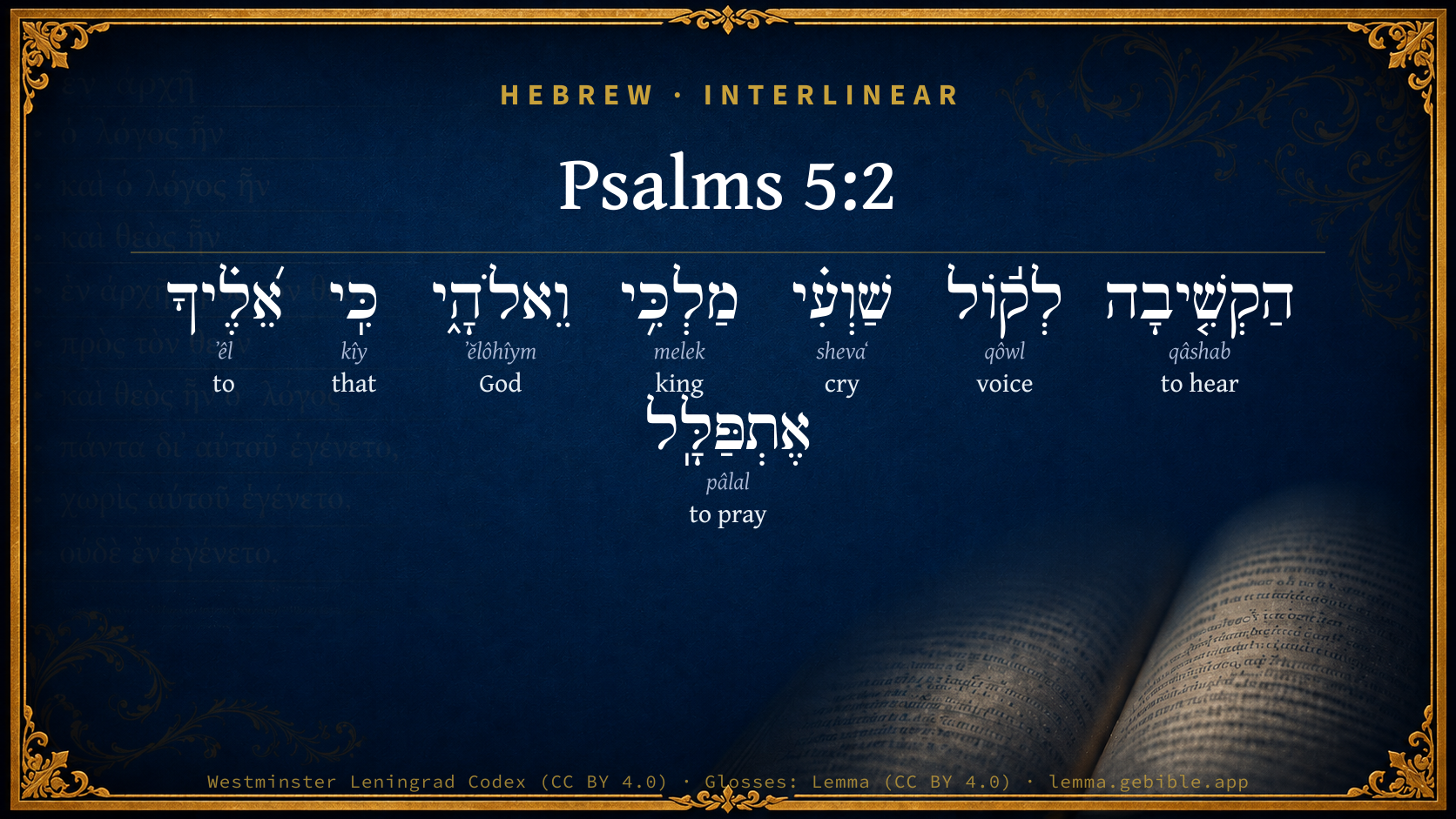
Psalms 5:2

Hebrew (Westminster Leningrad Codex) Psalms 5:2 appears in the Hebrew Old Testament. The text above is from the Westminster Leningrad Codex. Each word links to its Strong’s number, a concise gloss, and parsing drawn from the Open Scriptures Hebrew Bible morphology. Click any word for its full Brown-Driver-Briggs (BDB) entry.
Download image
Cite this verse

Psalms 5:2 (World English Bible). Public Domain. Lemma interlinear Bible study tool, https://lemma.gebible.app/v/psalms/5/2.

Show BibTeX & RIS
BibTeX
RIS
English Translation
Listen to the voice of my cry, my King and my God; For to you do I pray.
World English Bible · Public Domain
Highlights
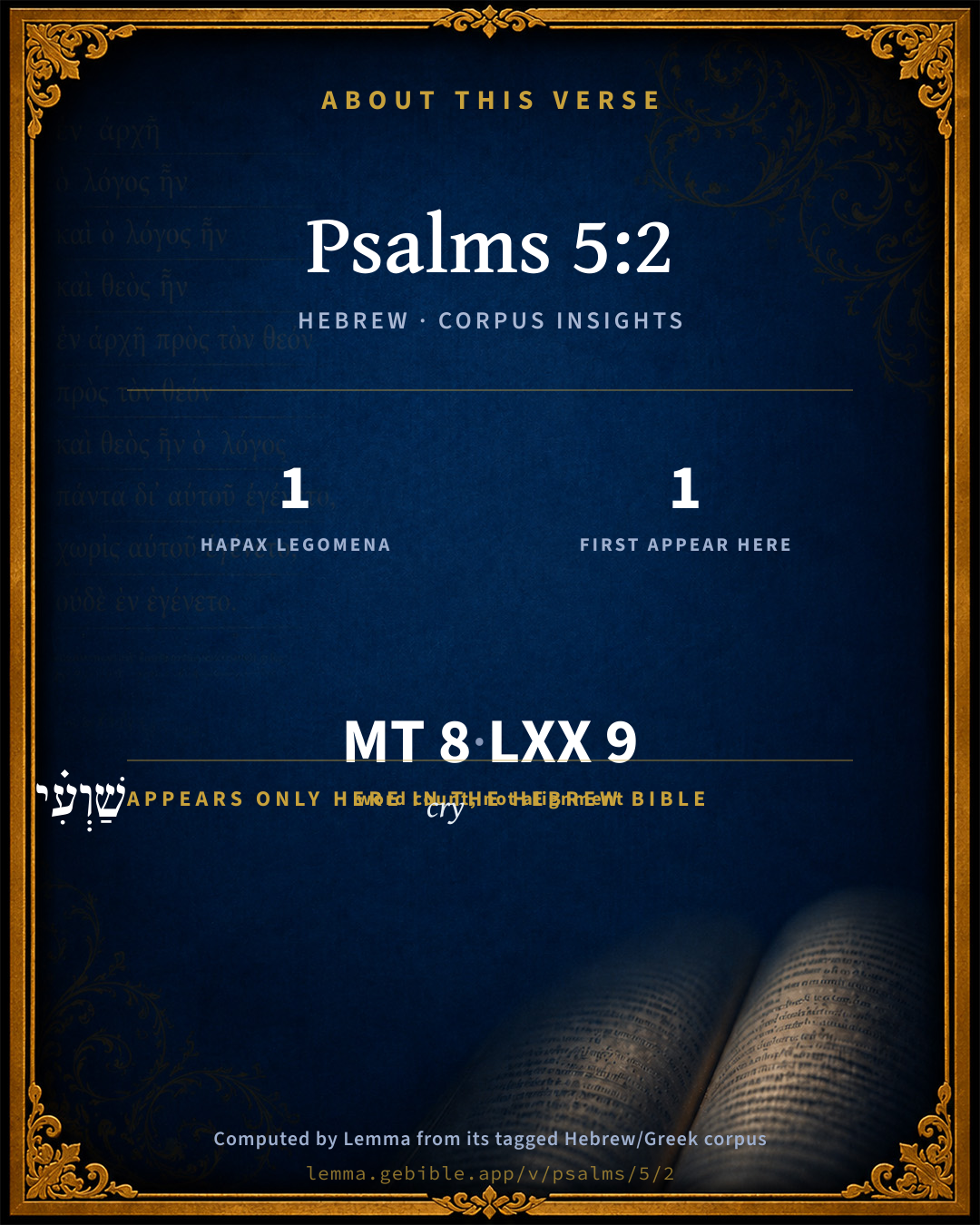
  • 1 hapax legomenon — only here in the Hebrew Bible
  • 1 first appearance in the Hebrew Bible
Full analysis ↓
Download a study sheet

One document with this verse’s original text, its word-by-word gloss line, the meaning frame, cross-references with their text, attributed commentary, and full source and license credits — printable, and it pastes into notes with its structure intact.

This verse Autodidact and up

Study sheet (.html) Plain text (.txt)

A passage Seminary Student

Up to 50 verses in one chapter. A passage sheet keeps up to 6 commentary sources and 12 cross-references per verse, in the order this page ranks them, and says so on the sheet whenever that leaves anything out. Ask for a single verse and you get the Autodidact verse sheet above.

Everything on this page stays free to read, with no account — the sheet is a download of what is already on screen, not access to it.

Want to remove ads? Support Godless Engineer
Compare translations 3

The same verse in 3 English versions, stacked beneath the original-language interlinear above. Click any original word for its lexicon entry.

Each is an independent rendering of the whole verse — the interlinear is not word-aligned to these translations.

Highlighted words mark where these versions differ — a whole-verse word diff, not a word-by-word alignment.

  • World English Bible Public Domain
    Listen to the voice of my cry, my King and my God; For to you do I pray.
  • King James Version Public Domain
    Hearken unto the voice of my cry, my King, and my God: for unto thee will I pray.
  • unfoldingWord Literal Text CC BY-SA 4.0
    Listen attentively to the sound of my cry for help, my king and my God, for to you I pray! ts\*

unfoldingWord Literal Text — © unfoldingWord, licensed CC BY-SA 4.0. Word-aligned USFM3 via Door43 (git.door43.org/unfoldingWord/en_ult).

Versions to compare (up to 4)

3 of 4 selected

Show all 18 translations

Every available English version of this verse, each an independent rendering of the whole verse.

  • World English Bible Public Domain
    Listen to the voice of my cry, my King and my God; For to you do I pray.
  • Berean Standard Bible Public Domain
    Attend to the sound of my cry, my King and my God, for to You I pray.
  • Majority Standard Bible Public Domain
    Attend to the sound of my cry, my King and my God, for to You I pray.
  • King James Version Public Domain
    Hearken unto the voice of my cry, my King, and my God: for unto thee will I pray.
  • American Standard Version (1901) Public Domain
    Hearken unto the voice of my cry, my King, and my God; For unto thee do I pray.
  • Revised Version (1885) Public Domain
    Hearken unto the voice of my cry, my King, and my God: for unto thee do I pray.
  • Geneva Bible (1599) Public Domain
    Hearken vnto the voyce of my crie, my King and my God: for vnto thee doe I pray.
  • Douay-Rheims (1899) Public Domain
    Give ear, O Lord, to my words, understand my cry.
  • Young's Literal Translation Public Domain
    Be attentive to the voice of my cry, My king and my God, For unto Thee I pray habitually.
  • Literal Standard Version CC BY-SA 4.0
    Be attentive to the voice of my cry, || My King and my God, || For I pray to You habitually.
  • Unlocked Literal Bible CC BY-SA 4.0
    Listen to the sound of my call, my King and my God, for it is to you that I pray.
  • unfoldingWord Literal Text CC BY-SA 4.0
    Listen attentively to the sound of my cry for help, my king and my God, for to you I pray! ts\*
  • Darby Bible Public Domain
    Hearken unto the voice of my crying, my king and my God; for to thee will I pray.
  • World Messianic Bible Public Domain
    Listen to the voice of my cry, my King and my God, for I pray to you.
  • Webster's Bible Public Domain
    \\5:1\\To the chief Musician upon Nehiloth, A Psalm of David. Give ear to my words, O LORD, consider my meditation.
  • Free Bible Version CC BY-SA 4.0
    Hear me pleading for help, my King and my God, because I'm praying to you.
  • Bible in Basic English Public Domain
    Let the voice of my cry come to you, my King and my God; for to you will I make my prayer.
  • JPS Tanakh (1917) Public Domain
    (5-3) Hearken unto the voice of my cry, my King, and my God; for unto Thee do I pray.

Literal Standard Version (2020), Covenant Press — licensed CC BY-SA 4.0. Text via the HelloAO Bible API (eBible.org). Unlocked Literal Bible (unfoldingWord) — licensed CC BY-SA 4.0. Text via the HelloAO Bible API (eBible.org). unfoldingWord Literal Text — © unfoldingWord, licensed CC BY-SA 4.0. Word-aligned USFM3 via Door43 (git.door43.org/unfoldingWord/en_ult). Free Bible Version, Dr. Jonathan Gallagher — licensed CC BY-SA 4.0. Text via the HelloAO Bible API (eBible.org).

Word by word

More ways to search: Search by grammar → Find every occurrence → Compare this word →

Practice this passage: Drill this verse → Learn its vocabulary →

About this verse

These counts appear in no published source. They are computed here, from the morphology-tagged text and Lemma’s own curated glosses. What Lemma adds →

8
words
8
distinct lemmas
Wisdom
section

Notable vocabulary

1 hapax legomenon — a word that appears only here in the entire Hebrew Bible:

  • שַׁוְעִ֗י cry H7773

First appearance in Scripture

This word makes its first canonical appearance in the Hebrew Bible here:

  • שַׁוְעִ֗י cry H7773

Shared distinctive vocabulary

הַקְשִׁ֤יבָה to hear H7181 occurs in 45 verses of the Hebrew Bible. Also found in:

Grammatical profile

  • 2 verbs
  • 4 nouns
  • 1 preposition
  • 1 conjunction

Verb forms

  • הַקְשִׁ֤יבָה Hiphil · Imperative
  • אֶתְפַּלָּֽל Hithpael · Imperfect

Hebrew & Septuagint length

In English translation the verse runs 18 words from the Hebrew and 20 from the Septuagint (LXX English) — closely comparable.

A rough comparison of the two English renderings, which tokenize alike — not a word-level alignment.

Word counts can differ between the Hebrew and the Greek without any difference in meaning — e.g. the Hebrew direct-object marker אֵת has no separate Greek word, and Greek often adds the article ὁ.

In the original languages it is 8 Hebrew tokens and 9 Greek tokens — but the two are counted differently (Hebrew bundles its prefixes and suffixes into one token; the Greek is in lemma form), so that isn’t a like-for-like length.

Cross-references

11

Topical passages linked to Psalms 5:2 in the Treasury of Scripture Knowledge — connected by theme and wording, ordered by reader-vote popularity; previews shown in the World English Bible.

  • Psalms 65:2 You who hear prayer, To you all men will come.
  • Psalms 3:4 I cry to Yahweh with my voice, And he answers me out of his holy hill. Selah.
  • Psalms 145:1 I will exalt you, my God, the King. I will praise your name forever and ever.
  • Isaiah 33:22 For Yahweh is our judge, Yahweh is our lawgiver, Yahweh is our king; he will save us.
  • Psalms 84:3 Yes, the sparrow has found a home, And the swallow a nest for herself, where she may have her young, Near your altars, Yahweh of Hosts, my King, and my God.
  • Psalms 24:7–8 Lift up your heads, you gates; Be lifted up, you everlasting doors: The King of glory will come in.
  • Psalms 74:12 Yet God is my King of old, Working salvation in the midst of the earth.
  • Psalms 99:1–4 Yahweh reigns! Let the peoples tremble. He sits enthroned among the cherubim. Let the earth be moved.
  • Psalms 10:16 Yahweh is King forever and ever! The nations will perish out of his land.
  • Psalms 44:4 You are my King, God. Command victories for Jacob!
  • Psalms 47:6–7 Sing praise to God, sing praises. Sing praises to our King, sing praises.

Cross-references courtesy of OpenBible.info (CC BY 4.0).

Hebrew and Greek witnesses Masoretic Hebrew ↔ Greek Septuagint

The same verse in the two great witnesses to the Old Testament, shown verse-for-verse.

You’re reading Greek Psalm 5 (Hebrew Psalm 5). The Septuagint counts the superscription, so verse numbers can differ from the Hebrew — chapter-level alignment, not verse-by-verse. Numbering follows Rahlfs.

These are two independent witnesses, not word-aligned to each other, and the Septuagint is shown in lemma (dictionary) form.

Hebrew Psalms 5:2 Masoretic · Westminster Leningrad Codex

הַקְשִׁ֤יבָה לְק֬וֹל שַׁוְעִ֗י מַלְכִּ֥י וֵאלֹהָ֑י כִּֽי אֵ֝לֶ֗יךָ אֶתְפַּלָּֽל

Listen to the voice of my cry, my King and my God; For to you do I pray.

World English Bible · Public Domain

Greek LXX Greek Psalm 5:2 Septuagint · lemma form

ὁ ῥῆμα ἐγώ ἐνὠτίζομαι κύριος συνἵημι ὁ κραυγή ἐγώ

Attend to the voice of my supplication, my King, and my God: for to you, O Lord, will I pray.

LXX2012 (modern English Septuagint) · Public Domain

Hebrew: Westminster Leningrad Codex (CC BY 4.0). Greek: Septuagint (public domain); English from LXX2012 (modern English Septuagint) (Public Domain). How the Septuagint differs from the Hebrew →

Commentary

Notes on Psalms 5:2 from classic Christian and Jewish commentators (each source and its license shown beneath its notes). The classic Christian expositions comment on the surrounding passage and are grouped to its opening verse, so a note may address several verses; the Jewish commentaries on the Tanakh (Rashi and others) are per-verse, so they appear only where the commentator wrote on this verse.

Lemma curates 59 commentaries, every one of them public domain or Creative Commons licensed, each selected and text-cleaned for this edition rather than reprinted as found. About our sources →

Trapp's Complete Commentary

John Trapp

Psa 5:2 Hearken unto the voice of my cry, my King, and my God: for unto thee will I pray.

Ver. 2. Hearken unto the voice of my cry] He thrice repeats the same request, to show the greatness of his grief and the necessity of help from heaven. Let mind and mouth, spirit and speech, go together in prayer, and then it is right, the voice of the heart is simply necessary. Moses cried to God at the Red Sea, though he said nothing. The voice of the lips is of great use also; 1. For preventing of distraction; 2. For exciting devotion.

My king] And therefore help, O king, as she said, 2Ki 5:24.

And my God] Who art in covenant with me, both offensive and defensive.

For unto thee will I cry] Thou art the proper object of prayer, as being omnipresent, omniscient, omnipotent; and a God in covenant with thy people.

John Trapp, A Commentary or Exposition upon All the Books of the Old and New Testament (1647–1656) — public domain. Text from a community e-Sword module.

The Biblical Illustrator

Joseph S. Exell

Psa_5:2

For unto Thee will I pray.

Prayer

If you restrain prayer before God--

1. You act in opposition to your sense and confession of what is right. You know that you ought to pray. How can you repel the charge of inconsistency, when prayer is excluded from your practical system?

2. By neglecting prayer, you resist the authority of God. God has commanded you to pray. Can you venture to treat His command with contempt, and yet hope to prosper? What title have you to expect that, in this particular more than in any other, you can disobey God with impunity?

3. Without prayer vain will be to you all the provisions that are made in the gospel for your deliverance and happiness. The gospel is a dispensation of Divine wisdom and goodness. It proposes to bestow on men the benefits of salvation. But it proposes to bestow them in a certain way, and according to a certain scheme. Do you know any ground for believing that these benefits can ever belong to those who do not pray for them? Lessons:

(1) It becomes us to form and adopt the purpose of the Psalmist. His purpose was to pray; and that purpose should be ours. We have many motives and inducements to engage in this exercise.

(2) It should be with great earnestness that we pray to God. Not going about the duty in a cold, formal, or perfunctory manner.

(3) We are not to pray as if God were unwilling to hear us, and to bestow the blessings which we need. He has revealed Himself as the hearer of prayer.

(4) Do not forget that the God to whom you pray is a holy God. Observe that the Psalmist did not satisfy himself with private prayer; he also resolved to engage in the exercises of public worship. The resolution of the Psalmist should be ours. (A. Thomson D. D.)

The directness of prayer

No priest stands between the worshipper and his Lord. Every man must state his own case. We pray for one another, but not instead of one another. What can be more beautiful than the picture which is thus represented? God is put in His right place as the throned Father, listening to each of His subjects as the subject may feel impelled to address Him. Every word is charged with tremulous life. No man can pray for another in the same exquisite and vital sense as a man can pray for himself; there are always circumstances in the case of the petitioner, which the petitioner alone knows, and even though he cannot throw such circumstances into literal expression he can suggest them all by the very tones of his voice. We mistake the nature of prayer if we think it can be limited to words. Even when we use the words of another in our devotional exercises, we throw into their expression accents which are personal and incommunicable. It is in such tones and accents that the true quality of prayer is found. If prayer consisted only in the utterance of certain words, then the wicked might pray, and pray with great elocutionary effect; but the prayer is hardly in the words at all, it is a subtle fragrance of the soul, an inexpressible something which we understand most nearly by the name of agony. This being the nature of prayer, it follows that whatever priestly mediation there may be in the universe--and that there is such mediation no student of the Bible can deny--the individual himself must stand in a direct relation to God, receiving help from the priest, but not in any degree to obliterate his personality, or reduce his spiritual enjoyment. (Joseph Parker, D. D.)

On the advantages of prayer

Prayer is the pulse of the soul. To be prayerless, or little inclined to pray, is the most dreadful state in which a human being can possibly be. But it is nearly as lamentable to pray under the influence of improper sentiments and feelings, as not to pray at all. It is by no means the province of prayer, to inform the Deity of what we need, or to induce Him to alter His purposes, or to prevail upon Him to bestow upon us whatever we may think fit to solicit from Him. To the omniscient God all our wants must be well known; even better than they are to ourselves. Nor can He be supposed, in consequence of our prayers, either to deviate from the course which He had determined to pursue, or to submit the disposal of His favours to our direction. The advantages of prayer must be considered as confined to ourselves; and we have only to reflect for a moment on the state and temper of mind which it is instrumental in cherishing, to be convinced that it is eminently calculated to promote our real improvement and happiness.

1. Prayer, in consequence of the dispositions which it excites and cherishes in the mind of the suppliant, is well calculated to produce the happiest effects upon his conduct and condition. There is not an error in the understanding, a wrong propensity in the will, or a blemish in the outward conduct, which may not, either directly or indirectly, be traced to a temper of mind, the reverse of that of the Christian suppliant, and which a similar temper to his would not tend either to prevent or remove.

2. Prayer qualifies the suppliant for receiving the enlightening, sanctifying, and comforting influences of the Divine Spirit. That the Spirit of God can communicate direction, energy, and purity to the soul in a secret and incomprehensible manner, cannot be denied. That it is chiefly by means of prayer such communication is made, is a truth, which the experience of every genuine Christian sufficiently corroborates. Prayer is the means God has appointed to be used for obtaining the influences of the Spirit, and for cherishing that frame and temper of mind which peculiarly qualify him for receiving them.

3. Prayer is happily fitted to fortify against temptation Our temptations chiefly arise from the world, and the things of the world. The influence which worldly objects produce upon the different tempers and circumstances of men is so great, that it is not to be described. The best way to counteract this influence, is to avert the mind as much as possible from earthly things, and in the frequent exercise of prayer to lay it open to the impression of things invisible and eternal. Prayer renders us independent of the world, by fixing and strengthening our dependence upon God.

4. Prayer imparts to the Christian such a serenity, strength, and stability, as fit him for all that is truly amiable, and great, and good. It renders him serene, composed, and cheerful. Seeing, then, that prayer is attended with such important and blessed effects, how gladly ought we to avail ourselves of this precious privilege! (J. Somerville, D. D.)

Objections to prayer answered

No argument has ever been adduced against prayer, which may not be traced to the source of human corruption. Men disrelish the duty of prayer, and then the judgment is set at work to devise arguments against it. Some tell us that they see little or no necessity for prayer: that God, who is rich in mercy, will bless them, whether they pray or not. Many are so irregular in the exercise of this duty, that they can scarcely be said to pray at all. They would pray, and they would not. Their hearts are divided. But how can they imagine that God will be served with a divided heart? Others say, for what purpose are we to pray, seeing that our prayers can have no effect upon God to dispose Him to grant us what we need, to alter His purposes, or to ward off from us those dangers by which we are threatened? Why we are to pray for quite another reason; namely, to produce the greatest and most important, and most beneficial effect upon ourselves. The purpose of prayer is answered, when, through the Divine blessing, a holy frame of mind is thereby wrought in us; when we are brought to yield to the impression of spiritual things. Some well-disposed persons allege that they cannot pray. This does not furnish any reasonable objection to prayer. Not to pray at all, because we are unable to pray well, is as absurd as it would be in a child not to walk, because it cannot walk with the elegance and grace of a full-grown man. Such an objection is too likely to arise from indolence, and the want of a real disposition to pray. It is not the manner or language of prayer that renders it acceptable to God, but the temper and dispositions with which it is offered up. If the poor afflicted sinner has right dispositions, he will approach the Lord, though in the most imperfect manner. Some sincere Christians say, they are conscious of so much sin and unworthiness, so much weakness and depravity, in the sight, of God, that they dare not pray. But their forget, the great Intercessor,. standing before the throne, with the golden censer in His hand, and offering up much incense with the prayers of the saints. By this, their fears are dissipated. Another objection to prayer is apt to arise in the minds of true Christians. However earnest and sincere they may have been in the performance of this duty, they have no reason to suppose that an answer to their prayers has ever been vouchsafed. This objection is sometimes made when prayers have been answered, but not in the particular form desired. God may have reasons for delaying or withholding answers. The true suppliant does not immediately cease to urge his suit, when he thinks that he is not heard. God knows both what is good for the Christian, and at what time, and in what manner, it should be granted. Therefore it becomes the Christian, instead of lessening his importunity when he thinks he is not heard, to wait with patience, and a renewed earnestness, till God be pleased to vouchsafe to him a gracious answer. (J. Somerville, D. D.)

On the nature of prayer

Prayer is well defined as an offering up of our desires to God, for things agreeable to His will, in the name of Christ, with confession of our sins, and thankful acknowledgment of His mercies. Prayer may be considered as a generic term, including adoration, confession, petition, and thanksgiving. All these are equally the result of a devotional temper.

1. The true suppliant is deeply conscious of his being in a state of dependence, weakness, ignorance, and inability to promote his own happiness. Without this, there may be a form of prayer, but nothing of its spirit.

2. The true suppliant comes to God in the firm belief of His existence, and with a confidential application to Him, as both able and willing to help all who put their trust in Him. Without such faith and confidence, there can be no such thing as prayer.

3. The true suppliant draws near to God, with clean hands and a pure heart. In all ages and nations, rites of purification have usually preceded the immediate approaches to Deity. If we regard iniquity in our hearts, the Lord will not hear us. But imperfection cleaves in a greater or less degree to the people of God in the present life; and as they are deeply conscious of this being the ease, and as such a consciousness naturally tends to weaken their confidence in God, observe--

4. That the true suppliant draws near to God, through the mediation of His Son, Jesus Christ. Through Him we have access by one Spirit unto the Father. Nor is this a recent appointment.

5. The true suppliant, in all his requests at the throne of grace, is regulated by the word and will of God. The desires of mankind are as various as their imaginary wants. The will of God, and not his own will, is the Christians guide in devotional duty. Let me remind yon of the glorious privilege of prayer; a privilege so great, that by improving it aright, dependent and sinful creatures like ourselves may lean with confidence on the Rock of Ages Himself. But such prayer as has been delineated is no natural attainment. The sentiments and feelings of the true suppliant are the produce of a Divine principle, specially engendered and nourished by Him who is denominated, the Spirit of grace and supplications. (J. Somerville, D. D.)

The Biblical Illustrator, edited by Joseph S. Exell (c. 1880s–1900s) — public domain. Text from a community e-Sword module.

Jamieson, Fausset & Brown

Robert Jamieson, A. R. Fausset & David Brown

Hearken--incline the ear (Psa 10:17; compare Psa 61:2) --give close attention.

my cry--that is, for help (Psa 61:2; Jer 8:19).

my King--thus by covenant relation interested in my cause.

Jamieson, Fausset & Brown — Commentary Critical and Explanatory on the Whole Bible (1871) — public domain (CC PDM 1.0). Text via the HelloAO Bible API.

Adam Clarke's Commentary

Verse 2. Hearken unto the voice of my cry] We may easily find the process through which David's mind was now passing:

1. We have seen from the preceding Psalm that he lay down in a very happy frame of mind, and that he had enjoyed profound repose.

2. As soon as he awakes in the morning, his heart, having a right direction, resumes its work.

3. He meditates on God's goodness; and on his own happy state, though pursued by enemies, and only safe as long as God preserved him by an almighty hand and especial providence.

4. This shows him the need he has of the continual protection of the Most High; and therefore he begins to form his meditation and the desires of his heart into words, to which he entreats the Lord to give ear.

5. As he was accustomed to have answers to his prayers, he feels the necessity of being importunate! and therefore lifts up his voice.

6. Seeing the workers of iniquity, liars, and blood-thirsty men strong to accomplish their own purposes in the destruction of the godly, he becomes greatly in earnest, and cries unto the Lord: "Hearken unto the voice of my cry."

7. He knows that, in order to have a right answer, he must have a proper disposition of mind. He feels his subjection to the supreme authority of the Most High, and is ready to do his will and obey his laws; therefore he prays to God as his King: "Hearken, my King and my God." I have not only taken thee for my GOD, to save, defend, and make me happy; but I have taken thee for my KING, to govern, direct, and rule over me.

8. Knowing the necessity and success of prayer, he purposes to continue in the spirit and practice of it: "Unto thee will I pray." R. S. Jarchi gives this a pretty and pious turn: "When I have power to pray, and to ask for the things I need, then, O Lord, give ear to my words; but when I have no power to plead with thee, and fear seizes on my heart, then, O Lord, consider my meditation!"

Adam Clarke's Commentary on the Bible (1810–1826) — public domain. Text from a community e-Sword/MySword module.

The Cambridge Bible for Schools and Colleges

gen. ed. J. J. S. Perowne

2. my cry] A word specially used of an imploring cry to God for help (Psa_22:24; Psa_28:2; &c.).

my King, and my God] Cp. Psa_84:3. The language is all the more significant, if the petitioner was David. He appeals to Him, Whose chosen representative he was.

The Cambridge Bible for Schools and Colleges (gen. ed. J. J. S. Perowne; Cambridge University Press, 1878–1918) — public domain. Text from a community e-Sword module.

John Gill's Exposition

Hearken unto the voice of my cry,.... Which seems to intend more than groans or words, even a loud outcry, as of a person in great distress; such as the strong crying of Christ, in the days of his flesh, when on the cross, forsaken by God, deserted by his friends, and surrounded by his enemies, Heb 5:7; and such, in some measure, was the case of David. The arguments used by him, that the Lord would hearken to him, are as follow: and the first is taken from his interest in the Lord, and his relation to him,

my King and my God; the Lord was David's King in a civil sense; though David was a king over others, yet the Lord, who is the King of kings, was King over him, and he owned him to be so; he was set upon the throne by him, had his kingdom from him, and was accountable to him: and he was his King in a natural sense, the kingdom of nature and providence belonging to him, as he was his Creator, preserver, protector, and defender; and in a spiritual sense, he being delivered from the dominion of other lords, sin, Satan, and the world, and brought to a subjection to him by his Spirit and grace; and so to own him as his King and Lawgiver, as well as his Saviour. And he was his God; not in a general way, as he is the God of the spirits of all flesh living; nor merely in the peculiar way in which he was the God of the people of Israel; but in a most special manner, as being his covenant God and Father in Christ. He was his God, not only as the God of nature and providence, but as the God of all grace; who had distinguished him by special and spiritual blessings and favours; and whom David loved, believed in, and worshipped as his God. And this his interest in him, and relation to him, he uses with great pertinence and propriety, as an argument that he might be heard by him; since the Lord was his King, and he his subject; the Lord was his God, and he one of his people; the Lord was his father, and he a child of his; and therefore entreats and hopes to be heard; see Isa 63:15. His next argument is taken from his resolution to pray to him, and to continue to do so:

for unto thee will I pray; and only to thee: not to the gods of the Heathen, to idols, the works of men's hands, who can neither hear nor save: and to thee always; suggesting, that he would never leave off praying till he was heard; he would give him no rest, day nor night, until he received an answer.

John Gill's Exposition of the Whole Bible (1746–1763) — public domain (CC PDM 1.0). Text via the HelloAO Bible API.

Albert Barnes' Notes on the Bible

Hearken unto the voice of my cry - My cry for assistance. The word “voice” refers to the utterance of his desires, or to his “expressed” wishes in a time of trouble.

My King, and my God - Though he was himself a king, yet he acknowledged his subjection to God as his supreme Ruler, and looked up to Him to protect him in his dangers, and to restore him to his rights. He was, at the same time, his God - his covenant God - to whom he felt that he was permitted to come in the hour of trouble, and whose blessing he was permitted to invoke.

For unto thee will I pray - He had no one else to go to in his troubles, and he felt that he “might” approach the living God. It was his fixed purpose - his regular habit - to pray to him, and to seek his favor and friendship, and he felt that he was permitted to do so now.

Albert Barnes' Notes on the Bible (1834–1885) — public domain. Text from a community e-Sword/MySword module.

Matthew Poole's English Annotations

It is the part and duty of a king to answer the just and humble desires of his subjects. To thee alone will I direct all my prayers, and therefore from thee alone I expect succour and relief.

Matthew Poole's English Annotations on the Holy Bible (1683–1685) — public domain. Text from a community e-Sword/MySword module.

Whedon's Commentary on the Bible

Daniel D. Whedon

2. Voice of my cry—My loud cry, or my outcry. There is a rising in the description—words, meditation, outcry. The last is the loud and earnest call for help of one who is ready to perish.

Daniel D. Whedon (gen. ed.), Commentary on the Old and New Testaments (1874–1909) — public domain. Text from a community e-Sword module.

The Pulpit Commentary

Hearken unto the voice of my cry. (comp. Psa_27:7 Psa_28:2 Psa_64:1 Psa_119:149 Psa_130:2 Psa_140:6) The Oriental habit of making requests in loud and shrill tones is the origin of these forms of speech. My King. David was "king" over Israel; but Jehovah was "King" over David. (comp. Psa_10:16 Psa_29:10 Psa_44:4 Psa_47:6, etc.) And my God. (see Psa_84:3) For auto thee will I pray. To thee, i.e. , and to no other.

The Pulpit Commentary (1880–1919), ed. H.D.M. Spence-Jones & Joseph S. Exell — public domain. Text from a community e-Sword module.

J. A. Alexander on Psalms

Joseph Addison Alexander

2. To my words, O Lord, Jehovah, give ear, perceive my thought. Attend not only to my vocal and audible petitions, but to my unexpressed desires, to those "groanings which cannot be uttered," but are no less significant to God than language (Rom 8:26-27). The second verb suggests the idea of attention, as well as that of simple apprehension.

Joseph Addison Alexander, The Psalms Translated and Explained (1850) — public domain. Text from a community e-Sword module.

Rashi

Rabbi Shlomo Yitzchaki (Rashi)

Give ear to my words, O Lord when I have strength to ask before You and, when I have no strength to pray before You and the worry is confined to my heart...consider my meditation Heb. בינה. Consider the meditation of my heart. So it is explained in Midrash [Psalms 5:6]: In every [instance of] בינה in Scripture, the accent is under the “nun,” except this one and its fellow (in Job 34: 16): “And if you wish, understand (בִּנָה), hearken to this,” which is not a noun but an expression of “understand,” like (Prov. 23:1): “you should understand well (בין תבין) who is in front of you.” Therefore, the accent is under the “beth.”

Rashi on the Tanakh — English translations: “The Judaica Press complete Tanach with Rashi, translated by A. J. Rosenberg” (CC BY 4.0); “Pentateuch with Rashi's commentary by M. Rosenbaum and A.M. Silbermann, 1929-1934” (public domain); “The Metsudah Tanach series, Lakewood, N.J” (CC BY 4.0); and “The Book of Joshua, Metsudah Publications, 1997” (CC BY 4.0). Text via Sefaria.

Radak

Rabbi David Kimhi (Radak)

Give ear to my words, O Lord, Consider my meditation: – Give ear to what I utter with my mouth and consider what I meditate in my heart. Therefore he uses the word consider with meditation, and give ear to with my words. He uses (the term) הגיגי (“my meditation”), which is derived from הגה by doubling the second radical, just as (in the verse) “for the lightning (חזיז) of the thunder” (Job 38:25), (where חזיז is derived) from חזה.

Radak on the Tanakh — English translations: “Sefaria Community Translation” (CC0 1.0 (public-domain dedication)); “Eliyahu Munk, HaChut Hameshulash” (CC BY 4.0); “Rabbi Mike Feuer, Jerusalem Anthology” (CC BY 4.0); and “R. David Kimhi on the first book of Psalms, Translated by R.G. Finch, London, 1919” (public domain). Text via Sefaria.

Ibn Ezra

Rabbi Abraham ibn Ezra

Give ear (ha'azinah) to my words: [The verb ha'azinah is] from the same root/sector (mi-gizrat) as oznayim (ears). [It means] "Incline Your ear."

Consider (binah): [This is] the imperative form (lashon tzivui). Similar to [the imperative] "Simah na" ("Place, please" - cf. Job 17:3).

My utterance (hagigi): [This noun is from a] doubled Ayin [root, ה-ג-ג / H-G-G], for it is from [the root] H-G-H. [It is formed] like [the noun] z'nuneha (her harlotry - from ז-נ-ה). And [the Psalmist] said "Consider" (Binah) to Ad-nai in the manner of a human being [using anthropomorphic language]. This is similar to [the request in (Psalm 139:23)] "And know my heart," and also [to] "Give ear" (Ha'azinah). And the meaning/reason is so that it will become clear to all that there is no doubt He knows everything, and He has no need for [physical] ears – in the manner of (Psalm 94:9): "He who plants the ear, shall He not hear?"

[Regarding the word] Attend (Hakshivah) [in the next verse, v. 3]: This root (gizrah - ק-שׁ-ב / Q-Sh-B) is [typically] connected with [the preposition] Lamed [ל־, meaning "to"]. Therefore, it is not correct usage (lo nakhon) to say [a phrase like] "Mi yakshiveni?" ("Who will listen me?" [without the Lamed indicating to whom one listens]).

And the meaning of My King [in v. 3] is: I have no [other] king to whom I cry for help (eshava elav), only You alone.

Ibn Ezra on the Tanakh — English translations: “Sefaria Community Translation” (CC0 1.0 (public-domain dedication)); “Yalkut, Sifsei Chachomim Chumash, Metsudah Publications, 2009” (CC BY 4.0); and “Commentary of Ibn Ezra on Isaiah - trans. by M. Friedlander, 1873” (public domain). Text via Sefaria.

Lesson kit

Teaching starters — assembled from the data on this page, not authored interpretation. Every prompt links to the verse data it draws on. Edit before teaching.

Psalms, in the Wisdom, opens this verse with 8 words (8 distinct Hebrew lemmas). Its most distinctive word is shevaʻ (“cry”). A historical commentator’s framing appears above. Read the whole chapter for the surrounding context.

Discussion questions

  1. What does “cry” (shevaʻ) contribute to the verse as a whole?
  2. 1 word here appears nowhere else in the Hebrew Bible. Why might the author reach for such rare wording?
  3. This is the first place “cry” appears in Scripture (first appears here). What does its debut here establish?
  4. How does 1 Samuel 15:22, which shares the word «to hear», read alongside this verse?
  5. The translations on this page render this verse differently — a whole-verse word diff, not a word-by-word alignment. What might account for the different wordings?
  6. «הַקְשִׁ֤יבָה» is a Hiphil Imperative verb. How does that grammatical form shape the action described?
  7. Compare how Trapp's Complete Commentary and The Biblical Illustrator read this verse. Where do they agree or differ?

Things to notice

Reading settings

Reading text

Shown beneath each verse's original-language words.

Old Testament
Old Testament edition

Read the OT as the Masoretic Hebrew (MT) or the Greek Septuagint (LXX).

English shown for the Greek Septuagint (in the Hebrew ↔ Greek comparison).

Comparing translations? Open the Compare panel on any verse page to stack up to four side by side.