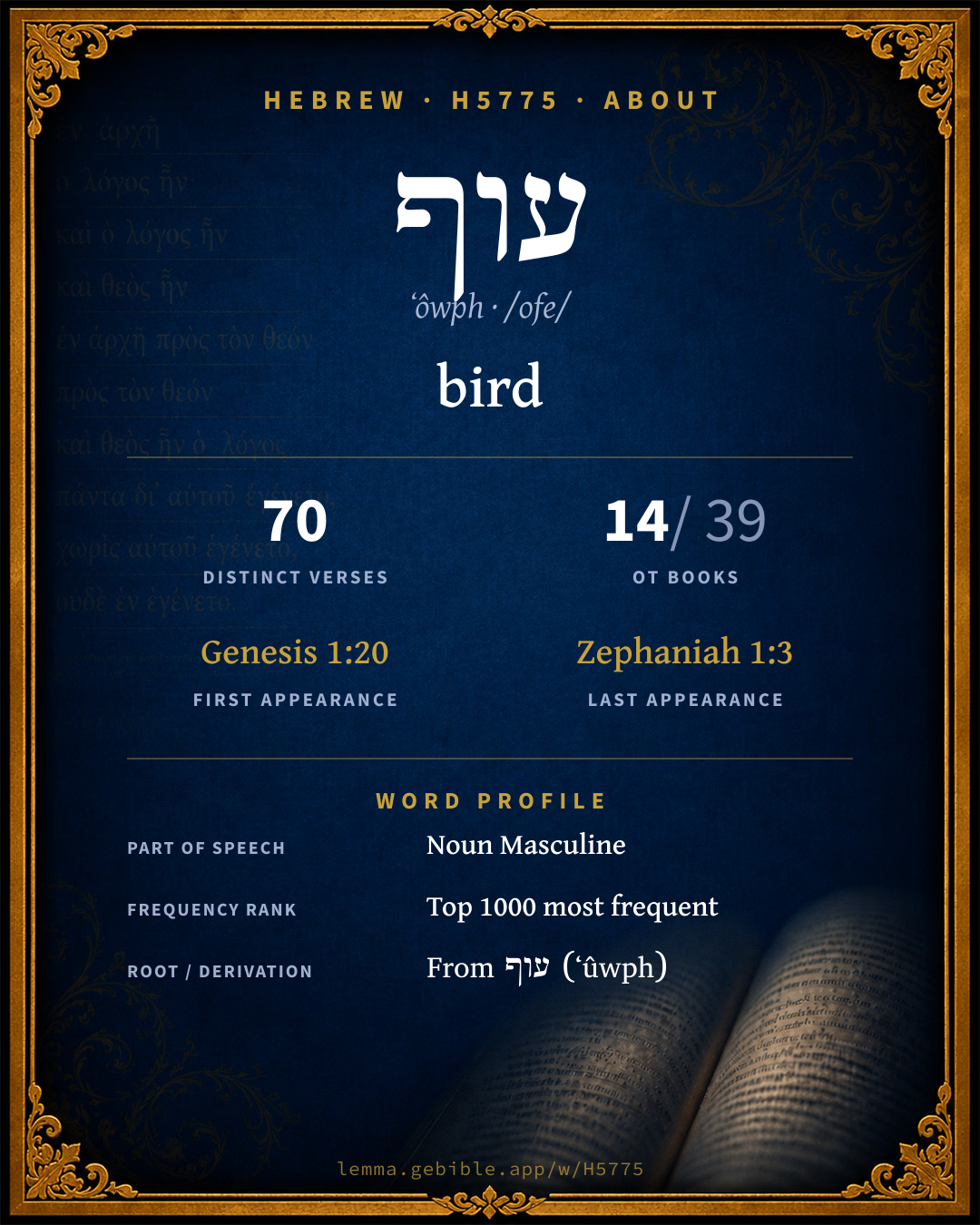
עוֹף
bird
‘bird’ is one of 3 main senses fuller range ↓
Full lexicon entry — Brown-Driver-Briggs (BDB)
From Brown-Driver-Briggs (BDB)
Where this word appears
See every Construct-state word in the Hebrew Bible →
Grammar key — what these labels mean
Part of speech
- Noun
- A naming word — a person, place, thing, or idea.
Noun type
- Common
- A common noun — a general class of person, place, or thing (“king,” “city,” “water”), not a specific name.
State
- Construct
- A noun bound to a following noun in a possessive / “of” relationship (the construct chain).
- Absolute
- The independent form of a noun, not bound to a following word.
Gender
- Masculine
- Grammatically masculine.
Number
- Singular
- One.
Grammatical forms
- Noun, Common, Masculine, Singular, Construct 40 times (56%)
- Noun, Common, Masculine, Singular, Absolute 31 times (44%)
Parsed forms decoded from the imported morphology (morphhb / Westminster Leningrad Codex — WLC text public domain, morphhb tagging CC BY 4.0), counted across 71 parsed occurrences — not distinct verses.
Every verse where H5775 appears — 70 distinct verses across 14 books. Click any verse to open its interlinear word-by-word view. Verse text shown in the World English Bible for context — . Each verse’s Hebrew form is shown with its reference; the English is not keyword-highlighted, since the data carries no word-level English alignment. Use “Compare translations” on any verse to read it across multiple English versions. This concordance covers the Hebrew Bible; Septuagint (Greek Old Testament) occurrences are not indexed here.
Genesis 22 verses
- Genesis 1:20 וְ/עוֹף֙ conj + n c ms God said, "Let the waters swarm with swarms of living creatures, and let birds fly above the earth in the open expanse of sky."
- Genesis 1:21 ע֤וֹף n c ms God created the large sea creatures, and every living creature that moves, with which the waters swarmed, after their kind, and every winged bird after its kind. God saw that it was good.
- Genesis 1:22 וְ/הָ/ע֖וֹף conj + ptcl def.art + n c ms God blessed them, saying, "Be fruitful, and multiply, and fill the waters in the seas, and let birds multiply on the earth."
- Genesis 1:26 וּ/בְ/ע֣וֹף conj + prep + n c ms cs God said, "Let us make man in our image, after our likeness: and let them have dominion over the fish of the sea, and over the birds of the sky, and over the cattle, and over all the earth, and over every creeping thing that creeps on the earth."
- Genesis 1:28 וּ/בְ/ע֣וֹף conj + prep + n c ms cs God blessed them. God said to them, "Be fruitful, multiply, fill the earth, and subdue it. Have dominion over the fish of the sea, over the birds of the sky, and over every living thing that moves on the earth."
- Genesis 1:30 ע֨וֹף n c ms cs To every animal of the earth, and to every bird of the sky, and to everything that creeps on the earth, in which there is life, I have given every green herb for food." And it was so.
- Genesis 2:19 ע֣וֹף n c ms cs Out of the ground Yahweh God formed every animal of the field, and every bird of the sky, and brought them to the man to see what he would call them. Whatever the man called every living creature, that was its name.
- Genesis 2:20 וּ/לְ/ע֣וֹף conj + prep + n c ms cs The man gave names to all cattle, and to the birds of the sky, and to every animal of the field; but for man there was not found a helper suitable for him.
- Genesis 6:7 ע֣וֹף n c ms cs Yahweh said, "I will destroy man whom I have created from the surface of the ground; man, along with animals, creeping things, and birds of the sky; for I am sorry that I have made them."
- Genesis 6:20 מֵ/הָ/ע֣וֹף prep + ptcl def.art + n c ms Of the birds after their kind, of the cattle after their kind, of every creeping thing of the ground after its kind, two of every sort shall come to you, to keep them alive.
- Genesis 7:3 מֵ/ע֧וֹף prep + n c ms cs Also of the birds of the sky, seven and seven, male and female, to keep seed alive on the surface of all the earth.
- Genesis 7:8 הָ/ע֔וֹף ptcl def.art + n c ms Clean animals, animals that are not clean, birds, and everything that creeps on the ground
- Genesis 7:14 הָ/ע֣וֹף ptcl def.art + n c ms they, and every animal after its kind, all the cattle after their kind, every creeping thing that creeps on the earth after its kind, and every bird after its kind, every bird of every sort.
- Genesis 7:21 בָּ/ע֤וֹף prep det + n c ms All flesh died that moved on the earth, including birds, cattle, animals, every creeping thing that creeps on the earth, and every man.
- Genesis 7:23 ע֣וֹף n c ms cs Every living thing was destroyed that was on the surface of the ground, including man, cattle, creeping things, and birds of the sky. They were destroyed from the earth. Only Noah was left, and those who were with him in the ark.
- Genesis 8:17 בָּ/ע֧וֹף prep det + n c ms Bring forth with you every living thing that is with you of all flesh, including birds, cattle, and every creeping thing that creeps on the earth; that they may breed abundantly in the earth, and be fruitful, and multiply on the earth."
- Genesis 8:19 הָ/ע֔וֹף ptcl def.art + n c ms Every animal, every creeping thing, and every bird, whatever moves on the earth, after their families, went forth out of the ark.
- Genesis 8:20 הָ/ע֣וֹף ptcl def.art + n c ms Noah built an altar to Yahweh, and took of every clean animal, and of every clean bird, and offered burnt offerings on the altar.
- Genesis 9:2 ע֣וֹף n c ms cs The fear of you and the dread of you will be on every animal of the earth, and on every bird of the sky. Everything that the ground teems with, and all the fish of the sea are delivered into your hand.
- Genesis 9:10 בָּ/ע֧וֹף prep det + n c ms and with every living creature that is with you: the birds, the cattle, and every animal of the earth with you. Of all that go out of the ark, even every animal of the earth.
- Genesis 40:17 וְ/הָ/ע֗וֹף conj + ptcl def.art + n c ms In the uppermost basket there was all kinds of baked food for Pharaoh, and the birds ate them out of the basket on my head."
- Genesis 40:19 הָ/ע֛וֹף ptcl def.art + n c ms Within three more days, Pharaoh will lift up your head from off you, and will hang you on a tree; and the birds will eat your flesh from off you."
Leviticus 9 verses
- Leviticus 1:14 הָ/ע֛וֹף ptcl def.art + n c ms "'If his offering to Yahweh is a burnt offering of birds, then he shall offer his offering of turtledoves, or of young pigeons.
- Leviticus 7:26 לָ/ע֖וֹף prep det + n c ms You shall not eat any blood, whether it is of bird or of animal, in any of your dwellings.
- Leviticus 11:13 הָ/ע֔וֹף ptcl def.art + n c ms "'These you shall detest among the birds; they shall not be eaten, they are an abomination: the eagle, and the vulture, and the black vulture,
- Leviticus 11:20 הָ/ע֔וֹף ptcl def.art + n c ms "'All flying insects that walk on all fours are an abomination to you.
- Leviticus 11:21 הָ/ע֔וֹף ptcl def.art + n c ms Yet you may eat these: of all winged creeping things that go on all fours, which have legs above their feet, with which to hop on the earth.
- Leviticus 11:23 הָ/ע֔וֹף ptcl def.art + n c ms But all winged creeping things which have four feet, are an abomination to you.
- Leviticus 11:46 וְ/הָ/ע֔וֹף conj + ptcl def.art + n c ms "'This is the law of the animal, and of the bird, and of every living creature that moves in the waters, and of every creature that creeps on the earth,
- Leviticus 17:13 ע֖וֹף n c ms "'Whatever man there is of the children of Israel, or of the strangers who live as foreigners among them, who takes in hunting any animal or bird that may be eaten; he shall pour out its blood, and cover it with dust.
- Leviticus 20:25 הָ/ע֥וֹף וּ/בָ/ע֗וֹף ptcl def.art + n c ms conj + prep det + n c ms "'You shall therefore make a distinction between the clean animal and the unclean, and between the unclean fowl and the clean: and you shall not make yourselves abominable by animal, or by bird, or by anything with which the ground teems, which I have separated from you as unclean for you.
Deuteronomy 3 verses
- Deuteronomy 14:19 הָ/ע֔וֹף ptcl def.art + n c ms All winged creeping things are unclean to you: they shall not be eaten.
- Deuteronomy 14:20 ע֥וֹף n c ms Of all clean birds you may eat.
- Deuteronomy 28:26 ע֥וֹף n c ms cs Your dead body shall be food to all birds of the sky, and to the animals of the earth; and there shall be none to frighten them away.
1 Samuel 2 verses
- 1 Samuel 17:44 לְ/ע֥וֹף prep + n c ms cs The Philistine said to David, Come to me, and I will give your flesh to the birds of the sky, and to the animals of the field.
- 1 Samuel 17:46 לְ/ע֥וֹף prep + n c ms cs This day will Yahweh deliver you into my hand; and I will strike you, and take your head from off you; and I will give the dead bodies of the host of the Philistines this day to the birds of the sky, and to the wild animals of the earth; that all the earth may know that there is a God in Israel,
2 Samuel 1 verse
1 Kings 4 verses
- 1 Kings 4:33 הָ/ע֔וֹף ptcl def.art + n c ms He spoke of trees, from the cedar that is in Lebanon even to the hyssop that springs out of the wall; he spoke also of animals, and of birds, and of creeping things, and of fish.
- 1 Kings 14:11 ע֣וֹף n c ms cs Him who dies of Jeroboam in the city shall the dogs eat; and him who dies in the field shall the birds of the sky eat: for Yahweh has spoken it.
- 1 Kings 16:4 ע֥וֹף n c ms cs Him who dies of Baasha in the city shall the dogs eat; and him who dies of his in the field shall the birds of the sky eat.
- 1 Kings 21:24 ע֥וֹף n c ms cs Him who dies of Ahab in the city the dogs shall eat; and him who dies in the field shall the birds of the sky eat.
Job 3 verses
- Job 12:7 וְ/ע֥וֹף conj + n c ms cs "But ask the animals, now, and they shall teach you; The birds of the sky, and they shall tell you.
- Job 28:21 וּ/מֵ/ע֖וֹף conj + prep + n c ms cs Seeing it is hidden from the eyes of all living, And kept close from the birds of the sky.
- Job 35:11 וּ/מֵ/ע֖וֹף conj + prep + n c ms cs Who teaches us more than the animals of the earth, And makes us wiser than the birds of the sky?'
Psalms 4 verses
- Psalms 50:11 ע֣וֹף n c ms cs I know all the birds of the mountains. The wild animals of the field are mine.
- Psalms 78:27 ע֣וֹף n c ms cs He rained also flesh on them as the dust; Winged birds as the sand of the seas.
- Psalms 79:2 לְ/ע֣וֹף prep + n c ms cs They have given the dead bodies of your servants to be food for the birds of the sky, The flesh of your saints to the animals of the earth.
- Psalms 104:12 עוֹף n c ms cs The birds of the sky nest by them. They sing among the branches.
Ecclesiastes 1 verse
Isaiah 1 verse
Jeremiah 9 verses
- Jeremiah 4:25 ע֥וֹף n c ms cs I saw, and, behold, there was no man, and all the birds of the sky were fled.
- Jeremiah 5:27 ע֔וֹף n c ms As a cage is full of birds, so are their houses full of deceit: therefore they are become great, and grew rich.
- Jeremiah 7:33 לְ/ע֥וֹף prep + n c ms cs The dead bodies of this people shall be food for the birds of the sky, and for the animals of the earth; and none shall frighten them away.
- Jeremiah 9:10 מֵ/ע֤וֹף prep + n c ms cs For the mountains will I take up a weeping and wailing, and for the pastures of the wilderness a lamentation, because they are burned up, so that none passes through; neither can men hear the voice of the cattle; both the birds of the sky and the animals are fled, they are gone.
- Jeremiah 12:4 וָ/ע֔וֹף conj + n c ms How long shall the land mourn, and the herbs of the whole country wither? for the wickedness of those who dwell therein, the animals are consumed, and the birds; because they said, He shall not see our latter end.
- Jeremiah 15:3 ע֧וֹף n c ms cs I will appoint over them four kinds, says Yahweh: the sword to kill, and the dogs to tear, and the birds of the sky, and the animals of the earth, to devour and to destroy.
- Jeremiah 16:4 לְ/ע֥וֹף prep + n c ms cs They shall die grievous deaths: they shall not be lamented, neither shall they be buried; they shall be as dung on the surface of the ground; and they shall be consumed by the sword, and by famine; and their dead bodies shall be food for the birds of the sky, and for the animals of the earth.
- Jeremiah 19:7 לְ/ע֥וֹף prep + n c ms cs I will make void the counsel of Judah and Jerusalem in this place; and I will cause them to fall by the sword before their enemies, and by the hand of those who seek their life: and their dead bodies will I give to be food for the birds of the sky, and for the animals of the earth.
- Jeremiah 34:20 לְ/ע֥וֹף prep + n c ms cs I will even give them into the hand of their enemies, and into the hand of those who seek their life; and their dead bodies shall be for food to the birds of the sky, and to the animals of the earth.
Ezekiel 6 verses
- Ezekiel 29:5 וּ/לְ/ע֥וֹף conj + prep + n c ms cs I will cast you forth into the wilderness, you and all the fish of your rivers: you shall fall on the open field; you shall not be brought together, nor gathered; I have given you for food to the animals of the earth and to the birds of the sky.
- Ezekiel 31:6 ע֣וֹף n c ms cs All the birds of the sky made their nests in its boughs; and under its branches did all the animals of the field bring forth their young; and under its shadow lived all great nations.
- Ezekiel 31:13 ע֣וֹף n c ms cs On his ruin all the birds of the sky shall dwell, and all the animals of the field shall be on his branches;
- Ezekiel 32:4 ע֣וֹף n c ms cs I will leave you on the land, I will cast you forth on the open field, and will cause all the birds of the sky to settle on you, and I will satisfy the animals of the whole earth with you.
- Ezekiel 38:20 וְ/ע֨וֹף conj + n c ms cs so that the fish of the sea, and the birds of the sky, and the animals of the field, and all creeping things who creep on the earth, and all the men who are on the surface of the earth, shall shake at my presence, and the mountains shall be thrown down, and the steep places shall fall, and every wall shall fall to the ground.
- Ezekiel 44:31 הָ/ע֖וֹף ptcl def.art + n c ms The priests shall not eat of anything that dies of itself, or is torn, whether it be bird or animal.
Hosea 4 verses
- Hosea 2:18 ע֣וֹף n c ms cs In that day I will make a covenant for them with the animals of the field, And with the birds of the sky, And with the creeping things of the ground. I will break the bow, the sword, and the battle out of the land, And will make them lie down safely.
- Hosea 4:3 וּ/בְ/ע֣וֹף conj + prep + n c ms cs Therefore the land will mourn, And everyone who dwells therein will waste away. All living things in her, Even the animals of the field and the birds of the sky; Yes, the fish of the sea also die.
- Hosea 7:12 כְּ/ע֥וֹף prep + n c ms cs When they go, I will spread my net on them. I will bring them down like the birds of the sky. I will chastise them, as their congregation has heard.
- Hosea 9:11 כָּ/ע֖וֹף prep det + n c ms As for Ephraim, their glory will fly away like a bird. There will be no birth, none with child, and no conception.
Zephaniah 1 verse
About this entry
At a glance — auto-summarized from this page’s data, not written by a person. Every figure links to its source below. This summary describes the numbers; it doesn’t interpret them.
“bird” is the headline sense of the Hebrew noun עוף (ʻôwph). Where the King James Version says “fowls,” newer translations reach for “birds” (Berean Standard Bible); the renderings breakdown has the detail. It appears 70 verses across 14 books of the Hebrew Bible, among its moderately common vocabulary. More than a quarter of its appearances fall in Genesis. Its meaning spans more than one sense — see its full sense range. See the sense tree, 70-verse concordance, and the renderings breakdown below.
Gloss history
Strong's 1890 vs modern scholarship
About this word
Strong's H5775 catalogs a Hebrew word from the Hebrew Old Testament.
These counts are not copied from any lexicon or concordance. They are computed here, from the morphology-tagged Hebrew Old Testament. What Lemma adds →
- 70
- distinct verses
- The word appears in 70 distinct verses.
- 14 / 39
- OT books
- The word appears in 14 of 39 Old Testament books.
- #558
- by frequency
- Top 1000 most frequent Hebrew words (rank 558 of 8,640 Hebrew words by occurrence).
View all 70 occurrences in the concordance →
By section of the Old Testament
By traditional corpus
Conventional, traditional groupings — biblical authorship is debated, so this is a traditional corpus grouping, not an authorship claim. Each share is this word’s portion of its verses in that division of the Hebrew canon. Each figure is a share of the word’s 70 distinct verses.
- Torah (Pentateuch) 34 verses · 49%
- Prophets (Nevi'im) 28 verses · 40%
- Writings (Ketuvim) 8 verses · 11%
How translations render this word
Counts come from each version’s own published word-to-Strong’s tagging or interlinear alignment — an approximate guide to how each version renders this word, not a word-level alignment the data otherwise carries. Because each total is that version’s own tagged count, the per-version totals vary from one another and need not match the appearance or distinct-verse counts above. These counts may also differ from a printed concordance because Lemma counts each distinctly tagged rendering and does not collapse phrase taggings into a single head-word total. This is a fixed set of word-tagged versions (KJV, ASV, BSB, ULT) and does not change with the reading translation you choose elsewhere. Each version’s license is shown beside its name below (and on Sources).
- King James Version: Fowls 23×, Fowl 7×, Birds 5×
- American Standard Version: Birds 31×, All winged 4×, Bird 4×
- Berean Standard Bible: Birds 42×, Bird 15×, Flying 4×
- unfoldingWord Literal Text: Birds 15×, Bird 12×, Bird of 12×
King James Version Public Domain
Renders H5775 across 71 tagged occurrences — most commonly:
Plus 17 renderings that appear only once — usually multi-word phrases or single function words the recovered tagging swept in, not distinct renderings.
American Standard Version Public Domain
Renders H5775 across 70 tagged occurrences — most commonly:
Plus 15 renderings that appear only once — usually multi-word phrases or single function words the recovered tagging swept in, not distinct renderings.
Berean Standard Bible Public Domain
Renders H5775 across 71 tagged occurrences — most commonly:
Plus 8 renderings that appear only once — usually multi-word phrases or single function words the recovered tagging swept in, not distinct renderings.
unfoldingWord Literal Text CC BY-SA 4.0
Renders H5775 across 76 tagged occurrences — most commonly:
Plus 12 renderings that appear only once — usually multi-word phrases or single function words the recovered tagging swept in, not distinct renderings.
Senses in the full BDB
What do BDB’s symbols mean?
BDB uses these scholarly abbreviations:
| Symbol | Meaning |
|---|---|
| 𝔊 | the Septuagint (the ancient Greek translation, LXX) |
| 𝔙 | the Vulgate (the Latin translation) |
| 𝔖 | the Syriac version (the Peshitta) |
| 𝔗 | the Targum (the Aramaic translation) |
| ψ | the Psalms |
| √ | root (the underlying root or stem) |
| ‖ | parallel passage (a synonymous or contrasted parallel) |
| † | the dagger: every passage where the word occurs is cited |
The 2 senses and sub-senses the full Brown-Driver-Briggs lexicon distinguishes for this word, in lexicon order (not ranked by frequency), with BDB’s own verbatim wording and sub-sense lettering. Shown in Hebrew script with BDB’s own scholarly abbreviations. The condensed entry is in the Lexicon Entry tab. See also the Forms in the corpus table below.
- 1. fowl birds, Gn 40:17, 19 (E), 7:8 (J), 1:20, 22 (P), 1 K 5:13 +; especially (38 times) ע׳ הַשָּׁמַיִם fowl of the sky, Gn 2:19, 20 (J), 1:26, 28, 30 (P), Ho 2:20 Ec 10:20 +, carrion birds 1 S 17:44, 46 2 S 21:10 1 K 14:11 + 11 times; ע׳ הָרִים ψ 50:11, ע׳ נוֹדֵד Is 16:2, כִּכְלוּב מָלֵא ע׳ Je 5:27; redundantly ע׳ כָּנָף fowl of wing Gn 1:21 (P), ψ 78:27 (for food); for food also Lv 7:26 (P), 17:13; 20:25 (both H), cf. Lv 11:13, 46 (H, clean and unclean); for offering Gn 8:20 (J; הָע׳ הַטָּהוֹר), Lv 1:14 (P). e.g. Genesis 40:17
- 2. winged insects (clean and unclean) שֶׁרֶץ הָע׳ הַהֹלֵךְ עַל־אַרְבַּע Lv 11:20, 21 (H), שׁ׳ הָע׳ Dt 14:19, so prob. הָע׳ alone v 20; שׁ׳ הָע׳ אֲשֶׁר־לוֹ אַרְבַּע רַגְלָ֑יִם Lv 11:23 (H). e.g. Leviticus 11:20
Senses from the full Brown-Driver-Briggs lexicon (Brown, Driver, Briggs; Oxford 1906 — public domain), digitized via Sefaria, supplemented by the OpenScriptures HebrewLexicon (CC BY 4.0). Full attribution on Sources.
Word origin
n.m. Gn 40:17 coll. flying creatures, fowl, insects;—ע׳ abs. Gn 1:20 +, cstr. v 21 +;—
— Brown-Driver-Briggs (Oxford 1906, public domain), digitized via Sefaria, supplemented by the OpenScriptures HebrewLexicon (CC BY 4.0). See Sources.
Derived from עוף (ʻûwph) (H5774) — to fly.
Jastrow Dictionary
A second Hebrew/Aramaic lexicon for comparison, covering Aramaic and post-biblical (Talmudic, Targumic, Midrashic) usage that the biblical-Hebrew BDB does not. Matched by lemma rather than by Strong’s number, so a lemma may carry more than one Jastrow headword (shown separately below), and the entries cover usage well beyond the Bible.
עוּף I
- to be bent, doubled; to be wearied. Ḥull. II, 3 ועָף, v. שָׁחַז. Midr. Sam. ch. XXIII, beg. מריב עונית … עָפִים ומתעלפים on account of the multitude of my sins are the righteous in me wearied and faint.—Denom. עוֹף, עָיֵף.
עוּף
- ch., v. עִיף
עוּף II
- to fly. Sabb. 26ᵃ מפני שהוא עָף because it is volatile (explosive). [Sot. 45ᵃ עפו, עף Ar., v. צוּף.]
- same. Ber. 63ᵃ פרנסתו מְעוֹפֶפֶת לו כעוף his sustenance comes flying to him like a bird. Ḥull. XII, 3 היתה מעופפת if the mother bird was flying about the nest; Tosef. ib. X, 10. Pirké d’R. El. ch. IV ובשתים מְעוֹפְפִים וכ׳ and with two wings they fly, and they sanctify &c.; Yalk. Is. 271; a. e.
עוּף ²
- Targ. O. Deut. IV, 17 דפרח דתיעוף ed. Lisb. (ed. only דפרח; דתיעוף being a gloss).
עוֹף
- [bend, wing; cmp. כָּנָף,] bird, fowl. B. Kam. 92ᵇ (quoted fr. כתובים) כל ע׳ למינו ישכון ובן אדם לדומה לו (not ובני; Tosaf. ע׳ כנף) every bird nests according to (with) its kind, and man with one like himself; Yalk. Gen. 116; Yalk. Jud. 67. Ḥull. 27ᵇ, a. fr. אין שחיטה לע׳ מן התורה the ritual slaughtering of birds is not indicated in the Torah. Sabb. 130ᵃ, a. e. במקומו … בשר ע׳ בחלב in the native town of R. J. the Galilean they ate poultry prepared with milk; a. v. fr.—Pl. עוֹפוֹת. Ḥull. l. c. Gen. R. s. 67, v. סִכְסֵךְ I; a. fr.
עוֹף ²
- Targ. Y. Lev. V, 10. Targ. Gen. I, 20; a. fr.—Pl. עוֹפִין, עוֹפַיָּא, עוֹפָן. Targ. Ps. L, 11 Ms. (ed. sing.). Ib. XXIII, 5 ed. Lag. Targ. Y. Gen. XXV, 27.
עִיף II
- to bend, double. Targ. Ex. XXVI, 9 ותְעוּף Ms. I (Ms. II ותְעִיף; O. ed. Berl. a. Y. ותֵיעוֹף; oth. ed. ותָעֵיף Af.).—Part. pass. (עֵיף) עִיף. Ib. XXVIII, 16; XXXIX, 9 (Y. ed. Vien. עֵיף).—Ber. 56ᵃ, v. חָסָא I. Ḥull. 51ᵇ עִיף מֵיעַף Ar. (Alf. עָיֵיף מיעף; ed. עוף ומעופף) if the cloak is well folded.
- to double, fold. Keth. 67ᵇ עַיְּיפִינְהוּ וכ׳ he doubled them (his gifts) and sent them to him. Sabb. 134ᵃ ולְעַיֵּיף ליה לעילאי (not ועייף; Rashi ולעַפְפֵיה; Ms. Rashi וליכייפיה, v. Rabb. D. S. a. l. note 10) let him bend the border upward. Erub. 96ᵇ אדעתא … עייפינהו he doubled them with the intention of making borders to a cloak. Men. 42ᵃ; a. e.
- same, v. supra.
- , v. עֲפַף
A Dictionary of the Targumim, the Talmud Babli and Yerushalmi, and the Midrashic Literature (Marcus Jastrow; London, Luzac, 1903) — Public Domain. Digitized via Sefaria. Digitized via Sefaria. Full attribution on Sources.
Forms in the corpus
The 36 distinct written forms H5775 takes in the Hebrew Bible, most frequent first — each parse links to that state’s occurrences in the concordance. Hebrew forms include their vowel points and cantillation, so a single lemma takes many written forms.
Same root — word family
Other BDB entries built from the same root as H5775, grouped by Strong’s listed origin. These share a root / origin per the lexicon — not necessarily a shared meaning. Each links to that word’s own entry.
Derives from
Shares the same root
- מועף mûwʻâph H4155 darkness
- מעוף mâʻûwph H4588 gloom
- עיפה ʻêyphâh H5890 darkness
- עפעף ʻaphʻaph H6079 eyelid
Derived from this word
Proper names from this root
People and places named from this root — a name, not an additional meaning of the word.
Compare all same-root words → Showing 4 of 8 — not the complete family. 1 of the same-root words is a proper name (a person or place). They share a root, not necessarily a meaning.
Septuagint verse parallels
This word appears in 66 verses that also exist in the Greek Old Testament (Septuagint), out of the 70 Hebrew verses it occurs in. You can read those verses in Greek by switching the Old Testament edition to the Septuagint.
Read these verses in the Septuagint
- Genesis 1:20
- Leviticus 1:14
- Deuteronomy 14:19
- 2 Samuel 21:10
- 1 Kings 14:11
- Job 12:7
- Psalms 50:11
- Ecclesiastes 10:20
- Isaiah 16:2
- Jeremiah 4:25
- Ezekiel 29:5
- Hosea 2:18
This is a verse-level parallel only — the same verses exist in both the Hebrew and Greek Old Testaments. No word-level Hebrew↔Greek correspondence is claimed: the data carries no such alignment, so no Greek word is shown as this Hebrew word’s translation. Coverage is not total — the Septuagint omits the deuterocanon and renumbers the Psalms, so some Hebrew verses have no direct Greek parallel.