Hosea 7:12

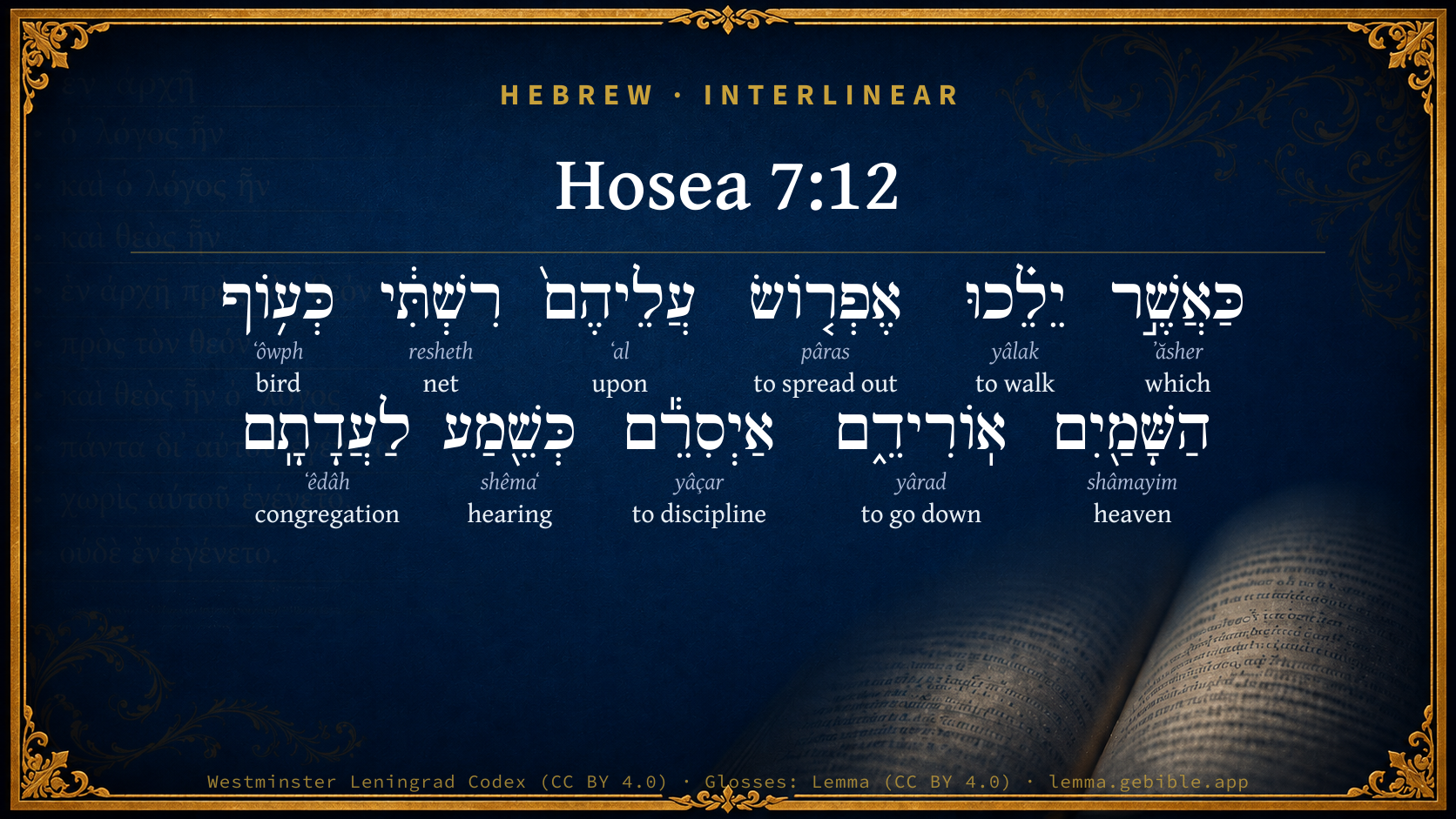
Hebrew (Westminster Leningrad Codex) Hosea 7:12 appears in the Hebrew Old Testament. The text above is from the Westminster Leningrad Codex. Each word links to its Strong’s number, a concise gloss, and parsing drawn from the Open Scriptures Hebrew Bible morphology. Click any word for its full Brown-Driver-Briggs (BDB) entry.
Download image
Cite this verse

Hosea 7:12 (World English Bible). Public Domain. Lemma interlinear Bible study tool, https://lemma.gebible.app/v/hosea/7/12.

Show BibTeX & RIS
BibTeX
RIS
English Translation
When they go, I will spread my net on them. I will bring them down like the birds of the sky. I will chastise them, as their congregation has heard.
World English Bible · Public Domain
Download a study sheet

One document with this verse’s original text, its word-by-word gloss line, the meaning frame, cross-references with their text, attributed commentary, and full source and license credits — printable, and it pastes into notes with its structure intact.

This verse Autodidact and up

Study sheet (.html) Plain text (.txt)

A passage Seminary Student

Up to 50 verses in one chapter. A passage sheet keeps up to 6 commentary sources and 12 cross-references per verse, in the order this page ranks them, and says so on the sheet whenever that leaves anything out. Ask for a single verse and you get the Autodidact verse sheet above.

Everything on this page stays free to read, with no account — the sheet is a download of what is already on screen, not access to it.

Want to remove ads? Support Godless Engineer
Compare translations 3

The same verse in 3 English versions, stacked beneath the original-language interlinear above. Click any original word for its lexicon entry.

Each is an independent rendering of the whole verse — the interlinear is not word-aligned to these translations.

Highlighted words mark where these versions differ — a whole-verse word diff, not a word-by-word alignment.

  • World English Bible Public Domain
    When they go, I will spread my net on them. I will bring them down like the birds of the sky. I will chastise them, as their congregation has heard.
  • King James Version Public Domain
    When they shall go, I will spread my net upon them; I will bring them down as the fowls of the heaven; I will chastise them, as their congregation hath heard.
  • unfoldingWord Literal Text CC BY-SA 4.0
    Whenever they go, I will spread my net over them; like birds of the heavens I will bring them down. I will discipline them according to the report to their congregation.

unfoldingWord Literal Text — © unfoldingWord, licensed CC BY-SA 4.0. Word-aligned USFM3 via Door43 (git.door43.org/unfoldingWord/en_ult).

Versions to compare (up to 4)

3 of 4 selected

Show all 18 translations

Every available English version of this verse, each an independent rendering of the whole verse.

  • World English Bible Public Domain
    When they go, I will spread my net on them. I will bring them down like the birds of the sky. I will chastise them, as their congregation has heard.
  • Berean Standard Bible Public Domain
    As they go, I will spread My net over them; I will bring them down like birds of the air. I will chastise them when I hear them flocking together.
  • Majority Standard Bible Public Domain
    As they go, I will spread My net over them; I will bring them down like birds of the air. I will chastise them when I hear them flocking together.
  • King James Version Public Domain
    When they shall go, I will spread my net upon them; I will bring them down as the fowls of the heaven; I will chastise them, as their congregation hath heard.
  • American Standard Version (1901) Public Domain
    When they shall go, I will spread my net upon them; I will bring them down as the birds of the heavens; I will chastise them, as their congregation hath heard.
  • Revised Version (1885) Public Domain
    When they shall go, I will spread my net upon them; I will bring them down as the fowls of the heaven: I will chastise them, as their congregation hath heard.
  • Geneva Bible (1599) Public Domain
    But when they shall go, I will spred my net vpon them, and drawe them downe as the foules of the heauen: I will chastice them as their congregation hath heard.
  • Douay-Rheims (1899) Public Domain
    And when they shall go, I will spread my net upon them: I will bring them down as the fowl of the air, I will strike them as their congregation hath heard.
  • Young's Literal Translation Public Domain
    When they go I spread over them My net, As the fowl of the heavens I bring them down, I chastise them as their company hath heard.
  • Literal Standard Version CC BY-SA 4.0
    When they go I spread over them My net, || As the bird of the heavens I bring them down, || I discipline them as their congregation has heard.
  • Unlocked Literal Bible CC BY-SA 4.0
    When they go, I will spread my net over them, I will bring them down like the birds of the sky. I will punish them in their flocking together.
  • unfoldingWord Literal Text CC BY-SA 4.0
    Whenever they go, I will spread my net over them; like birds of the heavens I will bring them down. I will discipline them according to the report to their congregation.
  • Darby Bible Public Domain
    When they go, I will spread my net upon them; I will bring them down as the fowl of the heavens; I will chastise them, according as their assembly hath heard.
  • World Messianic Bible Public Domain
    When they go, I will spread my net on them. I will bring them down like the birds of the sky. I will chastise them, as their congregation has heard.
  • Webster's Bible Public Domain
    When they shall go, I will spread my net upon them; I will bring them down as the fowls of the heaven; I will chastise them, as their congregation hath heard.
  • Free Bible Version CC BY-SA 4.0
    When they go I will throw my net over them; I will bring them down like wild birds. When I hear them flocking together I will punish them.
  • Bible in Basic English Public Domain
    When they go, my net will be stretched out over them; I will take them like the birds of heaven, I will give them punishment, I will take them away in the net for their sin.
  • JPS Tanakh (1917) Public Domain
    Even as they go, I will spread My net upon them; I will bring them down as the fowls of the heaven; I will chastise them, as their congregation hath been made to hear.

Literal Standard Version (2020), Covenant Press — licensed CC BY-SA 4.0. Text via the HelloAO Bible API (eBible.org). Unlocked Literal Bible (unfoldingWord) — licensed CC BY-SA 4.0. Text via the HelloAO Bible API (eBible.org). unfoldingWord Literal Text — © unfoldingWord, licensed CC BY-SA 4.0. Word-aligned USFM3 via Door43 (git.door43.org/unfoldingWord/en_ult). Free Bible Version, Dr. Jonathan Gallagher — licensed CC BY-SA 4.0. Text via the HelloAO Bible API (eBible.org).

Word by word

More ways to search: Search by grammar → Find every occurrence → Compare this word →

Practice this passage: Drill this verse → Learn its vocabulary →

כְּשֵׁ֖מַע
shêmaʻ
H8088
“like/as · hearing”
Preposition + Noun, Common, Masculine, Singular, Absolute
Part of Speech
Preposition + Noun
Type
Common
Gender
Masculine
Number
Singular
State
Absolute
Full BDB Definition

Origin: from H8085

TWOT: 2412b

report, a hearing
  1. כַּאֲשֶׁ֣ר ʼăsher H834 “like/as · which” Preposition + Particle, Relative
  2. יֵלֵ֗כוּ yâlak H3212 “to walk” Verb, Qal, Imperfect, 3rd Person, Masculine, Plural
  3. אֶפְר֤וֹשׂ pâras H6566 “to spread out” Verb, Qal, Imperfect, 1st Person, Common, Singular
  4. עֲלֵיהֶם֙ ʻal H5921 “upon · them” Preposition + Suffix, Personal, 3rd Person, Masculine, Plural
  5. רִשְׁתִּ֔י resheth H7568 “net · my” Noun, Common, Feminine, Singular, Construct + Suffix, Personal, 1st Person, Common, Singular
  6. כְּע֥וֹף ʻôwph H5775 “like/as · bird of” Preposition + Noun, Common, Masculine, Singular, Construct
  7. הַשָּׁמַ֖יִם shâmayim H8064 “the · heaven(s)” Particle, Definite Article + Noun, Common, Masculine, Plural, Absolute
  8. אֽוֹרִידֵ֑ם yârad H3381 “to go down · them” Verb, Hiphil, Imperfect, 1st Person, Common, Singular + Suffix, Personal, 3rd Person, Masculine, Plural
  9. אַיְסִרֵ֕ם yâçar H3256 “to discipline · them” Verb, Hiphil, Imperfect, 1st Person, Common, Singular + Suffix, Personal, 3rd Person, Masculine, Plural
  10. לַעֲדָתָֽם ʻêdâh H5712 “to/for · congregation · their” Preposition + Noun, Common, Feminine, Singular, Construct + Suffix, Personal, 3rd Person, Masculine, Plural

About this verse

These counts appear in no published source. They are computed here, from the morphology-tagged text and Lemma’s own curated glosses. What Lemma adds →

11
words
11
distinct lemmas
Prophets
section

Notable vocabulary

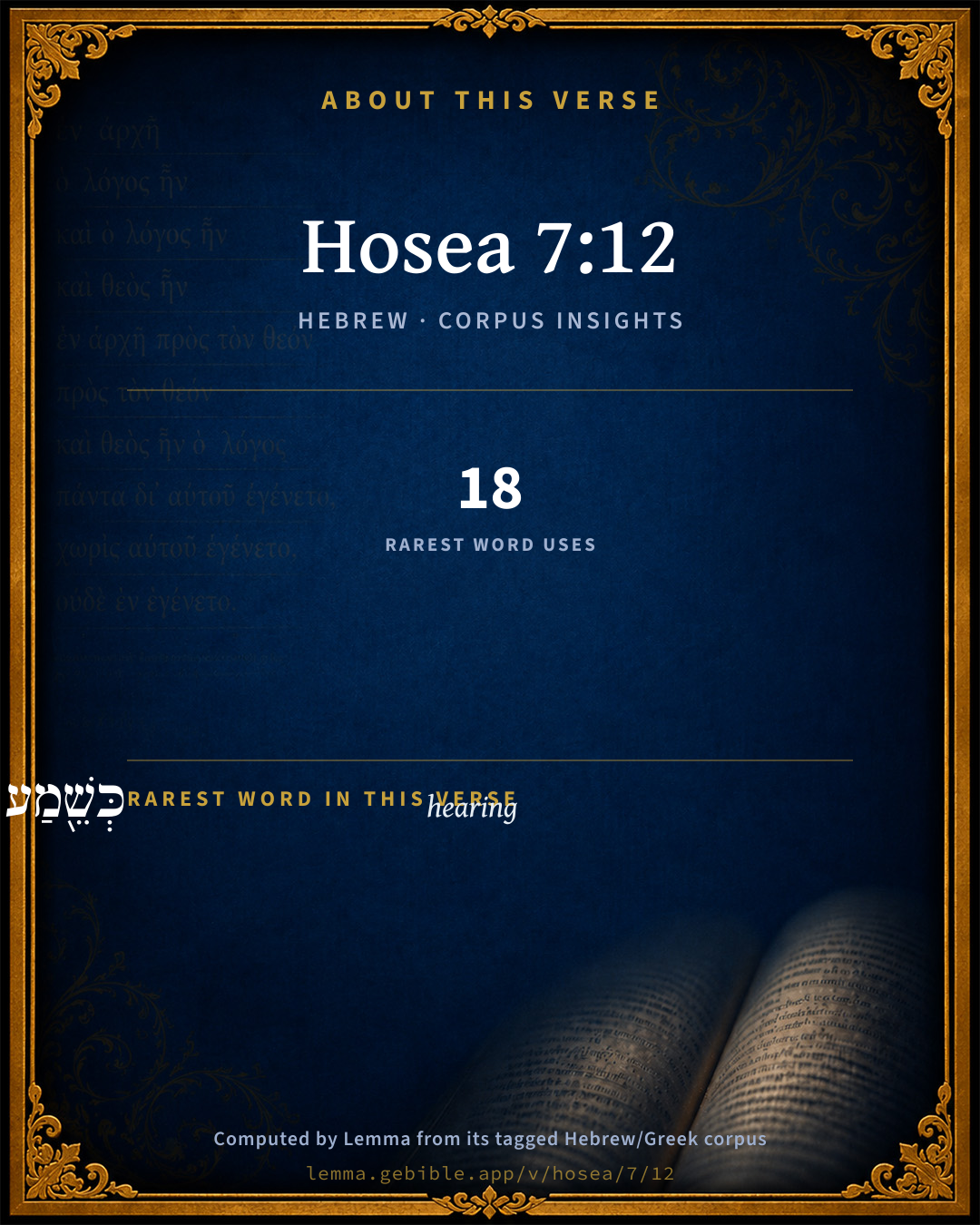
The rarest word here is כְּשֵׁ֖מַע hearing H8088 — appearing just 18 times in the whole Hebrew Bible.

Shared distinctive vocabulary

כְּשֵׁ֖מַע hearing H8088 occurs in 17 verses of the Hebrew Bible. Also found in:

Grammatical profile

  • 4 verbs
  • 5 nouns
  • 1 preposition
  • 1 particle

Verb forms

  • יֵלֵ֗כוּ Qal · Imperfect
  • אֶפְר֤וֹשׂ Qal · Imperfect
  • אֽוֹרִידֵ֑ם Hiphil · Imperfect
  • אַיְסִרֵ֕ם Hiphil · Imperfect

Hebrew & Septuagint length

In English translation the verse runs 30 words from the Hebrew and 33 from the Septuagint (LXX English) — closely comparable.

A rough comparison of the two English renderings, which tokenize alike — not a word-level alignment.

Word counts can differ between the Hebrew and the Greek without any difference in meaning — e.g. the Hebrew direct-object marker אֵת has no separate Greek word, and Greek often adds the article ὁ.

Cross-references

14

Topical passages linked to Hosea 7:12 in the Treasury of Scripture Knowledge — connected by theme and wording, ordered by reader-vote popularity; previews shown in the World English Bible.

  • Ezekiel 12:13 My net also will I spread on him, and he shall be taken in my snare; and I will bring him to Babylon to the land of the Chaldeans; yet shall he not see it, though he shall die there.
  • Deuteronomy 28:15–68 But it shall come to pass, if you will not listen to the voice of Yahweh your God, to observe to do all his commandments and his statutes which I command you this day, that all these curses shall come on you, and overtake you.
  • Deuteronomy 29:22–28 The generation to come, your children who shall rise up after you, and the foreigner who shall come from a far land, shall say, when they see the plagues of that land, and the sicknesses with which Yahweh has made it sick;
  • Leviticus 26:14–46 "'But if you will not listen to me, and will not do all these commandments;
  • Deuteronomy 31:16–29 Yahweh said to Moses, Behold, you shall sleep with your fathers; and this people will rise up, and play the prostitute after the strange gods of the land, where they go to be among them, and will forsake me, and break my covenant which I have made with them.
  • Deuteronomy 32:15–43 But Jeshurun grew fat, and kicked: You have grown fat, you are grown thick, you are become sleek; Then he forsook God who made him, Lightly esteemed the Rock of his salvation.
  • 2 Kings 17:13–18 Yet Yahweh testified to Israel, and to Judah, by every prophet, and every seer, saying, Turn you from your evil ways, and keep my commandments and my statutes, according to all the law which I commanded your fathers, and which I sent to you by my servants the prophets.
  • Job 19:6 Know now that God has subverted me, And has surrounded me with his net.
  • Ecclesiastes 9:12 For man also doesn't know his time. As the fish that are taken in an evil net, and as the birds that are caught in the snare, even so are the sons of men snared in an evil time, when it falls suddenly on them.
  • Jeremiah 16:16 Behold, I will send for many fishermen, says Yahweh, and they shall fish them up; and afterward I will send for many hunters, and they shall hunt them from every mountain, and from every hill, and out of the clefts of the rocks.
  • Jeremiah 44:4 However I sent to you all my servants the prophets, rising up early and sending them, saying, Oh, don't do this abominable thing that I hate.
  • Ezekiel 17:20 I will spread my net on him, and he shall be taken in my snare, and I will bring him to Babylon, and will enter into judgment with him there for his trespass that he has trespassed against me.
  • Ezekiel 32:3 Thus says the Lord Yahweh: I will spread out my net on you with a company of many peoples; and they shall bring you up in my net.
  • Revelation 3:19 As many as I love, I reprove and chasten. Be zealous therefore, and repent.

Cross-references courtesy of OpenBible.info (CC BY 4.0).

Hebrew and Greek witnesses Masoretic Hebrew ↔ Greek Septuagint

The same verse in the two great witnesses to the Old Testament, shown verse-for-verse.

These are two independent witnesses, not word-aligned to each other, and the Septuagint is shown in lemma (dictionary) form.

Hebrew Hosea 7:12 Masoretic · Westminster Leningrad Codex

כַּאֲשֶׁ֣ר יֵלֵ֗כוּ אֶפְר֤וֹשׂ עֲלֵיהֶם֙ רִשְׁתִּ֔י כְּע֥וֹף הַשָּׁמַ֖יִם אֽוֹרִידֵ֑ם אַיְסִרֵ֕ם כְּשֵׁ֖מַע לַעֲדָתָֽם

When they go, I will spread my net on them. I will bring them down like the birds of the sky. I will chastise them, as their congregation has heard.

World English Bible · Public Domain

Greek LXX Hosea 7:12 Septuagint · lemma form

καθώς ἄν πορεύομαι ἐπιβάλλω ἐπί αὐτός ὁ δίκτυον ἐγώ καθώς ὁ πετεινόν ὁ οὐρανός καταἄγω αὐτός παιδεύω αὐτός ἐν ὁ ἀκοή ὁ θλῖψις αὐτός

Whenever they shall go, I will cast my net upon them; I will bring them down as the birds of the sky, I will chasten them with the rumor of their coming affliction.

LXX2012 (modern English Septuagint) · Public Domain

On this verse, Whedon's Commentary on the Bible discusses the Septuagint’s reading. Read the note in Commentary ↓

Hebrew: Westminster Leningrad Codex (CC BY 4.0). Greek: Septuagint (public domain); English from LXX2012 (modern English Septuagint) (Public Domain). How the Septuagint differs from the Hebrew →

Targum (Aramaic paraphrase)

1

The Targum is the ancient Jewish Aramaic paraphrase of the Hebrew Scriptures — an interpretive translation, not the Hebrew text itself. Onkelos (literal) and Pseudo-Jonathan (expansive) render the Torah, and Jonathan the Prophets. Coverage is partial: where no permissively-licensed English translation exists for a verse, only the Aramaic is shown. This is verse-level text, not a word-by-word alignment to the Hebrew.

  1. Targum Jonathan Prophets (Joshua–Malachi)
    בַּאֲתַר דְיַהֲכוּן אֶפְרוֹס עֲלֵיהוֹן מְצֻדָתִי כְּעוֹפָא דִשְׁמַיָא אֲטַלְטְלִינוּן יְסוּרִין אַיְתֵי עֲלֵיהוֹן עַל דִשְׁמָעוּ לַעֲצָתְהוֹן:

    (no public-domain English translation for this verse)

    Targum Jonathan — Aramaic: “Mikraot Gedolot” (public domain). English: “Sefaria Community Translation” (CC0 1.0 (public-domain dedication)); “London "Chaldee Paraphrase," 1871” (public domain). Text via Sefaria.

Commentary

Notes on Hosea 7:12 from classic Christian and Jewish commentators (each source and its license shown beneath its notes). The classic Christian expositions comment on the surrounding passage and are grouped to its opening verse, so a note may address several verses; the Jewish commentaries on the Tanakh (Rashi and others) are per-verse, so they appear only where the commentator wrote on this verse.

Lemma curates 59 commentaries, every one of them public domain or Creative Commons licensed, each selected and text-cleaned for this edition rather than reprinted as found. About our sources →

Trapp's Complete Commentary

John Trapp

Hos 7:12 When they shall go, I will spread my net upon them; I will bring them down as the fowls of the heaven; I will chastise them, as their congregation hath heard.

Ver. 12. When they go] Yea, flee (as the dove doth very swiftly, pleasing herself in the clapping of her wings and cutting of the air); they cannot flee so high but I shall easily reach them, Oba 1:3-4, for in the thing wherein they deal proudly I am above them, Exo 18:11. I can overtop them, melt their waxen wings, and bring them down with a vengeance. "He taketh the wise in their own craftiness." And again, "The Lord knoweth the thoughts of the wise that they are vain," 1Co 3:19-20. So saith the apostle out of the Psalmist; but with this difference: the Psalmist saith, the "thoughts of men," Psa 94:11; the apostle, the "thoughs of the wise," meaning the world’s wizards, the choicest and most picked men, the greatest politicians, the most nimble and Mercurial wits: quorum praecordia ex meliore luto finxit Titan. These God will take, saith Paul; he will "lay hold upon them, as they are running away" (so the word significth), "as brute beasts made to be taken and destroyed," 2Pe 2:12; or as "fishes that are taken in an evil net, and as the birds that are caught in a snare; so are the sons of men snared in an evil time, when it falleth suddenly upon them," Ecc 9:12, δρασσομενος, Fugientes in cursu deprehendit manuque iniecta captat (Eras. Annot.).

I will spread my net upon them] As a skilful fowler. By net understand captivity, and other miseries, compared to a net, Eze 12:13; Eze 17:20; Eze 19:8 Lam 1:13 Psa 9:16; wherein being once caught, the more they struggle the faster they stick; the more they seek to extricate themselves, the more they are entangled; snares are round about them, and sudden fear surpriseth them, Job 22:10; the steps of their strength shall be straitened, and their own counsels shall bring them down, Job 18:7.

I will bring them down as the fowls of the heaven] Though they may think themselves extra iactum, out of gunshot, I will cause them to descend, as the Hebrew word signifieth; and though lifted up to heaven, as Capernaum, and nested in the clouds; yea, among the stars, as Edom, Oba 1:4, yet shall they be brought down to the nethermost hell. God will meet with them in their strays, casting his net over them; or bring them down with his bow, while (with the foolish bird) they are gazing at the bolt: he hath ways enough to hamper such as go out of his way; to be for a trap and for a snare unto them, Isa 8:14, to shoot at them with an arrow, suddenly shall they be wounded, Psa 64:7. "How are they brought into desolation in a moment! they are utterly consumed with terror," Psa 73:19.

I will chastise them as their congregation hath heard] Or, I will bind them (as a bird is bound in a net that she cannot stir forth), and, by binding, nurture them; as Gideon taught the men of Succoth, by tawing and tearing them with thorns and briars of the wilderness; παιδευσω αυτους, Sept.; ligabo eos, Kimchi. Jdg 8:16. "The hypocrites in heart heap up wrath: they cry not when God bindeth them," Job 36:13. God expects men should cry peccavi, I have sinned, when they are bound as Paul was, to be beaten with rods; and not be silent in darkness, 1Sa 2:9, or, not make moan when he hath them under hand. "Hear ye the rod, and who hath appointed it." Ye must now do so, that would not hear the word sounding in your congregations.

I will chastise them as their congregation hath heard] Crebro et clare, I have plainly and plentifully told them my mind, and foretold them by my prophets what would be the issue of their evil practices. Sed surdo fabulam, They would not hear Moses and the prophets. See 2Ki 17:13 2Ch 24:18-19. They thought that my words were but wind, and that all my threats were but in terrorem, to frighten them a little, and not in good earnest, Jer 5:13. Therefore they shall find that "the just Lord is in the midst of them, he will not do iniquity: every morning doth he bring his judgment to light, he faileth not; but the unjust knoweth no shame," Zep 3:5, feareth no colours, trembleth not at God’s word, though it come never so close to his conscience, though it even dash him in the mouth as it were, and make him spit blood. See Jer 7:13.

John Trapp, A Commentary or Exposition upon All the Books of the Old and New Testament (1647–1656) — public domain. Text from a community e-Sword module.

The Biblical Illustrator

Joseph S. Exell

Hos_7:12

I will spread My net upon them; I will bring them down as the fowls of the heaven.

The fowler of retribution

Trans. As they go, I spread My net over them, I bring them down as fowls of the heavens. As they go to Egypt or Asshur, seeking help in their difficulties. Here the work of retribution is spoken of as the work of the fowler. It includes two things.

I. Entrapment. The retributive providence of God employed the Assyrians as a net, which so ensnared the Israelites that they could not escape. How often in the history of the world is this retributive entrapment witnessed! Illustrate--Josephs brethren. Crucifixion of Christ. Luther at Wattburg. Bunyan at Bedford. The net that entangled sinners is not manufactured in heaven, it is made on earth, made by themselves.

II. Abasement. However high up they may tower in their ambitious work, retribution has missiles to bring them down. There are men who, in their worldly prosperity, pride, and ambition, soar like the eagles high up in heaven above all the rest. An ancient philosopher, being asked what Jupiter does in the highest heaven, replied, He pulls down the haughty, and exalts the humble. (Homilist.)

Self-dependence humiliated

The dove brought down from its almost viewless height, fluttering weakly, helplessly, and hopelessly under those same meshes, is a picture of the self-dependent spirit humiliated, overwhelmed by inevitable evils, against which it impotently struggles, from which it seems to see its escape, but by which it is held as fast as if it lay motionless in iron. (E. B. Pusey, D. D.)

The Biblical Illustrator, edited by Joseph S. Exell (c. 1880s–1900s) — public domain. Text from a community e-Sword module.

Whedon's Commentary on the Bible

Daniel D. Whedon

12. Such policy is contrary to the will of Jehovah, therefore he will make it of no effect; yea, he will severely punish them for it. As they go to Egypt or Assyria, thinking to find relief, Jehovah will bring upon them sudden ruin.

Net — The figure of the dove is continued. The silly dove, Israel, will be entangled in the net of calamity and ruin.

I will bring them down — A poetic parallel to the preceding. Just as the birds of the air are brought down and captured by the fowler, so Jehovah will bring down Israel from the air of freedom into the net of exile. The latter part of Hos_7:12 is obscure.

As their congregation hath heard — As has been publicly proclaimed by the prophets, for example, Amos and Hosea. The ancient versions reproduce a different text, and various emendations have been proposed: Marti, “on account of their sins,” Harper, “by the abundance of their afflictions.” The Hebrew is peculiar, but certainty as to the original is impossible. Harper’s transposition of “I will chastise” so that it follows Hos_7:10 does not improve the text. That the words might be omitted from their present place is true; that they “furnish just the required completion for the thought of Hos_7:10” is, to say the least, doubtful, since Hos_7:11 furnishes a proper continuation of Hos_7:10.

The announcement of judgment in Hos_7:12 is continued in Hos_7:13 in the form of a “Woe,” which is in turn explained by the exclamation, “destruction unto them!” There is, indeed, no escape; their rebellion has been too persistent.

They have fled [“wandered”] from me — The special sin condemned is not spiritual or moral, but political, apostasy; instead of seeking help from Jehovah they have sought it from Assyria and Egypt. As the second exclamation is an explanation of the first, so the second causal clause is an expansion of the first. The wandering away involved rebellion against the rightful master.

Transgressed — Better, rebelled, or, apostatized. The exact rendering and interpretation of 13b are uncertain.

Though I have redeemed… they have spoken lies. Refers to actual past deliverances and expressions of ingratitude. R.V., “though I would redeem… they have spoken lies,” emphasizes the willingness or desire of Jehovah to redeem, which is met by defiance. Others take the sentence conditionally, “If I should redeem… they would only speak lies,” or as a question of astonishment, “And I, should I redeem them, and they spoke only lies,” or, “when they have spoken only lies!” A still different though similar rendering makes it an exclamation of astonishment, “And I redeem them when they have spoken only lies!” The Hebrew permits any one of these renderings; the context must determine the correct one. Hos_7:14 makes it probable that “they have spoken lies” refers to an act of the past. As to the preceding clause it would seem, in view of the apparently unconditional announcement of judgment, that one of the last two interpretations must be accepted. Between the two there is little to choose. The words are a reply to a possible objection on the part of the people that destruction would be unjust; they set forth the truth that divine displeasure is well deserved. Additional justification is offered in Hos_7:14 — they have never sought Jehovah in sincerity.

Spoken lies — In saying by word or deed that Jehovah was unwilling or unable to help (Isa_44:8); they surely did not know God (compare Hos_4:6).

Not cried unto me with their heart — The people had not ceased entirely to worship Jehovah, or to call upon him, but their petitions were insincere; they did not come from the heart (Isa_29:13).

Howled upon their beds — In distress and despair they roll upon their beds unable to sleep. Since 14b refers to attempts to secure the favor and good will of Jehovah by acts of worship, the howling would better be connected with religious celebrations, perhaps the howling connected with sacrificial feasts (Amo_5:23); for “bed” we must then read “divans,” or “couches,” upon which they reclined during their meals. A simple emendation would give “beside their altars,” which is accepted by some commentators. Other emendations are less satisfactory.

Assemble themselves — The derivation, and therefore also the meaning of the Hebrew verb form, is uncertain. The English translation suggests a gathering together in solemn assembly at the sanctuary for the purpose of imploring Jehovah for a rich harvest. Another possible rendering is, they excite themselves, that is, in connection with the worship. LXX. presents a different text; changing one consonant, ר, into another, ד, it reads, “they cut themselves” (compare 1Ki_18:28; Deu_14:1; Jer_16:6, etc.). In some way this self-mutilation, condemned by the religious leaders of Israel, was thought to secure the divine favor. Whatever the exact meaning of the word, the prophet evidently speaks of some selfish efforts connected with the heartless worship to secure material blessings from Jehovah.

They rebel against me — Notwithstanding their religious zeal, they are rebels against Jehovah’s majesty.

Daniel D. Whedon (gen. ed.), Commentary on the Old and New Testaments (1874–1909) — public domain. Text from a community e-Sword module.

Tyndale Open Study Notes

Tyndale Open Resources

7:12 Like a fowler hunting birds, the Lord would throw his net over silly, witless Israel to punish them.

Tyndale Open Study Notes — © Tyndale Open Resources, licensed CC BY-SA 4.0. Text via the HelloAO Bible API.

Geneva Bible (1599)

Geneva Bible translators

According to my curses made to the whole Congregation of Israel.

Geneva Bible (1599) marginal notes — public domain. Text via Bolls.life.

Jamieson, Fausset & Brown

Robert Jamieson, A. R. Fausset & David Brown

When they shall go--to seek aid from this or that foreign state.

spread my net upon them--as on birds taken on the ground (Eze 12:13), as contrasted with "bringing them down" as the "fowls of the heavens," namely, by the use of missiles.

as their congregation hath heard--namely, by My prophets through whom I threatened "chastisement" (Hos 5:9; Kg2 17:13-18).

Jamieson, Fausset & Brown — Commentary Critical and Explanatory on the Whole Bible (1871) — public domain (CC PDM 1.0). Text via the HelloAO Bible API.

Adam Clarke's Commentary

Verse 12. When they shall go] To those nations for help -

I will spread my net upon them] I will cause them to be taken by those in whom they trusted.

I will bring them down] They shall no sooner set off to seek this foreign help, than my net shall bring them down to the earth. The allusion to the dove, and to the mode of taking the fowls of heaven, is still carried on.

As their congregation hath heard.] As in their solemn assemblies they before have heard; in the reading of my law, and the denunciation of my wrath against idolaters.

Bishop Newcome translates: "I will chastise them when they hearken to their assembly." That is, when they take the counsel of their elders to go down to Egypt for help, and trust in the arm of the Assyrians for succour.

Adam Clarke's Commentary on the Bible (1810–1826) — public domain. Text from a community e-Sword/MySword module.

John Calvin's Commentaries

But a denunciation of punishment afterwards follows, Wheresoever, he says, they shall go, I will expand over them my net, and will draw them down as the birds of heaven God shows that though the Israelites might turn about here and there, yet their end would be unhappy; for he would have his expanded net: and he follows up the simile he used in the last verse. He had said that they were like doves, which are carried by a sudden instinct to the bait, and consider not the expanded net. If then the dove sees only the lure, and at the same time shuns not the danger, it is a proof of foolish simplicity. Hence God says, I will expand my net; that is, I will cause all your endeavors and purposes to be disappointed, and all your hopes to be vain; for wheresoever they shall fly, my net shall be expanded.

This is a remarkable passage; for we hence learn, that the issue will always be unfortunate, if we attempt any thing contrary to the word of the Lord, and it we hold consultations over which his Spirit does not preside; as it is said by Isaiah 30:1,

‘Woe to them who weave a web, and draw not from my mouth! Woe to them who take counsel, and invoke not my Spirit!’

This passage wholly agrees with the words of Isaiah, though the form of speaking is different. It belongs then to God to bless our counsels, that they may have a prosperous and the desired success. But when God is not favorable, but even opposed to our designs, what end shall at last await us, but that whatever we may have attained shall at length be turned to our ruin? Let us then know, that whatever men do in this world is ruled by the hidden providence of God; and as God leads by his extended hand his own people, and gives his angels charge to guide them; so also he has his expanded net to catch all those who wander after their own erratic imaginations. Hence he says, Wheresoever they shall go, I will expand over them my net; and farther, I will draw them down as the birds of heaven

The Prophet seems to allude to the vain confidence, which he mentioned, when he said that Israel had bound wind in his wings. For when men presumptuously undertake any thing, they at the same time promise to themselves, that there will be nothing to prevent them from gaining their object. Inasmuch then as men, elated with this foolish confidence, gather more boldness, yea, at length furiously assail God, and seem as though they would break through the very clouds, the Prophet says, I will draw them down as the birds of heaven; that is, “I will allow them to be carried up for a time; but when they shall penetrate to the clouds, I will draw them down, I will make them to know that their flying will avail them nothing.” And we must notice from whence the Israelites had been drawn down. For who would not have thought that so much protection must have been found in the Assyrians or in the Egyptians, that they could not in vain expect deliverance? But the Lord laughs to scorn this vain power of the world; for whatever hope men may conceive when they alienate themselves from God, it will entirely vanish like smoke.

And he afterwards adds, I will chastise them, or, ‘I will bind them:’ for the verb יסר, isar, means both “to chastise” as well as “to bind;” so that either sense may be taken. If the word, “to bind,” be approved, it will well agree with the metaphor, as though he said, “I will hold you fast in my nets.” For as long as birds are allowed to fly, they think the whole heaven to be theirs; but when they fall into nets, they remain confined; they are then unable to fly, and cannot move their wings. So then this sense, “I will bind them”, is very suitable; which means, “They will not be able to break my net, but I will hold them there bound to the end.” But if one prefers the other sense, I will chastise them, I do not object; and as far as the meaning is concerned, we see that there is not much difference which sense we take, except that the word, “to bind,” as I have said, harmonizes better with the metaphor.

He says, According to the hearing of their assembly. Nearly all so render this, as if God had said that he would punish them as he had threatened by Moses, and as if it was also an indirect accusation of their carelessness, because they did not become wise after having been long admonished, but even despised those denunciations, which constantly resounded in their ears. For God had not only prescribed in his law the rule of a religious life, but also added heavy and severe threatening, by which he gave a sanction to the doctrine at the law. We know how dreadful are those curses of the law. Since then God had even from the beginning thus threatened the Israelites, ought they not to have walked more carefully before him? But they were not terrified by these denunciations. Hence God here indirectly reproves this great madness, that the Israelites did not sufficiently attend to his threatening, by which they might have been recalled to the right way; for Moses did by these put a restraint even on the furious passions of men, if only there remained in them a particle of sound understanding. Still further, the same admonitions had been often pressed on them by the Prophets; nor had God ever ceased to arouse them, until the ears of them all had become deaf to his voice. He therefore says, ‘I will hold them fast bound,’ or, ‘I will chastise them, according to the hearing of their assembly;’ that is, “The punishment which I shall inflict must have been long ago known to them, for I have openly commanded my law to be promulgated, that I might thus testify my people by severe threatening; I will now then execute the judgment, which they have not believed, because I have hitherto spared them.”

As I have already said, interpreters nearly all agree in this view, except that they do not consider the design of the Prophet; they do not perceive that the Israelites were upbraided for their hardness; but they only speak of punishment, without any intimation of the end or object for which God had promulgated maledictions in his law, and renewed the recollection of them by his Prophets. Jerome brings forward another meaning, even this, that God would punish the people according to the report of their assembly; that is, that as they had with one consent violated the worship of God, and transgressed his laws, so he would punish them all. I will at the same time add this view, that God would chastise them according to the clamour of their assembly, so that the Prophet points out, not only a conspiracy among the people of Israel, but also their violence in eliciting one another to sin. As, then, they had thus tumultuously risen up against God, so the Prophet in his turn declares, that God would punish them; as though he said, “Your tumult will not prevent me from quelling your fury. Ye do indeed with great noise oppose me, and think that you will be safe, though addicted to your sins; but this your violence will be no hindrance, for I have in my power the means of chastising you.”

John Calvin's Commentaries (1540-1563) — public domain. Text from the Calvin Translation Society English edition (1840s-50s) via the Christian Classics Ethereal Library (ccel.org). Calvin's coverage is partial (roughly two-thirds of the Bible); uncommented books and verses are honest gaps, never fabricated. The 19th-century editor's footnotes and remarks are omitted so the notes are faithfully Calvin's own voice.

Ellicott's Commentary for English Readers

(12) When they shall go.—Best rendered, Whenever they go, &c. The ultimate ruin produced by this policy of dependence on foreign states and of doubledealing intrigue was even at this early stage foreseen by the prophet, and portrayed under the simile of Jehovah’s net snaring the unwary bird.

As their congregation hath heard.—Should be, according to the report to their assembly—i.e., according to what they hear, perhaps from Hosea himself. The threatenings of the Pentateuch (Lev_26:14-39; Deu_28:13-68; Deu_32:15-35) find their echoes here.

A Bible Commentary for English Readers, edited by Charles John Ellicott (1878–1897) — public domain. Text from a community e-Sword module.

The Cambridge Bible for Schools and Colleges

gen. ed. J. J. S. Perowne

12. When they shall go] Rather, As soon as they go.

I will spread my net] The image of Jehovah’s net is not a frequent one; see however Job_19:6; Eze_12:13; Eze_17:20; Eze_19:8; Eze_32:3. Here the net means captivity.

I will bring them down] Apparently by placing a bait to draw them to the earth, at least if the figure is to be continued. Amo_9:2 is therefore not parallel.

as their congregation hath heard] Lit., ‘according to the announcement to their congregation.’ Comp. Isa_53:1, ‘Who hath believed our announcement’ (a cognate word) = ‘that which we heard’. The punishment, says Hosea, will agree exactly with his own repeated predictions (comp. Hos_5:9).

The Cambridge Bible for Schools and Colleges (gen. ed. J. J. S. Perowne; Cambridge University Press, 1878–1918) — public domain. Text from a community e-Sword module.

John Gill's Exposition

When they shall go,.... That is, to Egypt or Assyria:

I will spread my net upon them; bring them into great straits and difficulties; perhaps the Assyrian army is meant, which was the Lord's net, guided, and directed, and spread by his providence, and according to his will, to take this silly dove in; and which enclosed them on all sides, that they could not escape; see Eze 12:13. Hoshea the king of Israel was taken by the Assyrian, and bound and shut up in prison; Samaria the capital city was besieged three years, and then taken, Kg2 17:4;

I will bring them down as the fowls of the heaven; though they fly on high, soar aloft, and behave proudly, and fancy themselves out of all danger; yet, as the flying fowl, the eagle, and other birds, may be brought down to the earth by an arrow from the bow, or by some decoy so should they be brought down from their fancied safe and exalted state, and be taken in the net, and become a prey to their enemies:

I will chastise them, as their congregation hath heard; what was written in the law, and in the prophets, were read and explained in the congregations of Israel on their stated days they met together on for religious worship; in which it was threatened, that if they did not observe the laws and statutes of the Lord their God, but neglected and broke them, they should be severely chastised and corrected with his sore judgments, famine, pestilence, the sword of the enemy, and captivity: and now the Lord would fulfil his word, agreeably to what had often been heard by them, but not regarded; see Lev 26:1.

John Gill's Exposition of the Whole Bible (1746–1763) — public domain (CC PDM 1.0). Text via the HelloAO Bible API.

Albert Barnes' Notes on the Bible

When they go - (Literally, “according as” they go, in all circumstances of time or place or manner, when whithersoever or howsoever they shall go,) I “will spread My net upon them,” so as to surround and envelop them on all sides and hold them down. The “dove” soaring aloft, with speed like the storm-wind Psa 55:6-8, is a picture of freedom, independence, impetuous, unhindered, following on its own course; weak and timid, it trusts in the skillfulness with which it guides its flight, to escape pursuit; the “net,” with its thin slight meshes, betokens how weak instruments become all-sufficient in the hands of the Almighty; the same dove, brought down from its almost viewless height, fluttering weakly, helplessly and hopelessly, under those same meshes, is a picture of that same self-dependent spirit humiliated, overwhelmed by inevitable evils, against which it impotently struggles, from which it seems to see its escape, but by which it is held as fast, as if it lay motionless in iron.

As their congregation hath heard - Manifoldly had the message of reward on obedience, and of punishment on disobedience, come to Israel. It was spread throughout the law; it fills the book of Deuteronomy; it was concentrated in the blessing and the curse on mount Ebal and Gerizim; it was put into their mouths in the song of Moses; it was inculcated by all the prophets who had already prophesied to them, and now it was being enforced on that generation by Hosea himself. Other kingdoms have fallen; but their fall, apart from Scripture, has not been the subject of prophecy. Their ruin has come mostly unexpected, either by themselves or others.

Albert Barnes' Notes on the Bible (1834–1885) — public domain. Text from a community e-Sword/MySword module.

Haydock's Catholic Bible Commentary

Heard the menaces of Moses, (Deuteronomy xxvii.) and of the prophets, 4 Kings xxvii. 13. (Calmet) --- Septuagint, "I will instruct (or chastise) them by the hearing of their misery," (Haydock) when it shall become the subject of conversation throughout the world.

George Leo Haydock (1774–1849), Haydock's Catholic Family Bible and Commentary, 1859 edition — public domain. Excludes Psalms (Douay-Rheims chapter numbering differs from Protestant) and Deuterocanonical books (Catholic canon only).

Matthew Poole's English Annotations

When they shall go, whensoever they shall send their ambassadors to seek aid of Egypt or Assyria,

I will spread my net upon them; as fowlers spread the net, watch the birds, and cast it over them to catch them, so will God do to Ephraim. So he did with Israel when he accepted the alliance of Shalmaneser, and turned tributary; and again, when Israel sought by Egypt’s help to get out of the snares of their vassalage to Shalmaneser, who revenged the conspiracy with a total captivity; nor can there be likelihood or possibility these fugitives should escape when it is God’s net, and he spreads it, his almighty power, his allsearching wisdom, his just vengeance, that follows them.

I will bring them down as the fowls of the heaven; though they attempt to fly, yet as fowls in the net they shall certainly fall, I will bring them down; as he did when they were gathered into Samaria as a net, and there made prisoners, and thence carried captives.

I will chastise them, thus they shall be punished,

as their congregation hath heard, both from the law of Moses which they had with them, and as they had heard from my prophets which I have sent unto them. I will, saith God, make good my word.

Matthew Poole's English Annotations on the Holy Bible (1683–1685) — public domain. Text from a community e-Sword/MySword module.

The Pulpit Commentary

When they shall go, l will spread my net over them. Threats of punishment are contained in this and the following verses. He begins by the application of the comparison of Ephraim to a dove. Exactly as a dove in its silliness falls into the net set by the fowler, so Israel runs into the net of destruction in seeking help from Egypt and Assyria. The literal rendering is, according as they go, or, whatsoever way they shall go. God threatens to spread a net over them, from which there can be no escape. The chief aim of Hebrew sovereigns and rulers was to defend themselves from Egypt by the help of Assyria, or from Assyria by the aid of Egypt; in either case God threatens to spread over them the net of destruction as the bird-catcher. The application to one or other of these powers God forbade, but when they go to either for relief, the result is sure to prove fatal. The image of a net is frequent in Ezekiel; so in Job, he "hath compassed me with his net." I will bring them down as the fowls of the heaven. The comparison with birds and bird-catching continues. Though their sunward soaring flight be high as the eagle"s, or rapid as the soft swift wing of the dove, they cannot outspeed or escape the hand of God, but shall be brought down to earth. Or the idea may be that, swiftly as a bird of prey swoops down out of the free air of heaven upon its quarry on the low-lying earth, Jehovah will bring Israel down out of the air of freedom into the net of captivity. Thus in Oba_1:4 we read, "Though thou exalt thyself as the eagle, and though thou set thy nest among the stars, thence will I bring thee down, saith the Lord;" likewise in Amo_9:2, "Though they dig into hell, thence shall mine hand take them; though they climb up to heaven, thence will I bring them down." I will chastise them as their congregation hath heard. The word is an anomalous Hiph. instead of that is, yod mobile instead of yod quiescent or diphthongal zere. The literal rendering makes the meaning more obvious; it is: "I will chastise them according to the tidings or, "announcement to their congregation." In the Law and by the prophets it was repeatedly declared that judgments would fall upon the disobedient and rebellions. As specimens of such announcements, we may refer to Lev_26:14-39 Deu_28:15-68; and Deu_32:15-35 The prophet now assures Ephraim that the judgments so frequently and forcibly announced to the congregation of the children of Israel in the wilderness, and repeated in subsequent times by the prophets, would be executed on the rebellious rigorously, and in exact accordance with those many previous denunciations. Kimchi has the following comment: "I will assemble them through the chastisement of the peoples, as I announced to their assembly in the wilderness words of chastisement, which are written in the Law, if they will not hearken to the words of the Law." The LXX may have read as their rendering is en th akoh thv yliqewv autwn , equivalent to "I will chasten them with the rumor of their (coming) affliction.

The fowler of retribution,

"When they shall go, I will spread my net upon them; I will bring them down as the fowls of the heaven." Tills should be translated, "As they go I spread my net over them; I bring them down as fowls of the heavens" (Keil and Delitzsch). "As they go." Whither? "The preceding verse answers the question: to Egypt and Asshur seeking help in their difficulties rather than to Jehovah. Israel, here spoken of as Ephraim, being sorely pressed by Asshur, at one time seeks help from Egypt against Asshur; whilst at another they try to secure the friendship of the latter. For what threatened Israel was the burden of "the king of princes." And that they tried to avert, partly by their coquettish arts, (Hos_8:9) and partly by appealing to the help of Egypt; and while so doing, they did not observe that they had fallen into the net of destruction by the power of Assyria. In this net will the Lord entangle them as a punishment. As they go thither God will spread his net over them like a bird-catcher, and bring them down to the earth like flying birds; i.e. bring them from the open air, that is to say, from freedom unto the net of captivity or exile." Here the work of retribution is spoken of as the work of the fowler, and it includes two things entrapment and abasement.

I ENTRAPMENT. The spreading of the net refers to the taking of the birds that lay on the ground. The literal reference here is to 2Ki_17:4. Here the retributive providence of God employed the Assyrians as anet, but so ensnared the Israelites that they could not escape. Eliphaz observed this ensnaring work of Providence: "He taketh the wise in their own craftiness." So did David, who says, "He made a pit and digged it, and is fallen into the ditch which he made. His mischief shall return upon his own head, and his violent dealing shall come down upon his own pate." How often in the history of the world is this retributive entrapment witnessed.

I The cases of Joseph"s brethren and the crucifixion of Christ are striking examples in sacred history. Popery confined Luther in the Wartburg Castle, but there he translated that Bible which shattered the whole system. Anglican bigots confined Bunyan in Bedford Jail; there he produced a book that has given him immortal fame. The net that entangled sinners is not manufactured in heaven; it is made on earth, made by themselves. Righteous Providence allows them to be so ensnared by it as to render that enthrallment painful and lasting. Take care of the net.

II ABASEMENT. "I will bring them down as the fowls of the heaven." However high up they may tower in their ambitious work, retribution has missiles to bring them down. "Thine eyes are upon the haughty, that thou mayest bring them down." There are men on earth who in their worldly prosperity, pride, and ambition soar like the eagles high up in heaven above all the rest. It is said that an ancient philosopher, when once asked what Jupiter did in the highest heaven, replied, "He pulls down the haughty, and exalts the humble." Hear these words: "The pride of thine heart hath deceived thee, thou that dwellest in the clefts of the rock, whose habitation is high, that saith in his heart, Who shall bring me to the ground? Though thou exalt thyself as the eagle, and though thou set thy nest among the stars, thence will I bring thee down, saith the Lord.

CONCLUSION. Ponder well thy condition, sinner. Not only is the eye of retributive justice upon thee wherever thou art and whatever thou dost, but it has all the machinery for thy ruin. Art thou down groveling in the earth, working out thy sordid soul? it has nets that will ensnare thee there! Or art thou high up in the heavens of worldly prosperity and haughty ambition, proudly exulting in thy superiority? it has shots that will reach thee and bring thee down to the dust. Thy only safety is the cross. D.T.

The Pulpit Commentary (1880–1919), ed. H.D.M. Spence-Jones & Joseph S. Exell — public domain. Text from a community e-Sword module.

John Wesley's Explanatory Notes

Go - To seek aid of Egypt or Assyria. Bring them down - Though they attempt to fly, yet as fowls in the net they shall certainly fall. Hath heard - From the prophets whom I have sent unto them.

John Wesley, Explanatory Notes Upon the Whole Bible (1754–1765) — public domain. Text via the GEBible commentary corpus.

unfoldingWord translationNotes

Door43 World Missions Community

General Information:

Yahweh is speaking.

I will spread my net over them

This is a way to catch birds. Yahweh continues to compare the people of Israel to doves. When they go to Egypt or Assyria for help, Yahweh will punish them. (See: Metaphor)

I will bring them down like the birds of the sky

Yahweh speaks of the way he will judge Israel as if they were birds that he would catch in a net. AT: "I will hunt them like birds" or "I will catch them like a hunter catches birds" (See: Simile)

in their flocking together

This expression extends the metaphor of the birds.

translationWords

punish

woe

astray

devastate

rebel

unfoldingWord translationNotes — © Distant Shores Media and the Door43 World Missions Community, licensed CC BY-SA 4.0. Source: git.door43.org/Door43/en_tn.

Rashi

Rabbi Shlomo Yitzchaki (Rashi)

When they go to Egypt.

I will spread My net over them; like the fowl of the heaven For the eagle and the hawk ascend higher than he and they bring them down to the earth, so will I bring them down in Egypt through Nebuchadnezzar. Another explanation: like the fowl of the heaven that is caught in a net hung on poles, and after they are in the net, they bring down the net.

I will chastise them as I let their congregation hear I will bring chastisements upon them according to all that I let them hear through Jeremiah the prophet, that they are destined to say to him (42:2-6) “And pray in our behalf etc. And let the Lord your God tell etc. Whether good or bad etc.” And he said to them (verse 15f.), “If you direct your faces to come to Egypt etc. the sword that you fear will overtake you there,” and the entire section.

I will chastise them Heb. אַיְסִירֵם, an expression of chastisements (יִסּוּרִין) and Menahem (Machbereth Menahem pp. 128f.) explained [it as] an expression of binding. Comp. (Jer. 30:8) “and I will break your thongs (מוֹסְרוֹתֶיךָ),” but Dunash (Teshuvoth Dunash p. 34) interpreted [it as] an expression of chastisements (יִסּוּרִין). Comp. (Lev. 26:18) “to chastise you (לְיַסְרָה).” And the second “yud” in אַיְסִירֵם is added, as it is added in (יַיְשִׁירוּ) (Prov. 4:25) “and your eyelids look straight (יַיְשִירוּ) ahead of you.”

Rashi on the Tanakh — English translations: “The Judaica Press complete Tanach with Rashi, translated by A. J. Rosenberg” (CC BY 4.0); “Pentateuch with Rashi's commentary by M. Rosenbaum and A.M. Silbermann, 1929-1934” (public domain); “The Metsudah Tanach series, Lakewood, N.J” (CC BY 4.0); and “The Book of Joshua, Metsudah Publications, 1997” (CC BY 4.0). Text via Sefaria.

Lesson kit

Teaching starters — assembled from the data on this page, not authored interpretation. Every prompt links to the verse data it draws on. Edit before teaching.

Hosea, in the Prophets, opens this verse with 11 words (11 distinct Hebrew lemmas). Its most distinctive word is shêmaʻ (“hearing”). A historical commentator’s framing appears above. Read the whole chapter for the surrounding context.

Discussion questions

  1. The word shêmaʻ carries the sense “hearing.” How does it shape the verse?
  2. Genesis 29:13 shares the word «hearing» with this verse. How do the two illuminate each other?
  3. The translations on this page render this verse differently — a whole-verse word diff, not a word-by-word alignment. What might account for the different wordings?
  4. The verb «יֵלֵ֗כוּ» is Qal Imperfect. How does its form color the action?
  5. Reading how Trapp's Complete Commentary and The Biblical Illustrator read this verse, where do the two commentators agree and where do they part?

Things to notice

Reading settings

Reading text

Shown beneath each verse's original-language words.

Old Testament
Old Testament edition

Read the OT as the Masoretic Hebrew (MT) or the Greek Septuagint (LXX).

English shown for the Greek Septuagint (in the Hebrew ↔ Greek comparison).

Comparing translations? Open the Compare panel on any verse page to stack up to four side by side.