
Job 28:21

Hebrew (Westminster Leningrad Codex) Job 28:21 appears in the Hebrew Old Testament. The text above is from the Westminster Leningrad Codex. Each word links to its Strong’s number, a concise gloss, and parsing drawn from the Open Scriptures Hebrew Bible morphology. Click any word for its full Brown-Driver-Briggs (BDB) entry.
Download image
Cite this verse

Job 28:21 (World English Bible). Public Domain. Lemma interlinear Bible study tool, https://lemma.gebible.app/v/job/28/21.

Show BibTeX & RIS
BibTeX
RIS
English Translation
Seeing it is hidden from the eyes of all living, And kept close from the birds of the sky.
World English Bible · Public Domain
Download a study sheet

One document with this verse’s original text, its word-by-word gloss line, the meaning frame, cross-references with their text, attributed commentary, and full source and license credits — printable, and it pastes into notes with its structure intact.

This verse Autodidact and up

Study sheet (.html) Plain text (.txt)

A passage Seminary Student

Up to 50 verses in one chapter. A passage sheet keeps up to 6 commentary sources and 12 cross-references per verse, in the order this page ranks them, and says so on the sheet whenever that leaves anything out. Ask for a single verse and you get the Autodidact verse sheet above.

Everything on this page stays free to read, with no account — the sheet is a download of what is already on screen, not access to it.

Want to remove ads? Support Godless Engineer
Compare translations 3

The same verse in 3 English versions, stacked beneath the original-language interlinear above. Click any original word for its lexicon entry.

Each is an independent rendering of the whole verse — the interlinear is not word-aligned to these translations.

Highlighted words mark where these versions differ — a whole-verse word diff, not a word-by-word alignment.

  • World English Bible Public Domain
    Seeing it is hidden from the eyes of all living, And kept close from the birds of the sky.
  • King James Version Public Domain
    Seeing it is hid from the eyes of all living, and kept close from the fowls of the air.
  • unfoldingWord Literal Text CC BY-SA 4.0
    It is hidden from the eyes of each living; even from the birds of the heavens it is concealed.

unfoldingWord Literal Text — © unfoldingWord, licensed CC BY-SA 4.0. Word-aligned USFM3 via Door43 (git.door43.org/unfoldingWord/en_ult).

Versions to compare (up to 4)

3 of 4 selected

Show all 18 translations

Every available English version of this verse, each an independent rendering of the whole verse.

  • World English Bible Public Domain
    Seeing it is hidden from the eyes of all living, And kept close from the birds of the sky.
  • Berean Standard Bible Public Domain
    It is hidden from the eyes of every living thing and concealed from the birds of the air.
  • Majority Standard Bible Public Domain
    It is hidden from the eyes of every living thing and concealed from the birds of the air.
  • King James Version Public Domain
    Seeing it is hid from the eyes of all living, and kept close from the fowls of the air.
  • American Standard Version (1901) Public Domain
    Seeing it is hid from the eyes of all living, And kept close from the birds of the heavens.
  • Revised Version (1885) Public Domain
    Seeing it is hid from the eyes of all living, and kept close from the fowls of the air.
  • Geneva Bible (1599) Public Domain
    Seeing it is hid from the eyes of all the liuing, and is hid from the foules of the heauen?
  • Douay-Rheims (1899) Public Domain
    It is hid from the eyes of all living. and the fowls of the air know it not.
  • Young's Literal Translation Public Domain
    It hath been hid from the eyes of all living. And from the fowl of the heavens It hath been hidden.
  • Literal Standard Version CC BY-SA 4.0
    It has been hid from the eyes of all living. And from the bird of the heavens || It has been hidden.
  • Unlocked Literal Bible CC BY-SA 4.0
    Wisdom is hidden from the eyes of all living things and is kept hidden from the birds of the heavens.
  • unfoldingWord Literal Text CC BY-SA 4.0
    It is hidden from the eyes of each living; even from the birds of the heavens it is concealed.
  • Darby Bible Public Domain
    For it is hidden from the eyes of all living, and concealed from the fowl of the heavens.
  • World Messianic Bible Public Domain
    Seeing it is hidden from the eyes of all living, and kept close from the birds of the sky.
  • Webster's Bible Public Domain
    Seeing it is hid from the eyes of all living, and kept close from the fowls of the air.
  • Free Bible Version CC BY-SA 4.0
    Wisdom is hidden from the sight of all living things, even the birds of the air cannot see it.
  • Bible in Basic English Public Domain
    For it is kept secret from the eyes of all living, unseen by the birds of the air.
  • JPS Tanakh (1917) Public Domain
    Seeing it is hid from the eyes of all living, and kept close from the fowls of the air.

Literal Standard Version (2020), Covenant Press — licensed CC BY-SA 4.0. Text via the HelloAO Bible API (eBible.org). Unlocked Literal Bible (unfoldingWord) — licensed CC BY-SA 4.0. Text via the HelloAO Bible API (eBible.org). unfoldingWord Literal Text — © unfoldingWord, licensed CC BY-SA 4.0. Word-aligned USFM3 via Door43 (git.door43.org/unfoldingWord/en_ult). Free Bible Version, Dr. Jonathan Gallagher — licensed CC BY-SA 4.0. Text via the HelloAO Bible API (eBible.org).

Word by word

More ways to search: Search by grammar → Find every occurrence → Compare this word →

Practice this passage: Drill this verse → Learn its vocabulary →

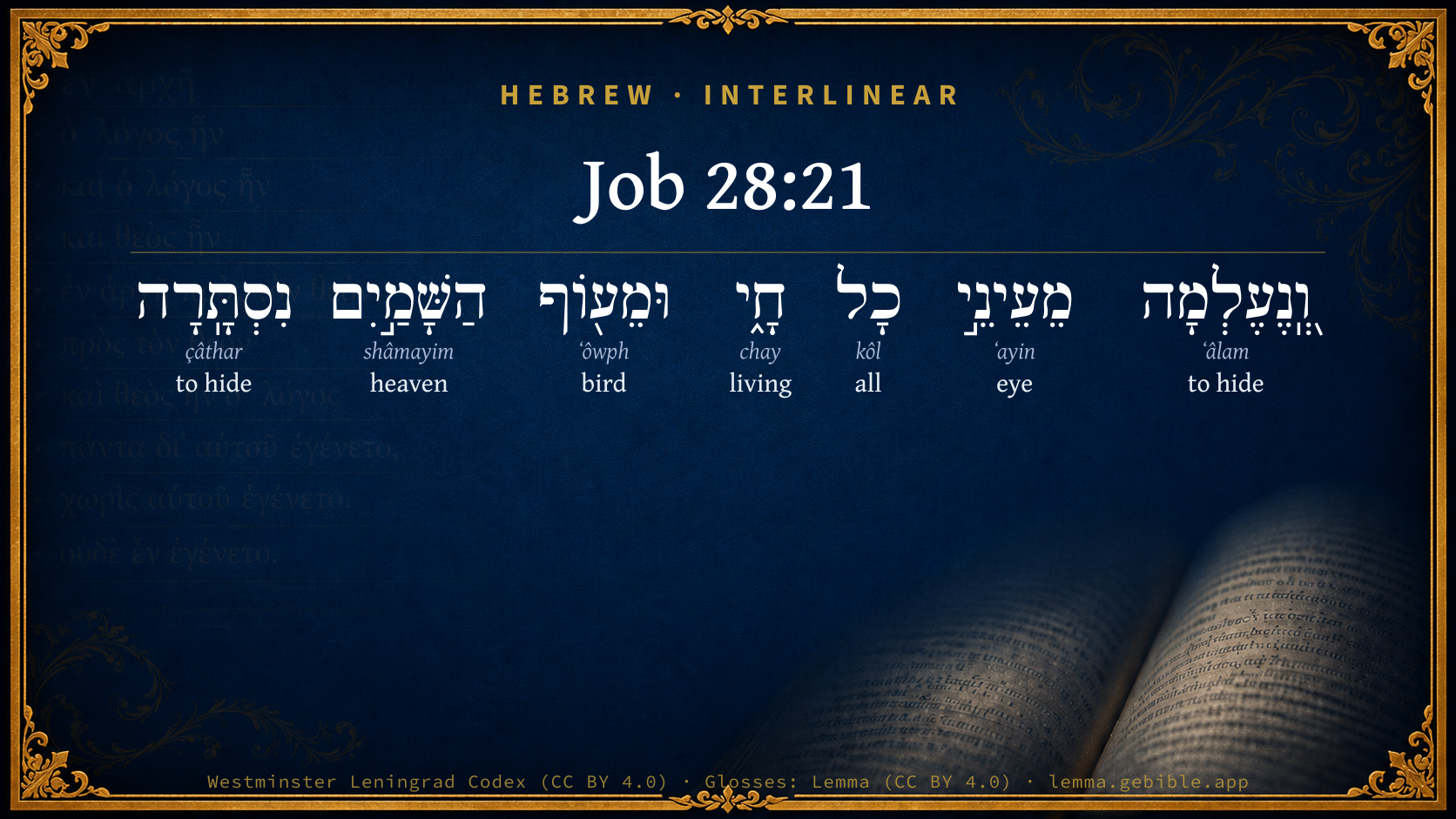
וְֽ֭נֶעֶלְמָה
ʻâlam
H5956
“and · to hide”
Conjunction + Verb, Niphal, Perfect, 3rd Person, Feminine, Singular
Part of Speech
Conjunction + Verb
Stem
Niphal
Form
Perfect
Person
3rd Person
Gender
Feminine
Number
Singular
Full BDB Definition

Origin: a primitive root

TWOT: 1629

to conceal, hide, be hidden, be concealed, be secret - (Qal) secret (participle) - (Niphal) - to be concealed - concealed, dissembler (participle) - (Hiphil) to conceal, hide - (Hithpael) to hide oneself
  1. מֵעֵינֵ֣י ʻayin H5869 “from · eyes of” Preposition + Noun, Common, Both, Dual, Construct
  2. כָל kôl H3605 “all of” Noun, Common, Masculine, Singular, Construct
  3. חָ֑י chay H2416 “living” Adjective, Adjective, Masculine, Singular, Absolute
  4. וּמֵע֖וֹף ʻôwph H5775 “and · from · bird of” Conjunction + Preposition + Noun, Common, Masculine, Singular, Construct
  5. הַשָּׁמַ֣יִם shâmayim H8064 “the · heaven(s)” Particle, Definite Article + Noun, Common, Masculine, Plural, Absolute
  6. נִסְתָּֽרָה çâthar H5641 “to hide” Verb, Niphal, Perfect, 3rd Person, Feminine, Singular

About this verse

These counts appear in no published source. They are computed here, from the morphology-tagged text and Lemma’s own curated glosses. What Lemma adds →

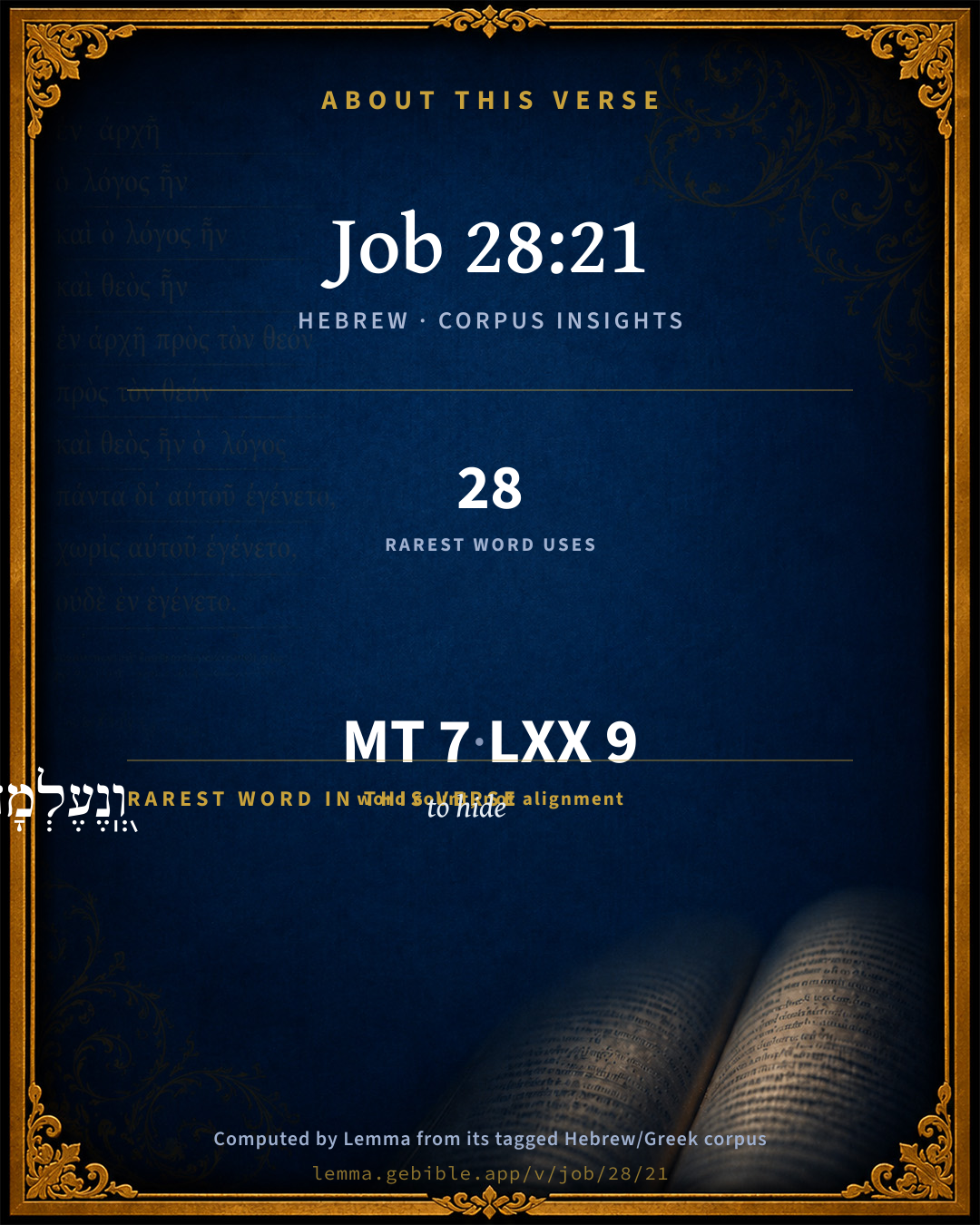
7
words
7
distinct lemmas
Wisdom
section

Shared distinctive vocabulary

וְֽ֭נֶעֶלְמָה to hide H5956 occurs in 27 verses of the Hebrew Bible. Also found in:

Grammatical profile

  • 2 verbs
  • 4 nouns
  • 1 adjective

Verb forms

  • וְֽ֭נֶעֶלְמָה Niphal · Perfect
  • נִסְתָּֽרָה Niphal · Perfect

Hebrew & Septuagint length

In English translation the verse runs 19 words from the Hebrew and 18 from the Septuagint (LXX English) — closely comparable.

A rough comparison of the two English renderings, which tokenize alike — not a word-level alignment.

Word counts can differ between the Hebrew and the Greek without any difference in meaning — e.g. the Hebrew direct-object marker אֵת has no separate Greek word, and Greek often adds the article ὁ.

In the original languages it is 7 Hebrew tokens and 9 Greek tokens — but the two are counted differently (Hebrew bundles its prefixes and suffixes into one token; the Greek is in lemma form), so that isn’t a like-for-like length.

Cross-references

6

Topical passages linked to Job 28:21 in the Treasury of Scripture Knowledge — connected by theme and wording, ordered by reader-vote popularity; previews shown in the World English Bible.

  • Psalms 49:3–4 My mouth will speak words of wisdom. My heart shall utter understanding.
  • Matthew 11:25 At that time, Jesus answered, "I thank you, Father, Lord of heaven and earth, that you hid these things from the wise and understanding, and revealed them to infants.
  • 1 Corinthians 2:7–10 But we speak God's wisdom in a mystery, the wisdom that has been hidden, which God foreordained before the worlds for our glory,
  • Colossians 2:3 in whom are all the treasures of wisdom and knowledge hidden.
  • Matthew 13:35 that it might be fulfilled which was spoken through the prophet, saying, "I will open my mouth in parables; I will utter things hidden from the foundation of the world."
  • Matthew 13:17 For most assuredly I tell you that many prophets and righteous men desired to see the things which you see, and didn't see them; and to hear the things which you hear, and didn't hear them.

Cross-references courtesy of OpenBible.info (CC BY 4.0).

Hebrew and Greek witnesses Masoretic Hebrew ↔ Greek Septuagint

The same verse in the two great witnesses to the Old Testament, shown verse-for-verse.

These are two independent witnesses, not word-aligned to each other, and the Septuagint is shown in lemma (dictionary) form.

Hebrew Job 28:21 Masoretic · Westminster Leningrad Codex

וְֽ֭נֶעֶלְמָה מֵעֵינֵ֣י כָל חָ֑י וּמֵע֖וֹף הַשָּׁמַ֣יִם נִסְתָּֽרָה

Seeing it is hidden from the eyes of all living, And kept close from the birds of the sky.

World English Bible · Public Domain

Greek LXX Job 28:21 Septuagint · lemma form

λανθάνω πᾶς ἄνθρωπος καί ἀπό πετεινόν ὁ οὐρανός κρύπτω

It has escaped the notice of every man, and has been hidden from the birds of the sky.

LXX2012 (modern English Septuagint) · Public Domain

Hebrew: Westminster Leningrad Codex (CC BY 4.0). Greek: Septuagint (public domain); English from LXX2012 (modern English Septuagint) (Public Domain). How the Septuagint differs from the Hebrew →

Commentary

Notes on Job 28:21 from classic Christian and Jewish commentators (each source and its license shown beneath its notes). The classic Christian expositions comment on the surrounding passage and are grouped to its opening verse, so a note may address several verses; the Jewish commentaries on the Tanakh (Rashi and others) are per-verse, so they appear only where the commentator wrote on this verse.

Lemma curates 59 commentaries, every one of them public domain or Creative Commons licensed, each selected and text-cleaned for this edition rather than reprinted as found. About our sources →

The Cambridge Bible for Schools and Colleges

gen. ed. J. J. S. Perowne

21. seeing it is hid] Rather simply, it is hidden. Job_28:20 as summing up Job_28:15-19 meant, thus Wisdom is nowhere to be attained; Job_28:21 proceeds, it is hidden &c.

kept close] i. e. it is concealed from, unknown to the fowls of the air (comp. Job_28:7)—no creature can attain to it.

The Cambridge Bible for Schools and Colleges (gen. ed. J. J. S. Perowne; Cambridge University Press, 1878–1918) — public domain. Text from a community e-Sword module.

Trapp's Complete Commentary

John Trapp

Job 28:21 Seeing it is hid from the eyes of all living, and kept close from the fowls of the air.

Ver. 21. Seeing it is hid from the eyes of all living] As hath been before set forth, Job 28:13. They that see most into it see but in part, and must needs say, that the greatest part of their knowledge is the least part of their ignorance, Maxima pars eorum quae scimus est minima pars eorum quae nescimus. Something they know of his revealed will, but nothing at all of his secret. Whereunto we may add, that there are many occult qualities in nature, the reason whereof the wisest men understand not.

And kept close from the fowls of the air] Which yet fly very high, and seem to touch the clouds of heaven; as the eagle, which delighteth in high flying. Some will have the angels (elsewhere set forth as winged creatures) to be here meant; who, although they stand always in God’s presence, and see much of his majesty, yet not at all nothing near, Isa 6:2-3, they cover their faces with their wings, as with a double scarf (as not able to behold his glory), and make their addresses unto him with greatest self-abasements.

John Trapp, A Commentary or Exposition upon All the Books of the Old and New Testament (1647–1656) — public domain. Text from a community e-Sword module.

Geneva Bible (1599)

Geneva Bible translators

Meaning, that there is no natural means whereby man might attain to the heavenly wisdom: which he meaneth by the souls that fly high.

Geneva Bible (1599) marginal notes — public domain. Text via Bolls.life.

Jamieson, Fausset & Brown

Robert Jamieson, A. R. Fausset & David Brown

None can tell whence or where, seeing it, &c.

fowls--The gift of divination was assigned by the heathen especially to birds. Their rapid flight heavenwards and keen sight originated the superstition. Job may allude to it. Not even the boasted divination of birds has an insight into it (Ecc 10:20). But it may merely mean, as in Job 28:7, It escapes the eye of the most keen-sighted bird.

Jamieson, Fausset & Brown — Commentary Critical and Explanatory on the Whole Bible (1871) — public domain (CC PDM 1.0). Text via the HelloAO Bible API.

John Gill's Exposition

Destruction and death say,.... Meaning the dead that are in the pit of destruction, the grave; not their dead bodies there, devoid of life and sense, and know not anything, but their souls; either the damned in hell, or the saints in heaven: the Targum is, the house of destruction, and the angel of death; or rather it regards such as are dead, who while alive had only a report of this wisdom; wherefore if their records and writings, or traditions handed down from them, are inquired into, the result of the information they will give concerning it will amount to no more than this:

we have heard the fame thereof with our ears; it has been reported to us there is such wisdom, but what it is we know not; and this is all that we can say about it.

John Gill's Exposition of the Whole Bible (1746–1763) — public domain (CC PDM 1.0). Text via the HelloAO Bible API.

Albert Barnes' Notes on the Bible

It is hid from the eyes of all living - That is, of all people, and of all animals. Man has not found it by the most sagacious of all his discoveries, and the keenest vision of beasts and fowls has not traced it out.

And kept close - Hebrew “concealed.”

From the fowls of the air - Compare the notes at Job 28:7. Umbreit remarks, on this passage, that there is attributed to the fowls in Oriental countries a deep knowledge, and an extraordinary gift of divination, and that they appear as the interpreters and confidants of the gods. One cannot but reflect, says he, on the personification of the good spirit of Ormuzd through the fowls, according to the doctrine of the Persians (Compare Creutzer’s Symbolik Thes 1. s. 723); upon the ancient fowlking (Vogelkonig) Simurg upon the mountain Kap, representing the highest wisdom of life; upon the discourses of the fowls of the great mystic poet of the Persians, Ferideddin Attar, etc. Among the ancient Greeks and Romans, also, a considerable part of their divinations consisted in observing the flight of birds, as if they were endowed with intelligence, and indicated coming events by the course which they took; compare also, Ecc 10:20, where wisdom or intelligence is ascribed to the birds of the air. “Curse not the king, no, not in thy thought; and curse not the rich in thy bed-chamber: for a bird of the air shall carry the voice, and that which hath wings shall tell the matter.”

Albert Barnes' Notes on the Bible (1834–1885) — public domain. Text from a community e-Sword/MySword module.

Matthew Poole's English Annotations

Of all living; of all men that live upon the earth.

From the fowls of the air: though they fly high, and can see far and well, yet they cannot discern this: men of the most raised understandings cannot discover it. It is to be found no where in this visible world, neither in the upper nor lower parts of it.

Matthew Poole's English Annotations on the Holy Bible (1683–1685) — public domain. Text from a community e-Sword/MySword module.

Whedon's Commentary on the Bible

Daniel D. Whedon

21. The fowls of the air — To their acuteness of vision and wondrous habits of migration may be due the widespread ascription to them of superior wisdom. In all their wide range of flight and vision they have never seen Wisdom’s abode.

Daniel D. Whedon (gen. ed.), Commentary on the Old and New Testaments (1874–1909) — public domain. Text from a community e-Sword module.

The Pulpit Commentary

Seeing it is hid from the eyes of all living. Man cannot see it, because it is immaterial, but he cannot even conceive of it, because its nature transcends him. And kept close from the fowls of the air. (comp. ver. 7). The sight of birds is far keener than that of man; but even birds cannot detect where wisdom is.

The Pulpit Commentary (1880–1919), ed. H.D.M. Spence-Jones & Joseph S. Exell — public domain. Text from a community e-Sword module.

John Wesley's Explanatory Notes

Hid - The line and plummet of human reason, can never fathom the abyss of the Divine counsels. Who can account for the maxims, measures and methods of God's government? Let us then be content, not to know the future events of providence, 'till time discover them: and not to know the secret reasons of providence, 'till eternity brings them to light.

John Wesley, Explanatory Notes Upon the Whole Bible (1754–1765) — public domain. Text via the GEBible commentary corpus.

Keil & Delitzsch

C. F. Keil & F. Delitzsch

21 It is veiled from the eyes of all living,

And concealed from the fowls of heaven.

22 Destruction and death say:

With our ears we heard a report of it. -

23 Elohim understandeth the way to it,

And He - He knoweth its place.

24 For He looketh to the ends of the earth,

Under the whole heaven He seeth.

No living created being (כּל־חי, as Job 12:10; Job 30:23) is able to answer the question; even the birds that fly aloft, that have keener and farther-seeing eyes than man, can give us no information concerning wisdom; and the world at least proclaims its existence in a rich variety of its operations, but in the realm of Abaddon and of death below (comp. the combination שׁאול ואבדון, Pro 15:11, ᾅδου καὶ τοῦ θανάτου, Rev 1:18) it is known only by an indistinct hearsay, and from confused impressions. Therefore: no creature, whether in the realm of the living or the dead, can help us to get wisdom. There is but One who possesses a perfect knowledge concerning wisdom, namely Elohim, whose gave extends to the ends of the earth, and who sees under the whole heaven, i.e., is everywhere present (תּחת, definition of place, not equivalent to אשׁר תּחת; comp. on Job 24:9), who therefore, after the removal of everything earthly (sub-celestial), alone remains. And why should He with His knowledge, which embraces everything, not also know the way and place of wisdom? Wisdom is indeed the ideal, according to which He has created the world.

Keil & Delitzsch — Biblical Commentary on the Old Testament (1861–1891) — public domain (CC PDM 1.0). Text via the HelloAO Bible API. (Old Testament only.)

Rashi

Rabbi Shlomo Yitzchaki (Rashi)

and from the winged creatures of the heavens The angels who fly.

Rashi on the Tanakh — English translations: “The Judaica Press complete Tanach with Rashi, translated by A. J. Rosenberg” (CC BY 4.0); “Pentateuch with Rashi's commentary by M. Rosenbaum and A.M. Silbermann, 1929-1934” (public domain); “The Metsudah Tanach series, Lakewood, N.J” (CC BY 4.0); and “The Book of Joshua, Metsudah Publications, 1997” (CC BY 4.0). Text via Sefaria.

Lesson kit

Teaching starters — assembled from the data on this page, not authored interpretation. Every prompt links to the verse data it draws on. Edit before teaching.

Job, in the Wisdom, opens this verse with 7 words (7 distinct Hebrew lemmas). Its most distinctive word is ʻâlam (“to hide”). A historical commentator’s framing appears above. Read the whole chapter for the surrounding context.

Discussion questions

  1. How does “to hide” (ʻâlam) shape what this verse is saying?
  2. Leviticus 4:13 shares the word «to hide» with this verse. How do the two illuminate each other?
  3. The translations on this page render this verse differently — a whole-verse word diff, not a word-by-word alignment. What might account for the different wordings?
  4. The verb «וְֽ֭נֶעֶלְמָה» is Niphal Perfect. How does its form color the action?
  5. Reading how The Cambridge Bible for Schools and Colleges and Trapp's Complete Commentary read this verse, where do the two commentators agree and where do they part?

Things to notice

Reading settings

Reading text

Shown beneath each verse's original-language words.

Old Testament
Old Testament edition

Read the OT as the Masoretic Hebrew (MT) or the Greek Septuagint (LXX).

English shown for the Greek Septuagint (in the Hebrew ↔ Greek comparison).

Comparing translations? Open the Compare panel on any verse page to stack up to four side by side.