
Psalms 50:11

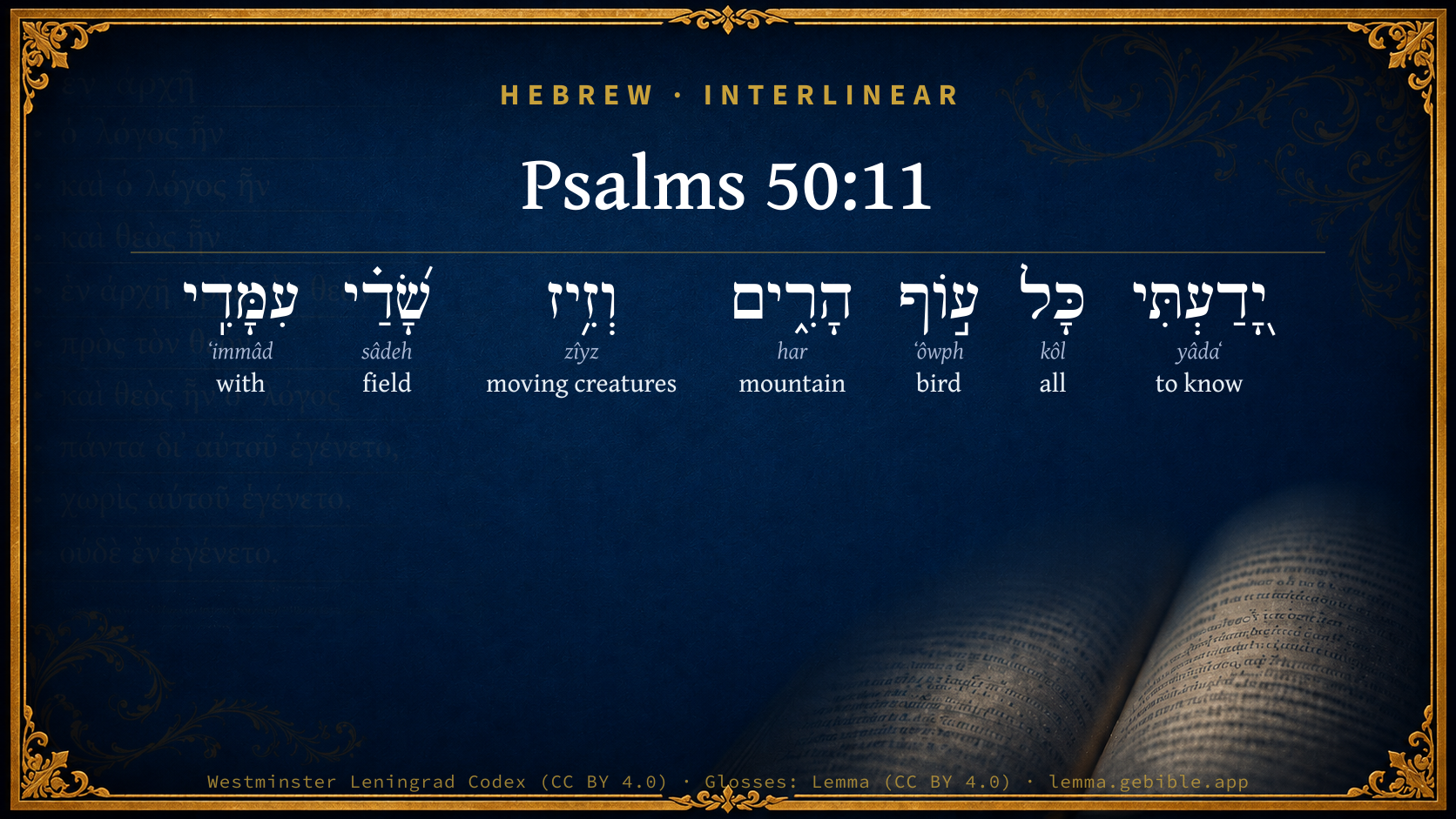
Hebrew (Westminster Leningrad Codex) Psalms 50:11 appears in the Hebrew Old Testament. The text above is from the Westminster Leningrad Codex. Each word links to its Strong’s number, a concise gloss, and parsing drawn from the Open Scriptures Hebrew Bible morphology. Click any word for its full Brown-Driver-Briggs (BDB) entry.
Download image
Cite this verse

Psalms 50:11 (World English Bible). Public Domain. Lemma interlinear Bible study tool, https://lemma.gebible.app/v/psalms/50/11.

Show BibTeX & RIS
BibTeX
RIS
English Translation
I know all the birds of the mountains. The wild animals of the field are mine.
World English Bible · Public Domain
Highlights
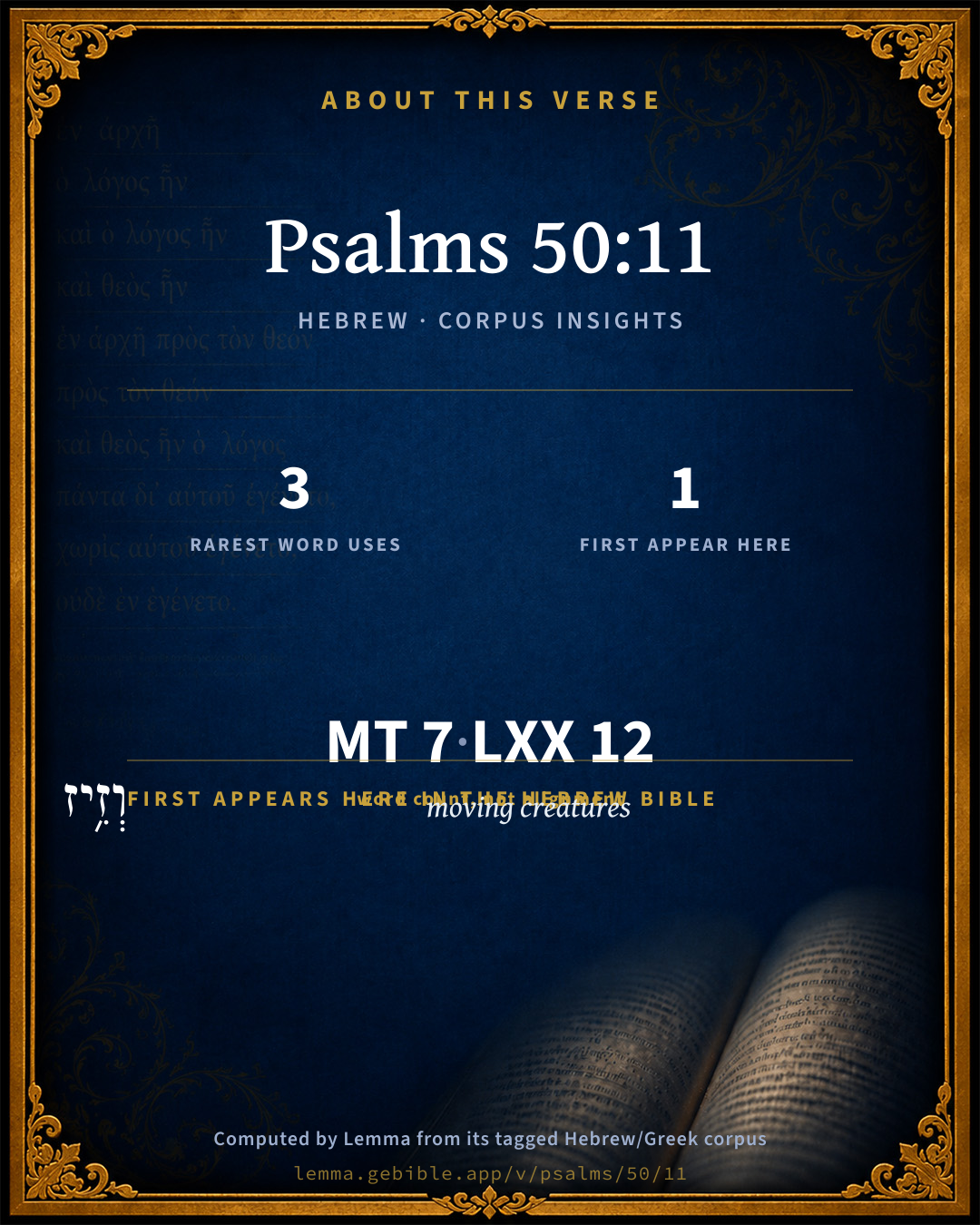
  • 1 first appearance in the Hebrew Bible
Full analysis ↓
Download a study sheet

One document with this verse’s original text, its word-by-word gloss line, the meaning frame, cross-references with their text, attributed commentary, and full source and license credits — printable, and it pastes into notes with its structure intact.

This verse Autodidact and up

Study sheet (.html) Plain text (.txt)

A passage Seminary Student

Up to 50 verses in one chapter. A passage sheet keeps up to 6 commentary sources and 12 cross-references per verse, in the order this page ranks them, and says so on the sheet whenever that leaves anything out. Ask for a single verse and you get the Autodidact verse sheet above.

Everything on this page stays free to read, with no account — the sheet is a download of what is already on screen, not access to it.

Want to remove ads? Support Godless Engineer
Compare translations 3

The same verse in 3 English versions, stacked beneath the original-language interlinear above. Click any original word for its lexicon entry.

Each is an independent rendering of the whole verse — the interlinear is not word-aligned to these translations.

Highlighted words mark where these versions differ — a whole-verse word diff, not a word-by-word alignment.

  • World English Bible Public Domain
    I know all the birds of the mountains. The wild animals of the field are mine.
  • King James Version Public Domain
    I know all the fowls of the mountains: and the wild beasts of the field are mine.
  • unfoldingWord Literal Text CC BY-SA 4.0
    I know all the birds of the mountains, and the creature of the field with me.

unfoldingWord Literal Text — © unfoldingWord, licensed CC BY-SA 4.0. Word-aligned USFM3 via Door43 (git.door43.org/unfoldingWord/en_ult).

Versions to compare (up to 4)

3 of 4 selected

Show all 18 translations

Every available English version of this verse, each an independent rendering of the whole verse.

  • World English Bible Public Domain
    I know all the birds of the mountains. The wild animals of the field are mine.
  • Berean Standard Bible Public Domain
    I know every bird in the mountains, and the creatures of the field are Mine.
  • Majority Standard Bible Public Domain
    I know every bird in the mountains, and the creatures of the field are Mine.
  • King James Version Public Domain
    I know all the fowls of the mountains: and the wild beasts of the field are mine.
  • American Standard Version (1901) Public Domain
    I know all the birds of the mountains; And the wild beasts of the field are mine.
  • Revised Version (1885) Public Domain
    I know all the fowls of the mountains: and the wild beasts of the field are mine.
  • Geneva Bible (1599) Public Domain
    I knowe all the foules on the mountaines: and the wilde beastes of the fielde are mine.
  • Douay-Rheims (1899) Public Domain
    I know all the fowls of the air: and with me is the beauty of the field.
  • Young's Literal Translation Public Domain
    I have known every fowl of the mountains, And the wild beast of the field `is' with Me.
  • Literal Standard Version CC BY-SA 4.0
    I have known every bird of the mountains, || And the wild beast of the field [is] with Me.
  • Unlocked Literal Bible CC BY-SA 4.0
    I know all the birds of the mountains, and the wild beasts of the field are mine.
  • unfoldingWord Literal Text CC BY-SA 4.0
    I know all the birds of the mountains, and the creature of the field with me.
  • Darby Bible Public Domain
    I know all the fowl of the mountains, and the roaming creatures of the field are mine:
  • World Messianic Bible Public Domain
    I know all the birds of the mountains. The wild animals of the field are mine.
  • Webster's Bible Public Domain
    I know all the fowls of the mountains: and the wild beasts of the field are mine.
  • Free Bible Version CC BY-SA 4.0
    I know every bird of the mountains; all living things in the fields are mine.
  • Bible in Basic English Public Domain
    I see all the birds of the mountains, and the beasts of the field are mine.
  • JPS Tanakh (1917) Public Domain
    I know all the fowls of the mountains; and the wild beasts of the field are Mine.

Literal Standard Version (2020), Covenant Press — licensed CC BY-SA 4.0. Text via the HelloAO Bible API (eBible.org). Unlocked Literal Bible (unfoldingWord) — licensed CC BY-SA 4.0. Text via the HelloAO Bible API (eBible.org). unfoldingWord Literal Text — © unfoldingWord, licensed CC BY-SA 4.0. Word-aligned USFM3 via Door43 (git.door43.org/unfoldingWord/en_ult). Free Bible Version, Dr. Jonathan Gallagher — licensed CC BY-SA 4.0. Text via the HelloAO Bible API (eBible.org).

Word by word

More ways to search: Search by grammar → Find every occurrence → Compare this word →

Practice this passage: Drill this verse → Learn its vocabulary →

About this verse

These counts appear in no published source. They are computed here, from the morphology-tagged text and Lemma’s own curated glosses. What Lemma adds →

7
words
7
distinct lemmas
Wisdom
section

Notable vocabulary

The rarest word here is וְזִ֥יז moving creatures H2123 — appearing just 3 times in the whole Hebrew Bible.

First appearance in Scripture

This word makes its first canonical appearance in the Hebrew Bible here:

  • וְזִ֥יז moving creatures H2123

Shared distinctive vocabulary

וְזִ֥יז moving creatures H2123 occurs in 3 verses of the Hebrew Bible. Also found in:

Grammatical profile

  • 1 verb
  • 5 nouns
  • 1 preposition

Verb forms

  • יָ֭דַעְתִּי Qal · Perfect

Hebrew & Septuagint length

In English translation the verse runs 16 words from the Hebrew and 16 from the Septuagint (LXX English) — the same length.

A rough comparison of the two English renderings, which tokenize alike — not a word-level alignment.

Word counts can differ between the Hebrew and the Greek without any difference in meaning — e.g. the Hebrew direct-object marker אֵת has no separate Greek word, and Greek often adds the article ὁ.

In the original languages it is 7 Hebrew tokens and 12 Greek tokens — but the two are counted differently (Hebrew bundles its prefixes and suffixes into one token; the Greek is in lemma form), so that isn’t a like-for-like length.

Cross-references

10

Topical passages linked to Psalms 50:11 in the Treasury of Scripture Knowledge — connected by theme and wording, ordered by reader-vote popularity; previews shown in the World English Bible.

  • Matthew 6:26 See the birds of the sky, that they don't sow, neither do they reap, nor gather into barns. Your heavenly Father feeds them. Aren't you of much more value than they?
  • Genesis 1:20–22 God said, "Let the waters swarm with swarms of living creatures, and let birds fly above the earth in the open expanse of sky."
  • Job 39:26–30 "Is it by your wisdom that the hawk soars, And stretches her wings toward the south?
  • Luke 12:24 Consider the ravens: they don't sow, they don't reap, they have no warehouse or barn, and God feeds them. How much more valuable are you than birds!
  • Job 39:13–18 "The wings of the ostrich wave proudly; But are they the feathers and plumage of love?
  • Psalms 104:12 The birds of the sky nest by them. They sing among the branches.
  • Psalms 147:9 He provides food for the cattle, And for the young ravens when they call.
  • Isaiah 56:9 All you animals of the field, come to devour, [yes], all you animals in the forest.
  • Ezekiel 14:15–16 If I cause evil animals to pass through the land, and they ravage it, and it be made desolate, so that no man may pass through because of the animals;
  • Matthew 10:29–31 "Aren't two sparrows sold for an assarion? Not one of them falls on the ground apart from your Father's will,

Cross-references courtesy of OpenBible.info (CC BY 4.0).

Hebrew and Greek witnesses Masoretic Hebrew ↔ Greek Septuagint

The same verse in the two great witnesses to the Old Testament, shown verse-for-verse.

You’re reading Greek Psalm 49 (Hebrew Psalm 50). The Septuagint counts the superscription, so verse numbers can differ from the Hebrew — chapter-level alignment, not verse-by-verse. Numbering follows Rahlfs.

These are two independent witnesses, not word-aligned to each other, and the Septuagint is shown in lemma (dictionary) form.

Hebrew Psalms 50:11 Masoretic · Westminster Leningrad Codex

יָ֭דַעְתִּי כָּל ע֣וֹף הָרִ֑ים וְזִ֥יז שָׂ֝דַ֗י עִמָּדִֽי

I know all the birds of the mountains. The wild animals of the field are mine.

World English Bible · Public Domain

Greek LXX Greek Psalm 49:11 Septuagint · lemma form

γιγνώσκω πᾶς ὁ πετεινόν ὁ οὐρανός καί ὡραιότης ἀγρός μετά ἐγώ εἰμί

I know all the birds of the sky; and the beauty of the field is mine.

LXX2012 (modern English Septuagint) · Public Domain

Hebrew: Westminster Leningrad Codex (CC BY 4.0). Greek: Septuagint (public domain); English from LXX2012 (modern English Septuagint) (Public Domain). How the Septuagint differs from the Hebrew →

Commentary

Notes on Psalms 50:11 from classic Christian and Jewish commentators (each source and its license shown beneath its notes). The classic Christian expositions comment on the surrounding passage and are grouped to its opening verse, so a note may address several verses; the Jewish commentaries on the Tanakh (Rashi and others) are per-verse, so they appear only where the commentator wrote on this verse.

Lemma curates 59 commentaries, every one of them public domain or Creative Commons licensed, each selected and text-cleaned for this edition rather than reprinted as found. About our sources →

Trapp's Complete Commentary

John Trapp

Psa 50:11 I know all the fowls of the mountains: and the wild beasts of the field [are] mine.

Ver. 11. I know all the fowls of the mountains] i.e. In numerato habeo, saith Vatablus, they are always before me ready at my service.

And the wild beasts of the field] R. Solomon interpreteth it reptiles, the creeping things of the field; others, copiam volucrum in vallibus, the abundance of birds that are up and down the fields and valleys.

John Trapp, A Commentary or Exposition upon All the Books of the Old and New Testament (1647–1656) — public domain. Text from a community e-Sword module.

The Treasury of David

Charles H. Spurgeon

Ver. 11. I know all the fowls of the mountain. All the winged creatures are under my inspection and near my hand; what then can be the value of your pairs of turtledoves, and your two young pigeons? The great Lord not only feeds all his creatures, but is well acquainted with each one; how wondrous is this knowledge! And the wild beasts of the fields are mine. The whole population moving over the plain belongs to me; why then should I seek you beeves and rams? In me all things live and move; how mad are you to suppose that I desire your living things! A spiritual God demands other life than that which is seen in animals; he looks for spiritual sacrifice; for the love, the trust, the praise, the life of your hearts.

Ver. 11-12. We show our scorn of God's sufficiency, by secret thoughts of meriting from him by any religious act, as though God could be indebted to us, and obliged by us. As though our devotions could bring a blessedness to God more than he essentially hath; when indeed "our goodness extends not to him." Ps 16:2. Our services to God are rather services to ourselves, and bring a happiness to us, not to God. This secret opinion of merit (though disputed among the Papists, yet) is natural to man; and this secret self pleasing, when we have performed any duty, and upon that account expect some fair compensation from God, as having been profitable to him; God intimates this: "The wild beasts of the field are mine. If I were hungry, I would not tell thee; for the world is mine, and the fulness thereof." He implies, that they wronged his infinite fulness, by thinking that he stood in need of their sacrifices and services, and that he was beholden to them for their adoration of him. All merit implies a moral or natural insufficiency in the person of whom we merit, and our doing something for him, which he could not, or at least so well do for himself. It is implied in our murmuring at God's dealing with us as a course of cross providences, wherein men think they have deserved better at the hands of God by their service, than to be cast aside and degraded by him. In our prosperity we are apt to have secret thoughts that our enjoyments were the debts God owes us, rather than gifts freely bestowed upon us. Hence it is that men are more unwilling to part with their righteousness than with their sins, and are apt to challenge salvation as a due, rather than beg it as an act of grace. Stephen Charnock.

Ver. 11-12. See Psalms on "Ps 50:11" for further information.

Charles H. Spurgeon's The Treasury of David (1869–1885) — public domain. Psalms only. Text from a community e-Sword/MySword module.

Ellicott's Commentary for English Readers

(11) Wild beasts.—Literally, that which moveth. (Comp. Psa_80:13.)

A Bible Commentary for English Readers, edited by Charles John Ellicott (1878–1897) — public domain. Text from a community e-Sword module.

The Cambridge Bible for Schools and Colleges

gen. ed. J. J. S. Perowne

11. The wild beasts of the field] A peculiar phrase, found only in another Asaphite Psalm (Psa_80:13), meaning probably all that moveth in the field, including the ‘creeping thing’ (Gen_1:24 f).

are mine] Lit., are with me, i.e. are in my sight (P.B.V.), or, in my mind (R.V. marg.).

12f. If God had need of sustenance, He would not be dependent upon man for it: but a spiritual Being needs no material support.

The Cambridge Bible for Schools and Colleges (gen. ed. J. J. S. Perowne; Cambridge University Press, 1878–1918) — public domain. Text from a community e-Sword module.

John Gill's Exposition

I know all the fowls of the mountains,.... God not only knows them, but takes care of them; not a sparrow fails to the ground without his knowledge, and all the fowls of the air are fed by him, Mat 10:29; and therefore needed not their turtledoves and young pigeons, which were the only fowls used in sacrifice;

and the wild beasts of the field are mine; which are mentioned in opposition to domestic ones, such as they had in their houses or folds, Psa 50:9.

John Gill's Exposition of the Whole Bible (1746–1763) — public domain (CC PDM 1.0). Text via the HelloAO Bible API.

Albert Barnes' Notes on the Bible

I know all the fowls of the mountains - That is, I am fully acquainted with their numbers; their nature; their habits; their residence. I have such a knowledge of them that I could appropriate them to my own use if I were in need of them. I am not, therefore, dependent on people to offer them, for I can use them as I please.

And the wild beasts of the field are mine - Margin, “with me.” That is, they are before me. They are never out of my presence. At any time, therefore, I could use them as I might need them. The word rendered “wild beasts” - זיז zı̂yz - means any moving thing; and the idea here is, whatever moves in the field, or roams abroad. Everything is his - whether on the mountains, in the forest, or in the cultivated field.

Albert Barnes' Notes on the Bible (1834–1885) — public domain. Text from a community e-Sword/MySword module.

Matthew Poole's English Annotations

I know where they are, and whence I can easily fetch them when I think good.

The fowls of the mountains; not only tame and domestic fowls, but even such as are wild and fly up and down upon mountains; which though out of man’s reach, are at God’s command.

Matthew Poole's English Annotations on the Holy Bible (1683–1685) — public domain. Text from a community e-Sword/MySword module.

The Pulpit Commentary

I know all the fowls of the mountains, and the wild beasts of the field are mine; literally, are with me. All creation is God"s, known to him, and owned by him, to be dealt with at his pleasure. How, then, should he need gifts from men?

The Pulpit Commentary (1880–1919), ed. H.D.M. Spence-Jones & Joseph S. Exell — public domain. Text from a community e-Sword module.

John Wesley's Explanatory Notes

The fowls - Such as are wild and fly up and down upon mountains.

John Wesley, Explanatory Notes Upon the Whole Bible (1754–1765) — public domain. Text via the GEBible commentary corpus.

Rashi

Rabbi Shlomo Yitzchaki (Rashi)

and the creeping things of the field are with me Heb. זיז, the creeping things of the field. They are called זִיז because they move (זזים) from place to place; esmoubemant in Old French, movement.

with Me I know them all.

Rashi on the Tanakh — English translations: “The Judaica Press complete Tanach with Rashi, translated by A. J. Rosenberg” (CC BY 4.0); “Pentateuch with Rashi's commentary by M. Rosenbaum and A.M. Silbermann, 1929-1934” (public domain); “The Metsudah Tanach series, Lakewood, N.J” (CC BY 4.0); and “The Book of Joshua, Metsudah Publications, 1997” (CC BY 4.0). Text via Sefaria.

Lesson kit

Teaching starters — assembled from the data on this page, not authored interpretation. Every prompt links to the verse data it draws on. Edit before teaching.

Psalms, in the Wisdom, opens this verse with 7 words (7 distinct Hebrew lemmas). Its most distinctive word is zîyz (“moving creatures”). A historical commentator’s framing appears above. Read the whole chapter for the surrounding context.

Discussion questions

  1. How does “moving creatures” (zîyz) shape what this verse is saying?
  2. This is the first place “moving creatures” appears in Scripture (first appears here). What does its debut here establish?
  3. How does Psalms 80:13, which shares the word «moving creatures», read alongside this verse?
  4. These translations render this verse differently; the difference is in the English rendering, not the original. What questions does that raise?
  5. «יָ֭דַעְתִּי» is a Qal Perfect verb. How does that grammatical form shape the action described?
  6. Compare how Trapp's Complete Commentary and The Treasury of David read this verse. Where do they agree or differ?

Things to notice

Reading settings

Reading text

Shown beneath each verse's original-language words.

Old Testament
Old Testament edition

Read the OT as the Masoretic Hebrew (MT) or the Greek Septuagint (LXX).

English shown for the Greek Septuagint (in the Hebrew ↔ Greek comparison).

Comparing translations? Open the Compare panel on any verse page to stack up to four side by side.