Psalms 79:2

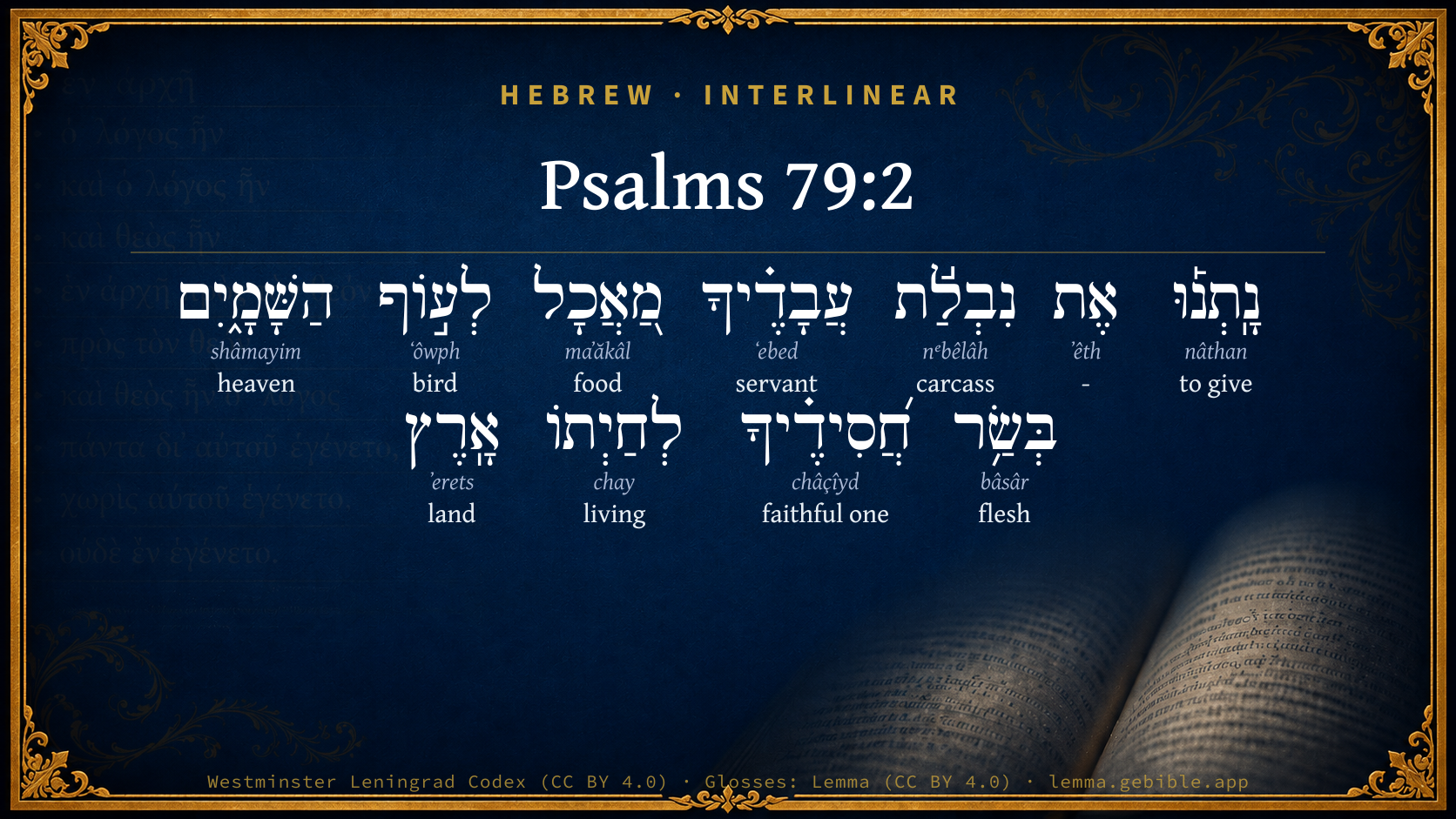
Hebrew (Westminster Leningrad Codex) Psalms 79:2 appears in the Hebrew Old Testament. The text above is from the Westminster Leningrad Codex. Each word links to its Strong’s number, a concise gloss, and parsing drawn from the Open Scriptures Hebrew Bible morphology. Click any word for its full Brown-Driver-Briggs (BDB) entry.
Download image
Cite this verse

Psalms 79:2 (World English Bible). Public Domain. Lemma interlinear Bible study tool, https://lemma.gebible.app/v/psalms/79/2.

Show BibTeX & RIS
BibTeX
RIS
English Translation
They have given the dead bodies of your servants to be food for the birds of the sky, The flesh of your saints to the animals of the earth.
World English Bible · Public Domain
Download a study sheet

One document with this verse’s original text, its word-by-word gloss line, the meaning frame, cross-references with their text, attributed commentary, and full source and license credits — printable, and it pastes into notes with its structure intact.

This verse Autodidact and up

Study sheet (.html) Plain text (.txt)

A passage Seminary Student

Up to 50 verses in one chapter. A passage sheet keeps up to 6 commentary sources and 12 cross-references per verse, in the order this page ranks them, and says so on the sheet whenever that leaves anything out. Ask for a single verse and you get the Autodidact verse sheet above.

Everything on this page stays free to read, with no account — the sheet is a download of what is already on screen, not access to it.

Want to remove ads? Support Godless Engineer
Compare translations 3

The same verse in 3 English versions, stacked beneath the original-language interlinear above. Click any original word for its lexicon entry.

Each is an independent rendering of the whole verse — the interlinear is not word-aligned to these translations.

Highlighted words mark where these versions differ — a whole-verse word diff, not a word-by-word alignment.

  • World English Bible Public Domain
    They have given the dead bodies of your servants to be food for the birds of the sky, The flesh of your saints to the animals of the earth.
  • King James Version Public Domain
    The dead bodies of thy servants have they given to be meat unto the fowls of the heaven, the flesh of thy saints unto the beasts of the earth.
  • unfoldingWord Literal Text CC BY-SA 4.0
    They have given the corpse of your servants food to the bird of the heavens, the flesh of your faithful to the beast of the earth.

unfoldingWord Literal Text — © unfoldingWord, licensed CC BY-SA 4.0. Word-aligned USFM3 via Door43 (git.door43.org/unfoldingWord/en_ult).

Versions to compare (up to 4)

3 of 4 selected

Show all 18 translations

Every available English version of this verse, each an independent rendering of the whole verse.

  • World English Bible Public Domain
    They have given the dead bodies of your servants to be food for the birds of the sky, The flesh of your saints to the animals of the earth.
  • Berean Standard Bible Public Domain
    They have given the corpses of Your servants as food to the birds of the air, the flesh of Your saints to the beasts of the earth.
  • Majority Standard Bible Public Domain
    They have given the corpses of Your servants as food to the birds of the air, the flesh of Your saints to the beasts of the earth.
  • King James Version Public Domain
    The dead bodies of thy servants have they given to be meat unto the fowls of the heaven, the flesh of thy saints unto the beasts of the earth.
  • American Standard Version (1901) Public Domain
    The dead bodies of thy servants have they given to be food unto the birds of the heavens, The flesh of thy saints unto the beasts of the earth.
  • Revised Version (1885) Public Domain
    The dead bodies of thy servants have they given to be meat unto the fowls of the heaven, the flesh of thy saints unto the beasts of the earth.
  • Geneva Bible (1599) Public Domain
    The dead bodies of thy seruats haue they giuen to be meat vnto foules of ye heauen: and the flesh of thy Saintes vnto the beastes of the earth.
  • Douay-Rheims (1899) Public Domain
    They have given the dead bodies of thy servants to be meat for the fowls of the air: the flesh of thy saints for the beasts of the earth.
  • Young's Literal Translation Public Domain
    They gave the dead bodies of Thy servants Food for the fowls of the heavens, The flesh of Thy saints For the wild beast of the earth.
  • Literal Standard Version CC BY-SA 4.0
    They gave the dead bodies of Your servants || [As] food for the birds of the heavens, || The flesh of Your saints || For the wild beast of the earth.
  • Unlocked Literal Bible CC BY-SA 4.0
    They have given the dead bodies of your servants as food to the birds of the skies, the bodies of your faithful people to the beasts of the earth.
  • unfoldingWord Literal Text CC BY-SA 4.0
    They have given the corpse of your servants food to the bird of the heavens, the flesh of your faithful to the beast of the earth.
  • Darby Bible Public Domain
    The dead bodies of thy servants have they given to be meat unto the fowl of the heavens, the flesh of thy saints unto the beasts of the earth:
  • World Messianic Bible Public Domain
    They have given the dead bodies of your servants to be food for the birds of the sky, the flesh of your holy ones to the animals of the earth.
  • Webster's Bible Public Domain
    The dead bodies of thy servants have they given to be food to the fowls of the heaven, the flesh of thy saints, to the beasts of the earth.
  • Free Bible Version CC BY-SA 4.0
    They have given the dead bodies of your servants as food to the birds of the air, the flesh of your faithful people to the beasts of the earth.
  • Bible in Basic English Public Domain
    They have given the bodies of your servants as food to the birds of the air, and the flesh of your saints to the beasts of the earth.
  • JPS Tanakh (1917) Public Domain
    They have given the dead bodies of Thy servants to be food unto the fowls of the heaven, the flesh of Thy saints unto the beasts of the earth.

Literal Standard Version (2020), Covenant Press — licensed CC BY-SA 4.0. Text via the HelloAO Bible API (eBible.org). Unlocked Literal Bible (unfoldingWord) — licensed CC BY-SA 4.0. Text via the HelloAO Bible API (eBible.org). unfoldingWord Literal Text — © unfoldingWord, licensed CC BY-SA 4.0. Word-aligned USFM3 via Door43 (git.door43.org/unfoldingWord/en_ult). Free Bible Version, Dr. Jonathan Gallagher — licensed CC BY-SA 4.0. Text via the HelloAO Bible API (eBible.org).

Word by word

More ways to search: Search by grammar → Find every occurrence → Compare this word →

Practice this passage: Drill this verse → Learn its vocabulary →

מַ֭אֲכָל
maʼăkâl
H3978
“food”
Noun, Common, Masculine, Singular, Absolute
Part of Speech
Noun
Type
Common
Gender
Masculine
Number
Singular
State
Absolute
Full BDB Definition

Origin: from H398

TWOT: 85d

food, fruit, meat
  1. נָֽתְנ֡וּ nâthan H5414 “to give” Verb, Qal, Perfect, 3rd Person, Common, Plural
  2. אֶת ʼêth H853 “-” Particle, Direct Object
  3. נִבְלַ֬ת nᵉbêlâh H5038 “carcass of” Noun, Common, Feminine, Singular, Construct
  4. עֲבָדֶ֗יךָ ʻebed H5650 “servants · your” Noun, Common, Masculine, Plural, Construct + Suffix, Personal, 2nd Person, Masculine, Singular
  5. לְע֣וֹף ʻôwph H5775 “to/for · bird of” Preposition + Noun, Common, Masculine, Singular, Construct
  6. הַשָּׁמָ֑יִם shâmayim H8064 “the · heaven(s)” Particle, Definite Article + Noun, Common, Masculine, Plural, Absolute
  7. בְּשַׂ֥ר bâsâr H1320 “flesh of” Noun, Common, Masculine, Singular, Construct
  8. חֲ֝סִידֶ֗יךָ châçîyd H2623 “faithful one · your” Adjective, Adjective, Masculine, Plural, Construct + Suffix, Personal, 2nd Person, Masculine, Singular
  9. לְחַיְתוֹ chay H2416 “to/for · living · his” Preposition + Noun, Common, Feminine, Singular, Construct + Suffix, Personal, 3rd Person, Masculine, Singular
  10. אָֽרֶץ ʼerets H776 “land” Noun, Common, Both, Singular, Absolute

About this verse

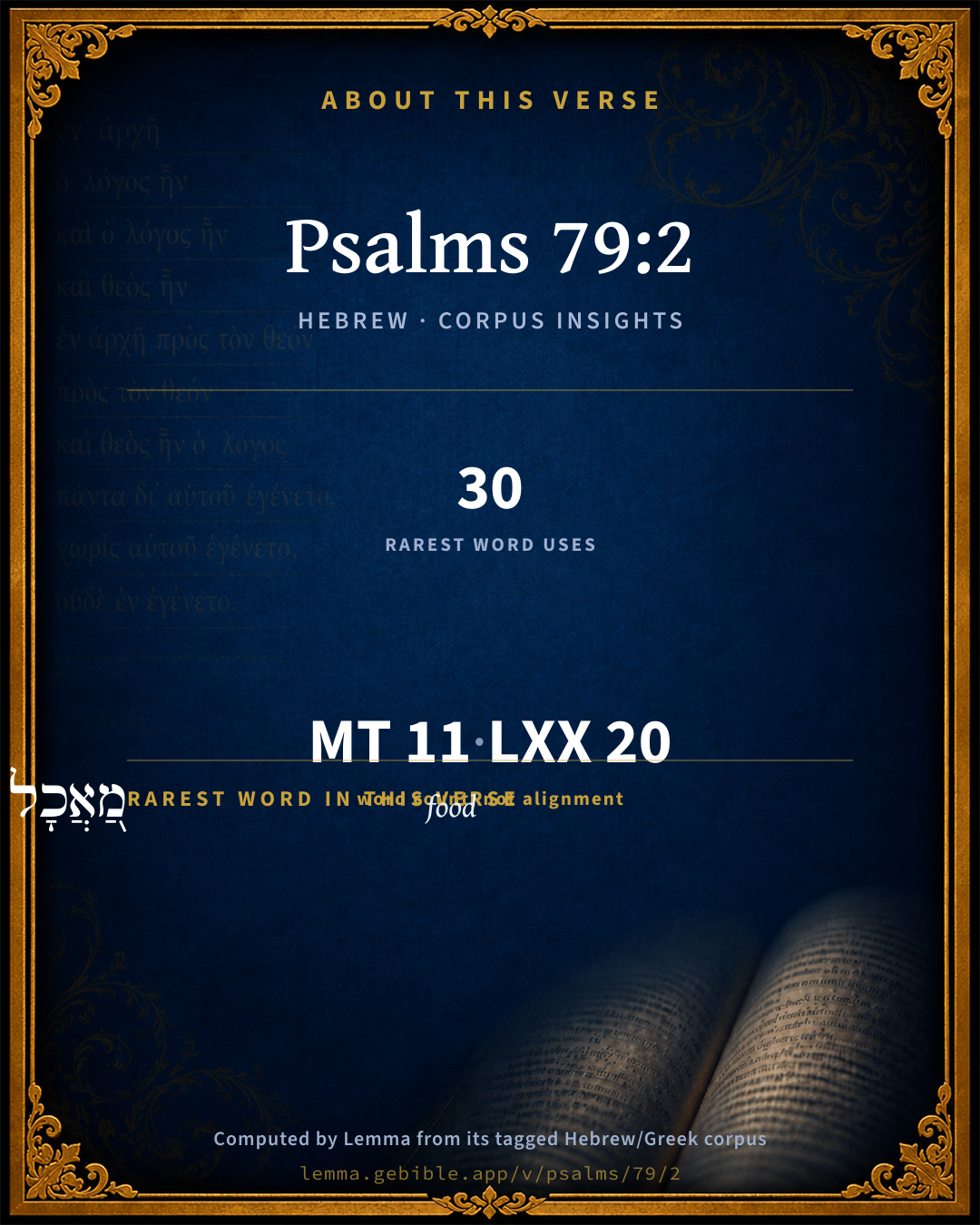
These counts appear in no published source. They are computed here, from the morphology-tagged text and Lemma’s own curated glosses. What Lemma adds →

11
words
11
distinct lemmas
Wisdom
section

Shared distinctive vocabulary

מַ֭אֲכָל food H3978 occurs in 29 verses of the Hebrew Bible. Also found in:

Grammatical profile

  • 1 verb
  • 8 nouns
  • 1 adjective
  • 1 particle

Verb forms

  • נָֽתְנ֡וּ Qal · Perfect

Hebrew & Septuagint length

In English translation the verse runs 29 words from the Hebrew and 31 from the Septuagint (LXX English) — closely comparable.

A rough comparison of the two English renderings, which tokenize alike — not a word-level alignment.

Word counts can differ between the Hebrew and the Greek without any difference in meaning — e.g. the Hebrew direct-object marker אֵת has no separate Greek word, and Greek often adds the article ὁ.

In the original languages it is 11 Hebrew tokens and 20 Greek tokens — but the two are counted differently (Hebrew bundles its prefixes and suffixes into one token; the Greek is in lemma form), so that isn’t a like-for-like length.

Cross-references

6

Topical passages linked to Psalms 79:2 in the Treasury of Scripture Knowledge — connected by theme and wording, ordered by reader-vote popularity; previews shown in the World English Bible.

  • Jeremiah 7:33 The dead bodies of this people shall be food for the birds of the sky, and for the animals of the earth; and none shall frighten them away.
  • Jeremiah 34:20 I will even give them into the hand of their enemies, and into the hand of those who seek their life; and their dead bodies shall be for food to the birds of the sky, and to the animals of the earth.
  • Jeremiah 16:4 They shall die grievous deaths: they shall not be lamented, neither shall they be buried; they shall be as dung on the surface of the ground; and they shall be consumed by the sword, and by famine; and their dead bodies shall be food for the birds of the sky, and for the animals of the earth.
  • Deuteronomy 28:26 Your dead body shall be food to all birds of the sky, and to the animals of the earth; and there shall be none to frighten them away.
  • Jeremiah 15:3 I will appoint over them four kinds, says Yahweh: the sword to kill, and the dogs to tear, and the birds of the sky, and the animals of the earth, to devour and to destroy.
  • Jeremiah 19:7 I will make void the counsel of Judah and Jerusalem in this place; and I will cause them to fall by the sword before their enemies, and by the hand of those who seek their life: and their dead bodies will I give to be food for the birds of the sky, and for the animals of the earth.

Cross-references courtesy of OpenBible.info (CC BY 4.0).

Hebrew and Greek witnesses Masoretic Hebrew ↔ Greek Septuagint

The same verse in the two great witnesses to the Old Testament, shown verse-for-verse.

You’re reading Greek Psalm 78 (Hebrew Psalm 79). The Septuagint counts the superscription, so verse numbers can differ from the Hebrew — chapter-level alignment, not verse-by-verse. Numbering follows Rahlfs.

These are two independent witnesses, not word-aligned to each other, and the Septuagint is shown in lemma (dictionary) form.

Hebrew Psalms 79:2 Masoretic · Westminster Leningrad Codex

נָֽתְנ֡וּ אֶת נִבְלַ֬ת עֲבָדֶ֗יךָ מַ֭אֲכָל לְע֣וֹף הַשָּׁמָ֑יִם בְּשַׂ֥ר חֲ֝סִידֶ֗יךָ לְחַיְתוֹ אָֽרֶץ

They have given the dead bodies of your servants to be food for the birds of the sky, The flesh of your saints to the animals of the earth.

World English Bible · Public Domain

Greek LXX Greek Psalm 78:2 Septuagint · lemma form

τίθημι ὁ θνησιμαῖος ὁ δοῦλος σύ βρῶμα ὁ πετεινόν ὁ οὐρανός ὁ σάρξ ὁ ὅσιος σύ ὁ θηρίον ὁ γῆ

They have given the dead bodies of your servants to be food for the birds of the sky, the flesh of your holy ones for the wild beasts of the earth.

LXX2012 (modern English Septuagint) · Public Domain

Hebrew: Westminster Leningrad Codex (CC BY 4.0). Greek: Septuagint (public domain); English from LXX2012 (modern English Septuagint) (Public Domain). How the Septuagint differs from the Hebrew →

Commentary

Notes on Psalms 79:2 from classic Christian and Jewish commentators (each source and its license shown beneath its notes). The classic Christian expositions comment on the surrounding passage and are grouped to its opening verse, so a note may address several verses; the Jewish commentaries on the Tanakh (Rashi and others) are per-verse, so they appear only where the commentator wrote on this verse.

Lemma curates 59 commentaries, every one of them public domain or Creative Commons licensed, each selected and text-cleaned for this edition rather than reprinted as found. About our sources →

Trapp's Complete Commentary

John Trapp

Psa 79:2 The dead bodies of thy servants have they given [to be] meat unto the fowls of the heaven, the flesh of thy saints unto the beasts of the earth.

Ver. 2. The dead bodies of thy servants] Either they denied them the honour of burial (which is reckoned among the τα νομιζομενα, the dues of the dead), or else they mangled their dead bodies, and exercised their rage upon them, as the Papists did upon Huss and Zwinglius, and many of the English martyrs. A barbarous practice, as Pausanias judged it in Herodot. Calliope, Nεκρω λυμαινεσθαι πρεπει μαλλον βαρβαροισιν, &c.

The flesh of thy saints, &c.] Of thy beneficiaries, whose souls are with thee in heaven; these have not so much as a burying place on earth, but lie like common carrion, Morticina, like cattle that die of the murrain, and are most ignominously dealt with; and yet these are God’s saints, and, in some sense, martyrs.

John Trapp, A Commentary or Exposition upon All the Books of the Old and New Testament (1647–1656) — public domain. Text from a community e-Sword module.

The Treasury of David

Charles H. Spurgeon

Ver. 2. "The dead bodies of thy servants have they given to be meat unto the fowls of the heaven, the flesh of thy saints unto the beasts of the earth." The enemy cared not to bury the dead, and there was not a sufficient number of Israel left alive to perform the funeral rites; therefore, the precious relics of the departed were left to be devoured of vultures and torn by wolves. Beasts on which man could not feed fed on him. The flesh of creation's Lord became meat for carrion crows and hungry dogs. Dire are the calamities of war, yet have they happened to God's saints and servants. This might well move the heart of the poet, and he did well to appeal to the heart of God by reciting the grievous evil. Such might have been the lamentation of an early Christian as he thought of the amphitheatre and all its deeds of blood. Note in the two verses how the plea is made to turn upon God's property in the temple and the people: --we read "thine inheritance, ""thy temple, ""thy servants, "and "thy saints." Surely the Lord will defend his own, and will not suffer rampant adversaries to despoil them.

Whole Psalm. This Psalm is, in every respect, the pendant of Psalm 74. The points of contact are not merely matters of style (Ps 79:5, "how long for ever?" with Ps 74:1, 10 79:10, edwy, with Ps 74:5 79:2, the giving over to the wild beasts, with Ps 74:19, 14 79:13, the conception of Israel as of a flock, in which respect Psalm 79 is judiciously appended to Ps 78:70-72, with Ps 74:1 and also with Ps 74:19.) But the mutual relationships lie still deeper. Both Psalms have the same Asaphic stamp, both stand in the same relation to Jeremiah, and both send forth their complaints out of the same circumstances of the time, concerning a destruction of the Temple and of Jerusalem, such as only the age of the Seleucidae (1 Maccabees 1:31, 3:45, 2 Maccabees 8:3), together with the Chaldean period can exhibit, and in conjunction with a defiling of the Temple and a massacre of the servants of God, of the Chasidim (1 Maccabees 7:13, 1 Maccabees 14:6), such as the age of the Seleucidae exclusively can exhibit. The work of the destruction of the Temple which was in progress in Ps 74:1-23, appears in Ps 79:1-13 as completed, and here, as in the former Psalm, one receives the impression of the outrages, not of some war, but of some persecution: it is straightway the religion of Israel for the sake of which the sanctuaries are destroyed and the faithful are massacred. Franz Delitzsch.

Ver. 2. "The dead bodies of thy servants, "etc. It is a true saying of S. Augustine, The care of our funeral, the manner of our burial, the exequial pomp, all these magis sunt vivorum solatia quam subsidia mortuorum, are rather comforts for the living than any way helps for the dead. To be interred profiteth not the party deceased; his body feels it not, his soul regards it not; and we know that many holy martyrs have been excluded from burial, who in a Christian scorn thereof bespoke their persecutors in words of those which were slain at Pharsalia: "You effect nothing by this anger; what matters it whether disease dissolve the body, or the funeral pile!" But yet there is an honesty (i.e. a right, a proper respect) which belongeth to the dead body of man. Jehu commanded Jezebel to be buried; David thanked the people of Jabesh Gilead for burying of Saul. Peter, who commanded Ananias and Sapphira, those false abdicators of their patrimony, to die, commanded to have them buried being dead. It is an axiom of charity, Mortuo non prohibeas gratiam, withhold not kindness from the dead. It shows our love and regard for men in our own flesh to see them buried; it manifests our faith and hope of the resurrection; and therefore when that body which is to rise again, and to be made glorious and immortal in heaven, shall be cast to the fowls of the air or beasts of the field, it argues in God great indignation against sin (Jer 22:19, of Jehoiakim, "He shall be buried as an ass is buried, and cast forth without the gates of Jerusalem"); in man inhuman and barbarous cruelty. John Dunster, in "Prodromus." 1613.

Ver. 2-3. (The following extract is from the writings of a godly monk who applies the language of the Psalm to the persecutions of his time. He wrote at Rome during the period of the Reformation, and was evidently a favourer of the gospel.) At this day what river is there, what brook, in this our afflicted Europe, (if it is still ours) that we have not seen flowing with the blood of Christians? And that too shed by the swords and spears of Christians? Wherefore there is made a great wailing in Israel; and the princes and elders mourn; the young men and virgins are become weak, and the beauty of the women is changed. Why? The holy place itself is desolate as a wilderness. Hast thou ever seen so dire a spectacle? They have piled up in heaps the dead bodies of thy servants to be devoured by birds: the unburied remains of thy saints, I say, they have given to the beasts of the earth. What greater cruelty could ever be committed? So great was the effusion of human blood at that time, that the rivulets, yea, rather, the rivers round the entire circuit of the city, flowed with it. And thus truly is the form of our most beautiful city laid waste, and its loveliness; and so reduced is it, that not even the men who carry forth dead bodies for burial can be obtained, though pressed with the offer of large rewards; so full of fear and horror were their minds: and this was all the more bitter, because "We are become a reproach to those round about us, "and are spoken of in derision by the infidels abroad and by enemies at home. Who is so bold as to endure this and live? How long therefore shall this most bitter disquietude last? Giambattista Folengo. 1490-1559.

Ver. 2. "Dead bodies of thy servants have they given to be meat unto the fowls." With what unconcern are we accustomed to view, on all sides of us, multitudes, "dead in trespasses and sins, "torn in pieces, and devoured by wild passions, filthy lusts, and infernal spirits, those dogs and vultures of the moral world! Yet, to a discerning eye, and a thinking mind, the latter is by far the more melancholy sight of the two. George Horne.

Ver. 2. "Thy servants." "Thy saints." No temporal wrath, no calamities whatsoever can separate the Lord's children from God's love and estimation of them, nor untie the relation between God and them: for here, albeit their carcases fall, and be devoured by the fowls of heaven and beasts of the earth, yet remain they the Lord's servants and saints under these sufferings. David Dickson.

None.

Psalms 79:3*

Ver. 2-3. See Psalms on "Ps 79:2" for further information.

None.

Psalms 79:4*

Charles H. Spurgeon's The Treasury of David (1869–1885) — public domain. Psalms only. Text from a community e-Sword/MySword module.

Joseph Benson's Commentary

Psa 79:2-3. The dead bodies of thy servants — Either, 1st, Of thy faithful and holy servants, whom they used as cruelly as the worst of the people. Or, 2d, Of the Jews in general, whom, though most of them were wicked, he calls God’s servants and saints, because they were such by profession; and some of them were really such; and the Chaldeans neither knew nor regarded those that were so, but promiscuously destroyed all that came in their way; have they given to be meat to the fowls, &c. — By casting them out, like dung upon the earth, and not suffering any to bury them. This is the fourth of those calamities which are bewailed in this Psalm: and a dreadful one it is. For “to behold, or even imagine,” as Dr. Horne observes, “the heaps of slaughtered bodies lying unburied, and exposed to birds and beasts of prey, is inexpressibly shocking to humanity.” Their blood they shed like water — Plentifully and contemptuously, valuing it no more than common water; and there was none to bury them — Because their friends, who should have done it, were either slain or fled, or were not permitted, or durst not undertake to perform that office to them.

Joseph Benson's Commentary on the Old and New Testaments (1811–1818) — public domain. Text from a community e-Sword module.

J. A. Alexander on Psalms

Joseph Addison Alexander

2. (Psa 79:2) They have given the corpse of thy servants (as) food to the bird of the heavens, the flesh of thy saints to the (wild) beast of the earth. A common description of extensive and promiscuous carnage. The words translated corpse, bird, beast, are all collectives. The last has here its most specific and distinctive sense as denoting beasts of prey. See above, on Psa 68:10; Psa 74:19.

Joseph Addison Alexander, The Psalms Translated and Explained (1850) — public domain. Text from a community e-Sword module.

Geneva Bible (1599)

Geneva Bible translators

The Prophet showeth to what extremities God suffereth sometime his Church to fall, to exercise their faith, before he set his hand to deliver them.

Geneva Bible (1599) marginal notes — public domain. Text via Bolls.life.

Adam Clarke's Commentary

Verse 2. The dead bodies of thy servants] It appears that in the destruction of Jerusalem the Chaldeans did not bury the bodies of the slain, but left them to be devoured by birds and beasts of prey. This was the grossest inhumanity.

Adam Clarke's Commentary on the Bible (1810–1826) — public domain. Text from a community e-Sword/MySword module.

Ellicott's Commentary for English Readers

(2) In addition to references in Margin see Deu_28:26.

Saints.—Heb., chasîdîm. (See Note, Psa_16:10.) Here with definite allusion to the Assdœans of 1 Maccabees 7.

A Bible Commentary for English Readers, edited by Charles John Ellicott (1878–1897) — public domain. Text from a community e-Sword module.

The Cambridge Bible for Schools and Colleges

gen. ed. J. J. S. Perowne

2. The horrors of a remorseless slaughter were aggravated by the disgrace of the corpses being left unburied, in accordance with the threats of the law (Deu_28:26) and prophets (Jer_7:33; Jer_8:2; Jer_9:22; Jer_15:3; Jer_16:4; Jer_19:7).

thy servants … thy saints] These titles are not meant to plead Israel’s merits, but Israel’s relationship to God in virtue of His covenant with them (Psa_74:20; Psa_50:5).

The Cambridge Bible for Schools and Colleges (gen. ed. J. J. S. Perowne; Cambridge University Press, 1878–1918) — public domain. Text from a community e-Sword module.

John Gill's Exposition

The dead bodies of thy servants have they given to be meat unto the fowls of the heaven,.... For such there were, both at the time of the Babylonish captivity, and in the times of Antiochus, who were good men, and served the Lord, and yet suffered in the common calamity. Nicanor, a general of Demetrius, in the time of the Maccabees, seems to have been guilty of such a fact as this, since, when he was slain, his tongue was given in pieces to the fowls, and the reward of his madness was hung up before the temple, as in the Apocrypha:

"And when he had cut out the tongue of that ungodly Nicanor, he commanded that they should give it by pieces unto the fowls, and hang up the reward of his madness before the temple.'' (2 Maccabees 15:33)

the flesh of thy saints unto the beasts of the earth; this clause and the following verse are applied to a case in the times of the Maccabees, when sixty men of the Assideans were slain, religious, devout, and holy men, so called from the very word here translated "saints";

"Now the Assideans were the first among the children of Israel that sought peace of them:'' (1 Maccabees 7:13)

"The flesh of thy saints have they cast out, and their blood have they shed round about Jerusalem, and there was none to bury them.'' (1 Maccabees 7:17)

John Gill's Exposition of the Whole Bible (1746–1763) — public domain (CC PDM 1.0). Text via the HelloAO Bible API.

Albert Barnes' Notes on the Bible

The dead bodies of thy servants ... - They have slain them, and left them unburied. See 2Ch 36:17. This is a description of widespread carnage and slaughter, such as we know occurred at the time when Jerusalem was taken by the Chaldeans. At such a time, it is not probable that the Chaldeans would pause to bury the slain, nor is it probable that they would give opportunity to the captive Hebrews to remain to bury them. That would occur, therefore, which often occurs in war, that the slain would be left on the field to be devoured by wild animals and by the fowls of heaven.

Albert Barnes' Notes on the Bible (1834–1885) — public domain. Text from a community e-Sword/MySword module.

Matthew Poole's English Annotations

Of thy servants; either,

1. Of thy faithful and holy servants, whom they used as cruelly as the worst of the people. Or,

2. Of the Jews, whom, though the generality of them were very wicked, he calleth God’s servants and saints, because they were all such by profession, and some of them were really such; and the Chaldeans did never know nor regard those that were so, but promiscuously destroyed all that came in their way. Given to be meat unto the fowls of heaven, by casting them out like dung upon the face of the earth, and not suffering any to bury them.

Matthew Poole's English Annotations on the Holy Bible (1683–1685) — public domain. Text from a community e-Sword/MySword module.

Whedon's Commentary on the Bible

Daniel D. Whedon

2. Dead bodies—The slaughter was so great that the bodies were left unburied, (Psa_79:3,) to become food for birds and wild beasts. Even the flesh of the saints, or truly pious, was given… unto the beasts of the earth. In national or public calamities the righteous suffer with the wicked, and because of the wicked.

Daniel D. Whedon (gen. ed.), Commentary on the Old and New Testaments (1874–1909) — public domain. Text from a community e-Sword module.

The Pulpit Commentary

The dead bodies of thy servants have they given to Be meat unto the fowls of the heaven. A common incident of warfare (see the Assyrian sculptures, passim). The flesh of thy saints unto the beasts of the earth; or, of the land. Hyaenas and jackals would dispute the flesh of the slain with vultures and crows.

The Pulpit Commentary (1880–1919), ed. H.D.M. Spence-Jones & Joseph S. Exell — public domain. Text from a community e-Sword module.

Rashi

Rabbi Shlomo Yitzchaki (Rashi)

the flesh of Your pious ones Now were they not wicked? But since they received their punishment, they are accounted as pious men. Similarly, Scripture states (Deut. 25:3): “your brother would be degraded before your eyes.” As soon as he is lashed, he is your brother. It is explained in this manner in the Aggadah (Mid. Ps. 79:4).

Rashi on the Tanakh — English translations: “The Judaica Press complete Tanach with Rashi, translated by A. J. Rosenberg” (CC BY 4.0); “Pentateuch with Rashi's commentary by M. Rosenbaum and A.M. Silbermann, 1929-1934” (public domain); “The Metsudah Tanach series, Lakewood, N.J” (CC BY 4.0); and “The Book of Joshua, Metsudah Publications, 1997” (CC BY 4.0). Text via Sefaria.

Lesson kit

Teaching starters — assembled from the data on this page, not authored interpretation. Every prompt links to the verse data it draws on. Edit before teaching.

Psalms, in the Wisdom, opens this verse with 11 words (11 distinct Hebrew lemmas). Its most distinctive word is maʼăkâl (“food”). A historical commentator’s framing appears above. Read the whole chapter for the surrounding context.

Discussion questions

  1. How does “food” (maʼăkâl) shape what this verse is saying?
  2. Genesis 2:9 shares the word «food» with this verse. How do the two illuminate each other?
  3. These translations render this verse differently; the difference is in the English rendering, not the original. What questions does that raise?
  4. The verb «נָֽתְנ֡וּ» is Qal Perfect. How does its form color the action?
  5. Reading how Trapp's Complete Commentary and The Treasury of David read this verse, where do the two commentators agree and where do they part?

Things to notice

Reading settings

Reading text

Shown beneath each verse's original-language words.

Old Testament
Old Testament edition

Read the OT as the Masoretic Hebrew (MT) or the Greek Septuagint (LXX).

English shown for the Greek Septuagint (in the Hebrew ↔ Greek comparison).

Comparing translations? Open the Compare panel on any verse page to stack up to four side by side.