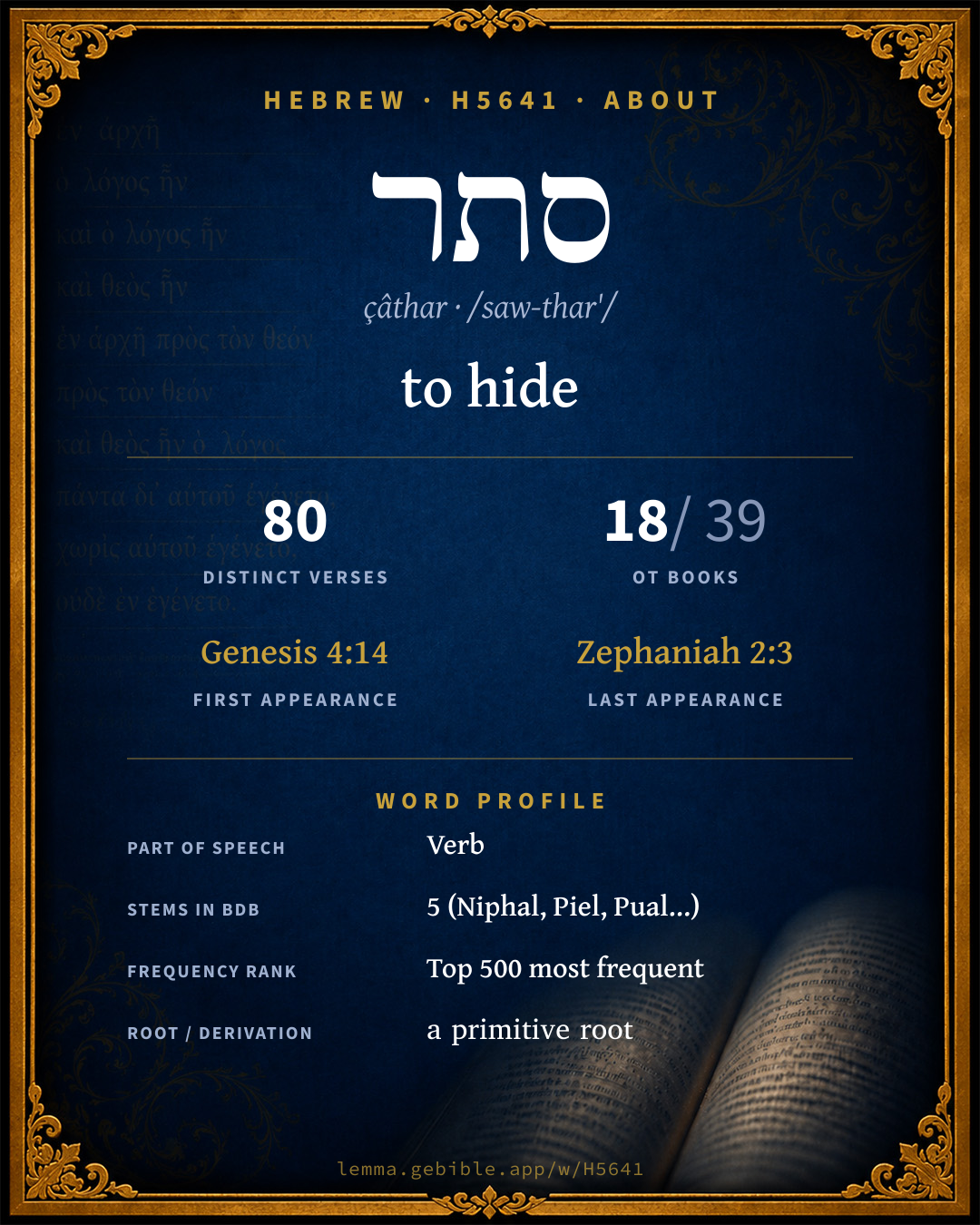
סָתַר
to hide
‘to hide’ is one of 5 main senses fuller range ↓
Full lexicon entry — Brown-Driver-Briggs (BDB)
From Brown-Driver-Briggs (BDB)
Where this word appears
See every Hiphil verb in the Hebrew Bible →
Grammar key — what these labels mean
Part of speech
- Verb
- An action or state-of-being word.
Stem
- Hiphil
- The causative active stem (“he caused / brought about”). Here: ‘a person from’
- Niphal
- Usually the simple passive or reflexive of the Qal (“he was written”). Here: ‘hide oneself’
- Hithpael
- The reflexive or reciprocal stem (the subject acts on itself).
- Pual
- The passive counterpart of the Piel.
- Piel
- An intensive or resultative active stem.
Form
- Imperfect
- An incomplete, ongoing, or future action (“he will / would write”).
- Jussive
- A third- or second-person volitional form expressing wish or command (“let him write”).
- Perfect
- A completed action or state — Hebrew marks aspect (completeness) more than strict tense (“he wrote”).
- Participle Active
- A verbal adjective expressing ongoing or characteristic action (“writing / one who writes”).
- Sequential Imperfect
- An imperfect with prefixed waw — the standard past-narrative form (waw-consecutive imperfect).
- Infinitive Absolute
- An unbound verbal noun, often intensifying or standing in for a finite verb.
- Imperative
- A direct command (“write!”).
- Sequential Perfect
- A perfect with prefixed waw continuing a preceding imperfect or command (waw-consecutive perfect).
- Infinitive Construct
- A bound verbal noun, frequently with prepositions (“to write / in writing”).
- Participle Passive
- A verbal adjective expressing action received (“written”).
- Cohortative
- A first-person volitional form expressing wish or resolve (“let me / let us write”).
State
- Absolute
- The independent form of a noun, not bound to a following word.
Person
- 2nd Person
- The one addressed (“you”).
- 3rd Person
- The one spoken about (“he / she / it / they”).
- 1st Person
- The speaker (“I / we”).
Gender
- Masculine
- Grammatically masculine.
- Feminine
- Grammatically feminine.
- Common
- Either gender — not distinguished for this form.
Number
- Singular
- One.
- Plural
- More than one (in Hebrew, generally three or more).
Grammatical forms 41 distinct
- Verb, Hiphil, Imperfect, 2nd Person, Masculine, Singular 9 times (11%)
- Verb, Hiphil, Jussive, 2nd Person, Masculine, Singular 5 times (6%)
- Verb, Niphal, Perfect, 3rd Person, Feminine, Singular 4 times (5%)
- Verb, Hithpael, Participle Active, Masculine, Singular, Absolute 4 times (5%)
- Verb, Niphal, Imperfect, 3rd Person, Masculine, Singular 4 times (5%)
- Verb, Hiphil, Imperfect, 3rd Person, Masculine, Singular 4 times (5%)
- Verb, Hiphil, Perfect, 1st Person, Common, Singular 3 times (4%)
- Verb, Hiphil, Sequential Imperfect, 3rd Person, Masculine, Singular 3 times (4%)
+33 more forms (46 occurrences)
Parsed forms decoded from the imported morphology (morphhb / Westminster Leningrad Codex — WLC text public domain, morphhb tagging CC BY 4.0), counted across 82 parsed occurrences — not distinct verses.
Every verse where H5641 appears — 80 distinct verses across 18 books. Click any verse to open its interlinear word-by-word view. Verse text shown in the World English Bible for context — . Each verse’s Hebrew form is shown with its reference; the English is not keyword-highlighted, since the data carries no word-level English alignment. Use “Compare translations” on any verse to read it across multiple English versions. This concordance covers the Hebrew Bible; Septuagint (Greek Old Testament) occurrences are not indexed here.
Genesis 2 verses
- Genesis 4:14 אֶסָּתֵ֑ר Niphal impf 1cs Behold, you have driven me out this day from the surface of the ground. I will be hidden from your face, and I will be a fugitive and a wanderer in the earth. It will happen that whoever finds me will kill me."
- Genesis 31:49 נִסָּתֵ֖ר Niphal impf 1cp and Mizpah, for he said, "Yahweh watch between me and you, when we are absent one from another.
Exodus 1 verse
Numbers 1 verse
Deuteronomy 5 verses
- Deuteronomy 7:20 וְ/הַ/נִּסְתָּרִ֖ים conj + ptcl def.art + Niphal ptcp.act mp Moreover Yahweh your God will send the hornet among them, until those who are left, and hide themselves, perish from before you.
- Deuteronomy 29:29 הַ֨/נִּסְתָּרֹ֔ת ptcl def.art + Niphal ptcp.act fp The secret things belong to Yahweh our God; but the things that are revealed belong to us and to our children forever, that we may do all the words of this law.
- Deuteronomy 31:17 וְ/הִסְתַּרְתִּ֨י conj + Hiphil wpf 1cs Then my anger shall be kindled against them in that day, and I will forsake them, and I will hide my face from them, and they shall be devoured, and many evils and troubles shall come on them; so that they will say in that day, Haven't these evils come on us because our God is not among us?
- Deuteronomy 31:18 הַסְתֵּ֨ר אַסְתִּ֤יר Hiphil inf.abs Hiphil impf 1cs I will surely hide my face in that day for all the evil which they shall have worked, in that they are turned to other gods.
- Deuteronomy 32:20 אַסְתִּ֤ירָה Hiphil coh 1cs He said, I will hide my face from them, I will see what their end shall be: For they are a very perverse generation, Children in whom is no faithfulness.
1 Samuel 6 verses
- 1 Samuel 20:2 יַסְתִּ֨יר Hiphil impf 3ms He said to him, "Far from it; you shall not die: behold, my father does nothing either great or small, but that he discloses it to me; and why should my father hide this thing from me? It is not so."
- 1 Samuel 20:5 וְ/נִסְתַּרְתִּ֣י conj + Niphal wpf 1cs David said to Jonathan, Behold, tomorrow is the new moon, and I should not fail to sit with the king at meat: but let me go, that I may hide myself in the field to the third day at evening.
- 1 Samuel 20:19 נִסְתַּ֥רְתָּ Niphal pf 2ms When you have stayed three days, you shall go down quickly, and come to the place where you did hide yourself when the business was in hand, and shall remain by the stone Ezel.
- 1 Samuel 20:24 וַ/יִּסָּתֵ֥ר conj + Niphal wimpf 3ms So David hid himself in the field: and when the new moon was come, the king sat him down to eat food.
- 1 Samuel 23:19 מִסְתַּתֵּ֨ר Hithpael ptcp.act ms Then came up the Ziphites to Saul to Gibeah, saying, Doesn't David hide himself with us in the strongholds in the wood, in the hill of Hachilah, which is on the south of the desert?
- 1 Samuel 26:1 מִסְתַּתֵּר֙ Hithpael ptcp.act ms The Ziphites came to Saul to Gibeah, saying, Doesn't David hide himself in the hill of Hachilah, which is before the desert?
1 Kings 1 verse
2 Kings 1 verse
2 Chronicles 1 verse
Job 8 verses
- Job 3:10 וַ/יַּסְתֵּ֥ר conj + Hiphil wimpf 3ms Because it didn't shut up the doors of my mother's womb, Nor did it hide trouble from my eyes.
- Job 3:23 נִסְתָּ֑רָה Niphal pf 3fs Why is light given to a man whose way is hid, Whom God has hedged in?
- Job 13:20 אֶסָּתֵֽר Niphal impf 1cs "Only don't do two things to me; Then I will not hide myself from your face:
- Job 13:24 תַסְתִּ֑יר Hiphil impf 2ms Why hide you your face, And hold me for your enemy?
- Job 14:13 תַּ֭סְתִּירֵ/נִי Hiphil impf 2ms + sfx pers 1cs "Oh that you would hide me in Sheol, That you would keep me secret, until your wrath is past, That you would appoint me a set time, and remember me!
- Job 28:21 נִסְתָּֽרָה Niphal pf 3fs Seeing it is hidden from the eyes of all living, And kept close from the birds of the sky.
- Job 34:22 לְ/הִסָּ֥תֶר prep + Niphal inf.cs There is no darkness, nor thick gloom, Where the workers of iniquity may hide themselves.
- Job 34:29 וְ/יַסְתֵּ֣ר conj + Hiphil impf 3ms When he gives quietness, who then can condemn? When he hides his face, who then can see him? Alike whether to a nation, or to a man:
Psalms 23 verses
- Psalms 10:11 הִסְתִּ֥יר Hiphil pf 3ms He says in his heart, "God has forgotten. He hides his face. He will never see it."
- Psalms 13:1 תַּסְתִּ֖יר Hiphil impf 2ms How long, Yahweh? Will you forget me forever? How long will you hide your face from me?
- Psalms 17:8 תַּסְתִּירֵֽ/נִי Hiphil impf 2ms + sfx pers 1cs Keep me as the apple of your eye; Hide me under the shadow of your wings,
- Psalms 19:6 נִ֝סְתָּ֗ר Niphal ptcp.pass ms His going forth is from the end of the heavens, His circuit to its ends; There is nothing hidden from its heat.
- Psalms 19:12 מִֽ/נִּסְתָּר֥וֹת prep + Niphal ptcp.act fp Who can discern his errors? Forgive me from hidden errors.
- Psalms 22:24 הִסְתִּ֣יר Hiphil pf 3ms For he has not despised nor abhorred the affliction of the afflicted, Neither has he hidden his face from him; But when he cried to him, he heard.
- Psalms 27:5 יַ֭סְתִּרֵ/נִי Hiphil impf 3ms + sfx pers 1cs For in the day of trouble he will keep me secretly in his pavilion. In the covert of his tent he will hide me. He will lift me up on a rock.
- Psalms 27:9 תַּסְתֵּ֬ר Hiphil juss 2ms Don't hide your face from me. Don't put your servant away in anger. You have been my help. Don't abandon me, Neither forsake me, God of my salvation.
- Psalms 30:7 הִסְתַּ֥רְתָּ Hiphil pf 2ms You, Yahweh, when you favored me, made my mountain to stand strong. But when you hid your face, I was troubled.
- Psalms 31:20 תַּסְתִּירֵ֤/ם Hiphil impf 2ms + sfx pers 3mp In the shelter of your presence you will hide them from the plotting of man. You will keep them secretly in a dwelling away from the strife of tongues.
- Psalms 38:9 נִסְתָּֽרָה Niphal pf 3fs Lord, all my desire is before you. My groaning is not hidden from you.
- Psalms 44:24 תַסְתִּ֑יר Hiphil impf 2ms Why do you hide your face, And forget our affliction and our oppression?
- Psalms 51:9 הַסְתֵּ֣ר Hiphil impv 2ms Hide your face from my sins, And blot out all of my iniquities.
- Psalms 54:1 מִסְתַּתֵּ֥ר Hithpael ptcp.act ms Save me, God, by your name. Vindicate me in your might.
- Psalms 55:12 וְ/אֶסָּתֵ֥ר conj + Niphal impf 1cs For it was not an enemy who insulted me, Then I could have endured it. Neither was it he who hated me who raised himself up against me, Then I would have hid myself from him.
- Psalms 64:2 תַּ֭סְתִּירֵ/נִי Hiphil impf 2ms + sfx pers 1cs Hide me from the conspiracy of the wicked, From the noisy crowd of the ones doing evil;
- Psalms 69:17 תַּסְתֵּ֣ר Hiphil juss 2ms Don't hide your face from your servant, For I am in distress. Answer me speedily!
- Psalms 88:14 תַּסְתִּ֖יר Hiphil impf 2ms Yahweh, why do you reject my soul? Why do you hide your face from me?
- Psalms 89:46 תִּסָּתֵ֣ר Niphal impf 2ms How long, Yahweh? Will you hide yourself forever? Will your wrath burn like fire?
- Psalms 102:2 תַּסְתֵּ֬ר Hiphil juss 2ms Don't hide your face from me in the day of my distress. Turn your ear to me. Answer me quickly in the day when I call.
- Psalms 104:29 תַּסְתִּ֥יר Hiphil impf 2ms You hide your face: they are troubled; You take away their breath: they die, and return to the dust.
- Psalms 119:19 תַּסְתֵּ֥ר Hiphil juss 2ms I am a stranger on the earth. Don't hide your commandments from me.
- Psalms 143:7 תַּסְתֵּ֣ר Hiphil juss 2ms Hurry to answer me, Yahweh. My spirit fails. Don't hide your face from me, So that I don't become like those who go down into the pit.
Proverbs 5 verses
- Proverbs 22:3 ו/יסתר וְ/נִסְתָּ֑ר conj + Niphal impf 3ms conj + Niphal pf 3ms A prudent man sees danger, and hides himself; But the simple pass on, and suffer for it.
- Proverbs 25:2 הַסְתֵּ֣ר Hiphil impv 2ms It is the glory of God to conceal a thing, But the glory of kings is to search out a matter.
- Proverbs 27:5 מְסֻתָּֽרֶת Pual ptcp.pass fs Better is open rebuke Than hidden love.
- Proverbs 27:12 נִסְתָּ֑ר Niphal pf 3ms A prudent man sees danger and takes refuge; But the simple pass on, and suffer for it:
- Proverbs 28:28 יִסָּתֵ֣ר Niphal impf 3ms When the wicked rise, men hide themselves; But when they perish, the righteous thrive.
Isaiah 14 verses
- Isaiah 8:17 הַ/מַּסְתִּ֥יר ptcl def.art + Hiphil ptcp.act ms I will wait for Yahweh, who hides his face from the house of Jacob, and I will look for him.
- Isaiah 16:3 סַתְּרִי֙ Piel impv 2fs Give counsel, execute justice; make your shade as the night in the midst of the noonday; hide the outcasts; don't betray the fugitive.
- Isaiah 28:15 נִסְתָּֽרְנוּ Niphal pf 1cp Because you have said, We have made a covenant with death, and with Sheol are we at agreement; when the overflowing scourge shall pass through, it shall not come to us; for we have made lies our refuge, and under falsehood have we hid ourselves:
- Isaiah 29:14 תִּסְתַּתָּֽר Hithpael impf 3fs therefore, behold, I will proceed to do a marvelous work among this people, even a marvelous work and a wonder; and the wisdom of their wise men shall perish, and the understanding of their prudent men shall be hid.
- Isaiah 29:15 לַ/סְתִּ֣ר prep + Hiphil inf.cs Woe to those who hide deep their counsel from Yahweh, and whose works are in the dark, and who say, Who sees us? and who knows us?
- Isaiah 40:27 נִסְתְּרָ֤ה Niphal pf 3fs Why say you, Jacob, and speak, Israel, My way is hid from Yahweh, and the justice [due] to me is passed away from my God?
- Isaiah 45:15 מִסְתַּתֵּ֑ר Hithpael ptcp.act ms Most assuredly you are a God who hid yourself, God of Israel, the Savior.'
- Isaiah 49:2 הִסְתִּירָֽ/נִי Hiphil pf 3ms + sfx pers 1cs and he has made my mouth like a sharp sword; in the shadow of his hand has he hid me: and he has made me a polished shaft; in his quiver has he kept me close:
- Isaiah 50:6 הִסְתַּ֔רְתִּי Hiphil pf 1cs I gave my back to the strikers, and my cheeks to those who plucked off the hair; I didn't hide my face from shame and spitting.
- Isaiah 54:8 הִסְתַּ֨רְתִּי Hiphil pf 1cs In overflowing wrath I hid my face from you for a moment; but with everlasting loving kindness will I have mercy on you, says Yahweh your Redeemer.
- Isaiah 57:17 הַסְתֵּ֣ר Hiphil inf.abs For the iniquity of his covetousness was I angry, and struck him; I hid [my face] and was angry; and he went on backsliding in the way of his heart.
- Isaiah 59:2 הִסְתִּ֧ירוּ Hiphil pf 3cp but your iniquities have separated between you and your God, and your sins have hidden his face from you, so that he will not hear.
- Isaiah 64:7 הִסְתַּ֤רְתָּ Hiphil pf 2ms There is none who calls on your name, who stirs up himself to take hold of you; for you have hid your face from us, and have consumed us by means of our iniquities.
- Isaiah 65:16 נִסְתְּר֖וּ Niphal pf 3cp so that he who blesses himself in the earth shall bless himself in the God of truth; and he who swears in the earth shall swear by the God of truth; because the former troubles are forgotten, and because they are hid from my eyes.
Jeremiah 5 verses
- Jeremiah 16:17 נִסְתְּר֖וּ Niphal pf 3cp For my eyes are on all their ways; they are not hidden from my face, neither is their iniquity concealed from my eyes.
- Jeremiah 23:24 יִסָּתֵ֨ר Niphal impf 3ms Can any hide himself in secret places so that I shall not see him? says Yahweh. Don't I fill heaven and earth? says Yahweh.
- Jeremiah 33:5 הִסְתַּ֤רְתִּי Hiphil pf 1cs while [men] come to fight with the Chaldeans, and to fill them with the dead bodies of men, whom I have killed in my anger and in my wrath, and for all whose wickedness I have hid my face from this city:
- Jeremiah 36:19 הִסָּתֵ֖ר Niphal impv 2ms Then said the princes to Baruch, Go, hide you, you and Jeremiah; and let no man know where you are.
- Jeremiah 36:26 וַ/יַּסְתִּרֵ֖/ם conj + Hiphil wimpf 3ms + sfx pers 3mp The king commanded Jerahmeel the king's son, and Seraiah the son of Azriel, and Shelemiah the son of Abdeel, to take Baruch the scribe and Jeremiah the prophet; but Yahweh hid them.
Ezekiel 3 verses
- Ezekiel 39:23 וָ/אַסְתִּ֥ר conj + Hiphil wimpf 1cs The nations shall know that the house of Israel went into captivity for their iniquity; because they trespassed against me, and I hid my face from them: so I gave them into the hand of their adversaries, and they fell all of them by the sword.
- Ezekiel 39:24 וָ/אַסְתִּ֥ר conj + Hiphil wimpf 1cs According to their uncleanness and according to their transgressions did I to them; and I hid my face from them.
- Ezekiel 39:29 אַסְתִּ֥יר Hiphil impf 1cs neither will I hide my face any more from them; for I have poured out my Spirit on the house of Israel, says the Lord Yahweh.
Hosea 1 verse
Amos 1 verse
Micah 1 verse
Zephaniah 1 verse
About this entry
At a glance — auto-summarized from this page’s data, not written by a person. Every figure links to its source below. This summary describes the numbers; it doesn’t interpret them.
The Hebrew verb סתר centers on the idea of “to hide.” Across 5 stems, its meaning turns on the binyan (Niphal, Piel). The Hebrew Bible uses it across 80 verses — moderately common. Psalms dominates its distribution — 23 of 80 verses. First canonically at Genesis 4:14, it enters the text early. For the data behind this summary, explore the sense tree and the renderings breakdown below.
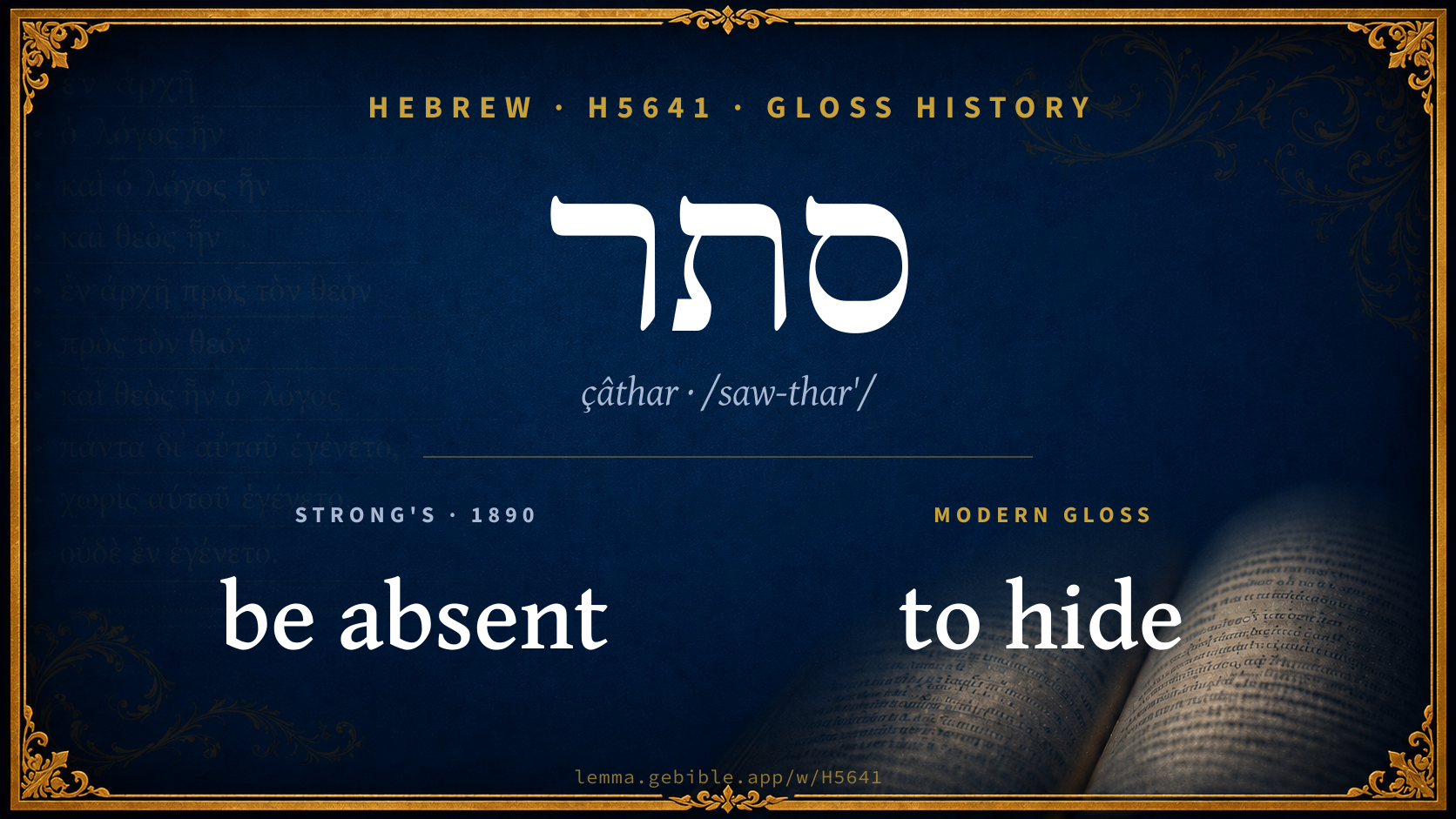
Gloss history
Strong's 1890 vs modern scholarship
About this word
Strong's H5641 catalogs a Hebrew word from the Hebrew Old Testament.
These counts are not copied from any lexicon or concordance. They are computed here, from the morphology-tagged Hebrew Old Testament. What Lemma adds →
- 80
- distinct verses
- The word appears in 80 distinct verses.
- 18 / 39
- OT books
- The word appears in 18 of 39 Old Testament books.
- #487
- by frequency
- Top 500 most frequent Hebrew words (rank 487 of 8,640 Hebrew words by occurrence).
View all 80 occurrences in the concordance →
By section of the Old Testament
By traditional corpus
Conventional, traditional groupings — biblical authorship is debated, so this is a traditional corpus grouping, not an authorship claim. Each share is this word’s portion of its verses in that division of the Hebrew canon. Each figure is a share of the word’s 80 distinct verses.
- Writings (Ketuvim) 37 verses · 46%
- Prophets (Nevi'im) 34 verses · 43%
- Torah (Pentateuch) 9 verses · 11%
How translations render this word
Counts come from each version’s own published word-to-Strong’s tagging or interlinear alignment — an approximate guide to how each version renders this word, not a word-level alignment the data otherwise carries. Because each total is that version’s own tagged count, the per-version totals vary from one another and need not match the appearance or distinct-verse counts above. These counts may also differ from a printed concordance because Lemma counts each distinctly tagged rendering and does not collapse phrase taggings into a single head-word total. This is a fixed set of word-tagged versions (KJV, ASV, BSB, ULT) and does not change with the reading translation you choose elsewhere. Each version’s license is shown beside its name below (and on Sources).
- King James Version: Hide 20×, Hid 6×, Hideth 3×
- American Standard Version: Hide 17×, Hid 3×, Hideth 3×
- Berean Standard Bible: Hide 17×, Hidden 4×, Hiding 4×
- unfoldingWord Literal Text: Hide 13×, Hidden 6×, Is hidden 4×
King James Version Public Domain
Renders H5641 across 81 tagged occurrences — most commonly:
Plus 38 renderings that appear only once — usually multi-word phrases or single function words the recovered tagging swept in, not distinct renderings. Not rendered by a distinct English word in 1 further occurrence.
American Standard Version Public Domain
Renders H5641 across 80 tagged occurrences — most commonly:
Plus 47 renderings that appear only once — usually multi-word phrases or single function words the recovered tagging swept in, not distinct renderings.
Berean Standard Bible Public Domain
Renders H5641 across 80 tagged occurrences — most commonly:
Plus 36 renderings that appear only once — usually multi-word phrases or single function words the recovered tagging swept in, not distinct renderings. Not rendered by a distinct English word in 1 further occurrence.
unfoldingWord Literal Text CC BY-SA 4.0
Renders H5641 across 96 tagged occurrences — most commonly:
Plus 50 renderings that appear only once — usually multi-word phrases or single function words the recovered tagging swept in, not distinct renderings.
12 senses and sub-senses in the full BDB
Hebrew verbs can shift meaning by stem (binyan): Qal is the basic action, Niphal is often passive or reflexive, Piel often intensifies or makes it factitive, and Hiphil is typically causative. The senses below are grouped under the stem BDB assigns to each. This entry also uses Pual (the passive of Piel) and Hithpael (reflexive or reciprocal).
What do BDB’s symbols mean?
BDB uses these scholarly abbreviations:
| Symbol | Meaning |
|---|---|
| 𝔊 | the Septuagint (the ancient Greek translation, LXX) |
| 𝔙 | the Vulgate (the Latin translation) |
| 𝔖 | the Syriac version (the Peshitta) |
| 𝔗 | the Targum (the Aramaic translation) |
| ψ | the Psalms |
| √ | root (the underlying root or stem) |
| ‖ | parallel passage (a synonymous or contrasted parallel) |
| † | the dagger: every passage where the word occurs is cited |
The 12 senses and sub-senses the full Brown-Driver-Briggs lexicon distinguishes for this word, in lexicon order (not ranked by frequency), with BDB’s own verbatim wording and sub-sense lettering. Shown in Hebrew script with BDB’s own scholarly abbreviations. The condensed entry is in the Lexicon Entry tab. See also the Forms in the corpus table below.
Niphal
- Pf. 3 ms. נִסְתָּ֑ר Pr 27:12 + 22:3 Qr (Kt וַיִּסָּתֵר); 2 ms. נִסְתַּ֫רְתָּ 1 S 20:19; 1 pl. נִסְתָּ֑רְנוּ Is 28:15, etc.; Impf. 3 ms. יִסָּתֵר Ho 13:14 +; 1 s. אֶסָּתֵר Gn 4:14 +; 3 mpl. יִסָּֽתְרוּ Am 9:3; 1 pl. נִסָּתֵר Gn 31:49, etc.; Imv. ms. הִסָּתֵר Je 36:19; inf. cstr. לְהִסָּ֫תֶר שָׁם Jb 34:22; Pt. נִסְתָּר ψ 19:7; pl. נִסְתָּרִים Dt 7:20; fpl. נִסְתָּרֹת Dt 29:28, -וֹת ψ 19:13;— e.g. Proverbs 27:12
- 1. hide oneself, c. בְּ loc., 1 S 20:5, 24; 1 K 17:3 Je 23:24, so (fig.) Is 28:15; c. שָׁם 1 S 20:19 Jb 34:22; abs. Je 36:19; Pr 22:3; 27:12; 28:28 ψ 89:47; c. מִפְּנֵי pers. Dt 7:20; Jb 13:20, c. מִן pers. ψ 55:13. e.g. 1 Samuel 20:5
- 2. be hid, concealed, especially fig. of escaping God’s notice, c. מִפְּנֵי pers. Gn 4:14 (J), מִלִּפְנֵי Je 16:17, מִנֶּגֶד עֵינַי Am 9:3, מֵעֵינַי Is 65:16; Ho 13:14 (subj. נֹחַם, i.e. I will not repent, change my purpose of judgment), מִן ψ 38:10 Is 40:27; from heat of sun ψ 19:7 (i.e. it penetrates everywhere); from birds Jb 28:21 (of place of wisdom); recipr. נִסּ׳ אִישׁ מֵרֵעֵהוּ Gn 31:49 (J) when we are hidden each from the other (i.e. separated); abs. Nu 5:13 Jb 3:23 (whose way is hid sc. from himself), Zp 2:3 (i.e. escape י׳’s judgment); pt. hidden, secret things, in gen. Dt 29:28; of sins ψ 19:13. e.g. Genesis 4:14
Piel
- Imv. fs. סַתְּרִי Is 16:3 carefully hide (i.e. shelter) the outcasts (Moab speaks to Zion). e.g. Isaiah 16:3
Pual
- Pt. fs. אַהֲבָה מְסֻתָּ֑רֶת Pr 27:5 love carefully concealed. e.g. Proverbs 27:5
Hithpael
- Impf. 3 fs. תִּסְתַּתָּ֑ר Is 29:14; Pt. מִסְתַּתֵּר 1 S 23:19 + 3 times;—hide oneself carefully, of David’s taking refuge with (עִם) Ziphites 1 S 23:19 = ψ 54:2 (title), in (בְּ) a hill 1 S 26:1; אֵל מ׳ Is 45:15 a God that completely hides himself. e.g. Isaiah 29:14
Hiphil
- Pf. 3 ms. הִסְתִּיר ψ 10:11; 22:25; 2 ms. הִסְתַּ֫רְתָּ ψ 30:8 Is 64:6, etc.; Impf. 3 ms. יַסְתִּיר 1 S 20:2, וַיַּסְתֵּר Ex 3:6 Jb 3:10, sf. יַסְתִּרֵ֫נִי ψ 27:5, וַיַּסְתִּרֵם Je 36:26; 3 fs. sf. וַתַּסְתִּירֵ֫הוּ 2 Ch 22:11; 1 s. וָאַסְתִּר Ez 39:23, 24, etc.; Imv. ms. הַסְתֵּר ψ 51:11; Inf. abs. הַסְתֵּר Dt 31:18; Is 57:17; cstr. הַסְתֵּר Pr 25:2 (v. Köi. 213 and reff.; yet cf. inf. abs. אָכֹל v 27), לַסְתִּר Is 29:15 (Ges§ 53 q); Pt. מַסְתִּיר Is 8:17;—conceal, hide: e.g. Psalms 10:11
- 1. a person from (מִפְּנֵי) enemy 2 K 11:2 = 2 Ch 22:11; subj. י׳, c. מִן ψ 64:3, abs. Je 36:26; hide anything from (מִן) one 1 S 20:2, a thing, in gen., Pr 25:2; anything (from י׳; מִן in ‖ cl.) Is 29:15; in gen. = shelter a person Jb 14:13, c. בְּ loc. (subj. י׳) ψ 17:8; 27:5; 31:21 (all metaph.); toil (עָמָל), מֵעֵינָ֑י Jb 3:10; commands from, מִן pers. (subj. י׳) ψ 119:19; hide one as arrow in quiver Is 49:2. e.g. 2 Kings 11:2
- 2. especially hide the face:
- a. lit., of Moses Ex 3:6 (E), usually fig.: e.g. Exodus 3:6
- b. subj. י׳, c. מִן, i.e. be not observant of sin ψ 51:11, abs. ψ 10:11; more often e.g. Psalms 51:11
- c. י׳ hides his face from (מִן pers.), i.e. withdraws his favour, Mi 3:4; Is 8:17; 54:8; 64:6; Dt 31:17; 32:20; Je 33:5; Ez 39:23, 24, 29 ψ 13:2; 22:25; 27:9; 69:18; 88:15; 102:3; 143:7; abs. Dt 31:18; Jb 13:24; 34:29 ψ 30:8 cf. 104:29; 44:25; פָּנִים om. Is 57:17; cf. Is 59:2 your sins have hidden (his) face from (מִן) you; of hiding one’s face from (מִן) shame, i.e. avoiding it Is 50:6 (of servant of י׳). e.g. Micah 3:4
Senses from the full Brown-Driver-Briggs lexicon (Brown, Driver, Briggs; Oxford 1906 — public domain), digitized via Sefaria, supplemented by the OpenScriptures HebrewLexicon (CC BY 4.0). Full attribution on Sources.
Word origin
vb. hide, conceal (NH id., der. species; 𝔗 סְתַר Pa. Ithpa., Syriac ܣܬܰܪ Pe. Pt. pass., chiefly Pa. Ithpa., id.; Arabic سَتَرَ veil, conceal, hide, Lane1304; Ethiopic ሰተረ (rare) Di364);—
— Brown-Driver-Briggs (Oxford 1906, public domain), digitized via Sefaria, supplemented by the OpenScriptures HebrewLexicon (CC BY 4.0). See Sources.
Origin: a primitive root
Jastrow Dictionary
A second Hebrew/Aramaic lexicon for comparison, covering Aramaic and post-biblical (Talmudic, Targumic, Midrashic) usage that the biblical-Hebrew BDB does not. Matched by lemma rather than by Strong’s number, so a lemma may carry more than one Jastrow headword (shown separately below), and the entries cover usage well beyond the Bible.
סָתַר I
- (b. h.) to cover, hide.
- to conceal. Meg. 13ᵃ (play on אסתר) שהיתה מְסַתֶּרֶת דבריה she used her words with discretion (ref. to Esth. II, 20); Yalk. Esth. 1053 (not שסתרת).—Part. pass. מְסוּתָּר; pl. מְסוּתָּרִים. Ab. d’R. N. ch. VI דברים המס׳ מבניִ אדם הוציאם וכ׳ things which are concealed to men, R. ‘Akiba brought forth to the light. e.g. Esther 2:20
- to hide. Yalk. Deut. 941 אע"פ שהִסְתַּרְתִּי פני וכ׳ although I hide my face before them, I will speak to him in a dream.
- to be hidden, protected; to hide one’s self. Midr. Till. to Ps. XIX, 7 לע׳'ל מי נִסְתָּר מחמתו וכ׳ in the future who will be protected from his heat?—Esp. to retire under suspicious circumstances (Num. V, 13). Sot. 3ᵃ קינא לה ונִסְתָּרָה he was jealous of her (forewarned her), and she retired (with the man). Y. ib. I, 16ᵇ bot. מה טיבה להִיסָּתֵר what business had she to retire? Bab. ib. 5ᵇ אל תִּסָּתְרִי do not hide thyself (with that man); ib. 2ᵇ (in Chald. dict.) לא תִיסָּתְרִי וכ׳ do not hide thyself with that man. Ber. 31ᵇ אלך ואֶסְתַּתֵּר וכ׳ I will go and seclude myself (with a man) before my husband. Ib. אם כן ילכו … ויִסְתַּתְּרוּ if this be so, all childless women would go and hide themselves; a. fr.—נִסְתָּרוֹת f.pl. a) secret things, mysteries. Ḥag. 13ᵃ (fr. Ben Sira) אין לך עסק בנ׳ thou must have nothing to do with (must not speculate on) mysteries; Gen. R. s. 8; a. e.—b) secret sins for which the whole community is made responsible. Snh. 43ᵇ לא ענש על הנ׳ וכ׳ the Lord did not punish (Israel) for secret sins until &c. Y. Sot. VII, end, 22ᵃ אין לכם עסק בנ׳ you will no more be made responsible for undetected sins. e.g. Numbers 5:13
סְתַר
- Pa. סַתֵּר same, to hide.—Part. pass. מְסַתַּר. Targ. Is. LXV, 16. Targ. Jer. XVI, 17 (ed. Wil. מִסַתְּרָן, corr. acc.).
- to hide one’s self; to find shelter. Targ. Koh. VII, 12.—*Targ. Y. I Deut. XXIX, 5 מִסְתְּרָא וכ׳ finding shelter in your schools.—Ber. 31ᵇ כיון דמִסְתַּתַּרְנָא when I closet myself (with a stranger), v. preced. Sot. 2ᵇ זמנין דלא אִיסְתַּתְּרָא ואמר איסתתרא (not איסתתר) it may happen that she did not closet herself with a man, but he (the husband) says that she did &c. Ib. ומִסְתַּתְּרָא וליכא וכ׳ Rashi (ed. ומיסתתרה) and she may closet herself, and we have in our days no waters … to test her &c.; a. e.
סָתַר II
- (= סחתר, Saf. of חתר; cmp. Arab. šatar) [to dig under,]
- 1. to upset, tear down. Meg. 31ᵇ אם אמרו לך זקנים סְתוֹר וכ׳ if the old tell thee, tear down, and the young, build, tear down and build not, v. סְתִירָה II; Ned. 40ᵃ. Sabb. VII, 2 הבונה והסוֹתֵר he who builds (on the Sabbath) or who tears down. Yoma 10ᵃ שיפלו בונין ביד סוֹתְרִין that the builders (of the Temple, the Persians) should fall through the hands of the destroyers (the Romans), v. סָתוֹרָא. Ab. d’R. N. ch. VI סְתָרוֹ ועקרו וכ׳ he dug under it (the rock) and broke it loose &c. Koh. R. to VII, 26 כותל קשה … וסוֹתְרוֹ a wall is strong, but man has more power and tears it down; a. fr.
- 2. [to stir up,] to loosen, unravel. Sot. I, 5 סותר את שערה the priest loosens her hair (Num. V, 18 ופרע); אם … לא היה סוֹתְרוֹ if her hair was beautiful, he did not loosen it. Treat. S’maḥ.ch. ch. VIII סוֹתְרִים שערות וכ׳ you may untie the hair of dead brides; a. e. e.g. Numbers 5:18
- 3. to dissolve, decompose. Lam. R. introd. (R. Ḥănina 1) (ref. to Prov. XXV, 20) כזה … וסוֹתְרוֹ כך היו סוֹתְרִים וכ׳ as one pours vinegar on natron and decomposes it, so they decomposed (counteracted) the words of the Law; v. infra. e.g. Proverbs 25:20
- 4. to undo, reverse, invalidate. Snh. III, 8 כל זמן … סותר את הדין whenever he offers new evidence, he reverses the decision, i.e. the court has to try his case again; לאחר שלשים יום אינו סותר after thirty days, the judgment cannot be disturbed.—Esp. to make void the days of a Nazarite’s vow which have been observed, to begin anew. Naz. II, 10 סותר שבעים he must count seventy days again. Ib. III, 3 ס׳ את הכל he must count over the whole period (of days); אינו ס׳ אלא שבעה he has to count only seven days over. Tosef. ib. II, 13 יש לו לִסְתּוֹר סותר וכ׳ if there is a portion of the period left to undo, i.e., if the period of his vow has not yet expired, he must count thirty days again; כל … ואין לו לסתור סותר וכ׳ whenever he becomes unclean on a day on which it is improper to offer a sacrifice, and he has nothing left to undo, i.e. his term has expired, and he lacks only a sacrifice to be released: he must count seven days; a. fr.—5 (logics) to contradict, disprove. Succ. 26ᵇ, a. fr. מעשה לסתור, v. מַעֲשֶׂה. Sabb. 13ᵇ שאלמלא … שהיו דבריו סוֹתְרִין וכ׳ but for him, the Book of Ezekiel would have been expunged from the canon, because its words seemed to contradict the words of the Law. Ib. 30ᵃ לא דייך שדבריך סותרין וכ׳ not only do thy words contradict those of David, but they contradict one another; a. fr.—Num. R. s. 13 לא אחד מהן סותר על חבירו neither of them conflicts with the other.—[Yalk. Ex. 356 שלא יסתרו, v. סָרַס I Hithpa.]
- to be disarranged, be undone. Y. Kil. IX, end, 32ᵈ; Y. Sabb. XIII, beg. 14ᵃ מִיסְתַּתֵּר הוא the web will go apart again, opp. מתקיים.
סְתַר ²
- 1. to tear down, destroy. Targ. Y. Deut. VII, 5. Targ. Jer. I, 19; a. fr.—Taan. 20ᵇ כל אשיתא … הווה ס׳ לה every threatening wall he ordered to be torn down. B. Bath. 3ᵇ לא לִיסְתּוֹר וכ׳ one must not tear down a synagogue before having built another one. Ib. סֵתְרֵי ובנו, v. סִתְוָא; a. fr.
- 2. to unravel, wind up. Ḥull. 60ᵃ, v. דַּוְלָלָא.
- same. Targ. Prov. XV, 25 (Var. ed. Lag. נסטר, corr. acc.). Targ. II Kings XI, 18; a. e.—Yeb. 116ᵇ קרע סַתְּרִי מזייך … rend thy garments, disarrange thy hair (in mourning). Ned. 50ᵇ עד דמְסַתְּרִין וכ׳ until the people of his household disarranged their hair for him (in sympathy with his pain).
- to be torn down. Meg. Taan. ch. VIII, v. סוֹרִיגָא.
סֵתֶר
- secrecy. Sot. I, 2 (2ᵃ) נכנסה עמו לבית הס׳ (not בס׳) if she went with him to a closeted place, v. סְתִירָה. Gen. R. s. 45 סִיתְרָהּ, v. גָּלוּי.—בַּסֵּ׳ in secret. B. Bath. 9ᵇ גדול העושה צדקה בס׳ וכ׳ he that dispenses charity in secret, is greater than Moses. Ḥag. 16ᵃ העובר עבירה בס׳ וכ׳ he who selects a secret place for committing a sin, is considered as though he pushed away the feet of the Divine Presence (denying the omniscience of God). Ab. IV, 4; a. fr.—Pl. סְתָרִים, constr. סִתְרֵי, סִי׳. Mikv. IX, 3; Lev. R. s. 15, a. fr. בית הס׳ covered parts of the body, posteriors &c. Meg. 3ᵃ מי הוא זה שגילה סְתָרַיי וכ׳ who is he that revealed my secrets to men? Ib. אני … סְתָרֶיךָ I did reveal thy secrets. Ḥag. 11ᵇ סתרי עריות the secrets of the laws of incest, i.e. the laws not explicitly stated (cmp. סְתָם). Y. Keth. V, 29ᵈ bot. סיתרי תורה the secrets of the Law, i.e. logical deductions; a. fr.
A Dictionary of the Targumim, the Talmud Babli and Yerushalmi, and the Midrashic Literature (Marcus Jastrow; London, Luzac, 1903) — Public Domain. Digitized via Sefaria. Digitized via Sefaria. Full attribution on Sources.
Forms in the corpus
The 72 distinct written forms H5641 takes in the Hebrew Bible, most frequent first — each parse links to that stem’s occurrences in the concordance. Hebrew forms include their vowel points and cantillation, so a single lemma takes many written forms.
The 60 most common forms are shown; 12 rarer forms follow in the full concordance.
Same root — word family
Other BDB entries built from the same root as H5641, grouped by Strong’s listed origin. These share a root / origin per the lexicon — not necessarily a shared meaning. Each links to that word’s own entry.
Derived from this word
- מסתור miçtôwr H4563 shelter
- מסתר maçtêr H4564 hiding
- מסתר miçtâr H4565 hiding place
- סתר çᵉthar H5642 to hide
- סתר çêther H5643 hiding place
Proper names from this root
People and places named from this root — a name, not an additional meaning of the word.
Compare all same-root words → Showing 4 of 7 — not the complete family. 1 of the same-root words is a proper name (a person or place). They share a root, not necessarily a meaning.
Septuagint verse parallels
This word appears in 71 verses that also exist in the Greek Old Testament (Septuagint), out of the 80 Hebrew verses it occurs in. You can read those verses in Greek by switching the Old Testament edition to the Septuagint.
Read these verses in the Septuagint
- Genesis 4:14
- Exodus 3:6
- Numbers 5:13
- Deuteronomy 7:20
- 1 Samuel 20:2
- 1 Kings 17:3
- 2 Kings 11:2
- 2 Chronicles 22:11
- Job 3:10
- Psalms 13:1
- Proverbs 22:3
- Isaiah 8:17
This is a verse-level parallel only — the same verses exist in both the Hebrew and Greek Old Testaments. No word-level Hebrew↔Greek correspondence is claimed: the data carries no such alignment, so no Greek word is shown as this Hebrew word’s translation. Coverage is not total — the Septuagint omits the deuterocanon and renumbers the Psalms, so some Hebrew verses have no direct Greek parallel.