
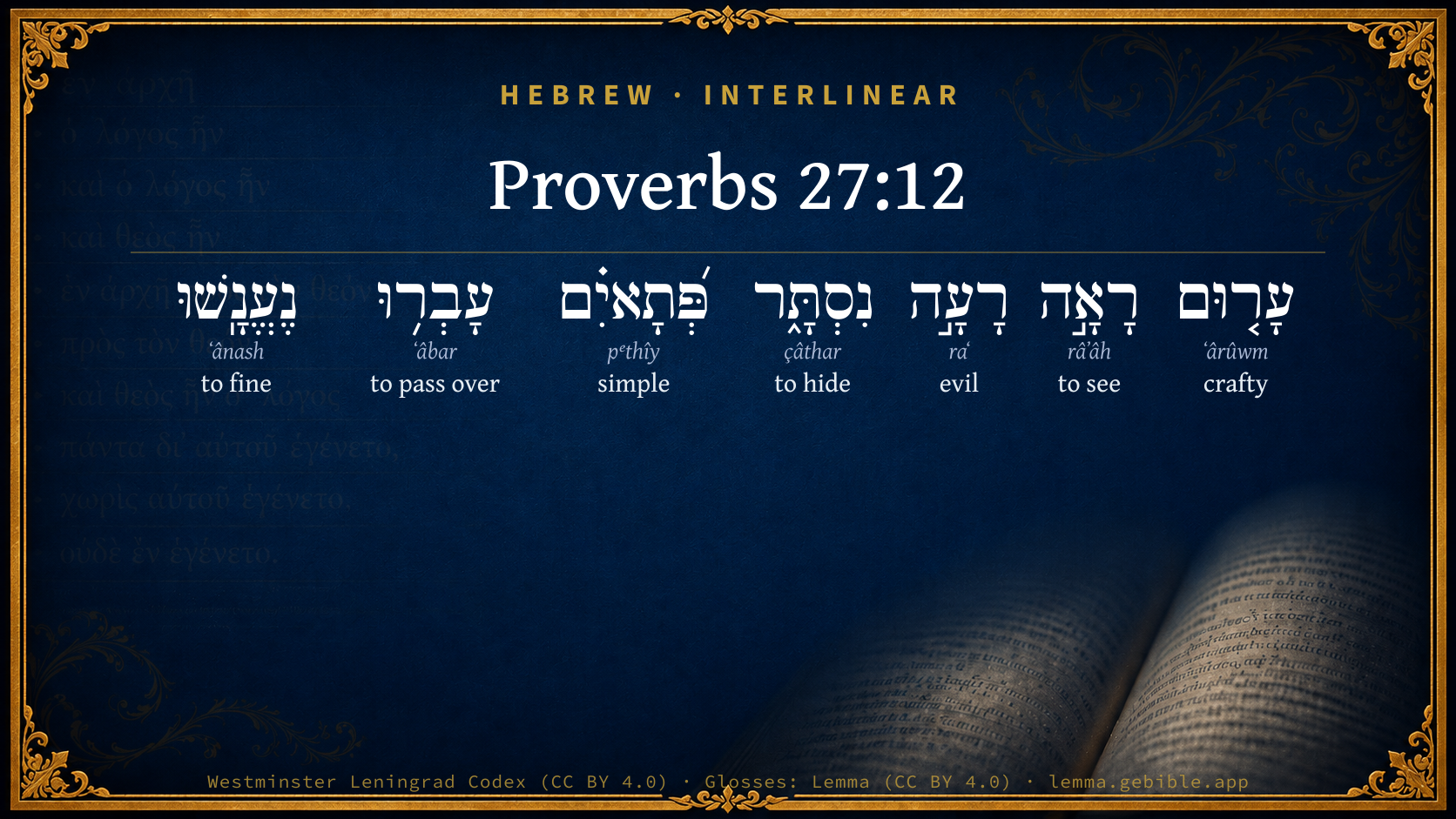
Proverbs 27:12

Hebrew (Westminster Leningrad Codex) Proverbs 27:12 appears in the Hebrew Old Testament. The text above is from the Westminster Leningrad Codex. Each word links to its Strong’s number, a concise gloss, and parsing drawn from the Open Scriptures Hebrew Bible morphology. Click any word for its full Brown-Driver-Briggs (BDB) entry.
Download image
Cite this verse

Proverbs 27:12 (World English Bible). Public Domain. Lemma interlinear Bible study tool, https://lemma.gebible.app/v/proverbs/27/12.

Show BibTeX & RIS
BibTeX
RIS
English Translation
A prudent man sees danger and takes refuge; But the simple pass on, and suffer for it:
World English Bible · Public Domain
Download a study sheet

One document with this verse’s original text, its word-by-word gloss line, the meaning frame, cross-references with their text, attributed commentary, and full source and license credits — printable, and it pastes into notes with its structure intact.

This verse Autodidact and up

Study sheet (.html) Plain text (.txt)

A passage Seminary Student

Up to 50 verses in one chapter. A passage sheet keeps up to 6 commentary sources and 12 cross-references per verse, in the order this page ranks them, and says so on the sheet whenever that leaves anything out. Ask for a single verse and you get the Autodidact verse sheet above.

Everything on this page stays free to read, with no account — the sheet is a download of what is already on screen, not access to it.

Want to remove ads? Support Godless Engineer
Compare translations 3

The same verse in 3 English versions, stacked beneath the original-language interlinear above. Click any original word for its lexicon entry.

Each is an independent rendering of the whole verse — the interlinear is not word-aligned to these translations.

Highlighted words mark where these versions differ — a whole-verse word diff, not a word-by-word alignment.

  • World English Bible Public Domain
    A prudent man sees danger and takes refuge; But the simple pass on, and suffer for it:
  • King James Version Public Domain
    A prudent man foreseeth the evil, and hideth himself; but the simple pass on, and are punished.
  • unfoldingWord Literal Text CC BY-SA 4.0
    A prudent one sees evil, he hides himself; naive ones pass on, they are fined.

unfoldingWord Literal Text — © unfoldingWord, licensed CC BY-SA 4.0. Word-aligned USFM3 via Door43 (git.door43.org/unfoldingWord/en_ult).

Versions to compare (up to 4)

3 of 4 selected

Show all 18 translations

Every available English version of this verse, each an independent rendering of the whole verse.

  • World English Bible Public Domain
    A prudent man sees danger and takes refuge; But the simple pass on, and suffer for it:
  • Berean Standard Bible Public Domain
    The prudent see danger and take cover; but the simple keep going and pay the penalty.
  • Majority Standard Bible Public Domain
    The prudent see danger and take cover, but the simple keep going and pay the penalty.
  • King James Version Public Domain
    A prudent man foreseeth the evil, and hideth himself; but the simple pass on, and are punished.
  • American Standard Version (1901) Public Domain
    A prudent man seeth the evil, `and' hideth himself; `But' the simple pass on, `and' suffer for it.
  • Revised Version (1885) Public Domain
    A prudent man seeth the evil, and hideth himself: but the simple pass on, and suffer for it.
  • Geneva Bible (1599) Public Domain
    A prudent man seeth the plague, and hideth himselfe: but the foolish goe on still, and are punished.
  • Douay-Rheims (1899) Public Domain
    The prudent man seeing evil hideth himself: little ones passing on have suffered losses.
  • Young's Literal Translation Public Domain
    The prudent hath seen the evil, he is hidden, The simple have passed on, they are punished.
  • Literal Standard Version CC BY-SA 4.0
    The prudent has seen the evil, he is hidden, || The simple have passed on, they are punished.
  • Unlocked Literal Bible CC BY-SA 4.0
    A prudent man sees trouble and hides himself, but the naive people go on and suffer because of it.
  • unfoldingWord Literal Text CC BY-SA 4.0
    A prudent one sees evil, he hides himself; naive ones pass on, they are fined.
  • Darby Bible Public Domain
    A prudent [man] seeth the evil, [and] hideth himself; the simple pass on, [and] are punished.
  • World Messianic Bible Public Domain
    A prudent man sees danger and takes refuge; but the simple pass on, and suffer for it.
  • Webster's Bible Public Domain
    A prudent man foreseeth the evil, and hideth himself; but the simple pass on, and are punished.
  • Free Bible Version CC BY-SA 4.0
    If you're sensible you see danger coming and get out of the way; but stupid people just keep going and suffer the consequences.
  • Bible in Basic English Public Domain
    The sharp man sees the evil and takes cover: the simple go straight on and get into trouble.
  • JPS Tanakh (1917) Public Domain
    A prudent man seeth the evil, and hideth himself; but the thoughtless pass on, and are punished.

Literal Standard Version (2020), Covenant Press — licensed CC BY-SA 4.0. Text via the HelloAO Bible API (eBible.org). Unlocked Literal Bible (unfoldingWord) — licensed CC BY-SA 4.0. Text via the HelloAO Bible API (eBible.org). unfoldingWord Literal Text — © unfoldingWord, licensed CC BY-SA 4.0. Word-aligned USFM3 via Door43 (git.door43.org/unfoldingWord/en_ult). Free Bible Version, Dr. Jonathan Gallagher — licensed CC BY-SA 4.0. Text via the HelloAO Bible API (eBible.org).

Word by word

More ways to search: Search by grammar → Find every occurrence → Compare this word →

Practice this passage: Drill this verse → Learn its vocabulary →

About this verse

These counts appear in no published source. They are computed here, from the morphology-tagged text and Lemma’s own curated glosses. What Lemma adds →

7
words
7
distinct lemmas
Wisdom
section

Notable vocabulary

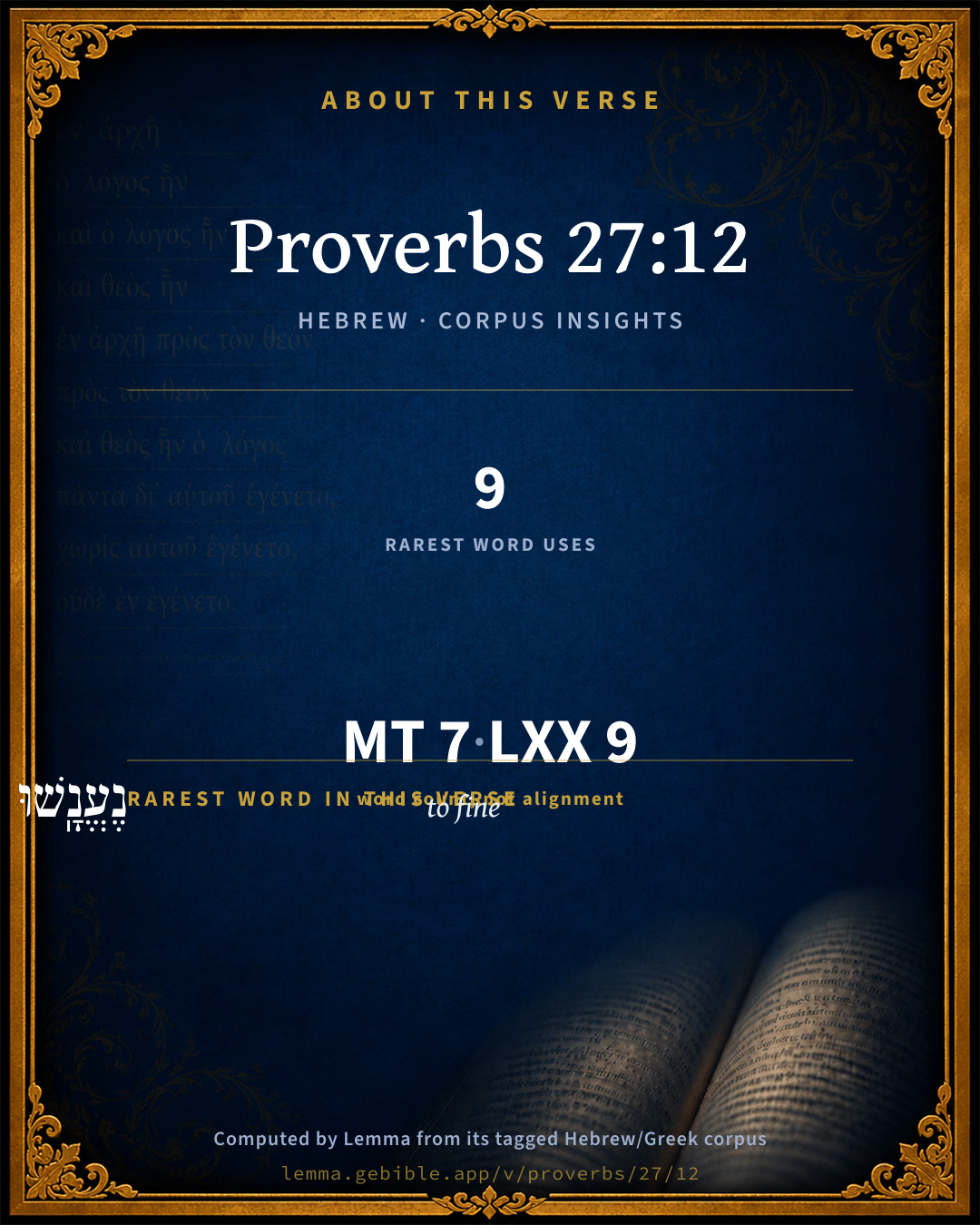
The rarest word here is נֶעֱנָֽשׁוּ to fine H6064 — appearing just 9 times in the whole Hebrew Bible.

Shared distinctive vocabulary

נֶעֱנָֽשׁוּ to fine H6064 occurs in 8 verses of the Hebrew Bible. Also found in:

Grammatical profile

  • 4 verbs
  • 2 nouns
  • 1 adjective

Verb forms

  • רָאָ֣ה Qal · Perfect
  • נִסְתָּ֑ר Niphal · Perfect
  • עָבְר֥וּ Qal · Perfect
  • נֶעֱנָֽשׁוּ Niphal · Perfect

Hebrew & Septuagint length

In English translation the verse runs 17 words from the Hebrew and 17 from the Septuagint (LXX English) — the same length.

A rough comparison of the two English renderings, which tokenize alike — not a word-level alignment.

Word counts can differ between the Hebrew and the Greek without any difference in meaning — e.g. the Hebrew direct-object marker אֵת has no separate Greek word, and Greek often adds the article ὁ.

In the original languages it is 7 Hebrew tokens and 9 Greek tokens — but the two are counted differently (Hebrew bundles its prefixes and suffixes into one token; the Greek is in lemma form), so that isn’t a like-for-like length.

Cross-references

10

Topical passages linked to Proverbs 27:12 in the Treasury of Scripture Knowledge — connected by theme and wording, ordered by reader-vote popularity; previews shown in the World English Bible.

  • Proverbs 22:3 A prudent man sees danger, and hides himself; But the simple pass on, and suffer for it.
  • Proverbs 18:10 The name of Yahweh is a strong tower: The righteous run to him, and are safe.
  • Hebrews 11:7 By faith, Noah, being warned about things not yet seen, moved with godly fear, prepared an ark for the saving of his house, through which he condemned the world, and became heir of the righteousness which is according to faith.
  • 2 Peter 3:10–14 But the day of the Lord will come as a thief in the night; in which the heavens will pass away with a great noise, and the elements will be dissolved with fervent heat, and the earth and the works that are in it will be burned up.
  • Exodus 9:20–21 Those who feared the word of Yahweh among the servants of Pharaoh made their servants and their cattle flee into the houses.
  • 2 Peter 3:7 But the heavens that now are, and the earth, by the same word have been stored up for fire, being reserved against the day of judgment and destruction of ungodly men.
  • Psalms 57:1–3 Be merciful to me, God, be merciful to me, For my soul takes refuge in you. Yes, in the shadow of your wings, I will take refuge, Until disaster has passed.
  • Isaiah 26:20–21 Come, my people, enter you into your chambers, and shut your doors about you: hide yourself for a little moment, until the indignation be past.
  • Matthew 3:7 But when he saw many of the Pharisees and Sadducees coming for his baptism, he said to them, "You offspring of vipers, who warned you to flee from the wrath to come?
  • Hebrews 6:18 that by two immutable things, in which it is impossible for God to lie, we may have a strong encouragement, who have fled for refuge to take hold of the hope set before us.

Cross-references courtesy of OpenBible.info (CC BY 4.0).

Hebrew and Greek witnesses Masoretic Hebrew ↔ Greek Septuagint

The same verse in the two great witnesses to the Old Testament, shown verse-for-verse.

These are two independent witnesses, not word-aligned to each other, and the Septuagint is shown in lemma (dictionary) form.

Hebrew Proverbs 27:12 Masoretic · Westminster Leningrad Codex

עָר֤וּם רָאָ֣ה רָעָ֣ה נִסְתָּ֑ר פְּ֝תָאיִ֗ם עָבְר֥וּ נֶעֱנָֽשׁוּ

A prudent man sees danger and takes refuge; But the simple pass on, and suffer for it:

World English Bible · Public Domain

Greek LXX Proverbs 27:12 Septuagint · lemma form

πανοῦργος κακός ἐπιἔρχομαι ἀποκρύπτω ἄφρων δέ ἐπιἔρχομαι ζημία τίνω

A wise man, when evils are approaching, hides himself; but fools pass on, and will be punished.

LXX2012 (modern English Septuagint) · Public Domain

On this verse, John Gill's Exposition discusses the Septuagint’s reading. Read the note in Commentary ↓

Hebrew: Westminster Leningrad Codex (CC BY 4.0). Greek: Septuagint (public domain); English from LXX2012 (modern English Septuagint) (Public Domain). How the Septuagint differs from the Hebrew →

Commentary

Notes on Proverbs 27:12 from classic Christian and Jewish commentators (each source and its license shown beneath its notes). The classic Christian expositions comment on the surrounding passage and are grouped to its opening verse, so a note may address several verses; the Jewish commentaries on the Tanakh (Rashi and others) are per-verse, so they appear only where the commentator wrote on this verse.

Lemma curates 59 commentaries, every one of them public domain or Creative Commons licensed, each selected and text-cleaned for this edition rather than reprinted as found. About our sources →

Trapp's Complete Commentary

John Trapp

Pro 27:12 A prudent [man] foreseeth the evil, [and] hideth himself; [but] the simple pass on, [and] are punished.

Ver. 12. A prudent man foreseeth the evil.] {See Trapp on "Pro 22:3"}

John Trapp, A Commentary or Exposition upon All the Books of the Old and New Testament (1647–1656) — public domain. Text from a community e-Sword module.

The Biblical Illustrator

Joseph S. Exell

Pro_27:12

A prudent man foreseeth the evil, and hideth himself; but the simple pass on, and are punished.

Eyes and no eyes

The distinction is not between goodness and wickedness, but between strength and weakness, wisdom and folly. The seeing and the acting man victoriously compels circumstances to further his own ends. The blind and the drifting man is conquered by the force of circumstances, and suffers penalty and loss. The proverb is applicable to every sphere of human life and effort, and becomes more and more rigidly and absolutely true the higher we ascend. In the lower spheres of action there may appear evils which the most prudent man cannot avoid; and the simple may sometimes escape disaster by a fortunate combination of circumstances. But these are exceptions. When we ascend to the sphere of moral and spiritual efforts, even the exceptions vanish, and the principle becomes absolute.

1. Mans life and destiny are determined, not by an inexorable and eternal fate, but by his free manhood. Circumstances are the material out of which he has to weave the garment of his life, and it depends upon himself whether it shall be a garment for honour or dishonour.

2. The radical distinction between men lies in the possession of true vision. The true man sees the realities of things, gazes into the truer and eternal. The unspiritual man sees only the show and appearance of things. This true vision, being an essential characteristic of the spiritual man, is more than intellectual apprehension. It is a perception in which the whole being is exercised.

3. True vision determines true action. There is a sense in which a man may see, and yet follow his evil passions rather than his nobler knowledge. But in such cases there is something perilously defective in the vision. It has lacked depth and splendour, and divineness.

4. Vision and action determine destiny. Drifting is fatal; to pass on in the unresisted current of circumstances is to suffer. For lack of the true vision that creates true action empires have perished, and individuals are subject to the same law. Spiritual blindness is death. (John Thomas, M.A.)

The foresight of prudence

A good husband will repair his house while the weather is fair, not put it off till winter; a careful pilot will take advantage of wind and tide, and so put out to sea, not stay till a storm arise. The traveller will take his time in his journey, and mind his pace when the night comes on, lest darkness overtake him; the smith will strike while the iron is hot, lest it grow cool, and so he lose his labour; so we ought to make every day the day of our repentance; to make use of the present time, that when we come to die we may have nothing to do but to die, for there will be a time when there will be no place for repentance, when time will be no more; when the door will be shut, when there will be no entrance at all. (J. Spencer.)

The Biblical Illustrator, edited by Joseph S. Exell (c. 1880s–1900s) — public domain. Text from a community e-Sword module.

Joseph Benson's Commentary

Pro 27:12-13. Of the former of these verses, see on Pro 22:3, and of the latter, on Pro 20:16.

Joseph Benson's Commentary on the Old and New Testaments (1811–1818) — public domain. Text from a community e-Sword module.

Keil & Delitzsch

C. F. Keil & F. Delitzsch

ערום appears to lean on חכם.

The prudent man seeth the misfortune, hideth himself;

The simple pass on, suffer injury.

= Pro 22:3, where וּפתיים for פּתאים, ונסתּר for נסתּר, and ונענשׁוּ for נענשׁוּ; the three asyndeta make the proverb clumsy, as if it counted out its seven words separately to the hearer. Ewald, 349a, calls it a "Steinschrift" an inscription on a stone. The perfects united in pairs with, and yet more without, Vav, express the coincidence

(Note: The second Munach is at Pro 22:3, as well as here, according to the rule Pro 18:4 of the Accentuationssystem, the transformation of the Dechi, and preserves its value of interpunction; the Legarmeh of ערום is, however, a disjunctive of less force than Dechi, so that thus the sequence of the accents denotes that ערום ראה רעה is a clause related to ונסתר as a hypothetical antecedent: if the prudent sees the calamity, then he hides himself from it. This syntactic relation is tenable at Pro 22:3, but not here at Pro 27:12. Here, at least, ערום would be better with Rebia, to which the following Dechi would subordinate itself. The prudent seeth the evil, concealeth himself; or also, prudent is he who sees the evil, hides himself. For of two disjunctives before Athnach, the first, according as it is greater or less than the second, retains either Legarmeh (e.g., Psa 1:5; Psa 86:12; Psa 88:14; Psa 109:14) or Rebia (Pro 12:2, Psa 25:2; Psa 69:9; Psa 146:5).)

as to time.

Keil & Delitzsch — Biblical Commentary on the Old Testament (1861–1891) — public domain (CC PDM 1.0). Text via the HelloAO Bible API. (Old Testament only.)

Tyndale Open Study Notes

Tyndale Open Resources

27:12 This proverb repeats 22:3.

Tyndale Open Study Notes — © Tyndale Open Resources, licensed CC BY-SA 4.0. Text via the HelloAO Bible API.

Geneva Bible (1599)

Geneva Bible translators

Read Prov. 22:3.

Geneva Bible (1599) marginal notes — public domain. Text via Bolls.life.

Matthew Henry's Commentary

This we had before, Pro 22:3. Note, 1. Evil may be foreseen. Where there is temptation, it is easy to foresee that if we thrust ourselves into it there will be sin, and as easy to foresee that if we venture upon the evil of sin there will follow the evil of punishment; and, commonly, God warns before he wounds, having set watchmen over us, Jer 6:17. 2. It will be well or ill with us according as we do or do not improve the foresight we have of evil before us: The prudent man, foreseeing the evil, forecasts accordingly, and hides himself, but the simple is either so dull that he does not foresee it or so wilful and slothful that he will take no care to avoid it, and so he passes on securely and is punished. We do well for ourselves when we provide for hereafter.

Matthew Henry's Commentary on the Whole Bible (1708–1710) — public domain (CC PDM 1.0). Text via the HelloAO Bible API.

Jamieson, Fausset & Brown

Robert Jamieson, A. R. Fausset & David Brown

(Compare Pro 20:16; Pro 22:3).

Jamieson, Fausset & Brown — Commentary Critical and Explanatory on the Whole Bible (1871) — public domain (CC PDM 1.0). Text via the HelloAO Bible API.

Adam Clarke's Commentary

Verse 12. A prudent man foreseeth the evil] The very same as Pr 22:3.

Adam Clarke's Commentary on the Bible (1810–1826) — public domain. Text from a community e-Sword/MySword module.

Ellicott's Commentary for English Readers

(12) A prudent man foreseeth the evil.—See above on Pro_22:3.

A Bible Commentary for English Readers, edited by Charles John Ellicott (1878–1897) — public domain. Text from a community e-Sword module.

The Cambridge Bible for Schools and Colleges

gen. ed. J. J. S. Perowne

12. See Pro_22:3 and notes.

The Cambridge Bible for Schools and Colleges (gen. ed. J. J. S. Perowne; Cambridge University Press, 1878–1918) — public domain. Text from a community e-Sword module.

John Gill's Exposition

Take his garment that is surety for a stranger, and take a pledge of him for a strange woman. See Gill on Pro 20:16, where the same proverb is, and is expressed in the same words as here.

, where the same proverb is, and is expressed in the same words as here.

Proverbs 27:14

pro 27:14

pro 27:14

pro 27:14He that blesseth his friend with a loud voice,.... So as not only to be heard by him, but by others; who is extravagant in his praises and commendations of him; who exceeds all bounds of modesty, truth, and decency; who affects pompous words, and hyperbolical expressions; and shows himself to be a real sycophant and flatterer, having some sinister end to serve by it;

rising early in the morning; lest any should be before him, and get the benefit he seeks by his flattery; or as if he had not time enough in the day to finish his encomium, unless he began early in the morning, and continued it all the day; and so it denotes his being incessant at this work, always harping on this string, or expressing himself in this adulatory way; or, as some think, this is mentioned as an aggravation of his sin, that he should be acting this low, mean, and criminal part, when he should be employed in devotion and prayer to God;

it shall be counted a curse to him; either to the flatterer, by his friend whom he blesses, and by all wise men that hear him, who will despise him all one as if he cursed him: the Septuagint, Syriac, and Arabic versions, render it to this sense, that such an one nothing differs, or nothing seems to differ, from one that curses: or else to the person blessed, whom others will curse or however detract from his character, because of the profuse praises bestowed upon him; nay, sometimes God himself curses such a man, who listens to, is fond of, and receives the fulsome flatteries of wicked men, as in the case of Herod, Act 12:22.

John Gill's Exposition of the Whole Bible (1746–1763) — public domain (CC PDM 1.0). Text via the HelloAO Bible API.

Albert Barnes' Notes on the Bible

Compare the marginal reference.

Albert Barnes' Notes on the Bible (1834–1885) — public domain. Text from a community e-Sword/MySword module.

Matthew Poole's English Annotations

This was delivered Pro 22:3, and is here repeated to enforce the foregoing exhortation, by representing the great advantage of wisdom.

Matthew Poole's English Annotations on the Holy Bible (1683–1685) — public domain. Text from a community e-Sword/MySword module.

Whedon's Commentary on the Bible

Daniel D. Whedon

12. Substantially the same as Pro_22:3. There is some difference in the form of the words, but none in the sense.

Prudent — Shrewd.

Daniel D. Whedon (gen. ed.), Commentary on the Old and New Testaments (1874–1909) — public domain. Text from a community e-Sword module.

The Pulpit Commentary

A repetition of Pro_22:3. The sentence is asyndeton.

Foresight of evil.

I IT IS NOT POSSIBLE TO FORSEE ALL FUTURE EVIL. God, in his great mercy, has drawn a thick veil over the face of futurity. We can reason of probabilities; in some cases we can almost predict certainties; but taking the whole round of life, and the full reach of futurity, we have to recognize the fact that the evil to come as well as the good are largely hidden from our view. It would not be possible for us to bear the sight if all dark experiences were crowded into one horrible picture and presented before our imagination at once. We can take one by one the evils that would crush us if we beheld them all together in a mighty, terrible phalanx. When the trouble comes the strength may be given to bear it, but not before.

II IT IS FOOLISH TO FRET OURSELVES WITH ANXIETIES ABOUT THE MORROW. This is the distinct teaching of Christ, based on various grounds.

1. We have enough to bear in the present. "Sufficient unto the day is the evil thereof.

2. We cannot command the future. No man by being anxious can add one cubit to his stature or change the natural colour of his hair.

3. God is our Father. He feeds the wild birds and clothes the fields. Much more will he feed and clothe his own children.

4. We base higher considerations to absorb our allergies. "Seek first the kingdom of God. and his righteousness.

III WE NEED TO MAKE A REASONABLE PROVISION FOR THE FUTURE. It may appear that the prudence of the Book of Proverbs is rebuked by teachings of Christ. No doubt our Lord does lift us into a higher atmosphere. But there is no contradiction between the two positions. Indeed, we are best able to banish needless care when we have made proper provision for the future. Thrift does not create anxiety. The man who has insured his house against fire does not dread the incendiary more than the man who has not provided himself against the contingency of a conflagration. He who is prepared for death need not fear death.

IV IT IS A MARK OF TRUE WISDOM TO GUARD AGAINST THE EVIL THAT MAY BE AVOIDED.

1. This obtains in secular pursuits. Ignorance is no excuse for not providing against a disaster when reasonable thoughtfulness would have foreseen it. The reckless general who burns the bridges behind him is guilty of the blood of his soldiers who are slaughtered after a great defeat.

2. This is most true in the spiritual world.

(1) Here we may foresee danger. For God has revealed the fatal consequences of sin. No one who reflects can say that he has no reason to expect that his sin will be punished. The very nature of sin foreshadows its own dreadful doom.

(2) Here we may provide against it. It is not an inevitable destiny. "God has opened up a way of escape." It is wise to consider the danger of sin, in order to flee from it to safety in Christ. (1Jn_2:1)

The Pulpit Commentary (1880–1919), ed. H.D.M. Spence-Jones & Joseph S. Exell — public domain. Text from a community e-Sword module.

Bridges on Proverbs

Charles Bridges

12 A prudent man foreseeth the evil, and hideth himself; but the simple pass on, and are punished. (Pro 22:3.)

Even animal instinct is the exercise of prudence. (Jer 8:7 .) Every intelligent man acts upon it. It is natural to see the evil when it is come, or close to our door. But the prudent man foreseeth the coming evil. God is the same unchangeable God of holiness and justice. Sin is the same abomination to him as ever. There must therefore be evil to the sinner. The prudent man sees the effect in the cause, the consequent in the antecedent. He must therefore provide himself with a shelter. We often see the Christian’s patience, security, and hope. Here is his prudence, securing a refuge. The evil is imminent. But "God in Christ" is to him "the munition of rocks;" not a cold and barren refuge, safe from enemies, but exposed to hunger; but a storehouse of food, as well as a citadel of defense. "Bread shall be given him, and his water shall be sure."†1 The man, who has never realized the evil, is without an hiding place. The man outside the gate perishes, as if there were no refuge. Only he, who "runneth into the strong tower, is safe." (Pro 18:10 .) A mighty blessing is any dispensation, that awakens from slumber, and brings care, prudence, confidence!

The Israelites, warned of the destruction of the firstborn,†2 and many ages after, of the ruin of their city, hid themselves.†3 This prudence combined with faith, rouses us as the man-slayer to flee from impending danger, and to "lay hold of the hope set before us."†4 For him there were six cities.†5 For us there is but one.†6 Nothing short of vital faith brings us into it.

But the simple — the willfully foolish — let things take their course. God is so merciful. All will be well at the last. They will not be warned. The fooleries of the world engage their heart. All besides is forgotten; they pass on, and are punished. The prudent hide themselves in God. The simple rush blindfold into hell. Oh! sinner, does not thy ruin lie at thine own door? What will it be to take the mad pleasures here, and to "lie down in everlasting sorrow"? (Isa 50:11 .) The tears of the penitent are but for a moment, and end in everlasting joy. (Psa 126:5-6 .) Thine will be for eternity, "the weeping" of utter despondency. (Mat 8:12 .) Wilt thou scorn this warning? The ox is driven to destruction. The sinner plunges into it, in despite of every effort to restrain him.

Footnotes:

†1 Isa 33:16. Compare Psa 142:5 .

†2 Exo 12:12-13, Exo 12:21-23 .

†3 Mat 24:15-21.

†4 Heb 6:18.

†5 Num 35:11-13.

†6 Act 4:12.

Charles Bridges, An Exposition of the Book of Proverbs (1846) — public domain. Text from a community e-Sword module.

Rashi

Rabbi Shlomo Yitzchaki (Rashi)

A cunning man saw harm He sees the retribution coming upon the earth and hides from it by withdrawing from sin, but the fools did not hide and passed on the way of harm.

and were punished They suffered loss.

Rashi on the Tanakh — English translations: “The Judaica Press complete Tanach with Rashi, translated by A. J. Rosenberg” (CC BY 4.0); “Pentateuch with Rashi's commentary by M. Rosenbaum and A.M. Silbermann, 1929-1934” (public domain); “The Metsudah Tanach series, Lakewood, N.J” (CC BY 4.0); and “The Book of Joshua, Metsudah Publications, 1997” (CC BY 4.0). Text via Sefaria.

Lesson kit

Teaching starters — assembled from the data on this page, not authored interpretation. Every prompt links to the verse data it draws on. Edit before teaching.

Proverbs, in the Wisdom, opens this verse with 7 words (7 distinct Hebrew lemmas). Its most distinctive word is ʻânash (“to fine”). A historical commentator’s framing appears above. Read the whole chapter for the surrounding context.

Discussion questions

  1. How does “to fine” (ʻânash) shape what this verse is saying?
  2. How does Exodus 21:22, which shares the word «to fine», read alongside this verse?
  3. These translations render this verse differently. What is at stake in choosing one wording over another?
  4. «רָאָ֣ה» is a Qal Perfect verb. How does that grammatical form shape the action described?
  5. Compare how Trapp's Complete Commentary and The Biblical Illustrator read this verse. Where do they agree or differ?

Things to notice

Reading settings

Reading text

Shown beneath each verse's original-language words.

Old Testament
Old Testament edition

Read the OT as the Masoretic Hebrew (MT) or the Greek Septuagint (LXX).

English shown for the Greek Septuagint (in the Hebrew ↔ Greek comparison).

Comparing translations? Open the Compare panel on any verse page to stack up to four side by side.