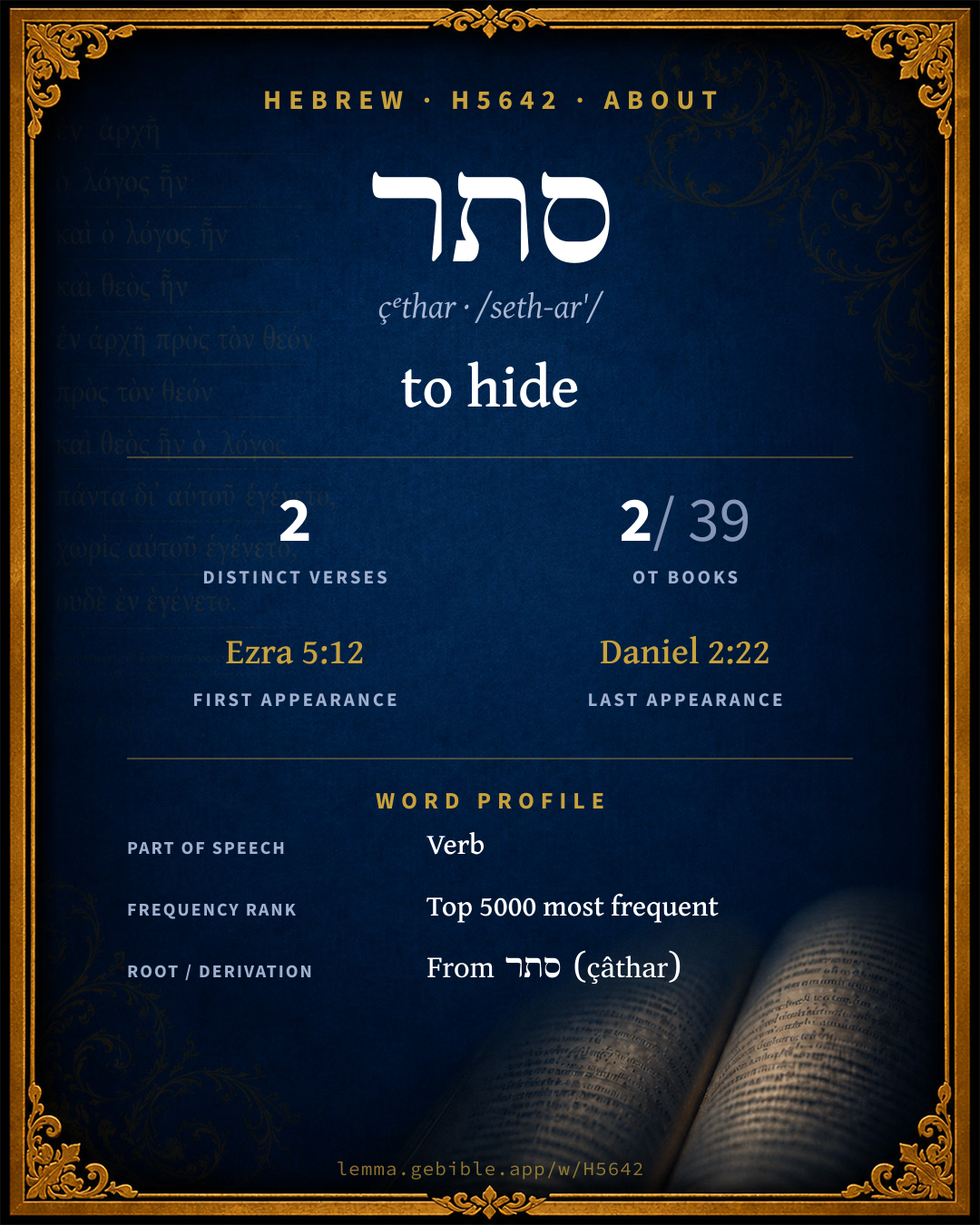
סְתַר
to hide
‘to hide’ is one of 2 main senses fuller range ↓
Full lexicon entry — Brown-Driver-Briggs (BDB)
From Brown-Driver-Briggs (BDB)
Where this word appears
Grammar key — what these labels mean
Part of speech
- Verb
- An action or state-of-being word.
Stem
- Qal
- The basic, simple active stem — the plain form of the verb (“he wrote”).
Form
- Perfect
- A completed action or state — Hebrew marks aspect (completeness) more than strict tense (“he wrote”).
Person
- 3rd Person
- The one spoken about (“he / she / it / they”).
Gender
- Masculine
- Grammatically masculine.
Number
- Singular
- One.
Grammatical forms
- Particle, Definite Article 1 time (50%)
- Verb, Qal, Perfect, 3rd Person, Masculine, Singular 1 time (50%)
Parsed forms decoded from the imported morphology (morphhb / Westminster Leningrad Codex — WLC text public domain, morphhb tagging CC BY 4.0), counted across 2 parsed occurrences — not distinct verses.
Every verse where H5642 appears — 2 distinct verses across 2 books. Click any verse to open its interlinear word-by-word view. Verse text shown in the World English Bible for context — . Each verse’s Hebrew form is shown with its reference; the English is not keyword-highlighted, since the data carries no word-level English alignment. Use “Compare translations” on any verse to read it across multiple English versions. This concordance covers the Hebrew Bible; Septuagint (Greek Old Testament) occurrences are not indexed here.
Ezra 1 verse
Daniel 1 verse
About this entry
At a glance — auto-summarized from this page’s data, not written by a person. Every figure links to its source below. This summary describes the numbers; it doesn’t interpret them.
סתר (çᵉthar) is a Hebrew verb most often rendered “to hide.” It is rare — just 2 verses in the entire Hebrew Bible. Ezra dominates its distribution — 1 of 2 verses. Scripture first uses it in Ezra 5:12. Ranging over 2 senses, it is not a single-sense word. The sections below give every sense, occurrence, and version rendering.
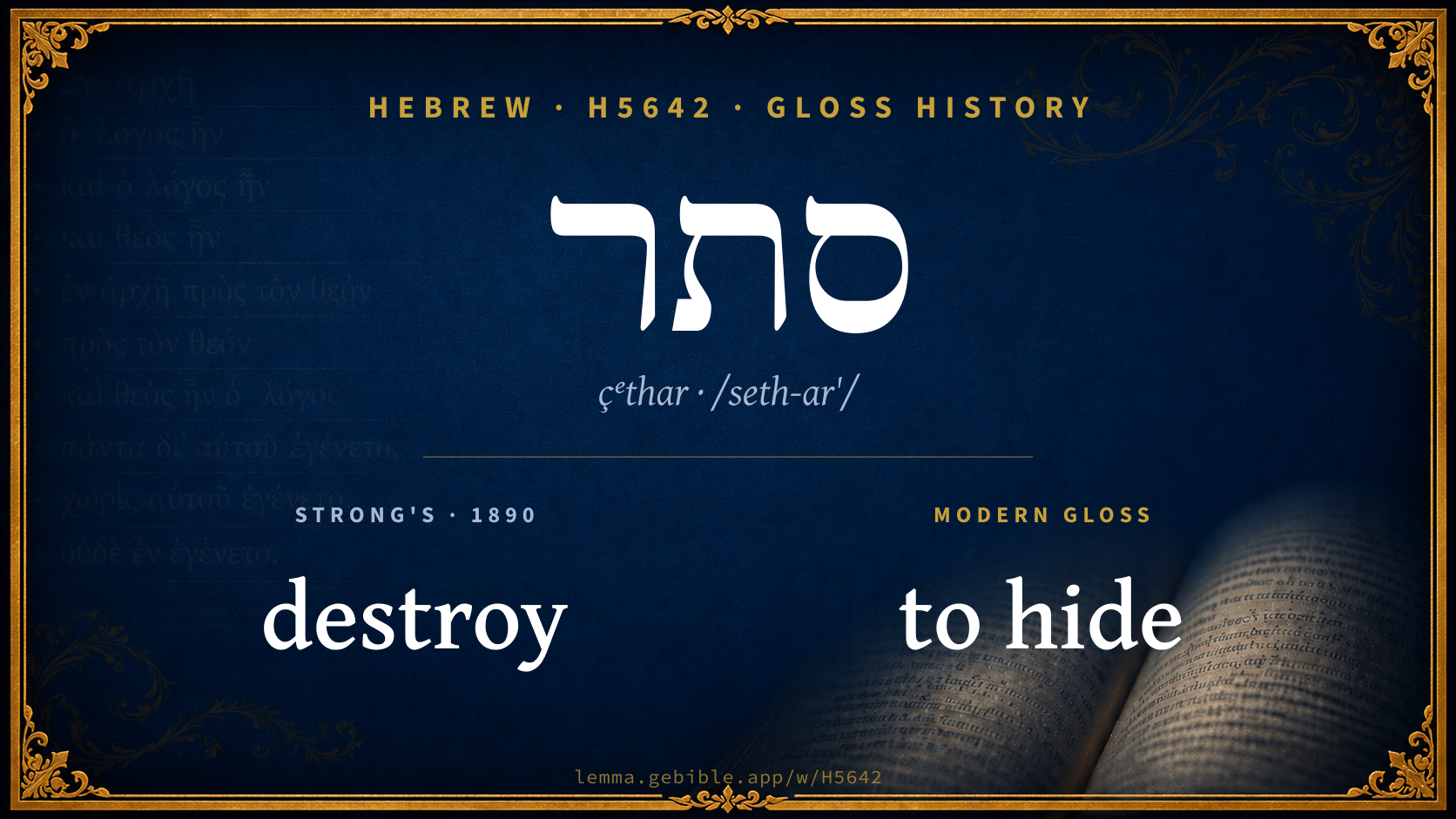
Gloss history
Strong's 1890 vs modern scholarship
About this word
Strong's H5642 catalogs a Hebrew word from the Hebrew Old Testament.
These counts are not copied from any lexicon or concordance. They are computed here, from the morphology-tagged Hebrew Old Testament. What Lemma adds →
- 2
- distinct verses
- The word appears in 2 distinct verses.
- 2 / 39
- OT books
- The word appears in 2 of 39 Old Testament books.
- #4,807
- by frequency
- Top 5000 most frequent Hebrew words (rank 4,807 of 8,640 Hebrew words by occurrence).
View all 2 occurrences in the concordance →
By traditional corpus
Conventional, traditional groupings — biblical authorship is debated, so this is a traditional corpus grouping, not an authorship claim. Each share is this word’s portion of its verses in that division of the Hebrew canon. Each figure is a share of the word’s 2 distinct verses.
- Writings (Ketuvim) 2 verses · 100%
How translations render this word
Counts come from each version’s own published word-to-Strong’s tagging or interlinear alignment — an approximate guide to how each version renders this word, not a word-level alignment the data otherwise carries. Because each total is that version’s own tagged count, the per-version totals vary from one another and need not match the appearance or distinct-verse counts above. These counts may also differ from a printed concordance because Lemma counts each distinctly tagged rendering and does not collapse phrase taggings into a single head-word total. This is a fixed set of word-tagged versions (KJV, ASV, BSB, ULT) and does not change with the reading translation you choose elsewhere. Each version’s license is shown beside its name below (and on Sources).
BDB lists this Strong’s number as 2 distinct words (homographs). Each count above pools all of them and is not split by sense — see the Senses section below. A low-frequency rendering may belong to a different one of those words, not the primary meaning.
- King James Version†: Destroyed 1×, Secret things 1×
- American Standard Version†: Destroyed 1×, Secret things 1×
- Berean Standard Bible†: Destroyed 1×, Hidden things 1×
- unfoldingWord Literal Text†: He destroyed 1×, Hidden things 1×
King James Version Public Domain
Renders H5642 across 2† tagged occurrences — most commonly:
American Standard Version Public Domain
Renders H5642 across 2† tagged occurrences — most commonly:
Berean Standard Bible Public Domain
Renders H5642 across 2† tagged occurrences — most commonly:
unfoldingWord Literal Text CC BY-SA 4.0
Renders H5642 across 2† tagged occurrences — most commonly:
Senses in the full BDB
What do BDB’s symbols mean?
BDB uses these scholarly abbreviations:
| Symbol | Meaning |
|---|---|
| 𝔊 | the Septuagint (the ancient Greek translation, LXX) |
| 𝔙 | the Vulgate (the Latin translation) |
| 𝔖 | the Syriac version (the Peshitta) |
| 𝔗 | the Targum (the Aramaic translation) |
| ψ | the Psalms |
| √ | root (the underlying root or stem) |
| ‖ | parallel passage (a synonymous or contrasted parallel) |
| † | the dagger: every passage where the word occurs is cited |
The 0 senses and sub-senses the full Brown-Driver-Briggs lexicon distinguishes for this word, in lexicon order (not ranked by frequency), with BDB’s own verbatim wording and sub-sense lettering. Shown in Hebrew script with BDB’s own scholarly abbreviations. The condensed entry is in the Lexicon Entry tab. See also the Forms in the corpus table below.
סתר I hide
סתר II destroy
Senses from the full Brown-Driver-Briggs lexicon (Brown, Driver, Briggs; Oxford 1906 — public domain), digitized via Sefaria, supplemented by the OpenScriptures HebrewLexicon (CC BY 4.0). Full attribution on Sources.
Word origin
I. [ סְתַר ] vb. Pa. hide;— Dn 2:22
II. [ סְתַר ] vb. destroy;— Pe. Ezr 5:12
— Brown-Driver-Briggs (Oxford 1906, public domain), digitized via Sefaria, supplemented by the OpenScriptures HebrewLexicon (CC BY 4.0). See Sources.
Derived from סתר (çâthar) (H5641) — to hide.
Jastrow Dictionary
A second Hebrew/Aramaic lexicon for comparison, covering Aramaic and post-biblical (Talmudic, Targumic, Midrashic) usage that the biblical-Hebrew BDB does not. Matched by lemma rather than by Strong’s number, so a lemma may carry more than one Jastrow headword (shown separately below), and the entries cover usage well beyond the Bible.
סָתַר I
- (b. h.) to cover, hide.
- to conceal. Meg. 13ᵃ (play on אסתר) שהיתה מְסַתֶּרֶת דבריה she used her words with discretion (ref. to Esth. II, 20); Yalk. Esth. 1053 (not שסתרת).—Part. pass. מְסוּתָּר; pl. מְסוּתָּרִים. Ab. d’R. N. ch. VI דברים המס׳ מבניִ אדם הוציאם וכ׳ things which are concealed to men, R. ‘Akiba brought forth to the light. e.g. Esther 2:20
- to hide. Yalk. Deut. 941 אע"פ שהִסְתַּרְתִּי פני וכ׳ although I hide my face before them, I will speak to him in a dream.
- to be hidden, protected; to hide one’s self. Midr. Till. to Ps. XIX, 7 לע׳'ל מי נִסְתָּר מחמתו וכ׳ in the future who will be protected from his heat?—Esp. to retire under suspicious circumstances (Num. V, 13). Sot. 3ᵃ קינא לה ונִסְתָּרָה he was jealous of her (forewarned her), and she retired (with the man). Y. ib. I, 16ᵇ bot. מה טיבה להִיסָּתֵר what business had she to retire? Bab. ib. 5ᵇ אל תִּסָּתְרִי do not hide thyself (with that man); ib. 2ᵇ (in Chald. dict.) לא תִיסָּתְרִי וכ׳ do not hide thyself with that man. Ber. 31ᵇ אלך ואֶסְתַּתֵּר וכ׳ I will go and seclude myself (with a man) before my husband. Ib. אם כן ילכו … ויִסְתַּתְּרוּ if this be so, all childless women would go and hide themselves; a. fr.—נִסְתָּרוֹת f.pl. a) secret things, mysteries. Ḥag. 13ᵃ (fr. Ben Sira) אין לך עסק בנ׳ thou must have nothing to do with (must not speculate on) mysteries; Gen. R. s. 8; a. e.—b) secret sins for which the whole community is made responsible. Snh. 43ᵇ לא ענש על הנ׳ וכ׳ the Lord did not punish (Israel) for secret sins until &c. Y. Sot. VII, end, 22ᵃ אין לכם עסק בנ׳ you will no more be made responsible for undetected sins. e.g. Numbers 5:13
סְתַר
- Pa. סַתֵּר same, to hide.—Part. pass. מְסַתַּר. Targ. Is. LXV, 16. Targ. Jer. XVI, 17 (ed. Wil. מִסַתְּרָן, corr. acc.).
- to hide one’s self; to find shelter. Targ. Koh. VII, 12.—*Targ. Y. I Deut. XXIX, 5 מִסְתְּרָא וכ׳ finding shelter in your schools.—Ber. 31ᵇ כיון דמִסְתַּתַּרְנָא when I closet myself (with a stranger), v. preced. Sot. 2ᵇ זמנין דלא אִיסְתַּתְּרָא ואמר איסתתרא (not איסתתר) it may happen that she did not closet herself with a man, but he (the husband) says that she did &c. Ib. ומִסְתַּתְּרָא וליכא וכ׳ Rashi (ed. ומיסתתרה) and she may closet herself, and we have in our days no waters … to test her &c.; a. e.
סָתַר II
- (= סחתר, Saf. of חתר; cmp. Arab. šatar) [to dig under,]
- 1. to upset, tear down. Meg. 31ᵇ אם אמרו לך זקנים סְתוֹר וכ׳ if the old tell thee, tear down, and the young, build, tear down and build not, v. סְתִירָה II; Ned. 40ᵃ. Sabb. VII, 2 הבונה והסוֹתֵר he who builds (on the Sabbath) or who tears down. Yoma 10ᵃ שיפלו בונין ביד סוֹתְרִין that the builders (of the Temple, the Persians) should fall through the hands of the destroyers (the Romans), v. סָתוֹרָא. Ab. d’R. N. ch. VI סְתָרוֹ ועקרו וכ׳ he dug under it (the rock) and broke it loose &c. Koh. R. to VII, 26 כותל קשה … וסוֹתְרוֹ a wall is strong, but man has more power and tears it down; a. fr.
- 2. [to stir up,] to loosen, unravel. Sot. I, 5 סותר את שערה the priest loosens her hair (Num. V, 18 ופרע); אם … לא היה סוֹתְרוֹ if her hair was beautiful, he did not loosen it. Treat. S’maḥ.ch. ch. VIII סוֹתְרִים שערות וכ׳ you may untie the hair of dead brides; a. e. e.g. Numbers 5:18
- 3. to dissolve, decompose. Lam. R. introd. (R. Ḥănina 1) (ref. to Prov. XXV, 20) כזה … וסוֹתְרוֹ כך היו סוֹתְרִים וכ׳ as one pours vinegar on natron and decomposes it, so they decomposed (counteracted) the words of the Law; v. infra. e.g. Proverbs 25:20
- 4. to undo, reverse, invalidate. Snh. III, 8 כל זמן … סותר את הדין whenever he offers new evidence, he reverses the decision, i.e. the court has to try his case again; לאחר שלשים יום אינו סותר after thirty days, the judgment cannot be disturbed.—Esp. to make void the days of a Nazarite’s vow which have been observed, to begin anew. Naz. II, 10 סותר שבעים he must count seventy days again. Ib. III, 3 ס׳ את הכל he must count over the whole period (of days); אינו ס׳ אלא שבעה he has to count only seven days over. Tosef. ib. II, 13 יש לו לִסְתּוֹר סותר וכ׳ if there is a portion of the period left to undo, i.e., if the period of his vow has not yet expired, he must count thirty days again; כל … ואין לו לסתור סותר וכ׳ whenever he becomes unclean on a day on which it is improper to offer a sacrifice, and he has nothing left to undo, i.e. his term has expired, and he lacks only a sacrifice to be released: he must count seven days; a. fr.—5 (logics) to contradict, disprove. Succ. 26ᵇ, a. fr. מעשה לסתור, v. מַעֲשֶׂה. Sabb. 13ᵇ שאלמלא … שהיו דבריו סוֹתְרִין וכ׳ but for him, the Book of Ezekiel would have been expunged from the canon, because its words seemed to contradict the words of the Law. Ib. 30ᵃ לא דייך שדבריך סותרין וכ׳ not only do thy words contradict those of David, but they contradict one another; a. fr.—Num. R. s. 13 לא אחד מהן סותר על חבירו neither of them conflicts with the other.—[Yalk. Ex. 356 שלא יסתרו, v. סָרַס I Hithpa.]
- to be disarranged, be undone. Y. Kil. IX, end, 32ᵈ; Y. Sabb. XIII, beg. 14ᵃ מִיסְתַּתֵּר הוא the web will go apart again, opp. מתקיים.
סְתַר ²
- 1. to tear down, destroy. Targ. Y. Deut. VII, 5. Targ. Jer. I, 19; a. fr.—Taan. 20ᵇ כל אשיתא … הווה ס׳ לה every threatening wall he ordered to be torn down. B. Bath. 3ᵇ לא לִיסְתּוֹר וכ׳ one must not tear down a synagogue before having built another one. Ib. סֵתְרֵי ובנו, v. סִתְוָא; a. fr.
- 2. to unravel, wind up. Ḥull. 60ᵃ, v. דַּוְלָלָא.
- same. Targ. Prov. XV, 25 (Var. ed. Lag. נסטר, corr. acc.). Targ. II Kings XI, 18; a. e.—Yeb. 116ᵇ קרע סַתְּרִי מזייך … rend thy garments, disarrange thy hair (in mourning). Ned. 50ᵇ עד דמְסַתְּרִין וכ׳ until the people of his household disarranged their hair for him (in sympathy with his pain).
- to be torn down. Meg. Taan. ch. VIII, v. סוֹרִיגָא.
סֵתֶר
- secrecy. Sot. I, 2 (2ᵃ) נכנסה עמו לבית הס׳ (not בס׳) if she went with him to a closeted place, v. סְתִירָה. Gen. R. s. 45 סִיתְרָהּ, v. גָּלוּי.—בַּסֵּ׳ in secret. B. Bath. 9ᵇ גדול העושה צדקה בס׳ וכ׳ he that dispenses charity in secret, is greater than Moses. Ḥag. 16ᵃ העובר עבירה בס׳ וכ׳ he who selects a secret place for committing a sin, is considered as though he pushed away the feet of the Divine Presence (denying the omniscience of God). Ab. IV, 4; a. fr.—Pl. סְתָרִים, constr. סִתְרֵי, סִי׳. Mikv. IX, 3; Lev. R. s. 15, a. fr. בית הס׳ covered parts of the body, posteriors &c. Meg. 3ᵃ מי הוא זה שגילה סְתָרַיי וכ׳ who is he that revealed my secrets to men? Ib. אני … סְתָרֶיךָ I did reveal thy secrets. Ḥag. 11ᵇ סתרי עריות the secrets of the laws of incest, i.e. the laws not explicitly stated (cmp. סְתָם). Y. Keth. V, 29ᵈ bot. סיתרי תורה the secrets of the Law, i.e. logical deductions; a. fr.
A Dictionary of the Targumim, the Talmud Babli and Yerushalmi, and the Midrashic Literature (Marcus Jastrow; London, Luzac, 1903) — Public Domain. Digitized via Sefaria. Digitized via Sefaria. Full attribution on Sources.
Forms in the corpus
The 2 distinct written forms H5642 takes in the Hebrew Bible, most frequent first — each parse links to that stem’s occurrences in the concordance. Hebrew forms include their vowel points and cantillation, so a single lemma takes many written forms.
| Form | Parsing | Example | Uses |
|---|---|---|---|
| וּ/מְסַתְּרָתָ֑/א | Particle, Definite Article | Daniel 2:22 | 1 |
| סַתְרֵ֔/הּ | Verb, Qal, Perfect, 3rd Person, Masculine, Singular | Ezra 5:12 | 1 |
Same root — word family
Other BDB entries built from the same root as H5642, grouped by Strong’s listed origin. These share a root / origin per the lexicon — not necessarily a shared meaning. Each links to that word’s own entry.
Derives from
Shares the same root
- מסתור miçtôwr H4563 shelter
- מסתר maçtêr H4564 hiding
- מסתר miçtâr H4565 hiding place
- סתר çêther H5643 hiding place
Proper names from this root
People and places named from this root — a name, not an additional meaning of the word.
Compare all same-root words → Showing 4 of 7 — not the complete family. 1 of the same-root words is a proper name (a person or place). They share a root, not necessarily a meaning.
Septuagint verse parallels
This word appears in 2 verses that also exist in the Greek Old Testament (Septuagint), out of the 2 Hebrew verses it occurs in. You can read those verses in Greek by switching the Old Testament edition to the Septuagint.
Read these verses in the Septuagint
This is a verse-level parallel only — the same verses exist in both the Hebrew and Greek Old Testaments. No word-level Hebrew↔Greek correspondence is claimed: the data carries no such alignment, so no Greek word is shown as this Hebrew word’s translation. Coverage is not total — the Septuagint omits the deuterocanon and renumbers the Psalms, so some Hebrew verses have no direct Greek parallel.