Micah 3:4

Hebrew (Westminster Leningrad Codex) Micah 3:4 appears in the Hebrew Old Testament. The text above is from the Westminster Leningrad Codex. Each word links to its Strong’s number, a concise gloss, and parsing drawn from the Open Scriptures Hebrew Bible morphology. Click any word for its full Brown-Driver-Briggs (BDB) entry.
Download image
Cite this verse

Micah 3:4 (World English Bible). Public Domain. Lemma interlinear Bible study tool, https://lemma.gebible.app/v/micah/3/4.

Show BibTeX & RIS
BibTeX
RIS
English Translation
Then they will cry to Yahweh, But he will not answer them. Yes, he will hide his face from them at that time, Because they made their deeds evil."
World English Bible · Public Domain
Download a study sheet

One document with this verse’s original text, its word-by-word gloss line, the meaning frame, cross-references with their text, attributed commentary, and full source and license credits — printable, and it pastes into notes with its structure intact.

This verse Autodidact and up

Study sheet (.html) Plain text (.txt)

A passage Seminary Student

Up to 50 verses in one chapter. A passage sheet keeps up to 6 commentary sources and 12 cross-references per verse, in the order this page ranks them, and says so on the sheet whenever that leaves anything out. Ask for a single verse and you get the Autodidact verse sheet above.

Everything on this page stays free to read, with no account — the sheet is a download of what is already on screen, not access to it.

Want to remove ads? Support Godless Engineer
Compare translations 3

The same verse in 3 English versions, stacked beneath the original-language interlinear above. Click any original word for its lexicon entry.

Each is an independent rendering of the whole verse — the interlinear is not word-aligned to these translations.

Highlighted words mark where these versions differ — a whole-verse word diff, not a word-by-word alignment.

  • World English Bible Public Domain
    Then they will cry to Yahweh, But he will not answer them. Yes, he will hide his face from them at that time, Because they made their deeds evil."
  • King James Version Public Domain
    Then shall they cry unto the LORD, but he will not hear them: he will even hide his face from them at that time, as they have behaved themselves ill in their doings.
  • unfoldingWord Literal Text CC BY-SA 4.0
    Then they will cry out to Yahweh, but he will not answer them. And he will hide his face from them at that time, just as they have made their deeds evil. q1

unfoldingWord Literal Text — © unfoldingWord, licensed CC BY-SA 4.0. Word-aligned USFM3 via Door43 (git.door43.org/unfoldingWord/en_ult).

Versions to compare (up to 4)

3 of 4 selected

Show all 18 translations

Every available English version of this verse, each an independent rendering of the whole verse.

  • World English Bible Public Domain
    Then they will cry to Yahweh, But he will not answer them. Yes, he will hide his face from them at that time, Because they made their deeds evil."
  • Berean Standard Bible Public Domain
    Then they will cry out to the LORD, but He will not answer them. At that time He will hide His face from them because of the evil they have done.
  • Majority Standard Bible Public Domain
    Then they will cry out to the LORD, but He will not answer them. At that time He will hide His face from them because of the evil they have done.
  • King James Version Public Domain
    Then shall they cry unto the LORD, but he will not hear them: he will even hide his face from them at that time, as they have behaved themselves ill in their doings.
  • American Standard Version (1901) Public Domain
    Then shall they cry unto Jehovah, but he will not answer them; yea, he will hide his face from them at that time, according as they have wrought evil in their doings.
  • Revised Version (1885) Public Domain
    Then shall they cry unto the LORD, but he will not answer them: yea, he will hide his face from them at that time, according as they have wrought evil in their doings.
  • Geneva Bible (1599) Public Domain
    Then shall they crye vnto the Lord, but he will not heare them: he wil euen hide his face from them at that time, because they haue done wickedly in their workes.
  • Douay-Rheims (1899) Public Domain
    Then shall they cry to the Lord, and he will not hear them: and he will hide his face from them at that time, as they have behaved wickedly in their devices.
  • Young's Literal Translation Public Domain
    Then do they cry unto Jehovah, And He doth not answer them, And hideth His face from them at that time, As they have made evil their doings.
  • Literal Standard Version CC BY-SA 4.0
    Then they cry to YHWH, || And He does not answer them, || And hides His face from them at that time, || As they have made evil their doings.
  • Unlocked Literal Bible CC BY-SA 4.0
    Then you rulers will cry out to Yahweh, but he will not answer you. He will hide his face from you at that time, because you have done evil deeds.”
  • unfoldingWord Literal Text CC BY-SA 4.0
    Then they will cry out to Yahweh, but he will not answer them. And he will hide his face from them at that time, just as they have made their deeds evil. q1
  • Darby Bible Public Domain
    Then shall they cry unto Jehovah, but he will not answer them; and he will hide his face from them at that time, according as they have wrought evil in their doings.
  • World Messianic Bible Public Domain
    Then they will cry to the LORD, but he will not answer them. Yes, he will hide his face from them at that time, because they made their deeds evil.”
  • Webster's Bible Public Domain
    Then shall they cry to the LORD, but he will not hear them: he will even hide his face from them at that time, as they have behaved themselves ill in their doings.
  • Free Bible Version CC BY-SA 4.0
    Then they'll cry out to the Lord, but he won't answer them. He will turn away from them at that time because of the evil things they have done.
  • Bible in Basic English Public Domain
    Then they will be crying to the Lord for help, but he will not give them an answer: yes, he will keep his face veiled from them at that time, because their acts have been evil.
  • JPS Tanakh (1917) Public Domain
    Then shall they cry unto the LORD, but He will not answer them; yea, He will hide His face from them at that time, according as they have wrought evil in their doings.

Literal Standard Version (2020), Covenant Press — licensed CC BY-SA 4.0. Text via the HelloAO Bible API (eBible.org). Unlocked Literal Bible (unfoldingWord) — licensed CC BY-SA 4.0. Text via the HelloAO Bible API (eBible.org). unfoldingWord Literal Text — © unfoldingWord, licensed CC BY-SA 4.0. Word-aligned USFM3 via Door43 (git.door43.org/unfoldingWord/en_ult). Free Bible Version, Dr. Jonathan Gallagher — licensed CC BY-SA 4.0. Text via the HelloAO Bible API (eBible.org).

Word by word

More ways to search: Search by grammar → Find every occurrence → Compare this word →

Practice this passage: Drill this verse → Learn its vocabulary →

מַעַלְלֵיהֶֽם
maʻălâl
H4611
“deeds · their”
Noun, Common, Masculine, Plural, Construct + Suffix, Personal, 3rd Person, Masculine, Plural
Part of Speech
Noun
Type
Common
Gender
Masculine
Number
Plural
State
Construct
Full BDB Definition

Origin: from H5953

TWOT: 1627e

deed, practice - practice (usually bad) - deeds - acts
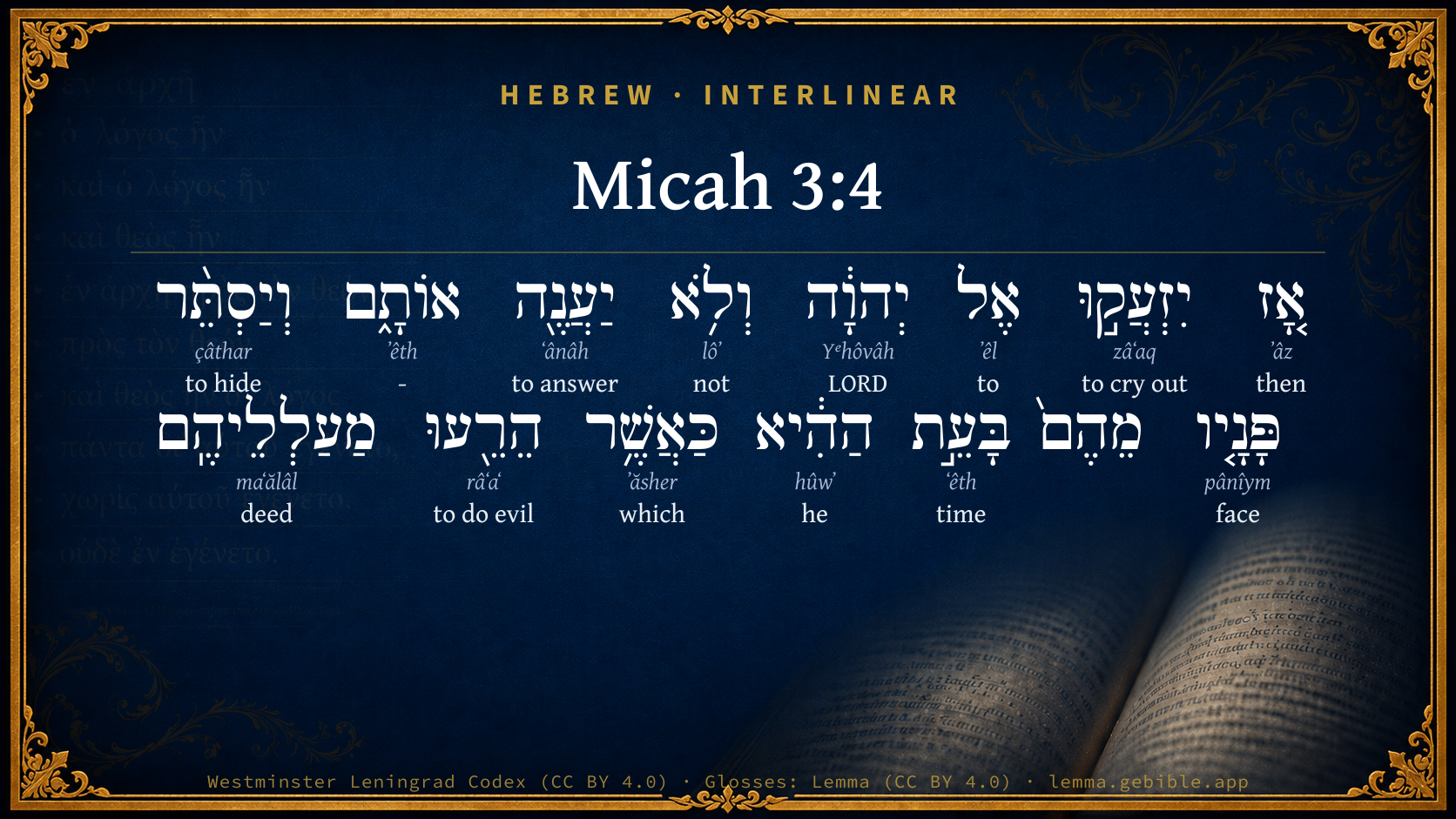
  1. אָ֚ז ʼâz H227 “then” Adverb
  2. יִזְעֲק֣וּ zâʻaq H2199 “to cry out” Verb, Qal, Imperfect, 3rd Person, Masculine, Plural
  3. אֶל ʼêl H413 “to” Preposition
  4. יְהוָ֔ה Yᵉhôvâh H3068 “LORD” Noun, Proper
  5. וְלֹ֥א lôʼ H3808 “and · not” Conjunction + Particle, Negative
  6. יַעֲנֶ֖ה ʻânâh H6030 “to answer” Verb, Qal, Imperfect, 3rd Person, Masculine, Singular
  7. אוֹתָ֑ם ʼêth H853 “- · them” Particle, Direct Object + Suffix, Personal, 3rd Person, Masculine, Plural
  8. וְיַסְתֵּ֨ר çâthar H5641 “and · to hide” Conjunction + Verb, Hiphil, Imperfect, 3rd Person, Masculine, Singular
  9. פָּנָ֤יו pânîym H6440 “face(s) · his” Noun, Common, Both, Plural, Construct + Suffix, Personal, 3rd Person, Masculine, Singular
  10. בָּעֵ֣ת ʻêth H6256 “in/at the · time” Preposition, Determined + Noun, Common, Both, Singular, Absolute
  11. הַהִ֔יא hûwʼ H1931 “the · he” Particle, Definite Article + Pronoun, Personal, 3rd Person, Feminine, Singular
  12. כַּאֲשֶׁ֥ר ʼăsher H834 “like/as · which” Preposition + Particle, Relative
  13. הֵרֵ֖עוּ râʻaʻ H7489 “to do evil” Verb, Hiphil, Perfect, 3rd Person, Common, Plural

About this verse

These counts appear in no published source. They are computed here, from the morphology-tagged text and Lemma’s own curated glosses. What Lemma adds →

15
words
14
distinct lemmas
Prophets
section

Shared distinctive vocabulary

מַעַלְלֵיהֶֽם deed H4611 occurs in 41 verses of the Hebrew Bible. Also found in:

Grammatical profile

  • 4 verbs
  • 4 nouns
  • 1 pronoun
  • 2 prepositions
  • 1 adverb
  • 3 particles

Verb forms

  • יִזְעֲק֣וּ Qal · Imperfect
  • יַעֲנֶ֖ה Qal · Imperfect
  • וְיַסְתֵּ֨ר Hiphil · Imperfect
  • הֵרֵ֖עוּ Hiphil · Perfect

Hebrew & Septuagint length

In English translation the verse runs 29 words from the Hebrew and 36 from the Septuagint (LXX English) — closely comparable.

A rough comparison of the two English renderings, which tokenize alike — not a word-level alignment.

Word counts can differ between the Hebrew and the Greek without any difference in meaning — e.g. the Hebrew direct-object marker אֵת has no separate Greek word, and Greek often adds the article ὁ.

In the original languages it is 15 Hebrew tokens and 28 Greek tokens — but the two are counted differently (Hebrew bundles its prefixes and suffixes into one token; the Greek is in lemma form), so that isn’t a like-for-like length.

Cross-references

19

Topical passages linked to Micah 3:4 in the Treasury of Scripture Knowledge — connected by theme and wording, ordered by reader-vote popularity; previews shown in the World English Bible.

  • Proverbs 1:28 Then will they call on me, but I will not answer. They will seek me diligently, but they will not find me;
  • Isaiah 1:15 When you spread forth your hands, I will hide my eyes from you; Yes, when you make many prayers, I will not hear. Your hands are full of blood.
  • Psalms 18:41 They cried, but there was none to save; Even to Yahweh, but he didn't answer them.
  • Ezekiel 8:18 Therefore will I also deal in wrath; my eye shall not spare, neither will I have pity; and though they cry in my ears with a loud voice, yet will I not hear them.
  • Deuteronomy 31:17–18 Then my anger shall be kindled against them in that day, and I will forsake them, and I will hide my face from them, and they shall be devoured, and many evils and troubles shall come on them; so that they will say in that day, Haven't these evils come on us because our God is not among us?
  • Deuteronomy 32:19–20 Yahweh saw [it], and abhorred [them], Because of the provocation of his sons and his daughters.
  • Matthew 7:22 Many will tell me in that day, 'Lord, Lord, didn't we prophesy in your name, in your name cast out demons, and in your name do many mighty works?'
  • Isaiah 3:11 Woe to the wicked! Disaster is upon them; For the deeds of his hands will be paid back to him.
  • Isaiah 59:1–15 Behold, Yahweh's hand is not shortened, that it can't save; neither his ear heavy, that it can't hear:
  • Micah 2:3–4 Therefore thus says Yahweh: "Behold, I am planning against these people a disaster, From which you will not remove your necks, Neither will you walk haughtily; For it is an evil time.
  • Zechariah 7:13 It has come to pass that, as he called, and they refused to listen, so they will call, and I will not listen," said Yahweh of Hosts;
  • John 9:31 We know that God doesn't listen to sinners, but if anyone is a worshipper of God, and does his will, he listens to him.
  • James 2:13 For judgment is without mercy to him who has shown no mercy. Mercy triumphs over judgment.
  • Proverbs 28:9 He who turns away his ear from hearing the law, Even his prayer is an abomination.
  • Jeremiah 2:27–28 who tell a stock, You are my father; and to a stone, You have brought me forth: for they have turned their back to me, and not their face; but in the time of their trouble they will say, Arise, and save us.
  • Jeremiah 5:31 the prophets prophesy falsely, and the priests bear rule by their means; and my people love to have it so: and what will you do in the end of it?
  • Jeremiah 33:5 while [men] come to fight with the Chaldeans, and to fill them with the dead bodies of men, whom I have killed in my anger and in my wrath, and for all whose wickedness I have hid my face from this city:
  • Luke 13:25 When once the master of the house has risen up, and has shut the door, and you begin to stand outside, and to knock at the door, saying, 'Lord, Lord, open to us!' then he will answer and tell you, 'I don't know you or where you come from.'
  • Romans 2:8–9 but to those who are self-seeking, and don't obey the truth, but obey unrighteousness, will be wrath and indignation,

Cross-references courtesy of OpenBible.info (CC BY 4.0).

Hebrew and Greek witnesses Masoretic Hebrew ↔ Greek Septuagint

The same verse in the two great witnesses to the Old Testament, shown verse-for-verse.

These are two independent witnesses, not word-aligned to each other, and the Septuagint is shown in lemma (dictionary) form.

Hebrew Micah 3:4 Masoretic · Westminster Leningrad Codex

אָ֚ז יִזְעֲק֣וּ אֶל יְהוָ֔ה וְלֹ֥א יַעֲנֶ֖ה אוֹתָ֑ם וְיַסְתֵּ֨ר פָּנָ֤יו מֵהֶם֙ בָּעֵ֣ת הַהִ֔יא כַּאֲשֶׁ֥ר הֵרֵ֖עוּ מַעַלְלֵיהֶֽם

Then they will cry to Yahweh, But he will not answer them. Yes, he will hide his face from them at that time, Because they made their deeds evil."

World English Bible · Public Domain

Greek LXX Micah 3:4 Septuagint · lemma form

οὕτως κράζω πρός κύριος καί οὐ εἰςἀκούω αὐτός καί ἀποστρέφω ὁ πρόσωπον αὐτός ἀπό αὐτός ἐν ὁ καιρός ἐκεῖνος ἀντί ὅς πονηρεύομαι ἐν ὁ ἐπιτήδευμα αὐτός ἐπί αὐτός

thus they shall cry to the Lord, but he shall not listen to them; and he shall turn away his face from them at that time, because they have done wickedly in their practices against themselves.

LXX2012 (modern English Septuagint) · Public Domain

On this verse, The Pulpit Commentary discusses the Septuagint’s reading. Read the note in Commentary ↓

Hebrew: Westminster Leningrad Codex (CC BY 4.0). Greek: Septuagint (public domain); English from LXX2012 (modern English Septuagint) (Public Domain). How the Septuagint differs from the Hebrew →

Targum (Aramaic paraphrase)

1

The Targum is the ancient Jewish Aramaic paraphrase of the Hebrew Scriptures — an interpretive translation, not the Hebrew text itself. Onkelos (literal) and Pseudo-Jonathan (expansive) render the Torah, and Jonathan the Prophets. Coverage is partial: where no permissively-licensed English translation exists for a verse, only the Aramaic is shown. This is verse-level text, not a word-by-word alignment to the Hebrew.

  1. Targum Jonathan Prophets (Joshua–Malachi)
    בְּכֵן יְצַלוּן קֳדָם יְיָ וְלָא יְקַבֵּל צְלוֹתְהוֹן וִיסַלֵק שְׁכִנְתֵּיהּ מִנְהוֹן בְּעִדָנָא הַהִיא כְּמָא דְאַבְאִישׁוּ עוֹבָדֵיהוֹן:

    (no public-domain English translation for this verse)

    Targum Jonathan — Aramaic: “Mikraot Gedolot” (public domain). English: “Sefaria Community Translation” (CC0 1.0 (public-domain dedication)); “London "Chaldee Paraphrase," 1871” (public domain). Text via Sefaria.

Commentary

Notes on Micah 3:4 from classic Christian and Jewish commentators (each source and its license shown beneath its notes). The classic Christian expositions comment on the surrounding passage and are grouped to its opening verse, so a note may address several verses; the Jewish commentaries on the Tanakh (Rashi and others) are per-verse, so they appear only where the commentator wrote on this verse.

Lemma curates 59 commentaries, every one of them public domain or Creative Commons licensed, each selected and text-cleaned for this edition rather than reprinted as found. About our sources →

The Cambridge Bible for Schools and Colleges

gen. ed. J. J. S. Perowne

4. Then shall they cry] We must suppose that, when Micah delivered this prophecy (of which we can have but a summary), he introduced between Mic_3:3 and Mic_3:4 a description of ‘the day of the Lord,’ the day of just retribution.

The Cambridge Bible for Schools and Colleges (gen. ed. J. J. S. Perowne; Cambridge University Press, 1878–1918) — public domain. Text from a community e-Sword module.

Trapp's Complete Commentary

John Trapp

Mic 3:4 Then shall they cry unto the LORD, but he will not hear them: he will even hide his face from them at that time, as they have behaved themselves ill in their doings.

Ver. 4. Then shall they cry unto the Lord, but he will not hear them] Then, sc. when God shall have changed their cheer, pulled the fat morsel from between their teeth, and fed them with the bread of affliction and water of affliction, 1Ki 22:27, with prisoners’ pittance, as they call it, which will neither keep them alive nor suffer them to die; then shall they cry and whine as hogs when hungry, as dogs when tied up from their meat; but God will not hear them. He will even cast out their prayers with contempt, as being the prayers of the flesh for ease, and not of the spirit for grace. They cry unto the Lord aloud, but it is only to be rid of his rod; they roar when upon the rack, but it is only to get off; they look ruefully, as the fox doth when taken in a gin, but it is only to be set at liberty; they chatter out a charm when God’s chastening is upon them, yea, they may be with child (as it were) of a prayer, and yet bring forth nothing but wind, Isa 26:16-18. For either God answereth them not at all, which was Saul’s case and curse, 1Sa 28:15, and Moab’s, Isa 16:12, and David’s enemies’, Psa 18:41; or else he give them bitter answers, Eze 14:4 Jdg 10:13-14. Or if better; it is but for a further mischief, that he may curse their blessings, and consume them after that he had done them good, Jos 24:20. Their preservation from one evil is but a reservation to seven worse; as we see in Pharaoh, Sennacherib, Ahab, and others. "Lo, this is the portion of a wicked man with God, and the heritage of oppressors which they shall receive of the Almighty," Job 27:13-15, &c. See the place. Remediless misery shall befall them, calamities that shall wring from them clamours, but to no purpose or profit. See Pro 1:28.

He will even hide his face from them] That is, withdraw his favour, care, providence, help, presence, and benefits, of all which the face is the symbol: that like as they have turned upon God the back and not the face, and have been merciless to men, hiding their eyes from their own flesh, Isa 58:7; so shall it be done to them in the day of their distress. God will award them judgment without mercy who showed no mercy, Jas 2:18. He will set off all hearts from them, as he did from wicked Haman, when the king frowned upon him. Lastly, he will turn their own consciences loose upon them (as once he did upon Joseph’s brethren, Gen 42:21), to ring that doleful knell in their ears, Isa 33:1, "Woe to thee that spoileth," &c. "when thou shalt cease to spoil, thou shalt be spoiled," &c. Talionis lege mulctabere, as Adonibezek, Phocas, Charles IX. See Pro 21:18. {See Trapp on "Pro 21:18"}

John Trapp, A Commentary or Exposition upon All the Books of the Old and New Testament (1647–1656) — public domain. Text from a community e-Sword module.

Tyndale Open Study Notes

Tyndale Open Resources

3:4 Then: Even after oppressing the Lord’s people, the leaders would selfishly beg for help from the Lord.

Tyndale Open Study Notes — © Tyndale Open Resources, licensed CC BY-SA 4.0. Text via the HelloAO Bible API.

Geneva Bible (1599)

Geneva Bible translators

That is, when I shall visit their wickedness: for though I hear the godly before they cry, Isa. 65:24, yet I will not hear these though they cry, Isa. 1:15 and Ezek. 8:18; James 2:13; 1 Pet. 3:11, 12.

Geneva Bible (1599) marginal notes — public domain. Text via Bolls.life.

Jamieson, Fausset & Brown

Robert Jamieson, A. R. Fausset & David Brown

Then--at the time of judgment, which Micah takes for granted, so certain is it (compare Mic 2:3).

they cry . . . but he will not hear--just as those oppressed by them had formerly cried, and they would not hear. Their prayer shall be rejected, because it is the mere cry of nature for deliverance from pain, not that of repentance for deliverance from sin.

ill in their doings--Men cannot expect to do ill and fare well.

Jamieson, Fausset & Brown — Commentary Critical and Explanatory on the Whole Bible (1871) — public domain (CC PDM 1.0). Text via the HelloAO Bible API.

Adam Clarke's Commentary

Verse 4. Then shall they cry] When calamity comes upon these oppressors, they shall cry for deliverance: but they shall not be heard; because, in their unjust exactions upon the people, they went on ruthlessly, and would not hear the cry of the oppressed.

Adam Clarke's Commentary on the Bible (1810–1826) — public domain. Text from a community e-Sword/MySword module.

John Calvin's Commentaries

Micah now denounces judgment on the chief men, such as they deserved. He says, They shall cry then to Jehovah The adverb אז, az, is often put indefinitely in Hebrew, and has the force of a demonstrative, and may be taken as pointing out a thing, (δεικτικως — demonstratively,) then, or there, as though the Prophet pointed out by his finger things which could be seen, though they were far away from the sight of men. But in this place, the Prophet seems rather to pursue the subject to which I have already referred: for he had before stated that God would take vengeance on that people. This adverb of time then is connected with the other combinations, which have been already explained. If, however, any one prefer a different meaning, namely that the Prophet meant here to hold them in suspense, as to the nearness of God’s vengeance, I do not oppose him, for this sense is not unsuitable. However this may be, the Prophet here testifies that the crimes of the chief men would not go unpunished, though they did not think themselves to be subject either to laws or to punishment. As then the princes and magistrates regarded themselves as exempt, by some imaginary privilege, from the lot of other people, the Prophet declares here expressly, that a distress was nigh at hand, which would extort a cry from them: for by the word, cry, he means the miseries which were nigh at hand. They shall then cry in their distress. I have now explained the design of the Prophet.

We indeed see how at this day those who are in high stations swell with arrogance; for as they abound in wealth, and as honor is as it were an elevated degree, so that being propped up by the shoulders of others they seem eminent, and as they are also feared by the rest of the people, they are on these accounts led to think that no adversity can happen to them. But the Prophet says, that such would be their distress, that it would draw a cry from them.

They shall then cry, but Jehovah will not hear; that is, they shall be miserable and without any remedy. Jehovah will not answer them, but will hide from them his face, as they have done perversely; that is, God will not hear their complaints; for he will return on their own heads all the injuries with which he now sees his own people to be afflicted. And thus God will show that he was not asleep, while they were with so much effrontery practicing all kinds of wrong.

It may however be asked here, how it is that God rejects the prayers and entreaties of those who cry to him? It must first be observed, that the reprobate, though they rend the air with their cries, do not yet direct their prayers to God; but if they address God himself, they do this clamorously; for they expostulate with him, and contend with him, yea, they vomit out their blasphemies, or at least they murmur and complain of their evils. The ungodly then cry, but not to the Lord; or if they address their cries to God, they are, as it has been said, full of glamour. Hence, except one is guided by the Spirit of God, he cannot pray from the heart. And we know that it is the peculiar office of the Spirit to raise up our hearts to heaven: for in vain we pray, except we bring faith and repentance: and who is the author of these but the Holy Spirit? It appears then that the ungodly so cry, that they only violently contend with God: but this is not the right way of praying. It is therefore no wonder that God rejects their clamors. The ungodly do indeed at times pour forth a flood of prayers and call on God’s name with the mouth; but at the same time they are, as we have said, full of perverseness, and they never really humble themselves before God. Since then they pour forth their prayers from a bitter and a proud heart, this is the reason why the Prophet says now, that the Lord would not then hear, but hide his face from them at that time, inasmuch as they acted perversely

He shows here that God would not be reconciled to men wholly irreclaimable, who could not be restored by any means to the right way. But when any one falls [and repents] he will ever find God propitious to him, as soon as he cries to him; but when with obstinate minds we pursue our own course, and give no place to repentance, we close up the door of mercy against ourselves; and so what the Prophet teaches here necessarily takes place, — the Lord hides his face in the day of distress. And we also hear what the Scripture says, — that judgment will be without mercy to those who are not merciful, (James 2:11.) Hence if any one be inexorable to his brethren, (as we see at this day many tyrants to be, and we also see many in the middle class to be of the same tyrannical and wholly sanguinary disposition,) he will at length, whoever he may be, meet with that judgment which Micah here denounces. The sentence then is not to be taken in a general sense, as though he had said, that the Lord would not be reconciled to the wicked; but he points out especially those irreclaimable men, who had wholly hardened themselves, so that they had become, as we have already seen, altogether inflexible. The Prophet now comes to his second reproof.

John Calvin's Commentaries (1540-1563) — public domain. Text from the Calvin Translation Society English edition (1840s-50s) via the Christian Classics Ethereal Library (ccel.org). Calvin's coverage is partial (roughly two-thirds of the Bible); uncommented books and verses are honest gaps, never fabricated. The 19th-century editor's footnotes and remarks are omitted so the notes are faithfully Calvin's own voice.

Ellicott's Commentary for English Readers

(4) Then shall they cry.—“Then”—i.e., in the day of retribution—“then shall they call upon me, saith the Lord, but I will not hear; they shall seek me early, but they shall not find me; and that because they hated knowledge, and received not the fear of the Lord, but abhorred my counsel and despised my correction. Then shall it be too late to knock when the door shall be shut, and too late to cry for mercy when it is the time of justice” (Commination Service). So also Isaiah declared (Isa_1:15): “When ye spread forth your hands, I will hide mine eyes from you; yea, when ye make many prayers, I will not hear: your hands are full of blood.”

A Bible Commentary for English Readers, edited by Charles John Ellicott (1878–1897) — public domain. Text from a community e-Sword module.

John Gill's Exposition

Then shall they cry unto the Lord, but he will not hear them,.... When all the above evils threatened them in the preceding chapters shall come upon them; when the enemy shall invade their hind, besiege their cities, and take them, and they, their families and substance, just ready to fall into their hands, they shall cry unto the Lord; or pray unto him, as the Targum, in the time of their distress; but he will not hear their prayer, so as to answer it according to their desire; that is, he will not save them from imminent danger, but deliver them up, them, and all that belong unto them, into the hands of such that shall use them as they have done others:

he will even hide his face from them at that time; turn his back upon them, and a deaf ear to them, and show them no favour, nor grant them any help and protection:

as they have behaved themselves ill in their doings; he will punish them according to the law of retaliation; as when the poor cried unto them, when they were stripping them of their substance, and they would not hearken to them, so now, when they cry unto the Lord in their distress, he will not hearken to them; and as they turned their backs, and hid their faces from those that were afflicted by them, and would show them no favour, so will the Lord deal with them; and as they exercised the utmost cruelty and barbarity that could be done, they will now be given up into the hands of cruel and merciless men, that will use them in like manner: or, "because they have done ill in their doings" (b) to the poor, whose cause God will defend and vindicate.

(b) "eo quod", Sept. "quia", Drusius; "pro eo quod", Grotius.

John Gill's Exposition of the Whole Bible (1746–1763) — public domain (CC PDM 1.0). Text via the HelloAO Bible API.

Albert Barnes' Notes on the Bible

Then shall they cry unto the Lord - “Then.” The prophet looks on to the Day of the Lord, which is always before his mind. So the Psalmist, speaking of a time or place not expressed, says, “There were they in great fear” Psa 53:5. He sees it, points to it, as seeing what those to whom he spoke, saw not, and the more awfully, because he saw, with superhuman (certain) vision, what was “hidden from their eyes.” The then was not then, “in the time of grace,” but when the Day of grace should be over, and the Day of Judgment should be come. So of that day, when judgment should set in, God says in Jeremiah, “Behold I will bring evil upon them which they shall not be able to go forth of, and they will cry unto Me, and I will not hearken unto them” Jer 11:11. And David, “They cried and there was none to save; unto the Lord, and He answered them not” Psa 18:41. And Solomon; “Whoso stoppeth his ears at the cry of the poor, he shall cry himself and shall not be heard” Pro 21:13. And James, “He shall have judgment without mercy, that hath shewed no mercy” Jam 2:13. The prayer is never too late, until judgment comes ; the day of grace is over, when the time of judgment has arrived. “They shall cry unto the Lord, and shall not be heard, because they too did not hear those who asked them, and the Lord shall turn His Face from them, because they too turned their face from those who prayed them.”

He will even hide His Face - He will not look in mercy on those who would not receive His look of grace. Your sins, He says by Isaiah, “have hid His face from you, that He heareth not.” O what will that turning away of the Face be, on which hangs eternity!

As - There is a proportion between the sin and the punishment . As I have done, so God hath requited me. “They have behaved themselves ill in their doings. literally have made their deeds evil.” The word rendered doings is almost always used in a bad sense, mighty deeds, and so deeds with a high hand. Not ignorantly or negligently, nor through human frailty, but with set purpose they applied themselves, not to amend but to corrupt their doings, and make them worse. God called to them by all His prophets, make good your doings Jer 35:15; and they, reversing it, used diligence to make their doings evil. Jerome: “All this they shall suffer, because they were not rulers, but tyrants; not Prefects, but lions; not masters of disciples, but wolves of sheep; and they sated themselves with flesh and were fattened, and, as sacrifices for the slaughter, were made ready for the punishment of the Lord. Thus far against evil rulers; then he turns to the false prophets and evil teachers, who by flatteries subvert the people of God, promising them the knowledge of His word.”

Albert Barnes' Notes on the Bible (1834–1885) — public domain. Text from a community e-Sword/MySword module.

Matthew Poole's English Annotations

Then; when that time and those miseries which Micah foretells shall come upon them, Mic 1:6-8; 2:3, when God shall retaliate and pay these great ones in their own coin. They; the cruel oppressors, these tyrannical judges, that pitied none, devoured all, and feared not the Divine vengeance.

Cry unto the Lord, as if they were his, and as if he were bound to deliver; they then shall own he can, and none else can deliver them, and they will expect a saving hand after all their rebellions against and contempts of God.

But he will not hear them; as they heard the cry of the oppressed, but would not hear; so God will hear the cry of their distresses, but not hear the requests they make; he will do no more for them than as if he did not hear them, he will be as a stranger to their case.

He will even hide his face from them; they turned away their face from beholding and pitying the poor, now God will turn away his eye from them, and, as if unconcerned, leave them to their own distresses, and their enemies’ rage and cruelty. At that time: this is added to assure them they should have least respect from God when they need it most; so they shall receive what they gave, judgment without mercy, as it is Jam 2:13.

As they have behaved themselves ill in their doings: this speaks both the reason why, and the manner how, God will thus leave them to the oppressor; the greatness of their sin deserved this, and such was the quality of their sins, that nothing fitter than a retaliation to punish the sin, convince the sinner, teach the world righteousness, and to vindicate God.

Matthew Poole's English Annotations on the Holy Bible (1683–1685) — public domain. Text from a community e-Sword/MySword module.

Whedon's Commentary on the Bible

Daniel D. Whedon

4. Such criminals Jehovah will forsake in the hour of judgment.

Not hear — They will cry unto him for deliverance, but he will leave them to their terrible fate. As they would not heed the cry of the oppressed, so Jehovah will not heed them.

Hide his face — In anger (compare Hos_5:15).

Then… at that time — The context leaves no doubt that these words refer to the time of judgment. Cheyne says, “We must suppose that, when Micah delivered this prophecy (of which we can have but a summary), he introduced between Mic_3:3-4 a description of the ‘day of Jehovah,’ the day of just retribution.” That we have but a summary of the prophet’s message is probably true, but it is not so certain that a description of the day of Jehovah, or even a specific reference to it, was needed; the people would comprehend the prophet’s meaning without it (compare the use of “now” in Amo_6:7; Hos_2:10).

Daniel D. Whedon (gen. ed.), Commentary on the Old and New Testaments (1874–1909) — public domain. Text from a community e-Sword module.

The Pulpit Commentary

The merciless shall not obtain mercy. Then, when the day of chastisement has come, "the day of the Lord," of which, perhaps, the prophet spoke more fully when he originally delivered this address. He will not hear them. A just retribution on those who refused to hearken to the cry of the poor and needy. (comp. Psa_18:41 Pro_1:28 Jer_11:11 Jam_2:13) As they have behaved themselves ill in their doings; according as they have made their actions evil, or because they have, etc.; any wn (Septuagint).

The Pulpit Commentary (1880–1919), ed. H.D.M. Spence-Jones & Joseph S. Exell — public domain. Text from a community e-Sword module.

John Wesley's Explanatory Notes

Then - When these miseries come upon them.

John Wesley, Explanatory Notes Upon the Whole Bible (1754–1765) — public domain. Text via the GEBible commentary corpus.

unfoldingWord translationNotes

Door43 World Missions Community

General Information:

Micah continues speaking.

cry out to Yahweh

"shout to Yahweh for help"

he will not answer you

"he will not do what you ask him to do"

He will hide his face from you

Hiding the face is a metaphor for refusing to listen. AT: "He will turn his face away from you and cover it" or "You will see that he has no desire to help you" (See: Metaphor)

translationWords

rule

Yahweh

face

evil

works

unfoldingWord translationNotes — © Distant Shores Media and the Door43 World Missions Community, licensed CC BY-SA 4.0. Source: git.door43.org/Door43/en_tn.

Rashi

Rabbi Shlomo Yitzchaki (Rashi)

Then they shall cry out to the Lord Then, when that time mentioned above, [that] “I will surely assemble Jacob,” comes, they shall cry out to the Lord to do good for them with the will of His people and with the joy of His nation, but He shall not respond to them.

Rashi on the Tanakh — English translations: “The Judaica Press complete Tanach with Rashi, translated by A. J. Rosenberg” (CC BY 4.0); “Pentateuch with Rashi's commentary by M. Rosenbaum and A.M. Silbermann, 1929-1934” (public domain); “The Metsudah Tanach series, Lakewood, N.J” (CC BY 4.0); and “The Book of Joshua, Metsudah Publications, 1997” (CC BY 4.0). Text via Sefaria.

Lesson kit

Teaching starters — assembled from the data on this page, not authored interpretation. Every prompt links to the verse data it draws on. Edit before teaching.

Micah, in the Prophets, opens this verse with 15 words (14 distinct Hebrew lemmas). Its most distinctive word is maʻălâl (“deed”). A historical commentator’s framing appears above. Read the whole chapter for the surrounding context.

Discussion questions

  1. How does “deed” (maʻălâl) shape what this verse is saying?
  2. How does Deuteronomy 28:20, which shares the word «deed», read alongside this verse?
  3. These translations render this verse differently; the difference is in the English rendering, not the original. What questions does that raise?
  4. «יִזְעֲק֣וּ» is a Qal Imperfect verb. How does that grammatical form shape the action described?
  5. Compare how The Cambridge Bible for Schools and Colleges and Trapp's Complete Commentary read this verse. Where do they agree or differ?

Things to notice

Reading settings

Reading text

Shown beneath each verse's original-language words.

Old Testament
Old Testament edition

Read the OT as the Masoretic Hebrew (MT) or the Greek Septuagint (LXX).

English shown for the Greek Septuagint (in the Hebrew ↔ Greek comparison).

Comparing translations? Open the Compare panel on any verse page to stack up to four side by side.