Job 14:13

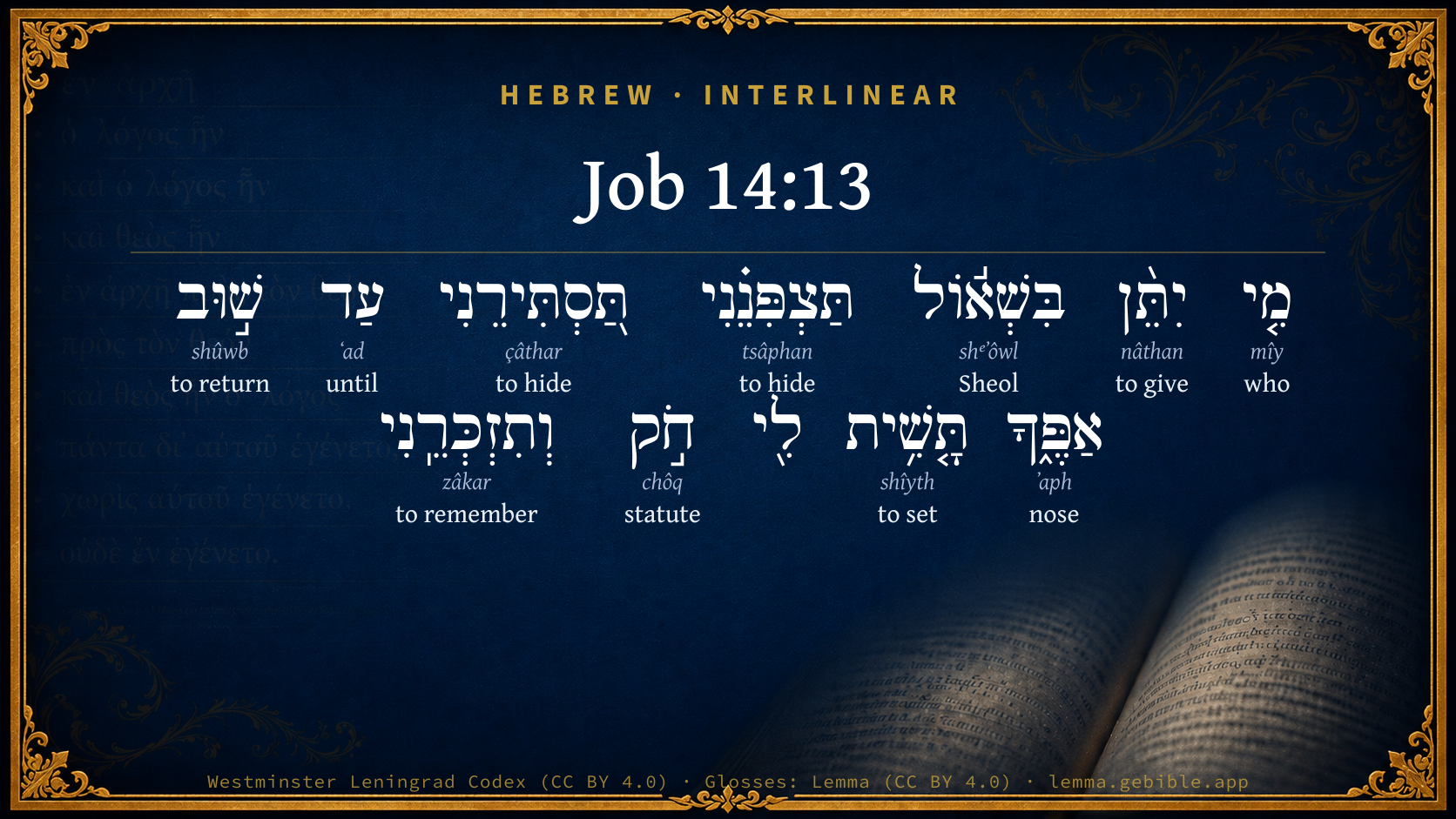
Hebrew (Westminster Leningrad Codex) Job 14:13 appears in the Hebrew Old Testament. The text above is from the Westminster Leningrad Codex. Each word links to its Strong’s number, a concise gloss, and parsing drawn from the Open Scriptures Hebrew Bible morphology. Click any word for its full Brown-Driver-Briggs (BDB) entry.
Download image
Cite this verse

Job 14:13 (World English Bible). Public Domain. Lemma interlinear Bible study tool, https://lemma.gebible.app/v/job/14/13.

Show BibTeX & RIS
BibTeX
RIS
English Translation
"Oh that you would hide me in Sheol, That you would keep me secret, until your wrath is past, That you would appoint me a set time, and remember me!
World English Bible · Public Domain
Download a study sheet

One document with this verse’s original text, its word-by-word gloss line, the meaning frame, cross-references with their text, attributed commentary, and full source and license credits — printable, and it pastes into notes with its structure intact.

This verse Autodidact and up

Study sheet (.html) Plain text (.txt)

A passage Seminary Student

Up to 50 verses in one chapter. A passage sheet keeps up to 6 commentary sources and 12 cross-references per verse, in the order this page ranks them, and says so on the sheet whenever that leaves anything out. Ask for a single verse and you get the Autodidact verse sheet above.

Everything on this page stays free to read, with no account — the sheet is a download of what is already on screen, not access to it.

Want to remove ads? Support Godless Engineer
Compare translations 3

The same verse in 3 English versions, stacked beneath the original-language interlinear above. Click any original word for its lexicon entry.

Each is an independent rendering of the whole verse — the interlinear is not word-aligned to these translations.

Highlighted words mark where these versions differ — a whole-verse word diff, not a word-by-word alignment.

  • World English Bible Public Domain
    "Oh that you would hide me in Sheol, That you would keep me secret, until your wrath is past, That you would appoint me a set time, and remember me!
  • King James Version Public Domain
    O that thou wouldest hide me in the grave, that thou wouldest keep me secret, until thy wrath be past, that thou wouldest appoint me a set time, and remember me!
  • unfoldingWord Literal Text CC BY-SA 4.0
    Who will give you will conceal me in Sheol, you will hide me until the turning of your nose, you will set a limit for me and remember me?

unfoldingWord Literal Text — © unfoldingWord, licensed CC BY-SA 4.0. Word-aligned USFM3 via Door43 (git.door43.org/unfoldingWord/en_ult).

Versions to compare (up to 4)

3 of 4 selected

Show all 18 translations

Every available English version of this verse, each an independent rendering of the whole verse.

  • World English Bible Public Domain
    "Oh that you would hide me in Sheol, That you would keep me secret, until your wrath is past, That you would appoint me a set time, and remember me!
  • Berean Standard Bible Public Domain
    If only You would hide me in Sheol and conceal me until Your anger has passed! If only You would appoint a time for me and then remember me!
  • Majority Standard Bible Public Domain
    If only You would hide me in Sheol and conceal me until Your anger has passed! If only You would appoint a time for me and then remember me!
  • King James Version Public Domain
    O that thou wouldest hide me in the grave, that thou wouldest keep me secret, until thy wrath be past, that thou wouldest appoint me a set time, and remember me!
  • American Standard Version (1901) Public Domain
    Oh that thou wouldest hide me in Sheol, That thou wouldest keep me secret, until thy wrath be past, That thou wouldest appoint me a set time, and remember me!
  • Revised Version (1885) Public Domain
    Oh that thou wouldest hide me in Sheol, that thou wouldest keep me secret, until thy wrath be past, that thou wouldest appoint me a set time, and remember me!
  • Geneva Bible (1599) Public Domain
    Oh that thou wouldest hide me in the graue, and keepe me secret, vntill thy wrath were past, and wouldest giue me terme, and remember me.
  • Douay-Rheims (1899) Public Domain
    Who will grant me this, that thou mayest protect me in hell, and hide me till thy wrath pass, and appoint me a. time when thou wilt remember me?
  • Young's Literal Translation Public Domain
    O that in Sheol Thou wouldst conceal me, Hide me till the turning of Thine anger, Set for me a limit, and remember me.
  • Literal Standard Version CC BY-SA 4.0
    O that You would conceal me in Sheol, || Hide me until the turning of Your anger, || Set a limit for me, and remember me.
  • Unlocked Literal Bible CC BY-SA 4.0
    Oh, that you would hide me away in Sheol away from troubles, and that you would keep me in private until your wrath is over, that you would set me a fixed time to stay there and then call me to mind!
  • unfoldingWord Literal Text CC BY-SA 4.0
    Who will give you will conceal me in Sheol, you will hide me until the turning of your nose, you will set a limit for me and remember me?
  • Darby Bible Public Domain
    Oh that thou wouldest hide me in Sheol, that thou wouldest keep me secret until thine anger be past, that thou wouldest appoint me a set time, and remember me, --
  • World Messianic Bible Public Domain
    “Oh that you would hide me in Sheol, that you would keep me secret until your wrath is past, that you would appoint me a set time and remember me!
  • Webster's Bible Public Domain
    O that thou wouldst hide me in the grave, that thou wouldst keep me secret, until thy wrath is past, that thou wouldst appoint me a set time, and remember me!
  • Free Bible Version CC BY-SA 4.0
    I wish you would hide me in Sheol; conceal me there until your anger is gone. Set a definite time for me there, and remember me!
  • Bible in Basic English Public Domain
    If only you would keep me safe in the underworld, putting me in a secret place till your wrath is past, giving me a fixed time when I might come to your memory again!
  • JPS Tanakh (1917) Public Domain
    Oh that Thou wouldest hide me in the nether-world, that Thou wouldest keep me secret, until Thy wrath be past, that Thou wouldest appoint me a set time, and remember me! —

Literal Standard Version (2020), Covenant Press — licensed CC BY-SA 4.0. Text via the HelloAO Bible API (eBible.org). Unlocked Literal Bible (unfoldingWord) — licensed CC BY-SA 4.0. Text via the HelloAO Bible API (eBible.org). unfoldingWord Literal Text — © unfoldingWord, licensed CC BY-SA 4.0. Word-aligned USFM3 via Door43 (git.door43.org/unfoldingWord/en_ult). Free Bible Version, Dr. Jonathan Gallagher — licensed CC BY-SA 4.0. Text via the HelloAO Bible API (eBible.org).

Word by word

More ways to search: Search by grammar → Find every occurrence → Compare this word →

Practice this passage: Drill this verse → Learn its vocabulary →

תַּצְפִּנֵ֗נִי
tsâphan
H6845
“to hide · me”
Verb, Hiphil, Imperfect, 2nd Person, Masculine, Singular + Suffix, Personal, 1st Person, Common, Singular
Part of Speech
Verb
Stem
Hiphil
Form
Imperfect
Person
2nd Person
Gender
Masculine
Number
Singular
Full BDB Definition

Origin: a primitive root

TWOT: 1953

to hide, treasure, treasure or store up - (Qal) - to hide, treasure, treasure up - to lie hidden, lurk - (Niphal) to be hidden, be stored up - (Hiphil) to hide, hide from discovery
  1. מִ֤י mîy H4310 “who” Particle, Interrogative
  2. יִתֵּ֨ן nâthan H5414 “to give” Verb, Qal, Imperfect, 3rd Person, Masculine, Singular
  3. בִּשְׁא֬וֹל shᵉʼôwl H7585 “in/at · Sheol” Preposition + Noun, Proper
  4. תַּ֭סְתִּירֵנִי çâthar H5641 “to hide · me” Verb, Hiphil, Imperfect, 2nd Person, Masculine, Singular + Suffix, Personal, 1st Person, Common, Singular
  5. עַד ʻad H5704 “until” Preposition
  6. שׁ֣וּב shûwb H7725 “to return” Verb, Qal, Infinitive Construct
  7. אַפֶּ֑ךָ ʼaph H639 “nose · your” Noun, Common, Masculine, Singular, Construct + Suffix, Personal, 2nd Person, Masculine, Singular
  8. תָּ֤שִׁ֥ית shîyth H7896 “to set” Verb, Qal, Imperfect, 2nd Person, Masculine, Singular
  9. חֹ֣ק chôq H2706 “statute” Noun, Common, Masculine, Singular, Absolute
  10. וְתִזְכְּרֵֽנִי zâkar H2142 “and · to remember · me” Conjunction + Verb, Qal, Imperfect, 2nd Person, Masculine, Singular + Suffix, Personal, 1st Person, Common, Singular

About this verse

These counts appear in no published source. They are computed here, from the morphology-tagged text and Lemma’s own curated glosses. What Lemma adds →

12
words
11
distinct lemmas
Wisdom
section

Shared distinctive vocabulary

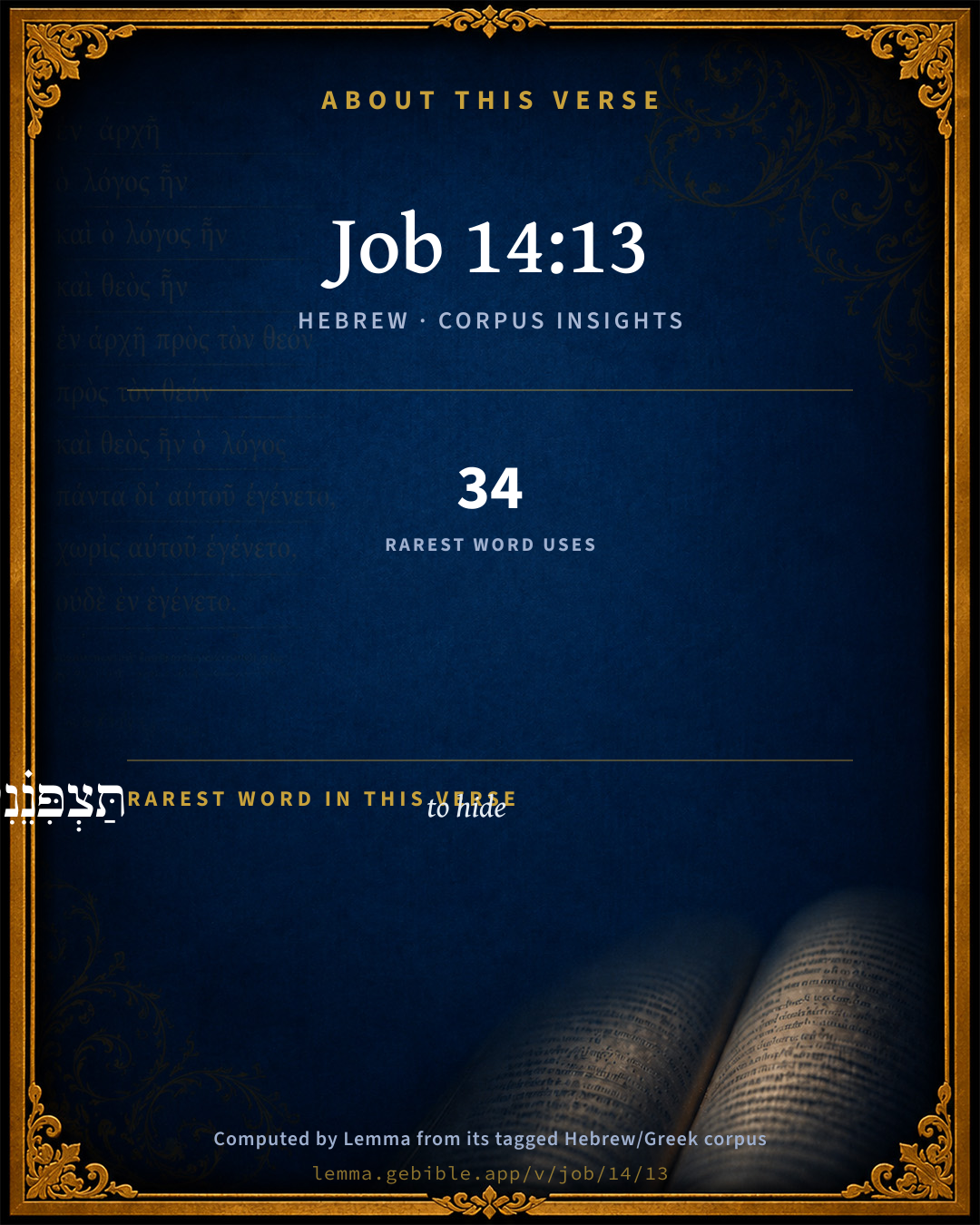
תַּצְפִּנֵ֗נִי to hide H6845 occurs in 31 verses of the Hebrew Bible. Also found in:

Grammatical profile

  • 6 verbs
  • 3 nouns
  • 2 prepositions
  • 1 particle

Verb forms

  • יִתֵּ֨ן Qal · Imperfect
  • תַּצְפִּנֵ֗נִי Hiphil · Imperfect
  • תַּ֭סְתִּירֵנִי Hiphil · Imperfect
  • שׁ֣וּב Qal · Infinitive Construct
  • תָּ֤שִׁ֥ית Qal · Imperfect
  • וְתִזְכְּרֵֽנִי Qal · Imperfect

Hebrew & Septuagint length

In English translation the verse runs 30 words from the Hebrew and 32 from the Septuagint (LXX English) — closely comparable.

A rough comparison of the two English renderings, which tokenize alike — not a word-level alignment.

Word counts can differ between the Hebrew and the Greek without any difference in meaning — e.g. the Hebrew direct-object marker אֵת has no separate Greek word, and Greek often adds the article ὁ.

Cross-references

10

Topical passages linked to Job 14:13 in the Treasury of Scripture Knowledge — connected by theme and wording, ordered by reader-vote popularity; previews shown in the World English Bible.

  • Isaiah 26:20–21 Come, my people, enter you into your chambers, and shut your doors about you: hide yourself for a little moment, until the indignation be past.
  • Isaiah 57:1–2 The righteous perishes, and no man lays it to heart; and merciful men are taken away, none considering that the righteous is taken away from the evil [to come].
  • Mark 13:32 But of that day or that hour no one knows, not even the angels in heaven, nor the Son, but only the Father.
  • Genesis 8:1 God remembered Noah, all the animals, and all the cattle that were with him in the ark; and God made a wind to pass over the earth. The waters subsided.
  • Job 3:17–19 There the wicked cease from troubling; There the weary are at rest.
  • Psalms 106:4 Remember me, Yahweh, with the favor that you show to your people. Visit me with your salvation,
  • Isaiah 12:1 In that day you will say, "I will give thanks to you, Yahweh; for though you were angry with me, your anger has turned away and you comfort me.
  • Luke 23:42 He said to Jesus, "Lord, remember me when you come into your Kingdom."
  • Acts 1:7 He said to them, "It isn't for you to know times or seasons which the Father has set within His own authority.
  • Acts 17:31 because he has appointed a day in which he will judge the world in righteousness by the man whom he has ordained; of which he has given assurance to all men, in that he has raised him from the dead."

Cross-references courtesy of OpenBible.info (CC BY 4.0).

Hebrew and Greek witnesses Masoretic Hebrew ↔ Greek Septuagint

The same verse in the two great witnesses to the Old Testament, shown verse-for-verse.

These are two independent witnesses, not word-aligned to each other, and the Septuagint is shown in lemma (dictionary) form.

Hebrew Job 14:13 Masoretic · Westminster Leningrad Codex

מִ֤י יִתֵּ֨ן בִּשְׁא֬וֹל תַּצְפִּנֵ֗נִי תַּ֭סְתִּירֵנִי עַד שׁ֣וּב אַפֶּ֑ךָ תָּ֤שִׁ֥ית לִ֖י חֹ֣ק וְתִזְכְּרֵֽנִי

"Oh that you would hide me in Sheol, That you would keep me secret, until your wrath is past, That you would appoint me a set time, and remember me!

World English Bible · Public Domain

Greek LXX Job 14:13 Septuagint · lemma form

εἰ γάρ ὀφείλω ἐν ᾅδης ἐγώ φυλάσσω κρύπτω δέ ἐγώ ἕως ἄν παύω σύ ὁ ὀργή καί τάσσω ἐγώ χρόνος ἐν ὅς μνεία ἐγώ ποιέω

For oh that you had kept me in the grave, and had hidden me until your wrath should cease, and you should set me a time in which you would remember me!

LXX2012 (modern English Septuagint) · Public Domain

On this verse, Albert Barnes' Notes on the Bible discusses the Septuagint’s reading. Read the note in Commentary ↓

Hebrew: Westminster Leningrad Codex (CC BY 4.0). Greek: Septuagint (public domain); English from LXX2012 (modern English Septuagint) (Public Domain). How the Septuagint differs from the Hebrew →

Commentary

Notes on Job 14:13 from classic Christian and Jewish commentators (each source and its license shown beneath its notes). The classic Christian expositions comment on the surrounding passage and are grouped to its opening verse, so a note may address several verses; the Jewish commentaries on the Tanakh (Rashi and others) are per-verse, so they appear only where the commentator wrote on this verse.

Lemma curates 59 commentaries, every one of them public domain or Creative Commons licensed, each selected and text-cleaned for this edition rather than reprinted as found. About our sources →

Trapp's Complete Commentary

John Trapp

Job 14:13 O that thou wouldest hide me in the grave, that thou wouldest keep me secret, until thy wrath be past, that thou wouldest appoint me a set time, and remember me!

Ver. 13. O that thou wouldest hide me in the grave] As in a sweet and safe repository ( Sepulchrum est quasi scrinium vel capsa in quam reponitur corpus), sanctuary! my soul meanwhile living and reigning with thee in heaven, expecting a glorious resurrection, and saying, How long, Lord, holy and true? The fable or fancy of Psychopannychia hath been long since hissed out, though lately revived by some libertines, that last brood of Beelzebub; our mortalists especially, who say, that the body and soul die together. But what saith the apostle, Rom 8:10? "If Christ be in you, the body is dead because of sin; but the Spirit is life because of righteousness." Now that Job thus woos death, and petitions for the grave, it is manifest that he saw some good in it, and that he promised himself by it malorum ademptionem, bonorum adeptionem, freedom from evil, and fulness of good. We should learn to familiarize death to ourselves, and put the grave under the fairest and easiest apprehensions, that we hear God speaking to us, as once he did Jacob, Fear not to go down to Egypt (so down to the grave), for I will go with thee, and will surely bring thee up again, Gen 46:3-4. Or as he did his labouring Church, Isa 26:20, "Come, my people, enter thou into thy chambers, and shut thy doors about thee: hide thyself as it were for a little moment, until the indignation be overpast."

That thou wouldest keep me secret] In limbo Patrum, say the Papists, in parabola ovis capras suas quaerentes.

Until thy wrath be past] For it is such as I can of myself neither avoid nor abide. Turn it away, therefore, or turn it into gentleness and kindness, Psa 6:4, and be friends again, Jer 2:35. Or, secrete and secure me till the resurrection, when all thy wrath will be gone from me.

That thou wouldest appoint me a set time] Heb. Set me a statute; set down even what time thou pleasest, either to send me to bed, or to call me up again, so that thou wilt but be sure at last to remember me.

And remember me] Job is willing to die out of the world, but not to die out of God’s memory; to be out of sight, but not out of mind; that God should bury him in the grave, but not bury his thoughts of him; he could be content to be free among the dead, free of that company, but not as the slain that lie in the grave, whom God remembereth no more, Psa 88:5. Job would be remembered for good, as Nehemiah prayeth, and be dealt with as Moses was, whose body, once hid in the valley of Moab, did afterwards appear glorious in mount Tabor at the transfiguration.

John Trapp, A Commentary or Exposition upon All the Books of the Old and New Testament (1647–1656) — public domain. Text from a community e-Sword module.

Joseph Benson's Commentary

Job 14:13. O that thou wouldest hide me in the grave — The grave is not only a resting-place, but a hiding-place to the children of God: Christ has the key of the grave to open and let in now, and to let out at the resurrection. God hides his people in the grave as we hide our treasure in a place of secrecy and safety; and he that hides will find what he has hid, and nothing shall be lost. O that thou wouldst hide me, not only from the storms and troubles of this life, but for the bliss and glory of a better life; let me lie in the grave reserved for immortality, in secret from all the world, but not from thee, not from those eyes which saw my substance when first curiously wrought in the lowest parts of the earth, Psa 139:15-16. Thus, it was not only in a passionate weariness of this life that he wished to die, but in a pious assurance of a better life, to which at length he should arise. Until thy wrath be past — As long as our bodies lie in the grave there are some effects of God’s wrath against sin, but when the body is raised, that wrath is wholly past, and death, the last enemy, is totally destroyed. That thou wouldest appoint me a set time — Not only fix a time when thou wilt end my sufferings and my life, but when thou wilt remember my flesh lodged in the grave, as thou didst remember Noah and every living thing in the ark, Gen 8:1. The bodies of the saints shall not be forgotten in the dust; there is a time appointed, a set time, for their being inquired after.

Joseph Benson's Commentary on the Old and New Testaments (1811–1818) — public domain. Text from a community e-Sword module.

Whedon's Commentary on the Bible

Daniel D. Whedon

Fourth strophe — Job’s abiding faith in God’s deep love for his intelligent creatures illumes the regions of the dead with the hope that the time shall come when God’s wrath will “turn,” and the dead be released from sheol — a hope which is immediately beclouded by the thought that God has already been preternaturally severe in punishing his transgressions, Job_14:13-17.

13. Thou wouldest hide me — As men, for protection, hide treasures in the earth. The dead in the grave are God’s hidden treasures. Compare Psa_83:3. In the grave — In sheol. See Excursus, p. 72. Gloomiest life in sheol is better than extinction of being.

Wrath be past — Death itself was the great wrath for whose turning (שׁוב) the pious dead in the earliest times were represented as waiting. (See LANGE’S Genesis, 275.) The ancients buried their dead in caverns or sepulchres of the rocks. These naturally suggested the idea of a covert from the tempest. The Hebrew hoped that a time would come for the storm to cease, and that the dominion of death, though long protracted, would have an end.

A set time — In the opinion of Dr. Adam Clarke this refers to the resurrection: “for what else can be said to be an object of desire to one whose body is mingled with the dust?”

Daniel D. Whedon (gen. ed.), Commentary on the Old and New Testaments (1874–1909) — public domain. Text from a community e-Sword module.

Tyndale Open Study Notes

Tyndale Open Resources

14:13 Since the grave is a permanent abode (14:10-12, see 3:13-19; 7:6-10; 10:20-22), Job could not even fulfill his request from 13:20-21 by hiding temporarily in the grave.

Tyndale Open Study Notes — © Tyndale Open Resources, licensed CC BY-SA 4.0. Text via the HelloAO Bible API.

Geneva Bible (1599)

Geneva Bible translators

Hereby he declareth that the fear of God’s judgment was the cause why he desired to die.

That is, release my pains and take me to mercy.

Geneva Bible (1599) marginal notes — public domain. Text via Bolls.life.

Jamieson, Fausset & Brown

Robert Jamieson, A. R. Fausset & David Brown

Job wishes to be kept hidden in the grave until God's wrath against him shall have passed away. So while God's wrath is visiting the earth for the abounding apostasy which is to precede the second coming, God's people shall be hidden against the resurrection glory (Isa 26:19-21).

set time--a decreed time (Act 1:7).

Jamieson, Fausset & Brown — Commentary Critical and Explanatory on the Whole Bible (1871) — public domain (CC PDM 1.0). Text via the HelloAO Bible API.

Adam Clarke's Commentary

Verse 13. O that thou wouldest hide me in the grave] Dreadful as death is to others, I shall esteem it a high privilege; it will be to me a covert from the wind and from the tempest of this affliction and distress.

Keep me secret] Hide my soul with thyself, where my enemies cannot invade my repose; or, as the poet expresses it: -

"My spirit hide with saints above,

My body in the tomb."

Job does not appear to have the same thing in view when he entreats God to hide him in the grave; and to keep him secret, until his wrath be past. The former relates to the body; the latter to the spirit.

That thou wouldest appoint me a set time] As he had spoken of the death of his body before, and the secreting of his spirit in the invisible world, he must refer here to the resurrection; for what else can be said to be an object of desire to one whose body is mingled with the dust?

And remember me!] When my body has paid that debt of death which it owes to thy Divine justice, and the morning of the resurrection is come, when it may be said thy wrath, אפך appecha, "thy displeasure," against the body is past, it having suffered the sentence denounced by thyself: Dust thou art, and unto dust thou shalt return, for in the day thou eatest thereof thou shalt surely die; then remember me-raise my body, unite my spirit to it, and receive both into thy glory for ever.

Adam Clarke's Commentary on the Bible (1810–1826) — public domain. Text from a community e-Sword/MySword module.

The Cambridge Bible for Schools and Colleges

gen. ed. J. J. S. Perowne

13–15. Having pursued the destiny of man through all its steps down to its lowest, its complete extinction in death, Job, with a revulsion created by the instinctive demands of the human spirit, rises to the thought that there might be another life after this one. This thought is expressed in the form of an impassioned desire.

To understand these verses the Hebrew conception of death must be remembered. Death was not an end of personal existence: the dead person subsisted, he did not live. He descended into Sheol, the abode of deceased persons. His existence was a dreamy shadow of his past life. He had no communion with the living, whether men or God; comp. Job_3:12-19; Job_10:21-22, Job_14:20-22. This idea of death is not strictly the teaching of revelation, it is the popular idea from which revelation starts, and revelation on the question rather consists in exhibiting to us how the pious soul struggled with this popular conception and sought to overcome it, and how faith demanded and realized, as faith does, its demand, that the communion with God enjoyed in this life should not be interrupted in death. This was in short a demand and a faith that the state of Sheol should be overleaped, and that the believing soul should be “taken” by God in death to Himself, cf. Psa_16:10; Psa_49:15; Psa_73:24. This was the solution that generally presented itself to the mind when death was contemplated. The present passage differs in two particulars. It does not exhibit such assured faith as these passages in the Psalms. The problem before the Psalmists was a much simpler one than that before Job. They were men who, when they wrote their words of faith, enjoyed God’s fellowship, and their faith protested against this fellowship being interrupted in death. But Job has lost the sense of God’s fellowship through his afflictions, which are to his mind proof of God’s estrangement from him, hence he has so to speak a double obstacle to overcome, where the Psalmists had only one, and this makes him do no more here than utter a prayer, while the Psalmists expressed a firm assurance. In the following chapters, especially ch. 19, Job also rises to assurance. In another particular this passage differs from these Psalms. It contemplates a different and much more complete solution of the problem. In both the hope of immortality has a purely religious foundation. It springs from the irrepressible longing for communion with God. The Psalmists, in the actual enjoyment of this communion, either protest against death absolutely (Psalms 16), and demand a continuance in life that this fellowship may continue—that is, they rise to the idea of true immortality; or, contemplating death as a fact, they protest against the popular conception of it, and demand that the deceased person shall not sink into Sheol, but pass across its gulf to God. Job’s conception is different from either of these, because his circumstances are different. He does not enjoy the fellowship of God, his afflictions are evidence of the contrary. His firm conviction is that his malady is mortal, in other words, that God’s anger will pursue him to the grave. On this side of death he has no hope of a return to God’s favour. Hence, contemplating that he shall die under God’s anger, his thought is that he might remain in Sheol till God’s wrath be past, for He keepeth not His anger for ever; that God would appoint him a period to remain in death and then remember him with returning mercy and call him back again to His fellowship. But to his mind this involves a complete return to life again of the whole man (Job_14:14), for in death there is no fellowship with God (Psa_6:5). Thus his solution, though it appears to his mind only as a momentary gleam of light, is broader than that of the Psalmists, and corresponds to that made known in subsequent revelation. It is probable that this conception, which the Author of the Poem allows Job to rise to out of the very extremity of his despair, was one not unfamiliar to himself (cf. Isa_24:22). The verses read as a whole:—

13 Oh that thou wouldst hide me in Sheol,

That thou wouldst keep me secret till thy wrath be past,

That thou wouldst appoint me a set time and remember me—

14 If a man die shall he live again?—

All the days of my appointed time would I wait

Till my release came;

15 Thou wouldst call and I would answer thee,

Thou wouldst have a desire to the work of thine hands.

As Job follows the fascinating thought, the feeling forces itself upon his mind how much is implied in it, nothing less than that a man when dead should live again (Job_14:14), but he will not allow himself to be arrested in his pursuit of the glorious vision—he describes how he would wait all the period appointed to him (his “warfare,” cf. ch. Job_7:1) till his release came, and dwells upon the joy and readiness with which he would answer the voice of his Creator calling him to His fellowship again when He longed after the work of His hands long estranged and hidden from Him (ch. Job_10:3). The words “call” and “answer,” Job_14:15, have here naturally quite a different sense from the forensic or judicial one which belongs to them in ch. Job_13:22 and similar passages.

The Cambridge Bible for Schools and Colleges (gen. ed. J. J. S. Perowne; Cambridge University Press, 1878–1918) — public domain. Text from a community e-Sword module.

John Gill's Exposition

And that thou wouldest hide me in the grave,.... The house appointed for all living, which some understand by the "chambers" in Isa 26:20; The cemeteries or dormitories of the saints, where they lie and sleep until the indignation of God against a wicked world is over and past; or in Hades, the state of the dead, where they are insensible of what is done in this world, what calamities and judgments are on the inhabitants of it, and so are not affected and grieved with these things; or in some cavern of the earth, in the utmost recesses of it, in the very centre thereof, if possible; his wish is, to be buried alive, or to live in some subterraneous place, free from his present afflictions and misery, than to be upon earth with them:

that thou wouldest keep me secret; so that no eye should see him, that is, no human eye; for he did not expect to be hid from the sight of God, be he where he would, before whom hell and destruction, or the grave, are and have no covering; and not only be secret, but safe from all trials and troubles, oppressions and oppressors; especially as he may mean the grave where the wicked cease from troubling and the weary are at rest; the keys of which Christ keeps in his hands, and locks and unlocks, and none but him; and where he has laid up his jewels, the precious dust of his saints and where they and that will be preserved as hidden treasure:

until thy wrath be past; either with respect to others, an ungodly world, to punish whom God sometimes comes out of his place in great wrath and indignation; and to prevent his dear children and people from being involved in common and public calamities, he takes them away beforehand, and hides them in his chambers, Isa 26:19; or with respect to himself, as to his own apprehension of things, who imagined that the wrath of God was upon him, being severely afflicted by him; all the effects of which he supposed would not be removed until he was brought to the dust, from whence he came, and until his body was changed at the resurrection; till that time there are some appearances of the displeasure of against sin: and then follows another petition,

that thou wouldest appoint me a set time, and remember me; either for his going down to the grave, and being hid there, for which there is an appointed time; for as that is the place appointed for man, it is appointed for man to go unto it, and the time when, as appears from Job 14:5; or his coming out of the grave, for his resurrection from thence, which also is fixed, even the last day, the day God has appointed to judge the world in righteousness by Christ at which time the dead will be raised; though of that day and hour no man knows: unless he should mean a time for deliverance from his afflictions which also is set; for God, as he settles the bounds of an affliction, how far it should go, and no farther, so likewise the time when it should end; and either of these Job might call a remembering of him, who thought himself in his present case, as a dead man, out of mind, as those that lie in the grave, remembered no more.

John Gill's Exposition of the Whole Bible (1746–1763) — public domain (CC PDM 1.0). Text via the HelloAO Bible API.

Albert Barnes' Notes on the Bible

Oh that thou wouldest hide me in the grave; - compare the notes at Job 3:11 ff. Hebrew “in Sheol” - ב־שׁאול bı̂-she'ôl. Vulgate, “in inferno.” Septuagint ἐν ἅδῃ en Hadē - “in Hades.” On the meaning of the word “Sheol,” see the notes at Isa 5:14. It does not mean here, I think, the grave. It means the region of departed spirits, the place of the dead, where he wished to be, until the tempest of the wrath of God should pass by. He wished to be shut up in some place where the fury of that tempest would not meet him, and where he would be safe. On the meaning of this passage, however, there has been considerable variety of opinion among expositors. Many suppose that the word here properly means “the grave,” and that Job was willing to wait there until the wrath of God should be spent, and then that he desired to be brought forth in the general resurrection of the dead.

So the Chaldee interprets it of the grave - קבורתא. There is evidently a desire on the part of Job to be hid in some secret place until the tempest of wrath should sweep by, and until he should be safe. There is an expectation that he would live again at some future period, and a desire to live after the present tokens of the wrath of God should pass by. It is probably a wish for a safe retreat or a hiding-place - where he might be secure, as from a storm. A somewhat similar expression occurs in Isa 2:19, where it is said that people would go into holes and caverns until the storm of wrath should pass by, or in order to escape it. But whether Job meant the grave, or the place of departed spirits, cannot be determined, and is not material. In the view of the ancients the one was not remote from the other. The entrance to Sheol was the grave; and either of them would furnish the protection sought. It should be added, that the grave was with the ancients usually a cave, or an excavation from the rock, and such a place might suggest the idea of a hiding-place from the raging storm.

That thou wouldest appoint me a set time - When I should be delivered or rescued. Herder renders this, “Appoint me then a new term.” The word rendered “a set time” - חק chôq - means, properly, something decreed, prescribed, appointed and here an appointed time when God would remember or revisit him. It is the expression of his lingering love of life. He had wished to die. He was borne down by heavy trials, and desired a release. He longed even for the grave; compare Job 3:20-22. But there is the instinctive love of life in his bosom, and he asks that God would appoint a time, though ever so remote, in which he would return to him, and permit him to live again. There is the secret hope of some future life - though remote; and he is willing to be hid for any period of time until the wrath of God should pass by, if he might live again. Such is the lingering desire of life in the bosom of man in the severest trials, and the darkest hours; and so instinctively does man look on even to the most remote period with the hope of life. Nature speaks out in the desires of Job; and one of the objects of the poem is to describe the workings of nature with reference to a future state in the severe trials to which he was subjected. We cannot but remark here, what support and consolation would he have found in the clear revelation which we have of the future world, and what a debt of gratitude do we owe to that gospel which has brought life and immortality to light!

Albert Barnes' Notes on the Bible (1834–1885) — public domain. Text from a community e-Sword/MySword module.

Haydock's Catholic Bible Commentary

That thou mayst protect me in hell. That is, in the state of the dead; an din the place where souls are kept waiting for their Redeemer; (Challoner) and in the grave, where the body awaits the resurrection. (Haydock) --- These words are repeated in the office of the dead, in the name of the souls in purgatory. (Denis the Carthusian, a. 34.) --- They are adduced in proof of limbo. But sheol denotes also "the grave." (Amama) --- What then? The soul is not confined there. It must consequently be explained of the lower receptacle for souls, as well as of the grave. (Haydock)

George Leo Haydock (1774–1849), Haydock's Catholic Family Bible and Commentary, 1859 edition — public domain. Excludes Psalms (Douay-Rheims chapter numbering differs from Protestant) and Deuterocanonical books (Catholic canon only).

Matthew Poole's English Annotations

In the grave; either,

1. In some dark vault under ground, such as good men hide themselves in times of persecution, Heb 11:38. Lord, hide me in some hiding place from thy wrath, and all the intolerable effects of it, which are upon me; for I cannot be hid from thee, but by thee. Or,

2. In the grave, properly so called. Though I know life once lost is irrecoverable, yet I heartily desire death, rather than to continue in these torments. And if the next words and wish seem to suppose the continuance of his life, that is not strange; for he speaks like one almost distracted with his miseries, sometimes wishing one thing, sometimes another and the quite contrary, as such persons use to do. And these wishes may be understood disjunctively, I wish either that I were dead, or that God would give me life free from these torments. Or the place may be understood thus, I could wish, if it were possible, that I might lie in the grave for a time till these storms be blown over, and then be restored to a comfortable life.

That thou wouldest keep me secret; in some secret and safe place, under the shadow of thy wings and favour, that I may have some support and comfort from thee.

Until thy wrath be past; whilst I am oppressed with such grievous and various calamities; which he calls God’s wrath, because they were, or seemed to be, the effects of his wrath.

A set time, to wit, to my sufferings, as thou hast done to my life, Job 14:5.

Remember me, i.e. wherein thou wilt remember me, to wit, in mercy, or so as to deliver me; for it is well known that God is frequently said to forget those whom he suffers to continue in misery, and to remember those whom he delivers out of it.

Matthew Poole's English Annotations on the Holy Bible (1683–1685) — public domain. Text from a community e-Sword/MySword module.

The Pulpit Commentary

Oh that thou wouldest hide me in the grave! literally, in Sheol"which here does not so much mean "the grave," as the place of departed spirits, described in Job_10:21, Job_10:22. Job desires to have God"s protection in that" land of darkness," and to be "hidden" there by him until his wrath be past. It has been generally supposed that he means after his death; but Schultens thinks his desire was to descend to Sheol alive"and there remain, while his punishment continued, hidden from the eyes of men. That thou wouldest keep me secret, until thy wrath be past. Job assumes that, if he is being punished for his youthful sins, (Job_13:26) his punishment will not be for long at any rate, not for ever; God"s anger will at last be satisfied and cease. That thou wouldest appoint me a set time, and remember me! How long he may have to suffer be does not greatly care. Only let it be "a set time a fixed, definite period and at the end of it, let God" remember" him.

Vers. 13-15. Self-defence before God: 3. Dawning of a new hope.

The thoughts of the sufferer now carry him beyond the confines of the present life. He has just been speaking of Sheol, or Hades, as his destined end, and now the reflection occurs What may happen then? It is the nature of thought to travel on and on, to know no bounds that it will not seek to overleap. It is perpetually asking, when one goal has been reached, for the after, the beyond. And in some such way must human thought have travelled towards the light of immortality, before the truth dawned by revelation on the world. Job evidently sees a glimmer of the truth, though it soon fades out"for want of definite knowledge, into darkness.

I LONGING FOR CONCEALMENT IN HADES FOR A SEASON. (Ver. 13) The intense desire, so frequently repeated, for a respite, marks the extremity of intolerable anguish. And if the source of it b, God"s wrath, perhaps in time his heart will relent. Then let the appointed judgment be held, and the decision be made. At least may the wrath of God not pursue him into the darkness of the other world!

II A FUTURE LIFE SUGGESTED. (Ver. 14) For if there is to be a future judgment, there must be a future life to be the subject of it. Perhaps this is the greatest question man can ask without the light of the gospel. But some preliminary answer is here suggested for a moment, though Job does not grasp it firmly, that the future life is guaranteed by the justice and the love of God. But it is observable how the very faintest thought of the possibility gives a new turn to feeling. Patience can only exist when there is hope. And Job feels he could patiently wait all the days of his earthly service were that hope assured. It awakens joy. A happy change must occur. The misunderstandings of the present will clear away. And with this is connected again the glimmering of

III THE CONSCIOUSNESS OF MAN"S ETERNAL RELATION TO GOD. The heart is made for God. How gladly, when he appears from out the clouds and darkness that surround him, will the heart respond to his call! God yearns for man. Man is his creature, his handiwork, his offspring. He cannot but regard man with tenderness, with eternal interest. Here again we find at the bottom of the patriarch"s heart the germ of that faith which the bright rays of the gospel were to bring to flower (ver. 15). The revolt of the heart from false views of God. The picture of One who numbers his steps, and has an eye only for his sins, is inconsistent with the filial consciousness of God (ver. 16). Yet there may be insufficient knowledge or faith to overcome this prevailing mood of despair. J. (comp. Job_10:8-12)

The Pulpit Commentary (1880–1919), ed. H.D.M. Spence-Jones & Joseph S. Exell — public domain. Text from a community e-Sword module.

John Wesley's Explanatory Notes

The grave - The grave is not only a resting-place, but an hiding-place to the children of God. He hides them in the grave, as we hide our treasure in a place of secrecy and safety. Hide me there, not only from the storms of this life, but for the glory of a better. Until thy wrath be past - As long as our bodies lie in the grave, there are some fruits of God's wrath against sin: until the set time comes, for their being remembered, as Noah was remembered in the ark, Gen. viii, 1. Our bodies shall not be forgotten in the grave, there is a time set for their being inquired after.

John Wesley, Explanatory Notes Upon the Whole Bible (1754–1765) — public domain. Text via the GEBible commentary corpus.

Keil & Delitzsch

C. F. Keil & F. Delitzsch

13 Oh that Thou wouldst hide me in Shel,

That Thou wouldst conceal me till Thine anger change,

That Thou wouldst appoint me a time and then remember me!

14 If man dieth, shall he live again?

All the days of my warfare would I wait,

Until my change should come.

15 Thou wouldst call and I would answer,

Thou wouldst have a desire for the work of Thy hands -

16 For now thou numberest my steps,

And dost not restrain thyself over my sins.

The optative יתּן מי introduces a wish that has reference to the future, and is therefore, as at Job 6:8, followed by futt.; comp. on the other hand, Job 23:3, utinam noverim. The language of the wish reminds one of such passages in the Psalms as Psa 31:21; Psa 27:5 (comp. Isa 26:20): "In the day of trouble He hideth me in His pavilion, and in the secret of His tabernacle doth He conceal me." So Job wishes that Hades, into which the wrath of God now precipitates him for ever, may only be a temporary place of safety for him, until the wrath of God turn away (שׁוּב, comp. the causative, Job 9:13); that God would appoint to him, when there, a חק, i.e., a terminus ad quem (comp. Job 14:5), and when this limit should be reached, again remember him in mercy. This is a wish that Job marks out for himself. The reality is indeed different: "if (ἐὰν) a man dies, will he live again?" The answer which Job's consciousness, ignorant of anything better, alone can give, is: No, there is no life after death. It is, however, none the less a craving of his heart that gives rise to the wish; it is the most favourable thought, - a desirable possibility, - which, if it were but a reality, would comfort him under all present suffering: "all the days of my warfare would I wait until my change came." צבא is the name he gives to the whole of this toilsome and sorrowful interval between the present and the wished-for goal, - the life on earth, which he likens to the service of the soldier or of the hireling (Job 7:1), and which is subject to an inevitable destiny (Job 5:7) of manifold suffering, together with the night of Hades, where this life is continued in its most shadowy and dismal phase. And חליפה does not here signify destruction in the sense of death, as the Jewish expositors, by comparing Isa 2:18 and Sol 2:11, explain it; but (with reference to צבאי, comp. Job 10:17) the following after (Arab. chlı̂ft, succession, successor, i.e., of Mohammed), relief, change (syn. תּמוּרה, exchange, barter), here of change of condition, as Psa 55:20, of change of mind; Aquila, Theod., ἄλλαγμα. Oh that such a change awaited him! What a blessed future would it be if it should come to pass! Then would God call to him in the depth of Shel, and he, imprisoned until the appointed time of release, would answer Him from the deep. After His anger was spent, God would again yearn after the work of His hands (comp. Job 10:3), the natural loving relation between the Creator and His creature would again prevail, and it would become manifest that wrath is only a waning power (Isa 54:8), and love His true and essential attribute. Schlottman well observes: "Job must have had a keen perception of the profound relation between the creature and his Maker in the past, to be able to give utterance to such an imaginative expectation respecting the future."

In Job 14:16, Job supports what is cheering in this prospect, with which he wishes he might be allowed to console himself, by the contrast of the present. עתּה כּי is used here as in Job 6:21; כי is not, as elsewhere, where עתה כי introduces the conclusion, confirmatory (indeed now = then indeed), but assigns a reason (for now). Now God numbers his steps (Job 13:27), watching him as a criminal, and does not restrain himself over his sin. Most modern expositors (Ew., Hlgst, Hahn, Schlottm.) translate: Thou observest not my sins, i.e., whether they are to be so severely punished or not; but this is poor. Raschi: Thou waitest not over my sins, i.e., to punish them; instead of which Ralbag directly: Thou waitest not for my sins = repentance or punishment; but שׁמר is not supported in the meaning: to wait, by Gen 37:11. Aben-Ezra: Thou lookest not except on my sins, by supplying רק, according to Ecc 2:24 (where, however, probably משׁיאכל should be read, and מ after אדם, just as in Job 33:17, has fallen away). The most doubtful is, with Hirzel, to take the sentence as interrogative, in opposition to the parallelism: and dost Thou not keep watch over my sins? It seems to me that the sense intended must be derived from the phrase אף שׁמר, which means to keep anger, and consequently to delay the manifestation of it (Amo 1:11). This phrase is here so applied, that we obtain the sense: Thou keepest not Thy wrath to thyself, but pourest it out entirely. Mercerus is substantially correct: non reservas nec differs peccati mei punitionem.

Keil & Delitzsch — Biblical Commentary on the Old Testament (1861–1891) — public domain (CC PDM 1.0). Text via the HelloAO Bible API. (Old Testament only.)

Scofield Reference Notes

C. I. Scofield

grave

Heb. "Sheol," (See Scofield "Hab 2:5").

The Scofield Reference Bible (1917 edition), notes by C. I. Scofield — public domain. Text from a community e-Sword module.

Kretzmann's Popular Commentary

Paul E. Kretzmann

A Prayer to be Delivered from his Affliction

v. 13. Oh, that Thou wouldest hide me in the grave, secure in the realm of the dead, that Thou wouldest keep me secret, safely hidden, until Thy wrath be past, change once more into kindness, that Thou wouldest appoint me a set time and remember me! Job pleaded to be remembered in mercy, to be reestablished in God’s grace. But for him, the reality differs much from this wish.

v. 14. If a man die, shall he live again? It is the voice of suspicion, of skepticism, which desires to banish all hope for the future, the doubt which endeavors to enter the heart of believers from time to time. All the days of my appointed time will I wait till my change come. The figure is taken from the life of the soldier, who will not abandon his post until he is relieved, discharged, or exchanged. The idea of an eventual deliverance from the realm of death is brought out pretty strongly at this point.

v. 15. Thou shalt call, that is, God would call to him, in granting him the discharge which he hoped for, and I will answer Thee; Thou wilt have a desire to the work of Thine hands, God would feel an affectionate yearning for Job, the poor, miserable creature, who was now groaning under such great afflictions.

v. 16. For now Thou numberest my steps, at this time God was still watching his every move as that of a transgressor; dost Thou not watch over my sin? So deep was Job’s despair that he believed God was still holding back, that He was still keeping anger, that His full manifestation of it had not yet taken place.

v. 17. My transgression is sealed up in a bag, his guilt, or wickedness, was kept in remembrance, and Thou sewest up mine iniquity, literally, "Thou hast stitched on to my transgressions," that is, made Job’s iniquity greater than it was in truth, and then punished him accordingly.

v. 18. And surely the mountain falling cometh to naught, it crumbles to pieces under the destroying influence of the elements, and the rock is removed out of his place, growing old and decaying in the same manner.

v. 19. The waters wear the stones, hollowing them out by continual dripping; Thou washest away the things which grow out of the dust of the earth, the floods of water carry away the fruitful soil very quickly; and Thou destroyest the hope of man, for mortal man also perishes without the slightest hope of being brought back to this life again. The strongest and most substantial things in nature are unable to withstand the destructive power of the elements in the hand of God; how much less will mortal man escape this destruction?

v. 20. Thou prevailest forever against him, overpowering him with His might, and he passeth; Thou changest his countenance, disfiguring him, distorting his features in the agony of death, and sendest him away, forth out of this earthly life.

v. 21. His sons come to honor, or, "should his children be in honor?" and he knoweth it not; and they are brought low, abased and disgraced; but he perceiveth it not of them. Man in the realm of death is utterly ignorant of that which takes place on this earth, being affected neither by the good nor by the ill fortune of his surviving relatives.

v. 22. But his flesh upon him shall have pain, feeling pain in the thought of his own misery, and his soul within him shall mourn. Pain is here, by personification, from our feelings while alive, attributed to the flesh and the soul, as if man could feel it in his body when dead. Note that the restoration of the body together with the soul is assumed in this passage, in a final awakening of the dead.

Paul E. Kretzmann, Popular Commentary of the Bible (1921–1924) — public domain. Text from a community e-Sword module.

unfoldingWord translationNotes

Door43 World Missions Community

General Information:

Job continues speaking to God.

Oh, that you would hide me

This is an exclamation showing what Job wants very much but does not really expect to happen. AT: "I wish that you would hide me" (See: Exclamations)

keep me in private

"keep me locked up" or "keep me hidden"

call me to mind

Call someone to mind is an idiom meaning to think about him. AT: "think about me" or "remember me" (See: Idiom)

If a man dies, will he live again?

The implicit answer is "no." AT: "If a man dies, he will not live again." (See: Rhetorical Question)

If so

What "so" refers to is understood from the previous phrase. AT: "If he would live again" (See: Assumed Knowledge and Implicit Information)

to wait all my weary time there

"to wait all my time there even though I would be weary"

until my release should come

The abstract noun "release" can be expressed with the verb "release." AT: "until I should be released" or "until you release me" (See: Abstract Nouns)

translationWords

Hades

trouble

wrath

mind

die

life

time

unfoldingWord translationNotes — © Distant Shores Media and the Door43 World Missions Community, licensed CC BY-SA 4.0. Source: git.door43.org/Door43/en_tn.

Lesson kit

Teaching starters — assembled from the data on this page, not authored interpretation. Every prompt links to the verse data it draws on. Edit before teaching.

Job, in the Wisdom, opens this verse with 12 words (11 distinct Hebrew lemmas). Its most distinctive word is tsâphan (“to hide”). A historical commentator’s framing appears above. Read the whole chapter for the surrounding context.

Discussion questions

  1. How does “to hide” (tsâphan) shape what this verse is saying?
  2. Exodus 2:2 shares the word «to hide» with this verse. How do the two illuminate each other?
  3. These translations render this verse differently. What is at stake in choosing one wording over another?
  4. The verb «יִתֵּ֨ן» is Qal Imperfect. How does its form color the action?
  5. Reading how Trapp's Complete Commentary and Joseph Benson's Commentary read this verse, where do the two commentators agree and where do they part?

Things to notice

Reading settings

Reading text

Shown beneath each verse's original-language words.

Old Testament
Old Testament edition

Read the OT as the Masoretic Hebrew (MT) or the Greek Septuagint (LXX).

English shown for the Greek Septuagint (in the Hebrew ↔ Greek comparison).

Comparing translations? Open the Compare panel on any verse page to stack up to four side by side.