
Psalms 17:8

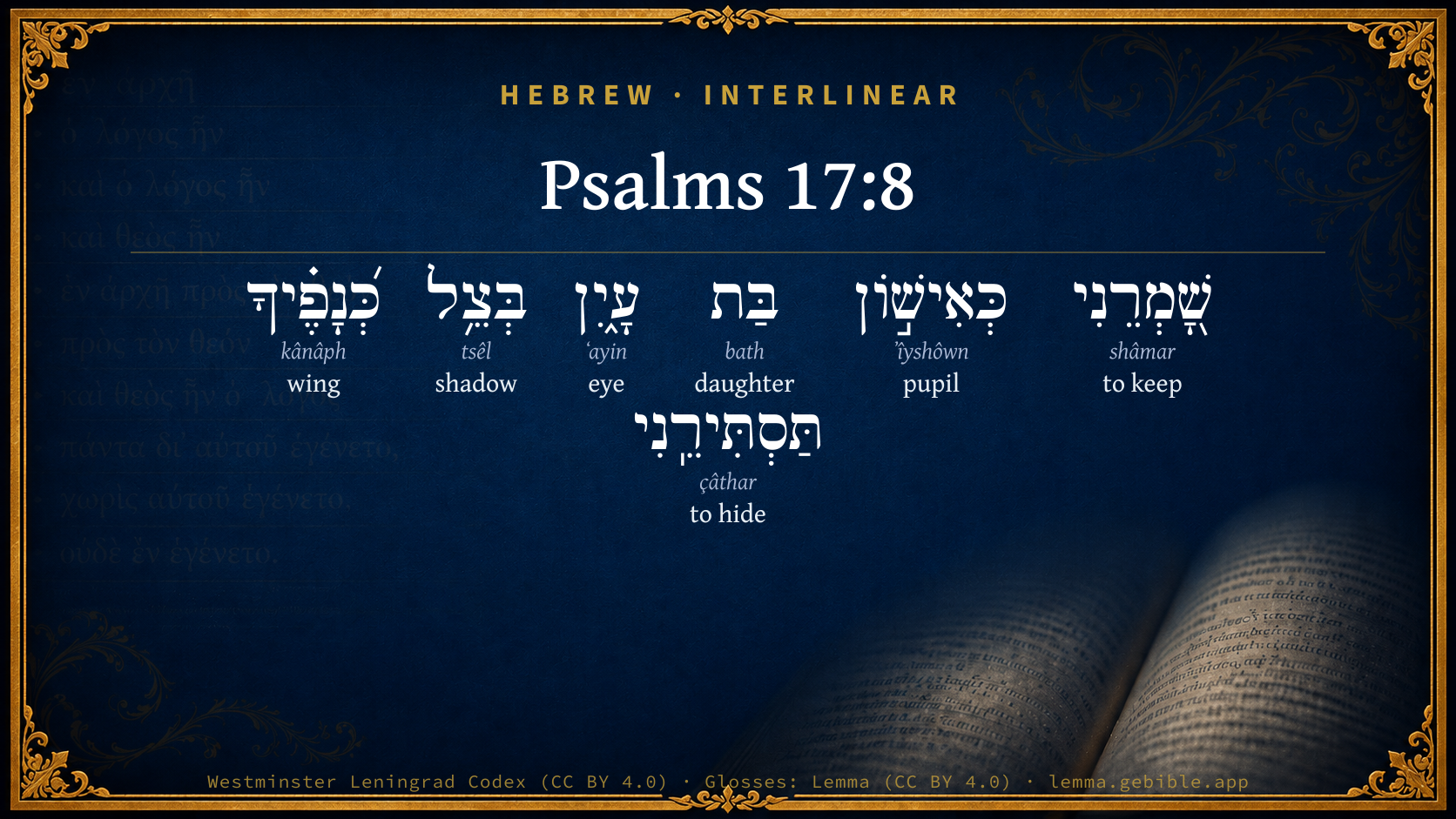
Hebrew (Westminster Leningrad Codex) Psalms 17:8 appears in the Hebrew Old Testament. The text above is from the Westminster Leningrad Codex. Each word links to its Strong’s number, a concise gloss, and parsing drawn from the Open Scriptures Hebrew Bible morphology. Click any word for its full Brown-Driver-Briggs (BDB) entry.
Download image
Cite this verse

Psalms 17:8 (World English Bible). Public Domain. Lemma interlinear Bible study tool, https://lemma.gebible.app/v/psalms/17/8.

Show BibTeX & RIS
BibTeX
RIS
English Translation
Keep me as the apple of your eye; Hide me under the shadow of your wings,
World English Bible · Public Domain
Download a study sheet

One document with this verse’s original text, its word-by-word gloss line, the meaning frame, cross-references with their text, attributed commentary, and full source and license credits — printable, and it pastes into notes with its structure intact.

This verse Autodidact and up

Study sheet (.html) Plain text (.txt)

A passage Seminary Student

Up to 50 verses in one chapter. A passage sheet keeps up to 6 commentary sources and 12 cross-references per verse, in the order this page ranks them, and says so on the sheet whenever that leaves anything out. Ask for a single verse and you get the Autodidact verse sheet above.

Everything on this page stays free to read, with no account — the sheet is a download of what is already on screen, not access to it.

Want to remove ads? Support Godless Engineer
Compare translations 3

The same verse in 3 English versions, stacked beneath the original-language interlinear above. Click any original word for its lexicon entry.

Each is an independent rendering of the whole verse — the interlinear is not word-aligned to these translations.

Highlighted words mark where these versions differ — a whole-verse word diff, not a word-by-word alignment.

  • World English Bible Public Domain
    Keep me as the apple of your eye; Hide me under the shadow of your wings,
  • King James Version Public Domain
    Keep me as the apple of the eye, hide me under the shadow of thy wings,
  • unfoldingWord Literal Text CC BY-SA 4.0
    Keep me as the pupil of your eye; hide me under the shadow of your wings,

unfoldingWord Literal Text — © unfoldingWord, licensed CC BY-SA 4.0. Word-aligned USFM3 via Door43 (git.door43.org/unfoldingWord/en_ult).

Versions to compare (up to 4)

3 of 4 selected

Show all 18 translations

Every available English version of this verse, each an independent rendering of the whole verse.

  • World English Bible Public Domain
    Keep me as the apple of your eye; Hide me under the shadow of your wings,
  • Berean Standard Bible Public Domain
    Keep me as the apple of Your eye; hide me in the shadow of Your wings
  • Majority Standard Bible Public Domain
    Keep me as the apple of Your eye; hide me in the shadow of Your wings
  • King James Version Public Domain
    Keep me as the apple of the eye, hide me under the shadow of thy wings,
  • American Standard Version (1901) Public Domain
    Keep me as the apple of the eye; Hide me under the shadow of thy wings,
  • Revised Version (1885) Public Domain
    Keep me as the apple of the eye, hide me under the shadow of thy wings,
  • Geneva Bible (1599) Public Domain
    Keepe me as the apple of the eye: hide me vnder the shadowe of thy wings,
  • Douay-Rheims (1899) Public Domain
    From them that resist thy right hand keep me, as the apple of thy eye. Protect me under the shadow of thy wings.
  • Young's Literal Translation Public Domain
    Keep me as the apple, the daughter of the eye; In shadow of Thy wings thou dost hide me.
  • Literal Standard Version CC BY-SA 4.0
    Keep me as the apple, the daughter of the eye; Hide me in the shadow of Your wings,
  • Unlocked Literal Bible CC BY-SA 4.0
    Protect me like the apple of your eye; hide me under the shadow of your wings
  • unfoldingWord Literal Text CC BY-SA 4.0
    Keep me as the pupil of your eye; hide me under the shadow of your wings,
  • Darby Bible Public Domain
    Keep me as the apple of the eye, hide me under the shadow of thy wings,
  • World Messianic Bible Public Domain
    Keep me as the apple of your eye. Hide me under the shadow of your wings,
  • Webster's Bible Public Domain
    Keep me as the apple of the eye, hide me under the shade of thy wings.
  • Free Bible Version CC BY-SA 4.0
    Keep me safe as someone you love; hide me underneath your wings.
  • Bible in Basic English Public Domain
    Keep me as the light of your eyes, covering me with the shade of your wings,
  • JPS Tanakh (1917) Public Domain
    Keep me as the apple of the eye, hide me in the shadow of Thy wings,

Literal Standard Version (2020), Covenant Press — licensed CC BY-SA 4.0. Text via the HelloAO Bible API (eBible.org). Unlocked Literal Bible (unfoldingWord) — licensed CC BY-SA 4.0. Text via the HelloAO Bible API (eBible.org). unfoldingWord Literal Text — © unfoldingWord, licensed CC BY-SA 4.0. Word-aligned USFM3 via Door43 (git.door43.org/unfoldingWord/en_ult). Free Bible Version, Dr. Jonathan Gallagher — licensed CC BY-SA 4.0. Text via the HelloAO Bible API (eBible.org).

Word by word

More ways to search: Search by grammar → Find every occurrence → Compare this word →

Practice this passage: Drill this verse → Learn its vocabulary →

כְּאִישׁ֣וֹן
ʼîyshôwn
H380
“like/as · pupil of”
Preposition + Noun, Common, Masculine, Singular, Construct
Part of Speech
Preposition + Noun
Type
Common
Gender
Masculine
Number
Singular
State
Construct
Full BDB Definition

Origin: diminutive from H376

TWOT: 83b

pupil of the eye - middle of the night (that is the deepest blackness)
  1. שָׁ֭מְרֵנִי shâmar H8104 “keep · me” Verb, Qal, Imperative, 2nd Person, Masculine, Singular + Suffix, Personal, 1st Person, Common, Singular
  2. בַּת bath H1323 “daughter of” Noun, Common, Feminine, Singular, Construct
  3. עָ֑יִן ʻayin H5869 “eye” Noun, Common, Both, Singular, Absolute
  4. בְּצֵ֥ל tsêl H6738 “in/at · shadow of” Preposition + Noun, Common, Masculine, Singular, Construct
  5. כְּ֝נָפֶ֗יךָ kânâph H3671 “wings · your” Noun, Common, Feminine, Dual, Construct + Suffix, Personal, 2nd Person, Masculine, Singular
  6. תַּסְתִּירֵֽנִי çâthar H5641 “to hide · me” Verb, Hiphil, Imperfect, 2nd Person, Masculine, Singular + Suffix, Personal, 1st Person, Common, Singular

About this verse

These counts appear in no published source. They are computed here, from the morphology-tagged text and Lemma’s own curated glosses. What Lemma adds →

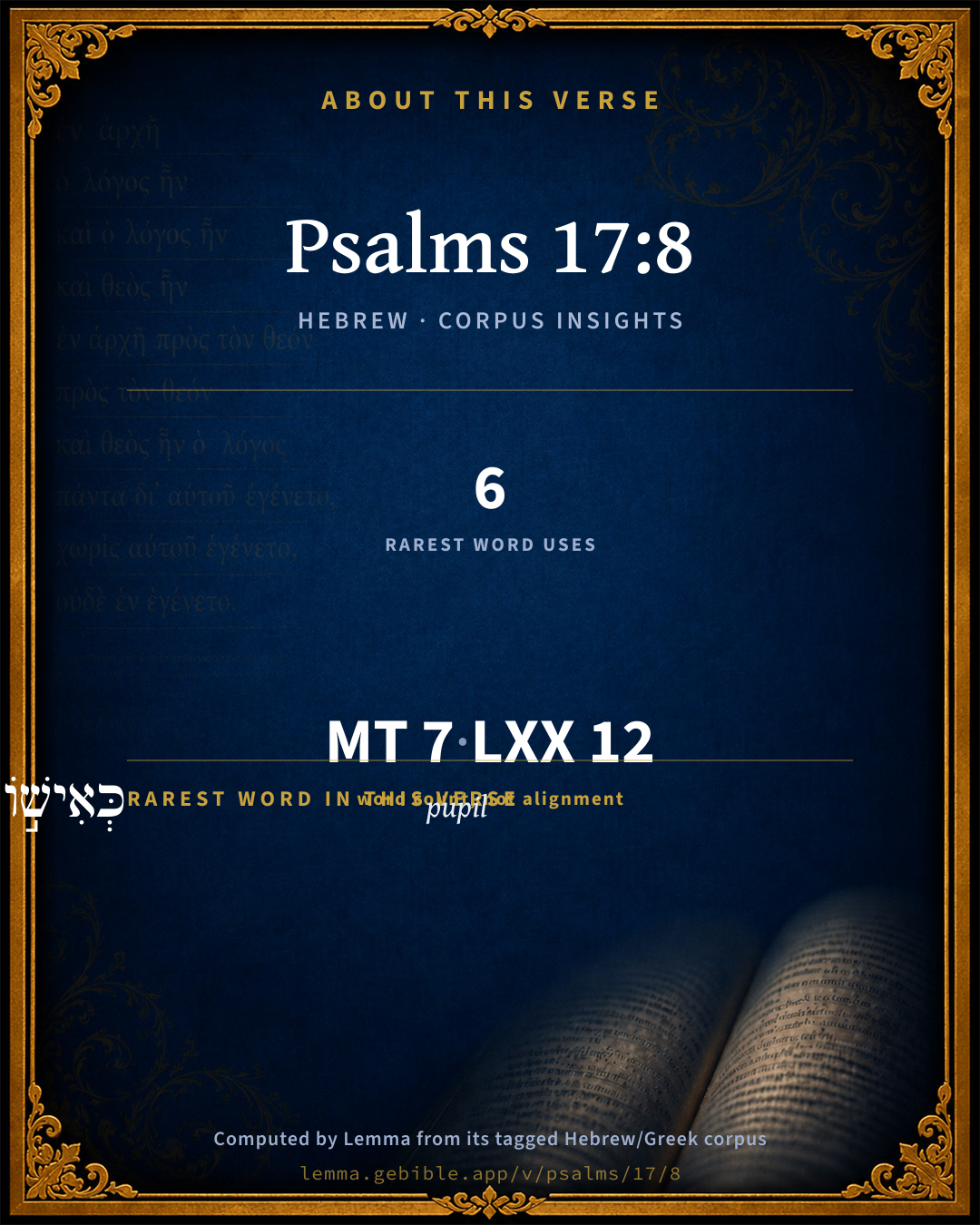
7
words
7
distinct lemmas
Wisdom
section

Notable vocabulary

The rarest word here is כְּאִישׁ֣וֹן pupil H380 — appearing just 6 times in the whole Hebrew Bible.

Shared distinctive vocabulary

כְּאִישׁ֣וֹן pupil H380 occurs in 5 verses of the Hebrew Bible. Also found in:

Grammatical profile

  • 2 verbs
  • 5 nouns

Verb forms

  • שָׁ֭מְרֵנִי Qal · Imperative
  • תַּסְתִּירֵֽנִי Hiphil · Imperfect

Hebrew & Septuagint length

In English translation the verse runs 16 words from the Hebrew and 25 from the Septuagint (LXX English) — closely comparable.

A rough comparison of the two English renderings, which tokenize alike — not a word-level alignment.

Word counts can differ between the Hebrew and the Greek without any difference in meaning — e.g. the Hebrew direct-object marker אֵת has no separate Greek word, and Greek often adds the article ὁ.

In the original languages it is 7 Hebrew tokens and 12 Greek tokens — but the two are counted differently (Hebrew bundles its prefixes and suffixes into one token; the Greek is in lemma form), so that isn’t a like-for-like length.

Cross-references

12

Topical passages linked to Psalms 17:8 in the Treasury of Scripture Knowledge — connected by theme and wording, ordered by reader-vote popularity; previews shown in the World English Bible.

  • Deuteronomy 32:10 He found him in a desert land, In the waste howling wilderness; He compassed him about, he cared for him, He kept him as the apple of his eye.
  • Psalms 91:4 He will cover you with his feathers. Under his wings you will take refuge. His faithfulness is your shield and rampart.
  • Psalms 91:1 He who dwells in the secret place of the Most High Will rest in the shadow of the Almighty.
  • Proverbs 7:2 Keep my commandments and live; Guard my teaching as the apple of your eye.
  • Psalms 61:4 I will dwell in your tent forever. I will take refuge in the shelter of your wings. Selah.
  • Zechariah 2:8 For thus says Yahweh of hosts: 'For honor he has sent me to the nations which plundered you; for he who touches you touches the apple of his eye.
  • Ruth 2:12 Yahweh recompense your work, and a full reward be given you of Yahweh, the God of Israel, under whose wings you are come to take refuge.
  • Psalms 36:7 How precious is your loving kindness, God! The children of men take refuge under the shadow of your wings.
  • Luke 13:34 "Jerusalem, Jerusalem, that kills the prophets, and stones those who are sent to her! How often I wanted to gather your children together, like a hen gathers her own brood under her wings, and you refused!
  • Psalms 57:1 Be merciful to me, God, be merciful to me, For my soul takes refuge in you. Yes, in the shadow of your wings, I will take refuge, Until disaster has passed.
  • Matthew 23:37 "Jerusalem, Jerusalem, who kills the prophets, and stones those who are sent to her! How often would I have gathered your children together, even as a hen gathers her chickens under her wings, and you would not!
  • Psalms 63:7 For you have been my help. I will rejoice in the shadow of your wings.

Cross-references courtesy of OpenBible.info (CC BY 4.0).

Hebrew and Greek witnesses Masoretic Hebrew ↔ Greek Septuagint

The same verse in the two great witnesses to the Old Testament, shown verse-for-verse.

You’re reading Greek Psalm 16 (Hebrew Psalm 17). The Septuagint counts the superscription, so verse numbers can differ from the Hebrew — chapter-level alignment, not verse-by-verse. Numbering follows Rahlfs.

These are two independent witnesses, not word-aligned to each other, and the Septuagint is shown in lemma (dictionary) form.

Hebrew Psalms 17:8 Masoretic · Westminster Leningrad Codex

שָׁ֭מְרֵנִי כְּאִישׁ֣וֹן בַּת עָ֑יִן בְּצֵ֥ל כְּ֝נָפֶ֗יךָ תַּסְתִּירֵֽנִי

Keep me as the apple of your eye; Hide me under the shadow of your wings,

World English Bible · Public Domain

Greek LXX Greek Psalm 16:8 Septuagint · lemma form

φυλάσσω ἐγώ ὡς κόρη ὀφθαλμός ἐν σκέπης ὁ πτέρυξ σύ σκεπάζω ἐγώ

Keep me as the apple of the eye from those that resist your right hand: you shall screen me by the covering of your wings,

LXX2012 (modern English Septuagint) · Public Domain

On this verse, Keil & Delitzsch discusses the Septuagint’s reading. Read the note in Commentary ↓

Hebrew: Westminster Leningrad Codex (CC BY 4.0). Greek: Septuagint (public domain); English from LXX2012 (modern English Septuagint) (Public Domain). How the Septuagint differs from the Hebrew →

Commentary

Notes on Psalms 17:8 from classic Christian and Jewish commentators (each source and its license shown beneath its notes). The classic Christian expositions comment on the surrounding passage and are grouped to its opening verse, so a note may address several verses; the Jewish commentaries on the Tanakh (Rashi and others) are per-verse, so they appear only where the commentator wrote on this verse.

Lemma curates 59 commentaries, every one of them public domain or Creative Commons licensed, each selected and text-cleaned for this edition rather than reprinted as found. About our sources →

Matthew Henry's Commentary

We may observe, in these verses,

I. What David prays for. Being compassed about with enemies that sought his life, he prays to God to preserve him safely through all their attempts against him, to the crown to which he was anointed. This prayer is both a prediction of the preservation of Christ through all the hardships and difficulties of his humiliation, to the glories and joys of his exalted state, and a pattern to Christians to commit the keeping of their souls to God, trusting him to preserve them to his heavenly kingdom. He prays,

1. That he himself might be protected (Psa 17:8): "Keep me safe, hide me close, where I may not be found, where I may not be come at. Deliver my soul, not only my mortal life from death, but my immortal spirit from sin." Those who put themselves under God's protection may in faith implore the benefit of it.

(1.) He prays that God would keep him, [1.] With as much care as a man keeps the apple of his eye with, which nature has wonderfully fenced and teaches us to guard. If we keep God's law as the apple of our eye (Pro 7:2), we may expect that God will so keep us; for it is said concerning his people that whoso touches them touches the apple of his eye, Zac 2:8. [2.] With as much tenderness as the hen gathers her young ones under her wings with; Christ uses the similitude, Mat 23:37. "Hide me under the shadow of thy wings, where I may be both safe and warm." Or, perhaps, it rather alludes to the wings of the cherubim shadowing the mercy-seat: "Let me be taken under the protection of that glorious grace which is peculiar to God's Israel." What David here prays for was performed to the Son of David, our Lord Jesus, of whom it is said (Isa 49:2) that God hid him in the shadow of his hand, hid him as a polished shaft in his quiver.

(2.) David further prays, "Lord, keep me from the wicked, from men of the world," [1.] "From being, and doing, like them, from walking in their counsel, and standing in their way, and eating of their dainties." [2.] "From being destroyed and run down by them. Let them not have their will against me; let them not triumph over me."

2. That all the designs of his enemies to bring his either into sin or into trouble might be defeated (Psa 17:13): "Arise, O Lord! appear for me, disappoint him, and cast him down in his own eyes by the disappointment." While Saul persecuted David, how often did he miss his prey, when he thought he had him sure! And how were Christ's enemies disappointed by his resurrection, who thought they had gained their point when they had put him to death!

II. What he pleads for the encouraging of his own faith in these petitions, and his hope of speeding. He pleads,

1. The malice and wickedness of his enemies: "They are such as are not fit to be countenanced, such as, if I be not delivered from them by the special care of God himself, will be my ruin. Lord, see what wicked men those are that oppress me, and waste me, and run me down." (1.) "They are very spiteful and malicious; they are my deadly enemies, that thirst after my blood, my heart's blood - enemies against the soul," so the word is. David's enemies did what they could to drive him to sin and drive him away from God; they bade him go serve other gods (Sa1 26:19), and therefore he had reason to pray against them. Note, Those are our worst enemies, and we ought so to account them, that are enemies to our souls. (2.) "They are very secure and sensual, insolent and haughty (Psa 17:10): They are enclosed in their own fat, wrap themselves, hug themselves, in their own honour, and power, and plenty, and then make light of God, and set his judgments at defiance, Psa 73:7; Job 15:27. They wallow in pleasure, and promise themselves that tomorrow shall be as this day. And therefore with their mouth they speak proudly, glorying in themselves, blaspheming God, trampling upon his people, and insulting them." See Rev 13:5, Rev 13:6. "Lord, are not such men as these fit to be mortified and humbled, and made to know themselves? Will it not be for thy glory to look upon these proud men and abase them?" (3.) "They are restless and unwearied in their attempts against me: They compass me about, Psa 17:9. They have now in a manner gained their point; they have surrounded us, they have compassed us in our steps, they track us wherever we go, follow us as close as the hound does the hare, and take all advantages against us, being both too many and too quick for us. And yet they pretend to look another way, and set their eyes bowing down to the earth, as if they were meditating, retired into themselves, and thinking of something else;" or (as some think), "They are watchful and intent upon it, to do us a mischief; they are down-looked, and never let slip any opportunity of compassing their design." (4.) "The ringleader of them (that was Saul) is in a special manner bloody and barbarous, politic and projecting (Psa 17:12), like a lion that lives by prey and is therefore greedy of it." It is as much the meat and drink of a wicked man to do mischief as it is of a good man to do good. He is like a young lion lurking in secret places, disguising his cruel designs. This is fitly applied to Saul, who sought David on the rocks of the wild goats (Sa1 24:2) and in the wilderness of Ziph (Psa 26:2), where lions used to lurk for their prey.

2. The power God had over them, to control and restrain them. He pleads, (1.) "Lord, they are thy sword; and will any father suffer his sword to be drawn against his own children?" As this is a reason why we should patiently bear the injuries of men, that they are but the instruments of the trouble (it comes originally from God, to whose will we are bound to submit), so it is an encouragement to us to hope both that their wrath shall praise him and that the remainder thereof he will restrain, that they are God's sword, which he can manage as he pleases, which cannot move without him, and which he will sheathe when he has done his work with it. (2.) "They are thy hand, by which thou dost chastise thy people and make them feel thy displeasure." He therefore expects deliverance from God's hand because from God's hand the trouble came. Una eademque manus vulnus opemque tulit - The same hand wounds and heals. There is no flying from God's hand but by flying to it. It is very comfortable, when we are in fear of the power of man, to see it dependent upon and in subjection to the power of God; see Isa 10:6, Isa 10:7, Isa 10:15.

3. Their outward prosperity (Psa 17:14): "Lord, appear against them, for," (1.) "They are entirely devoted to the world, and care not for thee and thy favour. They are men of the world, actuated by the spirit of the world, walking according to the course of this world, in love with the wealth and pleasure of this world, eager in the pursuits of it (making them their business) and at ease in the enjoyments of it - making them their bliss. They have their portion in this life; they look upon the good things of this world as the best things, and sufficient to make them happy, and they choose them accordingly, place their felicity in them, and aim at them as their chief good; they rest satisfied with them, their souls take their ease in them, and they look no further, nor are in any care to provide for another life. These things are their consolation (Luk 6:24), their good things (Luk 16:25), their reward (Mat 6:5), the penny they agreed for, Mat 20:13. Now, Lord, shall men of this character be supported and countenanced against those who honour thee by preferring thy favour before all the wealth in this world, and taking thee for their portion?" Psa 16:5. (2.) They have abundance of the world. [1.] They have enlarged appetites, and a great deal wherewith to satisfy them: Their bellies thou fillest with thy hidden treasures. The things of this world are called treasures, because they are so accounted; otherwise, to a soul, and in comparison with eternal blessings, they are but trash. They are hidden in the several parts of the creation, and hidden in the sovereign disposals of Providence. They are God's hidden treasures, for the earth is his and the fulness thereof, though the men of the world think it is their own and forget God's property in it. Those that fare deliciously every day have their bellies filled with these hidden treasures; and they will but fill the belly (Co1 6:13); they will not fill the soul; they are not bread for that, nor can they satisfy, Isa 55:2. They are husks, and ashes, and wind; and yet most men, having no care for their souls, but all for their bellies, take up with them. [2.] They have numerous families, and a great deal to leave to them: They are full of children, and yet their pasture is not overstocked; they have enough for them all, and leave the rest of their substance to their babes, to their grand-children; and this is their heaven, it is their bliss, it is their all. "Lord," said David, "deliver me from them; let me not have my portion with them. Deliver me from their designs against me; for, they having so much wealth and power, I am not able to deal with them unless the Lord be on my side."

4. He pleads his own dependence upon God as his portion and happiness. "They have their portion in this life, but as for me (Psa 17:15) I am none of them, I have but little of the world. Nec habeo, nec careo, nec curo - I neither have, nor need, nor care for it. It is the vision and fruition of God that I place my happiness in; that is it I hope for, and comfort myself with the hopes of, and thereby distinguish myself from those who have their portion in this life." Beholding God's face with satisfaction may be considered, (1.) As our duty and comfort in this world. We must in righteousness (clothed with Christ's righteousness, having a good heart and a good life) by faith behold God's face and set him always before us, must entertain ourselves from day to day with the contemplation of the beauty of the Lord; and, when we awake every morning, we must be satisfied with his likeness set before us in his word, and with his likeness stamped upon us by his renewing grace. Our experience of God's favour to us, and our conformity to him, should yield us more satisfaction than those have whose belly is filled with the delights of sense. 2. As our recompence and happiness in the other world. With the prospect of that he concluded the foregoing psalm, and so this. That happiness is prepared and designed only for the righteous that are justified and sanctified. They shall be put in possession of it when they awake, when the soul awakes, at death, out of its slumber in the body, and when the body awakes, at the resurrection, out of its slumber in the grave. That blessedness will consist in three things: - [1.] The immediate vision of God and his glory: I shall behold thy face, not, as in this world, through a glass darkly. The knowledge of God will there be perfected and the enlarged intellect filled with it. [2.] The participation of his likeness. Our holiness will there be perfect. This results from the former (Jo1 3:2): When he shall appear we shall be like him, for we shall see him as he is. [3.] A complete and full satisfaction resulting from all this: I shall be satisfied, abundantly satisfied with it. There is no satisfaction for a soul but in God, and in his face and likeness, his good-will towards us and his good work in us; and even that satisfaction will not be perfect till we come to heaven.

Matthew Henry's Commentary on the Whole Bible (1708–1710) — public domain (CC PDM 1.0). Text via the HelloAO Bible API.

Trapp's Complete Commentary

John Trapp

Psa 17:8 Keep me as the apple of the eye, hide me under the shadow of thy wings,

Ver. 8. Keep me as the apple of the eye] Heb. As the black of the apple of the eye, two words to the same sense, for more vehemence, q.d. Serva me studiosissime. The apple of the eye, that little man in the eye (as the Hebrew word importeth, the girl, κορη, as the Greeks for like cause call it), is the tenderest piece of the tenderest part, the eye; which is kept most diligently, and strongly guarded by nature with tunicles. David therefore fitly prayeth to be so kept. ( Huc pertinet locus Cicer. De Nat. Deor.).

Hide me under the shadow of thy wing] Another excellent similitude taken from fowls, which either cover their young with their wings from the scorching heat of the sunbeams, as doth the eagle; or keep them thereby from the cold, or from the kite, as hens do. God’s love to and care of his poor people is hereby shadowed out; as it was likewise by the outspread wings of the cherubims in the sanctuary. See Rth 2:12 Deu 32:10 Zec 2:8 Psa 36:8; Psa 57:2 Mat 23:37.

John Trapp, A Commentary or Exposition upon All the Books of the Old and New Testament (1647–1656) — public domain. Text from a community e-Sword module.

Albert Barnes' Notes on the Bible

Keep me as the apple of the eye - Preserve me; guard me; defend me, as one defends that which is to him most precious and valuable. In the original there is a remarkable strength of expression, and at the same time a remarkable confusion of gender in the language. The literal translation would be, “Keep me as the little man - the daughter of the eye.” The word “apple” applied to the eye means the pupil, the little aperture in the middle of the eye, through which the rays of light pass to form an image on the retina (“Johnson, Webster”); though “why” it is called the “apple” of the eye the lexicographers fail to tell us. The Hebrew word - אישׁון 'ı̂yshôn - means properly, “a little man,” and is given to the apple or pupil of the eye, “in which, as in a mirror, a person sees his own image reflected in miniature.” This comparison is found in several languages. The word occurs in the Old Testament only in Deu 32:10; Psa 17:8; Pro 7:2; where it is rendered “apple;” in Pro 7:9, where it is rendered “black;” and in Pro 20:20, where it is rendered “obscure.” The other expression in the Hebrew - “the daughter of the eye” - is derived from a usage of the Hebrew word “daughter,” as denoting that which is dependent on, or connected with (Gesenius, Lexicon), as the expression “daughters of a city” denotes the small towns or villages lying around a city, and dependent on its jurisdiction, Num 21:25, Num 21:32; Num 32:42; Jos 17:11. So the expression “daughters of song,” Ecc 12:4. The idea here is, that the little image is the “child” of the eye; that it has its birth or origin there. The prayer of the psalmist here is, that God would guard him, as one guards his sight - an object so dear and valuable to him.

Hide me under the shadow of thy wings - Another image denoting substantially the same thing. This is taken from the care evinced by fowls in protecting their young, by gathering them under their wings. Compare Mat 23:37. Both of the comparisons used here are found in Deu 32:10-12; and it is probable that the psalmist had that passage in his eye - “He instructed him, he kept him as the apple of his eye; as an eagle stirreth up her nest, fluttereth over her young, spreadeth abroad her wings, taketh them, beareth them on her wings; so the Lord alone did lead him.” Compare also Psa 36:7; Psa 57:1; Psa 61:4; Psa 63:7; Psa 91:1, Psa 91:4.

Albert Barnes' Notes on the Bible (1834–1885) — public domain. Text from a community e-Sword/MySword module.

The Biblical Illustrator

Joseph S. Exell

Psa_17:8

Keep me as the apple of the eye.

The plea for Divine protection

The world is no friend to righteousness; its spirit cannot endure the restraints that holiness imposes upon its workings. Hence the worlds hostility to all those who live truly godly lives. To understand the full force of keeping one as the apple of the eye it is necessary to consider first, how the whole eye is protected, sheltered by bones and sinews, opening and closing doors, light-softening and dust-excluding curtains, and then, that the pupil of the eye, located farther in, is protected by guardians equally wonderful and peculiarly its own. There is no other part of the human body so wonderfully protected, and no other part that, when endangered, we so instinctively try to shelter from harm. And so God guards His people as tenderly as we guard the pupil of our eye; yea, as tenderly as He guards the pupil of His own eye. (David Caldwell, A. M.)

The eye, a similitude

The man knows something of himself who sincerely offers this plaintive petition, Keep me. Is there not a sorrowful confession implied? But it implies knowledge of God too. What He is and will do. The keeping desired is that with which men guard the eye. It means, therefore--

I. Keep me with many guards and protections. The eye is kept by eye bones, eyelashes, eyelids, which serve as outworks, fences and barricades to protect the pupil of the eye, God has bestowed extraordinary pains upon all that concerns the eye. Sentries keep ward lest it should be imperilled. Whenever it is threatened, with agility so brisk that it seems almost involuntary, the arm is lifted up and the hand is raised to screen it. All the members of the body may be regarded as a patrol for the wardship of the eye. So should we pray to be kept with many protections--providence, grace ordinances, the Holy Spirit, the angels.

II. With constancy, unintermitting continuance. The eye is always guarded. Without our thinking of it. If a grain of dust enter, forthwith a watery burnout is exuded to carry it away or to dissolve it. The pain is a mercy, for it makes you restless until you get relief. When you fall asleep the curtains fall, the blinds, as it were, drop down, and the windows are shut up securely with lash and lid. So, and in yet other ways, doth the parable of the eye suggest the prayer of the text. Evermore, O Lord, watch over me. Remark here, that at no season is a Christian more in danger than when he has just been in communion with God. The footpads in olden time did not meddle with the farmers as they went to market; it was when they were coming home, and bringing back their money bags full. Our ships of war attacked the Spanish galleons not on their way to but from America, when they knew them to be laden to the Waters edge with silver and gold. You need keeping, then, always.

III. From little evils, the dust and grit of this world. Your eye needs not to be guarded so much from beams as motes. Be this your prayer, Keep me from what the world calls little sins. To one, a Puritan, who was offered great preferment if he would but comply with the government demands, it was said, Others have made long gashes in their consciences: could not you make a little nick in yours? But those little nicks swiftly run to the rending of the conscience from top to bottom. There was an officer who kept in his house a tame leopard which had been born in the house. It had grown up as harmless as a domestic cat. But one day when its master was asleep it gently licked his hand. The creatures tongue passed over a slight but recent wound. A little blood oozed out. The taste roused the demon spirit of the beast at once, and had it not been promptly shot its masters life would have been its victim. When the thief cannot break in at the door himself he puts a boy through the window, and then the great door is speedily opened.

IV. Sensitive, tender in heart, as the apple of the eye. God has made it thus sensitive for its own protection. The conscience should be a real indicator: if in good keeping it would be a wonderful tell-tale. It will startle you from your lethargy, it will arouse you as with an alarm.

V. As the eye ought to be kept. It should be single, clear, far-seeing. As an ornament, for the beauty of the countenance is in the eye. So should we adorn the doctrine and the Church of God. Useful, a genuine Christian will pray to be useful, not like a glass eye, a mere counterfeit. And then, though the remark may seem strange and quaint, I would entreat the Lord to keep me in the head. Solomon has made the shrewd remark, The wise mans eyes are in his head, but the fool walketh in darkness. I would give this a spiritual turn, and ask to be kept in Christ Jesus. Of what use were the eye of a man if not in the head? And what we, apart from Christ? There are some to whom this prayer is, nothing, for they are not Christs. Let your prayer be, Lord, save me, or I perish. Once saved, you may pray to be kept. (C. H. Spurgeon.)

Two Bible emblems

Gods Word and works, the two great sources of our knowledge of God. When we want to get clear and vivid conception of any truth we employ analogy and institute comparison, and say it is as or like some object in nature. Text an illustration of this. It means--

I. That the royal Psalmist prays to be Divinely protected. He did not possess all our modern knowledge of the anatomy of the eye, but he must have known much or he could not have penned this prayer. Of all the organs of the body the eye is the most delicate and precious, and is protected by the most wonderful and elaborate contrivances. The eyes are the sentinels of the body, and keep constant guard over it. They are the windows through which the soul looks out upon all things within its range. They are closely connected with the brain, and by a mysterious telegraphy of nerves convey to the brain knowledge of what is passing in the outer world. The eyes are like citizens within the entrenchments of a fortified town, surrounded by outworks, fences, and barricades. And the arms are like two warders to defend them. Note some of their protections. A protruding socket, like a wall around it: with overhanging brow to carry off drops of perspiration; with eyelashes to guard against dust and insects; with lids that automatically close at the approach of danger; with glands which secrete tears that clean and lubricate the ball of the eye; with beds, cushion like for their softness, upon which they repose and revolve with safety. All these and many more show how carefully God keeps the apple of the eye, and help us to see how David desired that God would keep him.

II. And he would be Divinely preserved. Hide me under the shadow of Thy wings. This emblem, like the former, is exceedingly suggestive. There may be reference to the wings of the cherubim which were the symbol of Gods presence in the tabernacle of old. David had ardent love for the house of God, he even envied the sparrows that built their nests near Gods altar. In the time of trouble he would be hidden in Gods pavilion, in the secret place of the tabernacle; and there, hiding as under the wings of the cherubim, he would find a shelter and a home. (F. W. Brown.)

The Biblical Illustrator, edited by Joseph S. Exell (c. 1880s–1900s) — public domain. Text from a community e-Sword module.

Joseph Benson's Commentary

Psa 17:8-9. Keep me as the apple of the eye — Which thou hast marvellously fenced on every side, and which men use their utmost care and diligence to preserve. Hide me under the shadow of thy wings — Protect me from my enemies, visible and invisible, as a hen protects her chickens from birds of prey. There seems also to be an allusion to the wings of the cherubim, overshadowing the mercy-seat. From the wicked — Or, Because of the wicked. From my deadly enemies — Hebrew, Mine enemies in, for, or, against my soul, or, life, whom nothing but my blood or life will satisfy. Who compass me about — And thereby show both their extreme malice and my danger.

Joseph Benson's Commentary on the Old and New Testaments (1811–1818) — public domain. Text from a community e-Sword module.

J. A. Alexander on Psalms

Joseph Addison Alexander

8. (Psa 17:8) Keep me as the apple of the eye, in the shadow of thy wings thou wilt hide me. The first verb means to watch over, guard, preserve with care. See above, on Psa 17:4, where it occurs in a figurative application. The pupil or apple of the eye is a proverbial type of that which is most precious and most easily injured, and which therefore has a double claim to sedulous protection. The original phrase is strongly idiomatic, exhibiting what seems to be a singular confusion of the genders. Its literal meaning is, supplying the articles omitted by poetic licence, the man (or the little man, or the man-like part) the daughter of the eye. The first word has reference to the image reflected in the pupil, which is then described, as belonging to the eye, by an oriental idiom which uses personal relations, son, daughter, etc., to denote the mutual relations even of inanimate objects. The comparison is borrowed from Deut. 32:10, where it is followed by another with the eagle's treatment of her young, to which there seems to be allusion in the last clause of the verse before us. The imperative form of the first verb is no reason for departing from the future form of the other, which is much more expressive. What he asks in one clause he expresses his assured hope of obtaining in the other.

Joseph Addison Alexander, The Psalms Translated and Explained (1850) — public domain. Text from a community e-Sword module.

Tyndale Open Study Notes

Tyndale Open Resources

17:8 as you would guard your own eyes (literally as the pupil of your eye): This metaphor expresses God’s care and affection for the psalmist (see Deut 32:10). • The shadow of God’s wings is a place of his protection from enemies and adversity (Pss 36:7; 57:1; 61:4; 63:7; 91:4).

Tyndale Open Study Notes — © Tyndale Open Resources, licensed CC BY-SA 4.0. Text via the HelloAO Bible API.

Jamieson, Fausset & Brown

Robert Jamieson, A. R. Fausset & David Brown

Similar figures, denoting the preciousness of God's people in His sight, in Deu 32:10-11; Mat 23:37.

Jamieson, Fausset & Brown — Commentary Critical and Explanatory on the Whole Bible (1871) — public domain (CC PDM 1.0). Text via the HelloAO Bible API.

Adam Clarke's Commentary

Verse 8. Keep me as the apple of the eye] Or, as the black of the daughter of eye. Take as much care to preserve me now by Divine influence, as thou hast to preserve my eye by thy good providence. Thou hast entrenched it deeply in the skull; hast ramparted it with the forehead and cheek-bones; defended it by the eyebrow, eyelids, and eyelashes; and placed it in that situation where the hands can best protect it.

Hide me under the shadow of thy wings] This is a metaphor taken from the hen and her chickens. See it explained at large in the note on Mt 23:37. The Lord says of his followers, Zec 2:8: "He that toucheth you, toucheth the apple of mine eye." How dear are our eyes to us! how dear must his followers be to God!

Adam Clarke's Commentary on the Bible (1810–1826) — public domain. Text from a community e-Sword/MySword module.

John Calvin's Commentaries

The two similitudes which David has subjoined in the following verse, respecting the apple of the eye, and the little birds which the mother keeps under her wings, “Et des petis oiseaux que la mere tient sous ses ailes.” — Fr.

John Calvin's Commentaries (1540-1563) — public domain. Text from the Calvin Translation Society English edition (1840s-50s) via the Christian Classics Ethereal Library (ccel.org). Calvin's coverage is partial (roughly two-thirds of the Bible); uncommented books and verses are honest gaps, never fabricated. The 19th-century editor's footnotes and remarks are omitted so the notes are faithfully Calvin's own voice.

Ellicott's Commentary for English Readers

(8) Apple of the eye.—Literally, little man, daughter of the eye. The mannikin is, of course, the reflection seen in the pupil. Daughter is either a contraction of a word meaning cavity, or is the common Hebrew idiom which by son or daughter of expresses relation, as sons of the bow = arrows. In fact, the curious Hebrew phrase is substantially like the Greek κόρη and Latin pupa, or pupilla, even to the gender.

Hide me under the shadow of thy wings.—The figure of the sheltering wings of the parent bird, so common in Hebrew literature, generally refers to the eagle or vulture, as in Deu_32:10-11, the source of both the beautiful images of the text. Our Lord’s use of the figure is made more tender by the English rendering, “hen” (Mat_23:37). (See Note New Testament Commentary.)

A Bible Commentary for English Readers, edited by Charles John Ellicott (1878–1897) — public domain. Text from a community e-Sword module.

The Cambridge Bible for Schools and Colleges

gen. ed. J. J. S. Perowne

8. Keep me &c.] Or, Preserve me (the same word as in Psa_16:1) as the apple or pupil of the eye, an emblem of that which is tenderest and dearest, and therefore guarded with the most jealous care. Cp. Deu_32:10; Pro_7:2; Zec_2:8.

Hide me &c.] A favourite figure, taken from the care of the mother-bird for her young, not however specially from the hen (Mat_23:37), for there is no trace in the O.T. of the practice of keeping domestic fowls. Cp. Psa_36:7; Psa_57:1; Psa_61:4; Psa_63:7; Psa_91:4. As the first half of the verse may refer to Deu_32:10, the figure may have been suggested by the reference to the eagle in Psa_17:11; but the figure there is quite different. God’s leading of His people is compared with the eagle teaching its young to fly.

The Cambridge Bible for Schools and Colleges (gen. ed. J. J. S. Perowne; Cambridge University Press, 1878–1918) — public domain. Text from a community e-Sword module.

John Gill's Exposition

Keep me as the apple of the eye,.... Which is weak and tender, and is hurt and put to pain, and made uneasy by every little thing that annoys it, and than which nothing is more dear to a man, or he is more careful of preserving from being hurt; and fitly represents the weak estate and condition of God's people, his affection for them, and tender care of them; who as he has provided tunics for the eye, and guarded it with eyebrows, so he has taken care for the safety of his dear children, Deu 32:10;

hide me under the shadow of thy wings; alluding either to the wings of the cherubim over the mercy seat, where God granted his presence; so the Targum paraphrases it,

"under the shadow of thy Shechinah hide me;''

or to birds, who cover their young ones with their wings to save them from birds of prey; see Psa 91:1. From such passages perhaps the Heathens had their notion of presenting their gods with wings (f).

(f) Vid. Cuperi Apotheos. Homer. p. 169, &c.

John Gill's Exposition of the Whole Bible (1746–1763) — public domain (CC PDM 1.0). Text via the HelloAO Bible API.

Matthew Poole's English Annotations

The apple of the eye; which God hath marvellously fenced on every side, and men use their utmost care and diligence to keep.

Under the shadow of thy Wings; as a hen doth her chickens.

Matthew Poole's English Annotations on the Holy Bible (1683–1685) — public domain. Text from a community e-Sword/MySword module.

The Treasury of David

Charles H. Spurgeon

Ver. 8. Keep me as the apple of the eye. No part of the body more precious, more tender, and more carefully guarded than the eye; and of the eye, no portion more peculiarly to be protected than the central apple, the pupil, or as the Hebrew calls it, "the daughter of the eye." The all wise Creator has placed the eye in a well protected position; it stands surrounded by projecting bones like Jerusalem encircled by mountains. Moreover, its great Author has surrounded it with many tunics of inward covering, besides the hedge of the eyebrows, the curtain of the eyelids, and the fence of the eyelashes; and, in addition to this, he has given to every man so high a value for his eyes, and so quick an apprehension of danger, that no member of the body is more faithfully cared for than the organ of sight. Thus, Lord, keep thou me, for I trust I am one with Jesus, and so a member of his mystical body.

Hide me under the shadow of thy wings. Even as the parent bird completely shields her brood from evil, and meanwhile cherishes them with the warmth of her own heart, by covering them with her wings, so do thou with me, most condescending God, for I am thine offspring, and thou hast a parent's love in perfection. This last clause is in the Hebrew in the future tense, as if to show that what the writer had asked for but a moment before he was now sure would be granted to him. Confident expectations should keep pace with earnest supplication.

Ver. 8. Keep me as the apple of the eye. He prays for deliverance (Ps 17:7), "Show thy marvellous lovingkindness" to me; Lord, my straits they are marvellous, I know not what to do, whither to turn me, but my eyes are toward thee; as straits are marvellous, so let the lovingkindness of God be marvellous towards me, and "Keep me as the apple of thy eye." O Lord, unto them I am but a dog, a vile creature in the eyes of Saul and those about him; but blessed be thy name, I can look up to thee, and know that I am dear unto thee as the apple of thy eye. All the saints of God are dear to God at all times, but the persecuted saints, they are the apple of God's eye; if at any time they are dear to God, then especially when they are most persecuted; now they are the apple of his eye, and the apple of an eye is weak, and little able to resist any hurt, but so much the more is the man tender of the apple of his eye. The saints are weak and shiftless for themselves, but the Lord is so much the more tender over them. Jeremiah Burroughs.

Ver. 8. Does it not appear to thee to be a work of providence, that considering the weakness of the eye, he has protected it with eyelids, as with doors, which whenever there is occasion to use it are opened, and are again closed in sleep? And that it may not receive injury from the winds, he has planted on it eyelashes like a strainer; and over the eyes has disposed the eyebrows like a penthouse, so that the sweat from the head may do no mischief. Socrates, in Xenophon.

Ver. 8. Two most suggestive emblems of tenderness and care. Involving in the one case living unity, as the eye with the body, and in the other, loving relationship, as the bird and its young.

Psalms 17:9*

Charles H. Spurgeon's The Treasury of David (1869–1885) — public domain. Psalms only. Text from a community e-Sword/MySword module.

Whedon's Commentary on the Bible

Daniel D. Whedon

8. As the apple of the eye—The pupil, or centre of the eye, a beautiful phrase, denoting a place of great safety, carefully guarded. The Hebrew reads: “Keep me as the little man, the daughter of the eye,” called so because the miniature picture of the man is seen in the door, or opening, of the eye. Mendelssohn reads, “The offspring of the eye;” and Kimchi, “The dark part of the eye, because there is seen in it the image of a man.” (See Deu_32:10; Lam_2:18; Zec_2:8.)

Shadow of thy wings—The figure changes, but the idea of complete safety is preserved. Psa_91:4; Mat_23:37

Daniel D. Whedon (gen. ed.), Commentary on the Old and New Testaments (1874–1909) — public domain. Text from a community e-Sword module.

The Pulpit Commentary

Keep me as the apple of the eye. (comp. Deu_32:10, where the same simile is used) Here, however, the expression employed is still more tender and more practical: "Keep me," says David," as the apple, daughter of the eye. " Hide me under the shadow of thy wings. This seems also to be a reminiscence of Deuteronomy, where, after the mention of the "apple of the eye," the water continues, As an eagle stirreth up her nest, fluttereth over her young spreadeth abroad her wings, taketh them, beareth them on her wings: so the Lord alone did lead him, and there was no strange god with him". (Deu_32:11, Deu_32:12; comp. further Psa_36:7 Psa_57:1 Psa_63:8 Psa_91:4)

The Pulpit Commentary (1880–1919), ed. H.D.M. Spence-Jones & Joseph S. Exell — public domain. Text from a community e-Sword module.

Keil & Delitzsch

C. F. Keil & F. Delitzsch

The covenant relationship towards Himself in which Jahve has placed David, and the relationship of love in which David stands to Jahve, fully justified the oppressed one in his extreme request. The apple of the eye, which is surrounded by the iris, is called אישׁון, the man (Arabic insân), or in the diminutive and endearing sense of the termination on: the little man of the eye, because a picture in miniature of one's self is seen, as in a glass, when looking into another person's eye. בּת־עין either because it is as if born out of the eye and the eye has, as it were, concentrated itself in it, or rather because the little image which is mirrored in it is, as it were, the little daughter of the eye (here and Lam 2:18). To the Latin pupilla (pupula), Greek κόρη, corresponds most closely בּבת עין, Zac 2:12, which does not signify the gate, aperture, sight, but, as בּת shows, the little boy, or more strictly, the little girl of the eye. It is singular that אישׁון here has the feminine בּת־עין as the expression in apposition to it. The construction might be genitival: "as the little man of the apple of the eye," inasmuch as the saint knows himself to be so near to God, that, as it were, his image in miniature is mirrored in the great eye of God. But (1) the more ozdinary name for the pupil of the eye is not בּת עין, but אישׁון; and (2) with that construction the proper point of the comparison, that the apple of the eye is an object of the most careful self-preservation, is missed. There is, consequently, a combination of two names of the pupil or apple of the eye, the usual one and one more select, without reference to the gender of the former, in order to give greater definition and emphasis to the figure. The primary passage for this bold figure, which is the utterance of loving entreaty, is Deu 32:10, where the dazzling anthropomorphism is effaced by the lxx and other ancient versions;

(Note: Vid., Geiger, Urschrift und Ueberstezungen der Bibel, S. 324.)

cf. also Sir. 17:22. Then follows another figure, taken from the eagle, which hides its young under its wings, likewise from Deut 32, viz., Psa 17:11, for the figure of the hen (Mat 23:37) is alien to the Old Testament. In that passage, Moses, in his great song, speaks of the wings of God; but the double figure of the shadow of God's wings (here and in Psa 36:8; Psa 57:2; Psa 63:8) is coined by David. "God's wings" are the spreadings out, i.e., the manifestations of His love, taking the creature under the protection of its intimate fellowship, and the "shadow" of these wings is the refreshing rest and security which the fellowship of this love affords to those, who hide themselves beneath it, from the heat of outward or inward conflict.

From Psa 17:9 we learn more definitely the position in which the psalmist is placed. שׁדד signifies to use violence, to destroy the life, continuance, or possession of any one. According to the accentuation בּנפשׁ is to be connected with איבי, not with יקּפוּ, and to be understood according to Eze 25:6 : "enemies with the soul" are those whose enmity is not merely superficial, but most deep-seated (cf. ἐκ ψυχῆς, Eph 6:6; Col 3:23). The soul (viz., the hating and eagerly longing soul, Psa 27:12; Psa 41:3) is just the same as if בנפשׁ is combined with the verb, viz., the soul of the enemies; and איבי נפשׁי would therefore not be more correct, as Hitzig thinks, than בנפשׁ איבי, but would have a different meaning. They are eager to destroy him (perf. conatus), and form a circle round about him, as ravenous ones, in order to swallow him up.

Keil & Delitzsch — Biblical Commentary on the Old Testament (1861–1891) — public domain (CC PDM 1.0). Text via the HelloAO Bible API. (Old Testament only.)

unfoldingWord translationNotes

Door43 World Missions Community

Protect me like the apple of your eye

The "apple of your eye" refers to something that is valuable. AT: "Protect me as you would something most valuable and precious" (See: Simile)

hide me under the shadow of your wings

David speaks of God's protection as if he were a bird protecting its young under its wings. AT: "Keep me safe as a mother bird protects her babies by gathering them under her wing" (See: Metaphor)

their mouths speak with pride

Here "their mouths speak" represents his enemies when they speak. AT: "they speak with pride" or "they are always boasting" (See: Synecdoche)

translationWords

shadow

evil

mercy

proud

unfoldingWord translationNotes — © Distant Shores Media and the Door43 World Missions Community, licensed CC BY-SA 4.0. Source: git.door43.org/Door43/en_tn.

Rashi

Rabbi Shlomo Yitzchaki (Rashi)

as the apple Heb. (כאישון). That is the pupil (lit. the black) of the eye, on which the vision depends. Because it is black, it is called אישון, an expression of darkness, and the Holy One, blessed be He, prepared a guard for it, viz. the eyelids, which constantly cover it.

Rashi on the Tanakh — English translations: “The Judaica Press complete Tanach with Rashi, translated by A. J. Rosenberg” (CC BY 4.0); “Pentateuch with Rashi's commentary by M. Rosenbaum and A.M. Silbermann, 1929-1934” (public domain); “The Metsudah Tanach series, Lakewood, N.J” (CC BY 4.0); and “The Book of Joshua, Metsudah Publications, 1997” (CC BY 4.0). Text via Sefaria.

Radak

Rabbi David Kimhi (Radak)

Keep me as the pupil (אישׁון) of the ball of the eye: – as a man guards the pupil of his eye – that is, the black part through which the light (passes). It is called the אישׁון (lit. little man), because the image of a man is seen in it; and the waw and nun mark the diminutive, because the image is diminutive; so also the ון of שׁבתון (sabbath keeping), with the idea of emphasising its holiness. So also, with the addition of yodh, אמינון in 2 Sam. 13:20. אישון is in the construct before בת, and (with it) forms one expression; בת (lit. daughter) is a substantive, (denoting) the eyeball through which the light (passes), while pupil is a descriptive term because the image of a man is seen in it.

And hide me in the shadow of Thy wings, –

Radak on the Tanakh — English translations: “Sefaria Community Translation” (CC0 1.0 (public-domain dedication)); “Eliyahu Munk, HaChut Hameshulash” (CC BY 4.0); “Rabbi Mike Feuer, Jerusalem Anthology” (CC BY 4.0); and “R. David Kimhi on the first book of Psalms, Translated by R.G. Finch, London, 1919” (public domain). Text via Sefaria.

Lesson kit

Teaching starters — assembled from the data on this page, not authored interpretation. Every prompt links to the verse data it draws on. Edit before teaching.

Psalms, in the Wisdom, opens this verse with 7 words (7 distinct Hebrew lemmas). Its most distinctive word is ʼîyshôwn (“pupil”). A historical commentator’s framing appears above. Read the whole chapter for the surrounding context.

Discussion questions

  1. What does “pupil” (ʼîyshôwn) contribute to the verse as a whole?
  2. Deuteronomy 32:10 shares the word «pupil» with this verse. How do the two illuminate each other?
  3. The translations on this page render this verse differently — a whole-verse word diff, not a word-by-word alignment. What might account for the different wordings?
  4. The verb «שָׁ֭מְרֵנִי» is Qal Imperative. How does its form color the action?
  5. Reading how Matthew Henry's Commentary and Trapp's Complete Commentary read this verse, where do the two commentators agree and where do they part?

Things to notice

Reading settings

Reading text

Shown beneath each verse's original-language words.

Old Testament
Old Testament edition

Read the OT as the Masoretic Hebrew (MT) or the Greek Septuagint (LXX).

English shown for the Greek Septuagint (in the Hebrew ↔ Greek comparison).

Comparing translations? Open the Compare panel on any verse page to stack up to four side by side.