
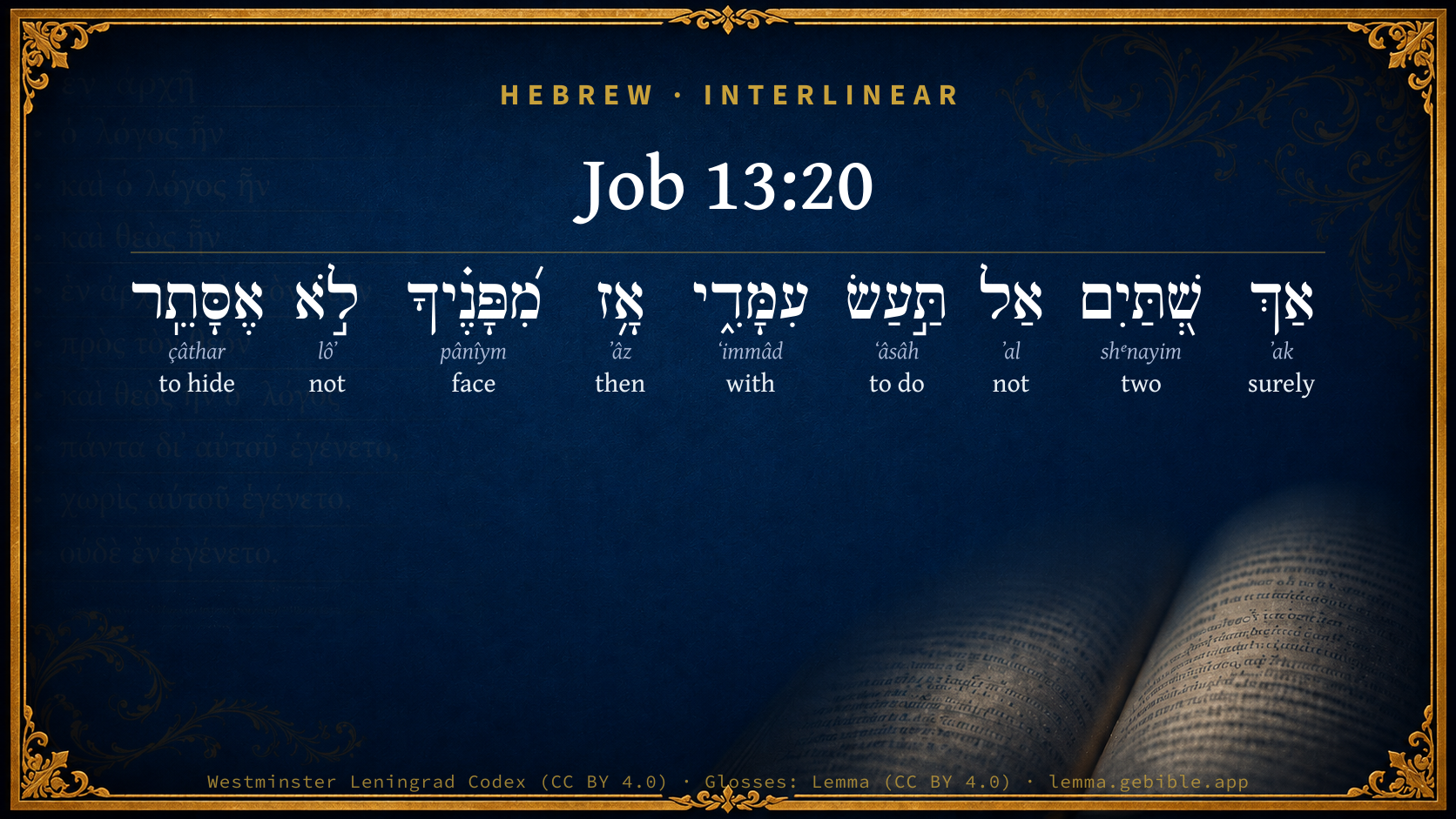
Job 13:20

Hebrew (Westminster Leningrad Codex) Job 13:20 appears in the Hebrew Old Testament. The text above is from the Westminster Leningrad Codex. Each word links to its Strong’s number, a concise gloss, and parsing drawn from the Open Scriptures Hebrew Bible morphology. Click any word for its full Brown-Driver-Briggs (BDB) entry.
Download image
Cite this verse

Job 13:20 (World English Bible). Public Domain. Lemma interlinear Bible study tool, https://lemma.gebible.app/v/job/13/20.

Show BibTeX & RIS
BibTeX
RIS
English Translation
"Only don't do two things to me; Then I will not hide myself from your face:
World English Bible · Public Domain
Download a study sheet

One document with this verse’s original text, its word-by-word gloss line, the meaning frame, cross-references with their text, attributed commentary, and full source and license credits — printable, and it pastes into notes with its structure intact.

This verse Autodidact and up

Study sheet (.html) Plain text (.txt)

A passage Seminary Student

Up to 50 verses in one chapter. A passage sheet keeps up to 6 commentary sources and 12 cross-references per verse, in the order this page ranks them, and says so on the sheet whenever that leaves anything out. Ask for a single verse and you get the Autodidact verse sheet above.

Everything on this page stays free to read, with no account — the sheet is a download of what is already on screen, not access to it.

Want to remove ads? Support Godless Engineer
Compare translations 3

The same verse in 3 English versions, stacked beneath the original-language interlinear above. Click any original word for its lexicon entry.

Each is an independent rendering of the whole verse — the interlinear is not word-aligned to these translations.

Highlighted words mark where these versions differ — a whole-verse word diff, not a word-by-word alignment.

  • World English Bible Public Domain
    "Only don't do two things to me; Then I will not hide myself from your face:
  • King James Version Public Domain
    Only do not two things unto me: then will I not hide myself from thee.
  • unfoldingWord Literal Text CC BY-SA 4.0
    Only two do not do to me, then I will not hide myself from your face:

unfoldingWord Literal Text — © unfoldingWord, licensed CC BY-SA 4.0. Word-aligned USFM3 via Door43 (git.door43.org/unfoldingWord/en_ult).

Versions to compare (up to 4)

3 of 4 selected

Show all 18 translations

Every available English version of this verse, each an independent rendering of the whole verse.

  • World English Bible Public Domain
    "Only don't do two things to me; Then I will not hide myself from your face:
  • Berean Standard Bible Public Domain
    Only grant these two things to me, so that I need not hide from You:
  • Majority Standard Bible Public Domain
    Only grant these two things to me, so that I need not hide from You:
  • King James Version Public Domain
    Only do not two things unto me: then will I not hide myself from thee.
  • American Standard Version (1901) Public Domain
    Only do not two things unto me; Then will I not hide myself from thy face:
  • Revised Version (1885) Public Domain
    Only do not two things unto me, then will I not hide myself from thy face:
  • Geneva Bible (1599) Public Domain
    But doe not these two things vnto me: then will I not hide my selfe from thee.
  • Douay-Rheims (1899) Public Domain
    Two things only do not to me, and then from thy face I shall not be hid:
  • Young's Literal Translation Public Domain
    Only two things, O God, do with me: Then from Thy face I am not hidden.
  • Literal Standard Version CC BY-SA 4.0
    Only two things, O God, do with me, || Then I am not hidden from Your face:
  • Unlocked Literal Bible CC BY-SA 4.0
    God, do only two things for me, and then I will not hide myself from your face:
  • unfoldingWord Literal Text CC BY-SA 4.0
    Only two do not do to me, then I will not hide myself from your face:
  • Darby Bible Public Domain
    Only do not two things unto me; then will I not hide myself from thee.
  • World Messianic Bible Public Domain
    “Only don’t do two things to me, then I will not hide myself from your face:
  • Webster's Bible Public Domain
    Only do not two things to me: then will I not hide myself from thee.
  • Free Bible Version CC BY-SA 4.0
    God, I have two requests, then I can face you.
  • Bible in Basic English Public Domain
    Only two things do not do to me, then I will come before your face:
  • JPS Tanakh (1917) Public Domain
    Only do not two things unto me, then will I not hide myself from Thee:

Literal Standard Version (2020), Covenant Press — licensed CC BY-SA 4.0. Text via the HelloAO Bible API (eBible.org). Unlocked Literal Bible (unfoldingWord) — licensed CC BY-SA 4.0. Text via the HelloAO Bible API (eBible.org). unfoldingWord Literal Text — © unfoldingWord, licensed CC BY-SA 4.0. Word-aligned USFM3 via Door43 (git.door43.org/unfoldingWord/en_ult). Free Bible Version, Dr. Jonathan Gallagher — licensed CC BY-SA 4.0. Text via the HelloAO Bible API (eBible.org).

Word by word

More ways to search: Search by grammar → Find every occurrence → Compare this word →

Practice this passage: Drill this verse → Learn its vocabulary →

About this verse

These counts appear in no published source. They are computed here, from the morphology-tagged text and Lemma’s own curated glosses. What Lemma adds →

9
words
9
distinct lemmas
Wisdom
section

Shared distinctive vocabulary

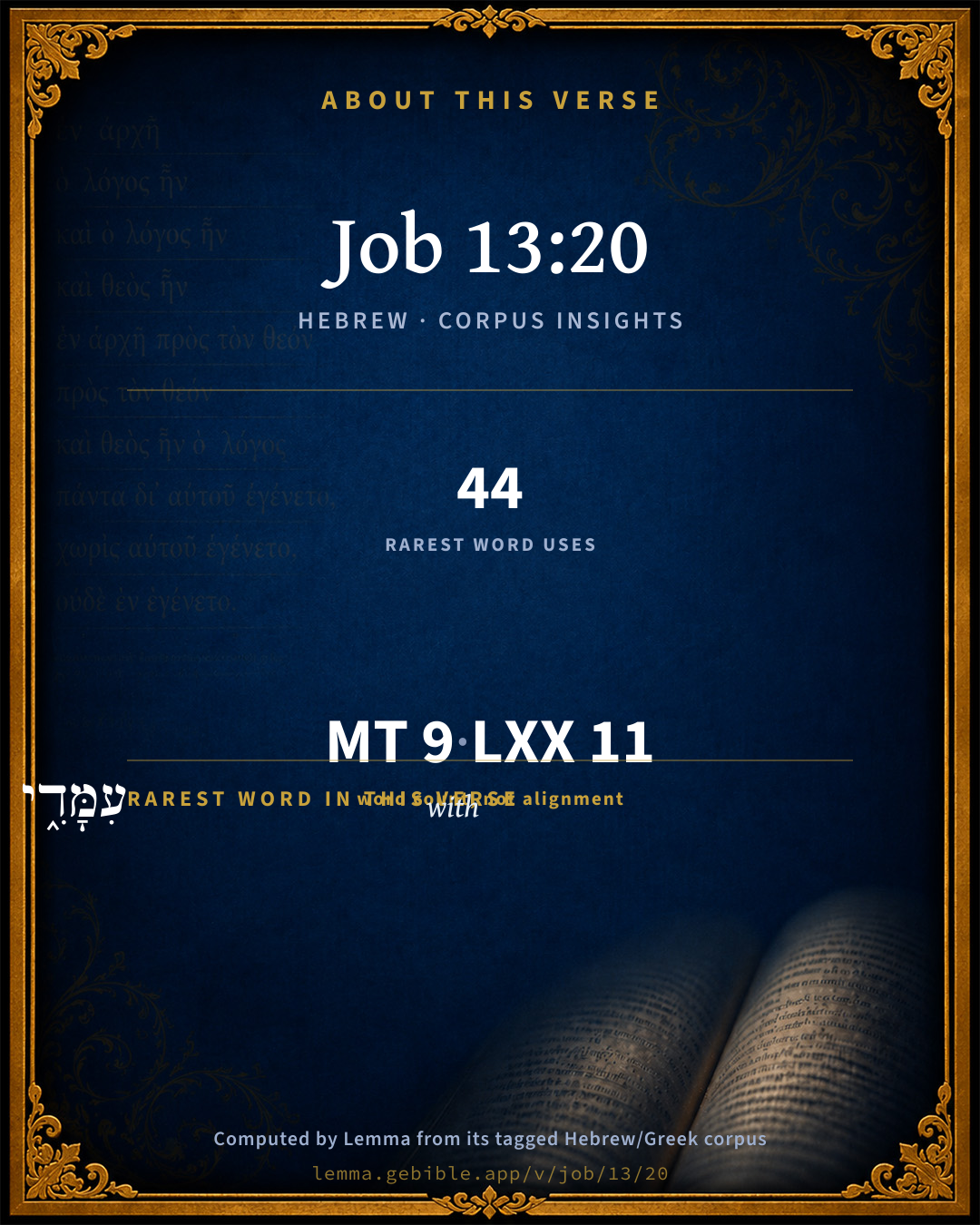
עִמָּדִ֑י with H5978 occurs in 44 verses of the Hebrew Bible. Also found in:

Grammatical profile

  • 2 verbs
  • 1 noun
  • 1 adjective
  • 1 preposition
  • 1 adverb
  • 3 particles

Verb forms

  • תַּ֣עַשׂ Qal · Jussive
  • אֶסָּתֵֽר Niphal · Imperfect

Hebrew & Septuagint length

In English translation the verse runs 16 words from the Hebrew and 14 from the Septuagint (LXX English) — closely comparable.

A rough comparison of the two English renderings, which tokenize alike — not a word-level alignment.

Word counts can differ between the Hebrew and the Greek without any difference in meaning — e.g. the Hebrew direct-object marker אֵת has no separate Greek word, and Greek often adds the article ὁ.

In the original languages it is 9 Hebrew tokens and 11 Greek tokens — but the two are counted differently (Hebrew bundles its prefixes and suffixes into one token; the Greek is in lemma form), so that isn’t a like-for-like length.

Cross-references

4

Topical passages linked to Job 13:20 in the Treasury of Scripture Knowledge — connected by theme and wording, ordered by reader-vote popularity; previews shown in the World English Bible.

  • Genesis 3:8–10 They heard the voice of Yahweh God walking in the garden in the cool of the day, and the man and his wife hid themselves from the presence of Yahweh God among the trees of the garden.
  • Job 9:34–35 Let him take his rod away from me, Let his terror not make me afraid:
  • Psalms 139:12 Even the darkness doesn't hide from you, But the night shines as the day. The darkness is like light to you.
  • Revelation 6:15–16 The kings of the earth, the princes, the commanding officers, the rich, the strong, and every slave and free person, hid themselves in the caves and in the rocks of the mountains.

Cross-references courtesy of OpenBible.info (CC BY 4.0).

Hebrew and Greek witnesses Masoretic Hebrew ↔ Greek Septuagint

The same verse in the two great witnesses to the Old Testament, shown verse-for-verse.

These are two independent witnesses, not word-aligned to each other, and the Septuagint is shown in lemma (dictionary) form.

Hebrew Job 13:20 Masoretic · Westminster Leningrad Codex

אַךְ שְׁ֭תַּיִם אַל תַּ֣עַשׂ עִמָּדִ֑י אָ֥ז מִ֝פָּנֶ֗יךָ לֹ֣א אֶסָּתֵֽר

"Only don't do two things to me; Then I will not hide myself from your face:

World English Bible · Public Domain

Greek LXX Job 13:20 Septuagint · lemma form

δύο δέ ἐγώ χράω τότε ἀπό ὁ πρόσωπον σύ οὐ κρύπτω

But grant me two things: then I will not hide myself from your face.

LXX2012 (modern English Septuagint) · Public Domain

Hebrew: Westminster Leningrad Codex (CC BY 4.0). Greek: Septuagint (public domain); English from LXX2012 (modern English Septuagint) (Public Domain). How the Septuagint differs from the Hebrew →

Commentary

Notes on Job 13:20 from classic Christian and Jewish commentators (each source and its license shown beneath its notes). The classic Christian expositions comment on the surrounding passage and are grouped to its opening verse, so a note may address several verses; the Jewish commentaries on the Tanakh (Rashi and others) are per-verse, so they appear only where the commentator wrote on this verse.

Lemma curates 59 commentaries, every one of them public domain or Creative Commons licensed, each selected and text-cleaned for this edition rather than reprinted as found. About our sources →

Trapp's Complete Commentary

John Trapp

Job 13:20 Only do not two [things] unto me: then will I not hide myself from thee.

Ver. 20. Only do not two things unto me] Accord me only two conditions, and then I will not fly the combat. He knew he might have anything from God that was fit and lawful to be asked. When poor men make requests to princes they usually answer them as the echo doth the voice, the answer cuts off half the petition; and if they beg two boons at once, they may be glad that they get one. But God dealeth by his servants and suppliants not only as the prophet did by the Shunammite (when he bade her ask what she needed, and promised her a son, which she most desired, and yet through modesty asked not, 2Ki 4:16), but also as Naaman did by Gehazi, when, asking one talent, he forced him to take two. This Job well knew, and, therefore, he beggeth two things at once; but better he had begged that one thing necessary, patience; or, if two, the best use of his present sufferings. As we read of one good man, that, lying under great torments of a gall stone, he would often cry out while his friends melted with compassion towards him, The use, Lord, the use; and of Mr William Perkins, that, when he lay in his last and killing torment of the gall stone, hearing the bystanders pray for a mitigation of his pain, he willed them not to pray for an ease of his complaint, but for an increase of his patience (Mr Leigh’s Saints’ Encouragement, &c., p. 164; Dr Hall’s Rem. of Profaneness, p. 143): thus if Job had done, he had done better; but by what he doth here we may easily gather that he expected no freedom from his misery but from God alone; and that he was wont familiarly to impart to God all the thoughts and actings of his heart; and, lastly, that he acknowledged him to be a most righteous Judge, who would not deal with his people upon unequal conditions, but give them a fair trial.

Then will I not hide myself from thee] i.e. I shall have no cause, either through fear or shame, to hide myself. It is not safe for a man to indent with God, and make a bargain with him; for so one may have the thing he would have, but better be without it; as those workmen, Mat 20:9-14, who bargained for a penny a day, and yet when they had it, were no whit contented. Socrates thought it was not fit to ask of God any more than this, that he would bestow good things upon us; but what, and how much, to leave that to him, not being overly earnest, or presuming to prescribe aught. Sir Thomas Moore’s wife was mightily desirous of a boy (that was her word), and she had one that proved a fool; and, saith her husband, you were never quiet till you had a boy, and now you have one that will be all his life a boy. But what were those two things that Job was so earnest for?

John Trapp, A Commentary or Exposition upon All the Books of the Old and New Testament (1647–1656) — public domain. Text from a community e-Sword module.

Joseph Benson's Commentary

Job 13:20-22. Let me only beg, O great Judge of all, that thou wilt forbear to make use of two things against me. Then will I not hide myself from thee — Then will I appear confidently to plead my cause before thee. Withdraw thy hand from me — Suspend my torments during the time of my pleading with thee, that my mind may be at liberty. And let not thy dread make me afraid — Do not present thyself to me in terrible majesty, neither deal with me in rigorous justice. Then call thou, and I will answer — Then choose thy own method: either do thou charge me with hypocrisy, or more than common guilt, and I will defend myself. Or let me speak, &c. — I will argue with thee concerning thy extraordinary severity toward me; and do thou show me the reasons of it. This proposal savours of self-confidence, and of irreverence toward God; for which, and the like speeches, he is reproved by God, Job 38:2-3; Job 40:2.

Joseph Benson's Commentary on the Old and New Testaments (1811–1818) — public domain. Text from a community e-Sword module.

Tyndale Open Study Notes

Tyndale Open Resources

13:20-21 Job had contemplated finding an arbiter to remove God’s heavy hand (9:33-34). Eliphaz had urged Job to accept God’s chastening (5:17).

Tyndale Open Study Notes — © Tyndale Open Resources, licensed CC BY-SA 4.0. Text via the HelloAO Bible API.

Jamieson, Fausset & Brown

Robert Jamieson, A. R. Fausset & David Brown

Address to God.

not hide--stand forth boldly to maintain my cause.

Jamieson, Fausset & Brown — Commentary Critical and Explanatory on the Whole Bible (1871) — public domain (CC PDM 1.0). Text via the HelloAO Bible API.

Adam Clarke's Commentary

Verse 20. Only do not two things unto me] These two things are the following:

1. Withdraw thine hand far from me-remove the heavy affliction which thy hand has inflicted.

2. Let not thy dread make me afraid-terrify me not with dreadful displays of thy majesty. The reasons of this request are sufficiently evident:

1. How can a man stand in a court of justice and plead for his life, when under grievous bodily affliction? Withdraw thy hand far from me.

2. Is it to be expected that a man can be sufficiently recollected, and in self-possession, to plead for his life, when he is overwhelmed with the awful appearance of the judge, the splendour of the court, and the various ensigns of justice? Let not thy dread make me afraid.

Adam Clarke's Commentary on the Bible (1810–1826) — public domain. Text from a community e-Sword/MySword module.

Ellicott's Commentary for English Readers

(20) Will I not hide myself from thee—i.e., “I shall not be hidden”—quite a different word from that in Gen_3:10, though the comparison of the two places is not without interest.

A Bible Commentary for English Readers, edited by Charles John Ellicott (1878–1897) — public domain. Text from a community e-Sword module.

The Cambridge Bible for Schools and Colleges

gen. ed. J. J. S. Perowne

20, 21. Yet the thought recurs before whom he is to appear and against whom he has to maintain his plea, and he begs God to grant two conditions, cf. ch. Job_9:34-35.

The Cambridge Bible for Schools and Colleges (gen. ed. J. J. S. Perowne; Cambridge University Press, 1878–1918) — public domain. Text from a community e-Sword module.

John Gill's Exposition

Only do not two things unto me,.... This is an address not to Zophar as in the place of God, as to me, but to God himself; by this it appears, that though in modesty he does not mention him, yet he it is he has the chief, if not the sole regard unto in Job 13:19; for his desire was to speak to the Almighty, and reason with God, and have nothing more to do with his friends, Job 13:3; but before any pleadings begin on either side, he is desirous of settling and fixing the terms and conditions of the dispute; he requests that two things might be granted him, which are mentioned in Job 13:21,

then will I not hide myself from thee; through fear or shame, but boldly appear before God, and come up even to his seat, and plead with him face to face.

John Gill's Exposition of the Whole Bible (1746–1763) — public domain (CC PDM 1.0). Text via the HelloAO Bible API.

Albert Barnes' Notes on the Bible

Only do not two - things “unto me.” The two things which are specified in the following verse. This is an address to God as Job argues his cause before him, and the request is, that he would remove every obstacle to his presenting his cause in the most favorable manner, and so that he may be on equal terms with him. See the notes at Job 9:34-35. He was ready to present his cause, and to plead before God, as Job 13:18 he had the utmost confidence that he would be able so to present it as to vindicate himself; and he asks of God that he would withdraw his hand for a time Job 13:21 and not terrify him Job 13:21, so that he could present his case with the full vigor of his mind and body, and so that he need not be overawed by the sense of the majesty and glory of the Most High. He wished to be free to present his cause without the impediments arising from a deeply distressing and painful malady. He wished to have his full intellectual and bodily vigor restored for a time to him, and then he was confident that he could successfully defend himself. He felt that, he was now enfeebled by disease, and incapacitated from making the effort for self-vindication and for maintaining his cause, which he would have been enabled to make in his palmy days.

Then will I not hide myself from thee - From God. I will stand forth boldly and maintain my cause. I will not attempt to conceal myself, or shun the trial and the argument. See Job 9:34-35.

Albert Barnes' Notes on the Bible (1834–1885) — public domain. Text from a community e-Sword/MySword module.

Haydock's Catholic Bible Commentary

Only. He makes the same petition to God as [in] chap. ix. 34., and xxxiii. 7. (Haydock)

George Leo Haydock (1774–1849), Haydock's Catholic Family Bible and Commentary, 1859 edition — public domain. Excludes Psalms (Douay-Rheims chapter numbering differs from Protestant) and Deuterocanonical books (Catholic canon only).

Matthew Poole's English Annotations

Which two he expresseth Job 13:21. Then shall I boldly present myself and cause before thee.

Matthew Poole's English Annotations on the Holy Bible (1683–1685) — public domain. Text from a community e-Sword/MySword module.

Whedon's Commentary on the Bible

Daniel D. Whedon

20. Two things — Specified in the following verse: 1. That God would grant him a respite from trouble; 2. That he would not overwhelm with his terror.

Daniel D. Whedon (gen. ed.), Commentary on the Old and New Testaments (1874–1909) — public domain. Text from a community e-Sword module.

The Pulpit Commentary

Only do not two things unto me. Before beginning his plea, Job has two requests to make of God.

(1) That he will put an end for a time to his bodily sufferings suspend them, at any rate, while the pleading continues;

(2) that he will during the same space abstain from terrifying him mentally, as he had done on previous occasions. (Job_6:4 Job_7:14 Job_9:14; see below, ver. 21) Then will I not hide myself from thee; literally, from thy face. (Job_9:34, Job_9:35, "Let him take his rod away from me, and let not his fear terrify me: then would I speak, and not fear him

The Pulpit Commentary (1880–1919), ed. H.D.M. Spence-Jones & Joseph S. Exell — public domain. Text from a community e-Sword module.

Keil & Delitzsch

C. F. Keil & F. Delitzsch

20 Only two things do not unto me,

Then will I not hide myself from Thy countenance:

21 Withdraw Thy hand from me,

And let Thy fear not terrify me -

22 Call then and I will answer,

Or I will speak and answer Thou me!

He makes only two conditions in his prayer, as he has already expressed it in Job 9:34 : (1) That God would grant him a cessation of his troubles; (2) That He would not overwhelm him with His majesty. The chastening hand of God is generally called יד elsewhere; but in spite of this prevalent usage of the language, כּף cannot be understood here (comp. on the contrary Job 33:7) otherwise than of the hand (Job 9:34 : the rod) of God, which lies heavily on Job. The painful pressure of that hand would prevent the collecting and ordering of his thoughts required for meeting with God, and the אימה (Codd. defectively אמתך) of God would completely crush and confound him. But if God grants these two things: to remove His hand for a time, and not to turn the terrible side of His majesty to him, then he is ready whether God should himself open the cause or permit him to have the first word. Correctly Mercerus: optionem ei dat ut aut actoris aut rei personam deligat, sua fretus innocentia, sed interim sui oblitus et immodicus. In contrast with God he feels himself to be a poor worm, but his consciousness of innocence makes him a Titan.

He now says what he would ask God; or rather, he now asks Him, since he vividly pictures to himself the action with God which he desires. His imagination anticipates the reality of that which is longed for. Modern expositors begin a new division at Job 13:23. But Job's speech does not yet take a new turn; it goes on further continually uno tenore.

Keil & Delitzsch — Biblical Commentary on the Old Testament (1861–1891) — public domain (CC PDM 1.0). Text via the HelloAO Bible API. (Old Testament only.)

unfoldingWord translationNotes

Door43 World Missions Community

Connecting Statement:

Job continues speaking to God.

from your face

"Face" represents the person. AT: "from you" (See: Synecdoche)

withdraw your oppressive hand

An oppressive hand is a metonym for doing things that oppress someone. Withdrawing the hand is a metaphor for stopping doing those things. AT: "stop oppressing me" (See: Metonymy and Metaphor)

do not let your terrors make me afraid

The phrase "your terrors" refers to what causes people to be terrified of God. AT: "do not terrify me" (See: Metonymy)

translationWords

oppress

terror

fear

call

unfoldingWord translationNotes — © Distant Shores Media and the Door43 World Missions Community, licensed CC BY-SA 4.0. Source: git.door43.org/Door43/en_tn.

Rashi

Rabbi Shlomo Yitzchaki (Rashi)

But do not do two things to me viz. Heavenly judgment and earthly judgment. If You come to judgment with one [of these], I will not hide from before You. If with Heavenly judgment, I will say, “I have sinned.” [because] (Prov. 28:13), “He who conceals his sins will not succeed.” If with earthly judgment, even I will not confess to concealing sin. I did not hear this (absent in some editions).

Rashi on the Tanakh — English translations: “The Judaica Press complete Tanach with Rashi, translated by A. J. Rosenberg” (CC BY 4.0); “Pentateuch with Rashi's commentary by M. Rosenbaum and A.M. Silbermann, 1929-1934” (public domain); “The Metsudah Tanach series, Lakewood, N.J” (CC BY 4.0); and “The Book of Joshua, Metsudah Publications, 1997” (CC BY 4.0). Text via Sefaria.

Lesson kit

Teaching starters — assembled from the data on this page, not authored interpretation. Every prompt links to the verse data it draws on. Edit before teaching.

Job, in the Wisdom, opens this verse with 9 words (9 distinct Hebrew lemmas). Its most distinctive word is ʻimmâd (“with”). A historical commentator’s framing appears above. Read the whole chapter for the surrounding context.

Discussion questions

  1. What does “with” (ʻimmâd) contribute to the verse as a whole?
  2. How does Genesis 3:12, which shares the word «with», read alongside this verse?
  3. These translations render this verse differently; the difference is in the English rendering, not the original. What questions does that raise?
  4. «תַּ֣עַשׂ» is a Qal Jussive verb. How does that grammatical form shape the action described?
  5. Compare how Trapp's Complete Commentary and Joseph Benson's Commentary read this verse. Where do they agree or differ?

Things to notice

Reading settings

Reading text

Shown beneath each verse's original-language words.

Old Testament
Old Testament edition

Read the OT as the Masoretic Hebrew (MT) or the Greek Septuagint (LXX).

English shown for the Greek Septuagint (in the Hebrew ↔ Greek comparison).

Comparing translations? Open the Compare panel on any verse page to stack up to four side by side.