Isaiah 50:6

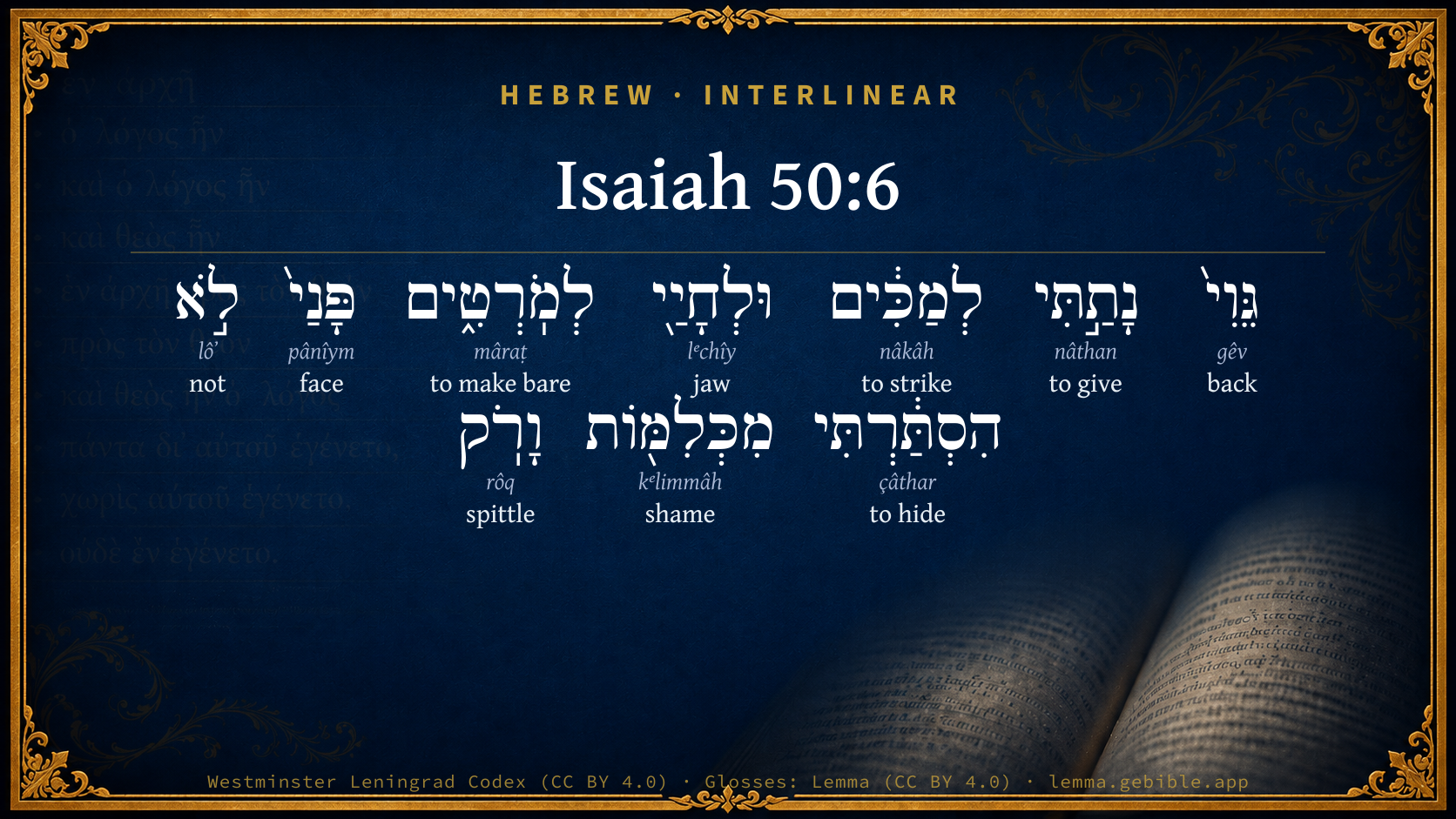
Hebrew (Westminster Leningrad Codex) Isaiah 50:6 appears in the Hebrew Old Testament. The text above is from the Westminster Leningrad Codex. Each word links to its Strong’s number, a concise gloss, and parsing drawn from the Open Scriptures Hebrew Bible morphology. Click any word for its full Brown-Driver-Briggs (BDB) entry.
Download image
Cite this verse

Isaiah 50:6 (World English Bible). Public Domain. Lemma interlinear Bible study tool, https://lemma.gebible.app/v/isaiah/50/6.

Show BibTeX & RIS
BibTeX
RIS
English Translation
I gave my back to the strikers, and my cheeks to those who plucked off the hair; I didn't hide my face from shame and spitting.
World English Bible · Public Domain
Download a study sheet

One document with this verse’s original text, its word-by-word gloss line, the meaning frame, cross-references with their text, attributed commentary, and full source and license credits — printable, and it pastes into notes with its structure intact.

This verse Autodidact and up

Study sheet (.html) Plain text (.txt)

A passage Seminary Student

Up to 50 verses in one chapter. A passage sheet keeps up to 6 commentary sources and 12 cross-references per verse, in the order this page ranks them, and says so on the sheet whenever that leaves anything out. Ask for a single verse and you get the Autodidact verse sheet above.

Everything on this page stays free to read, with no account — the sheet is a download of what is already on screen, not access to it.

Want to remove ads? Support Godless Engineer
Compare translations 3

The same verse in 3 English versions, stacked beneath the original-language interlinear above. Click any original word for its lexicon entry.

Each is an independent rendering of the whole verse — the interlinear is not word-aligned to these translations.

Highlighted words mark where these versions differ — a whole-verse word diff, not a word-by-word alignment.

  • World English Bible Public Domain
    I gave my back to the strikers, and my cheeks to those who plucked off the hair; I didn't hide my face from shame and spitting.
  • King James Version Public Domain
    I gave my back to the smiters, and my cheeks to them that plucked off the hair: I hid not my face from shame and spitting.
  • unfoldingWord Literal Text CC BY-SA 4.0
    I gave my back to the ones striking, and my cheeks to the ones plucking; I did not hide my face from disgraces and spitting.

unfoldingWord Literal Text — © unfoldingWord, licensed CC BY-SA 4.0. Word-aligned USFM3 via Door43 (git.door43.org/unfoldingWord/en_ult).

Versions to compare (up to 4)

3 of 4 selected

Show all 18 translations

Every available English version of this verse, each an independent rendering of the whole verse.

  • World English Bible Public Domain
    I gave my back to the strikers, and my cheeks to those who plucked off the hair; I didn't hide my face from shame and spitting.
  • Berean Standard Bible Public Domain
    I offered My back to those who struck Me, and My cheeks to those who tore out My beard. I did not hide My face from scorn and spittle.
  • Majority Standard Bible Public Domain
    I offered My back to those who struck Me, and My cheeks to those who tore out My beard. I did not hide My face from scorn and spittle.
  • King James Version Public Domain
    I gave my back to the smiters, and my cheeks to them that plucked off the hair: I hid not my face from shame and spitting.
  • American Standard Version (1901) Public Domain
    I gave my back to the smiters, and my cheeks to them that plucked off the hair; I hid not my face from shame and spitting.
  • Revised Version (1885) Public Domain
    I gave my back to the smiters, and my cheeks to them that plucked off the hair: I hid not my face from shame and spitting.
  • Geneva Bible (1599) Public Domain
    I gaue my backe vnto the smiters, and my cheekes to the nippers: I hidde not my face from shame and spitting.
  • Douay-Rheims (1899) Public Domain
    I have given my body to the strikers, and my cheeks to them that plucked them: I have not turned away my face from them that rebuked me, and spit upon me.
  • Young's Literal Translation Public Domain
    My back I have given to those smiting, And my cheeks to those plucking out, My face I hid not from shame and spitting.
  • Literal Standard Version CC BY-SA 4.0
    I have given My back to those striking, || And My cheeks to those plucking out, || I did not hide My face from shame and spitting.
  • Unlocked Literal Bible CC BY-SA 4.0
    I gave my back to those who beat me, and my cheeks to those who plucked out my beard; I did not hide my face from acts of shame and spitting.
  • unfoldingWord Literal Text CC BY-SA 4.0
    I gave my back to the ones striking, and my cheeks to the ones plucking; I did not hide my face from disgraces and spitting.
  • Darby Bible Public Domain
    I gave my back to smiters, and my cheeks to them that plucked off the hair; I hid not my face from shame and spitting.
  • World Messianic Bible Public Domain
    I gave my back to those who beat me, and my cheeks to those who plucked off the hair. I didn’t hide my face from shame and spitting.
  • Webster's Bible Public Domain
    I gave my back to the smiters, and my cheeks to them that plucked off the hair: I hid not my face from shame and spitting.
  • Free Bible Version CC BY-SA 4.0
    I offered my back for people to beat me and my cheeks for people to pull my beard. I didn't hide my face from their mocking and spitting.
  • Bible in Basic English Public Domain
    I was offering my back to those who gave me blows, and my face to those who were pulling out my hair: I did not keep my face covered from marks of shame.
  • JPS Tanakh (1917) Public Domain
    I gave my back to the smiters, and my checks to them that plucked off the hair; I hid not my face from shame and spitting.

Literal Standard Version (2020), Covenant Press — licensed CC BY-SA 4.0. Text via the HelloAO Bible API (eBible.org). Unlocked Literal Bible (unfoldingWord) — licensed CC BY-SA 4.0. Text via the HelloAO Bible API (eBible.org). unfoldingWord Literal Text — © unfoldingWord, licensed CC BY-SA 4.0. Word-aligned USFM3 via Door43 (git.door43.org/unfoldingWord/en_ult). Free Bible Version, Dr. Jonathan Gallagher — licensed CC BY-SA 4.0. Text via the HelloAO Bible API (eBible.org).

Word by word

More ways to search: Search by grammar → Find every occurrence → Compare this word →

Practice this passage: Drill this verse → Learn its vocabulary →

וָרֹֽק
rôq
H7536
“and · spittle”
Conjunction + Noun, Common, Masculine, Singular, Absolute
Part of Speech
Conjunction + Noun
Type
Common
Gender
Masculine
Number
Singular
State
Absolute
Full BDB Definition

Origin: from H7556

TWOT: 2219a

spittle
  1. גֵּוִי֙ gêv H1460 “back · my” Noun, Common, Masculine, Singular, Construct + Suffix, Personal, 1st Person, Common, Singular
  2. נָתַ֣תִּי nâthan H5414 “to give” Verb, Qal, Perfect, 1st Person, Common, Singular
  3. לְמַכִּ֔ים nâkâh H5221 “to/for · striking” Preposition + Verb, Hiphil, Participle Active, Masculine, Plural, Absolute
  4. וּלְחָיַ֖י lᵉchîy H3895 “and · jaws · my” Conjunction + Noun, Common, Both, Dual, Construct + Suffix, Personal, 1st Person, Common, Singular
  5. לְמֹֽרְטִ֑ים mâraṭ H4803 “to/for · making bare” Preposition + Verb, Qal, Participle Active, Masculine, Plural, Absolute
  6. פָּנַי֙ pânîym H6440 “face(s) · my” Noun, Common, Both, Plural, Construct + Suffix, Personal, 1st Person, Common, Singular
  7. לֹ֣א lôʼ H3808 “not” Particle, Negative
  8. הִסְתַּ֔רְתִּי çâthar H5641 “to hide” Verb, Hiphil, Perfect, 1st Person, Common, Singular
  9. מִכְּלִמּ֖וֹת kᵉlimmâh H3639 “from · reproaches” Preposition + Noun, Common, Feminine, Plural, Absolute

About this verse

These counts appear in no published source. They are computed here, from the morphology-tagged text and Lemma’s own curated glosses. What Lemma adds →

10
words
10
distinct lemmas
Prophets
section

Notable vocabulary

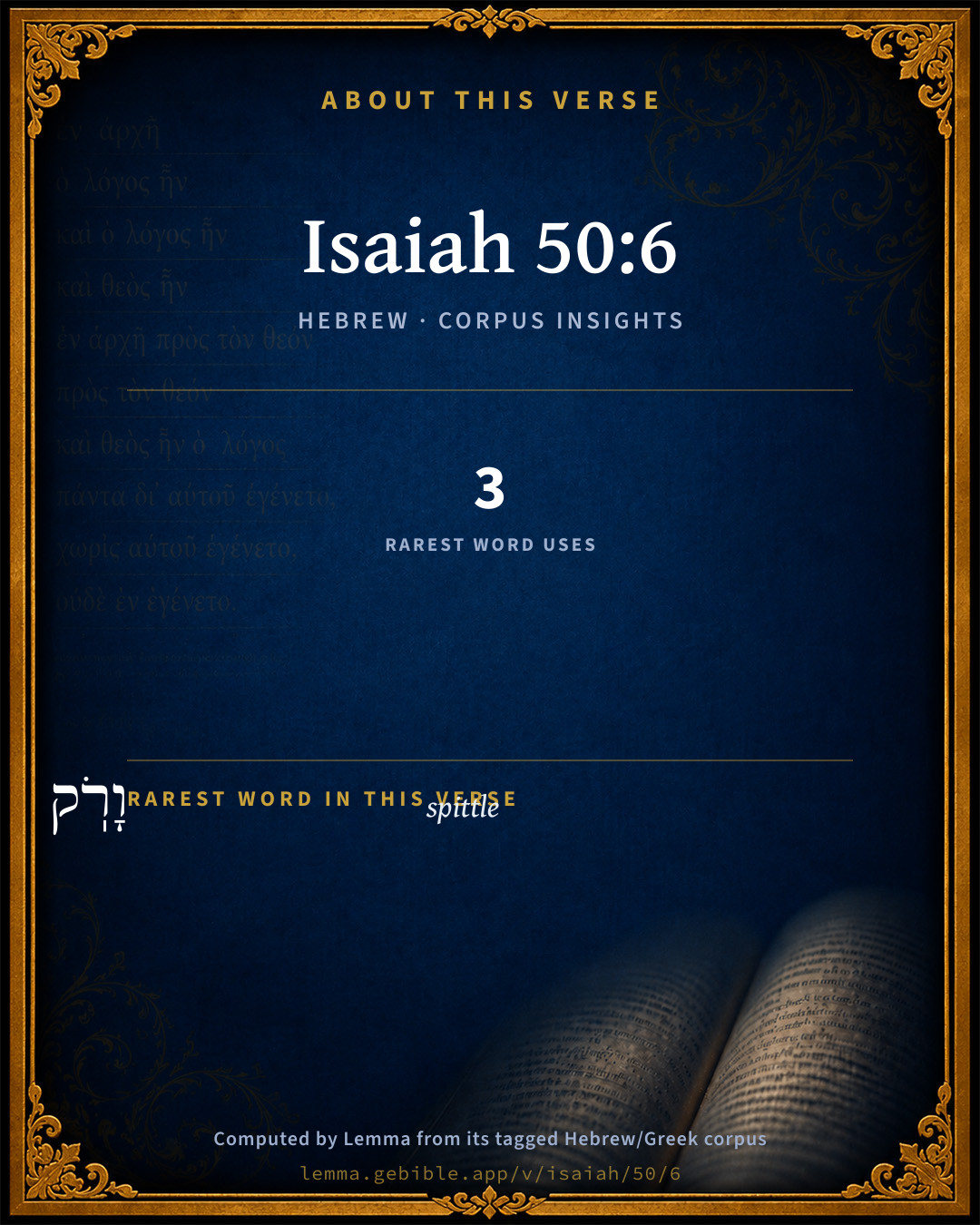
The rarest word here is וָרֹֽק spittle H7536 — appearing just 3 times in the whole Hebrew Bible.

Shared distinctive vocabulary

וָרֹֽק spittle H7536 occurs in 3 verses of the Hebrew Bible. Also found in:

Grammatical profile

  • 4 verbs
  • 5 nouns
  • 1 particle

Verb forms

  • נָתַ֣תִּי Qal · Perfect
  • לְמַכִּ֔ים Hiphil · Participle Active
  • לְמֹֽרְטִ֑ים Qal · Participle Active
  • הִסְתַּ֔רְתִּי Hiphil · Perfect

Hebrew & Septuagint length

In English translation the verse runs 26 words from the Hebrew and 23 from the Septuagint (LXX English) — closely comparable.

A rough comparison of the two English renderings, which tokenize alike — not a word-level alignment.

Word counts can differ between the Hebrew and the Greek without any difference in meaning — e.g. the Hebrew direct-object marker אֵת has no separate Greek word, and Greek often adds the article ὁ.

Cross-references

13

Topical passages linked to Isaiah 50:6 in the Treasury of Scripture Knowledge — connected by theme and wording, ordered by reader-vote popularity; previews shown in the World English Bible.

  • Matthew 26:67 Then they spit in his face and beat him with their fists, and some slapped him,
  • Mark 14:65 Some began to spit on him, and to cover his face, and to beat him with fists, and to tell him, "Prophesy!" The officers struck him with the palms of their hands.
  • Mark 15:19 They struck his head with a reed, and spat on him, and bowing their knees, did homage to him.
  • Matthew 27:30 They spat on him, and took the reed and struck him on the head.
  • Luke 22:63–64 The men who held Jesus mocked him and beat him.
  • Isaiah 53:5 But he was pierced for our transgressions, he was crushed for our iniquities; the punishment that brought our peace was on him; and by his wounds we are healed.
  • Lamentations 3:30 Let him give his cheek to him who strikes him; let him be filled full with reproach.
  • John 18:22 When he had said this, one of the officers standing by slapped Jesus with his hand, saying, "Do you answer the high priest like that?"
  • Matthew 5:39 But I tell you, don't resist him who is evil; but whoever strikes you on your right cheek, turn to him the other also.
  • Hebrews 12:2 looking to Jesus, the author and perfecter of faith, who for the joy that was set before him endured the cross, despising shame, and has sat down at the right hand of the throne of God.
  • Nehemiah 13:25 I contended with them, and cursed them, and struck certain of them, and plucked off their hair, and made them swear by God, [saying], You shall not give your daughters to their sons, nor take their daughters for your sons, or for yourselves.
  • Matthew 27:26 Then he released to them Barabbas, but Jesus he flogged and delivered to be crucified.
  • Micah 5:1 Now you shall gather yourself in troops, Daughter of troops. He has laid siege against us; They will strike the judge of Israel with a rod on the cheek.

Cross-references courtesy of OpenBible.info (CC BY 4.0).

Hebrew and Greek witnesses Masoretic Hebrew ↔ Greek Septuagint

The same verse in the two great witnesses to the Old Testament, shown verse-for-verse.

These are two independent witnesses, not word-aligned to each other, and the Septuagint is shown in lemma (dictionary) form.

Hebrew Isaiah 50:6 Masoretic · Westminster Leningrad Codex

גֵּוִי֙ נָתַ֣תִּי לְמַכִּ֔ים וּלְחָיַ֖י לְמֹֽרְטִ֑ים פָּנַי֙ לֹ֣א הִסְתַּ֔רְתִּי מִכְּלִמּ֖וֹת וָרֹֽק

I gave my back to the strikers, and my cheeks to those who plucked off the hair; I didn't hide my face from shame and spitting.

World English Bible · Public Domain

Greek LXX Isaiah 50:6 Septuagint · lemma form

ὁ νῶτος ἐγώ δίδωμι εἰς μάστιξ ὁ δέ σιαγῶν ἐγώ εἰς ῥάπισμα ὁ δέ πρόσωπον ἐγώ οὐ ἀποστρέφω ἀπό αἰσχύνη ἔπτυσμα

I gave my back to scourges, and my cheeks to blows; and I turned not away my face from the shame of spitting:

LXX2012 (modern English Septuagint) · Public Domain

On this verse, John Gill's Exposition discusses the Septuagint’s reading. Read the note in Commentary ↓

Hebrew: Westminster Leningrad Codex (CC BY 4.0). Greek: Septuagint (public domain); English from LXX2012 (modern English Septuagint) (Public Domain). How the Septuagint differs from the Hebrew →

Targum (Aramaic paraphrase)

1

The Targum is the ancient Jewish Aramaic paraphrase of the Hebrew Scriptures — an interpretive translation, not the Hebrew text itself. Onkelos (literal) and Pseudo-Jonathan (expansive) render the Torah, and Jonathan the Prophets. Coverage is partial: where no permissively-licensed English translation exists for a verse, only the Aramaic is shown. This is verse-level text, not a word-by-word alignment to the Hebrew.

  1. Targum Jonathan Prophets (Joshua–Malachi)
    גַבֵּי יְהָבֵית לְמָחָן וְלִיסְתֵּי לְמָרְטָן אַפִּי לָא טַמְרֵית מֵאִתְכְּנָעוּ וָרוֹק:

    I gave my back to the smiters, and I my cheeks to them that plucked off the hair: I hid not my face from shame and spitting.

    Targum Jonathan — Aramaic: “Mikraot Gedolot” (public domain). English: “Sefaria Community Translation” (CC0 1.0 (public-domain dedication)); “London "Chaldee Paraphrase," 1871” (public domain). Text via Sefaria.

Commentary

Notes on Isaiah 50:6 from classic Christian and Jewish commentators (each source and its license shown beneath its notes). The classic Christian expositions comment on the surrounding passage and are grouped to its opening verse, so a note may address several verses; the Jewish commentaries on the Tanakh (Rashi and others) are per-verse, so they appear only where the commentator wrote on this verse.

Lemma curates 59 commentaries, every one of them public domain or Creative Commons licensed, each selected and text-cleaned for this edition rather than reprinted as found. About our sources →

Trapp's Complete Commentary

John Trapp

Isa 50:6 I gave my back to the smiters, and my cheeks to them that plucked off the hair: I hid not my face from shame and spitting.

Ver. 6. I gave my back to the smiters.] Ecce pro impio pietas flagellatur, &c., saith Ambrose. {a} "Behold the man" (as Pilate once said), "the just" man scourged "for the unjust," {1Pe 3:18} wisdom derided for the fool’s sake, truth denied for the liar’s sake, mercy afflicted for the cruel man’s sake, life dying for the dead man’s sake. What are all our sufferings to his? how oft have we been whipped, depiled, despitefully spat upon, &c., for his sake? Oh that I might have the maidenhead of that kind of suffering! said one of the martyrs in the Marian times; for I have not heard that you have yet whipped any. Bishop Bonner afterwards, with his own hands, whipped some, and pulled a great part of their beards off.

I hid not my face from shame and spitting.] That is, from shameful spitting. See Mat 26:48; Mat 27:30. {See Trapp on "Mat 26:48"} {See Trapp on "Mat 27:30"} Discamus etiam hoc loco, saith Oecolampadius; Learn here also what is the character of a true Christian minister, namely, to express Christ to the world as much as may be, viz., by apt utterance, seasonable comforts, divine learning, ready obedience, constant patience, exemplary innocence, discreet zeal, &c.

{a} De Temp. Ser., 114.

John Trapp, A Commentary or Exposition upon All the Books of the Old and New Testament (1647–1656) — public domain. Text from a community e-Sword module.

The Biblical Illustrator

Joseph S. Exell

Isa_50:6

I gave My back to the smiters

The shame and smiting

I.

AS THE REPRESENTATIVE OF GOD. In the person of Christ Jesus, God himself came into the world, making a special visitation to Jerusalem and the Jewish people, but at the same time coming very near to all mankind. When our Lord came into this world as the representative of God, He came with all His Divine power about Him (Isa_50:2). He did equal marvels to those which were wrought in Egypt when the arm of the Lord was made bare in the eyes of all the people. It is true He did not change water into blood, but He turned water into wine. He did not make their fish to stink, but by His word He caused the net to be filled even to bursting with great fishes. He did the works of His Father, and those works bare witness of Him that He was come in His Fathers name. But when God thus came among men He was unacknowledged. What saith the prophet? Wherefore when I came was there no man? when I called was there none to answer? A few, taught by the Spirit of God, discerned Him and rejoiced; but they were so very few that we may say of the whole generation that they knew Him not. Yet our Lord was admirably adapted to be the representative of God, not only because He was God Himself, but because as man His whole human nature was consecrated to the work, and in Him was neither flaw nor spot. This is especially the sin of those who have heard the Gospel and yet reject the Saviour, for in their case the Lord has come to them in the most gracious form, and yet they have refused Him.

II. I want to set the Lord Jesus before you AS THE SUBSTITUTE FOR HIS PEOPLE.

III. AS THE SERVANT OF GOD.

1. Christ was personally prepared for service (Isa_50:4).

2. This service knew no reserve in its consecration. Our blessed Master was willing to be scoffed at by the lewdest and lowest of men.

3. There is something more here than perfect consecration in the mere form of it, for its heart and essence are manifest in an obedient delight in the will of the Father. The words seem to express alacrity. It is not said that He reluctantly permitted His enemies to pluck His hair, or smite His back, but I gave My back to the smiter, and My cheeks to them that plucked off the hair.

4. There was no flinching in Him. They spat in His face, but what says He in the seventh verse? I have set My face like a flint. Oh, the bravery of our Masters silence! Cruelty and shame could not make Him speak.

5. And do you notice all the while the confidence and quiet of His spirit! He almost seems to say, You may spit upon Me, but you cannot find fault with Me. You may pluck My hair, but you cannot impugn My integrity. You may lash My shoulders, but you cannot impute a fault to Me, etc. Be calm then, O true servant of God! In patience possess your soul. Serve God steadily and steadfastly though all men should belie you.

6. The last two verses of the chapter read you a noble lesson. He gave His back to the smiters; if, then, any of you walk in darkness, this is no new thing for a servant of God. The chief of all servants persevered, though men despised Him. Follow Him, then. Stay yourselves upon God as He did, and look for a bright ending of your trials.

IV. AS THE COMFORTER OF HIS PEOPLE.

1. Our blessed Lord is well qualified to speak a word in season to him that is weary, because He Himself is lowly, and meek, and so accessible to us. When men are in low spirits they feel as if they could not take comfort from persons who are harsh and proud. The comforter must come as a sufferer. Your Master gave His back to the smiters, and His cheek to them that plucked off the hair, and therefore He is the Comforter you want.

2. Remark not only His lowliness, but His sympathy. Are you full of aches and pains? Jesus knows all about them, for He gave His back to the smiters. Do you suffer from what is worse than pain, from scandal and slander? He hid not His face from shame and spitting. Have you been ridiculed of late? Jesus can sympathize with you, for you know what unholy mirth they made out of Him. In every pang that rends your heart your Lord has borne His share. Go and tell Him.

3. In addition to His gentle spirit and His power to sympathize, there is this to help to comfort us--namely, His example, for He can argue thus with you, I gave My back to the smiters. Cannot you do the like! Shall the disciple be above his master?

4. His example further comforts us by the fact that He was calm amid it all.

5. Our Saviours triumph is meant to be a stimulus and encouragement to us. (C. H. Spurgeon.)

The back given to the smiters

In Psa_129:3 the same figure is applied to the sufferings of Israel as a nation. (Prof. J. Skinner, D.D.)

The Roman lash

The lash is nothing among us compared with what it was among the Romans. I have heard that it was made of the sinews of oxen, and that in it were twisted the hucklebones of sheep, with slivers of bone, in order that every stroke might more effectually tear its way into the poor quivering flesh, which was mangled by its awful strokes. (C. H. Spurgeon.)

Plucking off the hair

Of the beard (Ezr_9:3; Neh_13:25); an extreme insult to an Oriental, to whom the beard is the symbol of dignity. (Prof. J. Skinner, D.D.)

The Biblical Illustrator, edited by Joseph S. Exell (c. 1880s–1900s) — public domain. Text from a community e-Sword module.

The Preacher's Complete Homiletical Commentary

Joseph S. Exell (gen. ed.)

OUR SAVIOUR’S SUBMISSION TO SHAME AND SUFFERING

Isa_50:6. I gave my back to the smiters, &c.

It was for us that our Lord thus submitted to shame and suffering. May a spirit of tenderness, and thankfulness, and love, be given to us while we remember what He endured on our behalf!

I. OUR LORD’S HUMILIATION WAS VOLUNTARY.

He gave Himself up freely to suffer, the just for the unjust. And while He was upon earth, in pursuance of His designs, He never was at the mercy of His foes (Mat_26:53). His sufferings were the unavoidable result of His voluntary determination to save us. And they were all foreseen. For the accomplishment of two great purposes, He cheerfully gave His back to the smiters, and His cheeks to them that pulled off the hair. These were the glory of God, and the salvation of sinners.

1. The highest end of His mediation was to display the glory of the Divine character in the strongest light, to afford to all intelligent creatures (Eph_3:10) the brightest manifestation they are capable of receiving of the manifold wisdom of God—His holiness, justice, truth, and love, the stability and excellence of His moral government, all mutually illustrating each other, as combining and shining forth in His person and in His mediatorial work. [1541]

[1541] See Watts’ great hymn—

“Father, how wide Thy glory shines!”

2. Inseparably connected with this design, was the complete and everlasting salvation of sinners. For their sakes He endured the cross, despising the shame—for us! (P. D. 456, 457, 459). [1544]

[1544] See the well-known hymn—

“Jesus, and can it ever be?”

II. OUR LORD’S HUMILIATION WAS EXTREME.

In the apprehensions of men, insults are aggravated in proportion to the disparity between the person who receives and who offers them. A blow from an equal is an offence, but would be still more deeply resented from an inferior. But if a subject, a servant, a slave, should presume to strike a king, it would be justly deemed an enormous crime. But Jesus, the King of kings, and Lord of lords, whom all the angels of God worship, made Himself so entirely of no reputation, that the basest of the people were not afraid to make Him the object of their derision, and to express their hatred in the most contemptuous manner.

1. They spat upon Him (Mat_26:66; Mat_27:30). Great as an insult of this kind would be deemed amongst us, it was considered as still greater, according to the customs prevalent in Eastern countries. There, to spit even in the presence of a person, though it were only on the ground, conveyed the idea of disdain and abhorrence. But the lowest of the people spat in the face—not of an Alexander or a Cæsar—but of THE SON OF GOD!

2. They buffeted Him on the face, and when He meekly offered His cheek to their blows, they plucked off the hair. The beard was in the East accounted honourable (2Sa_10:4-5). With savage violence they tore off the hair of His beard; while He, like a sheep before the shearers, was dumb, and quietly yielded Himself up to their outrages.

3. His back they tore with scourges, as was foretold by the psalmist (Psa_129:3). The Jewish Council condemned Him to death for blasphemy, because He said He was the Son of God. Stoning was the punishment prescribed by the law of Moses, in such cases (Lev_14:16). But this death was not sufficiently lingering and tormenting to gratify their malice. To glut their insatiable cruelty, they were therefore willing to own their subjection to the Roman power to be so absolute, that it was not lawful for them to put any one to death (Joh_17:26), according to their own judicial law; and thus wilfully, though unwillingly, they fulfilled the prophecies: they preferred the punishment which the Romans appropriated to slaves who were guilty of flagitious crimes, and therefore insisted that He should be crucified. According to the Roman custom, those who were crucified were previously scourged. It was not unfrequent for the sufferers to expire under the severity and torture of scourging. And we may be certain that Jesus experienced no lenity from their merciless hands. The ploughers ploughed His back. But more and greater tortures were before Him. He was engaged to make a full atonement for human sin by His sufferings; and as He had power over His own life, He would not dismiss His spirit until He could say, “It is finished!”

“Behold the Man!” Behold the Son of God mocked, blindfolded, spit upon, and scourged!

1. Shall we continue in sin, after we know what it cost Him to expiate our sins? God forbid! (H. E. I. 4589, 4590.)

2. Shall we refuse to suffer shame for His sake, and be intimidated by the frowns or contempt of men from avowing our attachment to Him? We are, indeed, capable of this baseness and ingratitude. But if He is pleased to strengthen us by the power of His Spirit, we will account such disgrace our glory. In this, as in all things, let our Lord be our exemplar. Let us neither court the smiles of men, nor shrink at the thought of their displeasure. Let it be our constant aim to glorify God. This is the secret of Christian heroism. True magnanimity is evidenced by the real importance of the end it proposes, and by the steadiness with which it pursues the proper means of attaining that end; undisturbed by difficulty, danger, or pain, and equally indifferent to the applause or the scorn of incompetent judges. How gloriously did it shine forth in our Saviour! In this let us strive to follow Him!—John Newton: Works, pp. 706–709.

Messiah’s sufferings and supports. I. His sufferings.

1. They were great and various.

2. He willingly undertook to sustain them all (H. E. I. 913). II. His supports.

1. Assurance of effectual succour (Isa_50:7).

2. Assurance of a triumphant issue (Isa_50:7).

Contemplate the holy sufferer—

1. As the predicted Saviour of the world.

2. As the great pattern of all holy obedience.—Charles Simeon, M.A.

Of whom speaketh the prophet this? Of himself or of some other? It is quite certain that Isaiah here wrote concerning the Lord Jesus Christ (Luk_8:31). Of whom else could you conceive the prophet to have spoken if you read the whole chapter? (Luk_23:11.) Pilate, the governor, gave Him up to the cruel process of scourging. Behold your King! Turn hither all your eyes and hearts, and look upon the despised and rejected of men! The sight demands adoration.

I. Gaze upon your despised and rejected Lord as THE REPRESENTATIVE OF GOD. In Him God came into the world, making a special visitation to Jerusalem and the Jewish people, but at the same time coming very near to all mankind. He came to and called the people whom He had favoured so long, and whom He was intent to favour still (Isa_50:2).

1. When our Lord came into this world as the representative of God, He came with all His divine power about Him. He fed the hungry, &c. He did equal marvels to those which were wrought in Egypt when the arm of the Lord was made bare in the eyes of all the people. He did the works of His Father, and those works bare witness of Him that He was come in His Father’s name.

2. But when God thus came among men He was unacknowledged (Isa_50:2). A few, taught by the Spirit of God, discerned Him and rejoiced; but they were so very few that we may say of the whole generation that they knew Him not.

3. Yet our Lord, when He came into the world, was admirably adapted to be the representative of God, not only because He was God Himself, but because as man His whole human nature was consecrated to the work, and in Him was neither flaw nor spot. His course and conduct were most conciliatory, for He went among the people, and ate with publicans and sinners; so gentle was He that He took little children in His arms, and blessed them; for this, if for nothing else, they ought to have welcomed Him right heartily, and rejoiced at the sight of Him. This is especially the sin of those who have heard the Gospel and yet reject the Saviour, for in their case the Lord has come to them in the most gracious form, and yet they have refused Him. This is in reality a scorning and despising of the Lord God, and is well set forth by the insults which were poured upon the Lord Jesus.

II. See the Lord Jesus as THE SUBSTITUTE FOR HIS PEOPLE. When He suffered thus, it was not on His own account, nor purely for the sake of His Father; but He was “wounded for our transgressions,” &c. There has risen up a modern idea which I cannot too much reprobate, that Christ made no atonement for our sin except upon the cross: whereas in this passage we are taught as plainly as possible that by His bruising and stripes, as well as by His death, we are healed. Never divide between the life and the death of Christ. How could He have died, if He had not lived? How could He suffer except while He lived? Death is not suffering, but the end of it. Guard also against the evil notion that you have nothing to do with the righteousness of Christ, for He could not have made an atonement by His blood, if He had not been perfect in His life. He could not have been acceptable, if He had not first been proven to be holy, harmless, and undefiled. The victim must be spotless, or it cannot be presented for sacrifice. Draw no nice lines and raise no quibbling questions, but look at your Lord as He is, and bow before Him. Jesus took upon Himself our sin, and being found bearing that sin, He had to be treated as sin should be treated. All this was voluntary. “He gave His back to the smiters.” They did not seize and compel Him, or, if they did, yet they could not have done it without His consent. That Christ should stand in our stead by force were a little thing, even had it been possible; but that He should stand there of His own free will, and that being there He should willingly be treated with derision, this is grace indeed. Here is matter for our faith to rest upon.

III. See the Lord Jesus Christ as THE SERVANT OF GOD. He took upon Himself the form of a servant when He was made in the likeness of man. This is to be the guide of our life.

1. As a servant, Christ was personally prepared for service. He was thirty years and more here below, learning obedience in His Father’s house, and the after years were spent in learning obedience by the things which He suffered.

2. Our text assures us that this service knew no reserve in its consecration. We generally draw back somewhere. Our blessed Master was willing to be scoffed at by the lewdest and the lowest of men. Such patience should be yours as servants of God.

3. Beside, there was an obedient delight in the will of the Father. How could He delight in suffering and shame? These things were even more repugnant to His sensitive nature than they can be to us; and yet, “For the joy,” &c.

4. There was no flinching in Him. Notice all the while the confidence and quiet of His spirit? He almost seems to say, “You may spit upon me, but you cannot find fault with me,” &c.

IV. AS THE COMFORTER OF HIS PEOPLE.

1. Our blessed Lord is well qualified to speak a word in season to him that is weary, because He Himself is lowly, and meek, and so accessible to us.

2. Beside, He is full of sympathy.

3. Then there is His example. “I gave my back,” &c. Cannot you do the like? &c. He was calm amid it all. Never was there a patience like to His. This is your copy.

4. Our Saviour’s triumph is meant to be a stimulus and encouragement. “Consider Him that endured,” &c. (Heb_12:3). Though once abased and despised, now He sitteth at the right hand of God, and reigns over all things; and the day is coming when every knee shall bow before Him, &c. Be like Him, then, ye who bear His name; trust Him, and live for Him, and you shall reign with Him in glory for ever.—C. H. Spurgeon: Metropolitan Tabernacle Pulpit, No. 1486.

The Preacher's Complete Homiletical Commentary (gen. ed. Joseph S. Exell; Funk & Wagnalls, c. 1892) — public domain (pre-1929). A full-Bible homiletical/sermon-outline anthology covering 65 of 66 books (2 John is absent from the source module). Text from a community e-Sword module.

MacLaren's Expositions of Holy Scripture

Alexander MacLaren

Isaiah

THE SERVANT’S VOLUNTARY SUFFERINGS

Isa 50:6.

Such words are not to be dealt with coldly. Unless they be grasped by the heart they are not grasped at all. We do not think of analysing in the presence of a great sorrow. There can be no greater dishonour to the name of Christ than an unemotional consideration of His sufferings for us. The hindrances to a due consideration of these are manifold; some arising from intellectual, and some from moral, causes. Most men have difficulty in vivifying any historical event so as to feel its reality. There is no nobler use of the historical imagination than to direct it to that great life and death on which the salvation of the world depends.

The prophet here has advanced from the first general conception of the Servant of the Lord as recipient of divine commission, and submissive to the divine voice, to thoughts of the sufferings which He would meet with on His path, and of how He bore them.

I. The sufferings of the Servant.

The minute particularity is very noteworthy, scourging, plucking the beard, shame, all sorts of taunts and buffets on the face, and the last indignity of spitting. Clearly, then, He is not only to suffer persecution, but is to be treated with insult and to endure that strange blending, so often seen, of grim infernal laughter with grim infernal fury, the hyena’s laugh and its ferocity. Wherever it occurs, it implies not only fell hate and cruelty, but also contempt and a horrible delight in triumphing over an enemy. It is found in all corrupt periods, and especially in religious persecutions. Here it implies the rejection of the Servant.

The prophecy was literally fulfilled, but not in all its traits. This may give a hint as to the general interpretation of prophecy and may teach that external fulfilment only points to a deeper correspondence. The most salient instance is in Jesus’ entrance into Jerusalem riding on an ass, which was but a finger-post to guide men’s thoughts to His fulfilling the ideal of the Messianic King. And yet, the minute correspondences are worth noticing. What a strange, solemn glimpse they give into that awful divine omniscience, and into the mystery of the play of the vilest passions as being yet under control in their extremest rage!

We must note the remarkable prominence in the narratives of the Passion, of signs of contempt and mockery; Judas’ kiss, the purple robe, the crown of thorns, ‘wagging their heads,’ ‘let be, let Elias come,’ etc.

Think of the exquisite pain of this to Christ. That He was sinless and full of love made it all the worse to bear. Not the physical pain, but the consciousness that He was encompassed by such an atmosphere of evil, was the sharpest pang. We should think with reverent sympathy of His perfect discernment of the sinful malignant hearts from which the sufferings came, of His pained and rejected love thrown back on itself, of His clear sight of what their heartless infliction of tortures would end in for the inflicters, of His true human feeling which shrank from being the object of contempt and execration.

II. His patient submission.

‘I gave,’-purely voluntary. That word originally expressed the patient submission with which He endured at the moment, when the lash scored His back, but it may be widened out to express Christ’s perfect voluntariness in all His passion. At any moment He could have abandoned His work if His filial obedience and His love to men had let Him do so. His would-be captors fell to the ground before one momentary flash of His majesty, and they could have laid no hand on Him, if His will had not consented to His capture. Fra Angelico has grasped the thought which the prophet here uttered, and which the evangelists emphasise, that all His suffering was voluntary, and that His love to us restrained His power, and led Him to the slaughter, silent as a sheep before her shearers. For he has pourtrayed the majestic figure seated in passive endurance, with eyes blindfolded but yet wide open behind the bandage, all-seeing, wistful, sad, and patient, while around are fragments of rods, and smiting hands, and a cruel face blowing spittle on the unshrinking cheeks. He seems to be saying: ‘These things hast thou done, and I kept silence.’ ‘Thou couldest have no power at all against Me unless it were given thee.’

III. His submission to suffering in obedience to the Father’s Will.

The context connects His opened ear and His not being rebellious with His giving His back to the smiters. That involves the idea that these indignities and insults were part of the divine counsel in reference to Him. That same combination of ideas is strongly presented in the early addresses of Peter, recorded in the first chapters of Acts, of which this is a specimen: ‘Him, being delivered by the determinate counsel and foreknowledge of God, ye with wicked hands have crucified and slain.’ The full significance of Christ’s passion as that of the atoning sacrifice was not yet clear to the apostle, any more than the Servant’s sufferings were to the prophet, but both prophet and apostle were carried on by fuller experience and reflection on what they already saw clearly, to discern the inwardness and depth of these. The one soon came to see that ‘by His stripes we are healed,’ and the other finally wrote: ‘Who His own self bare our sins in His own body on the tree.’ And whoever deeply ponders the startling fact that ‘it pleased the Lord to bruise Him,’ sinless and ever obedient as He was, will be borne, sooner or later, into the full sunlight of the blessed belief that when Jesus suffered and died, ‘He died for all.’ His sufferings were those of a martyr for truth, who is willing to die rather than cease to witness for it; but they were more. They were the sufferings of a lover of mankind who will face the extremest wrong that can be inflicted, rather than abandon His mission; but they were more. They were not merely the penalty which He had to pay for faithfulness to His work; they were themselves the crown and climax of His work. The Son of Man came, indeed, ‘not to be ministered to but to minister,’ but that, taken alone, is but a maimed view of what He came for, and we must whole-heartedly go on to say as He said, ‘and to give His life a ransom for many,’ if we would know the whole truth as to the sufferings of Jesus.

Again, since Christ suffers according to the will of God, it is clear that all representations of the scope of His atoning death, which represent it as moving the will of the Father to love and pardon, are travesties of the truth and turn cause into effect. God does not love, because Jesus died, but Jesus died because God loved.

Further, it is to be noted that His sufferings are the great means by which He sustains the weary. The word to which His ears were opened, morning by morning, was the word to which He was docile when He gave His back to the smiters. It is His passion, regarded as the sacrifice for a world’s sin, from which flow the most powerful stimulants to service and tonics for weary souls, the tenderest comfortings for sorrow. He sustains and comforts by the example of His life, but far more, and more sweetly, more mightily, by that which flows to us through His death. His sufferings are powerful to sustain, when thought of as our example, but they are a tenfold stronger source of patience and strength, when laid on our hearts as the price of our redemption. The Cross is, in all senses of the expression, the tree of life.

Wonder, reverence, love, gratitude, should well forth from our hearts, when we think of these cruel sufferings, but the deepest fountains in them will not be unsealed, unless we see in the suffering Servant the atoning Son.

Alexander MacLaren, Expositions of Holy Scripture (1904–1910) — public domain. Text from a community e-Sword module.

Tyndale Open Study Notes

Tyndale Open Resources

50:6 beat me . . . pulled out my beard . . . mockery and spitting: These connections with the experience of Jesus at his crucifixion are too close to be coincidental—Jesus is the true suffering servant (see Matt 27:27-31).

Tyndale Open Study Notes — © Tyndale Open Resources, licensed CC BY-SA 4.0. Text via the HelloAO Bible API.

Geneva Bible (1599)

Geneva Bible translators

I did not shrink from God for any persecution or calamity. Whereby he showeth that the true ministers of God can look for none other recompense of the wicked, but after this sort, and also what is their comfort.

Geneva Bible (1599) marginal notes — public domain. Text via Bolls.life.

Jamieson, Fausset & Brown

Robert Jamieson, A. R. Fausset & David Brown

smiters--with scourges and with the open hand (Isa 52:14; Mar 14:65). Literally fulfilled (Mat 27:26; Mat 26:27; Luk 18:33). To "pluck the hair" is the highest insult that can be offered an Oriental (Sa2 10:4; Lam 3:30). "I gave" implies the voluntary nature of His sufferings; His example corresponds to His precept (Mat 5:39).

spitting--To spit in another's presence is an insult in the East, much more on one; most of all in the face (Job 30:10; Mat 27:30; Luk 18:32).

Jamieson, Fausset & Brown — Commentary Critical and Explanatory on the Whole Bible (1871) — public domain (CC PDM 1.0). Text via the HelloAO Bible API.

Adam Clarke's Commentary

Verse 6. And my cheeks to them that plucked off the hair] The greatest indignity that could possibly be offered. See the note on Isa 7:20.

I hid not my face from shame and spitting.] Another instance of the utmost contempt and detestation. It was ordered by the law of Moses as a severe punishment, carrying with it a lasting disgrace; De 25:9. Among the Medes it was highly offensive to spit in any one's presence, Herod. i. 99; and so likewise among the Persians, Xenophon, Cyrop. Lib. i., p. 18.

"They abhor me; they flee far from me;

They forbear not to spit in my face."

Job 30:10.

"And JEHOVAH said unto Moses, If her father had but spit in her face, should she not be ashamed seven days?" Nu 22:14. On which place Sir John Chardin remarks, that "spitting before any one, or spitting upon the ground in speaking of any one's actions, is through the east an expression of extreme detestation."-Harmer's Observ. ii. 509. See also, of the same notions of the Arabs in this respect, Niebuhr, Description de l'Arabie, p. 26. It so evidently appears that in those countries spitting has ever been an expression of the utmost detestation, that the learned doubt whether in the passages of Scripture above quoted any thing more is meant than spitting,-not in the face, which perhaps the words do not necessarily imply,-but only in the presence of the person affronted. But in this place it certainly means spitting in the face; so it is understood in St. Luke, where our Lord plainly refers to this prophecy: "All things that are written by the prophets concerning the Son of man shall be accomplished; for he shall be delivered to the Gentiles, and shall be mocked and spitefully entreated, and spitted on, εμπτυσθησεται," Lu 18:31-32, which was in fact fulfilled; και ηρξεαντο τινες εμπτυειν αυτῳ, "and some began to spit on him," Mr 14:65; Mr 15:19. If spitting in a person's presence was such an indignity, how much more spitting in his face?

Adam Clarke's Commentary on the Bible (1810–1826) — public domain. Text from a community e-Sword/MySword module.

The Cambridge Bible for Schools and Colleges

gen. ed. J. J. S. Perowne

6. That persecutions were to be incurred in the performance of his work is already indicated in the last words of Isa_50:5; now the speaker declares his voluntary acquiescence in the hardships of his appointed lot.

I gave my back to the smiters] In Psa_129:3 the same figure is applied to the sufferings of Israel as a nation.

to them that plucked off the hair] of the beard (cf. Ezr_9:3; Neh_13:25); an extreme insult to an Oriental, to whom the beard is the symbol of dignity (see on ch. Isa_7:20).

from shame and spitting] Num_12:14; Deu_25:9; Mat_26:67; Mat_27:30.

The Cambridge Bible for Schools and Colleges (gen. ed. J. J. S. Perowne; Cambridge University Press, 1878–1918) — public domain. Text from a community e-Sword module.

John Gill's Exposition

I gave my back to the smiters,.... To Pontius Pilate, and those he ordered to scourge him, Mat 27:26.

and my cheeks to them that plucked off the hair; of the beard; which, is painful, so a great indignity and affront. The Septuagint renders it, "and my cheeks to blows"; , a word used by the evangelists when they speak of Christ being smitten and stricken with the palms of men's hands, and seem to refer to this passage, Mar 14:65,

I hid not my face from shame and spitting; or from shameful spitting; they spit in his face, and exposed him to shame, and which was a shameful usage of him, and yet he took it patiently, Mat 26:67, these are all instances of great shame and reproach; as what is more reproachful among us, or more exposes a man, than to be stripped of his clothes, receive lashes on his bare back, and that in public? in which ignominious manner Christ was used: or what reckoned more scandalous, than for a man to have his beard plucked by a mob? which used to be done by rude and wanton boys, to such as were accounted idiots, and little better than brutes (x); and nothing is more affronting than to spit in a man's face. So Job was used, which he mentions as a great indignity done to him, Job 30:10. With some people, and in some countries, particular places, that were mean and despicable, were appointed for that use particularly to spit in. Hence Aristippus the philosopher, being shown a fine room in a house, beautifully and richly paved, spat in the face of the owner of it; at which he being angry, and resenting it, the philosopher replied, that he had not a fitter place to spit in (y).

(x) "------------barbam tibi vellunt Lascivi pueri", Horace. "Idcirco stolidam praebet tibi vellere barbara Jupiter?" Persius, Satyr. 2. (y) Laertius in Vita Aristippi.

John Gill's Exposition of the Whole Bible (1746–1763) — public domain (CC PDM 1.0). Text via the HelloAO Bible API.

Albert Barnes' Notes on the Bible

I gave my back to the smiters - I submitted willingly to be scourged, or whipped. This is one of the parts of this chapter which can be applied to no other one but the Messiah. There is not the slightest evidence, whatever may be supposed to have been the probability, that Isaiah was subjected to any such trial as this, or that he was scourged in a public manner. Yet it was literally fulfilled in the Lord Jesus Christ (Mat 27:26; compare Luk 18:33).

And my cheeks to them that plucked off the hair - literally, ‘My cheeks to hose who pluck, or pull.’ The word used here (מרט māraṭ) means properly to polish, to sharpen, to make smooth; then to make smooth the head, to make bald; that is, to pluck out the hair, or the beard. To do this was to offer the highest insult that could be imagined among the Orientals. The beard is suffered to grow long, and is regarded as a mark of honor. Nothing is regarded as more infamous than to cut it off (see 2Sa 10:4), or to pluck it out; and there is nothing which an Oriental will sooner resent than an insult offered to his beard. ‘It is a custom among the Orientals, as well among the Greeks as among other nations, to cultivate the beard with the utmost care and solicitude, so that they regard it as the highest possible insult if a single hair of the beard is taken away by violence.’ (William of Tyre, an eastern archbishop, Gesta Dei, p. 802, quoted in Harmer, vol. ii. p. 359.) It is customary to beg by the beard, and to swear by the beard. ‘By your beard; by the life of your beard; God preserve your beard; God pour his blessings on your beard,’ - are common expressions there. The Mahometans have such a respect for the board that they think it criminal to shave (Harmer, vol. ii. p. 360). The Septuagint renders this, ‘I gave my cheeks to buffering’ (εἰς ῥαπίσμα eis rapisma); that is, to being smitten with the open hand, which was literally fulfilled in the case of the Redeemer Mat 26:67; Mar 14:65. The general sense of this expression is, that he would be treated with the highest insult.

I hid not my face from shame and spitting - To spit on anyone was regarded among the Orientals, as it is everywhere else, as an expression of the highest insult and indignity Deu 25:9; Num 12:14; Job 30:10. Among the Orientals also it was regarded as an insult - as it should be everywhere - to spit in the presence of any person. Thus among the Medes, Herodotus (i. 99) says that Deioces ordained that, ‘to spit in the king’s presence, or in the presence of each other, was an act of indecency.’ So also among the Arabians, it is regarded as an offence (Niebuhr’s Travels, i. 57). Thus Monsieur d’Arvieux tells us (Voydans la Pal. p. 140) ‘the Arabs are sometimes disposed to think, that when a person spits, it is done out of contempt; and that they never do it before their superiors’ (Harmer, iv. 439). This act of the highest indignity was performed in reference to the Redeemer Mat 26:67; Mat 27:30; and this expression of their contempt he bore with the utmost meekness. This expression is one of the proofs that this entire passage refers to the Messiah. It is said Luk 17:32 that the prophecies should be fulfilled by his being spit upon, and yet there is no other prophecy of the Old Testament but this which contains such a prediction.

Albert Barnes' Notes on the Bible (1834–1885) — public domain. Text from a community e-Sword/MySword module.

Haydock's Catholic Bible Commentary

Spit. The greatest indignity, Job xxx. 10., and Deuteronomy xxv. 9. Yet this was the treatment of our Saviour, Luke xviii. 31., and Matthew xxvi. 67. (Calmet) --- "The great Grotius, (I wish he were great in explaining the prophets)" applies this to Jeremias. (Houbigant)

George Leo Haydock (1774–1849), Haydock's Catholic Family Bible and Commentary, 1859 edition — public domain. Excludes Psalms (Douay-Rheims chapter numbering differs from Protestant) and Deuterocanonical books (Catholic canon only).

Matthew Poole's English Annotations

I gave my back to the smiters; I patiently yielded up myself, and turned my back to those who smote me. I was willing not only to do, but to suffer, the will of God, and the injuries of men. This and the following passages were literally fulfilled in Christ, as is expressly affirmed, Mat 26:57,67; 27:26,30, and elsewhere; but we read of no such thing concerning Isaiah. And therefore it is most safe and reasonable to understand it of Christ; the rather, because it is not usual with the prophets to commend themselves so highly as the prophet here commends the person of whom he speaketh.

Plucked off the hair; which was a contumely or punishment inflicted upon malefactors, Neh 13:25.

I hid not my face from shame, from all manner of reproachful usages; but did knowingly and willingly submit myself there unto.

And spitting: spitting in a man’s face was used in token of contempt and detestation, Num 12:14; Job 30:10; and this was literally fulfilled in Christ, Mat 26:67.

Matthew Poole's English Annotations on the Holy Bible (1683–1685) — public domain. Text from a community e-Sword/MySword module.

Whedon's Commentary on the Bible

Daniel D. Whedon

6. I gave my back to the smiters — Spoken in reference to Christ’s willingly-borne sufferings. His obedience was perfect. Psa_22:7; Psa_69:8, find in this their perfect anti-typical fulfilment. “He offered his back to such as smote it, his cheeks to such as plucked the hair of his beard.” This was submission to the deepest degree of shame an Oriental could conceive of. See Mat_26:67; Mat_27:30; Luk_18:31-38.

Daniel D. Whedon (gen. ed.), Commentary on the Old and New Testaments (1874–1909) — public domain. Text from a community e-Sword module.

The Pulpit Commentary

I gave my back to the smiters. (see Isa_53:5, ad fin.; and comp. Mat_26:67 Mat_27:26 Joh_19:1) My cheeks to them that plucked off the hair. This is a detail not historically recorded by the evangelists; but it may have had a literal fulfilment. Plucking off the hair was not unknown to the Jews as a punishment. (see Neh_13:25) I hid not my face from shame and spitting. (see Mat_26:67 Mat_27:30) Spitting in the East marked at once contempt and abhorrence. It is a practice which continues to the present day.

Contumely endured in God"s service.

This is part of a soliloquy of Messiah, and in it he dwells upon the sufferings which would attend his effort to carry out obediently his Divine mission; and upon his confidence that God would uphold his Servant through all the suffering and shame. This passage should be compared with Psalm 22 and Isa 53. The point more especially presented in this verse is the insult offered to Christ in the closing scenes of his life. This insult seems the strangest part of our Lord"s life-experience; but, if he had not known it, he could not have been "in all points tempted like us." The scenes here prophesied are narrated in Mat_26:67, 68 27:26-30 Mar_14:65 15:15-20 Luk_22:63-65 Luk_23:11Jo Luk_18:22, 23 19:1-3. Three forms of indignity are mentioned smiting, or scourging; plucking of hair; and spitting. Each must be estimated in the light of historical descriptions and Eastern sentiments.

I SCOURGING. The severity and barbarity of a Roman scourging has been brought out by Dr. C. Geikie, who says," Jesus was now seized by some of the soldiers standing near, and, after being stripped to the waist, was bound in a stooping posture, his hands behind his back to a post, or low pillar, near the tribunal. He was then beaten till the soldiers chose to stop, with knots of rope or plaited leather thongs, armed at the ends with acorn-shaped drops of lead, or small sharp-pointed bones. In many cases, not only was the back of the person scourged cut open in all directions; even the eyes, the face, and the breast were tern and cut, and the teeth not seldom knocked out. The judge stood by, to stimulate the sinewy executioners by cries of "Give it him!" but we may trust that Pilate, though his office required his presence, spared himself this crime. Under the fury of the countless stripes, the victims sometimes sank, amidst screams, convulsive leaps, and distortions, into a senseless heap; sometimes died on the spot; sometimes were taken away, an unrecognizable mass of bleeding flesh, to find deliverance in death, from the inflammation and fever, sickness and shame." Few New Testament readers duly appreciate the sufferings which Messiah endured in the judgment-hall. The cross so fills their vision that they fail to see how much he endured before the cross and its final strain and agony were reached.

II PLUCKING THE HAIR. Easterns have great respect for the beard, and plucking it was as extremely insulting as it was extremely painful. Eastern sentiment on this matter may be illustrated by the treatment of David"s ambassadors, one-half of whose beards were shaven off. (2Sa_10:5) See also David"s action when he would feign madness. (1Sa_21:13; comp. 2Sa_19:24 Ezr_9:3)

III SPITTING. This was the Eastern expression of contemptuous abhorrence; and so Job poetically expresses his sense of the treatment he had received, by saying, "They abhor me, they flee far from me, and spare not to spit in my face". (Job_30:10) Hanway, in his book of travels, says, "This instance of contempt and reproach offered to Christ was at the same time an expression of malice and a compliance with custom. The practice has descended to later generations; for in the year 1744, when a rebel prisoner was laid before Nadir Shah"s general, the soldiers were ordered to spit in his face an indignity of great antiquity in the East." And Gadsby tells us that "spitting in the face is still practised as a mark of contempt. An officer in Cairo had two Circassian concubines who died suddenly. He charged his wife with being the cause of their death, when she spat in his face. He drew his sabre and killed her. Mehemet All once spat in the face of one of his officers, because he used his wife badly.

The practical application of the fact that Messiah bore such insults in doing his work may be made on the following lines.

1. God"s message, sent by us, may be an offence to men.

2. If it is, they will be very likely to persuade themselves that we are the offence.

3. And when they take up that notion, they will be sure to vent on us the feeling which they have against the message. But this is apostolic consolation: "If ye be reproached for the Name of Christ, happy are ye; for the Spirit of glory and of God resteth upon you. R.T.

The Pulpit Commentary (1880–1919), ed. H.D.M. Spence-Jones & Joseph S. Exell — public domain. Text from a community e-Sword module.

John Wesley's Explanatory Notes

I gave - I patiently yielded up myself to those who smote me.

John Wesley, Explanatory Notes Upon the Whole Bible (1754–1765) — public domain. Text via the GEBible commentary corpus.

J. A. Alexander on Isaiah

Joseph Addison Alexander

“My back I gave to (those) smiting.” We may understand by ‘gave’ either yielded unresistingly or offered voluntarily. (Compare Mat 5:39). The punishment of scourging was a common one, and is particularly mentioned in the history of our Lord’s maltreatment. “And my cheeks to (those) plucking (the beard or hair).” The context here requires something more than the playful or even the contemptuous pulling of the beard, the vellere barbam of Horace and Persius, to which some writers have referred. A better parallel is Neh 13:25, where the Tirshatha is said to have contended with the Jews, and cursed them, and smote them, and plucked off their hair. (Compare Ezr 9:3). This particular species of abuse is not recorded in the history of our Savior’s sufferings, but some suppose it to be comprehended in the general term buffeting. “My face I did not hide from shame and spitting.” In the phrase ‘I did not hide my face’ there may be an allusion to the common figure of confusion covering the face (Jer 51:51) in reference no doubt to the natural expression of this feeling by a blush, or in extreme cases by a livid paleness overspreading the features. Some have imagined that by spitting nothing more is meant than spitting on the ground in one’s presence, which, according to the oriental usages and feelings, is a strong expression of abhorrence and contempt. But if spitting in a person’s presence was such an indignity, how much more spitting in his face; and the whole connection shows that the reference is not to any mitigated form of insult but to its extreme. That this part of the description was fulfilled in the experience of our Savior, is expressly recorded, Mat 26:67; Mat 27:30. From the impossibility of proving any literal coincidence between the prophetic description and the personal experience of the Prophet himself, when taken in connection with the palpable coincidences which have been already pointed out in the experience of Jesus Christ, many interpreters infer that it was meant to be a literal prediction of His sufferings. But it has been observed that if it were so, its fulfillment, or the record of it, would be imperfect, since the points of agreement are not fully commensurate with those of the description. (See for example what has been already said with respect to the plucking of the beard or hair.) The most satisfactory solution of the difficulty is the one which regards the prophecy as metaphorical, and as denoting cruel and contemptuous treatment in general, and supposes the literal coincidences, as in many other cases, to have been providentially secured, not merely to convict the Jews, but also to identify to others the great subject of the prophecy. But if the prophecy itself be metaphorical, it may apply to other subjects, less completely and remarkably but no less really; not to Isaiah, it is true, from whom its terms, even figuratively understood, are foreign, but to the church or people of God, the body of Christ, which like its head has ever been an object of contempt with those who did not understand its character or recognize its claims. What is literally true of the Head is metaphorically true of the Body. ‘I gave my back to the smiters and my cheeks to the pluckers, my face I did not hide from shame and spitting.’

Joseph Addison Alexander, The Prophecies of Isaiah (1846–1847; New York: Scribner, 1870–1878) — public domain. Text from a community e-Sword module.

Rashi

Rabbi Shlomo Yitzchaki (Rashi)

I gave my back to smiters He said to me, Isaiah, My children are obstinate; My children are bothersome. [You may go] on the condition that you do not become angry with them. I said to Him, On that condition.

Rashi on the Tanakh — English translations: “The Judaica Press complete Tanach with Rashi, translated by A. J. Rosenberg” (CC BY 4.0); “Pentateuch with Rashi's commentary by M. Rosenbaum and A.M. Silbermann, 1929-1934” (public domain); “The Metsudah Tanach series, Lakewood, N.J” (CC BY 4.0); and “The Book of Joshua, Metsudah Publications, 1997” (CC BY 4.0). Text via Sefaria.

Ibn Ezra

Rabbi Abraham ibn Ezra

I gave my back, etc. I did not care that I had to expose my back to strokes for the sake of His name.

Ibn Ezra on the Tanakh — English translations: “Sefaria Community Translation” (CC0 1.0 (public-domain dedication)); “Yalkut, Sifsei Chachomim Chumash, Metsudah Publications, 2009” (CC BY 4.0); and “Commentary of Ibn Ezra on Isaiah - trans. by M. Friedlander, 1873” (public domain). Text via Sefaria.

Lesson kit

Teaching starters — assembled from the data on this page, not authored interpretation. Every prompt links to the verse data it draws on. Edit before teaching.

Isaiah, in the Prophets, opens this verse with 10 words (10 distinct Hebrew lemmas). Its most distinctive word is rôq (“spittle”). A historical commentator’s framing appears above. Read the whole chapter for the surrounding context.

Discussion questions

  1. How does “spittle” (rôq) shape what this verse is saying?
  2. Job 7:19 shares the word «spittle» with this verse. How do the two illuminate each other?
  3. The translations on this page render this verse differently — a whole-verse word diff, not a word-by-word alignment. What might account for the different wordings?
  4. The verb «נָתַ֣תִּי» is Qal Perfect. How does its form color the action?
  5. Reading how Trapp's Complete Commentary and The Biblical Illustrator read this verse, where do the two commentators agree and where do they part?

Things to notice

Reading settings

Reading text

Shown beneath each verse's original-language words.

Old Testament
Old Testament edition

Read the OT as the Masoretic Hebrew (MT) or the Greek Septuagint (LXX).

English shown for the Greek Septuagint (in the Hebrew ↔ Greek comparison).

Comparing translations? Open the Compare panel on any verse page to stack up to four side by side.