
Psalms 64:2

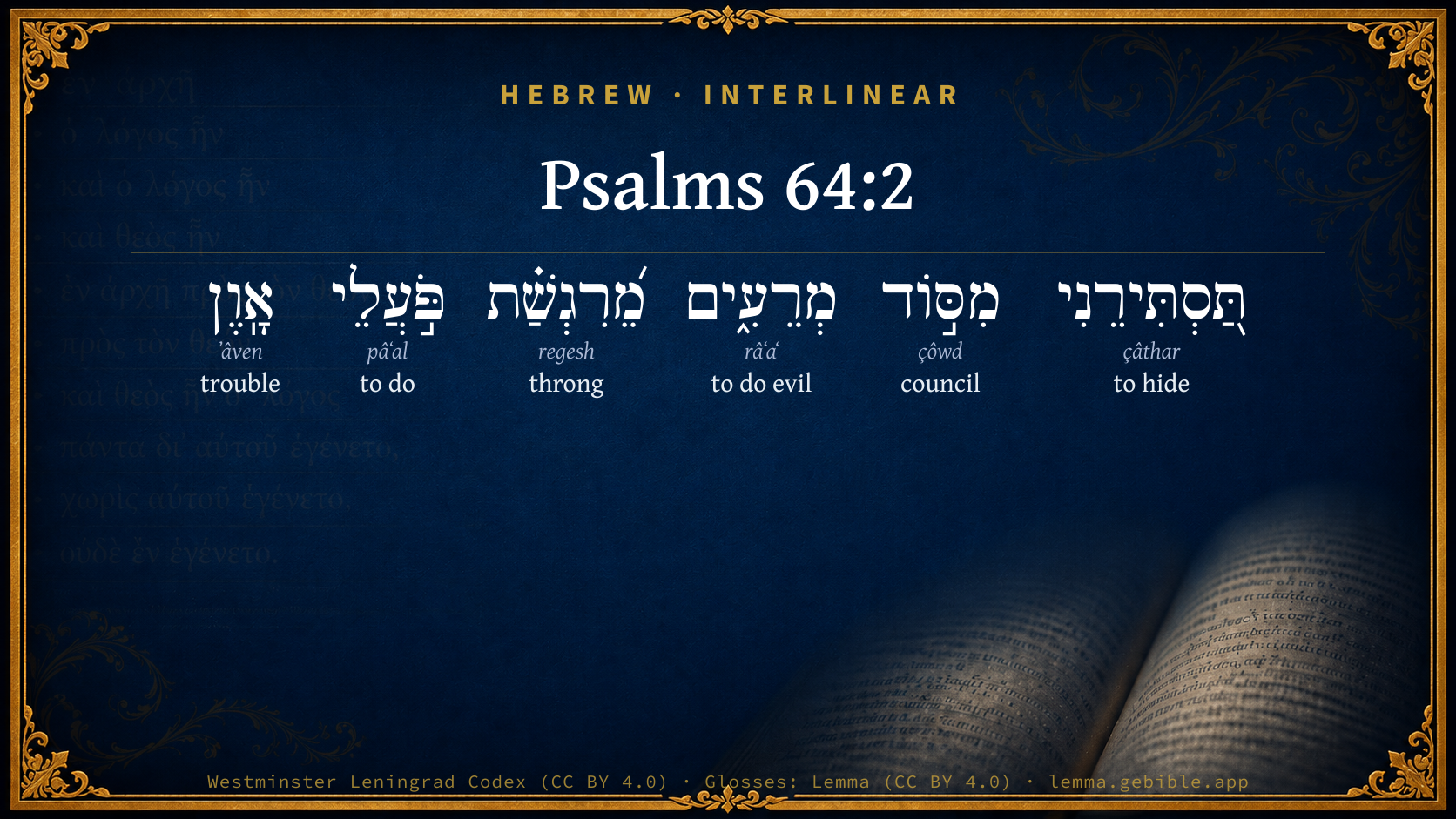
Hebrew (Westminster Leningrad Codex) Psalms 64:2 appears in the Hebrew Old Testament. The text above is from the Westminster Leningrad Codex. Each word links to its Strong’s number, a concise gloss, and parsing drawn from the Open Scriptures Hebrew Bible morphology. Click any word for its full Brown-Driver-Briggs (BDB) entry.
Download image
Cite this verse

Psalms 64:2 (World English Bible). Public Domain. Lemma interlinear Bible study tool, https://lemma.gebible.app/v/psalms/64/2.

Show BibTeX & RIS
BibTeX
RIS
English Translation
Hide me from the conspiracy of the wicked, From the noisy crowd of the ones doing evil;
World English Bible · Public Domain
Download a study sheet

One document with this verse’s original text, its word-by-word gloss line, the meaning frame, cross-references with their text, attributed commentary, and full source and license credits — printable, and it pastes into notes with its structure intact.

This verse Autodidact and up

Study sheet (.html) Plain text (.txt)

A passage Seminary Student

Up to 50 verses in one chapter. A passage sheet keeps up to 6 commentary sources and 12 cross-references per verse, in the order this page ranks them, and says so on the sheet whenever that leaves anything out. Ask for a single verse and you get the Autodidact verse sheet above.

Everything on this page stays free to read, with no account — the sheet is a download of what is already on screen, not access to it.

Want to remove ads? Support Godless Engineer
Compare translations 3

The same verse in 3 English versions, stacked beneath the original-language interlinear above. Click any original word for its lexicon entry.

Each is an independent rendering of the whole verse — the interlinear is not word-aligned to these translations.

Highlighted words mark where these versions differ — a whole-verse word diff, not a word-by-word alignment.

  • World English Bible Public Domain
    Hide me from the conspiracy of the wicked, From the noisy crowd of the ones doing evil;
  • King James Version Public Domain
    Hide me from the secret counsel of the wicked; from the insurrection of the workers of iniquity:
  • unfoldingWord Literal Text CC BY-SA 4.0
    Hide me from the council of evildoers, from the throng of the workers of iniquity,

unfoldingWord Literal Text — © unfoldingWord, licensed CC BY-SA 4.0. Word-aligned USFM3 via Door43 (git.door43.org/unfoldingWord/en_ult).

Versions to compare (up to 4)

3 of 4 selected

Show all 18 translations

Every available English version of this verse, each an independent rendering of the whole verse.

  • World English Bible Public Domain
    Hide me from the conspiracy of the wicked, From the noisy crowd of the ones doing evil;
  • Berean Standard Bible Public Domain
    Hide me from the scheming of the wicked, from the mob of workers of iniquity,
  • Majority Standard Bible Public Domain
    Hide me from the scheming of the wicked, from the mob of workers of iniquity,
  • King James Version Public Domain
    Hide me from the secret counsel of the wicked; from the insurrection of the workers of iniquity:
  • American Standard Version (1901) Public Domain
    Hide me from the secret counsel of evil-doers, From the tumult of the workers of iniquity;
  • Revised Version (1885) Public Domain
    Hide me from the secret counsel of evil-doers; from the tumult of the workers of iniquity:
  • Geneva Bible (1599) Public Domain
    Hide me from the conspiracie of the wicked, and from the rage of the workers of iniquitie.
  • Douay-Rheims (1899) Public Domain
    Hear, O God, my prayer, when I make supplication to thee: deliver my soul from the fear of the enemy.
  • Young's Literal Translation Public Domain
    Hidest me from the secret counsel of evil doers, From the tumult of workers of iniquity.
  • Literal Standard Version CC BY-SA 4.0
    Hide me from the secret counsel of evildoers, || From the tumult of workers of iniquity.
  • Unlocked Literal Bible CC BY-SA 4.0
    Hide me from the secret plotting of evildoers, from the commotion of the doers of iniquity.
  • unfoldingWord Literal Text CC BY-SA 4.0
    Hide me from the council of evildoers, from the throng of the workers of iniquity,
  • Darby Bible Public Domain
    Hide me from the secret counsel of evil-doers, from the tumultuous crowd of the workers of iniquity,
  • World Messianic Bible Public Domain
    Hide me from the conspiracy of the wicked, from the noisy crowd of the ones doing evil;
  • Webster's Bible Public Domain
    \\64:1\\To the chief Musician, a Psalm of David. Hear my voice, O God, in my prayer: preserve my life from fear of the enemy.
  • Free Bible Version CC BY-SA 4.0
    Shelter me from the plots of the wicked, from this evil mob.
  • Bible in Basic English Public Domain
    Keep me safe from the secret purpose of wrongdoers; from the band of the workers of evil;
  • JPS Tanakh (1917) Public Domain
    (64-3) Hide me from the council of evil-doers; from the tumult of the workers of iniquity;

Literal Standard Version (2020), Covenant Press — licensed CC BY-SA 4.0. Text via the HelloAO Bible API (eBible.org). Unlocked Literal Bible (unfoldingWord) — licensed CC BY-SA 4.0. Text via the HelloAO Bible API (eBible.org). unfoldingWord Literal Text — © unfoldingWord, licensed CC BY-SA 4.0. Word-aligned USFM3 via Door43 (git.door43.org/unfoldingWord/en_ult). Free Bible Version, Dr. Jonathan Gallagher — licensed CC BY-SA 4.0. Text via the HelloAO Bible API (eBible.org).

Word by word

More ways to search: Search by grammar → Find every occurrence → Compare this word →

Practice this passage: Drill this verse → Learn its vocabulary →

About this verse

These counts appear in no published source. They are computed here, from the morphology-tagged text and Lemma’s own curated glosses. What Lemma adds →

6
words
6
distinct lemmas
Wisdom
section

Notable vocabulary

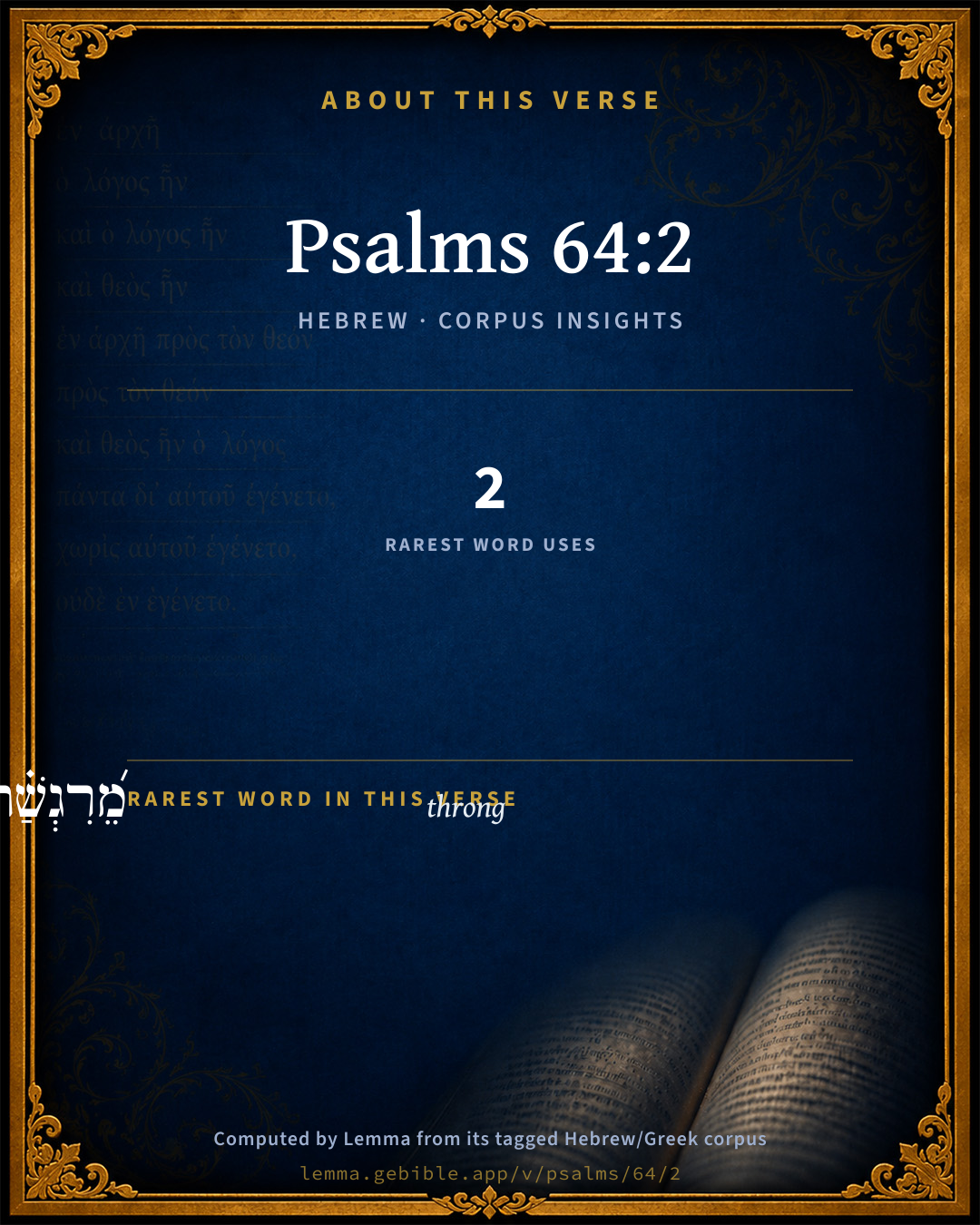
The rarest word here is מֵ֝רִגְשַׁ֗ת throng H7285 — appearing just 2 times in the whole Hebrew Bible.

Shared distinctive vocabulary

מֵ֝רִגְשַׁ֗ת throng H7285 occurs in 2 verses of the Hebrew Bible. Also found in:

Grammatical profile

  • 3 verbs
  • 3 nouns

Verb forms

  • תַּ֭סְתִּירֵנִי Hiphil · Imperfect
  • מְרֵעִ֑ים Hiphil · Participle Active
  • פֹּ֣עֲלֵי Qal · Participle Active

Hebrew & Septuagint length

In English translation the verse runs 17 words from the Hebrew and 20 from the Septuagint (LXX English) — closely comparable.

A rough comparison of the two English renderings, which tokenize alike — not a word-level alignment.

Word counts can differ between the Hebrew and the Greek without any difference in meaning — e.g. the Hebrew direct-object marker אֵת has no separate Greek word, and Greek often adds the article ὁ.

Cross-references

18

Topical passages linked to Psalms 64:2 in the Treasury of Scripture Knowledge — connected by theme and wording, ordered by reader-vote popularity; previews shown in the World English Bible.

  • Psalms 31:20 In the shelter of your presence you will hide them from the plotting of man. You will keep them secretly in a dwelling away from the strife of tongues.
  • Psalms 59:2 Deliver me from the workers of iniquity. Save me from the bloodthirsty men.
  • Psalms 143:9 Deliver me, Yahweh, from my enemies. I flee to you to hide me.
  • Psalms 27:5 For in the day of trouble he will keep me secretly in his pavilion. In the covert of his tent he will hide me. He will lift me up on a rock.
  • Psalms 109:2–3 For they have opened the mouth of the wicked and the mouth of deceit against me. They have spoken to me with a lying tongue.
  • Jeremiah 11:19 But I was like a gentle lamb that is led to the slaughter; and I didn't know that they had devised devices against me, [saying], Let us destroy the tree with the fruit of it, and let us cut him off from the land of the living, that his name may be no more remembered.
  • Psalms 3:1 Yahweh, how my adversaries have increased! Many are those who rise up against me.
  • Isaiah 32:2 A man shall be as a hiding-place from the wind, and a covert from the tempest, as streams of water in a dry place, as the shade of a great rock in a weary land.
  • Jeremiah 18:23 Yet, Yahweh, you know all their counsel against me to kill me; don't forgive their iniquity, neither blot out their sin from your sight; but let them be overthrown before you; deal you with them in the time of your anger.
  • Psalms 2:2 The kings of the earth take a stand, And the rulers take counsel together, Against Yahweh, and against his anointed, saying,
  • Psalms 56:6 They conspire and lurk, Watching my steps, they are eager to take my life.
  • Acts 25:3 asking a favor against him, that he would summon him to Jerusalem; plotting to kill him on the way.
  • Genesis 4:6 Yahweh said to Cain, "Why are you angry? Why has the expression of your face fallen?
  • 2 Samuel 17:2–4 and I will come on him while he is weary and weak-handed, and will make him afraid; and all the people who are with him shall flee; and I will strike the king only;
  • Matthew 26:3–4 Then the chief priests, the scribes, and the elders of the people were gathered together in the court of the high priest, who was called Caiaphas.
  • Acts 23:14–15 They came to the chief priests and the elders, and said, "We have bound ourselves under a great curse, to taste nothing until we have killed Paul.
  • 1 Samuel 23:22–23 Please go make yet more sure, and know and see his place where his haunt is, [and] who has seen him there; for it is told me that he deals very subtly.
  • Luke 23:18–23 But they all cried out together, saying, "Away with this man! Release to us Barabbas!" --

Cross-references courtesy of OpenBible.info (CC BY 4.0).

Hebrew and Greek witnesses Masoretic Hebrew ↔ Greek Septuagint

The same verse in the two great witnesses to the Old Testament, shown verse-for-verse.

You’re reading Greek Psalm 63 (Hebrew Psalm 64). The Septuagint counts the superscription, so verse numbers can differ from the Hebrew — chapter-level alignment, not verse-by-verse. Numbering follows Rahlfs.

These are two independent witnesses, not word-aligned to each other, and the Septuagint is shown in lemma (dictionary) form.

Hebrew Psalms 64:2 Masoretic · Westminster Leningrad Codex

תַּ֭סְתִּירֵנִי מִסּ֣וֹד מְרֵעִ֑ים מֵ֝רִגְשַׁ֗ת פֹּ֣עֲלֵי אָֽוֶן

Hide me from the conspiracy of the wicked, From the noisy crowd of the ones doing evil;

World English Bible · Public Domain

Greek LXX Greek Psalm 63:2 Septuagint · lemma form

εἰςἀκούω ὁ θεός ὁ φωνή ἐγώ ἐν ὁ δέω ἐγώ ἀπό φόβος ἐχθρός ἐκαἱρέω ὁ ψυχή ἐγώ

You have sheltered me from the conspiracy of them that do wickedly; from the multitude of them that work iniquity;

LXX2012 (modern English Septuagint) · Public Domain

Hebrew: Westminster Leningrad Codex (CC BY 4.0). Greek: Septuagint (public domain); English from LXX2012 (modern English Septuagint) (Public Domain). How the Septuagint differs from the Hebrew →

Commentary

Notes on Psalms 64:2 from classic Christian and Jewish commentators (each source and its license shown beneath its notes). The classic Christian expositions comment on the surrounding passage and are grouped to its opening verse, so a note may address several verses; the Jewish commentaries on the Tanakh (Rashi and others) are per-verse, so they appear only where the commentator wrote on this verse.

Lemma curates 59 commentaries, every one of them public domain or Creative Commons licensed, each selected and text-cleaned for this edition rather than reprinted as found. About our sources →

Trapp's Complete Commentary

John Trapp

Psa 64:2 Hide me from the secret counsel of the wicked; from the insurrection of the workers of iniquity:

Ver. 2. Hide me from the secret counsel of the wicked] Or, from the mystery of evil doers, from the Church malignant, that mystery of iniquity. See the contrary, Psa 111:1.

From the insurrection, &c.] Heb. from their tumult, their hurricum, their open force, as well as from their secret fraud. Let thy protection equal their projects, who turn every stone to undo me.

John Trapp, A Commentary or Exposition upon All the Books of the Old and New Testament (1647–1656) — public domain. Text from a community e-Sword module.

J. A. Alexander on Psalms

Joseph Addison Alexander

3. (Psa 64:2). Thou wilt hide me from the secret of evil doers, from the tumult of the workers of iniquity. By secret we are here to understand their confidential consultations and the devices there matured. See above, on Psa 25:14. The participle doing evil, used as a noun (evil doers) to describe the whole class of wicked men, is a favourite expression of David's. See above, Psa 22:16; Psa 26:5; Psa 27:2; Psa 37:1; Psa 37:9. As secrecy belongs, to the formation of the plot, so does noise or tumult to its execution. The same figures are combined, but in a very different application, Psa 55:14.

Joseph Addison Alexander, The Psalms Translated and Explained (1850) — public domain. Text from a community e-Sword module.

Geneva Bible (1599)

Geneva Bible translators

That is, from their secret malice.

To wit, their outward violence.

Geneva Bible (1599) marginal notes — public domain. Text via Bolls.life.

Jamieson, Fausset & Brown

Robert Jamieson, A. R. Fausset & David Brown

insurrection--literally, "uproar," noisy assaults, as well as their secret counsels.

Jamieson, Fausset & Brown — Commentary Critical and Explanatory on the Whole Bible (1871) — public domain (CC PDM 1.0). Text via the HelloAO Bible API.

Adam Clarke's Commentary

Verse 2. Hide me from the secret counsel] They plotted his destruction, and then formed insurrections in order to accomplish it.

Workers of iniquity] Those who made sin their labour, their daily employment; it was their occupation and trade. It is supposed that by this title the Babylonians are intended. See Ps 6:3; Ps 14:4; Ps 36:12; Ps 53:4; Ps 59:2.

Adam Clarke's Commentary on the Bible (1810–1826) — public domain. Text from a community e-Sword/MySword module.

Ellicott's Commentary for English Readers

(2) Secret counsel . . . insurrection—Better, secret league (sôd) . . . noisy gathering (rigshah). For sôd see Psa_25:14, and for rigshah see Note to Psa_2:2.

A Bible Commentary for English Readers, edited by Charles John Ellicott (1878–1897) — public domain. Text from a community e-Sword module.

The Cambridge Bible for Schools and Colleges

gen. ed. J. J. S. Perowne

2. Thou wilt hide me from the secret council of evil doers,

From the tumultuous throng of workers of iniquity.

i.e. from secret machinations and open attack. The cognate verbs are used together in Psa_2:1-2 (tumultuously assemble, R.V. marg.; take counsel). Cp. Psa_31:13. The same words occur in Psa_55:14, but in a good sense.

The Cambridge Bible for Schools and Colleges (gen. ed. J. J. S. Perowne; Cambridge University Press, 1878–1918) — public domain. Text from a community e-Sword module.

John Gill's Exposition

Hide me from the secret counsel of the wicked,.... The word used denotes both the place where wicked men meet together for consultation; see Gen 49:6; and the counsel itself they there take; from the bad effects of which the psalmist desired to be hid and preserved. So Saul and his courtiers secretly took counsel against David, and the Jews against Christ, and that very privily and secretly; see Mat 26:3;

from the insurrection of the workers of iniquity; their noise, rage, and tumult; see Psa 2:1. The former phrase denotes their secret machinations and designs, and this their open violence; and the persons that entered into such measures are no other than evildoers and workers of iniquity; though they might be under a profession of religion, as David's enemies, and the Jews, who were Christ's enemies, were, Mat 7:22; and who are further described in the next verses.

John Gill's Exposition of the Whole Bible (1746–1763) — public domain (CC PDM 1.0). Text via the HelloAO Bible API.

Albert Barnes' Notes on the Bible

Hide me - Or, more literally, thou wilt hide me. There is both an implied prayer that this might be done, and a confident belief that it would be done. The idea is, Protect me; guard me; make me safe - as one is who is hidden or concealed so that his enemies cannot find him.

From the secret counsel - The word used here - סוד sôd - means properly couch, cushion; and then, a divan, a circle of friends sitting together on couches for familiar conversation, or for counsel. See Psa 25:14, note; Psa 55:14, note; compare Job 15:8; Job 29:4. Here the reference is to the consultations of his enemies for the purpose of doing him wrong. Of course, as they took this counsel together, he could not know it, and the word secret is not improperly applied to it. The idea here is, that although he did not know what that counsel or purpose was, or what was the result of their consultations, yet God knew, and he could guard him against it.

Of the wicked - Not the wicked in general, but his particular foes who were endeavoring to destroy him. Luther renders this, “from the assembling of the wicked.”

From the insurrection - The word used here - רגשׁה rigshâh - means properly a “noisy crowd, a multitude.” The allusion is to such a crowd, such a disorderly and violent rabble, as constituted a mob. He was in danger not only from the secret purposes of the more calm and thoughtful of his enemies who were plotting against him, but from the excited passions of the multitude, and thus his life was in double danger. If he escaped the one, he had no security that he would escape the other. So the Redeemer was exposed to a double danger. There was the danger arising from the secret plottings of the Scribes and Pharisees assembled in council, and there was also the danger arising from the infuriated passions of the multitude. The former calmly laid the plan for putting him to death by a judicial trial; the others took up stones to stone him, or cried, “Crucify him, crucify him!” The word insurrection here does not well express the idea. The word tumult would better represent the meaning of the original.

Of the workers of iniquity - That is, of those who were arrayed against him.

Albert Barnes' Notes on the Bible (1834–1885) — public domain. Text from a community e-Sword/MySword module.

Matthew Poole's English Annotations

From the secret counsel, i.e. from the ill effects of their plots against me.

Matthew Poole's English Annotations on the Holy Bible (1683–1685) — public domain. Text from a community e-Sword/MySword module.

The Treasury of David

Charles H. Spurgeon

Ver. 2. Hide me from the secret counsel of the wicked. From their hidden snares hide me. Circumvent their counsel; let their secrets be met by thy secret providence, their counsels of malice by thy counsels of love.

From the insurrection of the workers of iniquity. When their secret counsels break forth into clamorous tumults, be thou still my preserver. When they think evil, let thy divine thoughts defeat them; and when they do evil, let thy powerful justice overthrow them: in both cases, let me be out of reach of their cruel hand, and even out of sight of their evil eye. It is a good thing to conquer malicious foes, but a better thing still to be screened from all conflict with them, by being hidden from the strife. The Lord knows how to give his people peace, and when he wills to make quiet, he is more than a match for all disturbers, and can defeat alike their deep laid plots and their overt hostilities.

None.

Ver. 2. (first clause). Applied to Satan.

I. The danger considered.

1. The enemy, wicked, mighty, malicious, experienced.

2. His counsel. He tempts cunningly, and with deliberation.

3. The secrecy of it. He may be exciting others against me, or sowing evil in myself. II. The deliverance implored. Hide me.

1. Keep me from being tempted.

2. Keep me from evil when tempted.

3. Bring me out of it all unharmed.

4. Meanwhile, let me be in thy secret place. III. The consolation of faith.

1. God does preserve praying ones.

2. Our enemy is his enemy.

3. He has preserved us.

4. We are his own.

5. His honour is involved.

Psalms 64:3*

Charles H. Spurgeon's The Treasury of David (1869–1885) — public domain. Psalms only. Text from a community e-Sword/MySword module.

Whedon's Commentary on the Bible

Daniel D. Whedon

2. Secret counsel—Conspiracy, dark plotting.

Insurrection—The word signifies a tumultuous assembly, a rushing together of the masses, as Psa_2:1; a noisy crowd, Psa_55:14. The secret counsel of Saul and the leaders of the nation gave birth to open demonstrations on the part of the people, both which are here deprecated.

Daniel D. Whedon (gen. ed.), Commentary on the Old and New Testaments (1874–1909) — public domain. Text from a community e-Sword module.

The Pulpit Commentary

Hide me from the secret counsel of the wicked; from the insurrection of the workers of iniquity. The first danger is from secret plots, which David knows to be going on against his authority. (2Sa_15:1-12) The second, and greater danger, will be from open insurrection. (2Sa_17:1-14)

The Pulpit Commentary (1880–1919), ed. H.D.M. Spence-Jones & Joseph S. Exell — public domain. Text from a community e-Sword module.

Rashi

Rabbi Shlomo Yitzchaki (Rashi)

Hear, O God, my voice in my prayer The authors of Aggadoth Tehllim (Mid. Ps.) interpreted this psalm as referring to Daniel, who was cast into the lions’ den. The language of the psalm fits the Aggadah very well. David foresaw with the holy spirit all that would happen to him [Daniel], and prayed for him, because Daniel was his descendant. As was said to Hezekiah (Isa. 39:7): “And they shall take [some] of your sons, etc., whom you shall beget, and they shall be officers in the palace of the king of Babylon.” These are Daniel, Hananiah, Mishael, and Azariah.

from fear of the enemy These are the satraps, who plotted against him, as it is stated (Dan. 6:5): “Then the viziers and the satraps sought to find a pretext against Daniel.”

Rashi on the Tanakh — English translations: “The Judaica Press complete Tanach with Rashi, translated by A. J. Rosenberg” (CC BY 4.0); “Pentateuch with Rashi's commentary by M. Rosenbaum and A.M. Silbermann, 1929-1934” (public domain); “The Metsudah Tanach series, Lakewood, N.J” (CC BY 4.0); and “The Book of Joshua, Metsudah Publications, 1997” (CC BY 4.0). Text via Sefaria.

Lesson kit

Teaching starters — assembled from the data on this page, not authored interpretation. Every prompt links to the verse data it draws on. Edit before teaching.

Psalms, in the Wisdom, opens this verse with 6 words (6 distinct Hebrew lemmas). Its most distinctive word is regesh (“throng”). A historical commentator’s framing appears above. Read the whole chapter for the surrounding context.

Discussion questions

  1. What does “throng” (regesh) contribute to the verse as a whole?
  2. Psalms 55:14 shares the word «throng» with this verse. How do the two illuminate each other?
  3. These translations render this verse differently; the difference is in the English rendering, not the original. What questions does that raise?
  4. The verb «תַּ֭סְתִּירֵנִי» is Hiphil Imperfect. How does its form color the action?
  5. Reading how Trapp's Complete Commentary and J. A. Alexander on Psalms read this verse, where do the two commentators agree and where do they part?

Things to notice

Reading settings

Reading text

Shown beneath each verse's original-language words.

Old Testament
Old Testament edition

Read the OT as the Masoretic Hebrew (MT) or the Greek Septuagint (LXX).

English shown for the Greek Septuagint (in the Hebrew ↔ Greek comparison).

Comparing translations? Open the Compare panel on any verse page to stack up to four side by side.