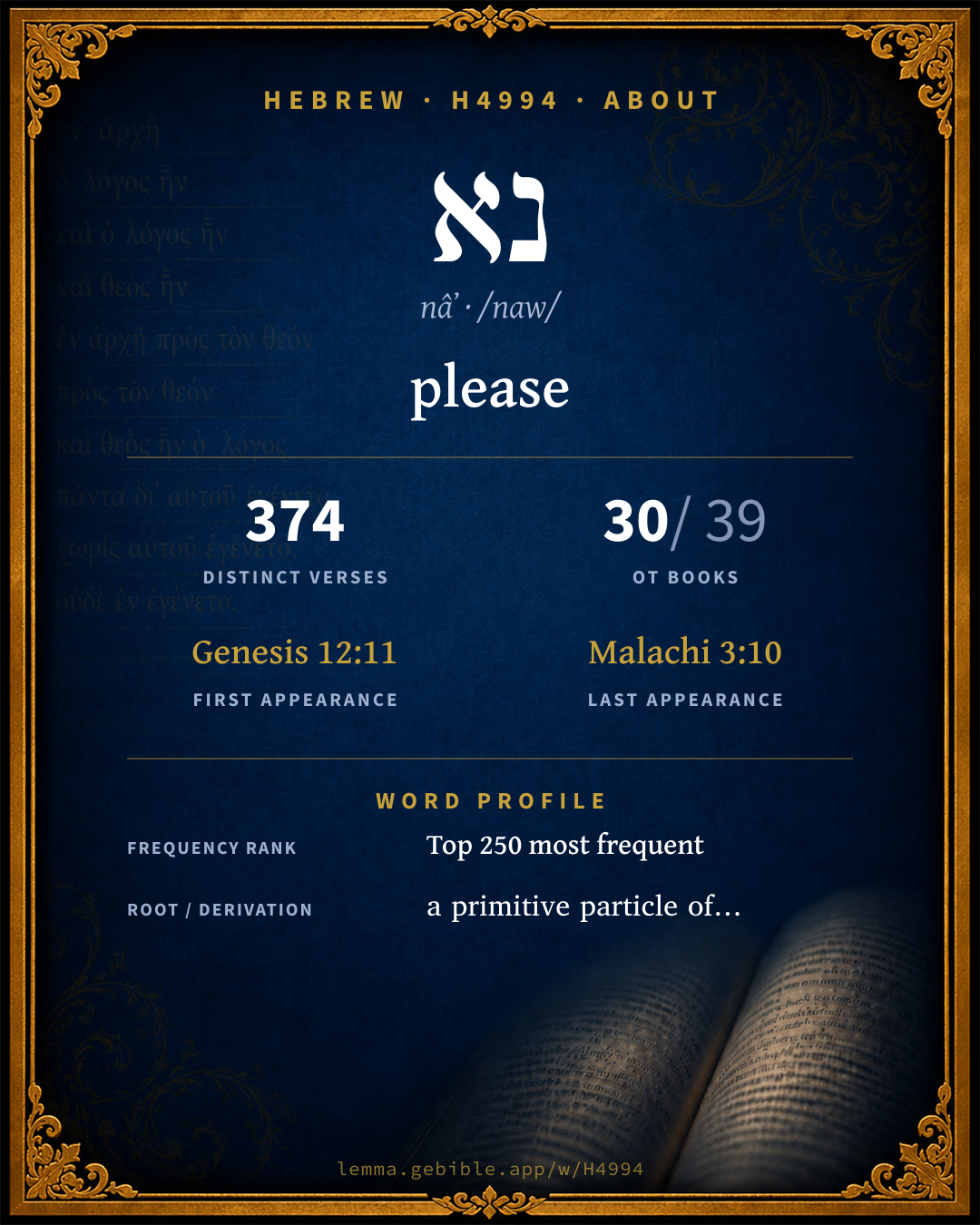
נָא
please
also: I pray, now fuller range ↓
Full lexicon entry — Brown-Driver-Briggs (BDB)
From Brown-Driver-Briggs (BDB)
Where this word appears
Grammar key — what these labels mean
Part of speech
- Particle
- A short function word — article, negation, interrogative, the sign of the direct object, and the like.
Every verse where H4994 appears in the Book of Numbers — 17 distinct verses. Click any verse to open its interlinear word-by-word view. Verse text shown in the World English Bible for context — . Each verse’s Hebrew form is shown with its reference; the English is not keyword-highlighted, since the data carries no word-level English alignment. Use “Compare translations” on any verse to read it across multiple English versions. This concordance covers the Hebrew Bible; Septuagint (Greek Old Testament) occurrences are not indexed here.
Numbers
- Numbers 10:31 נָ֖א ptcl exh He said, Don't leave us, please; because you know how we are to encamp in the wilderness, and you shall be to us instead of eyes.
- Numbers 11:15 נָא֙ ptcl exh If you deal thus with me, please kill me out of hand, if I have found favor in your sight; and let me not see my wretchedness.
- Numbers 12:6 נָ֣א ptcl exh He said, Hear now my words: if there be a prophet among you, I Yahweh will make myself known to him in a vision, I will speak with him in a dream.
- Numbers 12:11 נָ֨א ptcl exh Aaron said to Moses, Oh, my lord, please don't lay sin on us, for that we have done foolishly, and for that we have sinned.
- Numbers 12:12 נָ֥א ptcl exh Let her not, I pray, be as one dead, of whom the flesh is half consumed when he comes out of his mother's womb.
- Numbers 12:13 נָ֛א נָ֖א ptcl exh ptcl exh Moses cried to Yahweh, saying, Heal her, God, I beg you.
- Numbers 14:17 נָ֖א ptcl exh Now please let the power of the Lord be great, according as you have spoken, saying,
- Numbers 14:19 נָ֗א ptcl exh Pardon, Please, the iniquity of this people according to the greatness of your loving kindness, and according as you have forgiven this people, from Egypt even until now.
- Numbers 16:8 נָ֖א ptcl exh Moses said to Korah, Hear now, you sons of Levi:
- Numbers 16:26 נָ֡א ptcl exh He spoke to the congregation, saying, Depart, I pray you, from the tents of these wicked men, and touch nothing of theirs, lest you be consumed in all their sins.
- Numbers 20:10 נָא֙ ptcl exh Moses and Aaron gathered the assembly together before the rock, and he said to them, Hear now, you rebels; shall we bring you forth water out of this rock?
- Numbers 20:17 נָּ֣א ptcl intj Please let us pass through your land: we will not pass through field or through vineyard, neither will we drink of the water of the wells: we will go along the king's highway; we will not turn aside to the right hand nor to the left, until we have passed your border.
- Numbers 22:6 נָּ֨א ptcl intj Please come now therefore curse me this people; for they are too mighty for me: peradventure I shall prevail, that we may strike them, and that I may drive them out of the land; for I know that he whom you bless is blessed, and he whom you curse is cursed.
- Numbers 22:16 נָ֥א ptcl exh They came to Balaam, and said to him, Thus says Balak the son of Zippor, Please let nothing hinder you from coming to me:
- Numbers 22:17 נָּא֙ ptcl intj for I will promote you to very great honor, and whatever you say to me I will do. Please come therefore, and curse this people for me.
- Numbers 22:19 נָ֥א ptcl exh Now therefore, please wait also here this night, that I may know what Yahweh will speak to me more.
- Numbers 23:27 נָּא֙ ptcl intj Balak said to Balaam, Come now, I will take you to another place; peradventure it will please God that you may curse me them from there.
About this entry
At a glance — auto-summarized from this page’s data, not written by a person. Every figure links to its source below. This summary describes the numbers; it doesn’t interpret them.
“please” is the headline sense of the Hebrew word נא (nâʼ). Scripture first uses it in Genesis 12:11. With 374 verses in 30 books, it is a common word in the Hebrew Bible. Not a single-sense word: its full sense range also takes in “I pray” and “now”. See the sense tree, 374-verse concordance, and the renderings breakdown below.
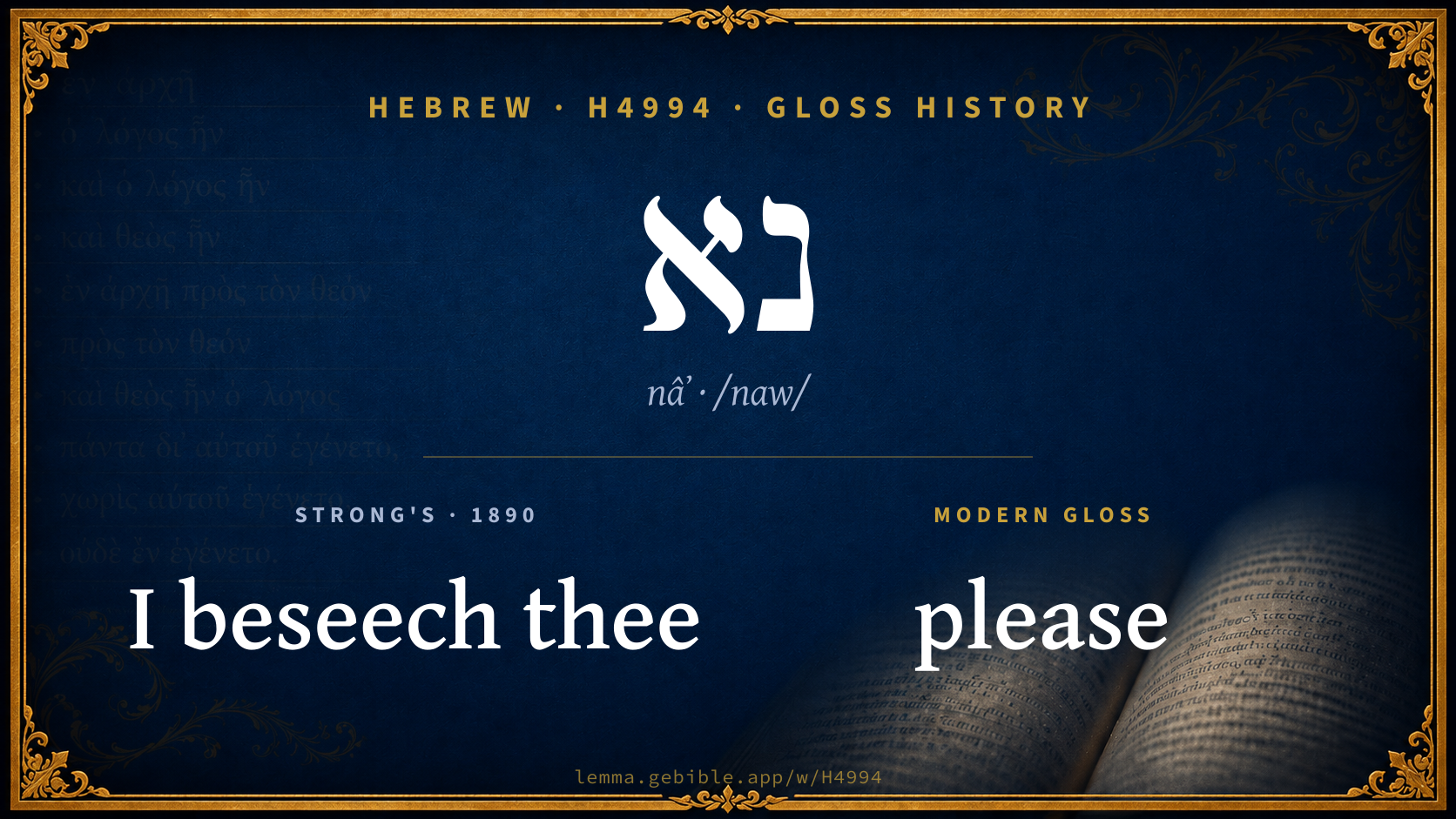
Gloss history
Strong's 1890 vs modern scholarship
About this word
Strong's H4994 catalogs a Hebrew word from the Hebrew Old Testament.
These counts are not copied from any lexicon or concordance. They are computed here, from the morphology-tagged Hebrew Old Testament. What Lemma adds →
- 374
- distinct verses
- The word appears in 374 distinct verses.
- 30 / 39
- OT books
- The word appears in 30 of 39 Old Testament books.
- #123
- by frequency
- Top 250 most frequent Hebrew words (rank 123 of 8,640 Hebrew words by occurrence).
View all 374 occurrences in the concordance →
By section of the Old Testament
By traditional corpus
Conventional, traditional groupings — biblical authorship is debated, so this is a traditional corpus grouping, not an authorship claim. Each share is this word’s portion of its verses in that division of the Hebrew canon. Each figure is a share of the word’s 374 distinct verses.
- Prophets (Nevi'im) 217 verses · 58%
- Torah (Pentateuch) 96 verses · 26%
- Writings (Ketuvim) 61 verses · 16%
How translations render this word
Counts come from each version’s own published word-to-Strong’s tagging or interlinear alignment — an approximate guide to how each version renders this word, not a word-level alignment the data otherwise carries. Because each total is that version’s own tagged count, the per-version totals vary from one another and need not match the appearance or distinct-verse counts above. These counts may also differ from a printed concordance because Lemma counts each distinctly tagged rendering and does not collapse phrase taggings into a single head-word total. This is a fixed set of word-tagged versions (KJV, ASV, BSB, ULT) and does not change with the reading translation you choose elsewhere. Each version’s license is shown beside its name below (and on Sources).
BDB lists this Strong’s number as 3 distinct words (homographs). Each count above pools all of them and is not split by sense — see the Senses section below. A low-frequency rendering may belong to a different one of those words, not the primary meaning.
- King James Version†: I beseech thee 1×, I pray now 1×, I pray thee 1×
- American Standard Version†: I pray thee 2×, Now 2×
- Berean Standard Bible†: Please 163×, Now 58×, I pray 7×
- unfoldingWord Literal Text†: Please 306×, Now 50×, Indeed 6×
King James Version Public Domain
Renders H4994 across 9† tagged occurrences — most commonly:
American Standard Version Public Domain
Renders H4994 across 9† tagged occurrences — most commonly:
Plus 5 renderings that appear only once — usually multi-word phrases or single function words the recovered tagging swept in, not distinct renderings.
Berean Standard Bible Public Domain
Renders H4994 across 253† tagged occurrences — most commonly:
Plus 17 renderings that appear only once — usually multi-word phrases or single function words the recovered tagging swept in, not distinct renderings. Not rendered by a distinct English word in 151 further occurrences.
unfoldingWord Literal Text CC BY-SA 4.0
Renders H4994 across 393† tagged occurrences — most commonly:
Plus 16 renderings that appear only once — usually multi-word phrases or single function words the recovered tagging swept in, not distinct renderings.
14 senses and sub-senses in the full BDB
What do BDB’s symbols mean?
BDB uses these scholarly abbreviations:
| Symbol | Meaning |
|---|---|
| 𝔊 | the Septuagint (the ancient Greek translation, LXX) |
| 𝔙 | the Vulgate (the Latin translation) |
| 𝔖 | the Syriac version (the Peshitta) |
| 𝔗 | the Targum (the Aramaic translation) |
| ψ | the Psalms |
| √ | root (the underlying root or stem) |
| ‖ | parallel passage (a synonymous or contrasted parallel) |
| † | the dagger: every passage where the word occurs is cited |
The 14 senses and sub-senses the full Brown-Driver-Briggs lexicon distinguishes for this word, in lexicon order (not ranked by frequency), with BDB’s own verbatim wording and sub-sense lettering. Shown in Hebrew script with BDB’s own scholarly abbreviations. The condensed entry is in the Lexicon Entry tab. See also the Forms in the corpus table below.
נא I part. of entreaty or exhortation, I (we) pray, now (enclitic) (Syriac ܢܺܐ, ܢܺܝ
- 1. to the imv., especially in colloquial style, when it expresses an entreaty or admonition, as Gn 12:13 אִמְרִי־נָא say, I pray, 13:9 הִפָּרֶד־נָא מֵעָלַי, v 14 שָׂא־נָא עֵינֶיךָ, 15:5 הַבֶּט־נָא השׁמימה, 24:2 + often, Nu 20:10 שׁמעו־נא המוֹרים, Ju 13:4; 16:6, 10, 28; 18:5, etc., Is 1:18; 5:3 Am 7:2, 5; rarely in a command, Gn 22:2 Is 7:3. Ironically, in a challenge, Is 47:12 Jb 40:10. Once anomalously attached to a subst., or (accents) prefixed to a verb, Nu 12:13 אֵ֕ל נָא֛ רְפָ֥א נָא֖ (Ew§ 246 a Di אַל־נָא; v. 3 b). e.g. Genesis 12:13
- 2. to the pf. with waw consec., in a precative sense (Dr§ 119 δ) Gn 40:14. e.g. Genesis 40:14
- 3. to the impf., when leave is asked, or a prayer or desire expressed;
- a. in 1 pers., especially with ה cohort., Gn 19:8 אוציאה־נא let me, I pray, bring out, v 20 אִמָּֽלְטָה־נָּא שָׁ֑מָּה, Ex 3:18 נלכה־נא let us go, I pray, אֵלְכָה נָּא 4:18 אִיעָצֵּךְ נָא עֵצָה let me give thee counsel, I pray, 1 Ki 1:12 Nu 20:17 Is 5:5; and in self-deliberation, Gn 18:21 ארדה־נּא I will go down, now! Ex 3:3 אסורה־נּא ואראה I will turn aside, now, and see, 2 S 14:15 Ct 3:2 Is 5:1; with אַל Jb 32:21. e.g. Genesis 19:8
- b. in 2 pers., with אַל, in deprecation, Gn 18:3 אל־נא תעבר מעל עבדך, 19:7; 47:29 Nu 10:31, etc.; hence ellipt. אל־נא do not, I pray, (do this,) Gn 19:18; 33:10 Nu 12:13 Ew Di e.g. Genesis 18:3
- c. in 3 pers., Gn 18:4 יֻקַּח־נָא let there be brought, I pray, 26:28; 33:14; 44:18, 33, etc., 2 S 14:11, 12, 17 1 K 17:21 2 K 2:9 ψ 7:10; 118:2, 3; ironically Is 19:12; 47:13, or defiantly Jer 17:15 where is the word of J.? יָבוֹא נָא; with אַל, Gn 13:8 אַל־נָא תְהִי מְרִיבָה, 18:30 אַל־נָא יִחַר לַאדֹנָי, 37:27 Nu 12:12. e.g. Genesis 18:4
- 4. joined to conjunctions and interjections:
- a. [אָהּ־נָא, contr.] אָ֫נָּא; v. p. 58.
- b. אַל־נָא, see above 3 b, c.
- c. אִם־נָא, especially in the phrase אם נא מצאתי חן בעיניך, used by one craving a favourable hearing †Gn 30:27; 33:10 Ju 6:17; 1 S 27:5, and with נא repeated in the request itself †Gn 18:3; 47:29; 50:4 Ex 33:13; 34:9; otherwise Gn 24:42. e.g. Genesis 30:27
- d. הִנֵּה־נָא behold, I pray, craving a favourable consideration of the fact pointed to by הִנֵּה, and of the request founded upon it (with which נא is often repeated), Gn 12:11; 16:2; 18:27, 31; 19:2, 8, 19, 20; 27:2 Ju 13:3; 19:9 1 S 9:6; 16:15 2 S 13:24 2 K 2:16, 19; 4:9 +, Jb 13:18; 33:2; 40:15, 16. e.g. Genesis 12:11
- e. (לנו) אוֹי־נָא לי Woe, now, to me (us)! †Je 4:31; 45:7 La 5:16. e.g. Jeremiah 4:31
- f. אַיֵּה־נָא where, pray? †ψ 115:2. e.g. Psalms 115:2
- g. נֶגְדָּה־נָּא, peculiarly, †ψ 116:14, 18 my vows to J. I will perform, נגדה־נא לכל־עמו O that (it may be) before all his people! e.g. Psalms 116:14
נא II raw, of flesh Ex 12
Senses from the full Brown-Driver-Briggs lexicon (Brown, Driver, Briggs; Oxford 1906 — public domain), digitized via Sefaria, supplemented by the OpenScriptures HebrewLexicon (CC BY 4.0). Full attribution on Sources.
Word origin
I. part. of entreaty or exhortation, I (we) pray, now (enclitic) (Syriac ܢܺܐ, ܢܺܝ; cf. Ethiopic ነዒ: veni, age! Di§ 160. 1 Lex675 Köii. 244);—attached:
III. adj. raw, of flesh Ex 12:9 (P; opp. בשׁל).
— Brown-Driver-Briggs (Oxford 1906, public domain), digitized via Sefaria, supplemented by the OpenScriptures HebrewLexicon (CC BY 4.0). See Sources.
Origin: a primitive particle of incitement and entreaty, which may usually be rendered: "I pray," "now," or "then"
Jastrow Dictionary
A second Hebrew/Aramaic lexicon for comparison, covering Aramaic and post-biblical (Talmudic, Targumic, Midrashic) usage that the biblical-Hebrew BDB does not. Matched by lemma rather than by Strong’s number, so a lemma may carry more than one Jastrow headword (shown separately below), and the entries cover usage well beyond the Bible.
נָא I
- = אֲנָא. Y. Ter. V, 43ᶜ bot. ואוף נא וכ׳ I, too, think so. Y. Ber. IV, beg. 7ᵃ וָנָא אמרית וכ׳ and I gave a reason for it; a. fr.—V. דְּנָה, לֵינָא.—Pl. נַן. Y. B. Kam. II, beg. 2ᵈ מה נן אמרין וכ׳ why do we say &c.; a. fr.
נָא II
- (also adverb)(b. h.;
- 1. hurried, half-done. Pes. 41ᵃ bot. אכלו נא if he ate it (the Passover lamb) half-done. Ib.ᵇ ישנו בבל תאכל נא is subject to the law (Ex. XII, 9) &c. Tosef. Macc. IV (III), 1, contrad. to חַי. Men. 78ᵇ מצה נא, v. הַיָנָא; a. fr. e.g. Exodus 12:9
- 2. slender, fine, brittle. — Pl. נָאִין; f. נָאוֹת. Tosef. Kel. B. Kam. II, 9 [read with R. S. to Kel. III, 2:] הוסקו והנאין (= והן נאין) if the vessels were heated but turned out brittle. B. Bath, 97ᵇ (expl. פיטסות, ib. VI, 2) נאות ומגופרות thin, but lined with pitch; Tosef. ib. VI, 3.
נָא III
- (b. h.) I pray, prithee. Yoma IV, 2; a. fr.—Ber. 9ᵃ, a. e. אין נא אלא וכ׳, v. בַּקָּשָׁה.
נַן
- , pl. of נָא I.
A Dictionary of the Targumim, the Talmud Babli and Yerushalmi, and the Midrashic Literature (Marcus Jastrow; London, Luzac, 1903) — Public Domain. Digitized via Sefaria. Digitized via Sefaria. Full attribution on Sources.
Forms in the corpus
The 43 distinct written forms H4994 takes in the Hebrew Bible, most frequent first — each parse links to that state’s occurrences in the concordance. Hebrew forms include their vowel points and cantillation, so a single lemma takes many written forms.
| Form | Parsing | Example | Uses |
|---|---|---|---|
| נָ֣א | Particle, Exhortation | Ezekiel 8:8 | 66 |
| נָ֥א | Particle, Exhortation | Daniel 1:12 | 48 |
| נָ֤א | Particle, Exhortation | Daniel 9:16 | 33 |
| נָא֙ | Particle, Exhortation | Exodus 33:13 | 33 |
| נָ֖א | Particle, Exhortation | Exodus 4:13 | 31 |
| נָּ֣א | Particle, Interjection | Exodus 3:3 | 20 |
| נָ֞א | Particle, Exhortation | Genesis 16:2 | 19 |
| נָ֨א | Particle, Exhortation | Genesis 13:8 | 19 |
| נָ֔א | Particle, Exhortation | Amos 7:2 | 11 |
| נָ֛א | Particle, Exhortation | Genesis 24:17 | 11 |
| נָ֭א | Particle, Exhortation | Job 5:1 | 9 |
| נָ֠א | Particle, Exhortation | Genesis 19:2 | 8 |
| נָּא֙ | Particle, Interjection | Genesis 24:42 | 8 |
| נָ֗א | Particle, Exhortation | Genesis 37:32 | 7 |
| נָא֩ | Particle, Exhortation | Deuteronomy 4:32 | 7 |
| נָּ֤א | Particle, Interjection | Genesis 19:8 | 7 |
| נָּ֥א | Particle, Interjection | Genesis 27:21 | 7 |
| נָּ֖א | Particle, Interjection | 1 Chronicles 22:5 | 5 |
| נָּ֗א | Particle, Interjection | Deuteronomy 3:25 | 5 |
| נָ֑א | Particle, Exhortation | 1 Kings 20:35 | 4 |
| נָ֕א | Particle, Exhortation | Genesis 37:6 | 4 |
| נָ֜א | Particle, Exhortation | 1 Samuel 26:8 | 4 |
| נָ֧א | Particle, Exhortation | Haggai 2:11 | 4 |
| נָּ֛א | Particle, Interjection | Ecclesiastes 2:1 | 4 |
| נָ֡א | Particle, Exhortation | 1 Samuel 20:29 | 3 |
| נָ֝א | Particle, Exhortation | Psalms 124:1 | 2 |
| נָֽא | Particle, Exhortation | Genesis 24:45 | 2 |
| נָא | Particle, Exhortation | Isaiah 29:11 | 2 |
| נָא֮ | Particle, Exhortation | 2 Kings 2:16 | 2 |
| נָּ֜א | Particle, Interjection | Genesis 19:20 | 2 |
| נָּ֝֗א | Particle, Interjection | Psalms 116:14 | 2 |
| נָּ֨א | Particle, Interjection | Jeremiah 38:25 | 2 |
| נָּא | Particle, Interjection | Genesis 19:2 | 2 |
| נָ֝֗א | Particle, Exhortation | Psalms 115:2 | 1 |
| נָ֬א | Particle, Exhortation | Psalms 7:9 | 1 |
| נָּ֑א | Particle, Interjection | Psalms 118:25 | 1 |
| נָּ֔א | Particle, Interjection | 2 Samuel 18:19 | 1 |
| נָּ֞א | Particle, Interjection | Exodus 3:18 | 1 |
| נָּ֡א | Particle, Interjection | Exodus 5:3 | 1 |
| נָּ֭א | Particle, Interjection | Job 17:3 | 1 |
| נָּֽא | Particle, Interjection | Psalms 118:25 | 1 |
| נָּא֩ | Particle, Interjection | 1 Kings 20:31 | 1 |
| נא | Particle, Exhortation | 2 Kings 5:18 | 1 |
Septuagint verse parallels
This word appears in 358 verses that also exist in the Greek Old Testament (Septuagint), out of the 374 Hebrew verses it occurs in. You can read those verses in Greek by switching the Old Testament edition to the Septuagint.
Read these verses in the Septuagint
- Genesis 12:11
- Exodus 3:3
- Numbers 10:31
- Deuteronomy 3:25
- Joshua 2:12
- Judges 1:24
- Ruth 2:2
- 1 Samuel 2:36
- 2 Samuel 1:4
- 1 Kings 1:12
- 2 Kings 1:13
- 1 Chronicles 21:8
This is a verse-level parallel only — the same verses exist in both the Hebrew and Greek Old Testaments. No word-level Hebrew↔Greek correspondence is claimed: the data carries no such alignment, so no Greek word is shown as this Hebrew word’s translation. Coverage is not total — the Septuagint omits the deuterocanon and renumbers the Psalms, so some Hebrew verses have no direct Greek parallel.