Numbers 23:27

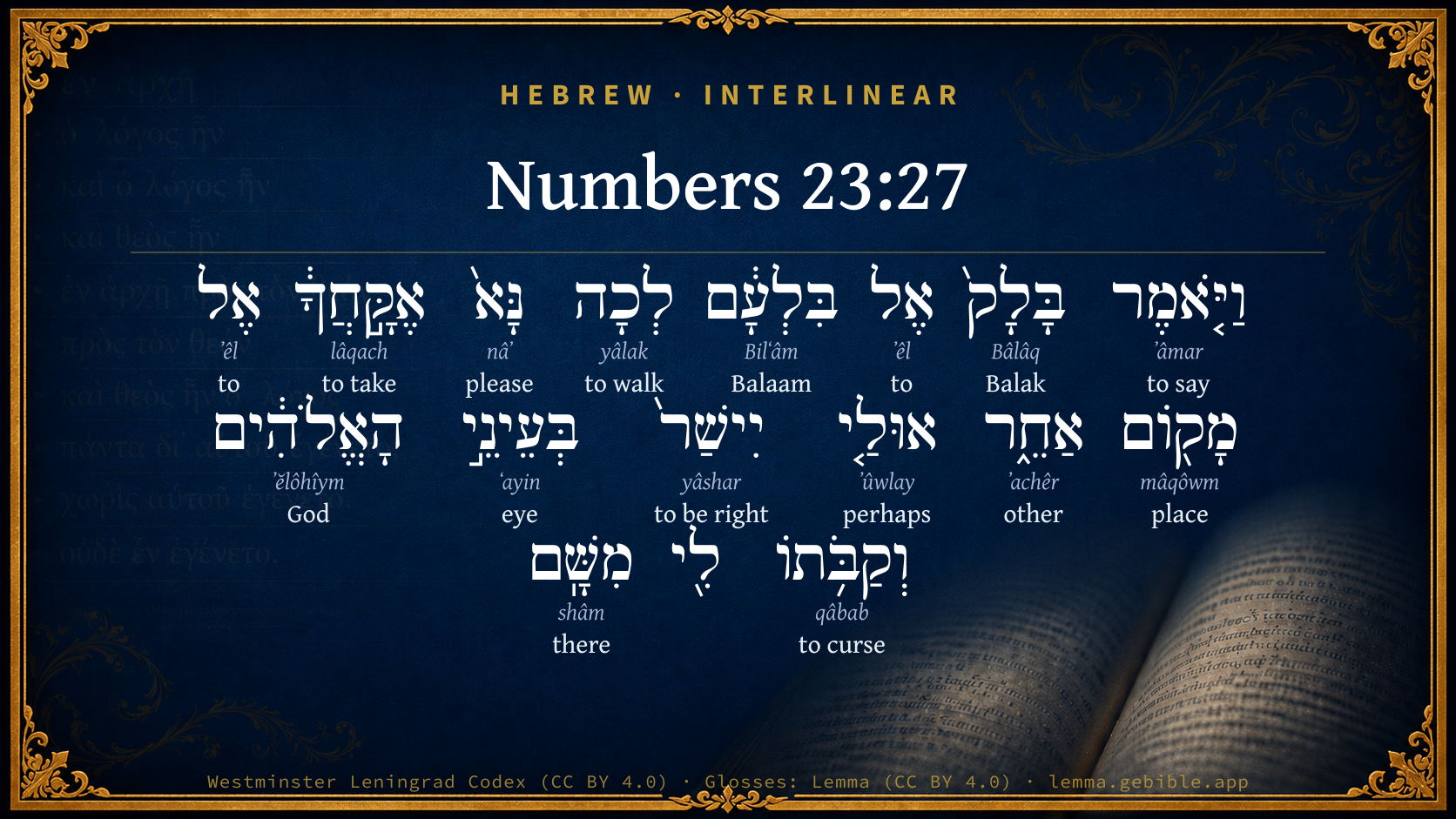
Hebrew (Westminster Leningrad Codex) Numbers 23:27 appears in the Hebrew Old Testament. The text above is from the Westminster Leningrad Codex. Each word links to its Strong’s number, a concise gloss, and parsing drawn from the Open Scriptures Hebrew Bible morphology. Click any word for its full Brown-Driver-Briggs (BDB) entry.
Download image
Cite this verse

Numbers 23:27 (World English Bible). Public Domain. Lemma interlinear Bible study tool, https://lemma.gebible.app/v/numbers/23/27.

Show BibTeX & RIS
BibTeX
RIS
English Translation
Balak said to Balaam, Come now, I will take you to another place; peradventure it will please God that you may curse me them from there.
World English Bible · Public Domain
Highlights
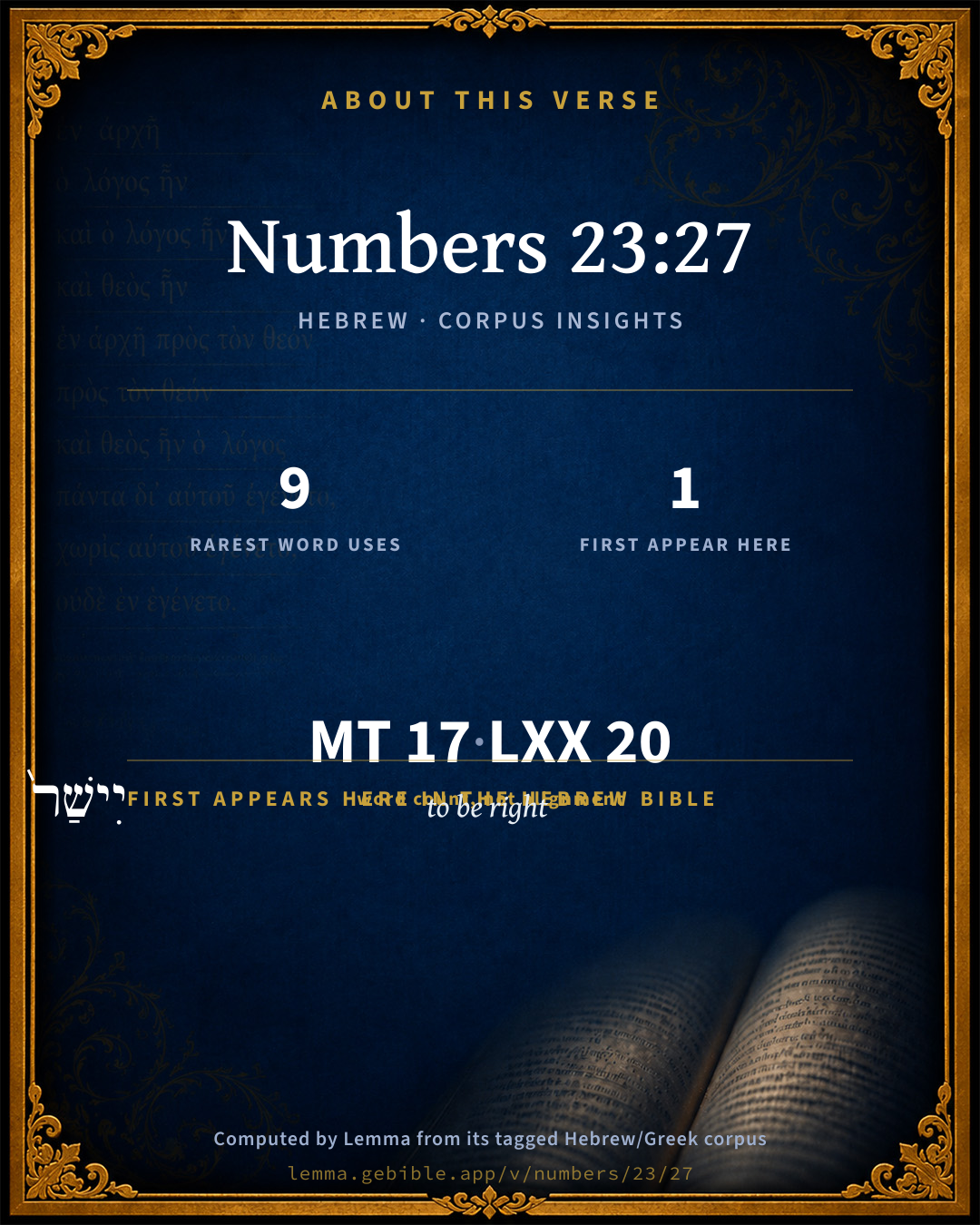
  • 1 first appearance in the Hebrew Bible
Full analysis ↓
Download a study sheet

One document with this verse’s original text, its word-by-word gloss line, the meaning frame, cross-references with their text, attributed commentary, and full source and license credits — printable, and it pastes into notes with its structure intact.

This verse Autodidact and up

Study sheet (.html) Plain text (.txt)

A passage Seminary Student

Up to 50 verses in one chapter. A passage sheet keeps up to 6 commentary sources and 12 cross-references per verse, in the order this page ranks them, and says so on the sheet whenever that leaves anything out. Ask for a single verse and you get the Autodidact verse sheet above.

Everything on this page stays free to read, with no account — the sheet is a download of what is already on screen, not access to it.

Want to remove ads? Support Godless Engineer
Compare translations 3

The same verse in 3 English versions, stacked beneath the original-language interlinear above. Click any original word for its lexicon entry.

Each is an independent rendering of the whole verse — the interlinear is not word-aligned to these translations.

Highlighted words mark where these versions differ — a whole-verse word diff, not a word-by-word alignment.

  • World English Bible Public Domain
    Balak said to Balaam, Come now, I will take you to another place; peradventure it will please God that you may curse me them from there.
  • King James Version Public Domain
    And Balak said unto Balaam, Come, I pray thee, I will bring thee unto another place; peradventure it will please God that thou mayest curse me them from thence.
  • unfoldingWord Literal Text CC BY-SA 4.0
    And Balak said to Balaam, “Come now, let me take you to another place. Perhaps it will be right in the eyes of God, and you will curse him for me from there.”

unfoldingWord Literal Text — © unfoldingWord, licensed CC BY-SA 4.0. Word-aligned USFM3 via Door43 (git.door43.org/unfoldingWord/en_ult).

Versions to compare (up to 4)

3 of 4 selected

Show all 18 translations

Every available English version of this verse, each an independent rendering of the whole verse.

  • World English Bible Public Domain
    Balak said to Balaam, Come now, I will take you to another place; peradventure it will please God that you may curse me them from there.
  • Berean Standard Bible Public Domain
    “Please come,” said Balak, “I will take you to another place. Perhaps it will please God that you curse them for me from there.”
  • Majority Standard Bible Public Domain
    “Please come,” said Balak, “I will take you to another place. Perhaps it will please God that you curse them for me from there.”
  • King James Version Public Domain
    And Balak said unto Balaam, Come, I pray thee, I will bring thee unto another place; peradventure it will please God that thou mayest curse me them from thence.
  • American Standard Version (1901) Public Domain
    And Balak said unto Balaam, Come now, I will take thee unto another place; peradventure it will please God that thou mayest curse me them from thence.
  • Revised Version (1885) Public Domain
    And Balak said unto Balaam, Come now, I will take thee unto another place; peradventure it will please God that thou mayest curse me them from thence.
  • Geneva Bible (1599) Public Domain
    Againe Balak sayd vnto Balaam, Come, I pray thee, I wil bring thee vnto another place, if so be it wil please God, that thou mayest thence curse them for my sake.
  • Douay-Rheims (1899) Public Domain
    And Balac said to him: Come and I will bring thee to another place; if peradventure it please God that thou mayest curse them from thence.
  • Young's Literal Translation Public Domain
    And Balak saith unto Balaam, `Come, I pray thee, I take thee unto another place; it may be it is right in the eyes of God -- to pierce it for me from thence.'
  • Literal Standard Version CC BY-SA 4.0
    And Balak says to Balaam, “Please come, I take you to another place; it may be it is right in the eyes of God to pierce it for me from there.”
  • Unlocked Literal Bible CC BY-SA 4.0
    So Balak replied to Balaam, “Come now, I will take you to another place. Perhaps it will please God for you to curse them there for me.”
  • unfoldingWord Literal Text CC BY-SA 4.0
    And Balak said to Balaam, “Come now, let me take you to another place. Perhaps it will be right in the eyes of God, and you will curse him for me from there.”
  • Darby Bible Public Domain
    And Balak said to Balaam, Come, I pray thee, I will bring thee to another place; perhaps it will be right in the sight of God that thou curse me them from thence.
  • World Messianic Bible Public Domain
    Balak said to Balaam, “Come now, I will take you to another place; perhaps it will please God that you may curse them for me from there.”
  • Webster's Bible Public Domain
    And Balak said to Balaam, Come, I pray thee, I will bring thee to another place; perhaps it will please God that thou mayest from thence curse them for me.
  • Free Bible Version CC BY-SA 4.0
    “Please come with me and I will take you somewhere else,” Balak said. “Maybe God would let you curse them for me from there.”
  • Bible in Basic English Public Domain
    Then Balak said to Balaam, Come now, I will take you to another place; it may be that God will let you put a curse on them from there.
  • JPS Tanakh (1917) Public Domain
    And Balak said unto Balaam: 'Come now, I will take thee unto another place; peradventure it will please God that thou mayest curse me them from thence.'

Literal Standard Version (2020), Covenant Press — licensed CC BY-SA 4.0. Text via the HelloAO Bible API (eBible.org). Unlocked Literal Bible (unfoldingWord) — licensed CC BY-SA 4.0. Text via the HelloAO Bible API (eBible.org). unfoldingWord Literal Text — © unfoldingWord, licensed CC BY-SA 4.0. Word-aligned USFM3 via Door43 (git.door43.org/unfoldingWord/en_ult). Free Bible Version, Dr. Jonathan Gallagher — licensed CC BY-SA 4.0. Text via the HelloAO Bible API (eBible.org).

Word by word

More ways to search: Search by grammar → Find every occurrence → Compare this word →

Practice this passage: Drill this verse → Learn its vocabulary →

וְקַבֹּ֥תוֹ
qâbab
H6895
“and · to curse · him”
Conjunction + Verb, Qal, Sequential Perfect, 2nd Person, Masculine, Singular + Suffix, Personal, 3rd Person, Masculine, Singular
Part of Speech
Conjunction + Verb
Stem
Qal
Form
Sequential Perfect
Person
2nd Person
Gender
Masculine
Number
Singular
Full BDB Definition

Origin: a primitive root

TWOT: 1978

to curse, utter a curse against - (Qal) to curse
  1. וַיֹּ֤אמֶר ʼâmar H559 “and · to say” Conjunction + Verb, Qal, Sequential Imperfect, 3rd Person, Masculine, Singular
  2. בָּלָק֙ Bâlâq H1111 “Balak” Noun, Proper
  3. אֶל ʼêl H413 “to” Preposition
  4. בִּלְעָ֔ם Bilʻâm H1109 “Balaam” Noun, Proper
  5. לְכָה yâlak H3212 “walk” Verb, Qal, Imperative, 2nd Person, Masculine, Singular + Suffix, h
  6. נָּא֙ nâʼ H4994 “please” Particle, Interjection
  7. אֶקָּ֣חֲךָ֔ lâqach H3947 “to take · you” Verb, Qal, Cohortative, 1st Person, Common, Singular + Suffix, Personal, 2nd Person, Masculine, Singular
  8. אֶל ʼêl H413 “to” Preposition
  9. מָק֖וֹם mâqôwm H4725 “place” Noun, Common, Masculine, Singular, Absolute
  10. אַחֵ֑ר ʼachêr H312 “other” Adjective, Adjective, Masculine, Singular, Absolute
  11. אוּלַ֤י ʼûwlay H194 “perhaps” Adverb
  12. יִישַׁר֙ yâshar H3474 “to be right” Verb, Qal, Imperfect, 3rd Person, Masculine, Singular
  13. בְּעֵינֵ֣י ʻayin H5869 “in/at · eyes of” Preposition + Noun, Common, Both, Dual, Construct
  14. הָאֱלֹהִ֔ים ʼĕlôhîym H430 “the · God(s)” Particle, Definite Article + Noun, Common, Masculine, Plural, Absolute
  15. מִשָּֽׁם shâm H8033 “from · there” Preposition + Adverb

About this verse

These counts appear in no published source. They are computed here, from the morphology-tagged text and Lemma’s own curated glosses. What Lemma adds →

17
words
15
distinct lemmas
Pentateuch
section

Notable vocabulary

The rarest word here is וְקַבֹּ֥תוֹ to curse H6895 — appearing just 9 times in the whole Hebrew Bible.

First appearance in Scripture

This word makes its first canonical appearance in the Hebrew Bible here:

  • יִישַׁר֙ to be right H3474

Shared distinctive vocabulary

וְקַבֹּ֥תוֹ to curse H6895 occurs in 9 verses of the Hebrew Bible. Also found in:

Grammatical profile

  • 5 verbs
  • 5 nouns
  • 1 adjective
  • 3 prepositions
  • 2 adverbs
  • 1 particle

Verb forms

  • וַיֹּ֤אמֶר Qal · Sequential Imperfect
  • לְכָה Qal · Imperative
  • אֶקָּ֣חֲךָ֔ Qal · Cohortative
  • יִישַׁר֙ Qal · Imperfect
  • וְקַבֹּ֥תוֹ Qal · Sequential Perfect

Repetition

A word recurs within this verse — often emphatic in Hebrew:

  • אֶל to H413 ×2

Hebrew & Septuagint length

In English translation the verse runs 26 words from the Hebrew and 25 from the Septuagint (LXX English) — closely comparable.

A rough comparison of the two English renderings, which tokenize alike — not a word-level alignment.

Word counts can differ between the Hebrew and the Greek without any difference in meaning — e.g. the Hebrew direct-object marker אֵת has no separate Greek word, and Greek often adds the article ὁ.

In the original languages it is 17 Hebrew tokens and 20 Greek tokens — but the two are counted differently (Hebrew bundles its prefixes and suffixes into one token; the Greek is in lemma form), so that isn’t a like-for-like length.

Cross-references

9

Topical passages linked to Numbers 23:27 in the Treasury of Scripture Knowledge — connected by theme and wording, ordered by reader-vote popularity; previews shown in the World English Bible.

  • Romans 11:29 For the gifts and the calling of God are irrevocable.
  • Numbers 23:13 Balak said to him, Please come with me to another place, from whence you may see them; you shall see but the utmost part of them, and shall not see them all: and curse me them from there.
  • Numbers 23:19–20 God is not a man, that he should lie, Neither the son of man, that he should repent: Has he said, and will he not do it? Or has he spoken, and will he not make it good?
  • Job 23:13 But he stands alone, and who can oppose him? What his soul desires, even that he does.
  • Proverbs 19:21 There are many plans in a man's heart, But Yahweh's counsel will prevail.
  • Proverbs 21:30 There is no wisdom nor understanding Nor counsel against Yahweh.
  • Isaiah 14:27 For Yahweh of Hosts has purposed, and who shall annul it? and his hand is stretched out, and who shall turn it back?
  • Isaiah 46:10–11 declaring the end from the beginning, and from ancient times things that are not [yet] done; saying, My counsel shall stand, and I will do all my pleasure;
  • Malachi 3:6 "For I, Yahweh, don't change; therefore you, sons of Jacob, are not consumed.

Cross-references courtesy of OpenBible.info (CC BY 4.0).

Hebrew and Greek witnesses Masoretic Hebrew ↔ Greek Septuagint

The same verse in the two great witnesses to the Old Testament, shown verse-for-verse.

These are two independent witnesses, not word-aligned to each other, and the Septuagint is shown in lemma (dictionary) form.

Hebrew Numbers 23:27 Masoretic · Westminster Leningrad Codex

וַיֹּ֤אמֶר בָּלָק֙ אֶל בִּלְעָ֔ם לְכָה נָּא֙ אֶקָּ֣חֲךָ֔ אֶל מָק֖וֹם אַחֵ֑ר אוּלַ֤י יִישַׁר֙ בְּעֵינֵ֣י הָאֱלֹהִ֔ים וְקַבֹּ֥תוֹ לִ֖י מִשָּֽׁם

Balak said to Balaam, Come now, I will take you to another place; peradventure it will please God that you may curse me them from there.

World English Bible · Public Domain

Greek LXX Numbers 23:27 Septuagint · lemma form

καί εἶπον βαλακ πρός βαλααμ δεῦρο παραλαμβάνω σύ εἰς τόπος ἄλλος εἰ ἀρέσκω ὁ θεός καί καταἀράομαι ἐγώ αὐτός ἐκεῖθεν

And Balac said to Balaam, Come and I will remove you to another place, if it shall please God, and curse me them from thence.

LXX2012 (modern English Septuagint) · Public Domain

Hebrew: Westminster Leningrad Codex (CC BY 4.0). Greek: Septuagint (public domain); English from LXX2012 (modern English Septuagint) (Public Domain). How the Septuagint differs from the Hebrew →

Targum (Aramaic paraphrase)

2

The Targum is the ancient Jewish Aramaic paraphrase of the Hebrew Scriptures — an interpretive translation, not the Hebrew text itself. Onkelos (literal) and Pseudo-Jonathan (expansive) render the Torah, and Jonathan the Prophets. Coverage is partial: where no permissively-licensed English translation exists for a verse, only the Aramaic is shown. This is verse-level text, not a word-by-word alignment to the Hebrew.

  1. Targum Onkelos Torah (Genesis–Deuteronomy)
    וַאֲמַר בָּלָק לְבִלְעָם אִיתָא כְּעַן אֲדַבְּרִינָךְ לַאֲתַר אָחֳרָן מָאִים יְהֵי רַעֲוָא מִן קֳדָם יְיָ וּתְלוּטֵיהּ לִי מִתַּמָן

    (no public-domain English translation for this verse)

    Targum Onkelos — Aramaic: “Onkelos Genesis” (public domain); “Onkelos Exodus” (public domain); “Onkelos Leviticus” (public domain); “Onkelos Numbers” (public domain); “Onkelos Deuteronomy” (public domain). English: “Sefaria Community Translation” (CC0 1.0 (public-domain dedication)); “J.W. Etheridge. The Targums of Onkelos and Jonathan Ben Uzziel on the Pentateuch. London: Longmans, Green, 1862” (public domain). Text via Sefaria.

  2. Targum Pseudo-Jonathan Torah (Genesis–Deuteronomy)
    וַאֲמַר בָּלָק לְבִלְעָם אִיתָא כְדוּן אִידַבְּרִינָךְ לַאֲתַר חוֹרָן דִלְמָא תְהֵי רַעֲוָא מִן קֳדָם יְיָ וּתְלַטְטֵיהּ בְּגִינִי מִתַּמָן

    And Balak said to Bileam, Come, and I will now take thee to another place, if so be it may be pleasing before the Lord, that thou mayest curse him for me from thence.

    Targum Pseudo-Jonathan — Aramaic: “Targum Jonathan on Genesis” (public domain); “Targum Jonathan on Exodus” (public domain); “Targum Jonathan on Leviticus” (public domain); “Targum Jonathan on Numbers” (public domain); “Targum Jonathan on Deuteronomy” (public domain). English: “The Targum of Jonathan ben Uzziel, trans. J. W. Etheridge, London, 1862” (public domain). Text via Sefaria.

Commentary

Notes on Numbers 23:27 from classic Christian and Jewish commentators (each source and its license shown beneath its notes). The classic Christian expositions comment on the surrounding passage and are grouped to its opening verse, so a note may address several verses; the Jewish commentaries on the Tanakh (Rashi and others) are per-verse, so they appear only where the commentator wrote on this verse.

Lemma curates 59 commentaries, every one of them public domain or Creative Commons licensed, each selected and text-cleaned for this edition rather than reprinted as found. About our sources →

Trapp's Complete Commentary

John Trapp

Num 23:27 And Balak said unto Balaam, Come, I pray thee, I will bring thee unto another place; peradventure it will please God that thou mayest curse me them from thence.

Ver. 27. Peradventure it will please God.] Heb., It will be right in the eyes of God. Never think it, man. "He is not a God that hath pleasure in wickedness." {Psa 5:4}

John Trapp, A Commentary or Exposition upon All the Books of the Old and New Testament (1647–1656) — public domain. Text from a community e-Sword module.

Tyndale Open Study Notes

Tyndale Open Resources

23:27–24:14 Disappointed with Balaam’s blessing, Balak hoped that yet another change of location would produce different results. Though the location of Mount Peor is unknown, this place was probably near a worship site of Baal of Peor (cp. 25:3, 5) and the Beth-peor of Deut 3:29; 34:6, where Moses was buried.

Tyndale Open Study Notes — © Tyndale Open Resources, licensed CC BY-SA 4.0. Text via the HelloAO Bible API.

Geneva Bible (1599)

Geneva Bible translators

Thus the wicked imagine of God, that that which he will not grant in one place, he will do it in another.

Geneva Bible (1599) marginal notes — public domain. Text via Bolls.life.

Ellicott's Commentary for English Readers

(27) Peradventure it will please God . . . —Here Balak makes mention of God as Elohim. He appears to be satisfied that Balaam was hindered by God from uttering the curses which he desired him to pronounce upon Israel (comp. Num_24:11). Or the words may have been spoken ironically (comp. Num_24:11, and Note).

A Bible Commentary for English Readers, edited by Charles John Ellicott (1878–1897) — public domain. Text from a community e-Sword module.

The Cambridge Bible for Schools and Colleges

gen. ed. J. J. S. Perowne

27. This verse is a connecting link, added by the compiler, between the E and the J narrative. The words ‘I will take thee unto another place’ cannot be from J , for he has not yet related that Balaam was taken to any place; but the whole of ch. 24 is from J .

The Cambridge Bible for Schools and Colleges (gen. ed. J. J. S. Perowne; Cambridge University Press, 1878–1918) — public domain. Text from a community e-Sword module.

John Gill's Exposition

And Balak said unto Balaam, come, I pray thee,.... Come along with me: I will bring thee unto another place: if not better for the view of the people, yet a more religious place, on which account the king hoped for success:

peradventure it will please God that thou mayest curse me them from thence; it may be God will give thee leave to curse the people from that place, being devoted to sacred service: this is the first time that Balak makes mention of the name of God; and he now seems to be satisfied that it was not Balaam's fault that he did not curse Israel, but that he was hindered by God, who would not suffer him to do it.

John Gill's Exposition of the Whole Bible (1746–1763) — public domain (CC PDM 1.0). Text via the HelloAO Bible API.

Whedon's Commentary on the Bible

Daniel D. Whedon

27. Peradventure it will please God — “It was the opinion of the heathen that what was not obtained through the first, second, or third victim might nevertheless be secured through a fourth.” — Clericus. Hence the continued altar-building and burnt offerings.

Daniel D. Whedon (gen. ed.), Commentary on the Old and New Testaments (1874–1909) — public domain. Text from a community e-Sword module.

The Pulpit Commentary

I will bring thee unto another place. At first (verse 25) Balak had in his vexation desired to stop the mouth of Balaam, but afterwards he thought it wiser to make yet another attempt to change the mind of God; as a heathen, he still thought that this might be done by dint of importunity and renewed sacrifices.

Ver. 27-Chapter Num_31:8, Num_31:16) that, after all, seeing, he did not perceive, and hearing, he did not understand. Nevertheless, at this time he saw sufficient to convince him how vain were Balak"s hopes of a curse from Jehovah. If Israel was to be overthrown, it was not in that way. Observe that in uttering this prophecy Balaam is thrown into a higher state of receptivity than before. When Balak refused to be satisfied with the first prophecy, he got a second one, specially addressed to himself, and fuller; more indicative of Israel"s resources, varied, ample, and unfailing as they were for every possible need. But now he does not so much get a prophecy fuller in itself; it is rather a clearer proof that Balaam is indeed employed by God as a prophet. He is thrown into an ecstatic state, His eyes are closed to the outward world, but the mind"s eye is opened, and a picture, first beautiful, and then terrible, is presented to his vision. We see from this how much God can do in controlling the powers of carnal and unsympathizing men. God not only puts his own words into Balaam"s lying lips, but he makes him see such visions as were customarily confined to men who were spiritually fit for them. Balaam doubtless, looking away into the distance of time from the present encampment of Israel in Moab to their future life in Canaan, would rather have seen ruin, confusion, and desolation something to rejoice the heart of his employer, and bring to himself the promised rewards. But he could only see what God showed him. If then God held this ungodly Balaam in such control, what may not his power be over those who submit to him with all their hearts? There is a sort of proportion in the matter. As the unwilling Balaam is to the completely submissive believer, so what God did to Balaam is to what God will do for such a believer. The more you give to God for working on, the more, by consequence, he will give to you in return. Yield yourselves to God, that he may not only work through you by his mighty power, but in you and for you according to the purpose of his love and the riches of his grace. The sad reflection is that Balaam allowed himself to be an evidence of the power, but not the grace; allowed God"s blessings to go through him, yet, in spite of his own expressed wish, made no attempt to keep blessings for himself.

II THE PROPHECY ITSELF. Here are set before us two pictures, as it were, a beautiful one and a terrible one. Picture the first. A spectator in an ordinary state of mind, looking down with his natural vision on the Israelite camp, sees long ranges of tents, set in four divisions, and at a reverent distance from the tabernacle in the midst of them. The people dwelt "not in stately palaces, but in coarse and homely tents, and those, no doubt, sadly weather-beaten." But Balaam in his ecstasy, when the Spirit of God came upon him, looked upon a more attractive and respiring scene. What he gazed upon at first was indeed these rows of tents, but, just as if in a dissolving view, they faded away before his eyes, and in place of them, valleys, gardens by the river-side, aloes of Jehovah"s planting, and cedars beside the waters were spread out before him. Everything is suggestive of quiet, steady prosperity, of fruitfulness, peace, and beauty. This is the internal life of the Church of Christ, when his people are living to the extent of their privileges. This is the difference between the external appearance and the inward life and experience, Just at that moment when the lot of the Christian looks least attractive to the casual and uninstructed glance, it may be rich in all the great elements of true blessedness. The position of the Christian in this world is not seldom like that of the kernel within the shell: outside, the rough, repulsive, unpromising shell; inside, the precious kernel, with "the promise and potency" in it of a tree like that from which it was taken. "Eye hath not seen, nor ear heard, neither have entered into the heart of man, the things which God hath prepared for them that love him. But God hath revealed them unto us by his Spirit. (1Co_2:9, 1Co_2:10) And thus it is here. It was not possible for Balaam to describe the blessed circumstances of Israel in direct language. He had to fall back on the comparison to certain visible things, such things as would raise in the mind of a dweller in Moab or Canaan, or anywhere round about, a picture of the highest satisfaction and success. Picture the second. The first picture is beautiful, and very beautiful; it is Eden raised in the waste wilderness. The second picture is terrible, and very terrible; yet what else could be expected? If Balak will go on presumptuously defying the sacred and beloved people of God, undeterred by the menaces to which he has already listened, then those menaces must be repeated with all the force and thoroughness of expression that can be thrown into them. The sudden transition from such a peaceful, beautiful scene as goes before heightens the effect, and probably was meant to do so. On one side is Israel engaged in tilling, the garden, the work to which man was set apart in the first days of innocence, watering his far-spread crops and enjoying his fragrant aloes and his cedars; on the other side is Israel the Destroyer, emphatically the Destroyer. The qualities of no one animal, however destructive, are sufficiently expressive to set him forth. Fierce, furious, strong, resistless as the lion is, the lion by himself is not enough to show forth Israel, and you must add the unicorn; and there you are invited to gaze on this unicorn-lion, strong in power, thorough in execution, leaving not one of his enemies unsubdued and undestroyed. Let Balak well understand that Israel, under the good hand of God, is climbing to the highest eminence among the nations. The repetition of the references to the unicorn and the lion shows how important the references are, and how needful it is to let the mind of the Christian dwell encouragingly on them. Balak sets forth the intolerant and suspicious spirit of the world in all its kingdoms; and the world does not heed prophecies; it does not take them to heart, else it would cease to be the world. These prophecies, though they were first spoken by a Balaam and listened to by a Balak, were meant in due course to reach, guide, assure, and comfort Israel. If there are times when we are tempted to fear the world, with its designs, its resources, and the might of its fascinating spirit, then we shall do well to recollect that, by a double and enlarged assurance, God reckons his Church to have the strength of the unicorn and the spirit of the lion, utterly to subdue and destroy all those kingdoms of the world which, to keep up the figure, are considered as the natural prey of the Church. Y.

The Pulpit Commentary (1880–1919), ed. H.D.M. Spence-Jones & Joseph S. Exell — public domain. Text from a community e-Sword module.

Rashi

Rabbi Shlomo Yitzchaki (Rashi)

וקבתי לי — This is not a command as is וקבנו (v. 13), but it is a future tense: perhaps it will seem right in His eyes that thou shalt curse them for me from there; malderas in O. F.

Rashi on the Tanakh — English translations: “The Judaica Press complete Tanach with Rashi, translated by A. J. Rosenberg” (CC BY 4.0); “Pentateuch with Rashi's commentary by M. Rosenbaum and A.M. Silbermann, 1929-1934” (public domain); “The Metsudah Tanach series, Lakewood, N.J” (CC BY 4.0); and “The Book of Joshua, Metsudah Publications, 1997” (CC BY 4.0). Text via Sefaria.

Sforno

Rabbi Ovadia Sforno

Perhaps Hashem will consider it proper. For perhaps the part of the people we will see from there will be more deserving of a curse.

Sforno on the Tanakh — English translation: “Yalkut, Sifsei Chachomim Chumash, Metsudah Publications, 2009” (CC BY 4.0). Text via Sefaria.

Lesson kit

Teaching starters — assembled from the data on this page, not authored interpretation. Every prompt links to the verse data it draws on. Edit before teaching.

Numbers, in the Pentateuch, opens this verse with 17 words (15 distinct Hebrew lemmas). Its most distinctive word is qâbab (“to curse”). A historical commentator’s framing appears above. Read the whole chapter for the surrounding context.

Discussion questions

  1. How does “to curse” (qâbab) shape what this verse is saying?
  2. The word “to be right” first appears here in Scripture. What is being introduced at this debut?
  3. Numbers 22:11 shares the word «to curse» with this verse. How do the two illuminate each other?
  4. “to” occurs 2× in this one verse. What is the effect of the repetition?
  5. These translations render this verse differently; the difference is in the English rendering, not the original. What questions does that raise?
  6. The verb «וַיֹּ֤אמֶר» is Qal Sequential Imperfect. How does its form color the action?
  7. Reading how Trapp's Complete Commentary and Tyndale Open Study Notes read this verse, where do the two commentators agree and where do they part?

Things to notice

Reading settings

Reading text

Shown beneath each verse's original-language words.

Old Testament
Old Testament edition

Read the OT as the Masoretic Hebrew (MT) or the Greek Septuagint (LXX).

English shown for the Greek Septuagint (in the Hebrew ↔ Greek comparison).

Comparing translations? Open the Compare panel on any verse page to stack up to four side by side.