Numbers 22:17

Hebrew (Westminster Leningrad Codex) Numbers 22:17 appears in the Hebrew Old Testament. The text above is from the Westminster Leningrad Codex. Each word links to its Strong’s number, a concise gloss, and parsing drawn from the Open Scriptures Hebrew Bible morphology. Click any word for its full Brown-Driver-Briggs (BDB) entry.
Download image
Cite this verse

Numbers 22:17 (World English Bible). Public Domain. Lemma interlinear Bible study tool, https://lemma.gebible.app/v/numbers/22/17.

Show BibTeX & RIS
BibTeX
RIS
English Translation
for I will promote you to very great honor, and whatever you say to me I will do. Please come therefore, and curse this people for me.
World English Bible · Public Domain
Download a study sheet

One document with this verse’s original text, its word-by-word gloss line, the meaning frame, cross-references with their text, attributed commentary, and full source and license credits — printable, and it pastes into notes with its structure intact.

This verse Autodidact and up

Study sheet (.html) Plain text (.txt)

A passage Seminary Student

Up to 50 verses in one chapter. A passage sheet keeps up to 6 commentary sources and 12 cross-references per verse, in the order this page ranks them, and says so on the sheet whenever that leaves anything out. Ask for a single verse and you get the Autodidact verse sheet above.

Everything on this page stays free to read, with no account — the sheet is a download of what is already on screen, not access to it.

Want to remove ads? Support Godless Engineer
Compare translations 3

The same verse in 3 English versions, stacked beneath the original-language interlinear above. Click any original word for its lexicon entry.

Each is an independent rendering of the whole verse — the interlinear is not word-aligned to these translations.

Highlighted words mark where these versions differ — a whole-verse word diff, not a word-by-word alignment.

  • World English Bible Public Domain
    for I will promote you to very great honor, and whatever you say to me I will do. Please come therefore, and curse this people for me.
  • King James Version Public Domain
    For I will promote thee unto very great honor, and I will do whatsoever thou sayest unto me: come therefore, I pray thee, curse me this people.
  • unfoldingWord Literal Text CC BY-SA 4.0
    for honoring, I will honor you very greatly, and all that you say to me I will do. And please come, denounce this people for me.’”

unfoldingWord Literal Text — © unfoldingWord, licensed CC BY-SA 4.0. Word-aligned USFM3 via Door43 (git.door43.org/unfoldingWord/en_ult).

Versions to compare (up to 4)

3 of 4 selected

Show all 18 translations

Every available English version of this verse, each an independent rendering of the whole verse.

  • World English Bible Public Domain
    for I will promote you to very great honor, and whatever you say to me I will do. Please come therefore, and curse this people for me.
  • Berean Standard Bible Public Domain
    for I will honor you richly and do whatever you say. So please come and put a curse on this people for me!’”
  • Majority Standard Bible Public Domain
    for I will honor you richly and do whatever you say. So please come and put a curse on this people for me!’”
  • King James Version Public Domain
    For I will promote thee unto very great honor, and I will do whatsoever thou sayest unto me: come therefore, I pray thee, curse me this people.
  • American Standard Version (1901) Public Domain
    for I will promote thee unto very great honor, and whatsoever thou sayest unto me I will do: come therefore, I pray thee, curse me this people.
  • Revised Version (1885) Public Domain
    for I will promote thee unto very great honour, and whatsoever thou sayest unto me I will do: come therefore, I pray thee, curse me this people.
  • Geneva Bible (1599) Public Domain
    For I wil promote thee vnto great honour, and wil do whatsoeuer thou sayest vnto me: come therefore, I pray thee, curse me this people.
  • Douay-Rheims (1899) Public Domain
    For I am ready to honour thee, and will give thee whatsoever thou wilt: come and curse this people.
  • Young's Literal Translation Public Domain
    for very greatly I honour thee, and all that thou sayest unto me I do; and come, I pray thee, pierce for me this people.'
  • Literal Standard Version CC BY-SA 4.0
    for I honor you very greatly, and all that you say to me I do; and come, please pierce this people for me.”
  • Unlocked Literal Bible CC BY-SA 4.0
    because I will pay you extremely well and give you great honor, and I will do whatever you tell me to do. So please come and curse this people for me.'”
  • unfoldingWord Literal Text CC BY-SA 4.0
    for honoring, I will honor you very greatly, and all that you say to me I will do. And please come, denounce this people for me.’”
  • Darby Bible Public Domain
    for very highly will I honour thee, and whatever thou shalt say to me will I do; come therefore, I pray thee, curse me this people.
  • World Messianic Bible Public Domain
    for I will promote you to very great honor, and whatever you say to me I will do. Please come therefore, and curse this people for me.’”
  • Webster's Bible Public Domain
    For I will promote thee to very great honor, and I will do whatever thou sayest to me: come therefore, I pray thee, curse this people for me.
  • Free Bible Version CC BY-SA 4.0
    because I will pay you a great deal and follow all the advice you give me. Please come and curse these people for me!’”
  • Bible in Basic English Public Domain
    For I will give you a place of very great honour, and whatever you say to me I will do; so come, in answer to my prayer, and put a curse on this people.
  • JPS Tanakh (1917) Public Domain
    for I will promote thee unto very great honour, and whatsoever thou sayest unto me I will do; come therefore, I pray thee, curse me this people.'

Literal Standard Version (2020), Covenant Press — licensed CC BY-SA 4.0. Text via the HelloAO Bible API (eBible.org). Unlocked Literal Bible (unfoldingWord) — licensed CC BY-SA 4.0. Text via the HelloAO Bible API (eBible.org). unfoldingWord Literal Text — © unfoldingWord, licensed CC BY-SA 4.0. Word-aligned USFM3 via Door43 (git.door43.org/unfoldingWord/en_ult). Free Bible Version, Dr. Jonathan Gallagher — licensed CC BY-SA 4.0. Text via the HelloAO Bible API (eBible.org).

Word by word

More ways to search: Search by grammar → Find every occurrence → Compare this word →

Practice this passage: Drill this verse → Learn its vocabulary →

קָֽבָה
qâbab
H6895
“curse”
Verb, Qal, Imperative, 2nd Person, Masculine, Singular + Suffix, h
Part of Speech
Verb
Stem
Qal
Form
Imperative
Person
2nd Person
Gender
Masculine
Number
Singular
Full BDB Definition

Origin: a primitive root

TWOT: 1978

to curse, utter a curse against - (Qal) to curse
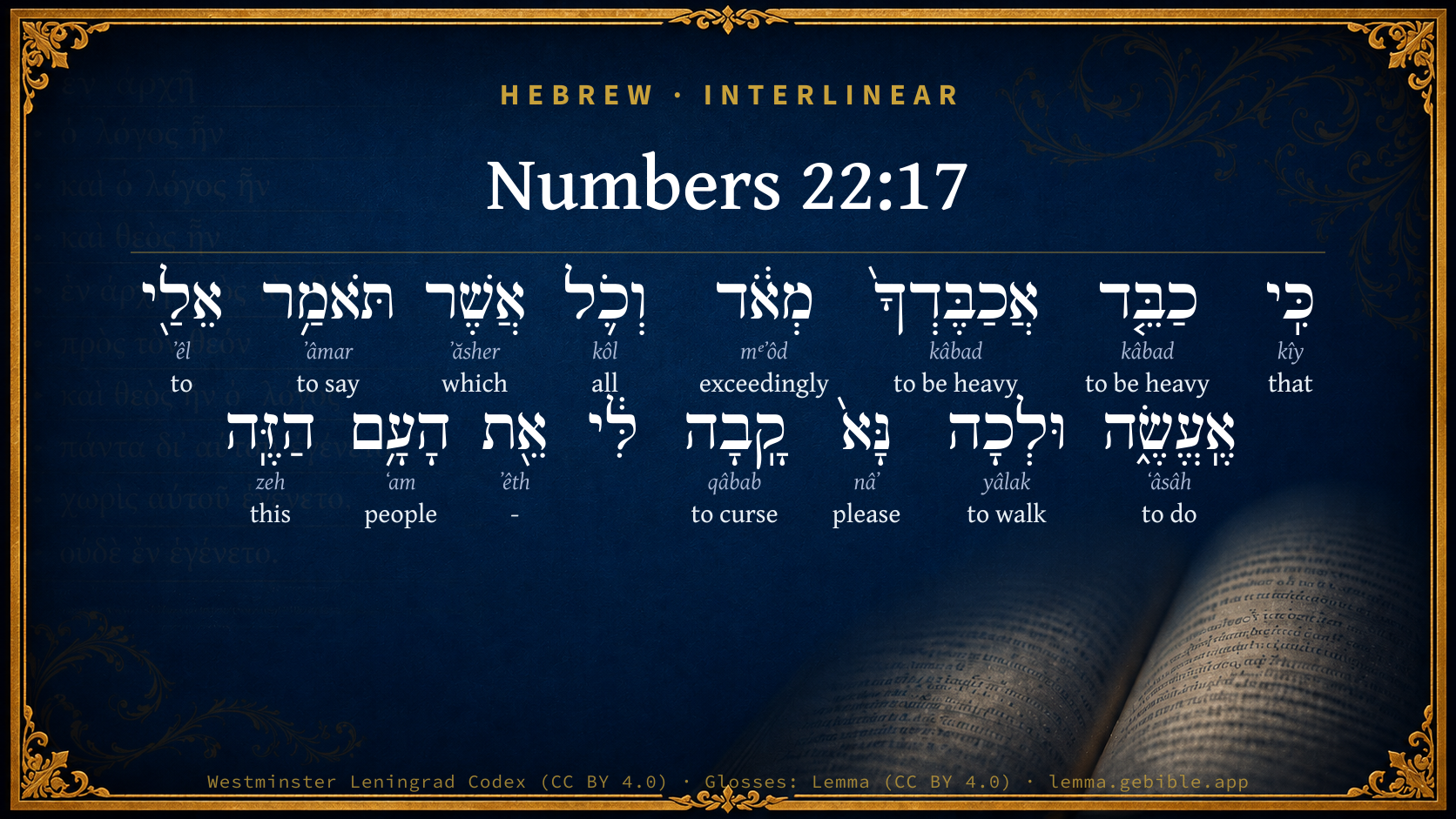
  1. כִּֽי kîy H3588 “that” Conjunction
  2. כַבֵּ֤ד kâbad H3513 “to be heavy” Verb, Piel, Infinitive Absolute
  3. אֲכַבֶּדְךָ֙ kâbad H3513 “to be heavy · you” Verb, Piel, Imperfect, 1st Person, Common, Singular + Suffix, Personal, 2nd Person, Masculine, Singular
  4. מְאֹ֔ד mᵉʼôd H3966 “exceedingly” Adverb
  5. וְכֹ֛ל kôl H3605 “and · all” Conjunction + Noun, Common, Masculine, Singular, Absolute
  6. אֲשֶׁר ʼăsher H834 “which” Particle, Relative
  7. תֹּאמַ֥ר ʼâmar H559 “to say” Verb, Qal, Imperfect, 2nd Person, Masculine, Singular
  8. אֵלַ֖י ʼêl H413 “to · me” Preposition + Suffix, Personal, 1st Person, Common, Singular
  9. אֶֽעֱשֶׂ֑ה ʻâsâh H6213 “to do” Verb, Qal, Imperfect, 1st Person, Common, Singular
  10. וּלְכָה yâlak H3212 “and · walk” Conjunction + Verb, Qal, Imperative, 2nd Person, Masculine, Singular + Suffix, h
  11. נָּא֙ nâʼ H4994 “please” Particle, Interjection
  12. אֵ֖ת ʼêth H853 “-” Particle, Direct Object
  13. הָעָ֥ם ʻam H5971 “the · people” Particle, Definite Article + Noun, Common, Masculine, Singular, Absolute
  14. הַזֶּֽה zeh H2088 “the · this” Particle, Definite Article + Pronoun, Demonstrative, Masculine, Singular

About this verse

These counts appear in no published source. They are computed here, from the morphology-tagged text and Lemma’s own curated glosses. What Lemma adds →

16
words
14
distinct lemmas
Pentateuch
section

Notable vocabulary

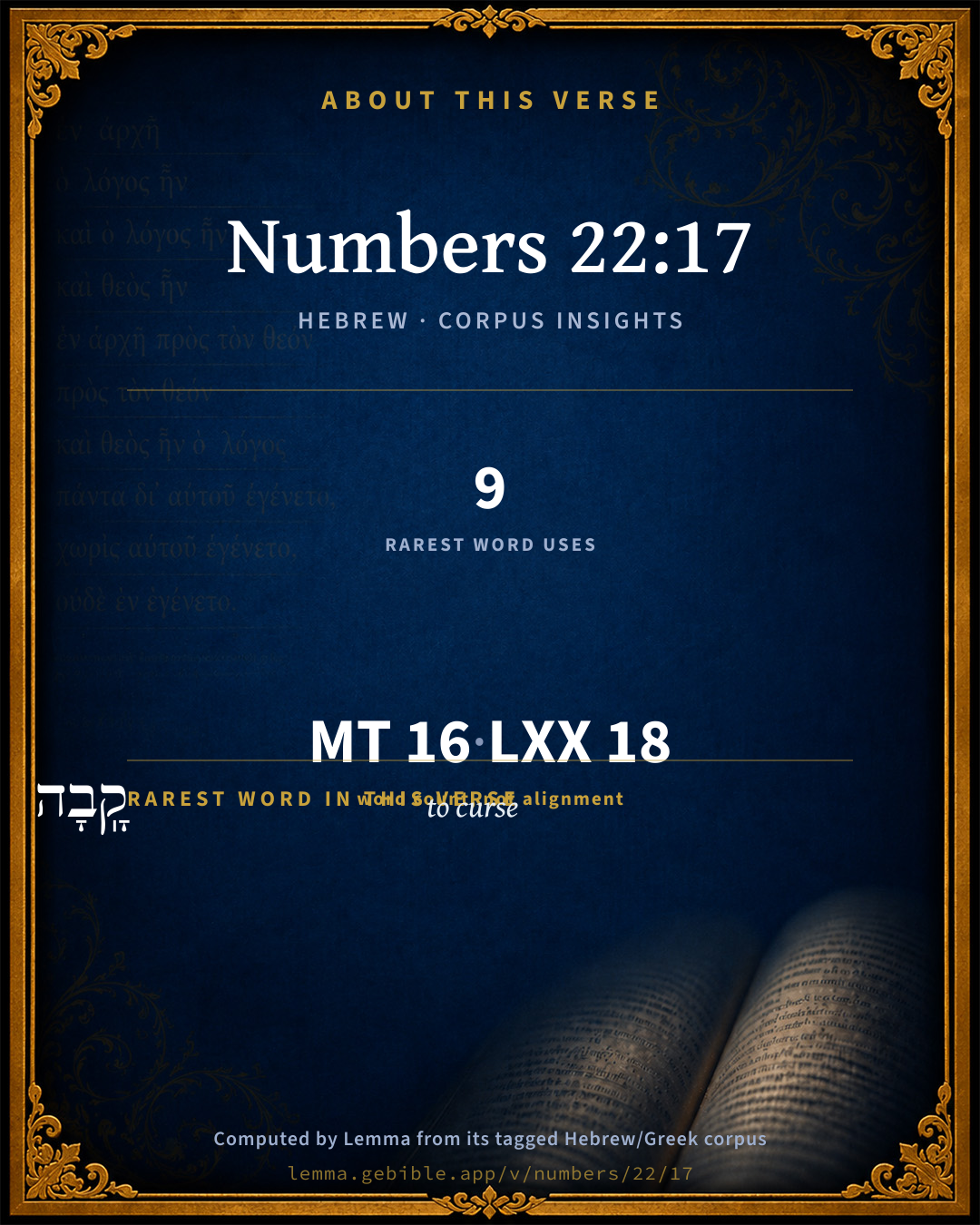
The rarest word here is קָֽבָה to curse H6895 — appearing just 9 times in the whole Hebrew Bible.

Shared distinctive vocabulary

קָֽבָה to curse H6895 occurs in 9 verses of the Hebrew Bible. Also found in:

Grammatical profile

  • 6 verbs
  • 2 nouns
  • 1 pronoun
  • 2 prepositions
  • 1 conjunction
  • 1 adverb
  • 3 particles

Verb forms

  • כַבֵּ֤ד Piel · Infinitive Absolute
  • אֲכַבֶּדְךָ֙ Piel · Imperfect
  • תֹּאמַ֥ר Qal · Imperfect
  • אֶֽעֱשֶׂ֑ה Qal · Imperfect
  • וּלְכָה Qal · Imperative
  • קָֽבָה Qal · Imperative

Repetition

A word recurs within this verse — often emphatic in Hebrew:

  • כַבֵּ֤ד to be heavy H3513 ×2

Hebrew & Septuagint length

In English translation the verse runs 27 words from the Hebrew and 21 from the Septuagint (LXX English) — closely comparable.

A rough comparison of the two English renderings, which tokenize alike — not a word-level alignment.

Word counts can differ between the Hebrew and the Greek without any difference in meaning — e.g. the Hebrew direct-object marker אֵת has no separate Greek word, and Greek often adds the article ὁ.

In the original languages it is 16 Hebrew tokens and 18 Greek tokens — but the two are counted differently (Hebrew bundles its prefixes and suffixes into one token; the Greek is in lemma form), so that isn’t a like-for-like length.

Cross-references

11

Topical passages linked to Numbers 22:17 in the Treasury of Scripture Knowledge — connected by theme and wording, ordered by reader-vote popularity; previews shown in the World English Bible.

  • Numbers 24:11 Therefore now flee you to your place: I thought to promote you to great honor; but, behold, Yahweh has kept you back from honor.
  • Numbers 22:6 Please come now therefore curse me this people; for they are too mighty for me: peradventure I shall prevail, that we may strike them, and that I may drive them out of the land; for I know that he whom you bless is blessed, and he whom you curse is cursed.
  • Numbers 22:37 Balak said to Balaam, Didn't I earnestly send to you to call you? why didn't you come to me? am I not able indeed to promote you to honor?
  • Numbers 23:2–3 Balak did as Balaam had spoken; and Balak and Balaam offered on every altar a bull and a ram.
  • Numbers 23:29–30 Balaam said to Balak, Build me here seven altars, and prepare me here seven bulls and seven rams.
  • Deuteronomy 16:9 Seven weeks shall you number to you: from the time you begin to put the sickle to the standing grain shall you begin to number seven weeks.
  • Esther 5:11 Haman recounted to them the glory of his riches, and the multitude of his children, and all the things in which the king had promoted him, and how he had advanced him above the princes and servants of the king.
  • Esther 7:9 Then said Harbonah, one of the chamberlains who were before the king, Behold also, the gallows fifty cubits high, which Haman has made for Mordecai, who spoke good for the king, stands in the house of Haman. The king said, Hang him thereon.
  • Matthew 4:8–9 Again, the devil took him to an exceedingly high mountain, and showed him all the kingdoms of the world, and their glory.
  • Matthew 14:7 Whereupon he promised with an oath to give her whatever she should ask.
  • Matthew 16:26 For what will it profit a man, if he gains the whole world, and forfeits his life? Or what will a man give in exchange for his life?

Cross-references courtesy of OpenBible.info (CC BY 4.0).

Hebrew and Greek witnesses Masoretic Hebrew ↔ Greek Septuagint

The same verse in the two great witnesses to the Old Testament, shown verse-for-verse.

These are two independent witnesses, not word-aligned to each other, and the Septuagint is shown in lemma (dictionary) form.

Hebrew Numbers 22:17 Masoretic · Westminster Leningrad Codex

כִּֽי כַבֵּ֤ד אֲכַבֶּדְךָ֙ מְאֹ֔ד וְכֹ֛ל אֲשֶׁר תֹּאמַ֥ר אֵלַ֖י אֶֽעֱשֶׂ֑ה וּלְכָה נָּא֙ קָֽבָה לִּ֔י אֵ֖ת הָעָ֥ם הַזֶּֽה

for I will promote you to very great honor, and whatever you say to me I will do. Please come therefore, and curse this people for me.

World English Bible · Public Domain

Greek LXX Numbers 22:17 Septuagint · lemma form

ἐντίμως γάρ τιμάω σύ καί ὅσος ἐάν εἶπον ποιέω σύ καί δεῦρο ἐπι καταἀράομαι ἐγώ ὁ λαός οὗτος

For I will greatly honor you, and will do for you whatever you shall say; come then, curse me this people.

LXX2012 (modern English Septuagint) · Public Domain

Hebrew: Westminster Leningrad Codex (CC BY 4.0). Greek: Septuagint (public domain); English from LXX2012 (modern English Septuagint) (Public Domain). How the Septuagint differs from the Hebrew →

Targum (Aramaic paraphrase)

2

The Targum is the ancient Jewish Aramaic paraphrase of the Hebrew Scriptures — an interpretive translation, not the Hebrew text itself. Onkelos (literal) and Pseudo-Jonathan (expansive) render the Torah, and Jonathan the Prophets. Coverage is partial: where no permissively-licensed English translation exists for a verse, only the Aramaic is shown. This is verse-level text, not a word-by-word alignment to the Hebrew.

  1. Targum Onkelos Torah (Genesis–Deuteronomy)
    אֲרֵי יְקָרָא אֲיַקְרִינָךְ לַחֲדָא וְכֹל דִי תֵימַר לִי אַעְבֵּד וְאִיתָא כְעַן לוֹט לִי יַת עַמָא הָדֵין

    (no public-domain English translation for this verse)

    Targum Onkelos — Aramaic: “Onkelos Genesis” (public domain); “Onkelos Exodus” (public domain); “Onkelos Leviticus” (public domain); “Onkelos Numbers” (public domain); “Onkelos Deuteronomy” (public domain). English: “Sefaria Community Translation” (CC0 1.0 (public-domain dedication)); “J.W. Etheridge. The Targums of Onkelos and Jonathan Ben Uzziel on the Pentateuch. London: Longmans, Green, 1862” (public domain). Text via Sefaria.

  2. Targum Pseudo-Jonathan Torah (Genesis–Deuteronomy)
    אֲרוּם מִיקְרָא אֲיַקְרִינָךְ לַחֲדָא וְכָל דְתֵימַר לִי אֶעֱבַד וְאִיתָא כְדוֹן לוּט לְוָתִי יַת עַמָא הָדֵין

    for honouring I will honour thee greatly, and whatever thou biddest me I will do. Come therefore now, and curse this people for me.

    Targum Pseudo-Jonathan — Aramaic: “Targum Jonathan on Genesis” (public domain); “Targum Jonathan on Exodus” (public domain); “Targum Jonathan on Leviticus” (public domain); “Targum Jonathan on Numbers” (public domain); “Targum Jonathan on Deuteronomy” (public domain). English: “The Targum of Jonathan ben Uzziel, trans. J. W. Etheridge, London, 1862” (public domain). Text via Sefaria.

Commentary

Notes on Numbers 22:17 from classic Christian and Jewish commentators (each source and its license shown beneath its notes). The classic Christian expositions comment on the surrounding passage and are grouped to its opening verse, so a note may address several verses; the Jewish commentaries on the Tanakh (Rashi and others) are per-verse, so they appear only where the commentator wrote on this verse.

Lemma curates 59 commentaries, every one of them public domain or Creative Commons licensed, each selected and text-cleaned for this edition rather than reprinted as found. About our sources →

Trapp's Complete Commentary

John Trapp

Num 22:17 For I will promote thee unto very great honour, and I will do whatsoever thou sayest unto me: come therefore, I pray thee, curse me this people.

Ver. 17. For I will promote thee.] Thus Satan tempted our Saviour, {Mat 4:8-9} and the Pope Luther, offering him a Cardinalship to hold his tongue, and proposing unto him the example of Aeneas Sylvius, who casting away his opinions, became Pope; and of Bessarion of Nice, who of a poor Calover of Trebizond, became a great renowned Cardinal, and wanted not much of being Pope. {a} But Luther answered the messenger, Contemptus est a me Romanus et favor et furor, I care not for the Pope’s proffers of any preferment. And when one counselled to try him with money, another more wise answered, Hem, Germana illa bestia non curat aurum, That Dutch beast cares not for gold. But Balaam was not a man of Luther’s make.

{a} Hist. of Coun. of Trent.

John Trapp, A Commentary or Exposition upon All the Books of the Old and New Testament (1647–1656) — public domain. Text from a community e-Sword module.

The Cambridge Bible for Schools and Colleges

gen. ed. J. J. S. Perowne

17. I will promote thee unto very great honour] I will surely honour thee exceedingly. The expression does not imply that Balaam would be appointed to a high office, but only that the king would shew him great respect and reward him liberally.

The Cambridge Bible for Schools and Colleges (gen. ed. J. J. S. Perowne; Cambridge University Press, 1878–1918) — public domain. Text from a community e-Sword module.

John Gill's Exposition

And the Lord came unto Balaam at night,.... As before, Num 22:9 it may be in a dream; the Targum of Jonathan is as there,"a word came from the Lord:"

and said unto him, if the men come and call thee, rise up, and go with them; this was said, as some think, not seriously, but sarcastically, or rather in an angry manner, bidding him go, if he would; so giving him up to his own heart's lusts, or, at most; only permitting him to go with them, but not to curse Israel; and this permission to go seems to be on this condition, if the princes first called him, and were urgent on him to go with them: this was a trial of Balaam, whether he would be eager and forward to go, or patiently wait until he should be called; or the words may be rendered, "seeing", or because (g):

they are come to call thee: but yet the word which I shall say unto thee, that shall thou do; whether he would or not, he should be forced to do it, as Jarchi; and therefore go not with any intention to curse Israel, which shall never be done; wherefore to go would be vain and fruitless, since he would never be able to answer the design of Balak: but still Balaam hoped, it not being so fully and clearly expressed as before, that he should not curse Israel; that God would say something else unto him, though he had no reason at all for it, but all the reverse; so blinded was he with a greedy desire of riches and honour.

(g) "quandoquidem", Junius & Tremellius, Piscator; so Noldius, p. 88. & Ainsworth.

John Gill's Exposition of the Whole Bible (1746–1763) — public domain (CC PDM 1.0). Text via the HelloAO Bible API.

Matthew Poole's English Annotations

Before he wrought upon his covetousness, now upon his ambition.

Matthew Poole's English Annotations on the Holy Bible (1683–1685) — public domain. Text from a community e-Sword/MySword module.

Rashi

Rabbi Shlomo Yitzchaki (Rashi)

כי כבד אכבדך מאד FOR I WILL HONOR THEE EXCEEDINGLY — Exceedingly: more than you have ever received as a fee in the past (cf. Rashi Numbers 21:27) will I now give you (Midrash Tanchuma, Balak 6).

Rashi on the Tanakh — English translations: “The Judaica Press complete Tanach with Rashi, translated by A. J. Rosenberg” (CC BY 4.0); “Pentateuch with Rashi's commentary by M. Rosenbaum and A.M. Silbermann, 1929-1934” (public domain); “The Metsudah Tanach series, Lakewood, N.J” (CC BY 4.0); and “The Book of Joshua, Metsudah Publications, 1997” (CC BY 4.0). Text via Sefaria.

Lesson kit

Teaching starters — assembled from the data on this page, not authored interpretation. Every prompt links to the verse data it draws on. Edit before teaching.

Numbers, in the Pentateuch, opens this verse with 16 words (14 distinct Hebrew lemmas). Its most distinctive word is qâbab (“to curse”). A historical commentator’s framing appears above. Read the whole chapter for the surrounding context.

Discussion questions

  1. How does “to curse” (qâbab) shape what this verse is saying?
  2. Numbers 22:11 shares the word «to curse» with this verse. How do the two illuminate each other?
  3. “to be heavy” occurs 2× in this one verse. What is the effect of the repetition?
  4. These translations render this verse differently; the difference is in the English rendering, not the original. What questions does that raise?
  5. The verb «כַבֵּ֤ד» is Piel Infinitive Absolute. How does its form color the action?
  6. Reading how Trapp's Complete Commentary and The Cambridge Bible for Schools and Colleges read this verse, where do the two commentators agree and where do they part?

Things to notice

Reading settings

Reading text

Shown beneath each verse's original-language words.

Old Testament
Old Testament edition

Read the OT as the Masoretic Hebrew (MT) or the Greek Septuagint (LXX).

English shown for the Greek Septuagint (in the Hebrew ↔ Greek comparison).

Comparing translations? Open the Compare panel on any verse page to stack up to four side by side.