
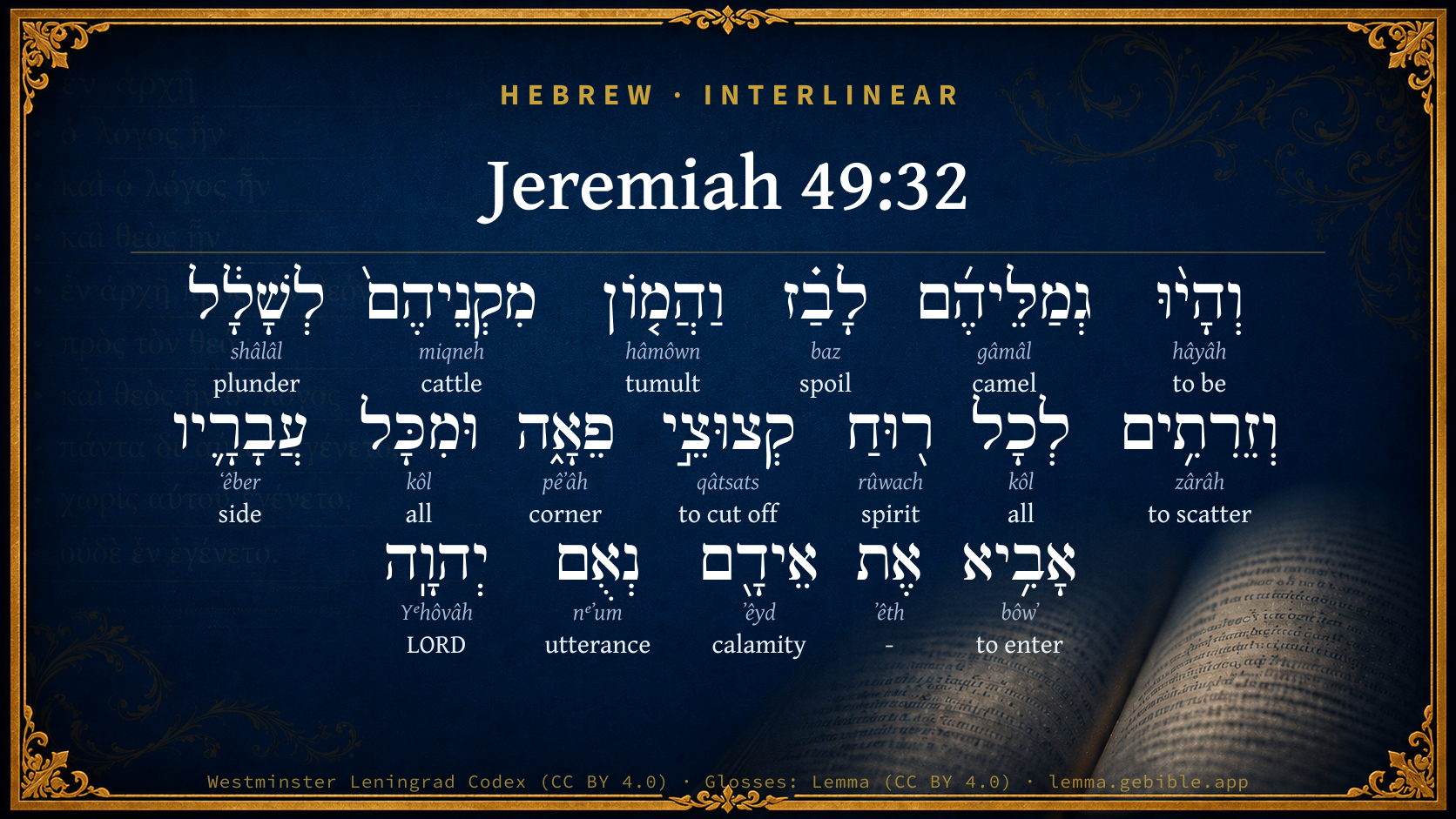
Jeremiah 49:32

Hebrew (Westminster Leningrad Codex) Jeremiah 49:32 appears in the Hebrew Old Testament. The text above is from the Westminster Leningrad Codex. Each word links to its Strong’s number, a concise gloss, and parsing drawn from the Open Scriptures Hebrew Bible morphology. Click any word for its full Brown-Driver-Briggs (BDB) entry.
Download image
Cite this verse

Jeremiah 49:32 (World English Bible). Public Domain. Lemma interlinear Bible study tool, https://lemma.gebible.app/v/jeremiah/49/32.

Show BibTeX & RIS
BibTeX
RIS
English Translation
Their camels shall be a booty, and the multitude of their cattle a spoil: and I will scatter to all winds those who have the corners [of their hair] cut off; and I will bring their calamity from every side of them, says Yahweh.
World English Bible · Public Domain
Download a study sheet

One document with this verse’s original text, its word-by-word gloss line, the meaning frame, cross-references with their text, attributed commentary, and full source and license credits — printable, and it pastes into notes with its structure intact.

This verse Autodidact and up

Study sheet (.html) Plain text (.txt)

A passage Seminary Student

Up to 50 verses in one chapter. A passage sheet keeps up to 6 commentary sources and 12 cross-references per verse, in the order this page ranks them, and says so on the sheet whenever that leaves anything out. Ask for a single verse and you get the Autodidact verse sheet above.

Everything on this page stays free to read, with no account — the sheet is a download of what is already on screen, not access to it.

Want to remove ads? Support Godless Engineer
Compare translations 3

The same verse in 3 English versions, stacked beneath the original-language interlinear above. Click any original word for its lexicon entry.

Each is an independent rendering of the whole verse — the interlinear is not word-aligned to these translations.

Highlighted words mark where these versions differ — a whole-verse word diff, not a word-by-word alignment.

  • World English Bible Public Domain
    Their camels shall be a booty, and the multitude of their cattle a spoil: and I will scatter to all winds those who have the corners [of their hair] cut off; and I will bring their calamity from every side of them, says Yahweh.
  • King James Version Public Domain
    And their camels shall be a booty, and the multitude of their cattle a spoil: and I will scatter into all winds them that are in the utmost corners; and I will bring their calamity from all sides thereof, saith the LORD.
  • unfoldingWord Literal Text CC BY-SA 4.0
    For their camels will become plunder, and the abundance of their property will become war plunder. Then I will scatter to every wind those who cut the corners of their hair, and I will bring disaster on them from every side—this is Yahweh’s declaration.

unfoldingWord Literal Text — © unfoldingWord, licensed CC BY-SA 4.0. Word-aligned USFM3 via Door43 (git.door43.org/unfoldingWord/en_ult).

Versions to compare (up to 4)

3 of 4 selected

Show all 18 translations

Every available English version of this verse, each an independent rendering of the whole verse.

  • World English Bible Public Domain
    Their camels shall be a booty, and the multitude of their cattle a spoil: and I will scatter to all winds those who have the corners [of their hair] cut off; and I will bring their calamity from every side of them, says Yahweh.
  • Berean Standard Bible Public Domain
    Their camels will become plunder, and their large herds will be spoil. I will scatter to the wind in every direction those who shave their temples; I will bring calamity on them from all sides,” declares the LORD.
  • Majority Standard Bible Public Domain
    Their camels will become plunder, and their large herds will be spoil. I will scatter to the wind in every direction those who shave their temples; I will bring calamity on them from all sides,” declares the LORD.
  • King James Version Public Domain
    And their camels shall be a booty, and the multitude of their cattle a spoil: and I will scatter into all winds them that are in the utmost corners; and I will bring their calamity from all sides thereof, saith the LORD.
  • American Standard Version (1901) Public Domain
    And their camels shall be a booty, and the multitude of their cattle a spoil: and I will scatter unto all winds them that have the corners `of their hair' cut off; and I will bring their calamity from every side of them, saith Jehovah.
  • Revised Version (1885) Public Domain
    And their camels shall be a booty, and the multitude of their cattle a spoil: and I will scatter unto all winds them that have the corners of their hair polled; and I will bring their calamity from every side of them, saith the LORD.
  • Geneva Bible (1599) Public Domain
    And their camels shall be a bootie, and the multitude of their cattel a spoile, and I will scatter them into all windes, and to the vtmost corners, and I will bring their destruction from al the sides thereof, sayeth the Lord.
  • Douay-Rheims (1899) Public Domain
    And their camels shall be for a spoil, and the multitude of their cattle for a booty, and I will scatter into every wind them that have their hair cut round, and I will bring destruction upon them from I all their confines, saith the Lord.
  • Young's Literal Translation Public Domain
    And their camels have been for a prey, And the multitude of their cattle for a spoil, And I have scattered them to every wind, Who cut off the corner `of the beard', And from all its passages I bring in their calamity, An affirmation of Jehovah.
  • Literal Standard Version CC BY-SA 4.0
    And their camels have been for a prey, || And the multitude of their livestock for a spoil, || And I have scattered them to every wind, || Who cut off the corner [of the beard], || And from all its passages I bring in their calamity, || A declaration of YHWH.
  • Unlocked Literal Bible CC BY-SA 4.0
    For their camels will become plunder, and the abundance of their property will become war plunder. Then I will scatter to every wind those who cut the corners of their hair, and I will bring disaster on them from every side—this is Yahweh's declaration.
  • unfoldingWord Literal Text CC BY-SA 4.0
    For their camels will become plunder, and the abundance of their property will become war plunder. Then I will scatter to every wind those who cut the corners of their hair, and I will bring disaster on them from every side—this is Yahweh’s declaration.
  • Darby Bible Public Domain
    And their camels shall be a booty, and the multitude of their cattle a spoil; and I will scatter to every wind them that have the corners [of their beard] cut off, and I will bring their calamity from all sides thereof, saith Jehovah.
  • World Messianic Bible Public Domain
    Their camels will be a booty, and the multitude of their livestock a plunder. I will scatter to all winds those who have the corners of their beards cut off; and I will bring their calamity from every side of them,” says the LORD.
  • Webster's Bible Public Domain
    And their camels shall be a booty, and the multitude of their cattle a spoil: and I will scatter into all winds them that are in the utmost corners; and I will bring their calamity from all sides of it, saith the LORD.
  • Free Bible Version CC BY-SA 4.0
    Their camels and large herds will be plunder for you. I will scatter them everywhere, these desert people who trim their hair on the sides of their heads. I will bring disaster down on them from all directions, declares the Lord.
  • Bible in Basic English Public Domain
    And their camels will be taken from them by force, and their great herds will come into the hands of their attackers: those who have the ends of their hair cut I will send in flight to all the winds; and I will send their fate on them from every side, says the Lord.
  • JPS Tanakh (1917) Public Domain
    And their camels shall be a booty, and the multitude of their cattle a spoil; and I will scatter unto all winds them that have the corners polled; and I will bring their calamity from every side of them, saith the LORD.

Literal Standard Version (2020), Covenant Press — licensed CC BY-SA 4.0. Text via the HelloAO Bible API (eBible.org). Unlocked Literal Bible (unfoldingWord) — licensed CC BY-SA 4.0. Text via the HelloAO Bible API (eBible.org). unfoldingWord Literal Text — © unfoldingWord, licensed CC BY-SA 4.0. Word-aligned USFM3 via Door43 (git.door43.org/unfoldingWord/en_ult). Free Bible Version, Dr. Jonathan Gallagher — licensed CC BY-SA 4.0. Text via the HelloAO Bible API (eBible.org).

Word by word

More ways to search: Search by grammar → Find every occurrence → Compare this word →

Practice this passage: Drill this verse → Learn its vocabulary →

קְצוּצֵ֣י
qâtsats
H7112
“cut off”
Verb, Qal, Participle Passive, Masculine, Plural, Construct
Part of Speech
Verb
Stem
Qal
Form
Participle Passive
Gender
Masculine
Number
Plural
State
Construct
Full BDB Definition

Origin: a primitive root

TWOT: 2060

to cut off - (Qal) to cut off - (Piel) to cut or hew off, cut in two, cut in pieces - (Pual) to be cut or hewn off
  1. וְהָי֨וּ hâyâh H1961 “and · to be” Conjunction + Verb, Qal, Sequential Perfect, 3rd Person, Common, Plural
  2. גְמַלֵּיהֶ֜ם gâmâl H1581 “camels · their” Noun, Common, Masculine, Plural, Construct + Suffix, Personal, 3rd Person, Masculine, Plural
  3. לָבַ֗ז baz H957 “to/for · spoil” Preposition + Noun, Common, Masculine, Singular, Absolute
  4. וַהֲמ֤וֹן hâmôwn H1995 “and · tumult of” Conjunction + Noun, Common, Masculine, Singular, Construct
  5. מִקְנֵיהֶם֙ miqneh H4735 “cattle · their” Noun, Common, Masculine, Singular, Construct + Suffix, Personal, 3rd Person, Masculine, Plural
  6. לְשָׁלָ֔ל shâlâl H7998 “to/for · plunder” Preposition + Noun, Common, Masculine, Singular, Absolute
  7. וְזֵרִתִ֥ים zârâh H2219 “and · to scatter · them” Conjunction + Verb, Piel, Sequential Perfect, 1st Person, Common, Singular + Suffix, Personal, 3rd Person, Masculine, Plural
  8. לְכָל kôl H3605 “to/for · all of” Preposition + Noun, Common, Masculine, Singular, Construct
  9. ר֖וּחַ rûwach H7307 “spirit” Noun, Common, Both, Singular, Absolute
  10. פֵאָ֑ה pêʼâh H6285 “corner” Noun, Common, Feminine, Singular, Absolute
  11. וּמִכָּל kôl H3605 “and · from · all of” Conjunction + Preposition + Noun, Common, Masculine, Singular, Construct
  12. עֲבָרָ֛יו ʻêber H5676 “sides · his” Noun, Common, Masculine, Plural, Construct + Suffix, Personal, 3rd Person, Masculine, Singular
  13. אָבִ֥יא bôwʼ H935 “to enter” Verb, Hiphil, Imperfect, 1st Person, Common, Singular
  14. אֶת ʼêth H853 “-” Particle, Direct Object
  15. אֵידָ֖ם ʼêyd H343 “calamity · their” Noun, Common, Masculine, Singular, Construct + Suffix, Personal, 3rd Person, Masculine, Plural
  16. נְאֻם nᵉʼum H5002 “utterance of” Noun, Common, Masculine, Singular, Construct
  17. יְהוָֽה Yᵉhôvâh H3068 “LORD” Noun, Proper

About this verse

These counts appear in no published source. They are computed here, from the morphology-tagged text and Lemma’s own curated glosses. What Lemma adds →

18
words
17
distinct lemmas
Prophets
section

Notable vocabulary

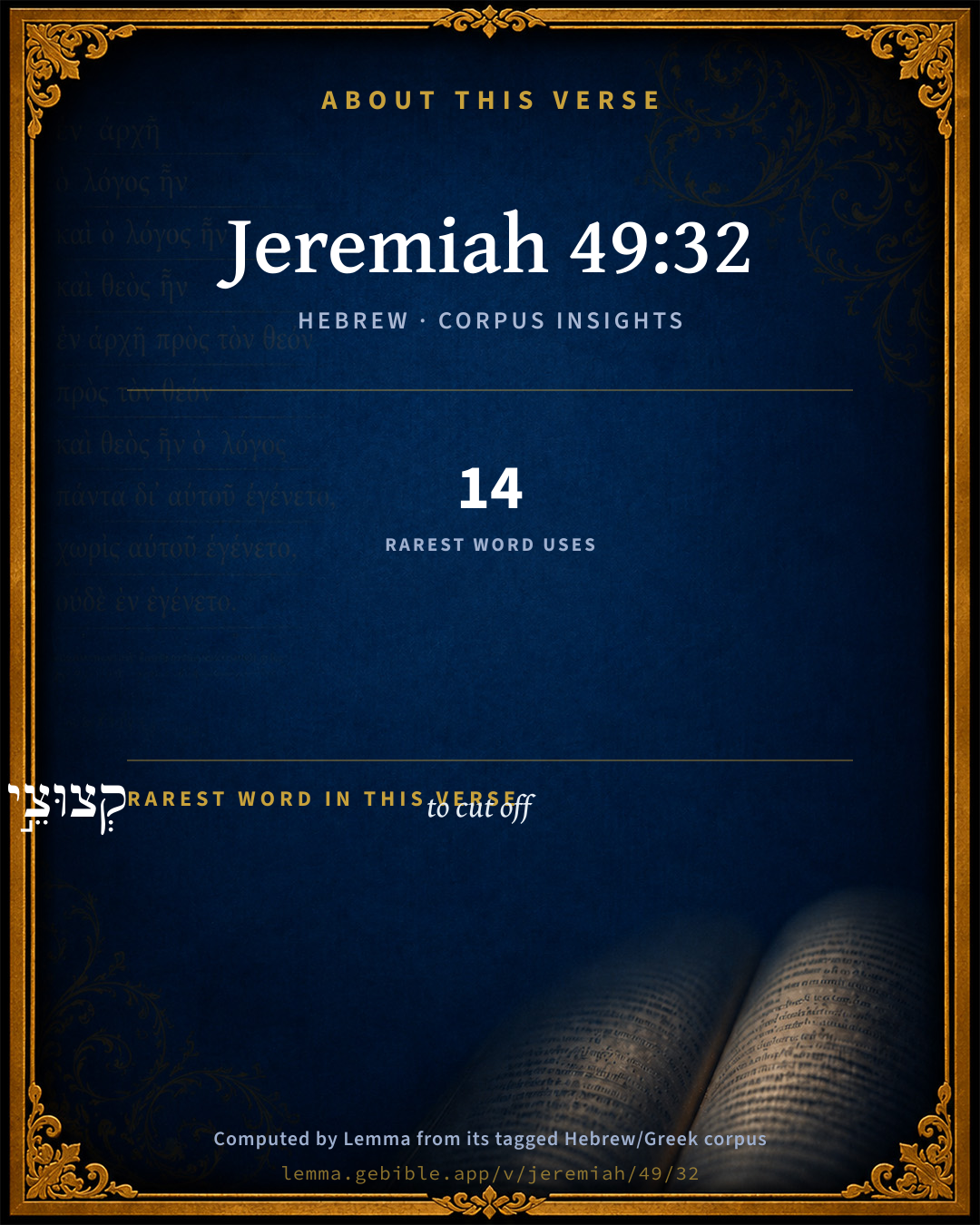
The rarest word here is קְצוּצֵ֣י to cut off H7112 — appearing just 14 times in the whole Hebrew Bible.

Shared distinctive vocabulary

קְצוּצֵ֣י to cut off H7112 occurs in 14 verses of the Hebrew Bible. Also found in:

Grammatical profile

  • 4 verbs
  • 13 nouns
  • 1 particle

Verb forms

  • וְהָי֨וּ Qal · Sequential Perfect
  • וְזֵרִתִ֥ים Piel · Sequential Perfect
  • קְצוּצֵ֣י Qal · Participle Passive
  • אָבִ֥יא Hiphil · Imperfect

Repetition

A word recurs within this verse — often emphatic in Hebrew:

  • לְכָל all H3605 ×2

Cross-references

7

Topical passages linked to Jeremiah 49:32 in the Treasury of Scripture Knowledge — connected by theme and wording, ordered by reader-vote popularity; previews shown in the World English Bible.

  • Jeremiah 9:26 Egypt, and Judah, and Edom, and the children of Ammon, and Moab, and all that have the corners [of their hair] cut off, who dwell in the wilderness; for all the nations are uncircumcised, and all the house of Israel are uncircumcised in heart.
  • Jeremiah 25:23 Dedan, and Tema, and Buz, and all who have the corners [of their hair] cut off;
  • Jeremiah 49:36 On Elam will I bring the four winds from the four quarters of the sky, and will scatter them toward all those winds; and there shall be no nation where the outcasts of Elam shall not come.
  • Ezekiel 5:10 Therefore the fathers shall eat the sons in the midst of you, and the sons shall eat their fathers; and I will execute judgments on you; and the whole remnant of you will I scatter to all the winds.
  • Ezekiel 12:14–15 I will scatter toward every wind all who are round about him to help him, and all his bands; and I will draw out the sword after them.
  • Deuteronomy 28:64 Yahweh will scatter you among all peoples, from the one end of the earth even to the other end of the earth; and there you shall serve other gods, which you have not known, you nor your fathers, even wood and stone.
  • Ezekiel 5:12 A third part of you shall die with the pestilence, and with famine shall they be consumed in the midst of you; and a third part shall fall by the sword round about you; and a third part I will scatter to all the winds, and will draw out a sword after them.

Cross-references courtesy of OpenBible.info (CC BY 4.0).

Hebrew and Greek witnesses Masoretic Hebrew ↔ Greek Septuagint

The same verse in the two great witnesses to the Old Testament, shown verse-for-verse.

These are two independent witnesses, not word-aligned to each other, and the Septuagint is shown in lemma (dictionary) form.

Hebrew Jeremiah 49:32 Masoretic · Westminster Leningrad Codex

וְהָי֨וּ גְמַלֵּיהֶ֜ם לָבַ֗ז וַהֲמ֤וֹן מִקְנֵיהֶם֙ לְשָׁלָ֔ל וְזֵרִתִ֥ים לְכָל ר֖וּחַ קְצוּצֵ֣י פֵאָ֑ה וּמִכָּל עֲבָרָ֛יו אָבִ֥יא אֶת אֵידָ֖ם נְאֻם יְהוָֽה

Their camels shall be a booty, and the multitude of their cattle a spoil: and I will scatter to all winds those who have the corners [of their hair] cut off; and I will bring their calamity from every side of them, says Yahweh.

World English Bible · Public Domain

Greek LXX Structure differs

In the Septuagint, Jeremiah is about an eighth shorter than the Hebrew and arranges its material differently — the Oracles Against the Nations (Hebrew chapters 46–51) appear in the middle of the Greek book, after 25:13. Because the chapter and verse boundaries do not line up, a verse-for-verse comparison with the Hebrew is not shown.

A verse-for-verse comparison isn’t shown here because the chapters and verses don’t line up. Switch to the LXX edition with the MT / LXX toggle above to read the Greek directly.

Hebrew: Westminster Leningrad Codex (CC BY 4.0). Greek: Septuagint (public domain); English from a public-domain English Septuagint. How the Septuagint differs from the Hebrew →

Targum (Aramaic paraphrase)

1

The Targum is the ancient Jewish Aramaic paraphrase of the Hebrew Scriptures — an interpretive translation, not the Hebrew text itself. Onkelos (literal) and Pseudo-Jonathan (expansive) render the Torah, and Jonathan the Prophets. Coverage is partial: where no permissively-licensed English translation exists for a verse, only the Aramaic is shown. This is verse-level text, not a word-by-word alignment to the Hebrew.

  1. Targum Jonathan Prophets (Joshua–Malachi)
    וִיהוֹן גַמְלֵיהוֹן לְבִזָא וַהֲמוֹן גֵיתֵיהוֹן לַעֲדֵי וֶאֱבַדְרִינוּן לְכָל רוּחַ מַקְפֵי פָתָא וּמִכָּל עֶבְרֵיהוֹן אַיְתֵי תְבַרְהוֹן אֲמַר יְיָ:

    (no public-domain English translation for this verse)

    Targum Jonathan — Aramaic: “Mikraot Gedolot” (public domain). English: “Sefaria Community Translation” (CC0 1.0 (public-domain dedication)); “London "Chaldee Paraphrase," 1871” (public domain). Text via Sefaria.

Commentary

Notes on Jeremiah 49:32 from classic Christian and Jewish commentators (each source and its license shown beneath its notes). The classic Christian expositions comment on the surrounding passage and are grouped to its opening verse, so a note may address several verses; the Jewish commentaries on the Tanakh (Rashi and others) are per-verse, so they appear only where the commentator wrote on this verse.

Lemma curates 59 commentaries, every one of them public domain or Creative Commons licensed, each selected and text-cleaned for this edition rather than reprinted as found. About our sources →

Trapp's Complete Commentary

John Trapp

Jer 49:32 And their camels shall be a booty, and the multitude of their cattle a spoil: and I will scatter into all winds them [that are] in the utmost corners; and I will bring their calamity from all sides thereof, saith the LORD.

Ver. 32. Them that are in the uttermost corners.] Or, That have the corners of their hair cut. See Jer 9:26; Jer 25:23.

John Trapp, A Commentary or Exposition upon All the Books of the Old and New Testament (1647–1656) — public domain. Text from a community e-Sword module.

Jamieson, Fausset & Brown

Robert Jamieson, A. R. Fausset & David Brown

camels--their chief possessions; not fields or vineyards.

in utmost . . . corners--who seemed least likely to be dispersed. Or else, "having the hair shaven (or clipped) in angles" (Jer 9:26; Jer 25:23) [GROTIUS].

calamity from all sides--which will force even those in "corners" to "scatter" themselves.

Jamieson, Fausset & Brown — Commentary Critical and Explanatory on the Whole Bible (1871) — public domain (CC PDM 1.0). Text via the HelloAO Bible API.

Adam Clarke's Commentary

Verse 32. The utmost corners] Even in these utmost inaccessible recesses the sword and pillage shall reach them. "'The utmost corners;' insulated coasts; the peninsula of Arabia." - Blayney.

Adam Clarke's Commentary on the Bible (1810–1826) — public domain. Text from a community e-Sword/MySword module.

John Calvin's Commentaries

It now follows, 1 will disperse them to every wind Here Jeremiah predicts the scattering of that nation. It sometimes happens that a country is plundered by enemies, when yet the inhabitants, stripped of their goods, remain there and live in poverty. But together with poverty, Jeremiah declares that there would be no ordinary exile, for the words are emphatical, I will scatter them to every wind There is here an implied contrast between that people and chaff; for as the chaff is carried away in all directions by blasts of wind, so would be, as Jeremiah shews, the scattering of that people. And he mentions also the utmost corners, קצוצי פאה, kotsutsi pae Jerome usually renders the words, “shorn of hair,” but very improperly; for there is no reason why the other people mentioned before should be thus called; for in Jeremiah 7 and Jeremiah 25 Jeremiah did not speak of the Kedareans, and yet he called many nations קצוצי פאה kotsutsi pae The verb קצף kotsets, whence this word comes, means to cut off; and פאה pae, signifies the extremity of anything. This phrase then is the same as though he mentioned those bordered by an extremity or a corner. And this is most suitable to this passage; for it was not probable that they who dwelt in recesses should be thus scattered. When any wealthy country is plundered by enemies, they flee here and there in all directions; for instance, were a part of Italy laid waste, they would flee to those parts who could receive fugitives; but when a nation dwells in an extreme corner, where could it betake itself, when routed by enemies? The Prophet therefore enhances the misery of exile when he says, that people at the extremities would become fugitives, so as to be scattered through all parts of the world.

He adds, and from all its sides will I bring their destruction. He confirms the same thing; for when an evil enters on one side, neighbors may assist; but when calamity urges on every side, miserable men must then of necessity be scattered; and they must seek some distant exile, as there is no part that can show them hospitality. All this then refers to their scattering. It afterwards follows, —

John Calvin's Commentaries (1540-1563) — public domain. Text from the Calvin Translation Society English edition (1840s-50s) via the Christian Classics Ethereal Library (ccel.org). Calvin's coverage is partial (roughly two-thirds of the Bible); uncommented books and verses are honest gaps, never fabricated. The 19th-century editor's footnotes and remarks are omitted so the notes are faithfully Calvin's own voice.

The Cambridge Bible for Schools and Colleges

gen. ed. J. J. S. Perowne

32. that have the corners of their hair polled] See on ch. Jer_9:26.

The Cambridge Bible for Schools and Colleges (gen. ed. J. J. S. Perowne; Cambridge University Press, 1878–1918) — public domain. Text from a community e-Sword module.

John Gill's Exposition

And their camels shall be a booty,.... To the Chaldean army, as before, Jer 49:29;

and the multitude of their cattle a spoil; to the same; the Kedarenes had large flocks of sheep, as well as a multitude of camels, on which they lived, and in which their substance lay; see Isa 60:6;

and I will scatter into all winds them that are in the utmost corners; them that were gone with their flocks to feed them in the uttermost parts of their land; who, on hearing of the Chaldean army being entered and ravaging their country, would leave their flocks, and flee and be dispersed in the several parts of the world: or, "them that are cut in the corner" (u); in the corners of their beard; that have their hair cut all around, as the Arabians had; See Gill on Jer 9:26;

and I will bring their calamity from all sides thereof, saith the Lord; suggesting that Nebuchadnezzar should surround them with his army, and so dispose of his troops, by placing them some in one part, and some in another, that they should not be able to escape on any side. It denotes their utter destruction and desolation.

(u) "attonsi comam", V. L. "praecisi lateribus", Piscator.

John Gill's Exposition of the Whole Bible (1746–1763) — public domain (CC PDM 1.0). Text via the HelloAO Bible API.

Albert Barnes' Notes on the Bible

Them ... corners - Or, those who clip the corners of their beards (compare Jer 9:26).

Albert Barnes' Notes on the Bible (1834–1885) — public domain. Text from a community e-Sword/MySword module.

Haydock's Catholic Bible Commentary

Wind; throughout the world. --- Round. Chap. ix. 26. (Calmet) --- This the Arabs did, in imitation of Bacchus. (Herodotus iii. 8.)

George Leo Haydock (1774–1849), Haydock's Catholic Family Bible and Commentary, 1859 edition — public domain. Excludes Psalms (Douay-Rheims chapter numbering differs from Protestant) and Deuterocanonical books (Catholic canon only).

Matthew Poole's English Annotations

And their camels shall be a booty, and the multitude of their cattle a spoil: these words sound like a part of the king of Babylon’s supposed speech encouraging his soldiers from the booty they should get, which should be a great multitude of camels and other cattle; the latter words are the words of the prophet, in the name of the Lord, threatening ruin to these Kedarens and Hazorites, though they lived in corners, and might upon that account think themselves secure; God saith he would fetch them out of their utmost corners, and bring calamity from all parts upon them.

Matthew Poole's English Annotations on the Holy Bible (1683–1685) — public domain. Text from a community e-Sword/MySword module.

Whedon's Commentary on the Bible

Daniel D. Whedon

32. Utmost corners — All shall be sought out and dispersed.

Daniel D. Whedon (gen. ed.), Commentary on the Old and New Testaments (1874–1909) — public domain. Text from a community e-Sword module.

The Pulpit Commentary

Them that are in the utmost corners. Another of Jeremiah"s characteristic phrases, which should rather be tendered, the corner clipped. (i.e. having the hair cut off about the ears and temples; see on Jer_9:26) From all sides. "Nebuchadnezzar will so arrange his troops that the Bedaween but the people of Hazer were not Bedaween, i.e. desert Arabs will be surrounded on all sides, and, being thus unable to escape in a body, will be scattered to "all the winds," to the four quarters of the earth" (Dr. Payne Smith).

The Pulpit Commentary (1880–1919), ed. H.D.M. Spence-Jones & Joseph S. Exell — public domain. Text from a community e-Sword module.

unfoldingWord translationNotes

Door43 World Missions Community

General Information:

Yahweh continues telling Nebuchadnezzar to attack the people of Kedar and the kingdom of Hazor.

For their camels will become plunder, and the abundance of their property will become war plunder

Yahweh is still speaking to Nebuchadnezzar as if he were there listening to him. This can be stated in second person. AT: "For your soldiers will take their camels and all of their property" (See: Apostrophe and First, Second, or Third Person)

Then I will scatter to every wind

Here "every wind" represents the nations. AT: "Then I will send to nations in all different directions" (See: Metaphor)

those who cut the corners of their hair

This probably refers to people who cut their hair short in order to honor a pagan god. Some modern versions interpret this Hebrew expression as "those who live on the edge of the wilderness." See how you translated a similar phrase in Jeremiah 9:26.

I will bring disaster on them from every side

The phrase containing the abstract noun "disaster" can be replaced by the verb "destroy." AT: "I will bring their enemies from every side to destroy them" (See: Abstract Nouns)

this is Yahweh's declaration

Yahweh speaks of himself by name to express the certainty of what he is declaring. See how you translated this in Jeremiah 1:8. AT: "this is what Yahweh has declared" or "this is what I, Yahweh, have declared" (See: First, Second, or Third Person)

a lair of jackals

"a place where jackals live." Jackals are fierce wild dogs. See how you translated "jackals" in Jeremiah 9:11.

No one will live there; no human being will stay there

These two lines mean basically the same thing and emphasize that Hazor will be completely uninhabited. (See: Parallelism)

translationWords

Yahweh

waste

unfoldingWord translationNotes — © Distant Shores Media and the Door43 World Missions Community, licensed CC BY-SA 4.0. Source: git.door43.org/Door43/en_tn.

Rashi

Rabbi Shlomo Yitzchaki (Rashi)

cast to the ends Separated from one end to the other end of the directions.

Rashi on the Tanakh — English translations: “The Judaica Press complete Tanach with Rashi, translated by A. J. Rosenberg” (CC BY 4.0); “Pentateuch with Rashi's commentary by M. Rosenbaum and A.M. Silbermann, 1929-1934” (public domain); “The Metsudah Tanach series, Lakewood, N.J” (CC BY 4.0); and “The Book of Joshua, Metsudah Publications, 1997” (CC BY 4.0). Text via Sefaria.

Lesson kit

Teaching starters — assembled from the data on this page, not authored interpretation. Every prompt links to the verse data it draws on. Edit before teaching.

Jeremiah, in the Prophets, opens this verse with 18 words (17 distinct Hebrew lemmas). Its most distinctive word is qâtsats (“to cut off”). A historical commentator’s framing appears above. Read the whole chapter for the surrounding context.

Discussion questions

  1. What does “to cut off” (qâtsats) contribute to the verse as a whole?
  2. How does Exodus 39:3, which shares the word «to cut off», read alongside this verse?
  3. What does the repetition of “all” (2× in this one verse) do in this verse?
  4. The translations on this page render this verse differently — a whole-verse word diff, not a word-by-word alignment. What might account for the different wordings?
  5. «וְהָי֨וּ» is a Qal Sequential Perfect verb. How does that grammatical form shape the action described?
  6. Compare how Trapp's Complete Commentary and Jamieson, Fausset & Brown read this verse. Where do they agree or differ?

Things to notice

Reading settings

Reading text

Shown beneath each verse's original-language words.

Old Testament
Old Testament edition

Read the OT as the Masoretic Hebrew (MT) or the Greek Septuagint (LXX).

English shown for the Greek Septuagint (in the Hebrew ↔ Greek comparison).

Comparing translations? Open the Compare panel on any verse page to stack up to four side by side.