
Psalms 78:48

Hebrew (Westminster Leningrad Codex) Psalms 78:48 appears in the Hebrew Old Testament. The text above is from the Westminster Leningrad Codex. Each word links to its Strong’s number, a concise gloss, and parsing drawn from the Open Scriptures Hebrew Bible morphology. Click any word for its full Brown-Driver-Briggs (BDB) entry.
Download image
Cite this verse

Psalms 78:48 (World English Bible). Public Domain. Lemma interlinear Bible study tool, https://lemma.gebible.app/v/psalms/78/48.

Show BibTeX & RIS
BibTeX
RIS
English Translation
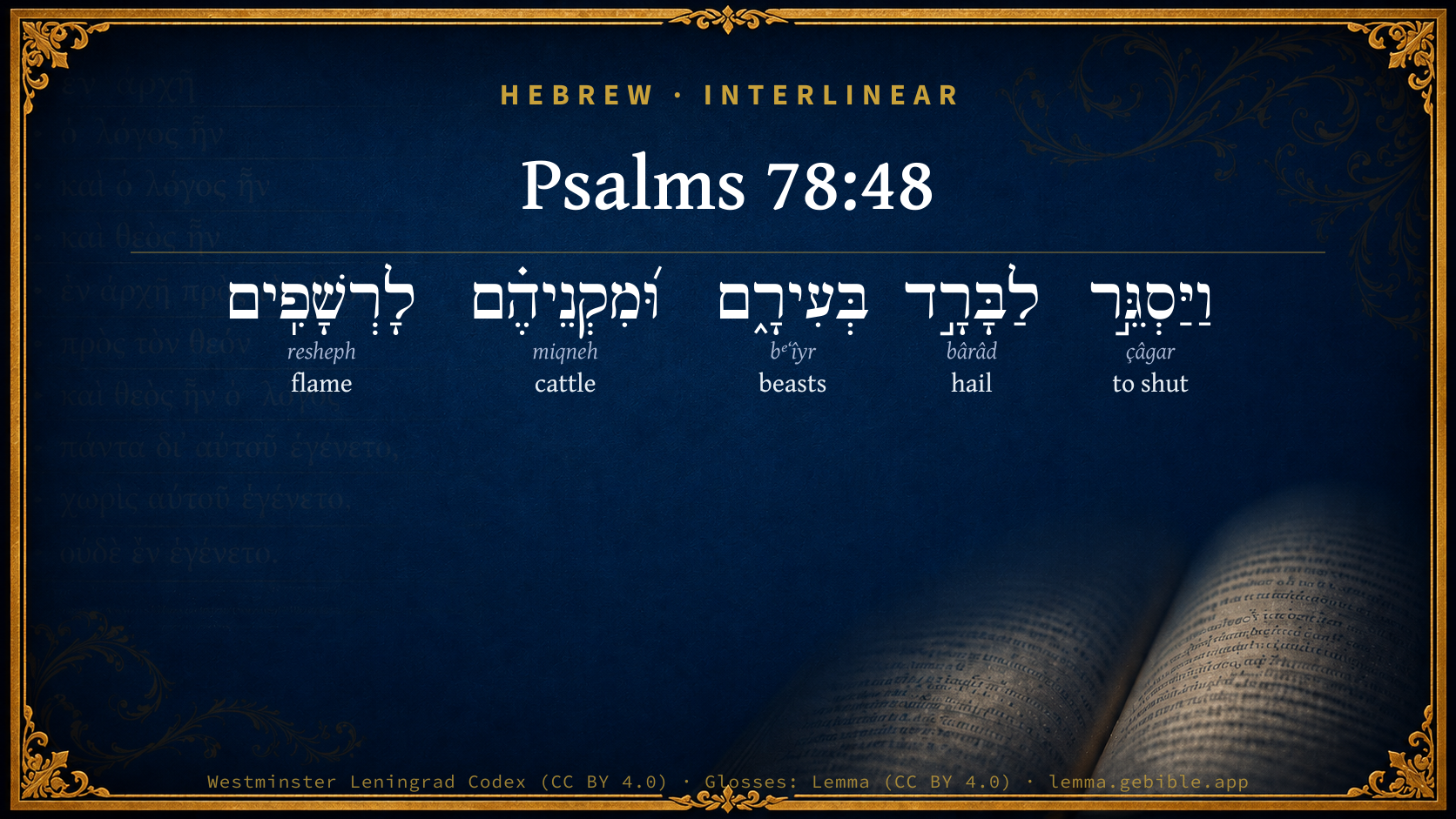
He gave over their cattle also to the hail, And their flocks to hot thunderbolts.
World English Bible · Public Domain
Download a study sheet

One document with this verse’s original text, its word-by-word gloss line, the meaning frame, cross-references with their text, attributed commentary, and full source and license credits — printable, and it pastes into notes with its structure intact.

This verse Autodidact and up

Study sheet (.html) Plain text (.txt)

A passage Seminary Student

Up to 50 verses in one chapter. A passage sheet keeps up to 6 commentary sources and 12 cross-references per verse, in the order this page ranks them, and says so on the sheet whenever that leaves anything out. Ask for a single verse and you get the Autodidact verse sheet above.

Everything on this page stays free to read, with no account — the sheet is a download of what is already on screen, not access to it.

Want to remove ads? Support Godless Engineer
Compare translations 3

The same verse in 3 English versions, stacked beneath the original-language interlinear above. Click any original word for its lexicon entry.

Each is an independent rendering of the whole verse — the interlinear is not word-aligned to these translations.

Highlighted words mark where these versions differ — a whole-verse word diff, not a word-by-word alignment.

  • World English Bible Public Domain
    He gave over their cattle also to the hail, And their flocks to hot thunderbolts.
  • King James Version Public Domain
    He gave up their cattle also to the hail, and their flocks to hot thunderbolts.
  • unfoldingWord Literal Text CC BY-SA 4.0
    And he gave over their cattle to the hail and their livestock to the bolts of lightning.

unfoldingWord Literal Text — © unfoldingWord, licensed CC BY-SA 4.0. Word-aligned USFM3 via Door43 (git.door43.org/unfoldingWord/en_ult).

Versions to compare (up to 4)

3 of 4 selected

Show all 18 translations

Every available English version of this verse, each an independent rendering of the whole verse.

  • World English Bible Public Domain
    He gave over their cattle also to the hail, And their flocks to hot thunderbolts.
  • Berean Standard Bible Public Domain
    He abandoned their cattle to the hail and their livestock to bolts of lightning.
  • Majority Standard Bible Public Domain
    He abandoned their cattle to the hail and their livestock to bolts of lightning.
  • King James Version Public Domain
    He gave up their cattle also to the hail, and their flocks to hot thunderbolts.
  • American Standard Version (1901) Public Domain
    He gave over their cattle also to the hail, And their flocks to hot thunderbolts.
  • Revised Version (1885) Public Domain
    He gave over their cattle also to the hail, and their flocks to hot thunderbolts.
  • Geneva Bible (1599) Public Domain
    He gaue their cattell also to the haile, and their flockes to the thunderboltes.
  • Douay-Rheims (1899) Public Domain
    And he gave up their cattle to the hail, and their stock to the fire.
  • Young's Literal Translation Public Domain
    And delivereth up to the hail their beasts, And their cattle to the burning flames.
  • Literal Standard Version CC BY-SA 4.0
    And delivers their beasts up to the hail, || And their livestock to the burning flames.
  • Unlocked Literal Bible CC BY-SA 4.0
    He rained hail on their cattle and hurled lightning bolts at their livestock.
  • unfoldingWord Literal Text CC BY-SA 4.0
    And he gave over their cattle to the hail and their livestock to the bolts of lightning.
  • Darby Bible Public Domain
    And he delivered up their cattle to the hail, and their flocks to thunderbolts.
  • World Messianic Bible Public Domain
    He also gave over their livestock to the hail, and their flocks to hot thunderbolts.
  • Webster's Bible Public Domain
    He gave up their cattle also to the hail, and their flocks to hot thunderbolts.
  • Free Bible Version CC BY-SA 4.0
    He handed over their cattle to hail and their flocks to lightning bolts.
  • Bible in Basic English Public Domain
    Ice was rained down on their cattle; thunderstorms sent destruction among the flocks.
  • JPS Tanakh (1917) Public Domain
    He gave over their cattle also to the hail, and their flocks to fiery bolts.

Literal Standard Version (2020), Covenant Press — licensed CC BY-SA 4.0. Text via the HelloAO Bible API (eBible.org). Unlocked Literal Bible (unfoldingWord) — licensed CC BY-SA 4.0. Text via the HelloAO Bible API (eBible.org). unfoldingWord Literal Text — © unfoldingWord, licensed CC BY-SA 4.0. Word-aligned USFM3 via Door43 (git.door43.org/unfoldingWord/en_ult). Free Bible Version, Dr. Jonathan Gallagher — licensed CC BY-SA 4.0. Text via the HelloAO Bible API (eBible.org).

Word by word

More ways to search: Search by grammar → Find every occurrence → Compare this word →

Practice this passage: Drill this verse → Learn its vocabulary →

About this verse

These counts appear in no published source. They are computed here, from the morphology-tagged text and Lemma’s own curated glosses. What Lemma adds →

5
words
5
distinct lemmas
Wisdom
section

Notable vocabulary

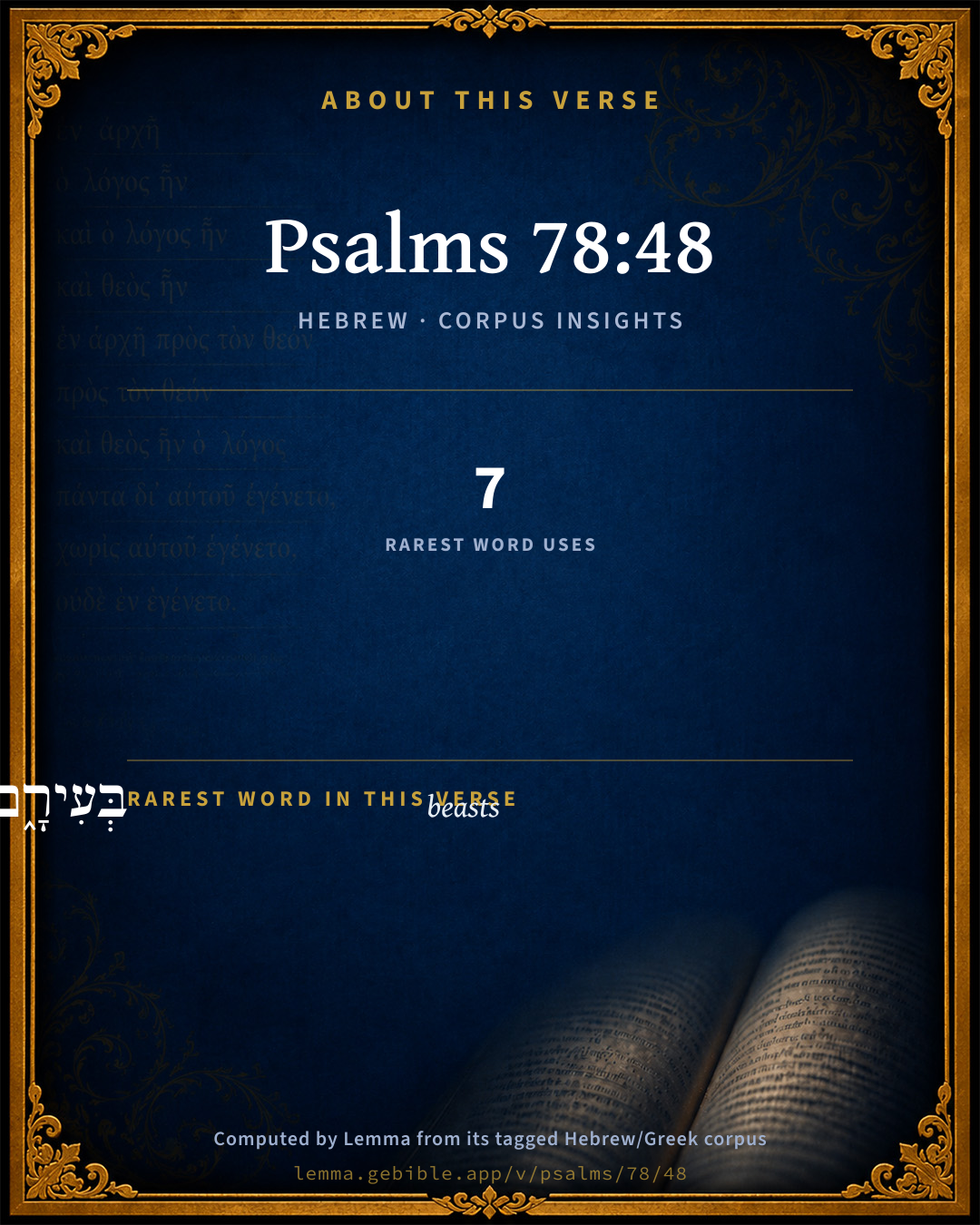
The rarest word here is בְּעִירָ֑ם beasts H1165 — appearing just 7 times in the whole Hebrew Bible.

Shared distinctive vocabulary

בְּעִירָ֑ם beasts H1165 occurs in 6 verses of the Hebrew Bible. Also found in:

Grammatical profile

  • 1 verb
  • 4 nouns

Verb forms

  • וַיַּסְגֵּ֣ר Hiphil · Sequential Imperfect

Hebrew & Septuagint length

In English translation the verse runs 15 words from the Hebrew and 14 from the Septuagint (LXX English) — closely comparable.

A rough comparison of the two English renderings, which tokenize alike — not a word-level alignment.

Word counts can differ between the Hebrew and the Greek without any difference in meaning — e.g. the Hebrew direct-object marker אֵת has no separate Greek word, and Greek often adds the article ὁ.

Cross-references

2

Topical passages linked to Psalms 78:48 in the Treasury of Scripture Knowledge — connected by theme and wording, ordered by reader-vote popularity; previews shown in the World English Bible.

  • Exodus 9:19 Now therefore command that all of your cattle and all that you have in the field be brought into shelter. Every man and animal that is found in the field, and isn't brought home, the hail shall come down on them, and they shall die."'"
  • Exodus 9:28 Pray to Yahweh; for there has been enough of mighty thunderings and hail. I will let you go, and you shall stay no longer."

Cross-references courtesy of OpenBible.info (CC BY 4.0).

Hebrew and Greek witnesses Masoretic Hebrew ↔ Greek Septuagint

The same verse in the two great witnesses to the Old Testament, shown verse-for-verse.

You’re reading Greek Psalm 77 (Hebrew Psalm 78). The Septuagint counts the superscription, so verse numbers can differ from the Hebrew — chapter-level alignment, not verse-by-verse. Numbering follows Rahlfs.

These are two independent witnesses, not word-aligned to each other, and the Septuagint is shown in lemma (dictionary) form.

Hebrew Psalms 78:48 Masoretic · Westminster Leningrad Codex

וַיַּסְגֵּ֣ר לַבָּרָ֣ד בְּעִירָ֑ם וּ֝מִקְנֵיהֶ֗ם לָרְשָׁפִֽים

He gave over their cattle also to the hail, And their flocks to hot thunderbolts.

World English Bible · Public Domain

Greek LXX Greek Psalm 77:48 Septuagint · lemma form

καί παραδίδωμι εἰς χάλαζα ὁ κτῆνος αὐτός καί ὁ ὕπαρξις αὐτός ὁ πῦρ

And he gave up their cattle to hail, and their substance to the fire.

LXX2012 (modern English Septuagint) · Public Domain

On this verse, Ellicott's Commentary for English Readers discusses the Septuagint’s reading. Read the note in Commentary ↓

Hebrew: Westminster Leningrad Codex (CC BY 4.0). Greek: Septuagint (public domain); English from LXX2012 (modern English Septuagint) (Public Domain). How the Septuagint differs from the Hebrew →

Commentary

Notes on Psalms 78:48 from classic Christian and Jewish commentators (each source and its license shown beneath its notes). The classic Christian expositions comment on the surrounding passage and are grouped to its opening verse, so a note may address several verses; the Jewish commentaries on the Tanakh (Rashi and others) are per-verse, so they appear only where the commentator wrote on this verse.

Lemma curates 59 commentaries, every one of them public domain or Creative Commons licensed, each selected and text-cleaned for this edition rather than reprinted as found. About our sources →

Trapp's Complete Commentary

John Trapp

Psa 78:48 He gave up their cattle also to the hail, and their flocks to hot thunderbolts.

Ver. 48. He gave up their cattle also to the hail] Moses saith men also, who were brained and burned by it.

John Trapp, A Commentary or Exposition upon All the Books of the Old and New Testament (1647–1656) — public domain. Text from a community e-Sword module.

J. A. Alexander on Psalms

Joseph Addison Alexander

48. (Psa 78:48) And delivered their cattle to the hail and their herds to the flames. The Hebrew verb strictly means shut up, and occurs, elsewhere in the combination to shut up in the hand, i. e. abandon to the power, of another. See above, on Psa 31:8, and compare 1 Sam. xxiii. 11. Here, as in Deu 32:30, the verb is used absolutely in the sense of the whole phrase. The word translated flames occurs above in Ps. lxxvi. 4 (3), and is here a poetical description of the lightning. The common version (hot thunder-bolts) is striking and poetical, but perhaps too strong. This verse does not relate to a distinct plague, but to the effects of the hail-storm upon animals, as its effect upon plants was described in the preceding verse.

Joseph Addison Alexander, The Psalms Translated and Explained (1850) — public domain. Text from a community e-Sword module.

Adam Clarke's Commentary

Verse 48. He gave up their cattle] See on Ex 9:23.

Adam Clarke's Commentary on the Bible (1810–1826) — public domain. Text from a community e-Sword/MySword module.

Ellicott's Commentary for English Readers

(48) Hail.—Some copies read “pestilence,” which from its association with resheph, as in Hab_3:5, a word there denoting some contagious malady (comp. Deu_32:24; see Note Psa_76:3), is probably to be preferred here though the authority of the LXX. is against it. If so, we must refer this verse to the murrain that came on the cattle.

A Bible Commentary for English Readers, edited by Charles John Ellicott (1878–1897) — public domain. Text from a community e-Sword module.

The Cambridge Bible for Schools and Colleges

gen. ed. J. J. S. Perowne

48. And he gave over their beasts to the hail,

And their cattle to fiery lightnings.

As the text stands, the reference is to the destruction of the Egyptian cattle as well as the crops by the lightning which accompanied the hailstorm (Exo_9:28). But two Hebrew MSS., with which agrees the version of Symmachus, read Deber, ‘pestilence’ in place of Bârâd, ‘hail.’ Now Deber is the word used in Exo_9:3 ff. of the murrain which attacked the cattle. Resheph, the word rendered fiery lightnings, is also used of burning fever in Deu_32:24; Hab_3:5; in the latter passage in parallelism with Deber. It seems possible, therefore, that this verse originally referred to the fifth plague, the murrain on the cattle. The LXX, Syr., Jer., Targ. however support the Massoretic Text.

The Cambridge Bible for Schools and Colleges (gen. ed. J. J. S. Perowne; Cambridge University Press, 1878–1918) — public domain. Text from a community e-Sword module.

John Gill's Exposition

He cast upon them the fierceness of his anger,.... This with the following words,

wrath, and indignation, and trouble, are thought by some to intend the other plagues, which are not particularly mentioned; or rather they express the manner in which they were all inflicted, in great wrath and hot displeasure for their sins and iniquities, and which particularly were shown

by sending evil angels among them; not evil in themselves, but because they were the instruments God made use of to bring evil things upon the Egyptians, as good angels often are; though some think that demons, devils, or wicked spirits, were sent among them at that time; the darkness was over all the land, and frightened them; in the Apocrypha:

"3 For while they supposed to lie hid in their secret sins, they were scattered under a dark veil of forgetfulness, being horribly astonished, and troubled with strange apparitions. 4 For neither might the corner that held them keep them from fear: but noises as of waters falling down sounded about them, and sad visions appeared unto them with heavy countenances.'' (Wisdom 17)

According to Arama, the three last plagues are meant: the words may be rendered "messengers of evil things" (l), as they are by some, and be understood of Moses and Aaron, who were sent time after time with messages of evil things to Pharaoh, in which were expressed his wrath and fury against them.

(l) "numcios malorum", Junius & Tremellius, Piscator.

John Gill's Exposition of the Whole Bible (1746–1763) — public domain (CC PDM 1.0). Text via the HelloAO Bible API.

Albert Barnes' Notes on the Bible

He gave up their cattle also to the hail - Margin, he shut up. Exo 9:22-25.

And their flocks to hot thunderbolts - Margin, lightnings. The original word means flame; then, lightning. There is no allusion in the word to the idea of a bolt, or shaft, accompanying the lightning or the thunder, by which destruction is produced. The destruction is caused by the lightning, and not by the thunder, and it is hardly necessary to say that there is no shaft or bolt that accompanies it. Probably this notion was formerly entertained, and found its way into the common language used. The same idea is retained by us in the word thunderbolt. But this idea is not in the original; nor is there any foundation for it in fact.

Albert Barnes' Notes on the Bible (1834–1885) — public domain. Text from a community e-Sword/MySword module.

Matthew Poole's English Annotations

He gave up, Heb. he shut up, as in a prison, that they could not escape them.

Matthew Poole's English Annotations on the Holy Bible (1683–1685) — public domain. Text from a community e-Sword/MySword module.

The Treasury of David

Charles H. Spurgeon

Ver. 48. He gave up their cattle also to the hail. What hail it must have been to have force enough to batter down bullocks and other great beasts. God usually protects animals from such destruction, but here he withdraws his safeguards and gave them up: may the Lord never give us up. Some read, "shut up, "and the idea of being abandoned to destructive influences is then before us in another shape.

And their flocks to hot thunderbolts. Fire was mingled with the hail, the fire ran along upon the ground, it smote the smaller cattle. What a storm must that have been: its effects were terrible enough upon plants, but to see the poor dumb creatures stricken must have been heartbreaking. Adamantine was that heart which quailed not under such plagues as these, harder than adamant those hearts which in after years forgot all that the Lord had done, and broke off from their allegiance to him.

Charles H. Spurgeon's The Treasury of David (1869–1885) — public domain. Psalms only. Text from a community e-Sword/MySword module.

Whedon's Commentary on the Bible

Daniel D. Whedon

48. Hot thunderbolts—The word indicates balls, or streams, of fire, like red hot coals, as in Hab_3:5; Son_8:6. It was an unparalleled electrical phenomenon, even for an Egyptian climate. The narrative says, “The fire ran along upon the ground.” Exo_9:23

Daniel D. Whedon (gen. ed.), Commentary on the Old and New Testaments (1874–1909) — public domain. Text from a community e-Sword module.

The Pulpit Commentary

He gave up their cattle also to the hall. (comp. Exo_9:19-21, Exo_9:25) And their flocks to hot thunderbolts. (see Exo_9:24, Exo_9:28, Exo_9:29, Exo_9:34) The "fire which ran along the ground" (Exo_9:23) must have been caused by electrified clouds of high tension; the highly charged drops of rain meeting the inductively charged earth, and sparking across when within striking distance. This is believed to accompany every thunderstorm, though generally invisible to the eye. When exceptionally severe, it would convey the idea of running fire, and would of course be very destructive of life. It is no wonder that most of the cattle which were left "in the field" died. (Exo_9:21, Exo_9:25)

The Pulpit Commentary (1880–1919), ed. H.D.M. Spence-Jones & Joseph S. Exell — public domain. Text from a community e-Sword module.

Rashi

Rabbi Shlomo Yitzchaki (Rashi)

He gave over their animals to hail When the hail began to fall, the Egyptian drove his sheep (his animal) into the house, and the hail came before him like a wall. The Egyptian slaughtered it [the animal] and put it on his shoulder, to take it to his house to eat it, but the birds came and took it from him. That is [the meaning of] “and their cattle to the birds (לרשפים),” as (Job. 5:7): “but flying creatures (בני רשף) fly upward.” This is its midrashic interpretation (Mid. Ps. 78:14), but according to its simple meaning, רשפים are bolts of fire, as it is written (Exod. 9:24): “and fire flaming within the hail.”

Rashi on the Tanakh — English translations: “The Judaica Press complete Tanach with Rashi, translated by A. J. Rosenberg” (CC BY 4.0); “Pentateuch with Rashi's commentary by M. Rosenbaum and A.M. Silbermann, 1929-1934” (public domain); “The Metsudah Tanach series, Lakewood, N.J” (CC BY 4.0); and “The Book of Joshua, Metsudah Publications, 1997” (CC BY 4.0). Text via Sefaria.

Lesson kit

Teaching starters — assembled from the data on this page, not authored interpretation. Every prompt links to the verse data it draws on. Edit before teaching.

Psalms, in the Wisdom, opens this verse with 5 words (5 distinct Hebrew lemmas). Its most distinctive word is bᵉʻîyr (“beasts”). A historical commentator’s framing appears above. Read the whole chapter for the surrounding context.

Discussion questions

  1. What does “beasts” (bᵉʻîyr) contribute to the verse as a whole?
  2. How does Genesis 45:17, which shares the word «beasts», read alongside this verse?
  3. These translations render this verse differently; the difference is in the English rendering, not the original. What questions does that raise?
  4. «וַיַּסְגֵּ֣ר» is a Hiphil Sequential Imperfect verb. How does that grammatical form shape the action described?
  5. Compare how Trapp's Complete Commentary and J. A. Alexander on Psalms read this verse. Where do they agree or differ?

Things to notice

Reading settings

Reading text

Shown beneath each verse's original-language words.

Old Testament
Old Testament edition

Read the OT as the Masoretic Hebrew (MT) or the Greek Septuagint (LXX).

English shown for the Greek Septuagint (in the Hebrew ↔ Greek comparison).

Comparing translations? Open the Compare panel on any verse page to stack up to four side by side.